
When it is said
It is sung at the services of 17 December, when the Church remembers the prophet Daniel and the three young men.
The same hymn returns on the Sunday of the Holy Forefathers, which falls two Sundays before Christmas.
Its last three lines make a short prayer of their own.
Where it comes from
No author known
The three young men in the fire
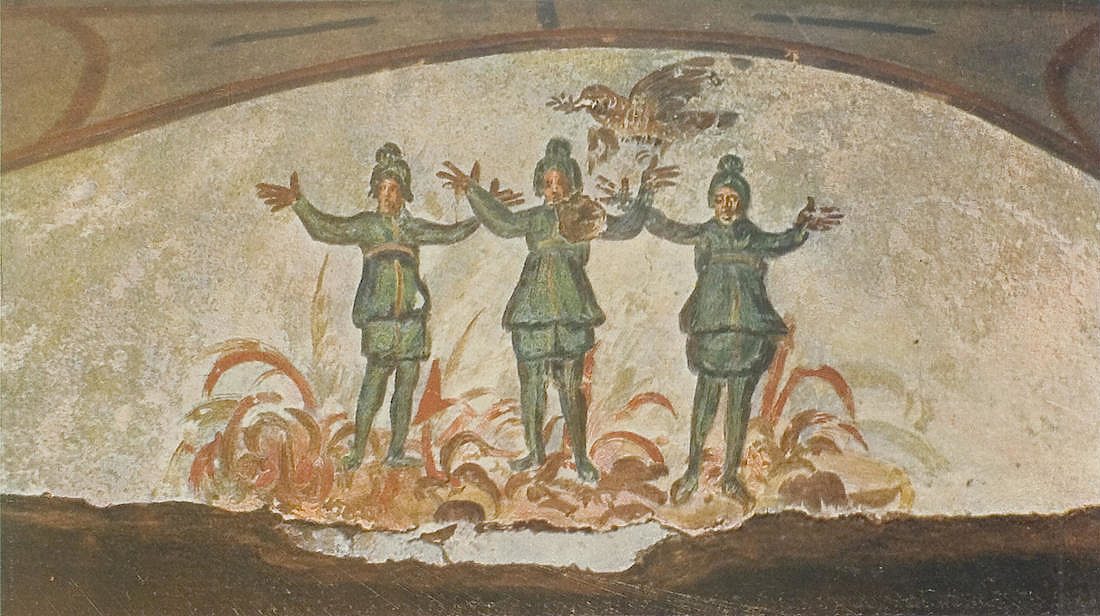
Hananiah, Mishael and Azariah were young Jews brought to serve at the king’s court in Babylon, where they were given the names Shadrach, Meshach and Abednego. King Nebuchadnezzar set up a golden statue and ordered everyone to worship it. The three refused, and he had them thrown into a blazing furnace. Then the king saw four men walking unbound in the fire, and the three came out unharmed.
Daniel 1:3-7, 3:1-27, Berean Standard Bible
What is a kontakion?
A kontakion is a kind of Byzantine hymn. It began as a long sermon in verse, and over time it was cut down to its opening and one stanza, or to the opening alone. In the Greek service book for 17 December, one longer stanza follows this hymn. It asks God to spare our souls as He spared the three in Babylon, and ends on the same cry.
What the words mean
If You will, You can
The hymn’s last words echo the man with leprosy who fell on his face before Jesus and told Him that if He was willing, He could make him clean. The three young men had said much the same before the furnace. They told the king that their God was able to save them, and that even if He did not, they would never worship his statue.
Luke 5:12 and Daniel 3:16-18, Berean Standard Bible
The Scripture in it
Shadrach, Meshach, and Abednego replied to the king, “O Nebuchadnezzar, we have no need to answer you in this matter. If the God Whom we serve exists, then He is able to deliver us from the blazing fiery furnace and from your hand, O king. But even if He does not, let it be known to you, O king, that we will not serve your gods or worship the golden statue you have set up.”
While Jesus was in one of the towns, a man came along who was covered with leprosy. When he saw Jesus, he fell facedown and begged Him, “Lord, if You are willing, You can make me clean.”
Bible text: Berean Standard Bible, public domain.
In Greek
Χειρόγραφον εἰκόνα μὴ σεβασθέντες, ἀλλ' ἀγράφῳ οὐσίᾳ θωρακισθέντες,
τρισμακάριοι ἐν τῷ σκάμματι, τοῦ πυρὸς ἐδοξάσθητε,
ἐν μέσῳ δὲ φλογός, ἀνυποστάτου ἱστάμενοι, Θεὸν ἐπεκαλεῖσθε.
Τάχυνον ὁ οἰκτίρμων, καὶ σπεῦσον ὡς ἐλεήμων,
εἰς τὴν βοήθειαν ἡμῶν, ὅτι δύνασαι βουλόμενος.