
Catherine of Siena
The dyer's daughter from Siena who could not read as a girl, yet counselled popes and became one of the Church's great teachers.
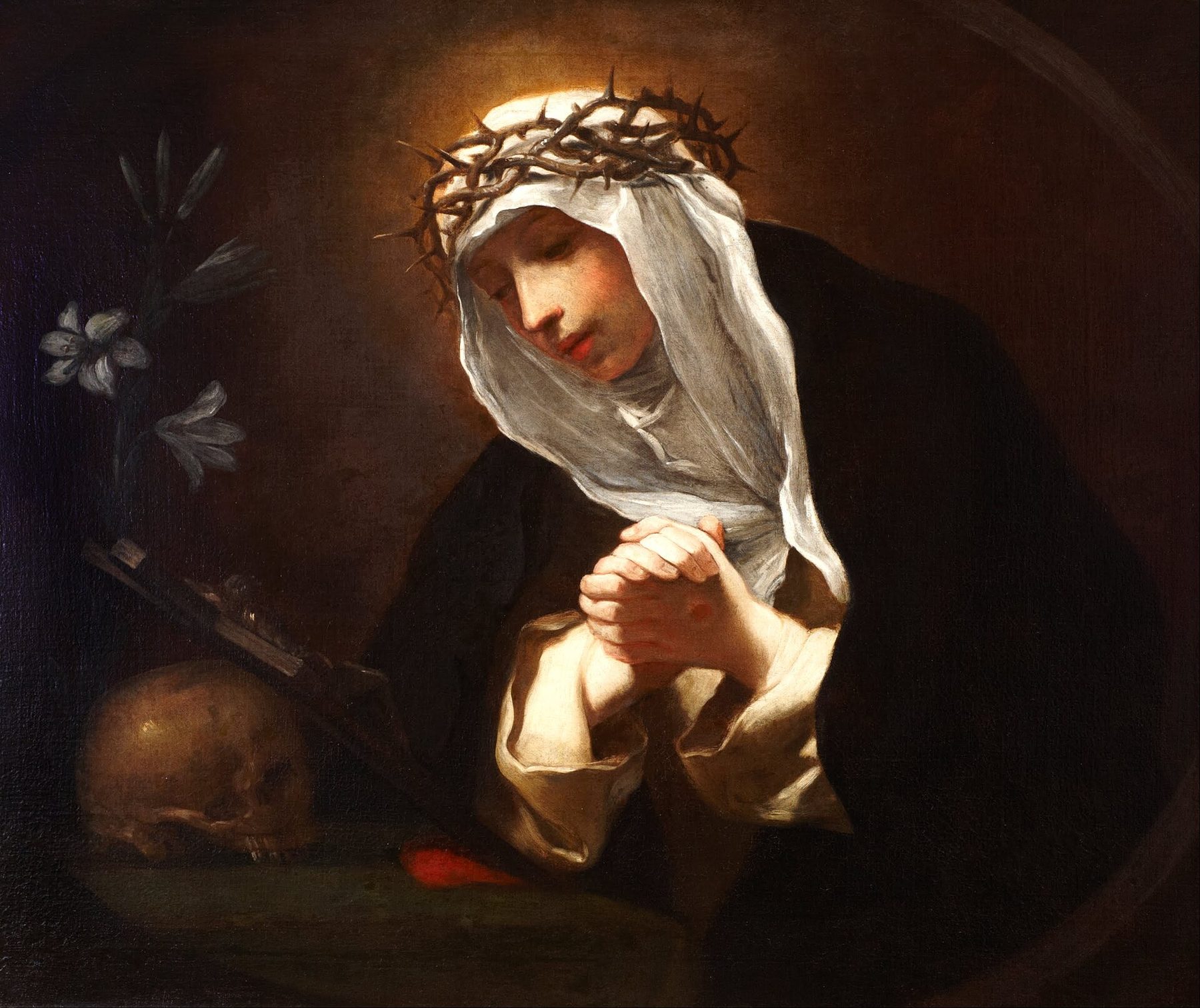
Picture: Saint Catherine of Siena, circle of Baldassare Franceschini, called Il Volterrano, 1600s. Dulwich Picture Gallery, London. Public domain.
Who was Catherine?
Catherine was born in Siena, Italy, in 1347. She gave her life to God but never entered a convent. She lived at home, nursed the sick and made peace between enemies. She wrote to popes and dictated a book of prayer. The Catholic Church names her a Doctor of the Church, a title for saints whose writings carry special weight.
at a glance
Her path, in order
- Dominican sisterOf St Dominic's order, but living at home
- NurseOf lepers and plague victims
- PeacemakerBetween feuding families, and for Florence
- EnvoyTo the pope at Avignon, 1376
- AuthorThe Dialogue and about 380 letters
- CounsellorTo Pope Urban VI in Rome
in numbers
- Children her mother bore25
- Catherine was the second youngest, and a twin
- Her twin sister, Giovanna, died as a baby
- Years she kept silent in her room3
- She spoke to no one but her confessor
- She left it only to go to church
- Letters of hers that survive380
- Nearly all dictated to her secretaries
- To popes, kings, soldiers and neighbours
- Her age when she died33
- In Rome, on 29 April 1380
- After months unable to eat, or even drink
did you know?
-
As a little girl she was such a delight that her neighbours stopped calling her Catherine and called her Euphrosyne, a Greek name meaning joy.
Raymond of Capua, Life, Part 1, chapter 2 (English of 1860, from the French) -
She learned to write at about thirty. The first letter she wrote in her own hand, to her secretary Stefano Maconi, ends: “this is the first letter I ever wrote myself.”
Friar Thomas of Siena's statement, in the appendix to Raymond's Life (English of 1860); Scudder (1905) -
She could dictate to two or three secretaries at once, each on a different subject, without stopping to think, said her friend Bartholomew Dominici, a Dominican priest.
Bartholomew Dominici's statement, in the appendix to Raymond's Life (English of 1860) -
So many people came to confession after meeting her that Pope Gregory XI gave three priests who travelled with her the power to forgive even sins that normally only a bishop could forgive.
Raymond of Capua, Life, Part 2, chapter 6 (English of 1860, from the French)
- Born
- 25 March 1347, in Siena, then a republic in Tuscany. Her father, Giacomo Benincasa, was a wool dyer. Her mother, Lapa, was the daughter of a local poet.
- Died
- 29 April 1380, a Sunday, in Rome. She was 33.
- Buried
- In Santa Maria sopra Minerva, a Dominican church in Rome. Her head was carried home to Siena in 1385.
- Also called
- Caterina Benincasa, her name at birth.
- Pronounced
- Siena is see-EN-ah.
- Home
- Her family lived in Fontebranda, a quarter of Siena named for its old spring, below the great Dominican church of San Domenico.
- She joined
- The Sisters of Penance of St Dominic, women who wore the Dominicans' white robe and black mantle but lived at home, not in a convent. Siena called them the Mantellate, after the mantle.
- Spoke
- Only the Italian of Tuscany. Pope Gregory XI spoke no Italian, so her confessor translated between them in Latin.
- Confessor
- Raymond of Capua, a Dominican priest, from 1374: he heard her confessions and guided her. Before him, Thomas della Fonte, a Dominican who had grown up in her family's house.
- Wrote
- The Dialogue, a book of prayer; about 380 letters; and 26 prayers. She dictated nearly all of it.
- Made a saint
- In 1461, by Pope Pius II, himself a man of Siena.
- Titles
- Doctor of the Church since 1970, an honour the Catholic Church gives for outstanding teaching. A patron saint of Rome, of Italy, and since 1999 of Europe.
- In art
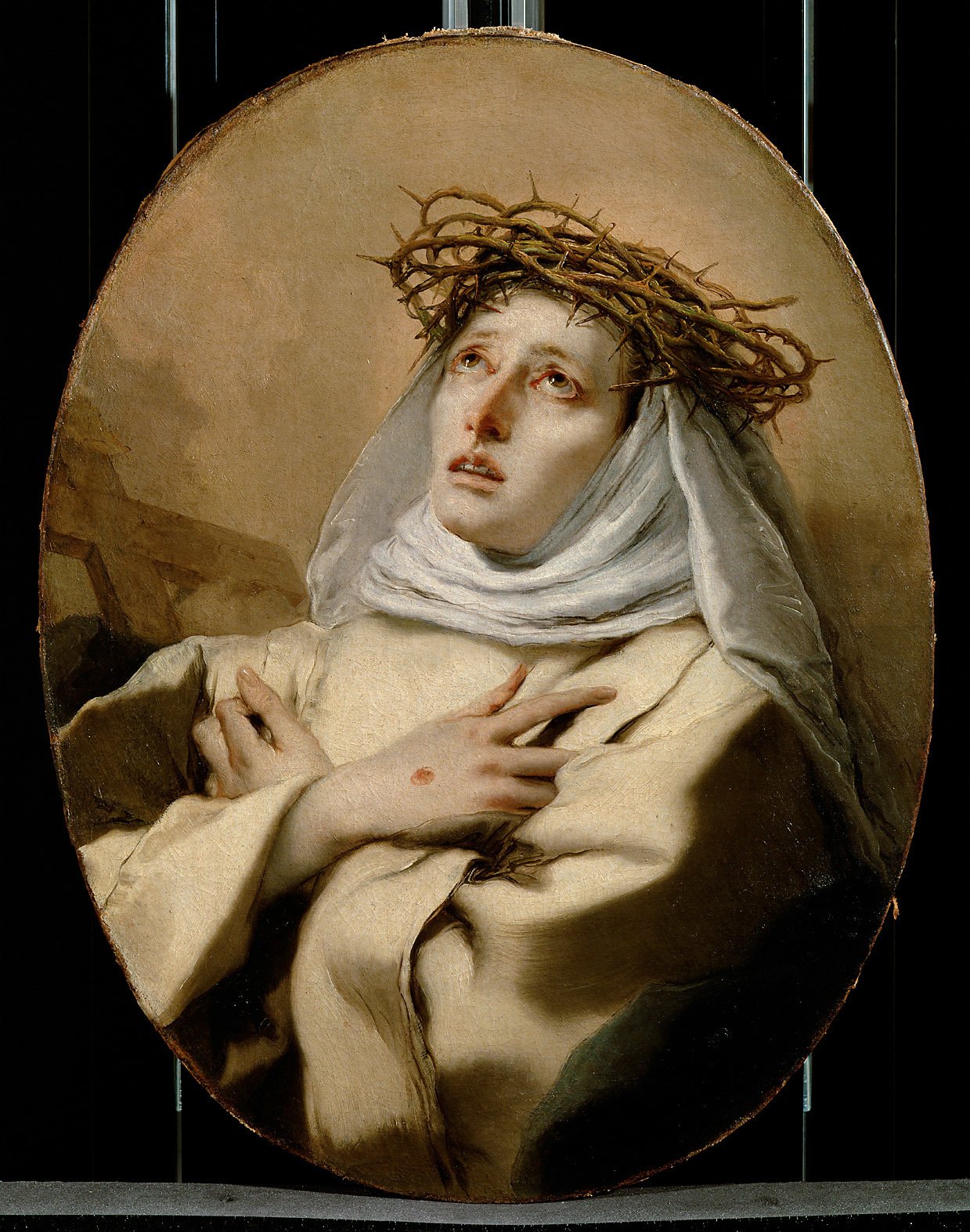
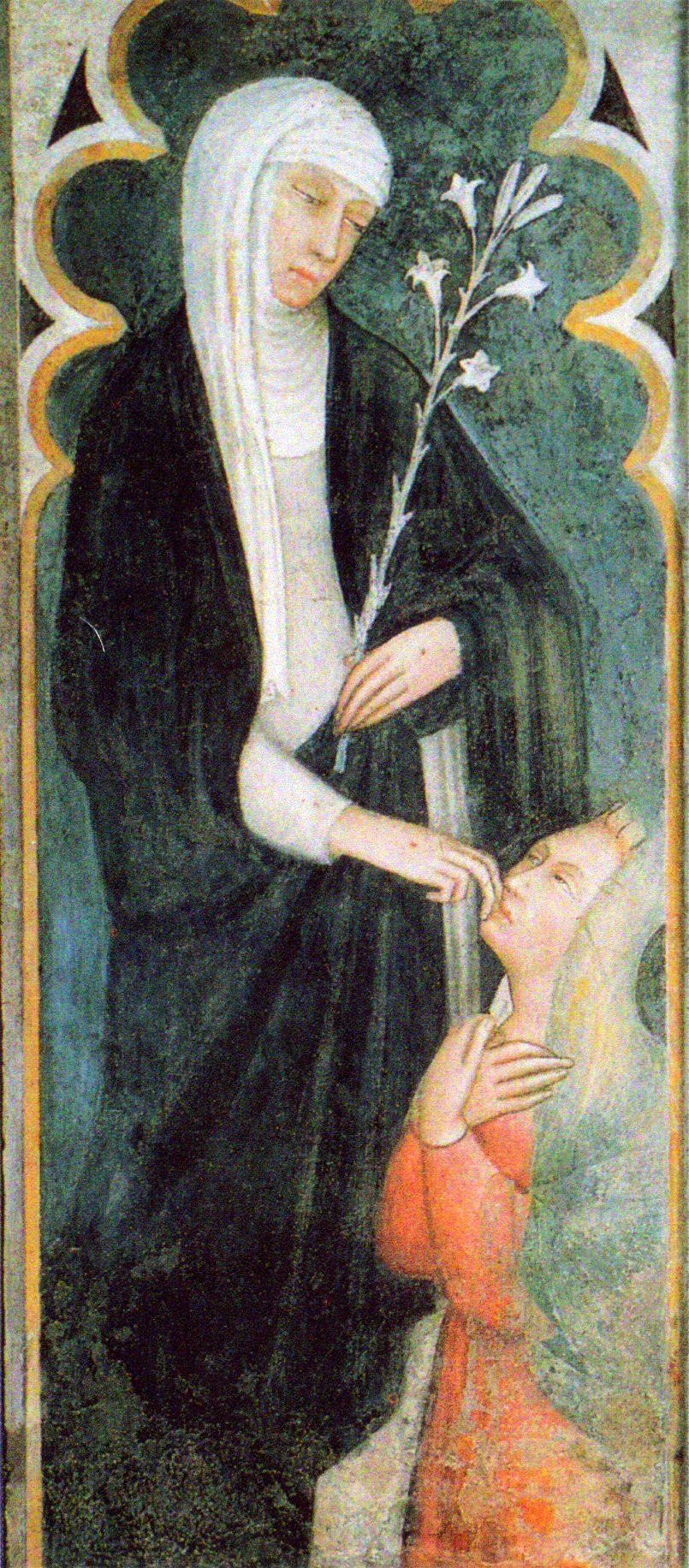
- The Dominican white robe and black mantle, with a lily, a book, a crown of thorns, a heart, or the wounds of Christ on her hands.
feast days
West
- Apr29
Her day in the Catholic calendar. Also the Church of England, the Episcopal Church and the ELCA, but not the Missouri Synod.
- Apr30
Her day in the Catholic calendar from 1628 to 1969, and in the 1916 Roman Martyrology, the Catholic Church's official list of saints.
Why two days? She died on 29 April, but that was already the feast of Peter of Verona, a Dominican martyr. So when Rome first put her in its calendar, in 1597, she had no day of her own, only a brief mention on his. In 1628 she was given her own day, 30 April. In 1969 Rome moved her back to the day she died. The Orthodox churches keep no day for her.
what was she like?
+forgiving
Andrea, an old widow in Catherine's own group of Dominican sisters, had breast cancer, and no one but Catherine would nurse her. In time Andrea turned on her, and told the other sisters that Catherine had lost her virginity. Catherine only answered, “Indeed I am a Virgin,” and kept on nursing her.
At last Andrea wept and confessed her lie. Catherine embraced her, and blamed the devil: “I do not accuse you but him.”
Raymond of Capua, Life, Part 2, chapter 3 (English of 1860, from the French)+generous
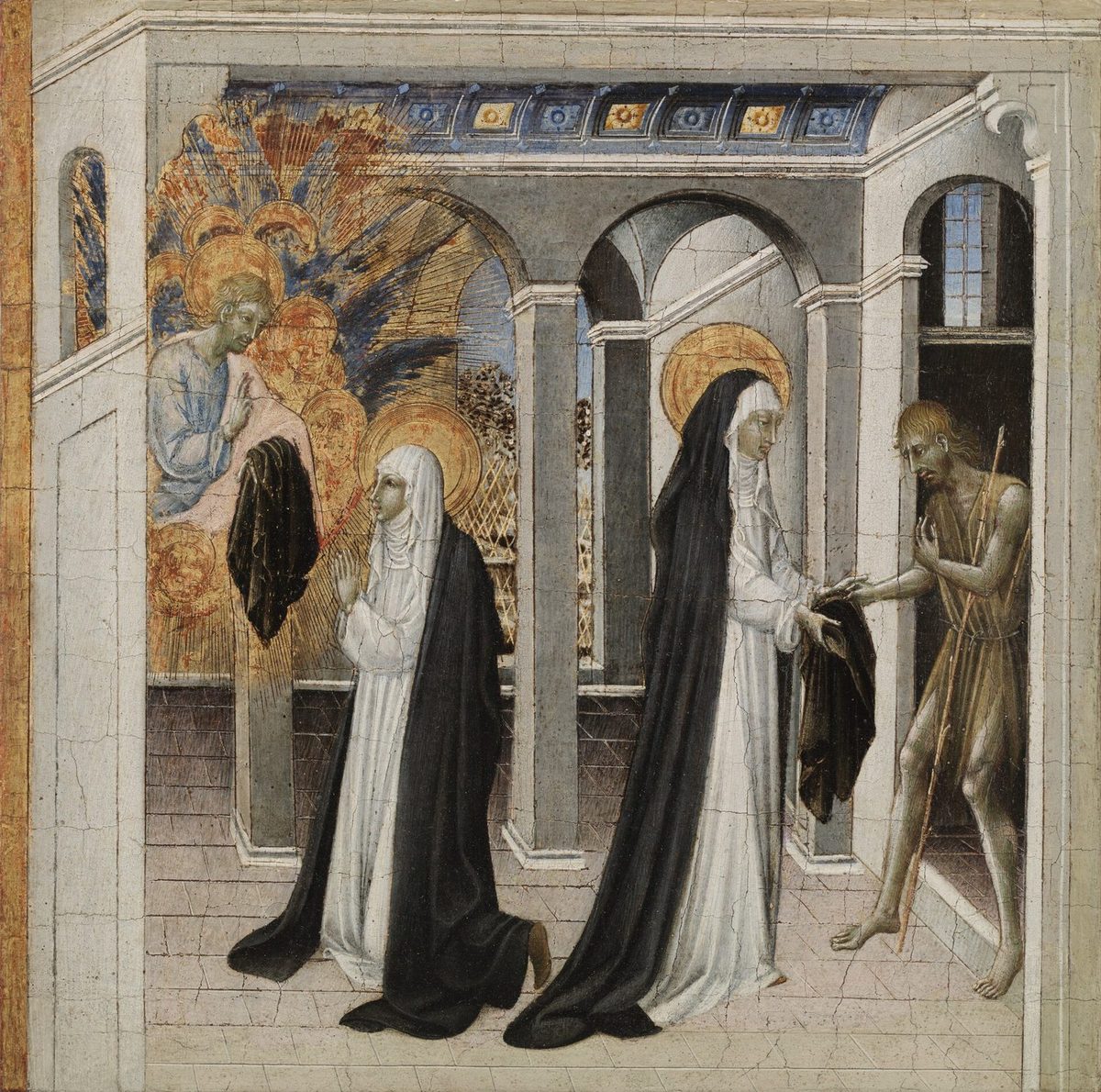
A half-dressed stranger once begged Catherine for clothes outside a chapel. She gave him the woollen garment she wore under her dress. He asked for linen, so she took him home and gave him two of her parents' linen shirts. He asked for sleeves, so she cut them off the maid's new dress.
That night Christ appeared to her in the stranger's form, holding up her woollen garment, now covered in pearls.
Raymond of Capua, Life, Part 2, chapter 2 (English of 1860, from the French)+wise and gentle
Two learned churchmen said Catherine was ignorant and led simple people astray with false readings of the Bible. They came to her house to catch her out with hard questions, and she answered every one.
Then, with great respect, she warned them that their learning fed their pride, and both were won over. One of them, a friar who had furnished his rooms more richly than a cardinal's, gave away everything in them but his prayer book.
Francesco Malavolti's account, in Edmund Gardner's translation (1907)+patient
Tecca, a poor woman with leprosy, was so ill that no one would go near her, and she was about to be sent outside the city, as lepers were then. Catherine promised to serve her for life, and came morning and evening. Tecca only scolded her for coming late from church.
When Catherine's own hands caught the disease, she kept on. She nursed Tecca to the end and buried her, and then her hands healed.
Raymond of Capua, Life, Part 2, chapter 3 (English of 1860, from the French)+never tired of talking about God
Her confessor, Raymond of Capua, says that when Catherine found someone who understood her, she could talk about God day and night, and it made her stronger, not weaker. Raymond could not keep up, and sometimes nodded off. She would raise her voice to wake him, and tell him he was leaving her “to converse with the walls”.
Raymond of Capua, Life, Part 1, chapter 5 (English of 1860, from the French)+fearless before the powerful
Her confessor, Raymond of Capua, wrote that God let Catherine see into souls, even far away. At Avignon, in France, where the popes then lived, she told Pope Gregory XI that his court was full of shameful vice.
The pope asked how she could know, after only a few days there. She answered that even in Siena she had seen its sins more clearly than the men who committed them. The pope had no answer.
Raymond of Capua, Life, Part 2, chapter 3 (English of 1860, from the French)what others said of her
Raymond of Capua, the priest who heard her confessions, wrote her life. Her secretaries and friends left letters and sworn statements. Popes and scholars have spoken of her since.
Behold, Brethren, when we yield to timidity how we become guilty before God. This humble woman confounds us
I commit the entire negotiation into your hands: only be careful of the honor of the Church.
I could not overcome my surprise, and shall never forget the tone of authority with which Catharine spoke to that great Pontiff.
Though always suffering terrible physical pain, living for long intervals on practically no food save the Blessed Sacrament, she was ever radiantly happy and full of practical wisdom no less than the highest spiritual insight.
Catherine Benincasa was probably the most remarkable woman of the fourteenth century
her life in twelve moments
Siena
1353, aged sixA vision above the church
Catherine was six, walking home through Siena with her little brother Stephen. Above the great church of San Domenico she saw Christ on a throne, robed and crowned like a pope. She stood still in the street. He smiled at her and blessed her.
Her brother came back and took her by the hand. “O did you but see what I see, you would never have disturbed me in such a sweet vision,” she told him. When she looked up again the vision was gone, and she wept. Raymond of Capua, who wrote her life, says that from that day she was no longer like a child.
Raymond of Capua, Life, Part 1, chapter 2 (English of 1860, from the French)Siena
From about 1359She cuts off her hair
When Catherine was about twelve, her family began to look for a husband for her. She would not marry: at seven she had promised herself to Christ. A Dominican priest, sent by her parents to change her mind, took her side instead, and told her to cut off her hair to show she meant it. She did, and the family was furious.
They took away her room and made her do all the housework. She served them gladly, picturing her father as Christ, her mother as Mary and her brothers as the apostles. And she made a little room for prayer inside her own soul, where no one could disturb her.
Raymond of Capua, Life, Part 1, chapter 4 (English of 1860, from the French); Gardner (1907)Siena
About 1362The dove, and her father's word
One day her father, Giacomo, walked into the room where Catherine was praying and saw a snow-white dove resting on her head. It flew out of the window. When he asked her about it, she said she had seen no bird.
Soon after, she told her parents and brothers of her promise never to marry: “it will be easier to dissolve a rock than to induce me to change my will.” They all wept. Her father remembered the dove, and told the family that no one was to stand in her way again, for she had chosen a Bridegroom Who would never die. She was given a small room of her own to pray in.
Raymond of Capua, Life, Part 1, chapter 4 (English of 1860, from the French)Siena
About 1363She joins the Dominican sisters
The women Catherine longed to join wore the white robe and black mantle of St Dominic's order, but lived in their own homes, praying and serving the sick. They took only widows, and twice they turned her down.
Then Catherine fell ill, covered in a rash, and told her mother, Lapa, that God would take her from the world unless she received that robe. Afraid of losing her, Lapa went back to the sisters. They agreed to take her only if she was not too pretty, for fear of what men might do. The rash hid her looks, and her wisdom won them over. At about sixteen she joined them, a girl among widows.
Raymond of Capua, Life, Part 1, chapter 6 (English of 1860, from the French); Benedict XVI, general audience, 24 November 2010Her room in Siena
About 1364 to 1367Three years of silence
After she received the robe, Catherine kept silent for three years in her small room in her father's house. She spoke to no one except in confession, and left the room only to go to church.
At night she prayed for the Dominican priests of San Domenico, the church near her home, while they slept. She called them her brothers. When their bell woke them for their night prayers, she lay down on her bare planks, with a log for a pillow. She longed to read the psalms herself. After weeks of struggling with the alphabet, she asked God to teach her, and rose from her knees able to read.
Raymond of Capua, Life, Part 1, chapters 8 and 10 (English of 1860, from the French)Siena
About 1367Back to the family table
For three years Catherine had stayed shut in her room to pray. She later told her confessor, Raymond of Capua, that Christ then began to send her out. At mealtimes He would tell her to go and eat with her family, and then come back to Him.
She wept and begged to stay. He answered that love has two commandments, love of God and love of neighbour, and she must keep both. So she went out and sat down at the family table. She took up the housework again, and began to care for the poor and the sick.
Raymond of Capua, Life, Part 2, chapter 1 (English of 1860, from the French)Siena
Summer 1370Four hours as if dead
In the summer of 1370, ill in bed, Catherine lay for about four hours as if dead. She later told Raymond of Capua, her confessor, that in that time her soul saw the glory of heaven and the pains of hell and purgatory, and that Christ sent her back to save souls.
From now on she was to go out through the whole city, and He would set her before popes and rulers. She wept for three days and nights at being sent back from heaven.
Raymond of Capua, Life, Part 2, chapter 5 (English of 1860, from the French); Catholic Encyclopedia (1908)Siena
The mid-1370sBeside a condemned man
Niccolò di Tuldo, a young man from Perugia, was sentenced to death in Siena for speaking rashly against its government. In prison he raged and despaired. Catherine went to him, and he grew calm, confessed, and took Communion for the first time. He made her promise to be with him at the end.
On the day of his execution he came to the block “like a gentle lamb”, smiling when he saw her waiting. She helped him lay down his head, and he died saying “Jesus” and “Catherine”. She caught his head in her hands. She wrote to Raymond of Capua that she then saw Christ receive his soul into the wound in His side.
Letter to Raymond of Capua, in Scudder (1905); Gardner (1907)Siena
About 1375A man with four feuds
Nanni di Ser Vanni, a powerful man of Siena, was secretly blocking peace in four blood feuds. A holy man from England, Brother William, talked him into meeting Catherine. Nanni told her plainly he would make no peace. So she went off alone to pray, while Raymond of Capua kept him talking.
A few minutes later Nanni offered, out of politeness, to give up one of his four feuds, and rose to go. Then he cried out that some power held him there: he could not leave, and had no strength left to refuse peace. He fell to his knees in tears, and Catherine made peace between him and all his enemies.
Raymond of Capua, Life, Part 2, chapter 6 (English of 1860, from the French); Scudder (1905)Avignon
1376To the pope at Avignon
For about seventy years the popes, who are bishops of Rome, had lived at Avignon, in France. They still ruled much of central Italy, and Florence had gone to war with Pope Gregory XI. In June 1376 Catherine went to Avignon to make peace for Florence, and begged the pope to return to Rome.
When he ordered her to tell him God's will, she answered: “Who knows more perfectly the will of God than your Holiness, who has pledged himself by a Vow?” Gregory was astonished. Before his election he had vowed to go back to Rome, and told no one. He made up his mind there and then, and entered Rome in January 1377.
Raymond of Capua, Life, Part 3, chapter 6, and Bartholomew Dominici's statement in its appendix (English of 1860, from the French); Gardner (1907); Scudder (1905)Florence
June 1378The mob in the garden
Early in 1378 Pope Gregory, who ruled much of central Italy, sent Catherine to Florence, still at war with him, to make peace. She advised the pope's friends there to oust a few men blocking it. They went much further and banished many others, and the city turned on her.
On 22 June armed men found her praying in a garden. She knelt before the one with a sword: “do whatever God suffers you to do to me; but in the name of the Almighty, I command you not to touch any of mine.” He could not bear to face her, and they left. She wept that she had missed dying for Christ.
Raymond of Capua, Life, Part 3, chapters 1 and 6 (English of 1860, from the French); Catholic Encyclopedia (1908)Rome
November 1378Two popes
Pope Gregory died in March 1378, and in April the cardinals in Rome elected an Italian, Urban VI. By September most of them said the Roman crowd had forced their hand, and they chose a rival pope, Clement VII. So began the Great Schism, when rival popes split the Church for almost forty years.
Urban called Catherine to Rome, and in November she came, with a band of followers who lived on alms. She told his cardinals to stand firm and fear nothing, wrote to kings, queens and cities to stand by him, and tried to calm his quick temper. She stayed in Rome until she died.
Gardner (1907); Raymond of Capua, Life, Part 3, chapter 1 (English of 1860, from the French); Scudder (1905)
her fasting
For most of her adult life Catherine ate almost nothing, and it wore her body out. Those closest to her wrote down what they saw.
What she ate
As a child she gave her meat away. Later she lived on a little bread and raw vegetables, then gave up even the bread. Her secretary Stefano Maconi, who watched her for years, says she would chew a little salad or the head of an eel, swallow the juice and spit out the rest. Anything more made her ill.
“As soon as she had any substance in her stomach as large as a hazel-nut, her whole system was in a state of suffering”Raymond of Capua, Life, Part 1, chapter 5, and Part 2, chapter 4; Stefano Maconi's letter, in its appendix (English of 1860, from the French)
Ordered to eat
Her first confessor, Thomas della Fonte, feared her fasting was a trick of the devil, and ordered her to eat every day. She obeyed, and grew so ill they feared for her life. So she reasoned with him: if fasting were killing her, he would forbid it; since eating was killing her, why not forbid that? He gave in.
Still, to quiet talk that she ate in secret, she sat at table once a day and tried. Afterwards she would go and make herself sick, saying of herself:
“Let us go and do justice to this miserable sinner.”Raymond of Capua, Life, Part 2, chapter 4; Stefano Maconi's letter, in its appendix (English of 1860, from the French); Gardner (1907)
In her own words
A devout man in Florence wrote to warn her that the devil might be deceiving her, and urged her to pray to be able to eat. She wrote back:
“I have prayed constantly, and do pray God and shall pray Him, that in this matter of eating He will give me grace to live like other creatures, if it is His will—for it is mine.”Letter to a religious man in Florence, in Scudder (1905)
Her other penances
She slept on bare planks, and in time allowed herself only half an hour's sleep every other day, says Raymond of Capua. She wore an iron chain so tight that it cut into her flesh.
Her mother took her to the hot sulphur baths to draw her away from her penances, but there she held her bare skin under the scalding water where it poured in. She told Raymond she offered the pain to God for her sins, and the thought that He accepted it made her happy through the pain.
Raymond of Capua, Life, Part 1, chapters 5 and 6, and Part 2, chapter 3 (English of 1860, from the French)What historians say now
In Holy Anorexia (1985), the historian Rudolph Bell argued that the fasting of medieval holy women like Catherine resembles the anorexia of teenage girls today. Caroline Walker Bynum, in Holy Feast and Holy Fast (1987), read it in the terms of its own time: such women gave up ordinary food to prepare for the food of Communion, and fasting gave them some control within their families and over their callings.
Raymond of Capua took her life without food as a miracle, yet held that holiness “is not measured by fasting but by holy charity”.
University of Chicago Press, Holy Anorexia; University of California Press, Holy Feast and Holy Fast; Raymond of Capua, Life, Part 2, chapter 4 (English of 1860)her miracles and visions
Raymond of Capua, the priest who heard her confessions and guided her, finished his Life of her in 1395. For the wonders he tells, he names his witnesses, and some he saw himself.
4 wonders with witnesses
-
Her father's house
Before 1368The cask that never ran out
With her father's leave, Catherine gave the poor the family's best food and wine. She drew their wine from the cask the household drank from, which should have run dry in two or three weeks. It lasted three months, and the wine was better than ever. At the grape harvest the men opened the cask to fill it with new wine. Wine had flowed from it the evening before, yet inside it was bone dry.
“it was so dry, that it seemed an impossibility that any liquid could have been drawn from it for a length of time”
Her mother and about twenty others in the house.
Raymond of Capua, Life, Part 2, chapter 2 (English of 1860, Dublin printing) -
Siena
18 August 1370Levitating in prayer
On 18 August 1370, after Communion, Catherine lay down on the planks she slept on. Then her body rose into the air and stayed there, with nothing holding it up, before it sank back. She began to pray aloud for several people, among them her first confessor, Thomas della Fonte. At that hour Thomas, in the Dominican church and in no mood for prayer, was suddenly filled with a fervour he had never known.
“then her body was raised in the air, and remained there without any sort of support”
Three of her companions, says Raymond.
Raymond of Capua, Life, Part 2, chapter 5 (English of 1860, from the French) -
Siena
October 1370Her mother brought back to life
In 1370 Catherine's mother, Lapa, fell gravely ill. Christ told Catherine that if Lapa died now she would be saved, and spared hard years to come. But Lapa dreaded death and begged to live, so Catherine prayed that God would not take her until she was ready, and death held off.
Still Lapa gave no thought to her soul, and at last she died without confession or the last rites. Raymond of Capua, who wrote Catherine's life, says God allowed this so that Catherine's holiness would be seen. Catherine wept, reminded God of His promise, and told Him she would not leave until He gave her mother back. God heard her. Lapa's body stirred, life came back, and she lived to 89.
“the body of Lapa suddenly recovered motion; life returned completely and she soon resumed her ordinary occupation”
Three women of Siena who heard her prayer, among them Lisa, her sister-in-law.
Raymond of Capua, Life, Part 2, chapter 7 (English of 1860, from the French) -
Siena
1374Father Matthew healed of plague
Plague struck Siena in 1374. Father Matthew, who ran the city's House of Mercy, a hospital, caught it one night while sitting with a sick man, and by morning he could not speak. His doctor said he would die.
Catherine hurried to his room and called out, “Get up Father Matthew, arise, this is not the moment to repose indolently in your bed.” The fever and the plague spots vanished. To show he was cured, Matthew sat down with his friends to a meal no sick man could stomach: raw onions and vegetables.
“At the very instant in which she uttered these words, the fever and the marks of the pestilence disappeared”
Raymond of Capua and more than twenty people of the house.
Raymond of Capua, Life, Part 2, chapter 7 (English of 1860, Dublin printing)
A ring only she could see
During carnival, the days of feasting before Lent, probably in 1366 or 1367, Catherine prayed alone in her room while her family feasted. She later told Raymond of Capua what she saw.
Christ appeared with His mother, the apostles John and Paul, St Dominic, founder of her order, and King David playing a harp. Mary took Catherine's hand, and Christ put a gold ring on her finger, set with four stones and a diamond, and took her as His bride. Blushing, she told Raymond that the ring stayed on her finger all her life, though no one else could see it.
“She saw it, but it was invisible to others”Raymond of Capua, Life, Part 1, chapter 11 (English of 1860, from the French); Catholic Encyclopedia (1908)
Her heart exchanged
Praying one day, Catherine begged Christ to take away her heart and give her a new one. In a vision she saw Him open her side and take her heart away. When she told her confessor, Thomas della Fonte, that she had no heart left, he laughed at her.
A few days later, in the Dominican church, she saw Christ holding a glowing red heart. He opened her side again and put it in. Her companions said they had often seen the scar. Christ's words to her, as she told them, were:
“Daughter, the other day I took thy heart, to-day I give thee Mine, and this will henceforward serve thee.”Raymond of Capua, Life, Part 2, chapter 5 (English of 1860, Dublin printing); Gardner (1907)
Marks no one could see
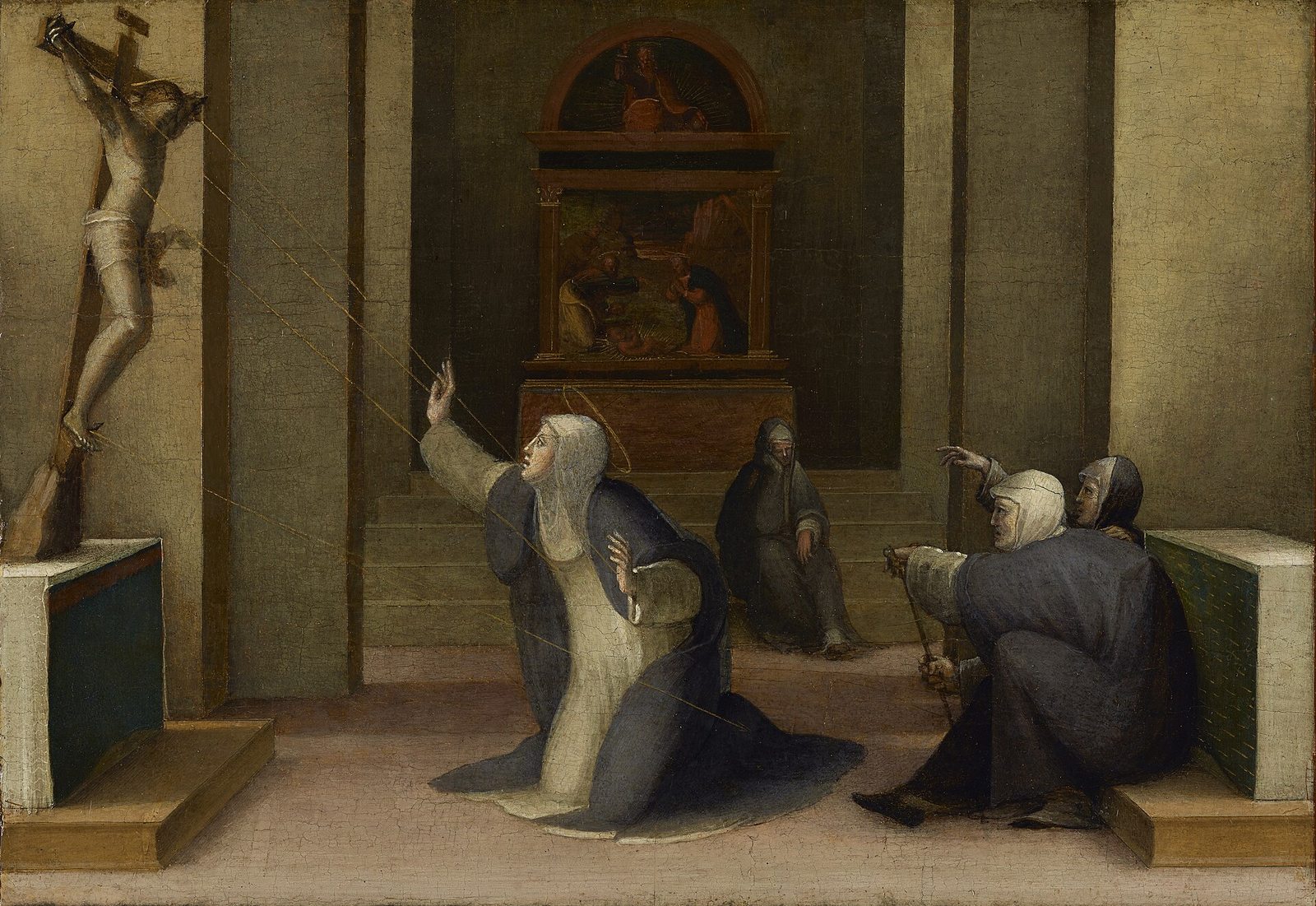
At Pisa in 1375, after Communion, Catherine lay in a long trance. Then, as Raymond of Capua and others watched, she rose to her knees, stretched out her arms and fell as if struck. She said rays from the five wounds of Christ had pierced her hands, feet and heart.
She had begged that no marks should show, and none did, but the pain was so great she thought she would die of it. Her friends prayed, and a week later she told Raymond the wounds now gave her strength instead.
“Father, I announce to you that, by the mercy of our Lord Jesus Christ, I bear His sacred stigmata in my body.”Raymond of Capua, Life, Part 2, chapter 5 (English of 1860, from the French); Catholic Encyclopedia (1908)
her words
Catherine dictated nearly everything she wrote: her book, the Dialogue, and about 380 letters. Her letters here are in Vida Scudder's English of 1905. What she said aloud comes from the Life by her confessor, Raymond of Capua.
To Pope Gregory XI, 1376
Ah me, father, I die of grief and cannot die! Come, come, and resist no more the will of God that calls you
She was begging him to leave Avignon, in France, and come back to Rome. In the same letter she calls him babbo, Italian for Daddy.
Letter to Gregory XI, in Scudder (1905)Be manly in my sight, and not timorous.
…since God and also our Holy Father have ordered a crusade against the infidels, and you take such pleasure in war and fighting, you should not make war against Christians any more
…let him not prefer a gentleman to a tradesman, for virtue is the thing that makes a man gentle.
Lord, where wast Thou, when my heart was so tormented?
Vidi arcana Dei
her book, the dialogue
In 1378, back home in Siena after the mob in Florence came for her, Catherine dictated a book. It is a conversation: she asks, and God the Father answers. For this book, her letters and her prayers, Pope Paul VI named her a Doctor of the Church in 1970, to honour the excellence of her teaching.
Dictated in prayer
Raymond of Capua says she told her secretaries to stay beside her when she was lost in prayer, and to write down whatever she said. They filled a whole book. The Catholic Encyclopedia of 1908 likens it to Dante's great poem of hell, purgatory and heaven, calling it
“the mystical counterpart in prose of Dante's Divina Commedia”Raymond of Capua, Life, Part 3, chapter 1 (English of 1860); Catholic Encyclopedia (1908)
Christ the bridge
The book says that sin broke the road between earth and heaven, and a flood of trouble drowned everyone who tried to cross. So God made His Son a bridge, joining heaven and earth in His human nature. But a bridge helps only those who walk on it.
“it is not enough, in order that you should have life, that My Son should have made you this Bridge, unless you walk thereon”The Dialogue, chapters 21 and 22, tr. Algar Thorold (1896)
Saved with our consent
The book insists that each person must choose. God made us without any help from us, but He will not save us without our consent.
“though He had created us without ourselves, He would not save us without ourselves”The Dialogue, chapter 23, tr. Algar Thorold (1896)
The cell of self-knowledge
A cell is the small, bare room of a monk or nun. When her family took away her room, Catherine made a cell inside her soul. In the Dialogue it becomes the cell of self-knowledge, where we learn how weak we are, and so learn how good God has been to us. The Catholic Encyclopedia calls this the keynote of all her teaching:
“man, whether in the cloister or in the world, must ever abide in the cell of self-knowledge”The Dialogue, tr. Algar Thorold (1896); Catholic Encyclopedia (1908)
myths and misquotes
“Be who God meant you to be and you will set the world on fire.”
What the sources sayA paraphrase. She wrote to her secretary Stefano Maconi, urging him to win Siena's rulers over to Pope Urban VI: “If you are what you ought to be, you will set fire to all Italy, and not only yonder.” In 2000 Pope John Paul II, quoting her loosely, widened it to “the whole world ablaze”.
Letter to Stefano Maconi, in Scudder (1905); John Paul II, homily at Tor Vergata, 20 August 2000She could not read or write.
What the sources sayNot all her life. She learned to read as a young woman, in answer to prayer, says her confessor, Raymond of Capua. She learned to write in 1377, three years before she died. Even then she dictated most of her letters.
Raymond of Capua, Life, Part 1, chapter 10 (English of 1860); Catholic Encyclopedia (1908); Scudder (1905)She brought the pope back from Avignon on her own.
What the sources sayNot on her own. Bridget of Sweden, a visionary, had begged the popes to return before her, and Gregory XI had vowed to go back before he was elected. Accounts differ on how much her words weighed. Her friend Bartholomew Dominici says they decided him. Britannica says she was “virtually ignored by the pope” at Avignon.
Bartholomew Dominici's statement, in the appendix to Raymond's Life (English of 1860); Gardner (1907); Britannica; Scudder (1905)She was a nun.
What the sources sayNot in a convent. She belonged to the Sisters of Penance of St Dominic, women who wore the Dominican robe but lived in their own homes. Raymond of Capua says she never took a nun's vows of poverty, chastity and obedience, though she lived by all three. As the historian Edmund Gardner put it: “These Mantellate were not nuns, strictly speaking”.
Raymond of Capua, Life, Part 1, chapters 6 and 8 (English of 1860); Gardner (1907)She was the first woman named a Doctor of the Church.
What the sources sayThe second, by a week. The title honours saints whose writings teach the whole Church. Pope Paul VI gave it to Teresa of Ávila, a Spanish Carmelite nun, on 27 September 1970, and to Catherine a week later. They were the first two women to hold it.
Paul VI, homilies for the proclamations of Teresa of Ávila and Catherine of Siena, 1970friends, family and rivals
A Dominican priest who heard Catherine's confessions and guided her from 1374. He was away on the pope's business when she died. His Life of her, finished in 1395, is the main account of her life. He went on to lead the whole Dominican order.
Catholic Encyclopedia (1908); Raymond of Capua, Life, Part 3, chapter 1Catherine's mother, who bore 25 children. Lapa fought her daughter's fasting and penances, and feared for her among the sick, but she was with Catherine at the end, and outlived her. She died at 89.
Raymond of Capua, Life, and Stefano Maconi's statement in its appendixCatherine's father, a dyer of Siena. Once she told the family of her promise, he let no one stand in her way, and let her give the poor whatever they needed from his house. He died in 1368.
Raymond of Capua, Life, Part 1, chapter 4, and Part 2, chapter 2; Scudder (1905)A young nobleman of Siena and one of Catherine's secretaries. He carried her body on his shoulders to her grave in Rome. Later he became a Carthusian, a monk of a strict order, and in time led the whole order.
Catholic Encyclopedia (1908); Stefano Maconi's statement, in the appendix to Raymond's LifeThe French pope at Avignon, whom Catherine called babbo, Italian for Daddy, in her letters. She met him there in 1376, and he returned to Rome the next January. He died in Rome in 1378.
Scudder (1905); Gardner (1907)Elected in Rome in 1378. When most of the cardinals chose a rival pope, Catherine stood by Urban, wrote letters for his cause and tried to calm his temper. He called her to Rome, where she died.
Scudder (1905); Gardner (1907)A young widow of a noble family of Siena, and the dearest of Catherine's women companions. In her last hours Catherine lay against her shoulder.
Scudder (1905); Barduccio Canigiani's letter, in the appendix to Raymond's LifeA young man of Florence, one of Catherine's secretaries in Rome. His letter to Sister Caterina Petriboni, a nun near Florence, is the fullest account of Catherine's last months.
Barduccio Canigiani's letter, in the appendix to Raymond's Life; Gardner (1907)A Swedish noblewoman and visionary who lived in Rome, and begged the popes to come back from Avignon before Catherine did. She died in 1373. In 1999 both women were named patron saints of Europe.
Gardner (1907); John Paul II, Spes Aedificandi (1999)how she died
Catherine died in Rome on Sunday 29 April 1380, aged 33, after months in which she could not eat or drink. To the end she offered her sufferings to God for the Church.
Her secretary Barduccio Canigiani, who was with her, wrote that from early January she could not swallow food, nor even a drop of water, though she burned with thirst. Yet she stayed cheerful.
That winter some in Rome threatened to kill Pope Urban VI. Catherine prayed day and night that God would not let it happen, and offered to bear in her own body what the city's sins deserved, says Raymond of Capua. God heard her: the unrest died down, and the pope was unharmed. From then on her own sufferings grew.
In late January she collapsed at evening prayer. Even so, through the first weeks of Lent, she walked a mile to St Peter's every day to pray.
One Sunday in Lent she was praying in St Peter's before Giotto's great mosaic of the apostles' boat on a stormy sea, long a picture of the Church. She felt the boat of the Church laid on her shoulders, crushing her.
Her followers carried her home, and for eight weeks she could not lift her head. Barduccio wrote that by the end her body was “reduced to that state in which Painters represent death”, but her face shone.
On her last day she confessed her faults aloud, asked her mother's blessing, prayed for the Church and for Pope Urban, and blessed her companions. She died about noon, and was buried in Santa Maria sopra Minerva, the Dominican church in Rome.
Near the end
Yes, Lord, Thou callest me and I go to Thee; I go, not on account of my merits, but merely on account of Thy mercies
Her last words
Father into Thy hands I commend my spirit.
is she a saint?
Yes. Pope Pius II made her a saint in 1461, and in 1970 Pope Paul VI named her a Doctor of the Church. Anglicans and Lutherans remember her too. The Orthodox churches do not keep her day.
- CatholicSaint and DoctorCanonised 1461, Doctor 1970, 29 April
- AnglicanRememberedChurch of England and Episcopal Church, 29 April
- LutheranRememberedELCA, 29 April; not the Missouri Synod
- OrthodoxNot on the calendarShe lived after the Orthodox and Catholic churches parted in 1054
Pius II, who made her a saint eighty-one years after she died, was himself a man of Siena. Pope Pius IX later named her a patron of Rome, and Pius XII a patron of Italy. In 1999 John Paul II made her a patron saint of Europe, with Bridget of Sweden and Edith Stein, a Carmelite nun who died at Auschwitz.
The Church of England calls her a Teacher of the Faith, and the Episcopal Church a Mystic and Prophetic Witness. The 1916 Roman Martyrology, the Catholic Church's official list of saints, gives her this line:
At Rome, St. Catherine of Siena, virgin, of the Order of St. Dominic, renowned for her life and miracles. She was inscribed among the canonized virgins by Pius II.
a prayer she wrote
The Dialogue ends with her prayer of thanks to the Trinity. This is part of it, in Algar Thorold's translation of 1896.
Thou, oh eternal Trinity, art a deep Sea, into which the deeper I enter the more I find, and the more I find the more I seek; the soul cannot be satiated in Thy abyss, for she continually hungers after Thee, the eternal Trinity, desiring to see Thee with light in Thy light. As the hart desires the spring of living water, so my soul desires to leave the prison of this dark body and see Thee in truth. How long, oh! Eternal Trinity, fire and abyss of love, will Thy face be hidden from my eyes?
what to read first
The Dialogue
Catherine, tr. Algar Thorold
Her book, dictated in 1378: God the Father answers her questions about the soul, the Church and prayer. It is long; begin with the chapters on Christ the bridge.
Read it freeSaint Catherine of Siena as Seen in Her Letters
Vida Scudder
A selection of her letters, to popes, a king, a soldier, her family and her friends, each with a short note on who it was for. The best way to hear her own voice.
Read it freeLife of Saint Catharine of Sienna
Raymond of Capua
Her confessor's life of her, in an English version of 1860 made from the French. At the end: her friends' sworn statements and letters, among them the account of her death.
Read it freeSaint Catherine of Siena
Edmund Gardner
A full history of her life and times, from 1907, by a scholar of Italian who read the sources in the original.
Read it freetake the quizzes
 Quiz Which early Christian
thinks like you? And which would argue with you? Start
 Quiz Christian

Personality Test Which of eight types are you? Find your own. Start
sources
Her life, and her words
- Raymond of Capua, Life of Saint Catharine of Sienna. Tr. from the French of E. Cartier by the Ladies of the Sacred Heart, Philadelphia, 1860. With the statements of her disciples and the letters of Barduccio Canigiani and Stefano Maconi.
- The same translation, New York, 1862
- The same translation, Dublin, undated.
- The Dialogue of the Seraphic Virgin Catherine of Siena. Tr. Algar Thorold, 1896.
- Vida D. Scudder, Saint Catherine of Siena as Seen in Her Letters, 1905.
- Edmund G. Gardner, Saint Catherine of Siena, 1907.
Reference
- Catholic Encyclopedia, 1908, “St. Catherine of Siena”, by Edmund Gardner
- Britannica, “St. Catherine of Siena”
- Benedict XVI, general audience, 24 November 2010
- John Paul II, Spes Aedificandi, 1 October 1999
- Paul VI, homily proclaiming Catherine of Siena a Doctor of the Church, October 1970, in Italian
- Paul VI, homily proclaiming Teresa of Ávila a Doctor of the Church, 27 September 1970, in Italian
- John Paul II, homily at the close of World Youth Day, Tor Vergata, 20 August 2000
- Rudolph M. Bell, Holy Anorexia, 1985 (the publisher's page)
- Caroline Walker Bynum, Holy Feast and Holy Fast, 1987 (the publisher's page)
- Merriam-Webster, “Siena”, for how to say it
Calendars
- USCCB, Liturgical Calendar 2026, 29 April
- Calendarium Romanum, 1969, on the moves of her feast
- The Roman Martyrology, 1916 edition, 30 April
- Church of England, Common Worship calendar
- The Episcopal Church, Lesser Feasts and Fasts 2022
- Evangelical Lutheran Worship, ELCA, the church year (final draft, 2006)
- The Lutheran Church–Missouri Synod, Commemorations
Pictures
- Saint Catherine of Siena, circle of Baldassare Franceschini (Il Volterrano), 1600s. Dulwich Picture Gallery, London. Public domain.
- Saint Catherine of Siena, Andrea Vanni, fresco, about 1400. San Domenico, Siena. Public domain.
- Hl. Katharina von Siena, Giambattista Tiepolo. Kunsthistorisches Museum, Vienna. Public domain. The hub's card is cut from it.
- Saint Catherine of Siena Receiving the Stigmata, Domenico Beccafumi, about 1513 to 1515. J. Paul Getty Museum. Public domain.
- St. Catherine of Siena and the Beggar, Giovanni di Paolo, about 1460. Cleveland Museum of Art. CC0.