
Joan of Arc
A farm girl from north-eastern France who walked into the court of France's uncrowned king in men's clothes and told him that God had sent her.
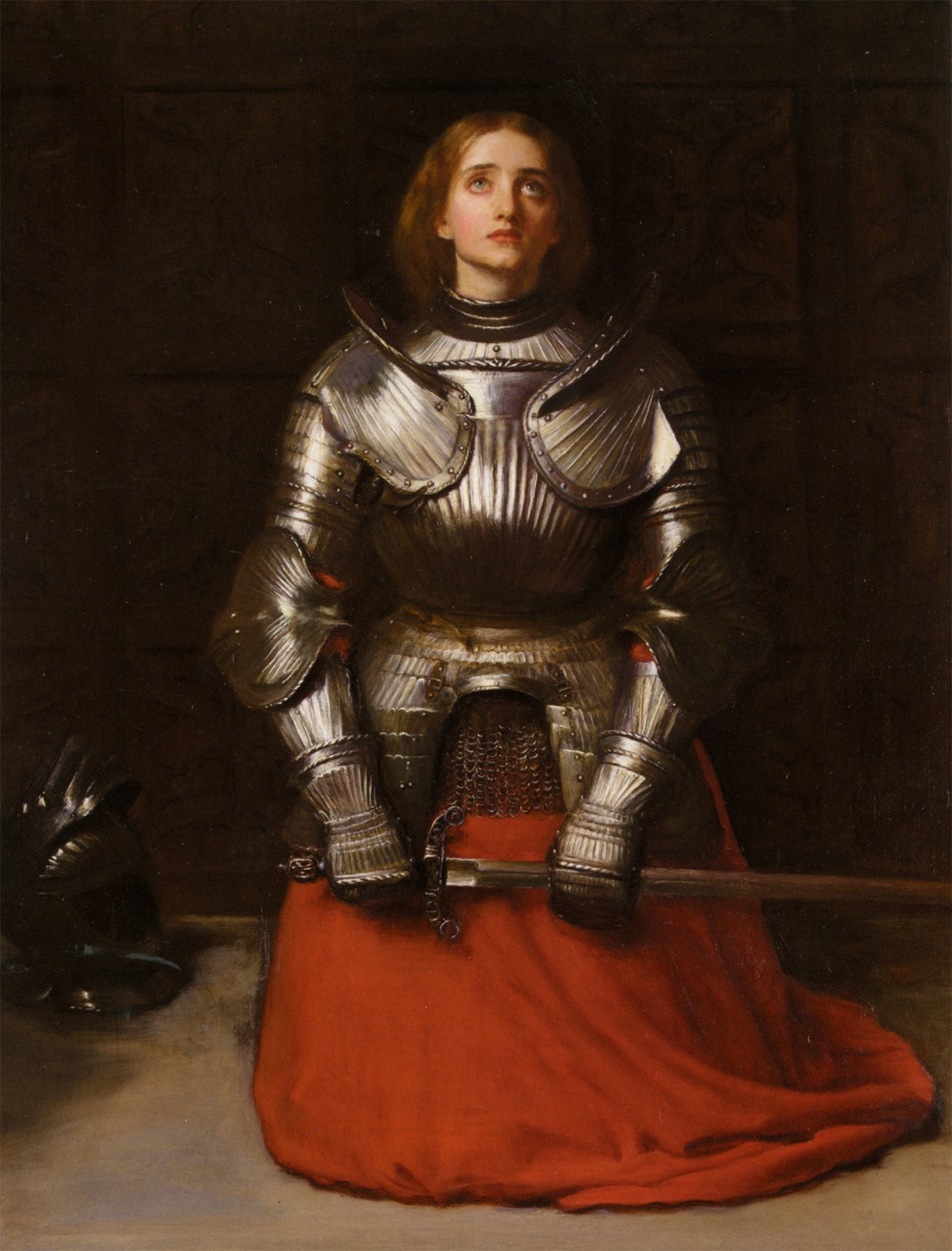
Picture: Joan of Arc, John Everett Millais, 1865. Public domain.
Who was Joan?
Joan of Arc was a French peasant girl who heard voices she believed came from God. She was 17 years old when she helped break the English siege of Orleans and brought Charles VII to Reims to be crowned. Captured and sold to the English, she was burned at the stake in 1431 and made a saint in 1920.
at a glance
Her path, in order
- Village girlSpun, sewed and prayed at Domremy
- MessengerRode 11 days to find Charles at Chinon
- Army leaderFrom Orleans to the crowning at Reims
- PrisonerCaptured at Compiègne, May 1430
- CondemnedTried at Rouen and burned, 1431
- SaintMade a saint in 1920
in numbers
- Her age when she was burned19
- She gave her age at her trial as about 19
- Burned at Rouen on 30 May 1431
- Days' ride to reach Charles at Chinon11
- With six men, mostly by night
- Through country held by the enemy
- Livres the English paid for her10k
- French pounds, “the usual ransom of a king”
- Charles VII offered nothing to free her
- Witnesses heard for her retrial115
- In five towns, from her village to Rouen
- Old neighbours, soldiers and priests
did you know?
-
The only picture of Joan made in her lifetime is a doodle in the margin of a court register. On 10 May 1429 the news reached English-held Paris that a girl with a banner had driven the English from Orleans, and the court's clerk drew her beside his note as he imagined her, with long loose hair, a dress, a sword and her banner.
Archives nationales, on the first portrait of Joan of Arc -
When people asked Joan to be godmother to their babies, she usually named the boys Charles, in honour of her king, and the girls Jeanne, which was her own name.
Trial, 3 March 1431, in Murray (1902) -
Mark Twain spent 12 years preparing his novel Personal Recollections of Joan of Arc. On his 73rd birthday he wrote, “I like the Joan of Arc best of all my books; & it is the best; I know it perfectly well.”
Albert Bigelow Paine, Mark Twain: A Biography (1912)
- Born
- Probably on 6 January 1412, the feast of the Epiphany, in Domremy, a village on the edge of Lorraine in north-eastern France. Some writers give 1410 or 1411.
- Died
- Burned at the stake in the Old Market at Rouen on 30 May 1431, when she was about 19 years old.
- Buried
- She has no grave. The English had her ashes thrown into the Seine.
- Her name
- At home she was called Jeannette, and later Jeanne, the French form of Joan. She called herself Jeanne the Maid, using the old word for a young unmarried girl. She gave her surname as “d'Arc or Rommée”, after her father and her mother, because girls in her part of the country took their mother's name too.
- Also called
- The Maid of Orleans, after the city she helped free. In French she is Jeanne d'Arc or la Pucelle.
- Parents
- Jacques d'Arc, who farmed his own land, and his wife Isabelle. Joan had brothers and a sister. At the end of 1429 Charles VII made the whole family nobles. They took the name du Lis from the lilies on their new coat of arms.
- Cleared
- Her trial and its sentences were declared null on 7 July 1456 by a court set up by Pope Calixtus III.
- Wrote
- Letters, which she dictated because she never learned to read or write. Her judges once read out one of her letters to the English. She said three of its words were not hers, and that no lord had written her letters for her: “it was I myself alone who dictated them”.
- Status
- Made a saint on 16 May 1920 by Pope Benedict XV.
- Patron of
- France, since 1922. She is its second patron saint, after the Virgin Mary.
- In art
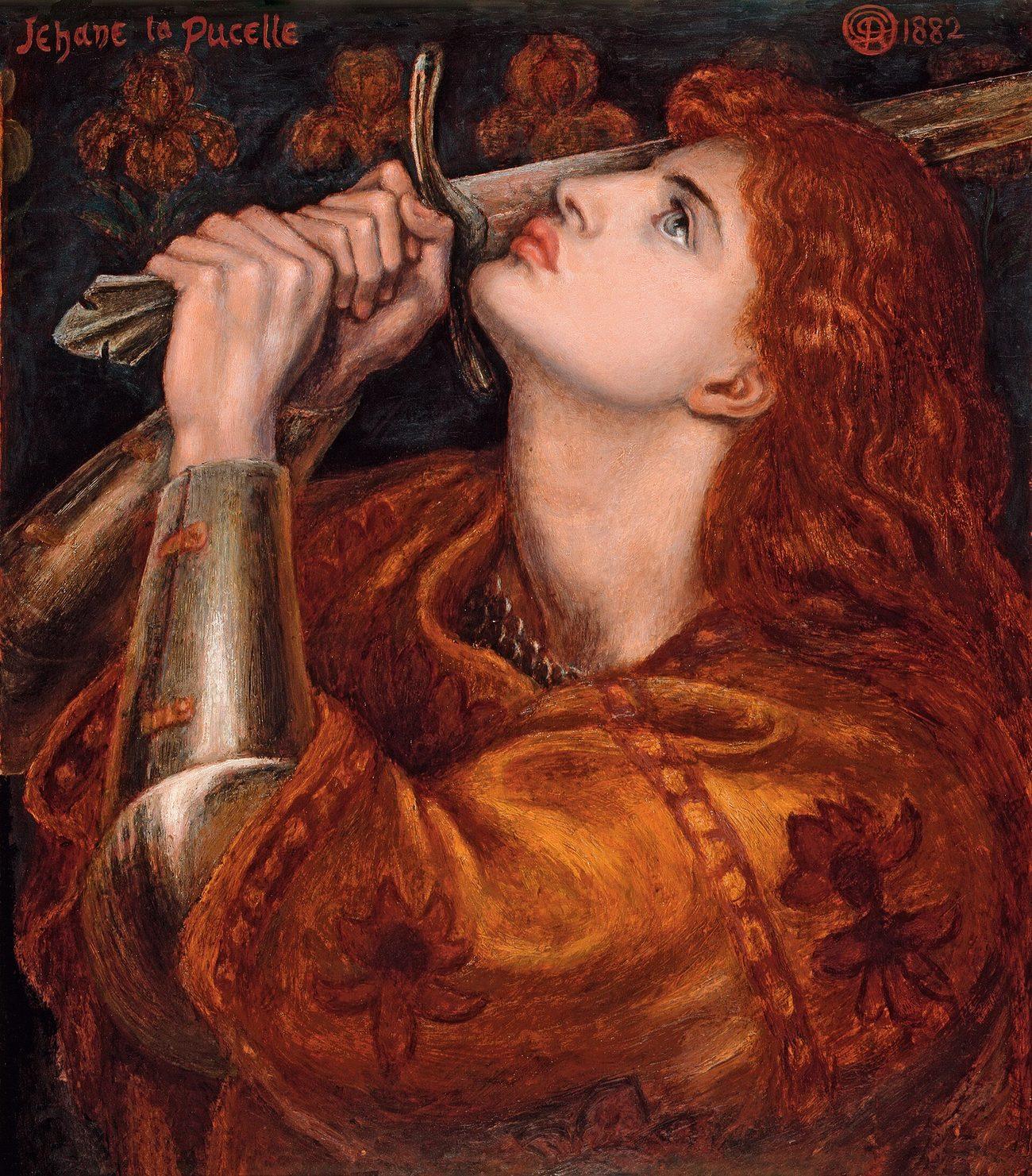
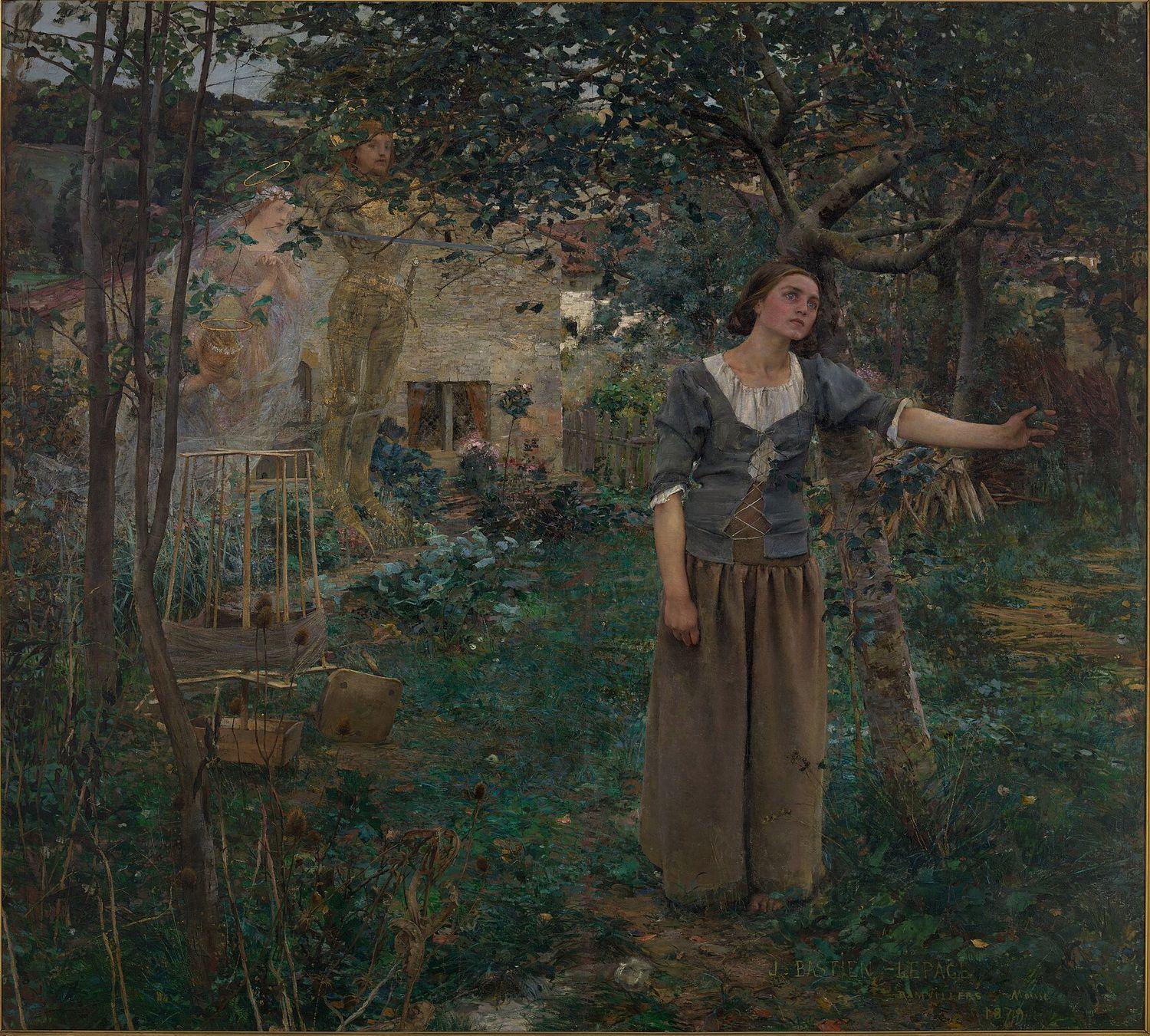
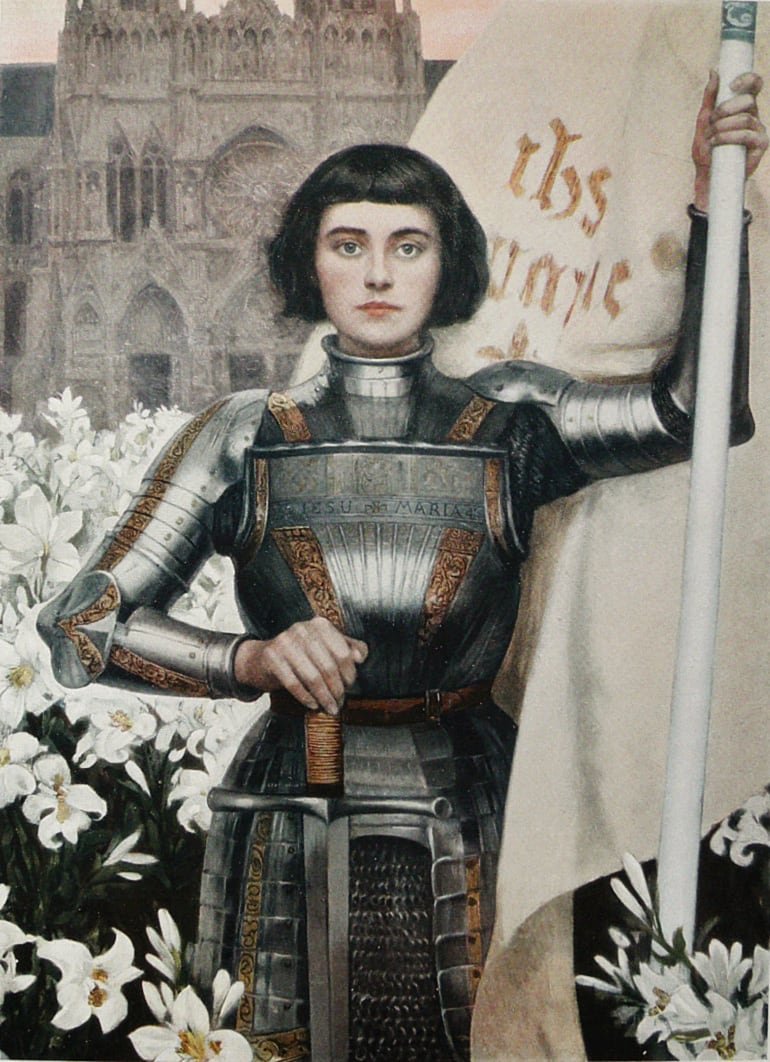
- Usually shown in armour with her white banner, on horseback or kneeling in prayer. No true likeness of her survives.
feast days
West
- May30
Catholic, in the Roman Martyrology since 1920. Also the Church of England.
30 May is the day she died. Her feast is not on the calendar the whole Catholic Church keeps, but Catholics in France keep it with its own Mass, and the Church of England keeps it as a commemoration. France also keeps a national day for her on the second Sunday of May, and every 8 May Orleans gives thanks for the end of its siege, as it has almost every year since 1429.
what was she like?
+hard to fool
A woman named Catherine de La Rochelle came to Joan with visions of her own. She said a white lady dressed in gold visited her at night and was sending her through the towns to gather hidden treasure to pay Joan's soldiers. Joan lay beside her to watch for the lady but fell asleep after midnight. In the morning Catherine told her the lady had come.
So Joan slept by day and watched the next night, but no one came. She told the king that Catherine's mission was “only folly and nothing more”.
Trial, 3 March 1431, in Murray (1902)+quick with an answer
Churchmen questioned Joan at Poitiers in 1429 before Charles would trust her with soldiers. Among them was Brother Séguin, who spoke the Limousin dialect. When he asked what language the voice she heard spoke, “A better one than yours,” she told him.
Asked whether she believed in God, she answered, “In truth, more than yourself!” Séguin came to believe God had sent her, because she arrived when the king and all his people had lost hope.
Brother Séguin, retrial evidence, in Murray (1902)+kind to her enemies
After the French victory at Patay in June 1429, Joan saw a Frenchman guarding English prisoners strike one of them on the head and leave him for dead. She got down from her horse, had a priest hear the dying man's confession, and held his head herself, comforting him as best she could. She did the same for other English soldiers she found dying.
Louis de Contes and Jean Pasquerel, retrial evidence, in Murray (1902)+pious from girlhood
As a girl at Domremy, Joan would kneel down in the fields when she heard the church bell. When the bell-ringer forgot to ring it, she scolded him and promised him some wool if he would ring on time. Her friends teased her for being too devout.
Perrin le Drapier, Jean Waterin and Mengette, retrial evidence, in Murray (1902)+humble
In 1429 Joan stayed at Bourges in the house of Marguerite La Touroulde, the wife of a royal official. Women kept coming to the house with rosaries and other holy objects for Joan to touch, but she only laughed at them: “Touch them yourselves. Your touch will do them as much good as mine.”
Marguerite La Touroulde, retrial evidence, in Murray (1902)+generous at home
At Domremy Joan gave to the poor from her father's goods and cared for the sick. She nursed a boy she grew up with when he fell ill. She would even sleep on the hearth so that poor people could have her bed.
Mengette, Simonin Musnier and Isabellette, retrial evidence, in Murray (1902)what others said of her
Almost everything known about Joan comes from two courts. The clerks of her trial in 1431 took down her own answers, and from 1450 to 1456 more than 100 people who had known her gave evidence under oath for her retrial.
In all she did, except in affairs of war, she was a very simple young girl; but for warlike things—bearing the lance, assembling an army, ordering military operations, directing artillery—she was most skilful.
I had absolute faith in her. Her words and her ardent faith in God inflamed me.
I should have been well pleased to have had a daughter as good as she.
It is the only story of a human life which comes to us under oath, the only one which comes to us from the witness-stand.
her life in 13 moments
Domremy
About 1412 to 1428A village at war
Joan grew up in the village of Domremy, where she helped her mother in the house. At her trial in Rouen years later she told the court, “In sewing and spinning I fear no woman in Rouen.”
All through her childhood France was at war. The English held Paris and the north with their French allies the Burgundians, and they claimed the French crown for their boy king Henry VI. The French heir was Charles, who had never been crowned. Domremy stayed loyal to him, and once the whole village fled from the Burgundians to the town of Neufchâteau.
Trial, 21 and 22 February 1431; Beatrix, retrial evidence; Catholic Encyclopedia (1910); Britannica (1911)Her father's garden
About 1425The first voice
By her own account Joan was about 13 years old when she first heard a voice, at midday one summer in her father's garden. It came from the direction of the church with a great light, and she was very frightened. The voice told her to be good and to go to church often.
In time she knew it as the archangel Michael, who came surrounded by angels. “I saw them with my bodily eyes as well as I see you,” she said. When they left her she wept, wishing they had taken her with them. Later she also heard Saint Catherine and Saint Margaret, two martyrs of the early Church.
Trial, 22 and 27 February and 12 March 1431, in Murray (1902)Vaucouleurs
1428 to 1429Twice turned away
By 1428, Joan later said, her voices were telling her to go to the help of Charles. Her uncle took her to the nearby royal town of Vaucouleurs to ask its captain Robert de Baudricourt for an escort. Baudricourt told him to take her home and give her a good slap.
She came back in January 1429 and stayed on in the town. When the knight Jean de Metz asked why she was there, she told him she must reach Charles “even if I have to wear down my feet to the knees!” He promised to take her himself. Baudricourt still doubted her, but she would not leave, and in February he gave her the escort.
Trial, 22 February 1431; Durand Laxart and Jean de Metz, retrial evidence; Catholic Encyclopedia (1910)Vaucouleurs to Chinon
February and March 1429The ride to Chinon
Before Joan set out from Vaucouleurs, Jean de Metz asked her whether she meant to travel in her red dress. She answered that she would gladly wear men's clothes, so he gave her a set belonging to one of his men. From then on she dressed like a soldier.
She rode out of Vaucouleurs on 23 February 1429 with six companions. They travelled mostly by night to slip past the enemy, and after 11 days they reached Charles at the castle of Chinon.
Trial, 22 and 27 February 1431; Jean de Metz, retrial evidence; Murray (1902), chronological tableChinon and Poitiers
March and April 1429She picked out Charles
At Chinon, Charles tested Joan by standing in disguise among his courtiers. The hall held “more than three hundred Knights and more than fifty torches”, yet she walked straight up to him, and later said her voice had shown him to her. She told him God had sent her to take him to Reims to be crowned. Afterwards Charles declared that she had told him secrets only God could know.
He still had churchmen question her at Poitiers. When one asked why God would need soldiers to free France, she answered, “The soldiers will fight, and God will give the victory.” They found nothing evil in her, and Charles sent her to Orleans.
Trial, 22 and 27 February 1431; Dunois, Jean Pasquerel and Brother Séguin, retrial evidence, in Murray (1902); Catholic Encyclopedia (1910)Orleans
29 April to 8 May 1429Orleans set free
Orleans had been under siege since October 1428 when Joan rode in on 29 April 1429. On 7 May the French attacked the Tourelles fort that the English held on the city's bridge, and Joan fought on after an arrow wounded her.
By evening the city's commander Dunois wanted to call off the attack. Joan went alone into a vineyard to pray, then carried her banner to the edge of the fort's ditch, and the French surged after it and took the fort. The English drew up for battle the next morning, a Sunday. Joan had Mass said in the field, and when the English turned away she would not let the French chase them, because it was Sunday.
Dunois, Jean Pasquerel and Jean de Champeaux, retrial evidence, in Murray (1902); Britannica (1911)Jargeau and Patay
June 1429A week on the Loire
In June 1429 Joan led the attack on the English-held town of Jargeau on the Loire. As she climbed a ladder with her banner, a stone struck her helmet and knocked her down. She got up shouting, “Friends! friends! come on! come on! ... They are ours!” and the town fell.
Six days later the French met the main English army near Patay. “Have all of you good spurs?” Joan asked the captains. They wondered whether she meant they would have to run. She answered that the English would run, and the French would need spurs to catch them. The English fled, and one of their commanders, Lord Talbot, was taken prisoner.
The duke of Alençon and Dunois, retrial evidence, in Murray (1902)Reims
17 July 1429Charles crowned at Reims
After the victories on the Loire, Charles's lords wanted to march into Normandy. Joan pressed for Reims, where French kings were crowned. Once Charles was crowned, she argued, his enemies' power would begin to fail. When the town of Troyes shut its gates against them on the way, she promised to take it within three days and had the army camp right up against its ditches. The next morning the town surrendered.
On Sunday 17 July 1429 Charles was crowned in Reims cathedral, with Joan beside him holding her banner. At her request he freed her home village of Domremy and its neighbour Greux from taxes.
Dunois, retrial evidence; Murray (1902), note 119; Britannica (1911)Compiègne and Beaurevoir
May to October 1430Taken prisoner
In September 1429 Joan was wounded in a failed attack on Paris. In May 1430 she rode to help Compiègne, which the Burgundians were besieging. On 23 May she led a charge out of its gates, was cut off and pulled from her horse, and became the prisoner of the Burgundian lord John of Luxembourg.
At his castle of Beaurevoir she heard that he was selling her to the English, and that everyone in Compiègne down to the age of seven would be killed. To escape and help the town, she jumped from a tower about 60 feet high, though her voices, she later said, had forbidden it. The Burgundians found her alive but badly hurt.
Catholic Encyclopedia (1910); Trial, 3 and 14 March 1431; Murray (1902), introductory note to the trialBeaurevoir to Rouen
November and December 1430Sold to the English
The English could not put Joan to death for beating them in battle, but a church court could condemn her as a witch and a heretic, and so shame the king she had helped to crown. The sale was arranged by Pierre Cauchon, a bishop on the English side. Compiègne lay in his diocese of Beauvais, which let him claim her for a church court.
In November 1430 John of Luxembourg sold her to the English for 10,000 livres, “the usual ransom of a king”, and Charles offered nothing to free her. In December she was chained in a tower of Rouen castle, the seat of English rule in France.
Murray (1902), introduction and note on the trial; Catholic Encyclopedia (1910); Britannica (1911); Jean Massieu and Ysambard de la Pierre, retrial evidenceRouen castle
February to May 1431On trial for heresy
Joan first stood before her judges on 21 February 1431. Bishop Cauchon presided with dozens of churchmen to advise him, most of them scholars of the University of Paris. No one was allowed to speak for her.
The charge was heresy. Her judges accused her of hearing voices from evil spirits, of breaking God's law by wearing men's clothes, and of refusing to let the Church on earth judge what she had seen and done. They questioned her for hours at a time, often several men at once. Again and again they warned her that she would be burned if she did not submit, and each time she refused.
Catholic Encyclopedia (1910); Jean Massieu and Guillaume Manchon, retrial evidence, in Murray (1902)Saint-Ouen, Rouen
24 May 1431She gave way
On 24 May Joan was brought before a great crowd in the churchyard of Saint-Ouen in Rouen. A preacher told her to swear off her errors, but she asked for her case to go to the pope. Her judges refused, and Bishop Cauchon began to read the sentence that would hand her over to be burned.
Then the preacher promised her that if she did as he advised, she would be freed from prison. In fear of the fire Joan gave way. If the churchmen decided her voices were not to be believed, she said, she would no longer believe in them. She swore never again to bear arms or wear men's clothes, but Cauchon sentenced her to prison for life.
Trial, 24 May 1431; Jean Massieu and Guillaume de la Chambre, retrial evidence, in Murray (1902); Catholic Encyclopedia (1910)Rouen castle
27 to 29 May 1431She took it back
Back in Rouen castle Joan wore a woman's dress, as she had sworn to do. There she was beaten, and an English lord tried to force himself on her. On 27 May she was found in men's clothes again. To her judges she said it was more fitting to dress as a man while she lived among men, and that they had broken their promise of Mass and release from her chains. She told the court usher Jean Massieu more: that morning her guards had taken her dress away and thrown her the men's clothes, and after arguing until noon she had to put them on.
She also took back her denial of her voices. They had grieved, she said, that she betrayed them to save her life. “All I said and revoked, I said for fear of the fire.” The court held she had fallen back into heresy, and on 29 May it agreed to hand her over to be burned.
Trial, 28 and 29 May 1431; Martin Ladvenu and Ysambard de la Pierre, retrial evidence, in Murray (1902); Catholic Encyclopedia (1910)
her trial
Her judges were learned churchmen, and she was a farm girl who could not read. She held her ground against them for three months, from February to May 1431.
An English prison
A prisoner of a church court was meant to be held in a church prison, with women to look after her. Joan was kept instead in Rouen castle in chains, with English soldiers in her room day and night. She was afraid to take off her men's clothes because of what they might try at night.
The earl of Warwick held the castle for the English. When she fell ill in April he called in doctors and told them to save her, because the king of England had paid too much for her to let her die a natural death.
Guillaume Manchon, retrial evidence; Guillaume de la Chambre, in Murray (1902), note 87; Catholic Encyclopedia (1910)A spy in her cell
To learn her secrets, Bishop Cauchon and the earl of Warwick sent a priest of Rouen named Nicolas Loyseleur into her cell dressed as a layman. He pretended to be a man from her own part of the country, on the French side, and brought her news from home while two court clerks listened through a hole in the wall.
One clerk, Guillaume Manchon, refused to write down what they heard, saying it was not honest to run a trial that way. Joan never saw through Loyseleur. She trusted him as a friend, and when he asked to be her confessor she agreed.
Guillaume Manchon, retrial evidence, in Murray (1902)The men's clothes
Asked about her men's clothes, Joan answered that God had commanded her to wear them, and that she would change only when He allowed.
Before Easter her judges offered to let her hear Mass if she would give up her men's clothes. She told them changing was not in her power, and she begged to hear Mass as she was, because the clothes did not weigh on her soul. She went without communion at Easter.
“What concerns this dress is a small thing—less than nothing.”Trial, 27 February, 17 and 25 March 1431; the Twelve Articles, in Murray (1902)
The Church, and the pope
Her judges kept asking Joan to submit to the Church Militant, as they called the Church on earth. When Bishop Cauchon pressed her, she asked what the Church was. If it meant him, she would not submit, because he was her deadly enemy. She asked to be taken to the pope instead, but she was never sent.
The friar Ysambard de la Pierre told her that a council of the whole Church was meeting at Basel, with churchmen from her own side among its members. She answered at once that she would gladly submit to it, and Cauchon had her words left out of the record.
“In my opinion it is all one, God and the Church; and one should make no difficulty about it.”Trial, 15 and 17 March 1431; Ysambard de la Pierre, retrial evidence, in Murray (1902); Catholic Encyclopedia (1910)
Threatened with torture
On 9 May Joan was taken into the great tower of Rouen castle, where the instruments of torture lay before her, and ordered to tell the truth or be tortured at once. She refused to say any more. Anything forced out of her, she warned, she would afterwards disown.
Three days later the judges asked 14 of their advisers whether to torture her. Since only two said yes, it was not done.
“Truly if you were to tear me limb from limb, and separate soul and body, I will tell you nothing more.”Trial, 9 and 12 May 1431, in Murray (1902)
her miracles and prophecies
When the churchmen at Poitiers asked Joan for a sign, she answered, “I am not come to Poitiers to shew signs,” and went on, “but send me to Orleans, where I shall shew you the signs by which I am sent.” Most of the wonders told of her are things she foretold, sworn to years later by people who heard her say them.
4 things she foretold at Poitiers
-
Orleans
8 May 1429The siege raised
Joan foretold the end of the English siege of Orleans in March 1429, before she had an army. She reached the city on 29 April, and on 8 May the English marched away.
“first, that the English would be destroyed, the siege of Orleans raised, and the town delivered from the English”
Brother Séguin, one of the churchmen who questioned her
Brother Séguin, retrial evidence, in Murray (1902) -
Reims
17 July 1429Crowned at Reims
Next she foretold that Charles would be crowned at Reims. The crowning took place there on 17 July 1429.
“secondly, that the King would be crowned at Rheims”
Brother Séguin
Brother Séguin, retrial evidence, in Murray (1902) -
Paris
1436Paris won back
Her third prediction was that Charles would win back Paris from the English. His army took the city in 1436, five years after her death.
“thirdly, that Paris would be restored to his dominion”
Brother Séguin
Brother Séguin, retrial evidence, in Murray (1902) -
England
1440The duke brought home
The duke of Orleans had been a prisoner in England since the battle of Agincourt in 1415. She predicted that he would come home, and he was ransomed in 1440, nine years after her death.
“and fourthly, that the Duke d'Orléans should be brought back from England”
Brother Séguin
Brother Séguin, retrial evidence, in Murray (1902); Britannica (1911), Charles, Duke of Orleans
At the retrial in 1456 Brother Séguin told the court, “I have in truth seen these four things accomplished.” Brother Séguin, retrial evidence, in Murray (1902)
The wind on the Loire
In late April 1429 Joan marched with an army bringing food to besieged Orleans. The captains thought the English too strong on the city's side of the Loire, so they led her along the far bank. There the food had to be loaded onto boats and sailed upstream, but the wind was against them.
When Dunois crossed from the city to meet her, Joan asked if it was he who had kept her from going straight at the English. He said it was. God's counsel was wiser than his, she told him, and God had taken pity on Orleans.
At that moment the wind swung round, and the boats sailed up to the city past the English. From then on, Dunois said, he put his hope in her more than ever.
“At that moment, the wind, being contrary, and thereby preventing the boats going up the river and reaching Orleans, turned all at once and became favourable.”Dunois, retrial evidence, in Murray (1902)
The arrow she foretold
Joan foretold that she would be wounded by an arrow at Orleans but would not die of it. A Flemish envoy wrote her prediction down in a letter on 22 April 1429, two weeks before the French attacked the English forts there.
On 6 May she told her chaplain Jean Pasquerel that she would be wounded the next day. On 7 May an arrow struck her above the breast. She was afraid and wept, yet she would not let soldiers charm the wound with a spell, because she would rather die than sin. Once it was dressed, she went straight back to the attack.
“to-morrow blood shall flow from my body, above the breast.”Jean Pasquerel, retrial evidence; Murray (1902), note 39; Catholic Encyclopedia (1910)
The sword behind the altar
On her way to Charles, Joan heard Mass at the church of Saint Catherine at Fierbois. Later she wrote to the priests there for a sword buried behind the altar, and said she knew of it only from her voices.
An armourer of Tours went to look for it and found it at once in the ground, rusty, with five crosses on the blade. When the priests rubbed it the rust fell away, and they sent it to her. She carried it until after her attack on Paris, but she refused at her trial to say what became of it then.
“As soon as it was found, the Priests of the Church rubbed it, and the rust fell off at once without effort.”Trial, 27 February 1431, in Murray (1902)
The baby at Lagny
At Lagny in 1430 a baby had died before it could be baptised, so it could not be buried in a churchyard. Joan was told it had been dead for three days, and she remembered it “as black as my coat”.
The girls of the town were praying before a statue of Our Lady for God to give it life, and Joan knelt and prayed with them. The baby yawned three times as its colour came back. It was baptised, died soon after and was buried in the churchyard. At her trial her judges asked whether the town gave her prayer the credit.
“I did not enquire about it.”Trial, 3 March 1431, in Murray (1902); Catholic Encyclopedia, Christian Burial
Taken before Saint John's Day
At Melun in Easter week of 1430, she said, her voices warned her that she would be taken prisoner before Saint John's Day, 24 June. She begged to die quickly rather than suffer long in prison, but they told her to accept it. From then on she took the captains' advice more often, though she never told them of the warning.
On 23 May she was captured outside Compiègne. Her voices had never told her the hour, and if she had known it, she would never have ridden out.
“Thou wilt be taken before Saint John's Day; and so it must be: do not torment thyself about it: be resigned; God will help thee.”Trial, 10 and 13 March 1431, in Murray (1902); Catholic Encyclopedia (1910)
her words
Her words survive because clerks took them down at her trial and witnesses repeated them under oath at her retrial. The English is T. Douglas Murray's, from his edition of 1902.
Asked if she was in God's grace
If I am not, may God place me there; if I am, may God so keep me. I should be the saddest in all the world if I knew that I were not in the grace of God.
Her judges asked this on 24 February 1431, and either answer was a trap. A yes would claim a certainty that Thomas Aquinas taught no one can have, while a no would admit she was in sin. One of the court's clerks said her answer left the questioners “much confounded”.
Trial, 24 February 1431; Jean Lefèvre and Guillaume Boisguillaume, retrial evidence; Aquinas, Summa Theologiae, First Part of the Second Part, question 112, article 5Daughter of God! go on! go on! go on! I will be thy Help: go on!
If God commanded it, had I had a hundred fathers and mothers, and had I been a king's daughter, I should have gone.
Do you think God has not wherewithal to clothe him?
Why should she speak English, when she is not on the English side?
It had shared the pain, it was only right it should share the honour.
Of the love or hate God may have for the English, or of what He will do for their souls, I know nothing; but I know quite well that they will be put out of France, except those who shall die there.
myths and misquotes
She said, “I am not afraid; I was born to do this.”
What the sources sayShe said something very like it, according to Henri Leroyer, who gave her lodging at Vaucouleurs. Asked in 1429 how she would get past the enemy on the road to Charles, she answered, “I fear them not ... I was born to do this.” God was with her, she explained, and knew how to clear the way.
Henri Leroyer, retrial evidence, in Murray (1902); WikiquoteAn English soldier cried, “God forgive us: we have burned a saint.”
What the sources sayThe words are close to real ones, but the man who spoke them was not a soldier. A citizen of Rouen heard one of the English king's secretaries, Jean Tressart, say as he came back weeping from the burning, “We are all lost; we have burnt a Saint.”
Pierre Cusquel and Ysambard de la Pierre, retrial evidence, in Murray (1902); the Latin record in Quicherat (1845), volume 3She was a shepherdess.
What the sources sayShe was not a shepherdess but a farmer's daughter who worked mostly in the house. At her trial she said that at home she “did not go to the fields with the sheep and the other animals”. Her neighbours remembered a little more: she spun, sometimes followed the plough, and when it was her father's turn to mind the village's animals, she sometimes kept them for him.
Trial, 22 and 24 February 1431; Beatrix and Jean Morel, retrial evidenceShe killed many men in battle.
What the sources sayAt her trial she explained that she carried her banner in the attacks herself so that she would not kill anyone, and that “I have never killed any one”. Asked whether she loved her banner or her sword more, she answered, “Better, forty times better, my banner than my sword!”
Trial, 27 February 1431, in Murray (1902)She was burned as a witch, for wearing men's clothes.
What the sources sayHer enemies called her a witch, but the sentence that sent her to the fire named her “a relapsed heretic”. Her judges held that she had gone back to the errors she swore off, because she had put on men's clothes again and insisted once more that her voices came from God.
Trial, 28 and 30 May 1431, in Murray (1902); Britannica (1911)claimed by every side
For almost six centuries writers, churches and parties have told her story in their own way.
A witch on the English stage
In Shakespeare's Henry VI, Part 1, she is a witch who calls up fiends to help the French until the fiends abandon her. In the play the English commander Talbot complains that she wins by frightening his men.
“A witch by fear, not force, like Hannibal, Drives back our troops and conquers as she lists.”Shakespeare, Henry VI, Part 1, Act 1 scene 5 and Act 5 scene 3
The Church and the Republic
In the late 1800s French Catholics published lives of Joan to show that her revelations were real and to win her a place among the saints. Supporters of the secular Republic claimed her too, and in 1894 the left-wing senator Joseph Fabre proposed a national day in her honour. A law of 1920, passed weeks after she was made a saint, set it on the second Sunday of May.
In 1979 the National Front party joined the day's ceremony, and from 1988 it held a parade of its own for her every 1 May.
“Joan of Arc belongs to no party. She belongs to France.”Joseph Fabre, to the French Senate, 16 March 1894, as quoted in the French government's answer to written question 5032, 18 April 2023 (our translation); Britannica (1911)
friends, family and rivals
Joan's father, a farmer of Domremy. He and her mother watched over her closely. Afraid he would stop her, she left for Vaucouleurs without telling him, and he almost lost his mind. She wrote to her parents later, and they forgave her.
Trial, 12 March 1431, in Murray (1902)Joan's mother, who taught her the Our Father, the Hail Mary and the Creed. In November 1455 she threw herself weeping at the feet of the pope's judges in Notre-Dame in Paris, and asked them to clear her daughter's name.
Trial, 21 February 1431; Murray (1902), note on the rehabilitationCommander of Orleans through the siege and a half-brother of the duke of Orleans, known in his day as the Bastard of Orleans. At her retrial he called what Joan did in war God's work rather than man's.
Dunois, retrial evidence; Murray (1902), note 140; Britannica (1911)A prince of the royal family who led the army with Joan on the Loire. She promised his anxious wife that she would bring him home safe. At Jargeau she made him step aside just before a man was killed on that spot.
The duke of Alençon, retrial evidence, in Murray (1902)A friar of Tours who became Joan's chaplain in 1429 and stayed with her until she was captured. She confessed to him nearly every day, and she wept when she did.
Jean Pasquerel, retrial evidence, in Murray (1902)A French captain who fought beside Joan and swore by God at every turn. She told him to swear “by my baton” instead, a harmless oath she often used herself, and he did so whenever he was with her.
Dunois, Louis de Contes and Brother Séguin, retrial evidence, and note 172, in Murray (1902)The bishop of Beauvais, who took the English side and was Joan's chief judge. She warned him to take care in judging her, “because you would put yourself in great danger”. On her last morning she told him, “Bishop, I die through you.”
Trial, 14 March 1431; Jean Toutmouillé, retrial evidence; Murray (1902)The court usher at Rouen, who led Joan between her prison and the court. He let her stop and pray at a chapel door on the way, though he was threatened with a month in a tower for it.
Jean Massieu, retrial evidence, in Murray (1902)A Dominican friar at her trial who tried to help her with signs and advice, until the English threatened to throw him into the Seine. He went with her to the stake and stayed with her to the end.
Ysambard de la Pierre and Guillaume Duval, retrial evidence, in Murray (1902)how she died
She was about 19 years old when she was burned at the stake in the Old Market square of Rouen, on 30 May 1431.
Early that morning the friar Martin Ladvenu told Joan she would die that day. She cried out and tore her hair, saying she would rather be beheaded seven times than burned, and that if she had been kept in a church prison, guarded by churchmen and not by her enemies, it would never have come to this. Her judges let Ladvenu hear her confession and give her communion.
More than 800 soldiers took her to the Old Market, where her judges declared her a relapsed heretic and handed her over to the city's officers to be sentenced. For half an hour she prayed aloud, asking everyone there to pray for her and forgiving them the harm they had done her.
She asked for a cross, and an Englishman made her a small one from a stick, which she kissed and put inside her clothes. The usher Massieu fetched a cross from a nearby church for her to hold.
Impatient English captains did not wait for the city's judge to give his sentence, and had her taken straight to the fire. Ysambard de la Pierre held the cross before her eyes while she called on the name of Jesus again and again in the flames. Many who saw it wept, even England's Cardinal Beaufort.
Her last word
Jesus!
Jean Massieu heard her cry it “with a loud voice”.
is she a saint?
The Catholic Church made her a saint in 1920, and the Church of England remembers her on its calendar. The Orthodox churches keep no day for her, and neither do the Lutheran calendars of the Missouri Synod and the ELCA.
- CatholicSaintMade a saint 1920; 30 May
- AnglicanRememberedChurch of England, 30 May; not the US Episcopal Church
- LutheranNot on the calendarNeither the Missouri Synod nor the ELCA
- OrthodoxNot on the calendarShe lived after the split of 1054
Her name was cleared long before she was made a saint. Charles VII ordered an inquiry into her trial in 1450, and her mother and brothers asked the Church to reopen her case. After hearing 115 witnesses, a court set up by the pope declared the old trial null and void on 7 July 1456.
Pope Pius X declared her Blessed in 1909, and Pope Benedict XV made her a saint in St Peter's Basilica on 16 May 1920. Two years later Pius XI named her the second patron saint of France, after the Virgin Mary.
At Rouen, Saint Joan of Arc, Virgin, called the Maid of Orleans. She fought bravely for her country, was at last handed over to her enemies, condemned by an unjust judgment and burned. Benedict XV, Supreme Pontiff, enrolled her among the saints.
a prayer she said
Her judges charged that she called up evil spirits to tell her how to answer them. On 28 March 1431 they asked what words she used when she prayed for help, and she gave them this prayer. By “this dress” she meant her men's clothes.
Most sweet Lord, in honour of Thy Holy Passion I beseech Thee, if Thou lovest me, that Thou wilt reveal to me how I should answer these Clergy. I know well, as regards this dress, the command by which I have taken it; but I do not know in what way I should leave it off: for this, may it please Thee to teach me.
what to read first
Jeanne d'Arc, Maid of Orleans, Deliverer of France
T. Douglas Murray (1902)
Both of her trials in English, with her own answers at Rouen and the evidence of more than 100 witnesses given from 1450 to 1456.
Read it freePersonal Recollections of Joan of Arc
Mark Twain
A novel built on the trial records and told as if by the boy who was her page. It is free online in two volumes.
Read it freeSt. Joan of Arc
Herbert Thurston, Catholic Encyclopedia (1910)
A short, careful life, written 10 years before she was made a saint.
Read it freetake the quizzes
 Quiz Which early Christian
thinks like you? And which would argue with you? Start
 Quiz Christian

Personality Test Which of eight types are you? Find your own. Start
sources
Her trials, and her words
- T. Douglas Murray (ed.), Jeanne d'Arc, Maid of Orleans, Deliverer of France. Heinemann, London, 1902: the trial of 1431 and the retrial of 1450 to 1456, in English.
- The same book, scanned. Internet Archive.
- Jules Quicherat (ed.), Procès de condamnation et de réhabilitation de Jeanne d'Arc, volume 3. Paris, 1845: the retrial evidence in its Latin.
Reference
- Catholic Encyclopedia, 1910, “St. Joan of Arc”, Herbert Thurston
- Catholic Encyclopedia, 1908, “Christian Burial”
- Encyclopædia Britannica, 1911, “Joan of Arc”, James T. Shotwell and Hugh Chisholm
- Thomas Aquinas, Summa Theologiae, First Part of the Second Part, question 112, article 5
- Archives nationales, on Fauquembergue's drawing of 1429
- B. Schildkrout (2023), “What caused Joan of Arc's neuropsychiatric symptoms? Medical hypotheses from 1882 to 2016”
- G. d'Orsi and P. Tinuper (2006), on her voices and a form of epilepsy
- Assemblée nationale, written question 5032 and the government's answer, 2023
- Albert Bigelow Paine, Mark Twain: A Biography, 1912
- Mark Twain, Personal Recollections of Joan of Arc, preface
- Shakespeare, Henry VI, Part 1
- Wikiquote, for the lines often misquoted
Calendars
- Acta Apostolicae Sedis 12 (1920): her canonisation on 16 May 1920, and her line for the Roman Martyrology
- Acta Apostolicae Sedis 14 (1922): Pius XI's letter of 2 March 1922 on the patrons of France
- AELF, the calendar of France for 30 May
- AELF, the general Roman calendar for 30 May
- Church of England, Common Worship calendar
- The Episcopal Church, Lesser Feasts and Fasts 2022
Pictures
- Joan of Arc, John Everett Millais, 1865. Public domain. The band and the hub card.
- Joan of Arc, Jules Bastien-Lepage, 1879. Metropolitan Museum of Art, New York. CC0.
- Joan of Arc on horseback, attributed to Jean Pichore, about 1505. Musée Dobrée, Nantes. Public domain.
- Joan of Arc, Dante Gabriel Rossetti, 1882. Fitzwilliam Museum, Cambridge. Public domain.