
Nicholas of Myra
A bishop of the 300s who left almost no record, and a thousand years of stories.
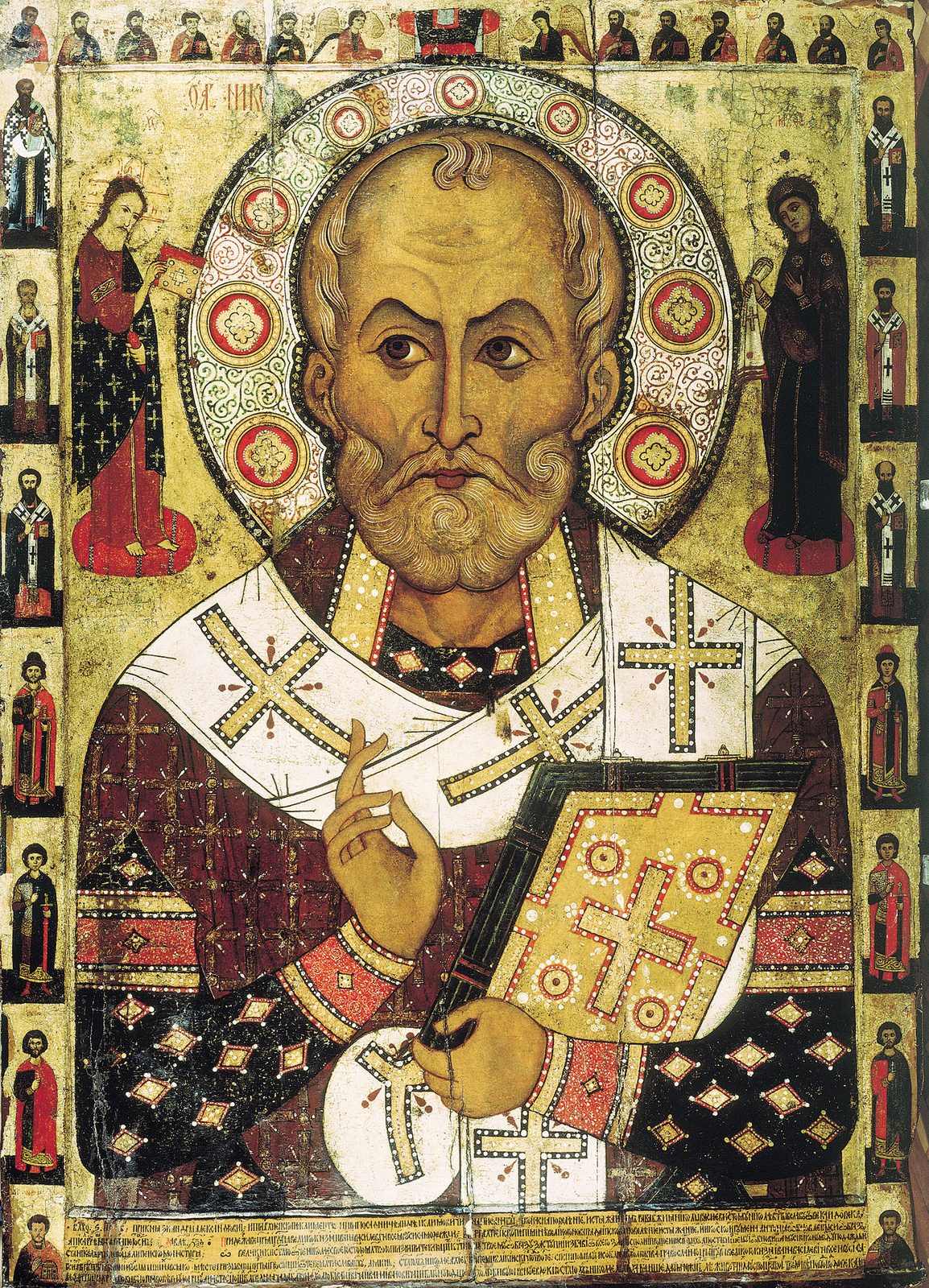
Picture: Saint Nicholas, an icon by Aleksa Petrov, 1294, from the Church of St Nicholas at Lipnya, near Novgorod. Public domain.
Who was Nicholas?
Nicholas was bishop of Myra, a port on the south coast of today's Turkey, in the 300s. He wrote nothing, and no one who knew him wrote about him. Stories of his secret gifts and rescues spread from his tomb across East and West. The name Santa Claus comes from his Dutch name, Sinterklaas.
at a glance
His path, in order
- HeirGave his fortune away, the stories say
- BishopOf Myra, a Lycian port, in the 300s
- WonderworkerHis title in the Orthodox churches
- PatronOf sailors, children and merchants
- RelicsCarried off to Bari in 1087
- SinterklaasThe Dutch gift-bringer of 6 December
- Santa ClausHis name, as New York said it
in numbers
- Times he threw gold into a house by night3
- A dowry for each of three sisters
- Their father caught him the third time
- Men of Bari who took his bones47
- Armed, in April 1087
- They tied up the four monks guarding the tomb
- Liquid drawn from his tomb each year50 ml
- At most, each 9 May in Bari
- Bari calls it manna, the Greeks myron
- Years from his death to the story he slapped a man1,000
- It is first told about 1370
- The man was a follower of Arius, not Arius
did you know?
-
Clement Clarke Moore's poem of 1823 ends with St Nicholas “laying his finger aside of his nose” before he rises up the chimney. Moore took the gesture from Washington Irving's History of New York, where the saint lays “his finger beside his nose”.
Troy Sentinel, 23 December 1823; Irving, A History of New York; Tom A. Jerman, History News Network -
The Coptic book of saints, read on his day, adds a footnote. He is “the true personality behind the story of St. Claus or Baba Noel”, as Arabic speakers call Father Christmas.
Coptic synaxarium, 10 Kiahk -
On his day, in much of medieval Europe, a boy was chosen bishop. He reigned until Holy Innocents' Day, 28 December.
Britannica, “St. Nicholas”
- Born
- In Patara, a port of Lycia, say his medieval biographers. The Coptic book of saints makes him a man of Myra itself. No record from his own time survives.
- Bishop of
- Myra, in Lycia, today Demre in Turkey, some time in the 300s.
- Died
- At Myra, on 6 December. The year is unknown. The Golden Legend says 343, the Catholic Encyclopedia 345 or 352. Church calendars today say about 326 or about 342.
- Buried
- In a church outside Myra's walls. Most of his bones have been in Bari, Italy, since 1087. Venice keeps fragments.
- Also called
- Nicholas the Wonderworker in the East, Nicholas of Bari in the West, and Sinterklaas in the Netherlands.
- His name
- The Greek Νικόλαος, from the words for victory and people.
- Wrote
- Nothing that survives.
- Patron of
- Sailors, merchants, bakers, travellers and children, says the 1911 Catholic Encyclopedia. Also of Russia and Greece.
- In art
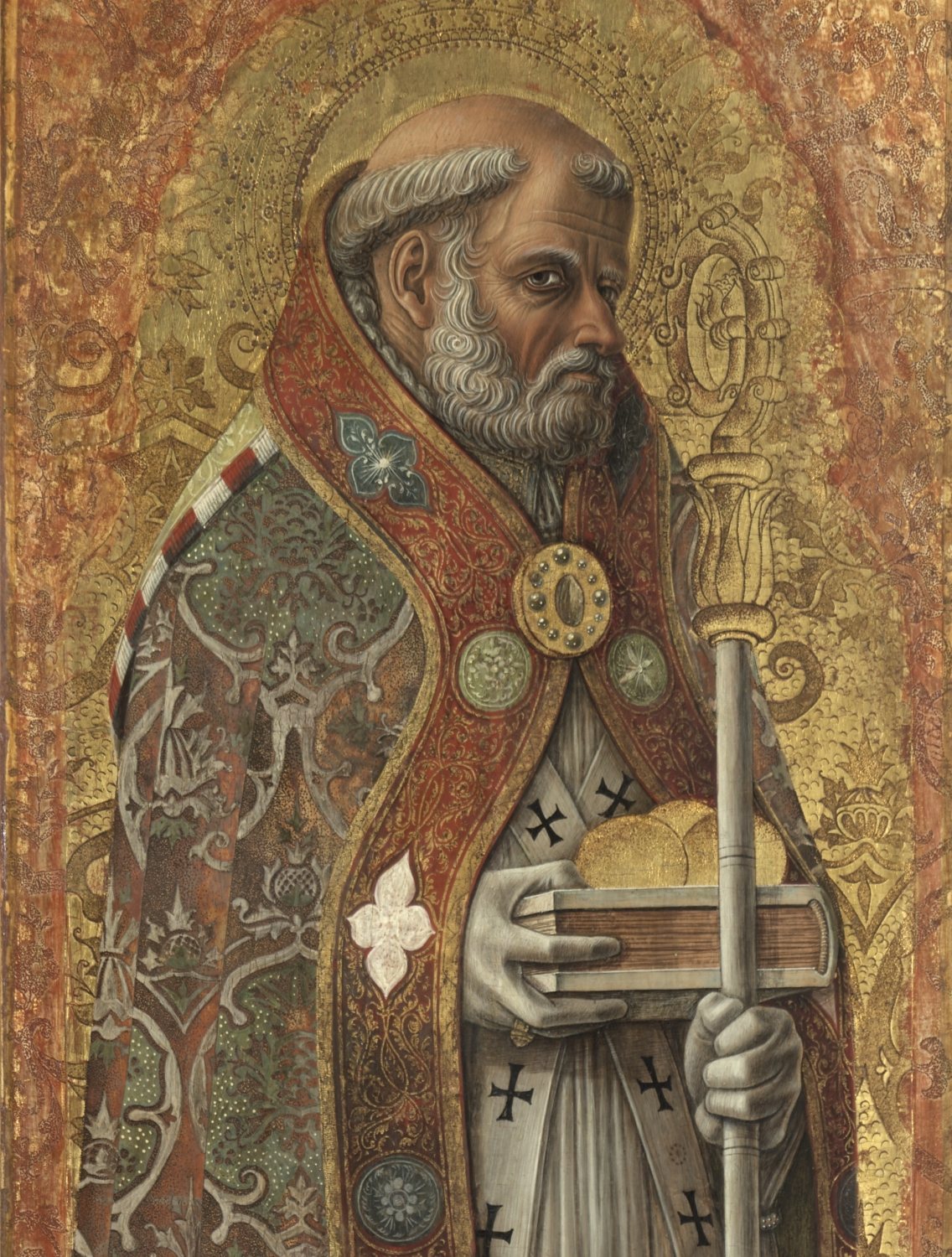
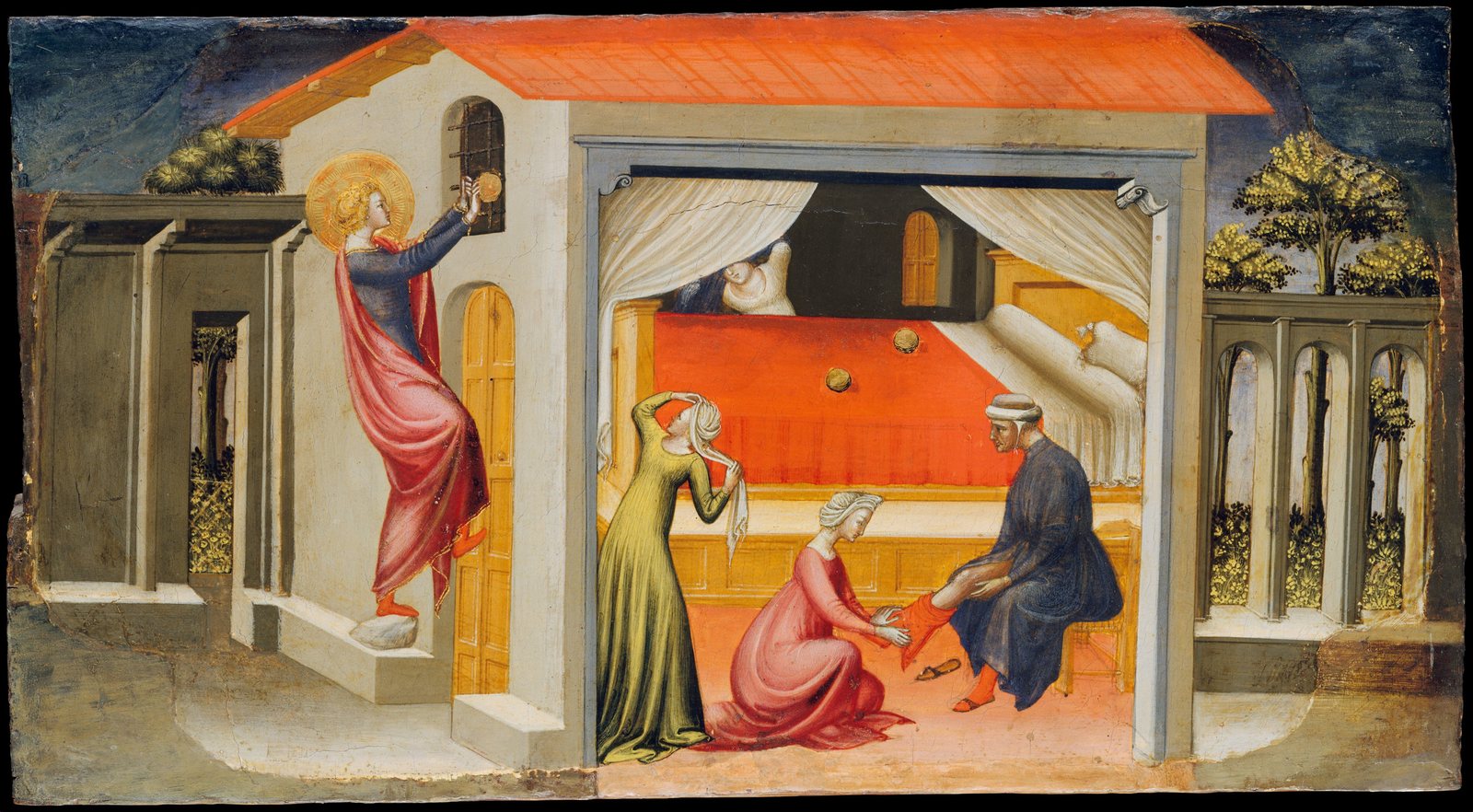
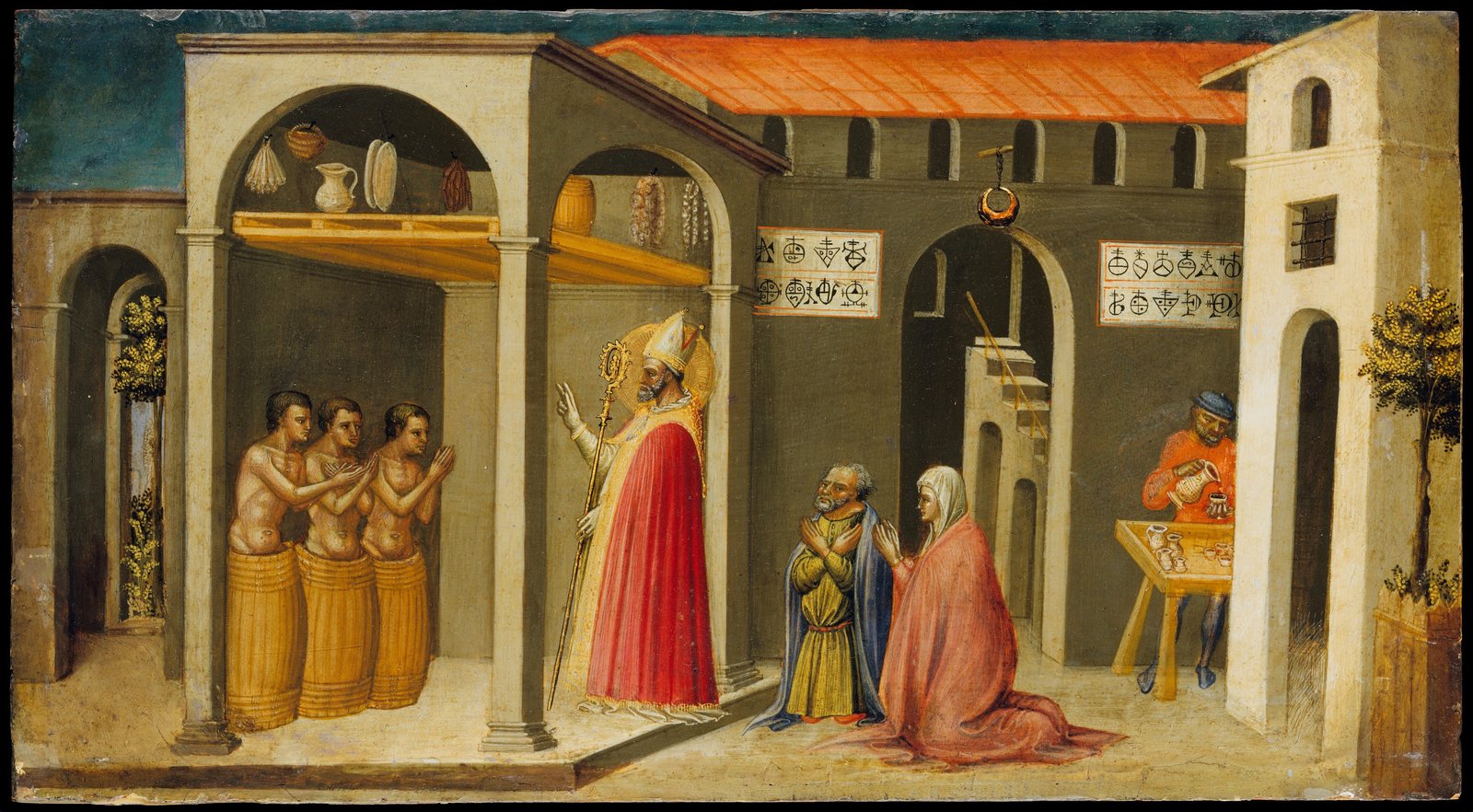
- A bishop with three gold balls or purses, for the dowries he gave three poor sisters. In the West, often with three boys in a tub. In icons, an old bishop with a high forehead and a white beard. About 1370, in a Latin book of saints, Petrus de Natalibus wrote that he is mostly painted without a mitre, because he lost it for striking an Arian.
- Status
- A saint to Catholics, Orthodox, Copts and Anglicans. Lutherans remember him too.
- Pronounced
- NIK-uh-lus of MY-ruh.
feast days
East and West, side by side
West
- May9
The coming of his relics to Bari, in the 1916 Roman Martyrology. In Bari it is the feast of the Translation, when the liquid called manna is drawn from his tomb.
- Dec6
Catholic optional memorial. Also the Church of England, the Episcopal Church, and Lutherans in the Missouri Synod and the ELCA.
East
- May9
The coming of his relics to Bari, in the Orthodox Church in America (OCA) and other churches on the new calendar that keep it.
- May22
The coming of his relics to Bari, in the Russian Church, on the old calendar.
- Dec6
The day he died, in the OCA and the other Orthodox churches on the new calendar.
- Dec19
The day he died, in the Russian Church, on the old calendar. Also the Coptic Church, on 10 Kiahk in its own calendar.
Why two feasts? 6 December is the day he died. 9 May is the day his bones reached Bari in 1087. Churches on the old calendar keep each date 13 days later, so they fall on 19 December and 22 May. The Orthodox Church in America (OCA) also remembers his birth on 29 July. The Greek Church did not take up 9 May. It saw the loss of his relics “as a sad event”, says the OCA.
what was he like?
+generous, and secret about it
In the oldest full account of his life, he gave his inheritance away. The best-known gift was gold thrown by night into a poor man's house. When the man caught him, Nicholas “required him not to tell nor discover this thing as long as he lived”. The Orthodox Church in America's life of him says he always tried to give in secret.
The Golden Legend, Life of St Nicholas; OCA, 6 December+unafraid of the powerful
In his oldest story he stopped an execution with his own hands. Then he went to the governor who had been bribed to order it. He “found the gates closed, which anon he opened by force”, and rebuked the man until he repented. Later he threatened the emperor himself, in a dream.
Praxis de stratelatis, as the Golden Legend tells it+a shepherd to his city
When three of the emperor's generals were held up in his port, he invited them to dine. He wanted to stop their plundering: “for he would keep his people from the ravin that they made”. In a famine, he talked the captains of the grain ships into sharing their cargo.
The Golden Legend, Life of St Nicholas+humble
When sailors he had saved from a storm came to thank him, “he bade them to attribute it to the mercy of God, and to their belief, and nothing to his merits”. Chosen bishop, he tried to refuse.
The Golden Legend, Life of St Nicholas+strict with himself
Of his life as a bishop, the Golden Legend says: “He woke in prayer and made his body lean, he eschewed company of women, he was humble in receiving all things, profitable in speaking, joyous in admonishing, and cruel in correcting.”
The Golden Legend, Life of St Nicholas+hard on the old gods
In the Golden Legend the people of his province still kept pagan customs, and sacrificed to Diana under a sacred tree. He made them stop, and “commanded to cut off the tree”.
The Golden Legend, Life of St Nicholaswhat others said of him
No one who knew him wrote about him. These are voices from the centuries after.
…the largess which Nicholas unto the maidens gave, in order to conduct their youth to honour.
Though he is one of the most popular saints in the Greek as well as the Latin Church, there is scarcely anything historically certain about him except that he was Bishop of Myra in the fourth century.
The Muscovites, who received their account of him from the Greeks, seem to pay a greater veneration to his memory than to that of any other saint who lived since the times of the apostles.
…no saint was more universally honoured in all Christian nations than St. Nicholas.
his life in six moments
Patara, in Lycia
The traditionA rich couple's only child
Accounts of his life place his birth at Patara, a port on the Lycian coast, to rich Christian parents. They cannot agree on his parents' names. The Golden Legend has Epiphanes and Johane. The Coptic book of saints has Epiphanius and Tona. The Orthodox Church in America has Theophanes and Nonna. As a baby, says the Golden Legend, he fed “but once on the Wednesday and once on the Friday”, the Church's fast days.
The Golden Legend; Coptic synaxarium, 10 Kiahk; OCA, 6 DecemberPatara
First written in the 800sGold through the window
His parents died and left him rich. A neighbour, a nobleman fallen into poverty, could not give his three daughters dowries, and meant to sell them into prostitution. Nicholas “threw by night secretly into the house of the man a mass of gold wrapped in a cloth”. The eldest daughter married. He did it again for the second. The third time the father lay awake, heard the gold fall and ran after him. The story is first told in the Life by Michael the Archimandrite. The German scholar Gustav Anrich dated that Life between 814 and 843. The scholar Gerardo Cioffari put it about 700.
The Golden Legend; Roger Pearse, after Aart Blom (1998), on the dates of the LivesMyra
First written in the 800sFirst through the door
When the bishop of Myra died, the bishops of the province met to choose another. The bishop who led the choosing heard a voice in the night. The first man to come to church at the hour of matins, named Nicholas, was to be made bishop. That bishop watched the doors, and Nicholas came first. Nicholas did not want it: “howbeit that he refused it strongly, yet they set him in the chair”.
The Golden Legend, Life of St NicholasMyra
First told about 900In prison for the faith
Later accounts of his life say he was jailed and tortured under Diocletian, in the last great persecution, and freed when Constantine came to power. The story first appears about 900. The Coptic book of saints says Diocletian “tortured him severely for many years”, and that he wrote to his church from prison. Alban Butler, a Catholic priest writing in 1756, noted the doubt: “The silence of other authors make many justly suspect these circumstances.”
Roger Pearse, after Aart Blom (1998); Coptic synaxarium, 10 Kiahk; Butler, Lives of the SaintsNicaea
325, if he was thereAt the great council?
Was he among the bishops who condemned Arius in 325? The Catholic Encyclopedia doubted it: “There is reason to doubt his presence at Nicaea, since his name is not mentioned in any of the old lists of bishops that attended this council.” The first account of his life to put him there is a eulogy by Nicetas of Paphlagonia, written before 890. His name does stand in one early list, kept by Theodore the Reader early in the 500s, but only in a manuscript of the 1200s. The German scholar Gustav Anrich took it for a later addition. The scholar Gerardo Cioffari holds it genuine. Of eleven medieval copies of the lists, three name him. The Orthodox and Coptic Churches count him among the fathers of the council: “he was one of the 318 fathers assembled there”.
Catholic Encyclopedia (1911); Roger Pearse, after Aart Blom (1998); Jona Lendering, Early Evidence; Coptic synaxarium, 10 KiahkMyra
First written in the 800sThe temple of Artemis
The Life by Michael the Archimandrite says he destroyed the temple of Artemis at Myra. That part at least has a real setting. Myra had a temple of Artemis, shown on a coin of the emperor Gordian III. The Dutch historian Jona Lendering notes that the Life knows the city well. It names real places, and the granaries of its famine story have been dug up at Andriake, Myra's harbour.
Jona Lendering, Early Evidence, after Cioffari (1987) and Blom (1998)
his miracles
The East calls him the Wonderworker. In the thousand years after his death, at least 50 miracle stories grew up around him. None was written down in his lifetime. Here are the oldest, mostly as the Golden Legend told them in the 1260s, and two later legends, marked as later. The Golden Legend's compiler was frank about his sources:
And the doctors of Greece write his legend, and some others say that Methodius the patriarch wrote it in Greek, and John the deacon translated it into Latin and adjousted thereto many things.
3 scenes in his oldest story
-
A port near Myra
While the generals dinedThe sword taken away
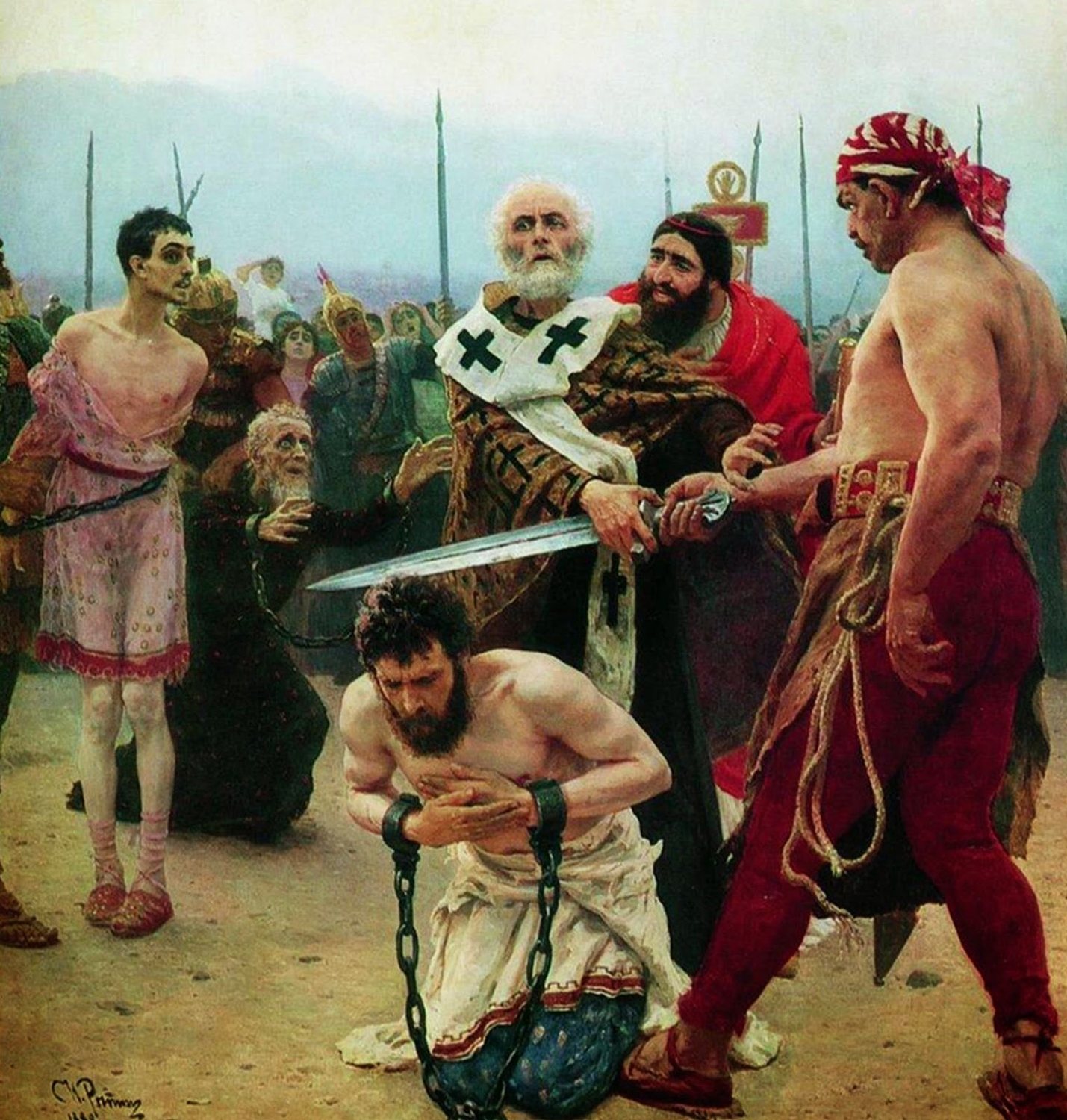
Constantine sent three generals to put down a revolt. Contrary winds held them in port near Myra, and Nicholas asked them to dine. Meanwhile a governor had taken a bribe to condemn three innocent men. Nicholas hurried to the place of execution with the generals. The condemned men knelt, blindfolded, with the sword raised over them. Nicholas ran in between.
“took the sword out of his hand, and threw it from him, and unbound the innocents”
The three generals, who had come with him.
Praxis de stratelatis, as the Golden Legend tells it -
Constantinople
LaterThe generals condemned
Constantine's three generals won their war without bloodshed and came home in honour. Then jealous men at court accused them of treason, and the emperor ordered them killed that same night. In prison, one of them thought of the bishop who had stopped the sword.
“then Nepotian remembered him how S. Nicholas had delivered the three innocents”
Praxis de stratelatis, as the Golden Legend tells it -
The palace
The night the generals were to dieA bishop in the emperor's dream
Nicholas came to Constantine in a dream. Free the three generals, he said, or I will pray God to send a war against you. The emperor asked who dared to enter his palace by night and speak so. Nicholas answered:
“I am Nicholas bishop of Mirea.”
Constantine, and his prefect, who had the same dream. “Each told to other their dreams”, and the generals went free.
Praxis de stratelatis, as the Golden Legend tells it
The story of Constantine's three generals is known as the Praxis de stratelatis. It went round on its own long before any full account of his life. The German scholar Gustav Anrich dated the version we have to between 460 and 580. The scholar Gerardo Cioffari put it earlier, before about 450. The 1916 Roman Martyrology still tells it on his day. Roger Pearse, after Aart Blom (1998); Roman Martyrology (1916), 6 December
Grain that did not run short
Famine struck Myra. Ships loaded with wheat for the emperor put in at the harbour. Nicholas asked each ship for a hundred measures. The sailors were afraid: the grain had been measured, and would be counted again at Alexandria. He promised nothing would be missing, and nothing was. The story is first told in the Life by Michael the Archimandrite. The Golden Legend says of the wheat:
“it sufficed for two years, not only for to sell, but also to sow”The Golden Legend; Michael the Archimandrite's Life, as listed by Roger Pearse after Blom
Sailors in a storm
A ship was going down. The sailors called on Nicholas. A man who looked like him appeared on board and helped them work the ship, and the storm died away. Later they came to his church to thank him, and knew him at once, though they had never seen him. On board, he had said to them:
“Lo! see ye me not? ye called me”The Golden Legend, Life of St Nicholas
Oil from his tomb
After his burial, the Golden Legend says, oil flowed from his body and healed the sick. When the next bishop was driven out, it stopped. When he came back, it flowed again. In Bari the liquid is still drawn every year.
“a fountain of oil sprang out from the head unto his feet; and unto this day holy oil issueth out of his body, which is much available to the health of sicknesses of many men”The Golden Legend, Life of St Nicholas
A later legend: the three boys
The most painted of his wonders is in none of the early Greek accounts of his life, and not in the Golden Legend. Three young clerks on their way to school are murdered at an inn, and Nicholas raises them to life. It first appears in Latin hymns of the 1000s, a Latin play from Hildesheim of about 1100, and Wace's French Life of about 1150. Later tellers made the killer a butcher, who hid the boys in a salting tub. Wace's version begins, in our translation:
“Three clerks were going to school”Wace, Life of St Nicholas, about 1150; Roger Pearse, after Joel Fredell and Charles W. Jones
A later legend: the boy carried home
A rich man named his son Deus dedit, God gave, and kept the feast of St Nicholas every year. The boy was captured by raiders and made to serve their king as cupbearer. A year later, on the feast day, he sighed at the thought of home. The king mocked him. Then a great wind shook the house, and the boy was carried home, still holding the cup:
“the child was ravished with the cup, and was set tofore the gate where his father held the solemnity of S. Nicholas”The Golden Legend, Life of St Nicholas
his words
He wrote nothing that survives. These are the words the stories give him, in the Golden Legend as William Caxton put it into English in 1483, edited by F. S. Ellis in 1900.
To the captains of the grain ships
Do this that I have said to you, and I promise, in the truth of God, that it shall not be lessed or minished when ye shall come to the garners.
Myra was starving. The captains feared to give away the emperor's wheat, because it would be measured again at Alexandria.
The Golden Legend, Life of St NicholasI have to name Nicholas.
Thou enemy of God, corrupter of the law, wherefore hast thou consented to so great evil and felony, how darest thou look on us?
Wherefore hast thou taken these three princes with so great wrong, and hast judged them to death without trespass?
often misquoted
He punched Arius at the Council of Nicaea.
What the sources sayNo early source says so. The story first appears about 1370, in a Latin book of saints by Petrus de Natalibus. There, as an old man, he strikes quemdam Arrianum, an Arian, on the jaw, and loses his mitre and pallium for it. Arius himself first takes the blow in a Greek Life by a monk named Damaskenos, printed in 1570. It was a slap, not a punch. The scene became part of Orthodox icons, and the Orthodox Church in America tells it as tradition: he “struck him upon the face”, and Christ and the Mother of God gave him back his Gospel and his bishop's stole. The historian Jona Lendering thinks a memory may lie behind it: “this anecdote is embarrassing, and this is a reason why it is unlikely to have been invented”.
Roger Pearse (2015), after Gustav Anrich, Hagios Nikolaos (1913); OCA, 6 December; Jona Lendering, Early EvidenceHe was abbot of Holy Sion, a monastery founded by his uncle, a bishop.
What the sources sayThat belongs to another saint: Nicholas of Sion, abbot of Holy Sion near Myra and bishop of Pinara, in the 500s. His own Life, written about 564, speaks of the tomb of the older Nicholas. A Greek writer of the 800s or 900s wove the two lives into one, and the joined story is still told, as in the Orthodox Church in America's life of him.
Roger Pearse, after Aart Blom (1998); OCA, 6 DecemberHe died a martyr.
What the sources sayNo account of his life says so. In later accounts he is jailed and tortured, and lives to go home. He dies in peace at Myra. The 1916 Roman Martyrology calls him “bishop and confessor”, the old title for a saint who was not a martyr.
Roman Martyrology (1916), 6 December; the Golden Legend; Coptic synaxarium, 10 Kiahkfriends, family and rivals
The first Christian emperor. In the oldest story told of Nicholas, the bishop comes to him in a dream and saves three of his generals from execution.
Praxis de stratelatis; the Golden LegendConstantine's three generals, as the Golden Legend names them. They watched Nicholas stop an execution. Later, condemned themselves, they called on him.
The Golden Legend, Life of St NicholasThe priest of Alexandria whose teaching the Council of Nicaea condemned in 325. The story that Nicholas slapped him is first told in the 1500s.
Roger Pearse (2015), after Gustav AnrichAbbot of Holy Sion near Myra and bishop of Pinara, in the 500s. His Life, written about 564, speaks of the tomb of the older Nicholas. Later writers merged the two men into one.
Roger Pearse, after Aart Blom (1998)how he died
He died at Myra on 6 December, some time in the 300s. No record from his own time gives the year.
As the Golden Legend tells it, he prayed the Lord to send His angels, and saw them coming. He began Psalm 31, In te Domine speravi, and died saying its fifth verse. The book puts his death in 343.
He was buried in a church outside the city walls. The Dutch historian Jona Lendering notes that Roman law still forbade burials inside a city in the early 300s. So the site of the tomb fits a cult that began soon after his death. The church over it still stands in Demre.
His last words, in the Golden Legend
Lord, into Thine hands I commend my spirit
The words of Psalm 31:5, which Jesus prayed on the cross.
his bones: from myra to bari
In 1087 sailors from Bari carried most of his bones across the sea. They are still in Bari, and every May a little liquid is drawn from the tomb.
The raid of 1087
By 1087 the Turks held Lycia. Merchants of Bari, sailing home from Antioch, put in near Myra in April 1087. Forty-seven armed men went up to the church, where four monks kept the tomb. They offered the monks 300 gold coins, and the monks refused. So the men bound them and broke open the tomb. The townspeople ran to the shore too late. On 9 May 1087 the relics were carried into Bari. To the men of Bari it was a rescue: they meant, says the Orthodox Church in America, “to save the relics of Saint Nicholas”. To the Greeks it was a loss. Alban Butler, a Catholic priest writing in 1756, said the raid “could only be justified by the laws of a just war”, together with the fear that the Turks would profane the relics.
“they opened it and found the bones swimming in the oil, and they bare them away honourably into the city of Bari”The Golden Legend; OCA, 9 May; Butler, Lives of the Saints; Britannica
The manna
A clear liquid gathers in his tomb. The Greeks call it myron, and Bari calls it manna. Each 9 May since 1980 it has been drawn out in front of a Catholic and an Orthodox bishop: no more than about 50 ml a year. Mixed with blessed water, it is bottled for the sick. Scientists at the University of Bari found in 1925 that it is water. Britannica calls it most likely condensation, since the tomb lies below ground in a port city. The basilica's own study centre answers that the casket has been proven watertight. Earlier, the Catholic Encyclopedia of 1911 had called it oil:
“an oily substance, known as Manna di S. Nicola, which is highly valued for its medicinal powers, is said to flow from them”St. Nicholas Center, Devotion and Use of Manna; Britannica, on the manna; Catholic Encyclopedia (1911)
Venice, and a bone in Illinois
Bari has most of his bones, but not all. The church of San Nicolò al Lido in Venice keeps as many as 500 fragments. An anatomical study found they fit with the bones in Bari, as if from one body. In 2017 Oxford scientists dated one of the smaller relics: a piece of pelvis kept at Morton Grove, Illinois, which had come from Lyon. It dates from the 300s. Bari has the upper part of the left hip bone. This piece is from the lower part, so the two could come from one person. The scientists did not claim it was his for certain:
“Science is not able to definitely prove that it is, it can only prove that it is not”University of Oxford, press release of 5 December 2017
how he became santa claus
Each step from Nicholas to Santa Claus is in print. How the steps join is argued over. Here are the texts, and each side in its own words.
A children's saint
In the Middle Ages his feast became a schoolboys' day. Wace, in his French Life of about 1150, links it to the legend of three murdered schoolboys he raised to life. After the Reformation his feast faded in Protestant lands, but not in Holland, where he stayed Sinterklaas. Wace, in George McKnight's English of 1917:
“Because he did such honor to schoolboys, they celebrate this day by reading and singing and reciting the miracles of St. Nicholas.”Wace, Life of St Nicholas, as quoted by George H. McKnight (1917), in Roger Pearse; Britannica
Irving's New York
Washington Irving's comic History of New York, of 1809, made St Nicholas the patron of the old Dutch town. In later editions, from 1812, Irving gave him more to do. In the text we read today he rides over the treetops, drops presents down chimneys, and in a dream lays “his finger beside his nose”. The book says:
“for the good St. Nicholas has ever been a great giver of gifts, particularly to children”Washington Irving, A History of New York, book 2 (later edition); Tom A. Jerman, History News Network
The poem of 1823
On 23 December 1823 the Troy Sentinel, a New York paper, printed an unsigned poem, “Account of a Visit from St. Nicholas”. By the mid-1800s it was known as the work of Clement Clarke Moore, a New York professor. It has a sleigh, eight reindeer and a trip down the chimney. Two of the reindeer were first called “Dunder and Blixem”. The poem itself never says Santa Claus. It says St. Nicholas and St. Nick. The editor's note above it says “Sante Claus”. Two years before, a New York booklet had shown “Santeclaus” in a sleigh pulled by a flying reindeer.
“He was chubby and plump, a right jolly old elf, And I laugh'd when I saw him in spite of myself”Troy Sentinel, 23 December 1823; Tom A. Jerman, History News Network
Who made Santa?
The older view is that Dutch settlers brought Sinterklaas to New Amsterdam. Britannica says so, and so does the Episcopal Church: “his name was brought to America by the Dutch colonists in New York”. In 1954 Charles W. Jones answered that there is no proof the colonists kept the custom. He gave the credit to Irving: “Without Irving there would be no Santa Claus.” In 2020 Tom A. Jerman answered Jones in turn. Irving's gift-giving lines came in 1812, he points out, and Santa grew from German winter figures by way of two New York poems. In his words, “St. Nicholas and Santa Claus were two different characters”.
Britannica; Lesser Feasts and Fasts 2022; Charles W. Jones (1954); Tom A. Jerman, History News Networkis he a saint?
Yes. Catholics, Orthodox, Copts and Anglicans count him a saint, and Lutherans remember him too.
- CatholicSaintAn optional memorial on 6 December
- OrthodoxSaintThe Wonderworker, 6 December, and in some churches 9 May
- CopticSaint10 Kiahk, which is 19 December
- AnglicanSaint6 December, in the Church of England
- LutheranRememberedMissouri Synod and ELCA, 6 December
His honour began at his tomb in Myra. The Catholic Encyclopedia notes that his name occurs in the Liturgy of St John Chrysostom, the Orthodox Church's usual Sunday service. The Russian Church honours him in particular every Thursday of the year, says the Orthodox Church in America.
Rome's calendar of 1969 notes that the Byzantine and Coptic rites keep 6 December, the day of his death. For the Copts, and for churches on the old calendar, that day falls on our 19 December. In the West, it says, his feast spread from the 900s, most of all after his relics came to Bari in 1087. The old Roman Martyrology gives him this line:
At Myra, the metropolis of Lycia, the birthday of St. Nicholas, bishop and confessor, of whom it is related, among other miracles, that, while at a great distance from the emperor Constantine, he appeared to him in a vision and moved him to mercy so as to deter him from putting to death some persons who had implored his assistance.
what to read first
The Life of S. Nicholas the Bishop
Jacobus de Voragine, in Caxton's English
The Golden Legend's chapter on him: the dowries, the generals, the storm and the grain ships, as the Middle Ages told them. About fifteen minutes.
Read it freeSt. Nicholas
Alban Butler, Lives of the Saints
An 18th-century priest sorts the stories, and tells the raid on Myra from the accounts written at Bari.
Read it freeAccount of a Visit from St. Nicholas
Clement Clarke Moore
The poem as the Troy Sentinel first printed it, unsigned, in 1823, with the editor's note on “Sante Claus”.
Read it freeSt. Nicholas of Myra
Catholic Encyclopedia, 1911
One short page: what is certain, what is legend, and the manna of Bari.
Read it freetake the quizzes
 Quiz Which early Christian thinks like you? And which would argue with you? Start
  Quiz Christian Personality Test Which of eight types are you? Find your own. Start
 sources
His life, and the stories
- Jacobus de Voragine, The Golden Legend, “The Life of S. Nicholas the Bishop”. Compiled about 1260, tr. William Caxton (1483), ed. F. S. Ellis (1900).
- Alban Butler, Lives of the Saints, “St. Nicholas”, 1756 to 1759; 1866 edition.
- Roger Pearse, The literary development of the Life of St Nicholas, after Aart Blom, Nikolaas van Myra en zijn tijd (1998), with the dates of Gustav Anrich (1913 and 1917) and Gerardo Cioffari (1987).
- Roger Pearse, Did St Nicholas of Myra punch Arius at the Council of Nicaea?, 2015, with the texts of Petrus de Natalibus and Damaskenos.
- Roger Pearse, St Nicholas and the story of the three schoolboys, 2019, with Wace, McKnight (1917) and Joel Fredell.
- Jona Lendering, Early Evidence, St. Nicholas Center, from Livius.
- Procopius, Buildings, Book 1, chapter 6. Tr. H. B. Dewing, 1940.
- Dante, Purgatorio, canto 20. Tr. Henry Wadsworth Longfellow, 1867.
- Washington Irving, A History of New York, first printed 1809; a later edition.
- Account of a Visit from St. Nicholas, Troy Sentinel, 23 December 1823.
- Tom A. Jerman, Revisiting the Knickerbocker Origin Story of Santa Claus, History News Network, quoting Charles W. Jones (1954).
- University of Oxford, Could ancient bones suggest Santa was real?, 5 December 2017.
- St. Nicholas Center, Devotion and Use of Manna, from Gerardo Cioffari and the Centro Studi Nicolaiani, Basilica of San Nicola, Bari.
Reference
- Catholic Encyclopedia, 1911, “St. Nicholas of Myra”
- Britannica, “St. Nicholas”
- Britannica, “Do the Relics of Saint Nicholas Really Emit a Holy Substance?”
- Merriam-Webster, “Saint Nicholas” and “Myra”, for how to say them
Calendars
- USCCB, Liturgical Calendar 2026, Saint Nicholas, Bishop, 6 December
- Calendarium Romanum, 1969, on 6 December
- The Roman Martyrology, 1916 edition, 9 May and 6 December
- OCA, Saint Nicholas the Wonderworker, Archbishop of Myra in Lycia
- OCA, the Translation of the Relics of Saint Nicholas to Bari
- CopticChurch.net, the Coptic synaxarium, 10 Kiahk
- Church of England, Common Worship calendar
- The Episcopal Church, Lesser Feasts and Fasts 2022
- The Lutheran Church–Missouri Synod, Commemorations
- Evangelical Lutheran Worship, ELCA, the church year (final draft, 2006)
Pictures
- Nikola from 1294, icon by Aleksa Petrov, 1294, from the Church of St Nicholas at Lipnya, near Novgorod. Public domain.
- Saint Nicholas of Bari, Carlo Crivelli, 1472. Cleveland Museum of Art. Public domain.
- Saint Nicholas of Myra saves three innocents from death, Ilya Repin, 1888. State Russian Museum, St Petersburg. Public domain.
- Saint Nicholas Providing Dowries, Bicci di Lorenzo, 1433 to 1435. The Metropolitan Museum of Art. CC0.
- Saint Nicholas Resuscitating Three Youths, Bicci di Lorenzo, 1433 to 1435. The Metropolitan Museum of Art. CC0.