
Patrick
A British boy taken as a slave, who went back to the land of his captors and never left it.
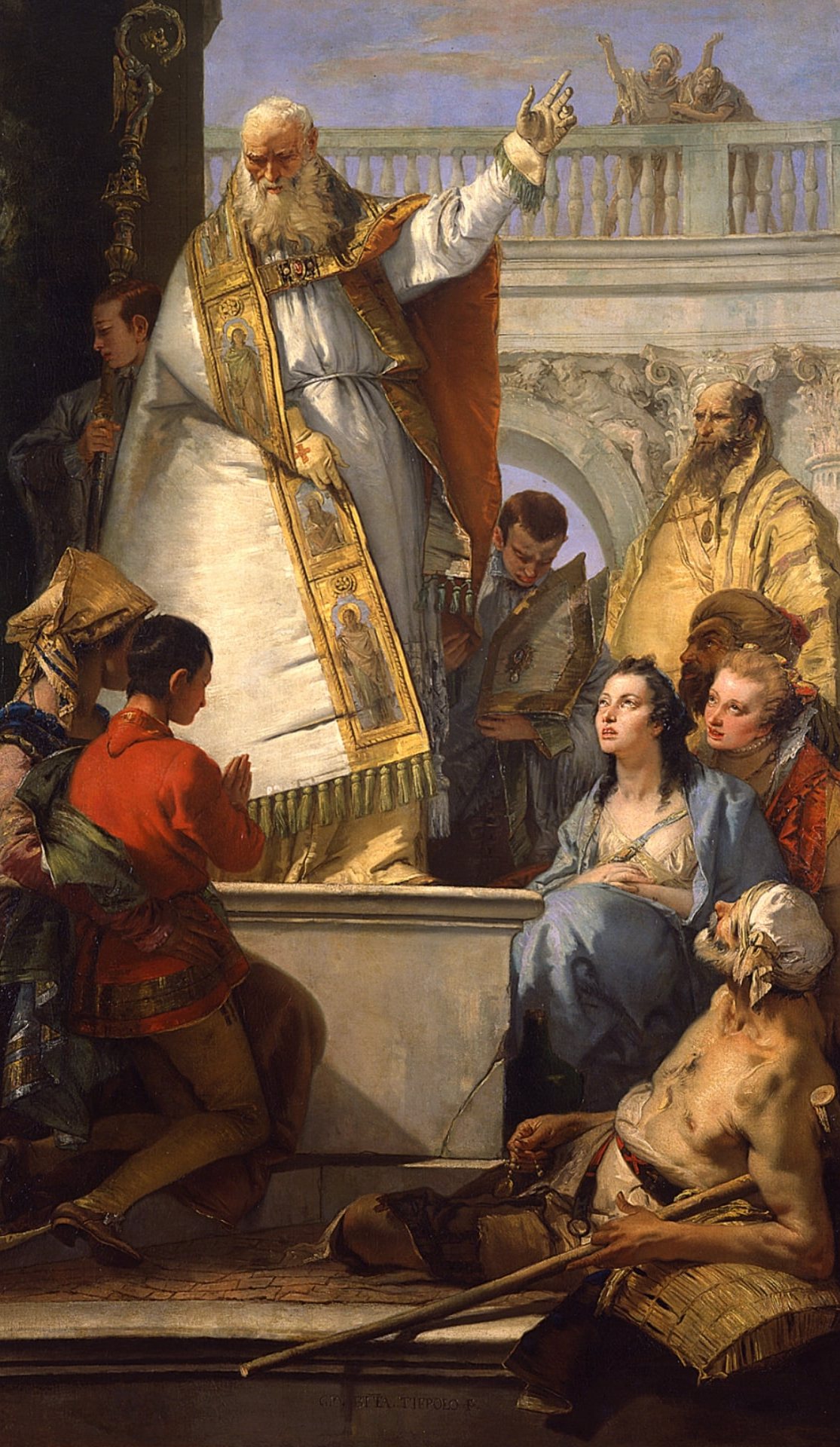
Picture: Saint Patrick heals a sick man: an altarpiece by Giambattista Tiepolo, 1746. Musei Civici, Padua. Public domain.
Who was Patrick?
Patrick was a Roman Briton, not an Irishman. Irish raiders seized him at sixteen, and he spent six years as a slave, herding flocks. He escaped home, then went back as a bishop and stayed in Ireland for good. Two short Latin writings of his survive. He died in 461, or about 493.
at a glance
His path, in order
- CaptiveSeized from his father's farm at sixteen
- SlaveSix years herding flocks in Ireland
- RunawayTwo hundred miles to a waiting ship
- BishopBack in Ireland for the rest of his life
- WriterThe Confession, and a furious letter
in numbers
- His age when raiders took him16
- Carried off from his father's farm
- “I knew not the true God”
- Years he spent as a slave6
- Tending flocks for one master
- Then he ran for a ship
- Prayers he said in a day100
- “and at night nearly as many”
- In snow, in frost, in rain
- Miles to the ship that took him home200
- To a port he had never seen
- He ran from his master to reach it
did you know?
-
The Irish called him Cothraige. Tírechán, who wrote about him in the 600s, took it to mean a slave in “the houses of four magicians”.
White, notes on the Confession, chapter 1 (1920) -
Bede, the great English historian of the 700s, never names him in his Ecclesiastical History. He records only Palladius, sent to the Irish in 431.
Bede, Ecclesiastical History, Book 1, chapter 13, with Sellar's note (1907) -
A chief gave him a bronze pot, then took it back. Both times, says his early biographer Muirchú, Patrick said only “Grazacham”, his way of saying the Latin gratias agamus, meaning let us give thanks. The chief gave it back, with the hill of Armagh.
Muirchú, Life of Patrick, Book 1, chapter 24, with White's note on the Confession, chapter 19 -
The druids foretold his coming, says his early biographer Muirchú: “Adze-head will come With his crook-headed staff”. The adze-head was the shaven head of a monk.
Muirchú, Life of Patrick, Book 1, chapter 10, with White's notes (1920)
- Born
- About 389, by the historian J. B. Bury's reckoning. Near a place Patrick calls Bannavem Taberniae, in Roman Britain. No one knows where it was. Guesses run from Dumbarton in Scotland to the Severn.
- Family
- His father Calpurnius was a deacon and a town councillor. His grandfather Potitus was a priest. His early biographer Muirchú names his mother Concessa.
- Captured
- At about 16, by Irish raiders, from the family's small farm. A slave in Ireland for six years.
- Trained
- Somewhere in Gaul, most likely. His early biographers differ: Tírechán says the island monastery of Lérins, Muirchú says Auxerre. Patrick himself never says.
- Bishop in
- Ireland, where he stayed until he died. Tradition makes Armagh his chief church.
- Died
- On 17 March, in 461 or about 493, most likely at Saul in County Down.
- Buried
- At Downpatrick, says his early biographer Muirchú. Armagh and Glastonbury once claimed his grave too.
- Also called
- Sucat, or Sochet, at home. Cothraige in Irish. The Apostle of Ireland. The Enlightener of Ireland in the Orthodox churches.
- Wrote
- The Confession, in old age, and a letter to the soldiers of a British king, Coroticus. Both in Latin.
- His Latin
- Rough, and he knew it. His schooling stopped when he was taken. He called Latin “a tongue not my own”.
- In art
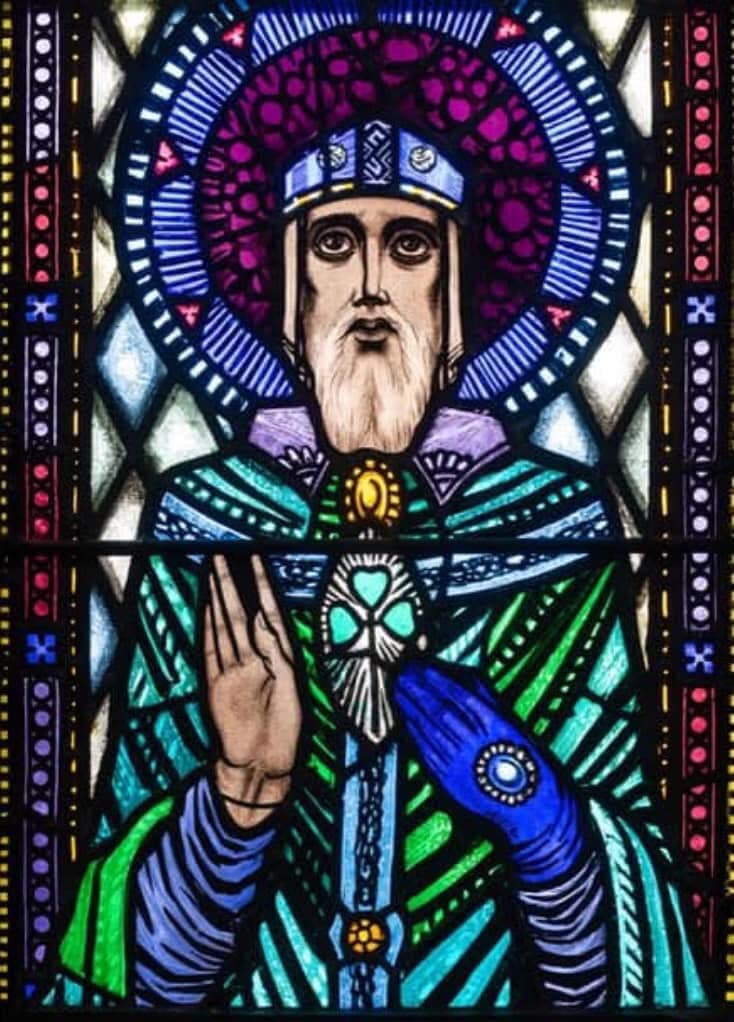
- A bishop with a crozier. From the later legends, a shamrock in his hand and snakes at his feet.
- Status
- A saint to Catholics, Orthodox and Anglicans. Lutherans remember him too.
feast days
East and West, side by side
West
- Mar17
Catholic: an optional memorial in the general calendar, and a solemnity in Ireland. Also the Church of England, the Episcopal Church, and Lutherans in the Missouri Synod and the ELCA.
East
- Mar17
The Orthodox churches that keep him, as the Orthodox Church in America does: “Enlightener of Ireland”.
- Mar30
Churches on the old calendar, whose 17 March falls on this day.
Why one day? He lived long before East and West split, and both keep 17 March. Rome's calendar of 1969 notes that early copies of the martyrology called Jerome's, an old list of saints' days, mark it as the day he was laid to rest. So does Bede's martyrology. Rome itself added his feast to its calendar only in 1631. Churches on the old calendar keep each date 13 days later.
what was he like?
+ashamed of his Latin
His schooling stopped when he was taken, and he never caught up. Others had studied from childhood. He had not. “For my speech and language is translated into a tongue not my own”, he wrote. “And so to-day I blush and am exceedingly afraid to lay bare my lack of education”.
Confession, chapters 9 and 10+given to prayer
As a slave on the hills he prayed through the day and much of the night. “And before daybreak I used to be roused to prayer, in snow, in frost, in rain; and I felt no hurt”. He felt no hurt, he says, because the spirit burned in him then.
Confession, chapter 16+clean-handed
Devout women laid their jewellery on the altar for him. He gave it back, and they were offended. He would not let anyone say he had profited from a baptism or an ordination. His challenge: “if I demanded from one of them even the price of my shoe; tell it against me and I shall restore you more.”
Confession, chapters 49 and 50+stubborn in his calling
His family wept and offered gifts to keep him from going back to Ireland. His elders were against it too. He went anyway: “And I displeased them, and also, against my wish, not a few of my elders; but, God being my guide, in no way did I consent or yield to them.”
Confession, chapter 37+cut deep by a friend
He had once told his closest friend of a sin from his youth. The friend later shamed him in public. It still hurt as he wrote: “But rather I am grieved for my dearest friend that we should have merited to hear such an answer as that; a man to whom I had even entrusted my soul!”
Confession, chapter 32+unafraid
He lived among people who could kill him on any day, and said so plainly: “for daily I expect either slaughter, or to be defrauded, or reduced to slavery, or an unfair attack of some kind.” Then: “But none of these things move me”.
Confession, chapter 55+tender to his captors' people
He knew how strange his love for the Irish was. They had enslaved him and ruined his father's house. He could only credit God with it: “Is it from me that springs that godly compassion which I exercise towards that nation who once took me captive, and made havoc of the menservants and maidservants of my father's house?”
Letter to the soldiers of Coroticus, chapter 10+fierce for his flock
When British soldiers killed and carried off his converts, he called the soldiers “fellow-citizens of demons because of their evil deeds”. He told Christians to shun them: “It is not right to pay court to such men, nor to take food or drink with them”.
Letter to the soldiers of Coroticus, chapters 2 and 7what others said of him
His first biographers wrote two centuries after him. Since then he has been praised, doubted and argued over, sometimes by the same people.
…he used to sign himself with the sign of the cross a hundred times every hour of the day and night. And whenever he saw a cross, he would alight from his car, and turn aside there to pray.
…the birthday of St. Patrick, bishop and confessor, who was the first to preach Christ in that country, and became illustrious by great miracles and virtues.
I incline to the opinion that they are the issue of an age subsequent to that of Ireland's Saint.
…it would perhaps be more correct to style him, with the ‘Annals of Ulster’ and the poet Ninnine, ‘Chief Apostle of Ireland.’
His was evidently an intensely spiritual nature, and in addition to the qualities which go to form a strong man of action he must have possessed an enthusiasm which enabled him to surmount all difficulties.
These documents bear the stamp of genuineness upon them as plainly as does the Epistle of St. Paul to the Galatians or the Second to the Corinthians.
The moral and spiritual greatness of the man shines through every stumbling sentence of his ‘rustic’ Latin.
his life in 13 moments
Roman Britain
BoyhoodA deacon's son
Patrick was born in Roman Britain, not in Ireland. His father Calpurnius was a deacon and a town councillor. His grandfather Potitus was a priest. The family had a small farm near a place he calls Bannavem Taberniae. No one now knows where that was. The boy was not religious. “I knew not the true God”, he admits.
Confession, chapter 1; Letter to the soldiers of Coroticus, chapter 10Britain
At about 16Taken by raiders
Irish raiders fell on his family's farm and carried him off. He was one of “many thousands of persons” taken to Ireland that time. He saw it as a judgement: “because we departed away from God, and kept not His commandments, and were not obedient to our priests”.
Confession, chapter 1Ireland
Six yearsA hundred prayers a day
He was set to herding flocks for one master. Alone on the hills, he felt his faith wake up. “Love of God and the fear of Him increased more and more”, he wrote. He stayed out “even in the woods and on the mountain” to pray. Tradition names the mountain as Slemish, in County Antrim.
Confession, chapter 16; White, introduction (1920)Ireland
After six years“Lo, thy ship is ready”
One night a voice told him he would soon go home. Soon after came another: “Lo, thy ship is ready.” The ship was about two hundred miles away, where he had never been. He ran from his master and reached it the day it sailed. The captain refused him: “On no account seek to go with us.” As Patrick walked away praying, a sailor shouted him back.
Confession, chapters 17 and 18An empty land
Twenty-eight daysHunger on the road
After three days at sea, Patrick and the sailors landed, and walked for twenty-eight days through empty country. The food ran out. The captain turned on him: “How is this, O Christian? thou sayest that thy God is great and almighty; wherefore then canst thou not pray for us, for we are in danger of starvation?” Patrick told them to turn to God. Soon a herd of pigs crossed their path.
Confession, chapter 19Britain
A few years laterThe Voice of the Irish
When he was home at last, his family begged him never to leave again. Then he dreamt of a man called Victoricus, coming from Ireland with “countless letters”. The first was headed “The Voice of the Irish”. As he read, he heard the people of the Wood of Foclut, by the western sea, calling him back. He woke “exceedingly broken in heart”.
Confession, chapter 23Gaul, perhaps
The years betweenDoubted by his elders
He does not say where he trained. He speaks of longing to see “the brethren” in Gaul again. A saying kept in the Book of Armagh has him travel through Gaul, Italy and the islands of the Tyrrhene Sea. His early biographer Muirchú puts him with Bishop Germanus at Auxerre. His elders thought him unfit: “Why does this fellow thrust himself into danger amongst hostile people who know not God?”
Confession, chapters 43 and 46; Sayings of Patrick; Muirchú, Book 1, chapter 6Ireland
Traditionally 432Bishop in Ireland
He returned to Ireland despite his family's tears: “And many gifts were proffered me with weeping and tears.” In 431 Pope Celestine had sent a bishop, Palladius, to the Irish who already believed. Patrick's mission is traditionally dated to the next year. He calls himself simply “a bishop, appointed by God, in Ireland”.
Confession, chapter 37; Letter, chapter 1; Bede, Ecclesiastical History, Book 1, chapter 13Across Ireland
Thirty years or moreThousands baptized
He baptized “many thousands of persons” and ordained clergy everywhere. He went, he says, where no one had come “to baptize, or ordain clergy, or confirm the people”. He gave presents to kings and paid their sons to travel with him. He paid the local judges “not less than the price of fifteen men”. Once a king's men seized him and put him in irons, meaning to kill him. He was free on the fourteenth day.
Confession, chapters 14, 51, 52 and 53Ireland
During his missionChieftains' daughters
Patrick wrote: “Sons and daughters of Scottic chieftains are seen to become monks and virgins of Christ.” The Scots here are the Irish. One noble young woman came back a few days after her baptism: an angel had told her to give her life to God. Six days later she did. Many did so against their fathers' will. Women held as slaves had it hardest: “they constantly endure even unto terrors and threats.”
Confession, chapters 41 and 42Ireland
Perhaps the 450sThe massacre
Soldiers of Coroticus, a British king, raided Patrick's new converts the day after their baptism. The oil was “still fragrant on their foreheads” when they were cut down. Others were carried off to be sold. Patrick sent a priest and other clergy to ask for the captives. “They jeered at them.” So he wrote an open letter, to be read out before the king himself.
Letter to the soldiers of Coroticus, chapters 2, 3 and 21Britain and Ireland
Late in lifeBetrayed by his dearest friend
His elders in Britain turned on him. They dug up a sin from his youth, from about the age of fifteen. He had told it to his closest friend before he was even a deacon. He never says what it was. That same friend had once backed him: “Lo, thou art to be raised to the rank of bishop”. Now the friend shamed him in public. The Confession is Patrick's answer.
Confession, chapters 26, 27 and 32Ireland
Old ageBound to Ireland
He longed to visit his family in Britain and his fellow Christians in Gaul. He would not go. “I am bound in the Spirit”, he wrote, and feared to lose the work he had begun. He stayed in Ireland to the end, and wrote his Confession there, he says, “before I die”.
Confession, chapters 43 and 62
when did he live?
Even the year of his death is argued over. The old Irish annals give more than one, and each has its defenders.
Died 461
The Annals of Ulster note, at 461, that some record his death then. The historian J. B. Bury worked out 389 to 461, and White, who translated Patrick's writings, agreed. Rome's own calendar of 1969 gives 461. So do the Episcopal Church and the Lutherans of the ELCA.
“…a man who lived between a.d. 389 and a.d. 461, the dates of St. Patrick's birth and death according to the most recent calculations.”White, introduction (1920); The Annals of Ulster, at 461, in the CELT translation; Calendarium Romanum (1969); Lesser Feasts and Fasts 2022; ELCA
Died 493
The Annals of Ulster, at 493, have him die on 17 March in his hundred and twentieth year, sixty years after he came to Ireland. The Catholic Encyclopedia of 1911 followed this date, with his birth in 387. The Orthodox Church in America gives 461, “some say 492”. Thomas Olden, in 1895, thought 493 rested only on the idea of sixty years' labour from 432. Britannica places his mission in the second half of the 400s: his letter still calls the Franks heathen, so it was written before their baptism in 496.
“…died at Saul, Downpatrick, Ireland, 17 March, 493.”Catholic Encyclopedia (1911), “St. Patrick”; The Annals of Ulster, at 493; OCA, 17 March; Dictionary of National Biography (1895); Britannica
Palladius, and two Patricks?
Pope Celestine sent Palladius to the Irish in 431. Muirchú, an early biographer of Patrick, says Palladius failed and soon died in Britain. The annals also record the death of an elder Patrick in 457. So some have wondered if two men's stories were woven into one. The Celtic scholar Heinrich Zimmer argued that Palladius and Patrick were the same man. Patrick's translator White called that notion refuted. Thomas Olden, in the Dictionary of National Biography, blamed medieval scribes instead. They altered the old records, he wrote, and that led for a time to
“…the belief that two persons were confused together—one the simple missionary of the ‘Confession,’ the other the great thaumaturge of whom so many marvels were told.”Bede, Ecclesiastical History, Book 1, chapter 13; Muirchú, Book 1, chapter 8; The Annals of Ulster, at 457; Britannica (1911); White (1920); Dictionary of National Biography (1895)
his miracles
In his own writings Patrick works no wonders. He tells of answered prayer, voices in the night and dreams. The marvels arrive with the writers who came after him: Tírechán about 670, Muirchú before 700, and Jocelin in the late 1100s. Muirchú was frank about his sources:
My skill is small; my authorities are uncertain [or, anonymous]; my memory is treacherous; my intelligence is worn out; my style is poor; yet the feeling of my love is most pious.
3 wonders of his first Easter, as Muirchú tells it
-
Near Slane
Easter EveThe fire
The High King Loegaire held a pagan feast at Tara on Easter Eve. No one might light a fire before the king's own. Patrick kept Easter on the great plain, in sight of Tara, and lit his Easter fire first. Muirchú places it at a spot called the Graves of the Men of Fecc. Later tellers put it on the hill of Slane.
“kindled a divine fire, very bright and blessed, which as it shone forth at night, was seen by almost all the dwellers in the plain”
The king's magicians: “unless it be put out on this night on which it has been lighted up, it will not be put out for ever.”
Muirchú, Life of Patrick, Book 1, chapters 13 to 15; Britannica (1911) -
The road to Tara
Easter EveEight stags and a fawn
King Loegaire summoned Patrick, pretending peace, and meant to kill him. Patrick blessed his eight men and a boy in the name of Jesus Christ and walked towards the king. The king counted them as they came, and then they were gone.
“but the heathen folk saw nought but eight stags and a fawn going as it were to the wilderness”
Loegaire and the few with him, who went back to Tara at dawn.
Muirchú, Life of Patrick, Book 1, chapter 18 -
Tara
Easter DaySnow on the plain
At King Loegaire's feast a magician challenged Patrick. The magician brought snow down on the whole plain, waist deep, but could not take it away. Patrick told him, “Thou art able to do evil, but not good; I am not of that sort.” Then Patrick blessed the plain.
“and the snow vanished quicker than a word could be uttered, without any rain or cloud or wind”
Everyone at the feast. The contest ended in a trial by fire, and the king gave in: “It is better for me to believe than to die.”
Muirchú, Life of Patrick, Book 1, chapters 20 and 21
Muirchú tells the night of the Easter fire as a new Book of Daniel. Tara is “their Babylon” and Loegaire a Nebuchadnezzar. The 1911 Britannica read it as a real clash with the king's power, told “in picturesque fashion”. Muirchú, Life of Patrick, Book 1, chapter 15; Britannica (1911)
Pigs in the empty land
His own story, told as answered prayer. The sailors he escaped with were starving, and mocked his God. He told them to turn to Him, and pigs appeared, he says, “by the help of God”. They stayed two nights and ate their fill, and thanked God.
“Lo, a herd of swine appeared in the way before our eyes”Confession, chapter 19
The sun at night
Also his own story, from his escape home. The night the pigs appeared, Satan fell on him in his sleep “as it were a huge rock”, and he could not move. He cried out “Helias”, perhaps meaning Elijah, perhaps the sun, Helios. He believed Christ had helped him.
“lo, the splendour of that sun fell upon me, and straightway shook all weight from off me”Confession, chapter 20, with White's note (1920)
The fawn at Armagh
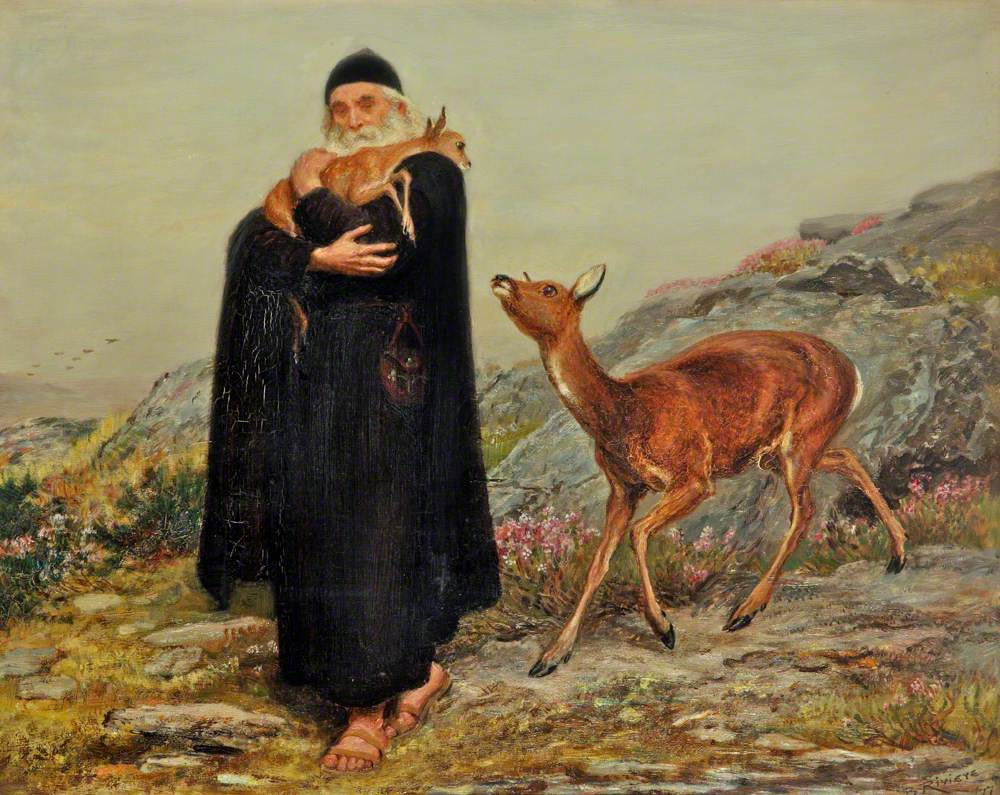
When a chief named Daire gave him the hill of Armagh, Patrick and his men found a doe and her fawn where the altar would stand. His men wanted to kill the fawn. Patrick would not allow it.
“the Saint himself took the fawn and carried it on his shoulders. And the hind followed him, like a gentle and tame sheep”Muirchú, Life of Patrick, Book 1, chapter 24
A king turned fox
The early biographer Muirchú's ending for Coroticus, the British king whose soldiers killed Patrick's converts. When the king mocked Patrick's letter, Patrick prayed that God would banish him from this world and the next. In the middle of his court the king changed shape and was never seen again.
“took on the spot the form of a little fox”Muirchú, Life of Patrick, Book 1, chapter 29
Twelve nights without dark
When he died, says his biographer Muirchú, the nights of mourning stayed light for twelve days. The people of Ulster said the nights were never so dark again that year.
“Because on the day of his death there was no night”Muirchú, Life of Patrick, Book 2, chapter 8
A later legend: 33 raised
Jocelin, a monk of Furness, wrote his Life in the late 1100s. It holds the story of the snakes, and much more. He credits Patrick with 350 bishops, 700 churches, and the dead brought back:
“Thirty and three dead men, some of whom had many years been buried, did this great reviver raise from the dead”Jocelin, Life and Acts of St. Patrick, chapters 185 and 186, tr. Edmund L. Swift (1809)
his words
Two short writings are surely his: the Confession, written in old age, and an open letter to the soldiers of a British king. Both are in rough Latin. They are quoted here in Newport J. D. White's translation of 1920.
The dream that called him back
We beseech thee, holy youth, to come and walk among us once more.
Home in Britain, he dreamt of a letter from Ireland headed “The Voice of the Irish”. As he read it, he heard the Irish cry out “as with one mouth”. His Latin word for Ireland was Hiberio.
Confession, chapter 23I, Patrick the sinner, am the most illiterate and the least of all the faithful, and contemptible in the eyes of very many.
Whence came to me this wisdom, which was not in me, I who neither knew the number of my days, nor cared for God?
It was not any grace in me, but God Who overcometh in me.
Moreover, as regards those heathen amongst whom I dwell, I have kept faith with them, and will keep it.
Sufficient to me is the honour which is not seen as yet, but is believed on in the heart.
Behold, we are witnesses that the Gospel has been preached to the limit beyond which no man dwells.
We, on the other hand, who believe in and worship the true sun, Christ — Who will never perish
It is in their eyes a disgraceful thing that we were born in Ireland.
Thanks be to God, it was as baptized believers that ye departed from the world to Paradise. I can see you.
I had the fear of God as the guide of my journey through Gaul and Italy and, moreover, in the islands which are in the Tyrrhene Sea.
the breastplate: is it his?
The best-loved prayer under his name is an Irish hymn called the Lorica, or Breastplate. In Irish it is the Deer's Cry. Whether he wrote it is argued. Here are both sides.
What it is
A lorica was a prayer for protection, worn like armour. This one survives in manuscripts from the 1000s on. It calls on the Trinity, on Christ's life, on the angels and on the powers of creation. It asks for help against “spells of women and smiths and druids”. Cecil Frances Alexander turned it into the English hymn “I bind unto myself today”, printed in 1889.
“I arise to-day: in the might of Heaven; brightness of Sun; whiteness of Snow; splendour of Fire; speed of Lightning; swiftness of Wind; depth of Sea; stability of Earth; firmness of Rock.”The Lorica, stanza 4, tr. Atkinson, in White (1920); Hymnary.org
For: “Patrick made this hymn”
An old Irish preface says he made it, and gives the day: he sang it on the road to Tara, when King Loegaire laid an ambush. His men were seen as wild deer, and so it got its name. The Book of Armagh, written about 807, bids the churches always sing his Irish canticle, canticum eius Scotticum. Patrick's translator White saw no reason to doubt it. Its editor Robert Atkinson thought its odd grammar more likely old than faked. The Catholic Encyclopedia of 1911 called it “now universally accepted as genuine”.
“Patrick made this hymn; in the time of Loegaire macNeill it was made, and the cause of its composition was for the protection of himself and his monks against the deadly enemies that lay in ambush for the clerics.”Preface to the Lorica, tr. Atkinson, in White (1920); Catholic Encyclopedia (1911)
Against: later than Patrick
Many scholars now date it after his time. His early biographer Muirchú tells the story of the deer at Tara but says nothing of a hymn. White granted that tying the name Deer's Cry to that story may be “due to a false derivation of the name in later times”. The Episcopal Church's book of saints says the hymn was probably not his, but still expresses “his faith and zeal”.
“…was probably not written by him, dating most probably from the eighth century rather than from the fifth…”Lesser Feasts and Fasts 2022, 17 March; White, introduction to the Lorica (1920)
“Christ with me”
Whoever wrote the Breastplate, its seventh stanza is among the best-known prayers of the Irish Church. In 1839 the antiquary George Petrie found part of it still said by country people “usually at bed-time”. The scholar Eleanor Hull suspected they were saying the older charms it grew from.
“Christ with me, Christ before me, Christ behind me, Christ in me, Christ under me, Christ over me, Christ to right of me, Christ to left of me, Christ in lying down, Christ in sitting, Christ in rising up.”The Lorica, stanza 7, tr. Atkinson; Petrie (1839), as quoted by White (1920)
often misquoted
He was Irish.
What the sources sayHe was a Roman Briton, and says so: “I was freeborn according to the flesh; I am born of a father who was a decurion”, a Roman town councillor. His early biographer Muirchú agreed he “was of the British race and born in Britain”. Ireland was the land of his captivity, and then of his choice.
Letter to the soldiers of Coroticus, chapter 10; Muirchú, Book 1, chapter 1He drove the snakes out of Ireland.
What the sources sayIreland had no snakes to drive. Bede noted it in 731, and never linked it to Patrick: “No reptiles are found there, and no snake can live there”. The story is told by Jocelin, a monk of Furness, in the late 1100s: Patrick drove every poisonous creature onto Croagh Patrick and “by the power of his word he drove the whole pestilent swarm from the precipice of the mountain headlong into the ocean.” Britannica notes that scientists say “Ireland has never had snakes”. The Orthodox Church in America agrees many see “no historical basis” in it.
Bede, Ecclesiastical History, Book 1, chapter 1; Jocelin, chapter 170, tr. Swift (1809); Britannica; OCA, 17 MarchHe taught the Trinity with a shamrock.
What the sources sayIt is not in his writings or in any of his early biographies. The first writer known to record it is the botanist Caleb Threlkeld, in 1726. He wrote that the plant “is worn by the People in their Hats upon the 17. Day of March yearly”, and called the Trinity story “a Current Tradition”. The Orthodox Church in America tells it as fact. The Spectator judged the tradition “impossible to date”, and said it “could indeed be founded on reality”.
Threlkeld, Synopsis Stirpium Hibernicarum (1726; 1727 printing); OCA, 17 March; The SpectatorHis colour is green.
What the sources sayIt was once blue. The earliest pictures of him, notes Smithsonian magazine, “show him clothed in blue garments, not green”. When George III founded the Order of St Patrick, its colour was a sky blue, called St Patrick's blue. Green took over from the late 1700s, as a colour of Irish identity and rebellion.
Smithsonian magazine, on St Patrick's blueHe brought Christianity to Ireland.
What the sources sayThere were Christians before him. Bede, following the chronicler Prosper of Aquitaine, says that in 431 Palladius “was sent by Celestinus, the Roman pontiff, to the Scots that believed in Christ, to be their first bishop”. Bede's Scots are the Irish. Patrick claims only to have gone further, to places “where never had any one come to baptize”. The 1916 Roman Martyrology still called him “the first to preach Christ in that country”.
Bede, Ecclesiastical History, Book 1, chapter 13; Confession, chapter 51; Roman Martyrology (1916), 17 March17 March was his birthday.
What the sources sayIt is the day he died. The Roman Martyrology of 1916 does call 17 March his “birthday”, but in its own words a saint's birthday is “the day on which a Saint enters heaven”. His early biographer Muirchú dates his death to “the 17th day of March”.
Roman Martyrology (1916); Muirchú, Book 2, chapter 7He lived to be 120.
What the sources sayThat is Moses's age, and the likeness was the point. Muirchú, who wrote the oldest Life of Patrick, says he died “when the 120 years of his whole life had been completed”. An old British history spells it out: “In four points Patrick was like unto Moses”, the third being “because he passed 120 years in the present life”. The historian J. B. Bury's dates make him about 72 when he died.
Muirchú, Book 2, chapter 7; Historia Brittonum, as quoted by White (1920); Deuteronomy 34:7friends, family and rivals
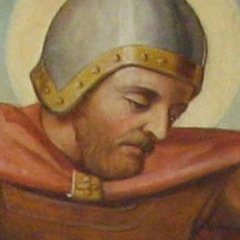 Martin of Tours
 Later tradition tied Patrick and Martin together. The Catholic Encyclopedia made Patrick's mother Concessa “a near relative” of Martin. Later biographies sent Patrick to study at Tours, and Thomas Olden believed it: “without doubt was the master under whom Patrick studied”. Patrick never mentions him. On the historian J. B. Bury's dates, Martin died when Patrick was about eight.
Catholic Encyclopedia (1911); Dictionary of National Biography (1895)His father: a deacon, and a decurion, a member of a Roman town council. He owned the small farm where his son was seized.
Confession, chapter 1; Letter, chapter 10His grandfather, a priest. Patrick's translator White notes that a married clergy raised no scandal then.
Confession, chapter 1; White, introduction (1920)The man in Patrick's dream who brought letters from Ireland, calling him back. The early biographer Muirchú made him an angel who had spoken to Patrick in his slavery.
Confession, chapter 23; Muirchú, Book 1, chapter 1Unnamed. Patrick told him a sin from his youth. He backed Patrick for bishop, then shamed him in public. Patrick's translator White wondered if he was Bishop Germanus of Auxerre.
Confession, chapters 27 and 32; White, introduction (1920)A British king, most likely of Strathclyde, ruling from the Rock of Dumbarton. His soldiers killed and enslaved Patrick's converts.
Letter to the soldiers of Coroticus; White, introduction to the Letter (1920)Patrick's master in slavery, says the early biographer Muirchú. When Patrick came back to pay his ransom, Miliucc burned himself in his house rather than face his old slave.
Muirchú, Book 1, chapters 11 and 12High King at Tara, son of Niall. In Muirchú's Life of Patrick, he is the king whose ban Patrick broke by lighting his Easter fire. He believed at last, grudgingly.
Muirchú, Book 1, chapters 10 to 21Patrick's first convert, in the early Life by Muirchú. He meant to kill Patrick and his companions, until he saw Patrick's face. His barn became the church at Saul, a name from the Irish for barn.
Muirchú, Book 1, chapter 11; Britannica (1911)Sent by Pope Celestine in 431 as the first bishop of the Irish believers. Patrick's biographer Muirchú says the Irish would not hear him, and he died in Britain.
Bede, Ecclesiastical History, Book 1, chapter 13; Muirchú, Book 1, chapter 8Bishop of Auxerre, in Gaul. The early biographer Muirchú says Patrick studied with him for many years. Patrick never names him.
Muirchú, Book 1, chapter 6Benen, Patrick's young companion: the boy seen as a fawn on the road to Tara. He succeeded Patrick at Armagh, says the 1911 Britannica.
Preface to the Lorica, in White (1920); Britannica (1911)The bishop who gave Patrick the last Sacrament, as he was dying.
Muirchú, Book 2, chapter 9how he died
He died in Ireland on 17 March, in 461 or about 493, most likely at Saul in County Down.
His own writings end with the Confession, in old age. He expected a violent death, and hoped to share it with his converts. How he died we know only from later writers.
Muirchú says an angel told him death was near. He set out for Armagh, “which he loved beyond all other places”. On the way an angel stopped him and sent him back to Saul. There Bishop Tassach gave him the last Sacrament. Patrick's translator White thought it “plain that he died at Saul”.
For the burial, Muirchú's angel had a plan: “Let two unbroken oxen be chosen, and let them go whithersoever they will, and in whatever place they lie down, let a church be built in honour of thy poor body.” The oxen stopped at Downpatrick. Two peoples nearly went to war over the body. Muirchú says the sea rose to keep them apart.
His grave was argued over for centuries: Saul, Downpatrick, Armagh and Glastonbury all claimed it. The Annals of Ulster say the Irish saint Colum Cille put his relics in a shrine sixty years after his death. In 1899 a granite slab was laid at his traditional grave at Downpatrick.
What he hoped for
I pray Him to grant to me that I may shed my blood with those strangers and captives for His name's sake, even though I should lack burial itself
The last line of his Confession
And this is my confession before I die.
is he a saint?
Yes. Catholics, Orthodox and Anglicans count him a saint, and Lutherans remember him too. No pope ever canonised him: like other early saints, he was made one by the Church's memory.
- CatholicSaint17 March, a solemnity in Ireland
- OrthodoxSaintEnlightener of Ireland, 17 March
- AnglicanSaintA Lesser Festival in the Church of England
- LutheranRememberedMissouri Synod and ELCA, 17 March
Ireland kept his day from early on, and the oldest martyrologies, the lists of saints' days, mark it. Rome added it to the calendar of the whole Western Church in 1631.
Thomas Olden, writing in 1895, put it bluntly: “he was never canonised at Rome, and his acceptance as a saint is the outcome of popular tradition.” That is true of nearly every saint of his age. Formal canonisation came centuries later.
He lived before the split between East and West, so the Orthodox can claim him too. The Orthodox Church in America keeps him on 17 March as the Enlightener of Ireland.
from his confession
The Confession is his answer to the elders who turned on him. Midway through, he stops arguing and gives thanks.
Hence therefore I render unwearied thanks to my God Who kept me faithful in the day of my temptation, so that to-day I can confidently offer to Him a sacrifice, as a living victim, my soul to Christ my Lord Who saved me out of all my troubles, so that I may say, Who am I, O Lord, or what is my calling, that Thou hast worked together with me with such divine power? so that to-day among the heathen I should steadfastly exult, and magnify Thy name wherever I may be; and that not only in prosperity, but also in troubles, so that whatever may happen to me, whether good or bad, I ought to receive it with an equal mind, and ever render thanks to God Who shewed me that I might trust Him endlessly.
what to read first
St. Patrick, His Writings and Life
Newport J. D. White
Patrick's Confession, his letter to Coroticus's soldiers, the Breastplate and Muirchú's Life, in the translation this page quotes. The Confession is about thirty pages.
Read it freeThe Life of St. Patrick and His Place in History
J. B. Bury
The historian's reconstruction of 1905, whose dates most later writers follow.
Read it freeThe Most Ancient Lives of Saint Patrick
James O'Leary
Old Lives of Patrick, with Jocelin's whole book: the snakes, the thirty-three raised from the dead, and the rest.
Read it freetake the quizzes
 Quiz Which early Christian thinks like you? And which would argue with you? Start
  Quiz Christian Personality Test Which of eight types are you? Find your own. Start
 sources
His life, and his words
- St. Patrick, His Writings and Life. Tr. Newport J. D. White, 1920: the Confession, the Letter to the soldiers of Coroticus, the Lorica (tr. Robert Atkinson), the Sayings, and Muirchú's Life, with White's introduction and notes.
- Bede, Ecclesiastical History, Book 1, chapters 1 and 13. Tr. A. M. Sellar, 1907, with her notes.
- Jocelin, The Life and Acts of St. Patrick. Tr. Edmund L. Swift, 1809, as printed by James O'Leary.
- James O'Leary, The Most Ancient Lives of Saint Patrick, 1874, with his preface.
- The Annals of Ulster, the entries for 431, 457, 461, 492, 493 and 553, in the translation published by CELT.
- Caleb Threlkeld, Synopsis Stirpium Hibernicarum, first printed in Dublin in 1726; quoted from the 1727 printing, under Trifolium pratense album.
Reference
- J. B. Bury, The Life of St. Patrick and His Place in History, 1905
- Encyclopaedia Britannica, 1911, “Patrick, St”, by Edmund Crosby Quiggin
- Catholic Encyclopedia, 1911, “St. Patrick”, by Patrick Francis Moran
- Dictionary of National Biography, 1895, “Patrick (373–463)”, by Thomas Olden
- Britannica, “Saint Patrick”
- Smithsonian magazine, “Should We Be Wearing Blue on St. Patrick's Day?”
- The Spectator, “How the shamrock became the symbol of St Patrick's Day”
- Hymnary.org, “I bind unto myself today”, for Cecil Frances Alexander's version
Calendars
- USCCB, Liturgical Calendar 2026, 17 March
- CatholicCulture.org, 17 March, for the solemnity in Ireland
- Calendarium Romanum, 1969, on the old martyrologies and the year 1631
- The Roman Martyrology, 1916 edition, 17 March
- OCA, Saint Patrick, Bishop of Armagh, Enlightener of Ireland, 17 March
- Church of England, Common Worship calendar
- The Episcopal Church, Lesser Feasts and Fasts 2022
- The Lutheran Church–Missouri Synod, Commemorations
- Evangelical Lutheran Worship, ELCA, the church year (final draft, 2006)
Pictures
- Giambattista Tiepolo, San Patrizio vescovo d'Irlanda, 1746. Musei Civici, Padua. Public domain.
- Harry Clarke, Saint Patrick (detail), stained glass, 1925. Photograph CC0.
- Briton Rivière, A Legend of Saint Patrick, 1877. Sudley House, National Museums Liverpool. Public domain.
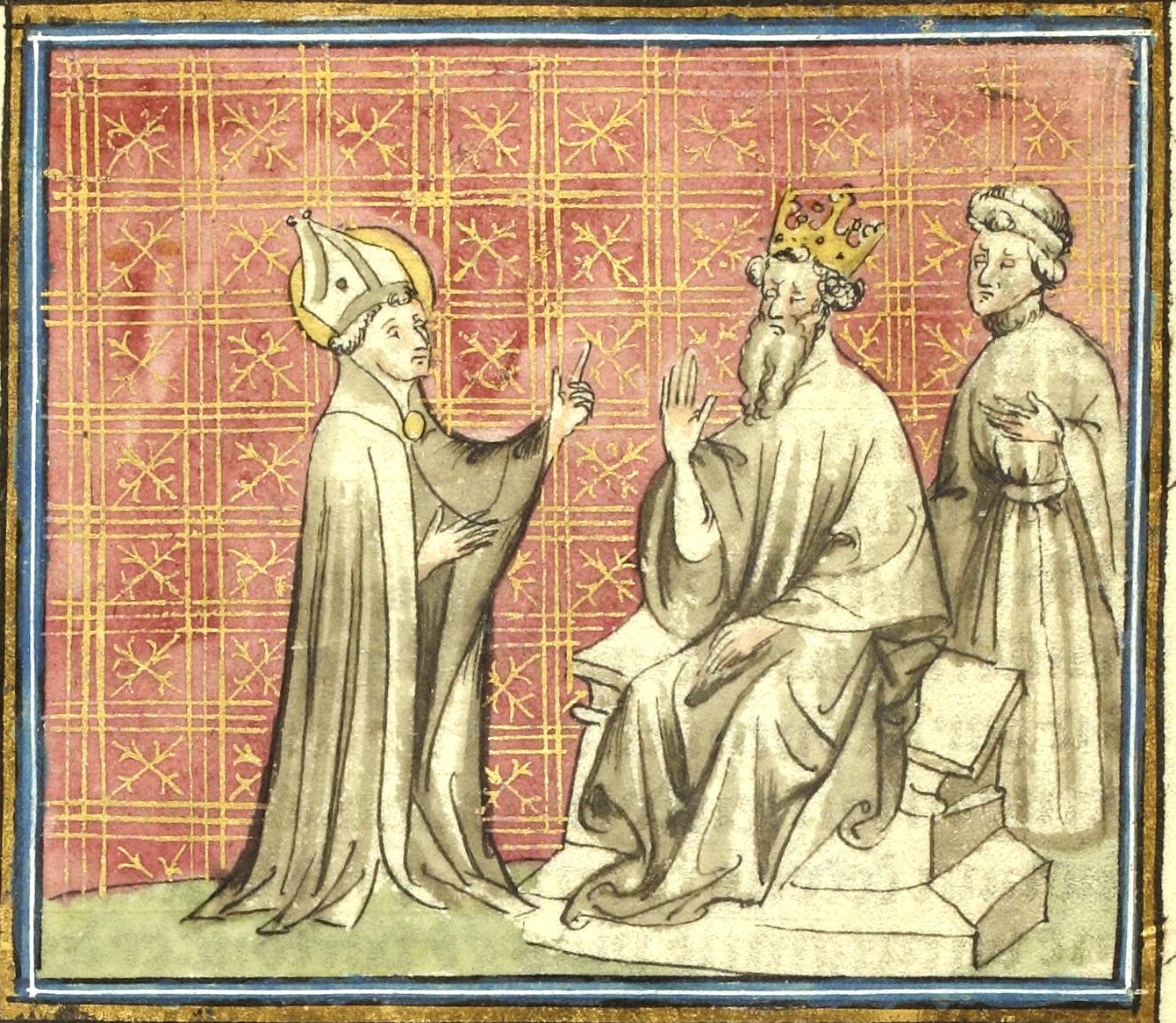
- Richard de Montbaston, Saint Patrick and the King, 1348. Bibliothèque nationale de France. Photograph CC0.