
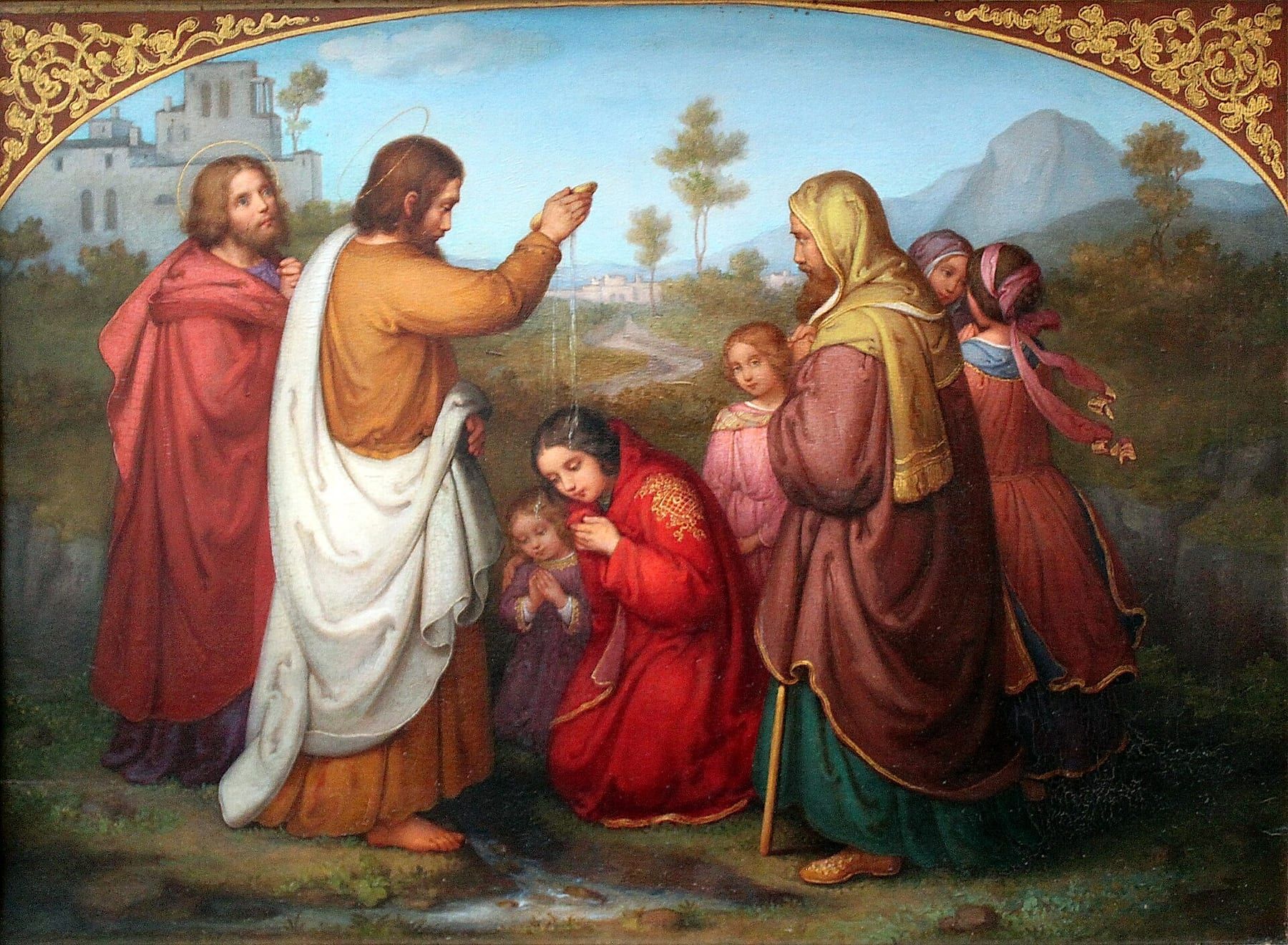
When it is said
At every Orthodox baptism. After the child is anointed with chrism, the priest leads the godparent, who holds the child, three times around the font, and all sing it.
At the Liturgy it takes the place of the Trisagion (“Holy God, Holy Mighty”) at Christmas, Theophany, the Saturday before Palm Sunday, Holy Saturday, Easter and Pentecost.
Where it comes from
Author known
St Paul’s words
The hymn is one line from St Paul’s letter to the Galatians, with “Alleluia” added. In the next line Paul says what follows from it: there is neither Jew nor Greek, slave nor free, male nor female, for all are one in Christ Jesus.
Galatians 3:27-28
The old days of baptism
Isabel Hapgood’s service book of 1906 explains why it is sung on these feasts. In the early Church, new Christians were baptized mostly at these seasons. Singing it today, she writes, the Church reminds us of the vows made for us at our own baptism.
Isabel F. Hapgood, Service Book of the Holy Orthodox-Catholic Apostolic Church (1906)
What the words mean
“Put on” like a robe
The image is clothing. Right after the baptism, the newly baptized is dressed in a robe, “the robe of righteousness”. A hymn asks Christ, Who wears light like a garment, for a shining robe. Soon after, as the child is carried around the font, this hymn says it plainly: the baptized have put on Christ.
G. V. Shann, Book of Needs of the Holy Orthodox Church (1894)
Three times around the font
Hapgood’s notes explain why the procession circles the font with lit candles. A circle stands for eternity, and the newly baptized has entered into eternal union with Christ, the Light of the world.
Isabel F. Hapgood, Service Book of the Holy Orthodox-Catholic Apostolic Church (1906)
The Scripture in it
For all of you who were baptized into Christ have clothed yourselves with Christ.
Bible text: Berean Standard Bible, public domain.
In Greek
Ὅσοι εἰς Χριστὸν ἐβαπτίσθητε, Χριστὸν ἐνεδύσασθε. Ἀλληλούϊα.