
When it is said
The Church sings its Sunday hymns in eight tones, or sets of melodies.
On a Sunday of the sixth tone, this hymn opens the sixth ode of the canon at Matins.
The same verse comes back at the memorial service for the departed and in the Canon of Repentance to our Lord Jesus Christ in the Jordanville Prayer Book.
Said alone it takes a few seconds, so it can be prayed under the breath whenever the day turns rough.
Where it comes from
No author known
An irmos
In the service books this hymn is an irmos, a verse that sets the rhythm for the verses that follow it. At Matins the Church sings a canon, a set of hymns in nine parts called odes, and each ode opens with an irmos.
G. V. Shann, Euchology (1891), the notes and the Sunday service in the sixth tone; The Octoechos in Greek, the Greek Orthodox Archdiocese of America
Jonah’s prayer
Each ode of a canon is built on one of nine songs from the Bible. The sixth is Jonah’s prayer from inside the fish (Jonah 2). This hymn opens the sixth ode, and its last line takes up Jonah’s own words: “But You raised my life from the pit, O LORD my God!” (Jonah 2:6).
G. V. Shann, Euchology (1891), the note on the canon; The King James Version, Jonah
The Scripture in it
To the roots of the mountains I descended; the earth beneath me barred me in forever! But You raised my life from the pit, O LORD my God!
Bible text: Berean Standard Bible, public domain.
In Greek
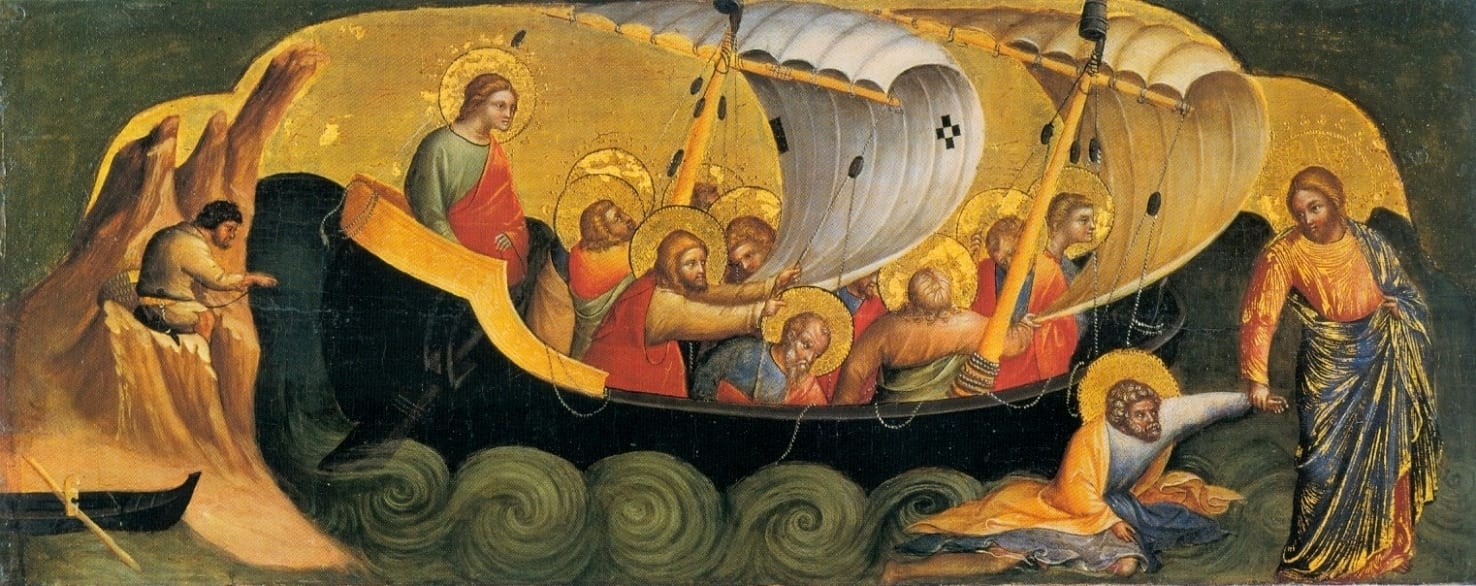
Τοῦ βίου τὴν θάλασσαν,
ὑψουμένην καθορῶν,
τῶν πειρασμῶν τῷ κλύδωνι,
ἐν εὐδίῳ λιμένι Σου προσδραμών,
βοῶ Σοι· Ἀνάγαγε
ἐκ φθορᾶς τὴν ζωήν μου Πολυέλεε.
From the Octoechos, the Sunday canon of the sixth tone, Ode 6.