
When it is said
It is a private prayer from Russian prayer collections, for one person to say at home or under the breath whenever troubles rise.
It takes about 20 seconds.
Where it comes from
Author by tradition
St Tikhon of Zadonsk
St Tikhon lived from 1724 to 1783. He became a monk when he was 34 years old and was later made Bishop of Voronezh in Russia. After a little under seven years as bishop he retired to the monastery of Zadonsk, where he lived until he died. The Russian Orthodox Church made him a saint in 1861.
Prayers taken from the Gospel
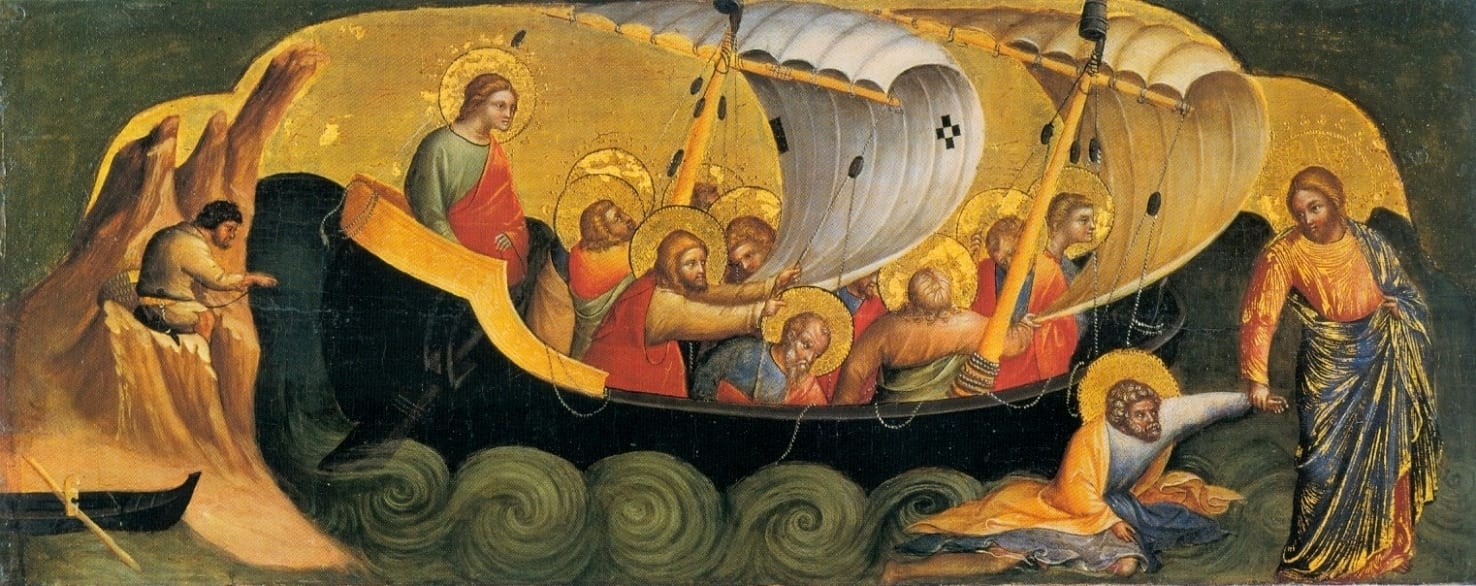
A Russian collection of prayers credits St Tikhon with a set of prayers to Christ, each one taken from a story in the Gospel. One comes from the parable of the sower and another from the story of the Canaanite woman. This one comes from the apostles in danger at sea (Matthew 8:23-27), and its heading says whom it is for: someone facing temptations of many kinds.
Azbyka’s prayer book, the prayers of St Tikhon of Zadonsk (in Russian); Azbyka’s prayer book, rare prayers of great Russian saints (in Russian)
What the words mean
The storm at sea
In Matthew’s Gospel a violent storm broke over the sea while Jesus slept in the boat. When the waves swept over it, the disciples woke Him and begged Him to save them, because they were perishing. He rebuked the winds and the sea, and it was perfectly calm (Matthew 8:24-26). St Tikhon turns their cry into one person’s prayer and their storm into the troubles of one life.
Not Peter’s cry
“Lord, save me!” is also what Peter cried when he began to sink in the water (Matthew 14:30). St Tikhon built his prayer on the other storm, when the whole boat was in danger and Jesus was asleep in it. It ends with what the amazed disciples said about Him, that even the winds and the sea obey Him (Matthew 8:27).
The Scripture in it
The disciples went and woke Him, saying, “Lord, save us! We are perishing!”
“You of little faith,” Jesus replied, “why are you so afraid?” Then He got up and rebuked the winds and the sea, and it was perfectly calm. The men were amazed and asked, “What kind of man is this? Even the winds and the sea obey Him!”
For we do not have a high priest who is unable to sympathize with our weaknesses, but we have one Who was tempted in every way that we are, yet was without sin.
Bible text: Berean Standard Bible, public domain.
In Church Slavonic
Го́споди! Спаси́ мя́, погиба́ю.
Се́ бо корабле́ц мо́й бе́дствует от искуше́ния во́лн, и бли́з потопле́ния е́сть.
Ты́, я́ко Бо́г милосе́рд и сострада́телен не́мощем на́шим,
вла́стию Твое́ю всеси́льною запрети́ волне́нию бе́дствий,
хотя́щих погрузи́ти мя́ и низвести́ во глубину́ зо́л, —
и бу́дет тишина́, я́ко ве́тры и мо́ре послу́шают Тебе́.
Ами́нь.