
When it is said
It comes near the end of Matins, the morning service. Matins should begin in the dark, so the hymn marks the dawn. Just before it comes the line “Glory to You, Who have shown the light!” In Russian churches the priest says that line with raised hands; in Greek ones the choir sings it.
On Sundays and feasts it is sung, ending with the Trisagion, “Holy God, Holy Mighty, Holy Immortal”. On other days a daily form is read, with its parts in a different order.
It is also sung at the end of the Orthodox service of thanksgiving, held when God has answered a prayer. Russian books allow the Te Deum, the hymn “We praise You, O God”, in its place. The Greek Orthodox Archdiocese of America prints a short service of praise for 28 October, Greece’s national day. It is called a “Doxology”, and this hymn is part of it.
Where it comes from
No author known
The angels’ song, and more
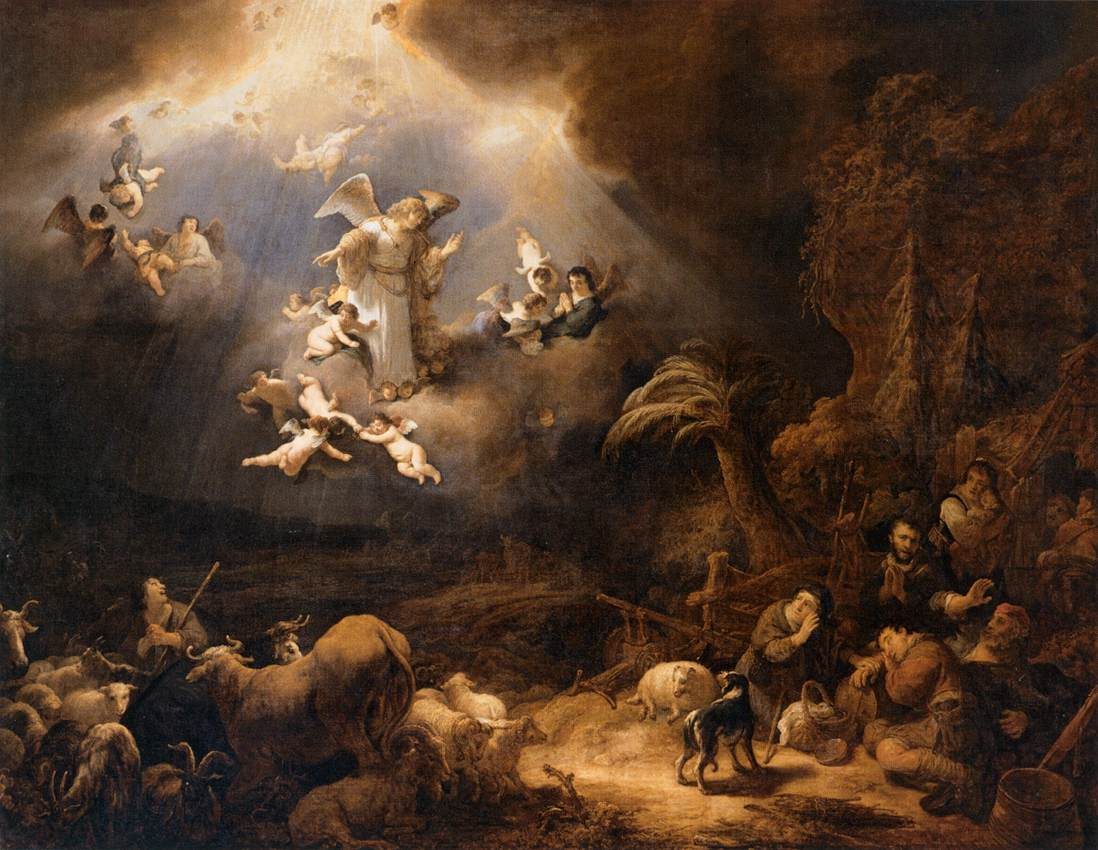
Its first line is the song the angels sang at Christ’s birth, in Luke’s Gospel. Christians added more praise to it very early. A form of it stands as a morning prayer in the Apostolic Constitutions, a book of church order from about AD 380. Another stands in the Codex Alexandrinus, a Bible of the 400s, among the songs of Scripture.
Adrian Fortescue, “Gloria in Excelsis Deo”, The Catholic Encyclopedia (1909); M. S. Zheltov, “The Great Doxology”, Orthodox Encyclopedia (Pravoslavnaya Entsiklopediya), volume 7
Why it ends with “Holy God”
In the cathedral services of Constantinople, from the 800s to the 1100s, a singer climbed the ambo, the raised stand in the church, with a cross in his hands. He called out “Glory to God in the highest”, and the choir sang the rest. As it ended, the clergy walked into the sanctuary. So the Trisagion, the usual chant for that entrance, was added to its end.
M. S. Zheltov, “The Great Doxology”, Orthodox Encyclopedia (Pravoslavnaya Entsiklopediya), volume 7
Sung together
In some Orthodox monasteries, every monk at the service gathers in the middle of the church for this hymn. They stand in two rows facing each other and sing it together. Russian composers set it to music too, among them Tchaikovsky, Rachmaninoff and Chesnokov.
M. S. Zheltov, “The Great Doxology”, Orthodox Encyclopedia (Pravoslavnaya Entsiklopediya), volume 7
What the words mean
The same hymn as the Gloria
In the West this hymn became the Gloria, sung at Mass. The Latin stops after the praise of Christ. The Greek goes on with about 10 more verses, mostly from the Psalms, and ends with the Trisagion. The Orthodox do not sing it at the Liturgy: for them it belongs to the morning service.
Adrian Fortescue, “Gloria in Excelsis Deo”, The Catholic Encyclopedia (1909)
The Scripture in it
“Glory to God in the highest, and on earth peace to men on whom His favor rests!”
The next day John saw Jesus coming toward him and said, “Look, the Lamb of God, Who takes away the sin of the world!”
Every day I will bless You, and I will praise Your name forever and ever.
Blessed are You, O LORD; teach me Your statutes.
Lord, You have been our dwelling place through all generations.
For with You is the fountain of life; in Your light we see light. Extend Your loving devotion to those who know You, and Your righteousness to the upright in heart.
Bible text: Berean Standard Bible, public domain.
In Greek
Δόξα Σοι τῷ δείξαντι τὸ φῶς.
Δόξα ἐν ὑψίστοις Θεῷ καὶ ἐπὶ γῆς εἰρήνη ἐν ἀνθρώποις εὐδοκία.
Ὑμνοῦμέν Σε, εὐλογοῦμέν Σε, προσκυνοῦμέν Σε, δοξολογοῦμέν Σε, εὐχαριστοῦμέν Σοι, διὰ τὴν μεγάλην Σου δόξαν.
Κύριε Βασιλεῦ, ἐπουράνιε Θεέ, Πάτερ Παντοκράτορ, Κύριε Υἱὲ Μονογενές, Ἰησοῦ Χριστέ, καὶ Ἅγιον Πνεῦμα.
Κύριε ὁ Θεός, ὁ Ἀμνὸς τοῦ Θεοῦ, ὁ Υἱός τοῦ Πατρός, ὁ αἴρων τὴν ἁμαρτίαν τοῦ κόσμου, ἐλέησον ἡμᾶς, ὁ αἴρων τὰς ἁμαρτίας τοῦ κόσμου.
Πρόσδεξαι τὴν δέησιν ἡμῶν, ὁ καθήμενος ἐν δεξιᾷ τοῦ Πατρός, καὶ ἐλέησον ἡμᾶς.
Ὅτι Σὺ εἶ μόνος Ἅγιος, Σὺ εἶ μόνος Κύριος, Ἰησοῦς Χριστός, εἰς δόξαν Θεοῦ Πατρός. Ἀμήν.
Καθ' ἑκάστην ἡμέραν εὐλογήσω Σε, καὶ αἰνέσω τὸ ὄνομά Σου εἰς τὸν αἰῶνα καὶ εἰς τὸν αἰῶνα τοῦ αἰῶνος.
Καταξίωσον, Κύριε, ἐν τῇ ἡμέρᾳ ταύτῃ, ἀναμαρτήτους φυλαχθῆναι ἡμᾶς.
Εὐλογητὸς εἶ, Κύριε, ὁ Θεὸς τῶν Πατέρων ἡμῶν, καὶ αἰνετὸν καὶ δεδοξασμένον τὸ ὄνομά Σου εἰς τοὺς αἰῶνας. Ἀμήν.
Γένοιτο, Κύριε, τὸ ἔλεός Σου ἐφ’ ἡμᾶς, καθάπερ ἠλπίσαμεν ἐπὶ Σέ.
Εὐλογητὸς εἶ, Κύριε, δίδαξόν με τὰ δικαιώματά Σου.
Εὐλογητὸς εἶ, Κύριε, δίδαξόν με τὰ δικαιώματά Σου.
Εὐλογητὸς εἶ, Κύριε, δίδαξόν με τὰ δικαιώματά Σου.
Κύριε, καταφυγὴ ἐγενήθης ἡμῖν, ἐν γενεᾷ καὶ γενεᾷ.
Ἐγὼ εἶπα· Κύριε, ἐλέησόν με, ἴασαι τὴν ψυχήν μου, ὅτι ἥμαρτόν Σοι.
Κύριε, πρὸς Σὲ κατέφυγον, δίδαξόν με τοῦ ποιεῖν τὸ θέλημά Σου, ὅτι Σὺ εἶ ὁ Θεός μου.
Ὅτι παρὰ Σοὶ πηγὴ ζωῆς, ἐν τῷ φωτί Σου ὀψόμεθα φῶς.
Παράτεινον τὸ ἔλεός Σου τοῖς γινώσκουσί Σε.
Ἅγιος ὁ Θεός, Ἅγιος Ἰσχυρός, Ἅγιος Ἀθάνατος, ἐλέησον ἡμᾶς.
Ἅγιος ὁ Θεός, Ἅγιος Ἰσχυρός, Ἅγιος Ἀθάνατος, ἐλέησον ἡμᾶς.
Ἅγιος ὁ Θεός, Ἅγιος Ἰσχυρός, Ἅγιος Ἀθάνατος, ἐλέησον ἡμᾶς.
Δόξα Πατρὶ καὶ Υἱῷ καὶ Ἁγίῳ Πνεύματι.
Καὶ νῦν καὶ ἀεὶ καὶ εἰς τοὺς αἰῶνας τῶν αἰώνων. Ἀμήν.
Ἅγιος Ἀθάνατος, ἐλέησον ἡμᾶς.
Ἅγιος ὁ Θεός, Ἅγιος Ἰσχυρός, Ἅγιος Ἀθάνατος, ἐλέησον ἡμᾶς.