Sign Up My Profile
Prayers

The Paschal Hours

A short service of Easter hymns. Through Bright Week, the week after Pascha, the Russian prayer book sets it in place of the usual morning and evening prayers.

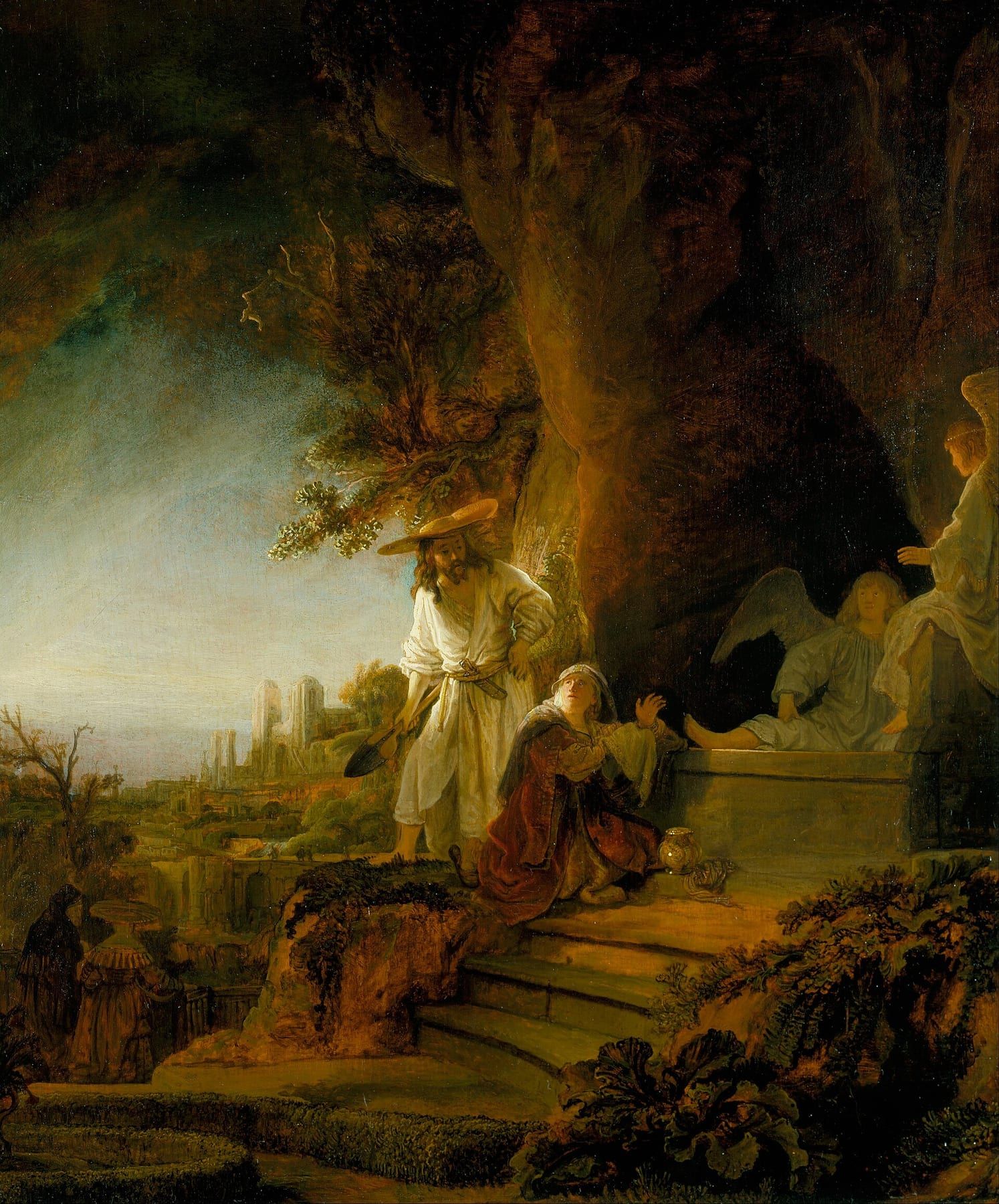
Picture: Rembrandt, Christ and Saint Mary Magdalene at the Tomb, 1638

The words of the prayer

Plain English

Through the prayers of our holy fathers,Lord Jesus Christ our God,have mercy on us. Amen.

Christ is risen from the dead,trampling down death by death,and giving lifeto those in the tombs.Three times

Having seen the resurrection of Christ,let us worship the holy Lord Jesus,the only sinless One.We worship Your Cross, O Christ,and we praise and glorifyYour holy resurrection.For You are our God;we know no other but You;we call on Your name.Come, all you faithful,let us worship Christ’s holy resurrection.For see: through the Crossjoy has come to all the world.Always blessing the Lord,we praise His resurrection.For He endured the Cross for us,and by death He destroyed death.Three times

The women with Mary came before the dawnand found the stone rolled away from the tomb.They heard the angel say:“Why do you seek among the deadthe One Who lives in everlasting light,as if He were a mortal man?See the grave cloths.Run and tell the worldthat the Lord is risen and has put death to death.For He is the Son of GodWho saves the human race.”

Though You went down into the tomb, O Immortal One,You destroyed the power of Hades,and You rose as victor, O Christ our God.You said to the women bearing myrrh, “Rejoice!”and You give peace to Your apostles,You Who grant resurrection to the fallen.

O Christ, You were in the tomb with Your body,in Hades with Your soul, for You are God,in Paradise with the thief,and on the throne with the Father and the Spirit,filling all things, O boundless One.

Glory to the Father, and to the Son, and to the Holy Spirit.

How full of life,how much fairer than Paradise,and truly brighter than any royal bridal chamberYour tomb has proved to be, O Christ:the fountain of our resurrection.

Now and ever, and for ever and ever. Amen.

Rejoice, holy and divine dwelling of the Most High!For through you, O Mother of God,joy is given to those who cry out:“Blessed are you among women,O all-blameless lady.”

Lord, have mercy.Forty times

Glory to the Father, and to the Son, and to the Holy Spirit,now and ever, and for ever and ever. Amen.

More honorable than the cherubim,and beyond compare more glorious than the seraphim,without corruption you gave birth to God the Word:true Mother of God, we magnify you.

Christ is risen from the dead,trampling down death by death,and giving lifeto those in the tombs.Three times

Lord Jesus Christ, Son of God,through the prayers of Your most pure Mother,of our holy and God-bearing fathersand of all the saints,have mercy on us. Amen.

Traditional wording, 1906

Christ is risen from the dead,trampling down Death by death,and upon those in the tomb bestowing life.

In that we have beheld the Resurrection of Christ,let us bow down before our holy Lord Jesus, the only sinless One.Thy Cross do we adore, O Christ,and Thy holy Resurrection we laud and glorify.For Thou art our God, and we know none other beside Thee, we call upon Thy Name.O come, all ye faithful, let us adore Christ's holy Resurrection:for lo, through the Cross is joy come into all the world.Ever blessing the Lord, let us sing His Resurrection.For in that He endured the Cross, He hath destroyed Death by death.

When they who came with the Marys came, forestalling the dawn,and found the stone rolled away from the sepulchre,they heard from the Angel:Why seek ye among the dead, as He were mortal, Him Who abideth in everlasting light?Behold the grave-clothes.Go quickly, and proclaim to the world that the Lord is risen, and hath slain Death.For He is the Son of God Who saveth mankind.

Though Thou didst descend into the grave, O Deathless One,yet didst Thou annihilate the power of Hell,and didst rise again as conqueror, O Christ our God,announcing unto the Myrrh-bearing Women: Rejoice!and giving grace unto Thine Apostles,and bestowing Resurrection upon the fallen.

In the Grave with the body, but in Hell with the soul, in that Thou art God;in Paradise with the thief, and on the throne with the Father and the Spirit,wast Thou, O Christ, filling all things, in that Thou art infinite.

Glory to the Father, and to the Son, and to the Holy Spirit.

As life-bearing, as of a truth than Paradise more fair,and than every royal palace more brighthath been revealed Thy tomb, the source of our Resurrection, O Christ.

Now, and ever, and unto ages of ages. Amen.

Hail, O thou hallowed, divine abode of the Most High!For through thee, O Birth-giver of God, was joy given unto those who cry aloud to thee:Blessed art thou among women, O Lady all-undefiled!

Lord, have mercy.

More honourable than the Cherubim, and beyond compare more glorious than the Seraphim,thou who without defilement barest God the Word,true Birth-giver of God, we magnify thee.

Plain English by Wiser Walk, from the Church Slavonic and the Greek, with Hapgood’s 1906 translation beside it. How the wording is made. Traditional wording: Isabel F. Hapgood, Service Book of the Holy Orthodox-Catholic Apostolic Church, 1906.

Hapgood gives the order as it is said in church. The prayers that open and close it at home are not in her book.

When it is said

The Russian prayer book sets it for every day of Bright Week, from Pascha until Saturday morning, in place of the morning and evening prayers said at home. It is best sung, but it may be read.

In church it takes the place of each of the Hours, the short services through the day. It replaces Compline and the Midnight Office too.

In that week the prayers before Communion also begin with it. The canon of Pascha follows: the long hymn of the Easter night service.

In church a priest begins it with “Blessed is our God” and ends it with a blessing. At home it opens and closes with the prayers given here.

Where it comes from

No author known

Hours with no psalms

Unlike the usual Hours, which are built on psalms, this order has none at all. It is much shorter, and the whole of it is meant to be sung. The Greek service book says to repeat it at each of the Hours, at Compline (the service before sleep) and at the Midnight Office.

The Greek service of Pascha, on the Greek Orthodox Archdiocese of America’s liturgical texts site; Wikipedia, Paschal Hours

Hymns from Jerusalem

The Paschal Hours gather the hymns of the feast. They are printed in the Pentecostarion, the service book for the season from Easter to Pentecost. The first two hymns, “Christ is risen” and “Having beheld the resurrection”, are known from Jerusalem’s ancient hymn book, the Iadgari, which survives in a Georgian translation.

Isabel F. Hapgood, Service Book (1906); Wikipedia, Paschal troparion; Deacon Vladimir Vasilik, on Pravoslavie.ru

What the words mean

In the tomb, in Hades, in Paradise

One short hymn puts Christ in four places at once. His body lay in the tomb. With His soul He went down to Hades, the place of the dead: Peter writes that He preached to the spirits in prison. He was in Paradise with the thief, as He had promised him on the cross that very day. And He was on the throne with the Father and the Spirit. Paul says the One Who went down also rose above the heavens, to fill all things.

1 Peter 3:18-19; Luke 23:43; Ephesians 4:10

“Rejoice!”

One of its hymns, the kontakion, has the risen Christ greet the women who came to the tomb with spices for His body. He says one word: “Rejoice!” It is His word in Matthew’s Gospel, when He met them on their way from the empty tomb. Matthew’s Greek and the hymn’s Greek use the same word. The Berean Bible gives it as “Greetings!”

Matthew 28:9, in the Greek New Testament

The Scripture in it

On the first day of the week, very early in the morning, the women came to the tomb, bringing the spices they had prepared. They found the stone rolled away from the tomb, but when they entered, they did not find the body of the Lord Jesus. While they were puzzling over this, suddenly two men in radiant apparel stood beside them. As the women bowed their faces to the ground in terror, the two men asked them, “Why do you look for the living among the dead? He is not here; He has risen! Remember how He told you while He was still in Galilee:”

Luke 24:1-6 Echoed The women at the tomb before dawn, the stone rolled away, and the angel’s question: why look for the living among the dead?

Suddenly Jesus met them and said, “Greetings!” They came to Him, grasped His feet, and worshiped Him.

Matthew 28:9 Echoed The risen Christ meets the women with one word: the kontakion’s “Rejoice!”

It was the first day of the week, and that very evening, while the disciples were together with the doors locked for fear of the Jews, Jesus came and stood among them. “Peace be with you!” He said to them.

John 20:19 Echoed He stands among His disciples and gives them peace: “You give peace to Your apostles”.

And Jesus said to him, “Truly I tell you, today you will be with Me in Paradise.”

Luke 23:43 Echoed “Today you will be with Me in Paradise”: Christ “in Paradise with the thief”.

He Who descended is the very One Who ascended above all the heavens, in order to fill all things.

Ephesians 4:10 Echoed He went down and rose again to fill all things: “filling all things, O boundless One”.

In a loud voice she exclaimed, “Blessed are you among women, and blessed is the fruit of your womb!”

Luke 1:42 Quoted Elizabeth’s words to Mary, sung in the hymn to the Mother of God: “Blessed are you among women.”

Bible text: Berean Standard Bible, public domain.

In Church Slavonic

Моли́твами святы́х оте́ц на́ших, Го́споди Иису́се Христе́, Бо́же наш, поми́луй нас. Ами́нь.

Христо́с воскре́се из ме́ртвых, сме́ртию смерть попра́в и су́щим во гробе́х живо́т дарова́в.

Воскресе́ние Христо́во ви́девше, поклони́мся Свято́му Го́споду Иису́су, еди́ному безгре́шному, Кресту́ Твоему́ покланя́емся, Христе́, и свято́е Воскресе́ние Твое́ пое́м и сла́вим. Ты бо еси́ Бог наш, ра́зве Тебе́ ино́го не зна́ем, и́мя Твое́ имену́ем.

Прииди́те вси ве́рнии, поклони́мся Свято́му Христо́ву Воскресе́нию, се бо прии́де Кресто́м ра́дость всему́ ми́ру. Всегда́ благословя́ще Го́спода, пое́м Воскресе́ние Его́: распя́тие бо претерпе́в, сме́ртию смерть разруши́.

Предвари́вшия у́тро, я́же о Мари́и, и обре́тшия ка́мень отвале́н от гро́ба, слы́шаху от А́нгела: во све́те присносу́щнем Су́щаго с ме́ртвыми что и́щете, я́ко челове́ка? Ви́дите гро́бныя пелены́, тецы́те и ми́ру пропове́дите, я́ко воста́ Госпо́дь, умертви́вый смерть, я́ко есть Сын Бо́га, спаса́ющаго род челове́ческий.

А́ще и во гроб снизше́л еси́, Безсме́ртне, но а́дову разруши́л еси́ си́лу и воскре́сл еси́, я́ко Победи́тель, Христе́ Бо́же, жена́м мироно́сицам веща́вый: ра́дуйтеся! И Твои́м апо́столом мир да́руяй, па́дшим подая́й воскресе́ние.

Во гро́бе пло́тски, во а́де же с душе́ю я́ко Бог, в раи́ же с разбо́йником и на Престо́ле был еси́, Христе́, со Отце́м и Ду́хом, вся исполня́яй, неопи́санный.

Слава Отцу и Сыну и Святому Духу

Я́ко Живоно́сец, я́ко рая́ красне́йший, вои́стину и черто́га вся́каго ца́рскаго показа́ся светле́йший, Христе́, гроб Твой, исто́чник на́шего воскресе́ния.

И ныне и присно и во веки веков. Аминь

Вы́шняго освяще́нное Боже́ственное селе́ние, ра́дуйся. Тобо́ю бо даде́ся ра́дость, Богоро́дице, зову́щим: благослове́нна Ты в жена́х еси́, Всенепоро́чная Влады́чице.

Го́споди, поми́луй

Сла́ва Отцу́ и Сы́ну и Свято́му Ду́ху, и ны́не и при́сно и во ве́ки веко́в. Ами́нь.

Честне́йшую Херуви́м и сла́внейшую без сравне́ния Серафи́м, без истле́ния Бо́га Сло́ва ро́ждшую, су́щую Богоро́дицу, Тя велича́ем.

Христо́с воскре́се из ме́ртвых, сме́ртию смерть попра́в и су́щим во гробе́х живо́т дарова́в

Го́споди Иису́се Христе́, Сы́не Бо́жий, моли́тв ра́ди Пречи́стыя Твоея́ Ма́тере, преподо́бных и богоно́сных оте́ц на́ших и всех святы́х, поми́луй нас. Ами́нь.

From the Paschal Hours in Church Slavonic, in the form said at home, on the Azbyka.ru prayer book, a Russian Orthodox website.

Close to this

All prayers

Suggest a correction

Berean Standard Bible