Sign Up My Profile
Prayers

Prayer for healing

An old prayer “for every kind of illness”. It asks God, the Physician of souls and bodies, to heal and forgive. It stands in the oldest Byzantine service book that survives.

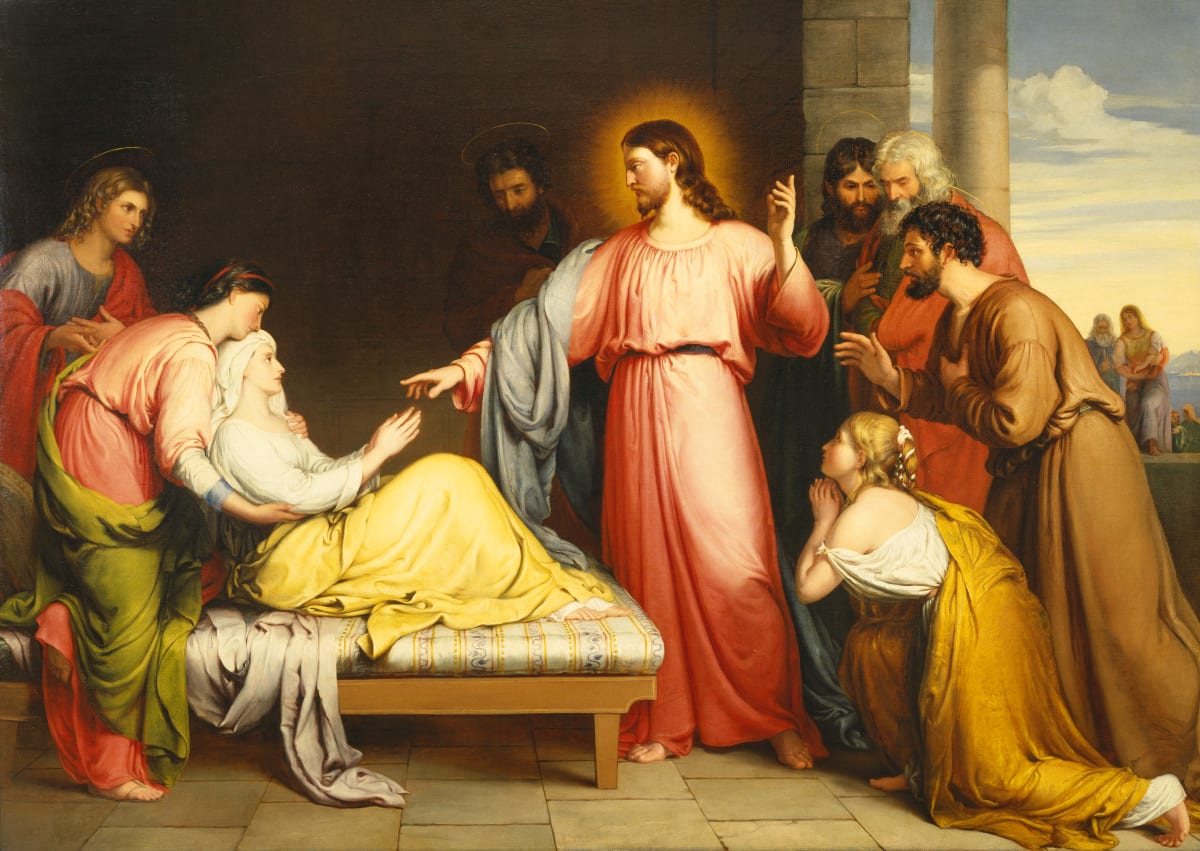
Picture: John Bridges, Christ Healing the Mother of Simon Peter’s Wife, 1839

The words of the prayer

Plain English

Master Almighty,Physician of souls and bodies,You humble and You lift up;You discipline, and You heal again.In Your mercy visit Your servant (name),who is sick.Stretch out Your arm,full of healing and cure,and heal them.Raise them up from their bed and from their sickness.

Rebuke the spirit of sickness.Drive away from them every wound,every pain, every affliction,every fever or chill.And if there is any fault or sin in them,set them free from it, pardon it and forgive it,for You love mankind.

Yes, Lord, through Christ Jesus our Lord,spare the one You have made.With Him You are blessed,together with Your all-holy, good and life-giving Spirit,now and always,and for ever and ever. Amen.

Master Almighty,Physician of souls and bodies,You humble and You lift up;You discipline, and You heal again.In Your mercy visit me, Your servant,for I am sick.Stretch out Your arm,full of healing and cure,and heal me.Raise me up from my bed and from my sickness.

Rebuke the spirit of sickness.Drive away from me every wound,every pain, every affliction,every fever or chill.And if there is any fault or sin in me,set me free from it, pardon it and forgive it,for You love mankind.

Yes, Lord, through Christ Jesus our Lord,spare me, the one You have made.With Him You are blessed,together with Your all-holy, good and life-giving Spirit,now and always,and for ever and ever. Amen.

Traditional wording, 1999

O Almighty Master, Physician of souls and bodies,Who humbleth and raiseth up, Who chasteneth and again healeth:As Thou art merciful, do Thou visit our brother (sister), N., who is sick.Stretch forth Thine arm, full of healing and cures,and heal him (her), raising him (her) up from his (her) bed and illness.

Do Thou forbid the spirit of sickness;dismiss from him (her) every wound, every infirmity, every sore, every fever and seizure.And if there be imputed unto him (her) iniquity or transgression,do Thou loose, remit and forgive him (her), out of Thy love for mankind.

Yea, O Lord, be merciful unto Thy creation,in Christ Jesus, our Lord, with Whom Thou art blessed,together with Thy Most-holy, Good and Lifegiving Spirit,now and ever, and unto the ages of ages. Amen.

Plain English by Wiser Walk, from the Greek, with “Your servant” from the Russian prayer books. How the wording is made. Traditional wording: St Tikhon’s Monastery, The Great Book of Needs, Volume III, 1999.

The traditional wording is translated from the Church Slavonic of the Russian Book of Needs, the priest’s service book. Like the Greek, it prays for “our brother (sister)”. The plain English says “Your servant”, as the Russian prayer books for home do.

When it is said

In the Russian Church’s Book of Needs, the priest’s service book, it is “A prayer for every kind of illness”. The priest says it for a sick person, by name.

It is said at home too. The Russian Orthodox magazine Foma prints it for anyone praying for someone’s recovery, and says it is good when family or friends pray with the sick person. Russian prayer books give a shorter form among the “Prayers for the sick”. Greek service books print it too.

Where it comes from

No author known

In the oldest Byzantine service book

The oldest Byzantine service book that survives, a manuscript of the late 700s now in the Vatican Library, already has this prayer among its prayers for the sick. Four other early service books have it too. In all five it stands on its own, outside any service.

Miguel Arranz, “Le preghiere degli infermi nella tradizione bizantina”, Orientalia Christiana Periodica 62 (1996); Orthodox Encyclopedia (Pravoslavnaya Entsiklopediya), Holy Unction

An “invisible arm”

In the oldest copies the prayer asks God to stretch out His “invisible arm”, full of healing. The Greek service book printed in Venice in 1862, reprinted in Athens since 1970, leaves out “invisible”. So does the Russian Book of Needs.

Miguel Arranz, “Le preghiere degli infermi nella tradizione bizantina”, Orientalia Christiana Periodica 62 (1996); Great Euchologion, Venice 1862

What the words mean

Loose, remit, forgive

Near its end the prayer asks God to set the sick person free from any sin, and to pardon and forgive it. In the traditional wording the three words are “loose, remit and forgive”. The Jesuit scholar Miguel Arranz notes that they are a reminder: healing the sick includes forgiving their sins, as the letter of James says.

Miguel Arranz, “Le preghiere degli infermi nella tradizione bizantina”, Orientalia Christiana Periodica 62 (1996)

The Scripture in it

The LORD sends poverty and wealth; He humbles and He exalts.

1 Samuel 2:7 Echoed Hannah praises the Lord, Who humbles and exalts. The prayer opens with the same praise, then says God disciplines and heals again. The Bible gives the reason He disciplines: out of love, as a father does (Hebrews 12:6-7).

On hearing this, Jesus said, “It is not the healthy who need a doctor, but the sick.”

Matthew 9:12 Echoed The prayer calls God the Physician of souls and bodies, the Doctor the sick need.

When Jesus arrived at Peter’s house, He saw Peter’s mother-in-law sick in bed with a fever. So He touched her hand, and the fever left her, and she got up and began to serve Him.

Matthew 8:14-15 Echoed Jesus touched Peter’s mother-in-law, and her fever left her. The prayer asks God to drive away every fever.

And the prayer offered in faith will restore the one who is sick. The Lord will raise him up. If he has sinned, he will be forgiven.

James 5:15 Echoed The Lord raises up the sick, and if they have sinned, they will be forgiven. The prayer asks for both.

Bible text: Berean Standard Bible, public domain.

In Greek

Δέσποτα Παντοκράτορ, Ἰατρὲ ψυχῶν καὶ σωμάτων, ὁ ταπεινῶν καὶ ἀνυψῶν, ὁ παιδεύων καὶ πάλιν ἰώμενος, τὸν ἀδελφὸν ἡμῶν (τὸν δεῖνα) τὸν ἀσθενοῦντα ἐπίσκεψαι ἐν τῷ ἐλέει Σου. Ἔκτεινον τὸν βραχίονά Σου τὸν πλήρη ἰάσεως καὶ θεραπείας, καὶ ἴασαι αὐτόν, ἐξανιστῶν ἀπὸ κλίνης καὶ ἀρρωστίας.

Ἐπιτίμησον τῷ πνεύματι τῆς ἀσθενείας· ἀπόστησον ἀπ᾿ αὐτοῦ πᾶσαν πληγήν, πᾶσαν ἀλγηδόνα, πᾶσαν μάστιγα, πάντα πυρετὸν ἢ ῥῖγος· καὶ εἴ τι ἔστιν ἐν αὐτῷ πλημμέλημα ἢ ἀνόμημα, ἄνες, ἄφες, συγχώρησον διὰ τὴν Σὴν φιλανθρωπίαν.

Ναί, Κύριε, φεῖσαι τοῦ πλάσματός Σου, ἐν Χριστῷ Ἰησοῦ τῷ Κυρίῳ ἡμῶν, μεθ᾿ Οὗ εὐλογητὸς εἶ, σὺν τῷ παναγίῳ καὶ ἀγαθῷ καὶ ζωοποιῷ Σου Πνεύματι, νῦν καὶ ἀεὶ καὶ εἰς τοὺς αἰῶνας τῶν αἰώνων. Ἀμήν.

From the Great Euchologion printed in Venice in 1862, reprinted in Athens since 1970, with capitals for God.

Close to this

All prayers

Suggest a correction

Berean Standard Bible