Sign Up My Profile
Prayers

The prayer for one who has suffered long

A priest prays it for someone whose dying is long and hard, asking God to release them from unbearable pain and give them rest with the righteous.

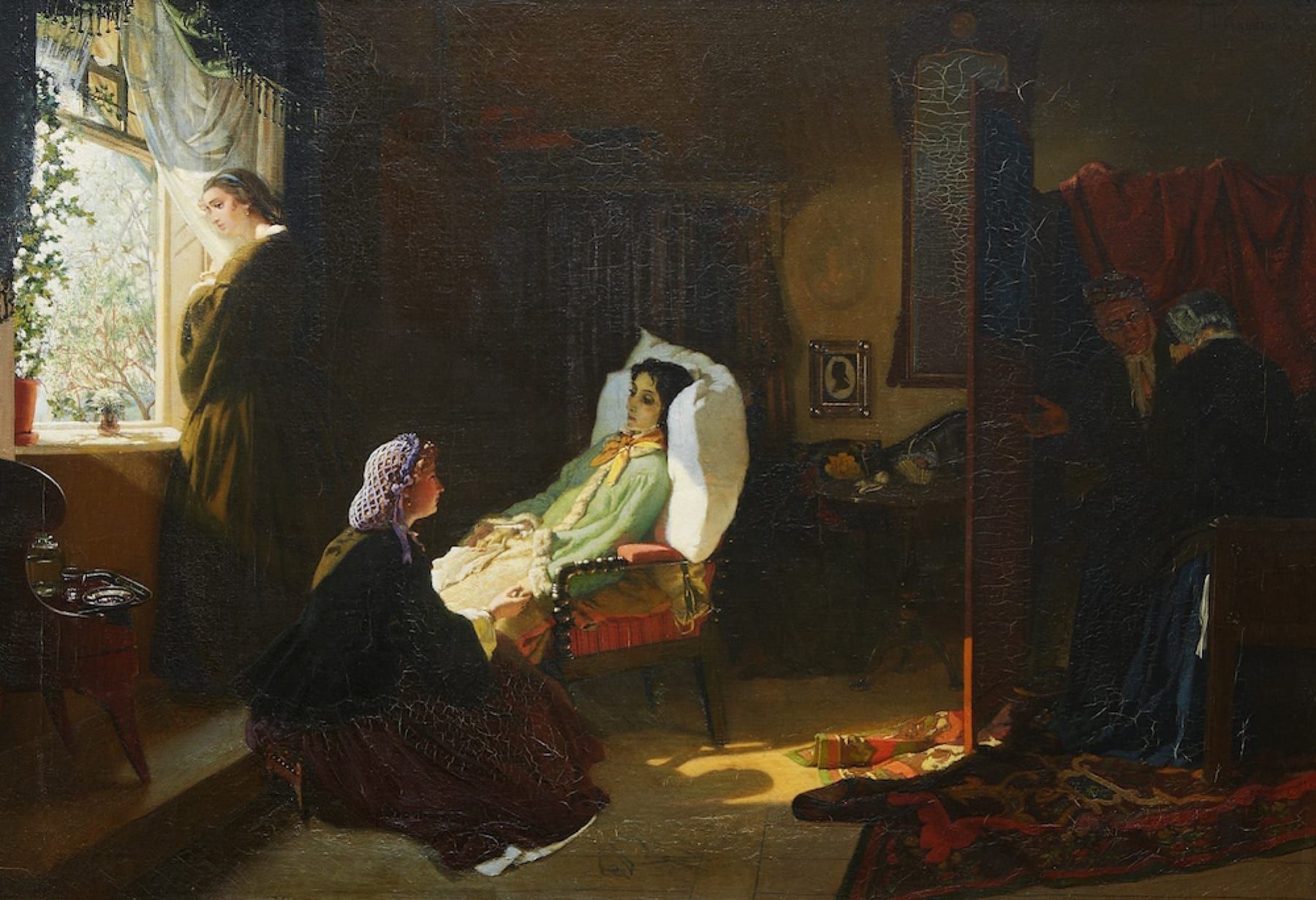
Picture: Mikhail Klodt, The Last Spring, 1861

The words of the prayer

Plain English

O Lord our God,in Your wisdom beyond all wordsYou created man and shaped him from the dust,and adorned him with form and beautyas a precious and heavenly possession,for the praise and splendour of Your glory and Your kingdom,because You brought him into beingin Your image and likeness.

But he broke the commandment You had given him;he received Your image and did not keep it.And so that evil would not become immortal,You, the God of our fathers, in Your love for mankind,ordered this release,and willed that this unbreakable bond be cut and undone:the body goes back to what it was made from,and the soul goes to the place where it received its being,until the resurrection of all.

Therefore we pray to You,the immortal Father without beginning,and to Your only-begotten Son,and to Your all-holy Spirit:release Your servant (name) from the bodyinto rest.

If they offended Your goodness in anything,knowingly or unknowingly,or came under a priest’s curse,or grieved their parents,or broke an oath,or fell into the delusions of demons and shameful sorcerythrough the envy of the evil demon,I ask forgiveness for them from Your goodness beyond all words.

Yes, O Master, Lord God,hear me, Your sinful and unworthy servant, in this hour.Release Your servant (name)from this unbearable painand from the bitter sickness that holds them,and give them restwhere the spirits of the righteous are.

For You are the rest of our souls and bodies,and to You we give glory,to the Father and the Son and the Holy Spirit,now and always, and for ever and ever. Amen.

Traditional wording, 1906

O Lord our God, Who in Thine ineffable wisdom hast created man,fashioning him out of the dust, and adorning him with comeliness and goodness,as an honourable and heavenly acquisition,to the exaltation and magnificence of Thy glory and kingdom,that Thou mightest bring him into this image and likeness;

but forasmuch as he sinned against the command of Thy statute,having accepted the image but preserved it not,for which reason, also, evil shall not be eternal:Thou hast ordained remittance unto the same, through Thy love toward mankind;and that this indestructible bond, which as the God of our fathers Thou hadst sanctified by Thy divine will, should be dissolved,and that his body should dissolve,but his soul should be translated to that place where it shall take up its abode until the final Resurrection.

Therefore we pray unto Thee, the Father Who is from everlasting, and immortal,and unto Thine Only-begotten Son, and unto Thine all-holy Spirit,that Thou wilt deliver N. from the body unto repose.

And if he (she) in any wise, whether of knowledge or in ignorance, hath offended Thy goodness,or is under the ban of a priest, or hath embittered his (her) parents,or hath broken a vow, or hath fallen into devilish imaginations and shameful sorceries,through the malice of the crafty demon:

Yea, O Master, Lord our God, hearken unto me a sinner and Thine unworthy servant in this hour,and deliver Thy servant, N., from this intolerable sickness which holdeth him (her) in bitter impotency,and give him (her) rest where the souls of the righteous dwell.

For Thou art the repose of our souls and of our bodies,and unto Thee do we ascribe glory, to the Father, and to the Son, and to the Holy Spirit,now, and ever, and unto ages of ages. Amen.

Plain English by Wiser Walk, from the Church Slavonic, checked against the Greek, with Hapgood’s 1906 translation beside it. How the wording is made. Traditional wording: Isabel F. Hapgood, Service Book of the Holy Orthodox-Catholic Apostolic Church, 1906.

Hapgood leaves out the request for forgiveness after the list of wrongs, which the Slavonic and the Greek both make.

When it is said

A priest prays it at the bedside of someone whose dying is long and hard.

When no priest can come, the family may read the rest of this short service themselves. The Russian bishop St Athanasius (Sakharov) taught that they should leave this prayer out, because only a priest reads it.

Where it comes from

No author known

For a long and hard dying

The Russian book of needs sets a short service for the bedside of someone whose suffering before death goes on and on. The priest begins it, and this prayer comes at its end. Isabel Hapgood’s English service book of 1906 prints it after the priest’s prayers at the departure of the soul, as “another prayer for a person who hath suffered long”.

The Russian book of needs (Trebnik), Moscow, 1906: the order at the parting of the soul from the body, when a person suffers long (in Church Slavonic, on Azbyka.ru); Azbyka.ru prayer book: the canon at the parting of the soul from the body (in Russian); Isabel F. Hapgood, Service Book of the Holy Orthodox-Catholic Apostolic Church (1906)

Who wrote it?

No one knows. It is a priest’s prayer from the Greek service book, the Euchologion, where it is headed “another prayer for one who is dying”. The Russian book of needs carries it in Church Slavonic.

Εὐχολόγιον τὸ μέγα, the Great Euchologion (scan on archive.org, in Greek); The Russian book of needs (Trebnik), Moscow, 1906 (in Church Slavonic, on Azbyka.ru)

What the words mean

Why soul and body part

The prayer gives the reason death came. Man broke God’s commandment and did not keep the image he was given. So that evil would not become immortal, God in His love let soul and body part. The body goes back to the dust it was made from, and the soul to the place where it received its being, until the resurrection.

The Russian book of needs (Trebnik), Moscow, 1906 (in Church Slavonic, on Azbyka.ru)

The Scripture in it

Then the LORD God formed man from the dust of the ground and breathed the breath of life into his nostrils, and the man became a living being.

Genesis 2:7 Echoed God formed man from the dust of the ground.

Then God said, “Let Us make man in Our image, after Our likeness, to rule over the fish of the sea and the birds of the air, over the livestock, and over all the earth itself and every creature that crawls upon it.” So God created man in His own image; in the image of God He created him; male and female He created them.

Genesis 1:26-27 Echoed Man made in God’s image and likeness.

… before the dust returns to the ground from which it came and the spirit returns to God Who gave it.

Ecclesiastes 12:7 Echoed The dust returns to the ground and the spirit to God Who gave it.

… in joyful assembly, to the congregation of the firstborn, enrolled in heaven. You have come to God the Judge of all, to the spirits of the righteous made perfect …

Hebrews 12:23 Echoed Rest where the spirits of the righteous are.

Bible text: Berean Standard Bible, public domain.

In Church Slavonic

Го́споди Бо́же на́ш, И́же неизрече́нною Твое́ю му́дростию созда́вый челове́ка, и от пе́рсти сего́ возъобрази́вый, в ви́д и добро́ту украси́вый, я́ко честно́е и небе́сное стяжа́ние, в славосло́вие и благоле́пие Твоея́ сла́вы и Ца́рства, за е́же по о́бразу и по подо́бию сего́ привести́,

но поне́же за́поведь преступи́ Твоего́ повеле́ния, прие́м о́браз и не сохрани́в, и сего́ ра́ди да не зло́ безсме́ртное бу́дет, человеколю́бно повеле́вый разреше́ния сему́, и неруши́мей се́й у́зе, я́ко Бо́г отце́в, Твои́м Боже́ственным хоте́нием отсещи́ся, и разы́тися, и те́лу у́бо от ни́хже сложи́ся разы́тися, души́ же та́мо пресели́тися, иде́же и е́же бы́ти прия́ла е́сть, да́же до о́бщаго воскресе́ния,

сего́ ра́ди мо́лимся Тебе́ Безнача́льному и Безсме́ртному Отцу́, и единоро́дному Твоему́ Сы́ну, и Пресвято́му Твоему́ Ду́ху, да от те́ла разреше́ние, и́мярек, во упокое́ние сотвори́ши.

И а́ще что́ в ве́дении, или́ не в ве́дении прирази́ся Твое́й бла́гости, или́ под кля́твою свяще́нническою бы́сть, или́ своя́ роди́тели преогорчи́, или́ кля́тву преступи́, или́ в мечта́ния де́монския и волхвова́ния сту́дная впаде́, за́вистию лука́ваго де́мона, проще́ния от Твоея́ неизрече́нныя бла́гости моля́:

е́й Влады́ко Го́споди Бо́же, услы́ши мене́ гре́шнаго и недосто́йнаго раба́ Твоего́ в ча́с се́й, и разреши́ раба́ Твоего́, и́мярек, нестерпи́мыя сея́ боле́зни и содержа́щия его́ го́рькия не́мощи, и упоко́й его́ иде́же пра́ведных ду́си.

Я́ко Ты́ еси́ упокое́ние ду́ш и теле́с на́ших, и Тебе́ сла́ву возсыла́ем, Отцу́, и Сы́ну, и Свято́му Ду́ху, ны́не и при́сно, и во ве́ки веко́в, ами́нь.

From the Russian book of needs (Trebnik), Moscow Synodal Press, 1906, in modern letters, on Azbyka.ru, a Russian Orthodox website.

Close to this

All prayers

Suggest a correction

Berean Standard Bible