
When it is said
On Great and Holy Thursday the Orthodox Church reads one long Gospel joined from Matthew, John and Luke. It holds both prayers, the first in Matthew’s words rather than Luke’s.
Anyone may pray His words to accept God’s will in something they would not have chosen.
Where it comes from
Author known
The night before the cross
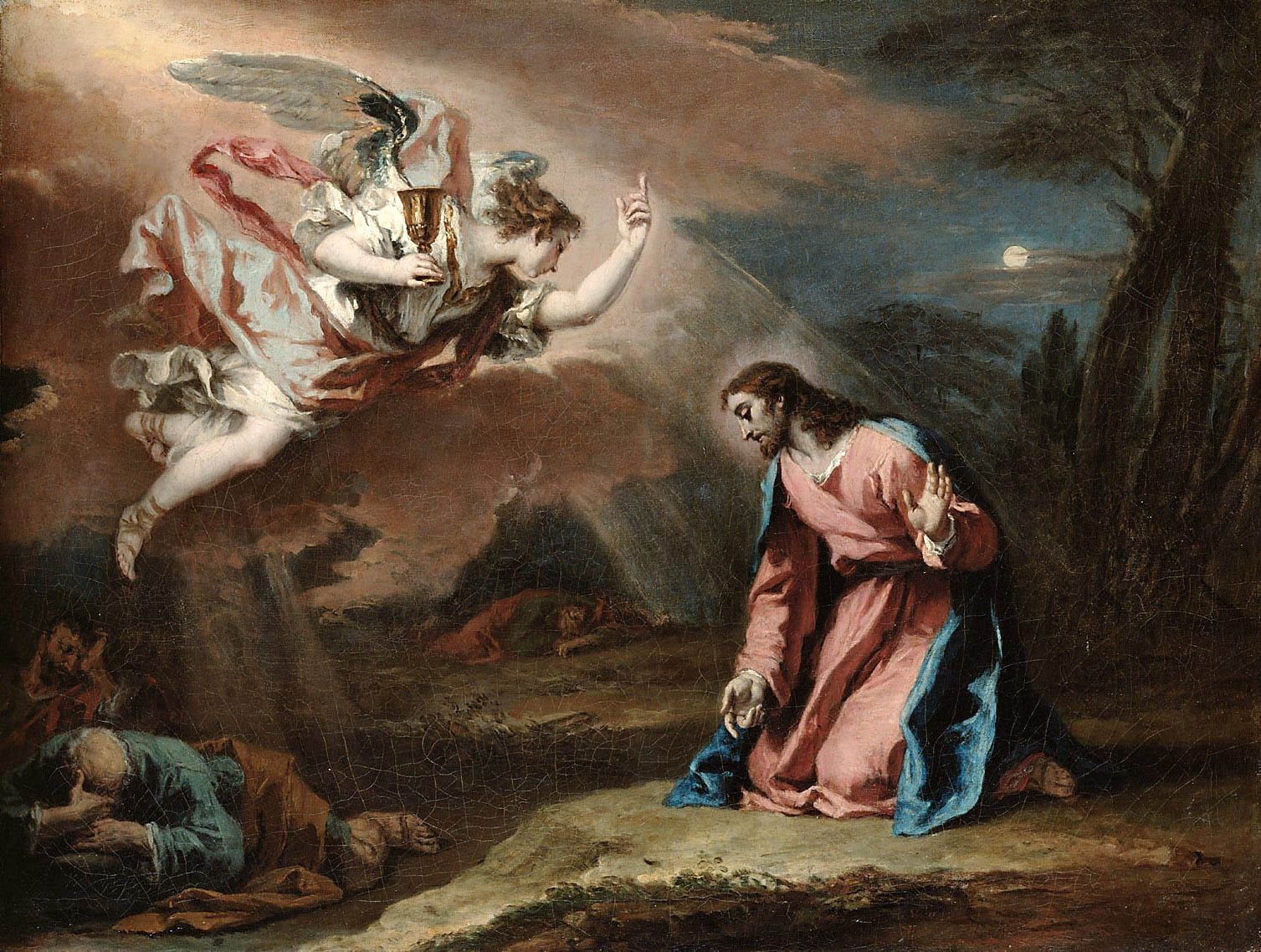
After the Last Supper, Jesus took His disciples to Gethsemane, a garden on the Mount of Olives. He brought Peter, James and John farther in and told them His soul was sorrowful to the point of death. Then He went a little farther, fell on His face and prayed. Luke adds that an angel came to strengthen Him, and that His sweat fell to the ground like great drops of blood.
Matthew 26:30-39; Mark 14:33; John 18:1-2; Luke 22:43-44
He prayed three times
Jesus came back and found the three disciples asleep. He went away and prayed a second time, and later a third time with the same words. In the second prayer He no longer asks for the cup to be taken away. He asks only that the Father’s will be done.
Matthew 26:40-44
What the words mean
Why did He ask for the cup to pass?
The preacher St John Chrysostom answers this in a sermon on Matthew. Asking for the cup to pass showed His human nature. His words “not My will” taught us to follow God “even when nature pulls us back.” In the second prayer Chrysostom sees Christ fully at one with the Father’s will, which we must always follow and seek.
John Chrysostom, Homily 83 on Matthew (English translation of 1888)
What is the cup?
On the way up to Jerusalem, the mother of James and John asked Jesus to seat her sons at His right and left in His kingdom. He asked them, “Can you drink the cup I am going to drink?” Chrysostom points out that Jesus did not ask whether they could be killed or shed their blood. He spoke of a cup, and He meant that they would suffer what He was about to suffer.
Matthew 20:17-22; John Chrysostom, Homily 65 on Matthew (English translation of 1888)
The Scripture in it
“Father, if You are willing, take this cup from Me. Yet not My will, but Yours be done.”
A second time He went away and prayed, “My Father, if this cup cannot pass unless I drink it, may Your will be done.”
Bible text: Berean Standard Bible, public domain.
In Greek
πάτερ, εἰ βούλει παρενεγκεῖν τοῦτο τὸ ποτήριον ἀπ᾿ ἐμοῦ· πλὴν μὴ τὸ θέλημά μου, ἀλλὰ τὸ σὸν γινέσθω.
πάτερ μου, εἰ οὐ δύναται τοῦτο τὸ ποτήριον παρελθεῖν ἀπ᾿ ἐμοῦ ἐὰν μὴ αὐτὸ πίω, γενηθήτω τὸ θέλημά σου.
From Luke’s and Matthew’s Gospels in Greek, on Elpenor (ellopos.net).