Sign Up My Profile
Prayers

The Prayer of Manasseh

The prayer of King Manasseh, who turned back to God in chains. Orthodox Bibles keep it, and the Church reads it in Lent at Great Compline, the late-evening service.

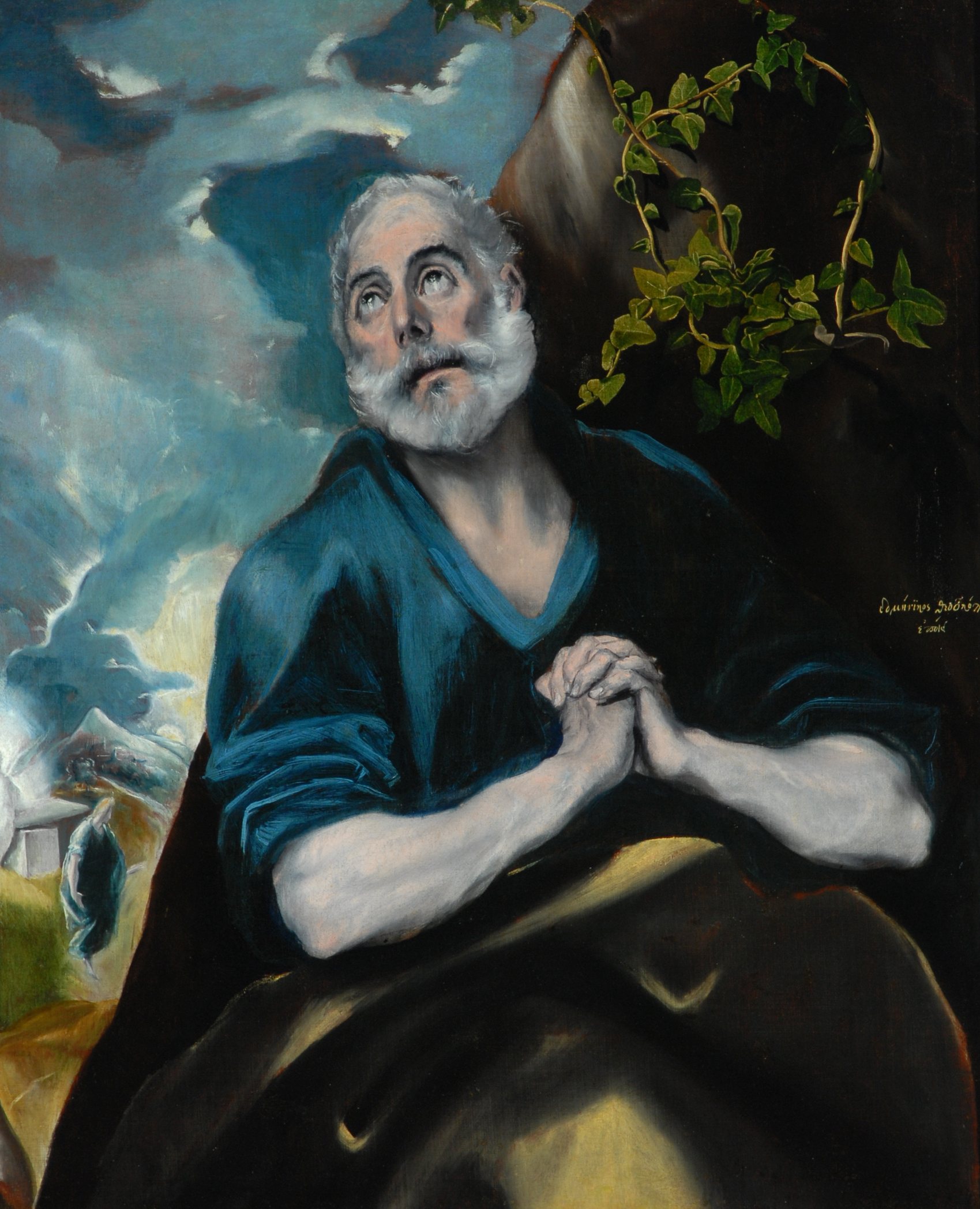
Picture: El Greco, The Tears of Saint Peter, 1580s

The words of the prayer

Plain English

O Lord Almighty, God of our fathers,of Abraham, Isaac and Jacob,and of their righteous offspring:You made heaven and earthwith all their beauty.You bound the sea by the word of Your command.You shut up the deepand sealed it with Your awesome and glorious name.

All things shudder before Youand tremble before Your power,for no one can bear the majesty of Your glory,and no one can withstand the anger You threaten against sinners.Yet the mercy You have promisedis beyond measure and beyond searching out.

For You are the Lord Most High,tender-hearted, patient and rich in mercy,and You relent at human suffering.In Your great goodness, O Lord,You have promised repentance and forgivenessto those who have sinned against You.In the fullness of Your compassionYou have appointed repentance for sinners,so that they may be saved.

So You, O Lord, God of hosts,did not appoint repentance for the righteous,for Abraham, Isaac and Jacob,who did not sin against You.But You appointed repentance for me, a sinner,for my sins outnumber the sand of the sea.

My transgressions are many, O Lord,my transgressions are many.I am not worthy to look upand see the height of heaven,because of my many wrongs.I am bent low by many iron chains,so that I cannot lift my head,and I have no relief,for I have stirred up Your angerand done evil in Your sight.I have not done Your willor kept Your commandments.

And now I bend the knee of my heart,begging You for Your kindness.I have sinned, O Lord, I have sinned,and I know my transgressions.But I ask and beg You:forgive me, O Lord, forgive me!Do not destroy me along with my sins.Do not be angry with me for ever,storing up my evil deeds against me,and do not condemn me to the depths of the earth.

For You are God,the God of those who repent,and in me You will show all Your goodness.Unworthy as I am,You will save me in Your great mercy,and I will praise You always,all the days of my life.For all the host of heaven sings Your praise,and Yours is the glory for ever and ever.Amen.

Traditional wording, 1906

O Lord Almighty, Thou God of our fathers,of Abraham, of Isaac, and of Jacob, and of their righteous seed;Who hast made heaven and earth, with all the firmament thereof;Who hast bound the sea with the word of Thy commandment;Who hast shut up the deep and sealed it with Thy terrible and glorious Name:

All creatures fear Thee, yea, they do tremble before the presence of Thy power;for the majesty of Thy glory cannot be borne,and not to be resisted is the anger of Thy threatening toward sinners;but Thy merciful promise is unmeasurable and unsearchable.

For Thou art the Lord most high, of tender compassion, long-suffering, rich in mercy,and grievest over the evils of men.Thou, O Lord, according to the multitude of Thy loving-kindness,hast promised repentance and forgiveness to those who have sinned against Thee;and in the plenitude of Thy compassions hast appointed repentance unto sinners,that they may be saved.

Thou, therefore, the Lord God of Hosts, hast not appointed repentance to the just,to Abraham, and to Isaac, and to Jacob, who have not sinned against Thee;but Thou hast appointed repentance to me a sinner:for my sins are more in number than the sands of the sea.

My transgressions are multiplied, Lord, my transgressions are multiplied,and I am not worthy to behold and see the height of heavenbecause of the multitude of mine iniquities.I am bowed down with many iron bands, so that I cannot lift up my head by reason of my sins,neither have I any respite:for I have provoked Thy wrath, and have done that which is evil in Thy sight:I have not done Thy will, neither have I kept Thy commandments.

Now, therefore, I bow the knees of my heart, supplicating grace of Thee.I have sinned, O Lord, I have sinned, and I acknowledge mine iniquities:but I humbly beseech Thee, forgive me, O Lord, forgive me,and destroy me not together with mine iniquities,neither preserve Thou Thy divine wrath against my evil deeds forever;neither condemn me to the lower parts of the earth.

For Thou, O Lord, art the God of those who are penitent;and in me wilt Thou manifest all Thy goodness;for Thou wilt save me, unworthy though I be, because of Thy great mercy,and I will praise Thee henceforth, all the days of my life.For all the Host of heaven doth sing Thy praise,and Thine is the glory, unto ages of ages. Amen.

Plain English by Wiser Walk, from the Greek, with Hapgood’s 1906 translation beside it. How the wording is made. Traditional wording: Isabel F. Hapgood, Service Book of the Holy Orthodox-Catholic Apostolic Church, 1906.

When it is said

It is read at Great Compline, the long late-evening service of Great Lent, the fast before Easter. It comes just after Psalm 51, David’s psalm of repentance, and Psalm 102. The Greek and the Slavonic books have it in the same place.

Outside Lent the Church says a shorter service, Little Compline, which does not have it.

Where it comes from

Author doubtful

A king who came back

Manasseh was a king of Judah who led his people into the worship of idols. The Second Book of Chronicles tells how the Assyrians took him to Babylon in bronze shackles. In his distress he humbled himself and prayed. God heard him and brought him home to Jerusalem. Then Manasseh knew that the LORD is God.

2 Chronicles 33:10-13, Berean Standard Bible

Who wrote it?

Chronicles says Manasseh’s own prayer was written down in the records of the kings of Israel, which are now lost. The prayer we have was built on that story by a later writer, who put it in his mouth. Most scholars think it was written in Greek in the second or first century BC. Old copies of the Greek Old Testament place it after the Psalms. The oldest is the Codex Alexandrinus, from the 400s.

Catholic Encyclopedia (1907), Apocrypha: the Prayer of Manasses; Wikipedia, Prayer of Manasseh

Named at confession

In the Orthodox service of confession, the priest prays over the person confessing. His prayer remembers that God accepted Manasseh’s prayer of repentance, and asks God to accept this person too. It recalls that God has no pleasure in the death of a sinner, but would have him turn back and live.

G. V. Shann, Book of Needs (1894): the Order concerning Confession

What the words mean

The iron chains

“I am bent low by many iron chains” fits the story, for Manasseh prayed as a prisoner. The Apostolic Constitutions, a book of Church rules from the 300s, quote the whole prayer. They tell bishops to set it before sinners as an example of repentance. And they add that, as he prayed, a flame appeared around him and his chains fell off.

Apostolic Constitutions, Book II, chapter 22; Catholic Encyclopedia (1907), Apostolic Constitutions

Which Bibles have it?

Orthodox Christians count the prayer as part of Scripture. Jews, Catholics and Protestants do not. Still, the Clementine Vulgate, the Catholic Latin Bible, keeps it in an appendix. And the King James Bible of 1611 printed it among its Apocrypha.

Catholic Encyclopedia (1907), Apocrypha: the Prayer of Manasses; Wikipedia, Prayer of Manasseh

The Scripture in it

And in his distress, Manasseh sought the favor of the LORD his God and earnestly humbled himself before the God of his fathers. And when he prayed to Him, the LORD received his plea and heard his petition. So He brought him back to Jerusalem and to his kingdom. Then Manasseh knew that the LORD is God.

2 Chronicles 33:12-13 Echoed Chronicles tells how Manasseh prayed in his distress, and how God heard him.

So rend your hearts and not your garments, and return to the LORD your God. For He is gracious and compassionate, slow to anger, abounding in loving devotion. And He relents from sending disaster.

Joel 2:13 Echoed Patient, rich in mercy, relenting: the prayer praises God in the words of Joel.

Against You, You only, have I sinned and done what is evil in Your sight, so that You may be proved right when You speak and blameless when You judge.

Psalm 51:4 Echoed “Done evil in Your sight”: David’s confession, in the psalm read shortly before this prayer.

Who enclosed the sea behind doors when it burst forth from the womb, when I made the clouds its garment and thick darkness its blanket, when I fixed its boundaries and set in place its bars and doors, and I declared: ‘You may come this far, but no farther; here your proud waves must stop’?

Job 38:8-11 Echoed God shut in the sea and set its bounds, as the prayer’s opening praises Him.

Bible text: Berean Standard Bible, public domain.

In Greek

Κύριε παντοκράτορ, ὁ Θεὸς τῶν Πατέρων ἡμῶν, τοῦ Ἀβραάμ, καὶ Ἰσαάκ, καὶ Ἰακώβ, καὶ τοῦ σπέρματος αὐτῶν τοῦ δικαίου,

ὁ ποιήσας τὸν οὐρανὸν καὶ τὴν γῆν σύν παντὶ τῷ κόσμῳ αὐτῶν, ὁ πεδήσας τὴν θάλασσαν τῷ λόγῳ τοῦ προστάγματός Σου, ὁ κλείσας τὴν ἄβυσσον, καὶ σφραγισάμενος αὐτὴν τῷ φοβερῷ καὶ ἐνδόξῳ ὀνόματί Σου,

ὃν πάντα φρίσσει καὶ τρέμει ἀπὸ προσώπου τῆς δυνάμεώς Σου, ὅτι ἄστεκτος ἡ μεγαλοπρέπεια τῆς δόξης Σου, καὶ ἀνυπόστατος ἡ ὀργὴ τῆς ἐπὶ ἁμαρτωλοῖς ἀπειλῆς Σου,

ἀμέτρητόν τε καὶ ἀνεξιχνίαστον τὸ ἔλεος τῆς ἐπαγγελίας Σου.

Σὺ γὰρ εἶ Κύριος ὕψιστος, εὔσπλαγχνος, μακρόθυμος, καὶ πολυέλεος, καὶ μετανοῶν ἐπὶ κακίας ἀνθρώπων.

Σύ, Κύριε, κατὰ τὸ πλῆθος τῆς χρηστότητός Σου ἐπηγγείλω μετάνοιαν, καὶ ἄφεσιν τοῖς ἡμαρτηκόσι Σοι,

καὶ τῷ πλήθει τῶν οἰκτιρμῶν Σου ὥρισας μετάνοιαν ἁμαρτωλοῖς εἰς σωτηρίαν.

Σὺ οὖν, Κύριε, ὁ Θεὸς τῶν δυνάμεων, οὐκ ἔθου μετάνοιαν δικαίοις, τῷ Ἀβραάμ, καὶ Ἰσαάκ, καὶ Ἰακώβ, τοῖς οὐχ ἡμαρτηκόσι Σοι,

ἀλλ' ἔθου μετάνοιαν ἐπ' ἐμοὶ τῷ ἁμαρτωλῷ, διότι ἥμαρτον ὑπὲρ ἀριθμὸν ψάμμου θαλάσσης.

Ἐπλήθυναν αἱ ἀνομίαι μου, Κύριε, ἐπλήθυναν αἱ ἀνομίαι μου, καὶ οὐκ εἰμὶ ἄξιος ἀτενίσαι, καὶ ἰδεῖν τὸ ὕψος τοῦ οὐρανοῦ, ἀπὸ τοῦ πλήθους τῶν ἀδικιῶν μου,

κατακαμπτόμενος πολλῷ δεσμῷ σιδηρῷ, εἰς τὸ μὴ ἀνανεῦσαι τὴν κεφαλήν μου, καὶ οὐκ ἔστι μοι ἄνεσις,

διότι παρώργισα τὸν θυμόν Σου, καὶ τὸ πονηρὸν ἐνώπιόν Σου ἐποίησα, μὴ ποιήσας τὸ θέλημά Σου, καὶ μὴ φυλάξας τὰ προστάγματά Σου.

Καὶ νῦν, κλίνω γόνυ καρδίας, δεόμενος τῆς παρὰ Σοῦ χρηστότητος.

Ἡμάρτηκα, Κύριε, ἡμάρτηκα, καὶ τὰς ἀνομίας μου ἐγὼ γινώσκω, ἀλλ' αἰτοῦμαι δεόμενος.

Ἄνες μοι, Κύριε, ἄνες μοι, καὶ μὴ συναπολέσῃς με ταῖς ἀνομίαις μου,

μηδὲ εἰς τὸν αἰῶνα μηνίσας τηρήσῃς τὰ κακά μοι, μηδὲ καταδικάσῃς με ἐν τοῖς κατωτάτοις τῆς γῆς·

διότι Σὺ εἶ Θεός, Θεὸς τῶν μετανοούντων, καὶ ἐν ἐμοὶ δείξεις πᾶσαν τὴν ἀγαθωσύνην Σου,

ὅτι ἀνάξιον ὄντα, σώσεις με κατὰ τὸ πολὺ ἔλεός Σου, καὶ αἰνέσω Σε διὰ παντὸς ἐν ταῖς ἡμέραις τῆς ζωῆς μου.

Ὅτι Σὲ ὑμνεῖ πᾶσα ἡ δύναμις τῶν οὐρανῶν, καὶ Σοῦ ἐστιν ἡ δόξα εἰς τοὺς αἰῶνας τῶν αἰώνων, Ἀμήν.

From the Greek book of hours (the Horologion), at Great Compline, on the Greek Orthodox Archdiocese of America’s liturgical texts site, with capitals for God.

Close to this

All prayers

Suggest a correction

Berean Standard Bible