
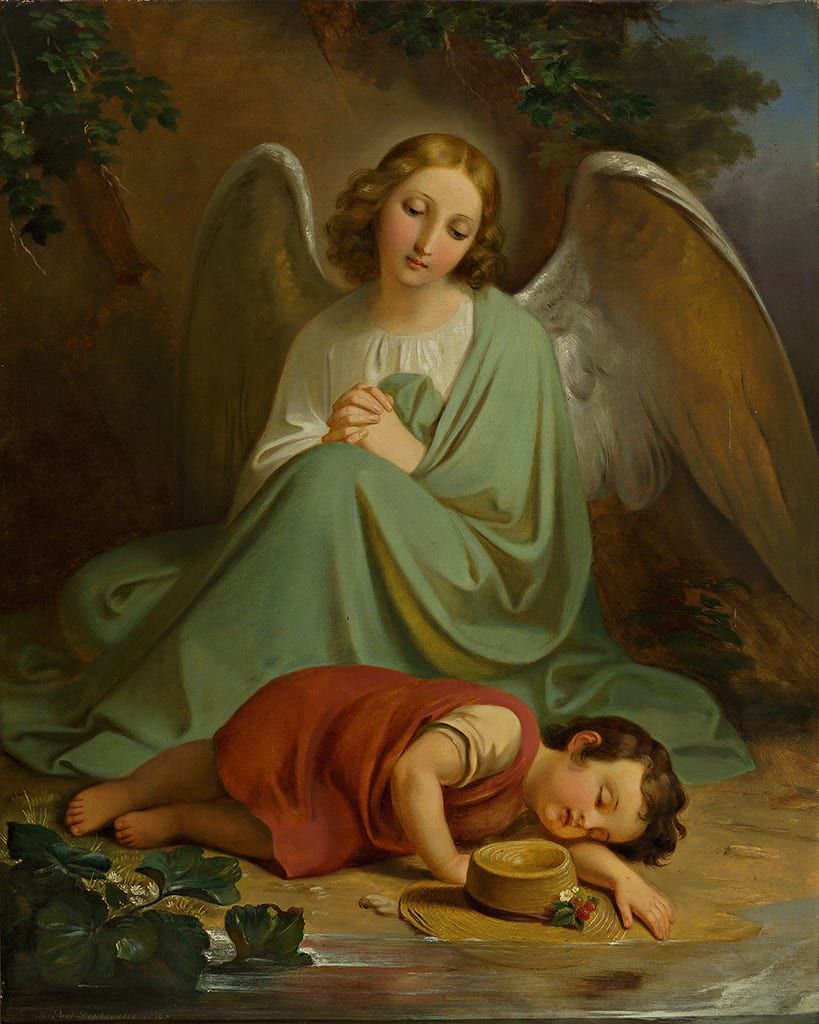
When it is said
Its English translator titled it “Before retiring to Rest”, a prayer for the last moments of the day.
One line speaks of Christ’s body “which I have eaten”, meaning Holy Communion, which Orthodox children receive from infancy.
Where it comes from
Author by tradition
Who wrote it?
Tradition credits it to St Ephrem the Syrian. He served as a deacon in Nisibis, later lived in Edessa, and died in AD 373. The prayer is one of 76 Exhortations to Penitence printed in Syriac under his name in the Roman edition of his works (1732 to 1743). The Syriac scholar G. M. Kessel notes that some of those chapters are certainly not Ephrem’s own, so this one may be later.
Henry Burgess, Select Metrical Hymns and Homilies of Ephraem Syrus (1853), Introduction; G. M. Kessel, a bibliographical index of St Ephrem’s works translated from Syriac (Azbyka, in Russian); Wikipedia, “Ephrem the Syrian”
Straight from the Syriac
The Anglican priest Henry Burgess translated the prayer from the Syriac and published it in London in 1853. He warned that the old Latin translation of these hymns could not be trusted, and he showed why from this prayer. Its plain words “by Thy sacrifice” had become, in the Latin, a long phrase about the sacrifice offered to the eternal Father on the most holy altar of the Cross.
Henry Burgess, Select Metrical Hymns and Homilies of Ephraem Syrus (1853), notes to Hymn 27
What the words mean
The living Watcher
Burgess explains the last lines in a note. The Syriac word he put into verse as “guardian Spirit” is one that church writers used for the guardian spirits thought to watch over good people. Here the prayer calls Christ “Thou living watcher”, and in its last line the one praying takes the same word for himself, “a watcher for Thy praise”.
Henry Burgess, Select Metrical Hymns and Homilies of Ephraem Syrus (1853), notes to Hymn 27
The Scripture in it
I will lie down and sleep in peace, for You alone, O LORD, make me dwell in safety.
Your hands have made me and fashioned me; give me understanding to learn Your commandments.
… that the creation itself will be set free from its bondage to decay and brought into the glorious freedom of the children of God.
Bible text: Berean Standard Bible, public domain.