
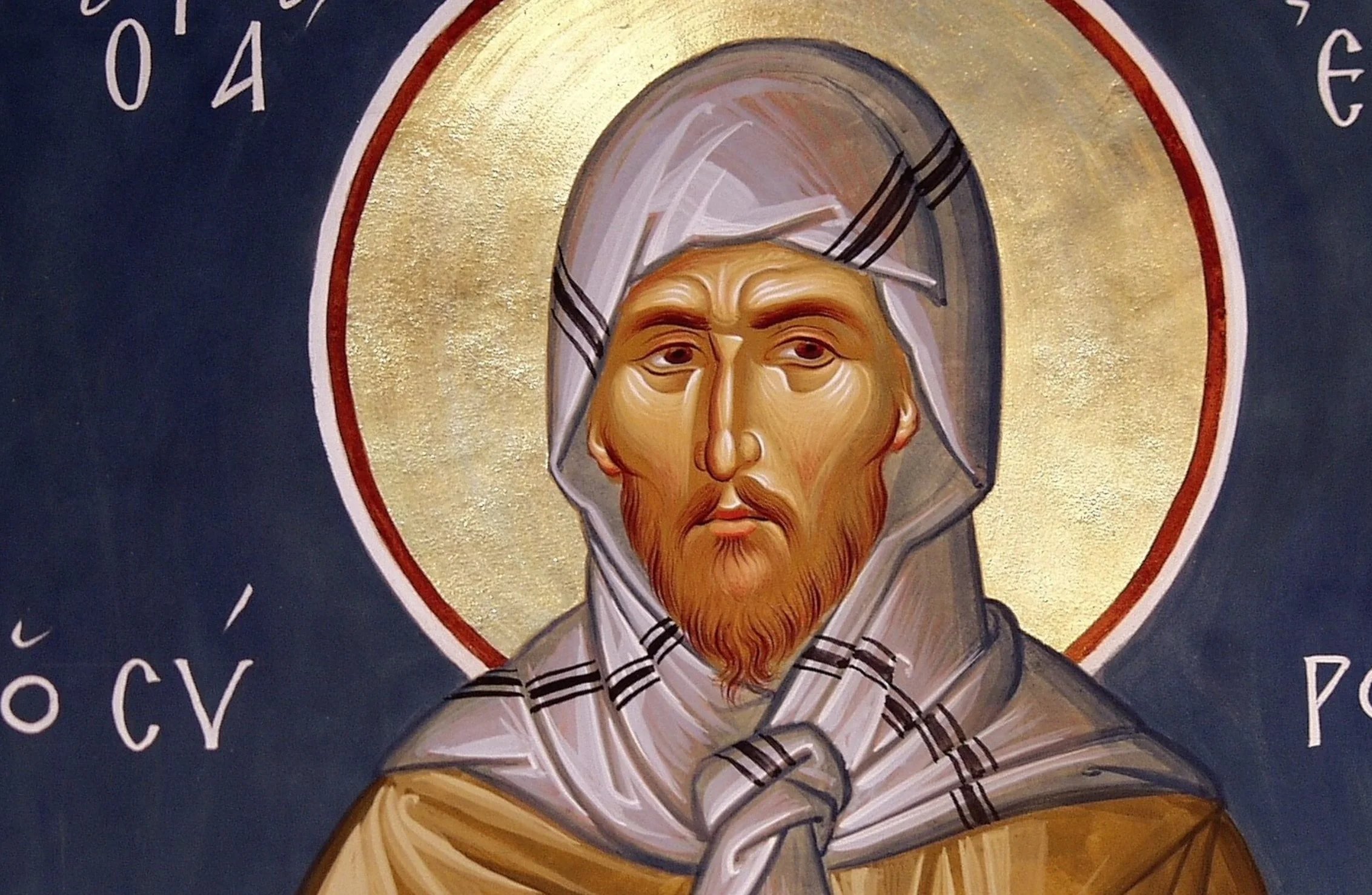
Ephrem the Syrian
A Syrian deacon and poet who wrote a hymn begging God to hold back the flood while a Persian army turned a river against the walls of his city.
Who was Ephrem?
Ephrem the Syrian was a deacon of the 300s in Edessa, near Rome’s border with Persia. When Syria was singing the popular songs of Harmonius, which spread ideas the Church rejected, he wrote hymns of the true faith to the same tunes. Within 20 years of his death, some churches read his writings in services, after the Bible readings.
at a glance
His path, in order
- Poet of NisibisWrote prayers in the voice of his besieged city
- RefugeeLeft when a treaty handed Nisibis to Persia, AD 363
- Famine nurseSet up 300 beds for Edessa’s starving in his last year
- Doctor of the ChurchNamed a teacher of the whole Church by the Pope, 1920
in numbers
- About how many of his hymns survive400
- Kept in copies made in the 500s
- Sung to some 50 tunes, each named at the head of its hymn
- Persian sieges he lived through3
- At Nisibis, in AD 338, 346 and 350
- The city held out every time
did you know?
-
One of the four great early copies of the Greek Bible, made in the 400s, had faded by the 1100s, so a scribe wrote Greek translations of works credited to Ephrem over its pages. Scholars have since read much of the old Bible underneath, and the book, now in Paris, is still called the Codex Ephraemi Rescriptus, Ephrem’s book written over.
J. F. Fenlon, Catholic Encyclopedia (1908) -
In Ephrem’s day the Syriac churches knew the Gospels as a single book, the Diatessaron, made in the 100s by weaving all four into one telling of Jesus’s life. Ephrem’s commentary on the Gospels follows that one book.
J. Labourt, Catholic Encyclopedia (1909); John Gwynn, introduction to Ephrem’s works (1898) -
The Orthodox book of Lenten services sets readings from writings under Ephrem’s name at morning prayer on every weekday of Lent. Ephrem wrote in Syriac, but most of these were almost certainly first written in Greek, by monks who lived after him.
Ephrem Lash, note on the Greek works under St Ephrem’s name (1997)
- Born
- About 306, in or near Nisibis (now Nusaybin, on Turkey’s border with Syria)
- Died
- Probably 9 June 373 at Edessa (now Şanlıurfa in south-east Turkey), aged about 67
- Buried
- First in Edessa’s cemetery for foreigners, later among its bishops
- Also called
- Ephraim; the harp of the Spirit
- Home
- Nisibis until AD 363, then Edessa
- Parents
- Christians, by his own account
- Office
- Deacon, never a priest or bishop
- Language
- Syriac; he knew little or no Greek
- Translated
- Into Greek, while he was still alive
- Wrote
- Hymns, sermons in verse and commentaries on Genesis and the Gospels
- Status
- A saint in East and West, and a Doctor of the Church to Catholics
- Feast day
- Orthodox on 28 January, Catholic on 9 June
- Looked like
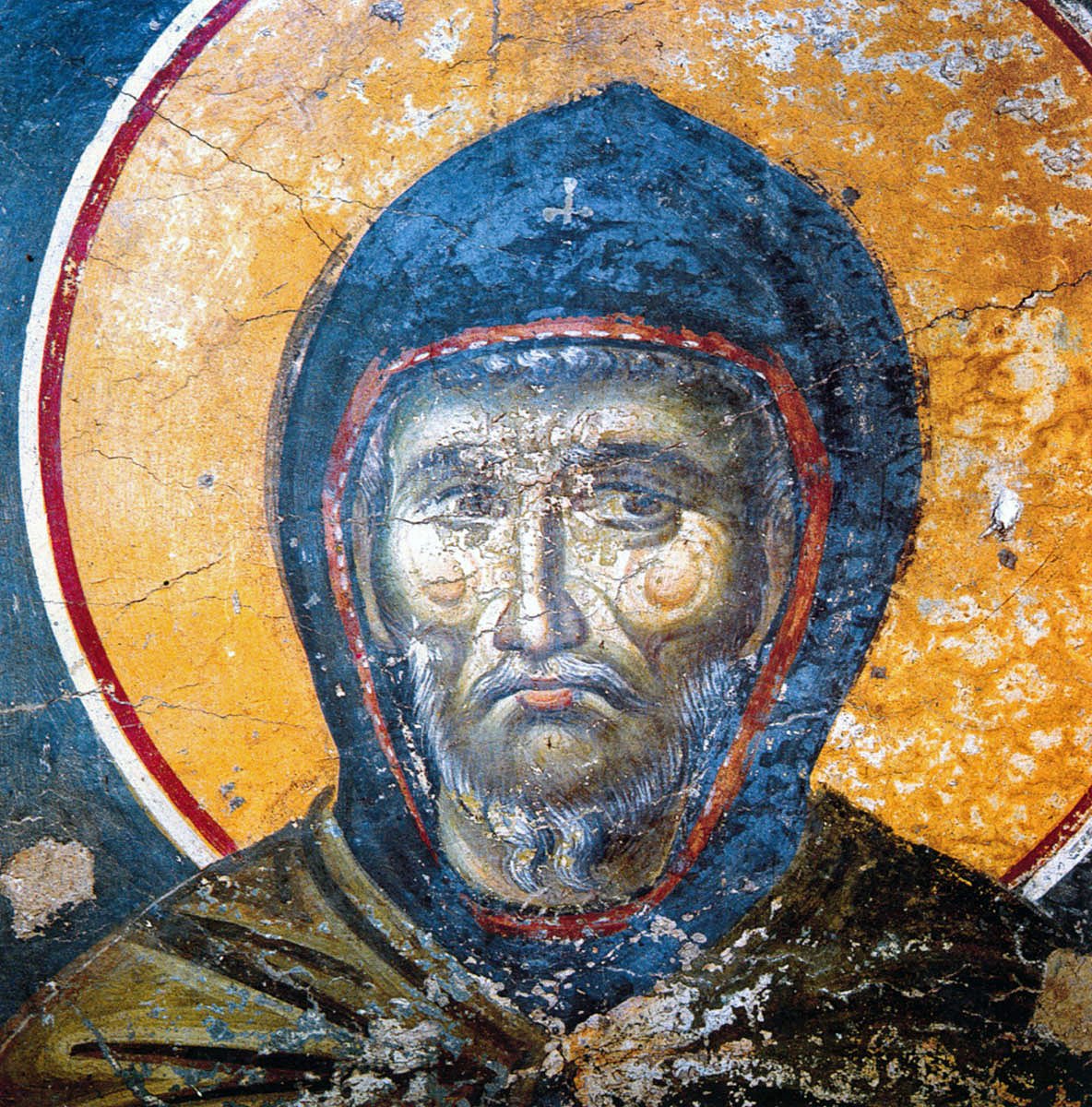
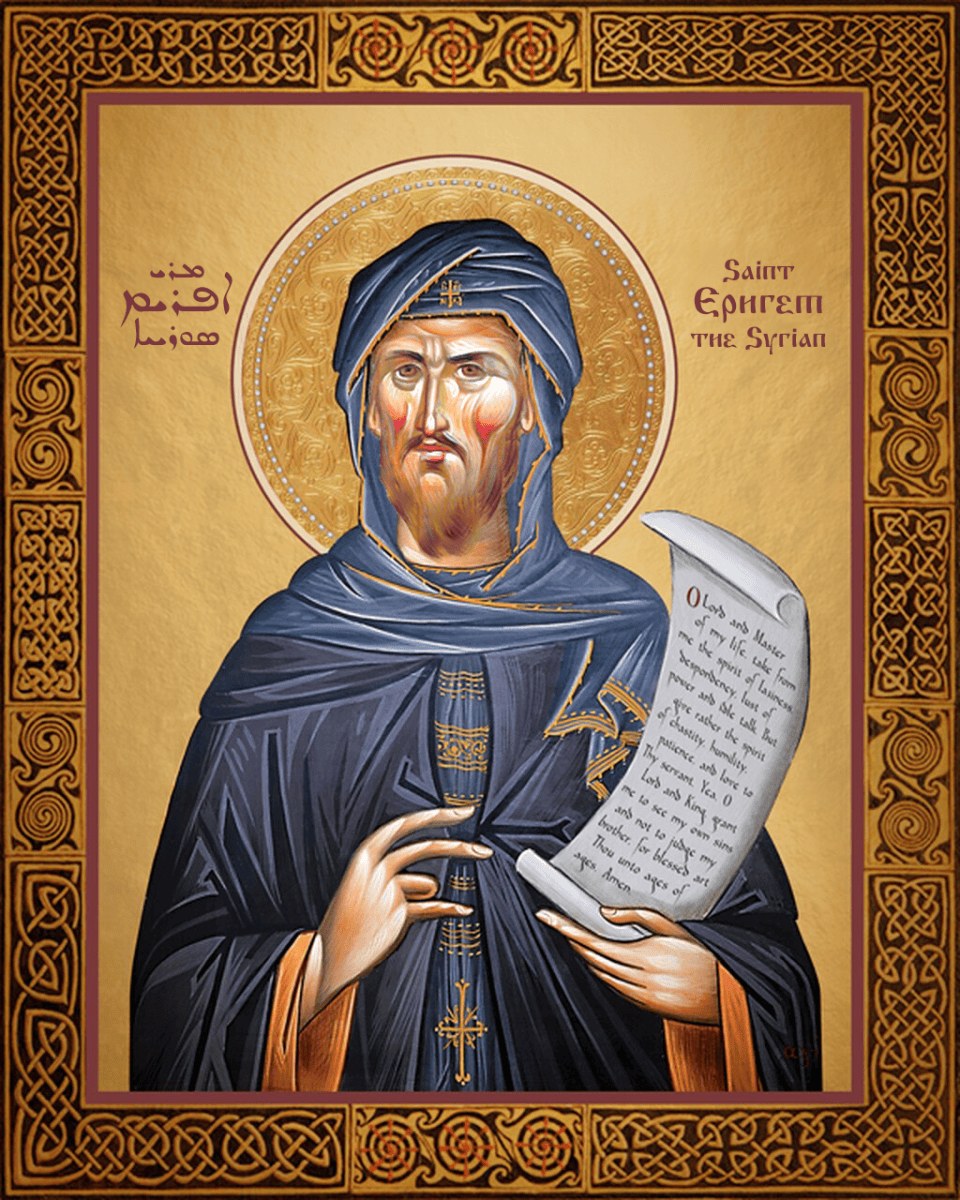
- No portrait from life survives, but a Syriac Life of the 500s describes him as short, bald and beardless.
feast days
East and West
West
- Jun9
Catholic, a feast each church may keep or leave. Also the Church of England.
- Jun10
Episcopal Church (USA), as Ephrem of Nisibis, deacon and poet.
East
- Jan28
Orthodox, with Isaac the Syrian. On the old (Julian) calendar, 13 days behind, it falls on 10 February.
- Jul22
Coptic Orthodox, as 15 Abib in the Coptic calendar.
The western 9 June is the day a chronicle kept at Edessa gives for his death in AD 373. The Syriac Orthodox keep him on the Saturday of the first week of Lent, and also on 28 January and 19 February.
what was he like?
+Never let his temper show
Ephrem had a quick temper by nature, but from the time he gave himself to a strict life of prayer and fasting, he never showed anger toward anyone.
When a servant brought him food after several days of fasting and dropped the dish, Ephrem saw how ashamed and frightened the man was. He told the man to take heart, and said that since the food would not come to them, they would go to the food. Then he sat down beside the broken pieces and ate his supper.
Sozomen, Ecclesiastical History 3.16 (about AD 443), tr. Chester D. Hartranft (1890)+Ran from being made a bishop
A town once chose Ephrem as its bishop and sent men to carry him off to be ordained.
As soon as he saw what they meant to do, Ephrem ran into the market place and played the madman, staggering about, dragging his clothes along the ground and eating in the street. The men decided he had lost his mind and went home, and he stayed in hiding until another man had been made bishop in his place.
Sozomen, Ecclesiastical History 3.16, tr. Chester D. Hartranft (1890)+Warned against prying
into God
Ephrem’s Hymns on Faith answer the Arians, who taught that the Son of God was a created being, lower than the Father. Ephrem saw their error as prying, searching into the depths of God when they should have been praising Him.
Among them is The Pearl, seven short hymns in which he turns a pearl in his palm to look at one side of it, but it has no side, only a face that shines all round. He sees in it that the Son cannot be fully grasped, since He is wholly light.
When he asks whether it holds still more mysteries, it answers, “Search thou out the sea, but search not out the Lord of the sea!”
Ephrem, The Pearl 1, tr. J. B. Morris, revised by John Gwynn (1898); Sebastian Brock (2011) on the hymns on faith+Struck by a stranger’s answer
Ephrem would not even look at women, so that no one could gossip about him. Once a woman with a bad name, who had either set out to tempt him or been paid to, stood in front of him and stared, and he told her to look at the ground.
She answered that woman was made from man, but man from the earth (Genesis 2:7, 22), so he should look at the ground he came from, and she at him. Ephrem was so astonished that he wrote the whole exchange into a book, which most Syrians in the 400s counted among his best.
Sozomen, Ecclesiastical History 3.16, tr. Chester D. Hartranft (1890)what others said of him
I once read in Greek a volume by him On the Holy Spirit, which some one had translated from the Syriac, and recognized even in translation, the incisive power of lofty genius.
His style of writing was so replete with splendid oratory and with richness and temperateness of thought that he surpassed the most approved writers of Greece.
Ephraim, harp of the Spirit, who daily waters the people of Syria with the streams of grace
his life in six moments
Nisibis
Early 300sBorn into the faith
Ephrem grew up in Nisibis, a Roman fortress city on the border with Persia. A Syriac Life of Ephrem written two centuries later makes his father a pagan priest who beat him and drove him from home for talking with Christians. But in a hymn of his own, Ephrem says, “I was born in the way of truth,” and writes that as a boy he did not see what a gift that was until hard times came.
Ephrem, Hymns against Heresies 26, and John Gwynn’s summary of the Syriac Life (1898)Nisibis
AD 350The flood at the walls
In AD 350 the Persian king Shapur II besieged Nisibis. His men dammed the river until the city stood in a lake. In a hymn written during the siege, Ephrem reminded God of the rainbow He gave Noah (Genesis 9:13-15): “Stretch forth Thy bow against the flood, for lo! it has lifted up its waves against our walls!”
When the water broke down a stretch of wall, Shapur sent in his horses and elephants, but they floundered in the flooded, churned-up ground. By morning the people had built a new wall across the gap, and Shapur gave up the siege and marched away. In his hymn of thanks afterwards, Ephrem sang that God “has saved us without wall, and taught us that He is our wall”.
Ephrem, Nisibene Hymns 1 and 2, tr. J. T. Sarsfield Stopford (1898); John Gwynn on the siege (1898)Nisibis to Edessa
AD 363Leaving a city given to Persia
In June AD 363 the emperor Julian died fighting deep inside Persia. His successor Jovian, stranded there with what was left of the Roman army, bought a safe way home with a peace treaty that handed Nisibis to Persia. The Christians of Nisibis had to leave the city, which now belonged to a kingdom that was persecuting Christians.
Ephrem went with them and settled at Edessa, a Roman city to the west, where he spent the last 10 years of his life.
Sebastian P. Brock (2011); J. Labourt, Catholic Encyclopedia (1909); John Gwynn (1898)Edessa
AD 363 to 373Songs against songs
Long before Ephrem’s time, Harmonius had written the first Syriac songs set to metre and music. He was the son of Bardaisan, who about AD 200 had founded a teaching of his own that the Church rejected. Harmonius kept some of his father’s errors and worked them into his songs, along with the Greek philosophers’ ideas about the soul and the body.
In Ephrem’s day people still sang them, charmed by the words and the tunes, and Ephrem feared they would take in the beliefs along with the songs. So he studied how Harmonius’s verses worked and wrote hymns of his own to the same tunes, filled with the Church’s teaching. From then on the Syrians sang Ephrem’s words to Harmonius’s melodies.
Sozomen, Ecclesiastical History 3.16; Theodoret, Ecclesiastical History 4.26Edessa’s churches
His last decadeThe women’s choirs
To bring his hymns into the churches, Ephrem trained choirs from among the Daughters of the Covenant, women who had promised to stay unmarried and serve the church.
In the Syriac Life of Ephrem, the women sing his hymns in church every morning and evening, at the shrines of the martyrs and at funerals, with Ephrem standing among them and singing too. The Syriac poet Jacob of Serugh wrote a sermon in verse in Ephrem’s honour in the early 500s, and it remembers him above all for his work with these women.
Joseph Amar on Jacob of Serugh’s homily, and Sebastian Brock (2011); the Syriac Life 31, in T. J. Lamy’s Latin (1886)Edessa
AD 372 to 373The famine
In Ephrem’s last year a great famine struck Edessa, and people across the countryside were dying. Ephrem went to the city’s rich and asked why they let people starve while their wealth went to waste, to the ruin of their own souls.
They answered that they had no one honest enough to hand out what they gave. When Ephrem asked them, “What do you think of me?” they said they knew him to be a man of God, so he told them to trust him with it.
With their money he set up about 300 beds in the city’s covered walkways. There he nursed the starving and buried those who died, feeding people from the city and the villages alike, until the next harvest came and everyone went home.
Palladius, Lausiac History 40 (about AD 420), tr. W. K. Lowther Clarke (1918); Sozomen, Ecclesiastical History 3.16
his miracles and visions
The wonders told of Ephrem come from writers of the 440s to the 600s, and from his Testament, a farewell poem that bears his name but may be by a later hand.
2 dreams about his words
-
On his mother’s lap
A small childA vine from his tongue
As a small child lying on his mother’s lap, Ephrem dreamed that a vine grew from his tongue and spread until it reached heaven. All creation came to gather its fruit, and the more came, the more its clusters grew. The dream is told in the Testament, a farewell poem that bears his name. In it the clusters are his sermons and the leaves his hymns, all of them God’s gift to him.
“There grew a vine-shoot on my tongue: and increased and reached unto heaven, And it yielded fruit without measure: leaves likewise without number.”
The Testament that bears Ephrem’s name, tr. John Gwynn (1898); the Syriac Palladius, tr. E. A. Wallis Budge (1907) -
Edessa
His teaching yearsThe scroll no one else could hold
A holy man dreamed that angels came down from heaven, one of them holding a scroll written on both sides. They asked one another who could be trusted with it. Some named one man and some another, and each time the rest answered that he was holy but not holy enough, until at last they gave the scroll to Ephrem.
The next morning the holy man heard people saying that Ephrem was teaching and that words flowed from his mouth like water from a spring. He understood then that what Ephrem said came from the Holy Spirit.
“No man is fit to be entrusted with this thing except Ephraim”
The angels, in the holy man’s dream
The Syriac Palladius, chapter 58, in The Paradise of the Holy Fathers, tr. E. A. Wallis Budge (1907)
Gnats against the Persian army
In Theodoret’s history of the 440s, the Persian king Shapur has besieged Nisibis and turned its river against the walls. The water has broken down part of the wall, and the people have built it up again. Ephrem begs Bishop Jacob to go up on the wall and curse Shapur’s army.
Jacob climbs one of its towers, sees the huge army and asks God only for clouds of gnats and mosquitoes, so that the Persians will learn His power from tiny creatures. The insects fill the trunks of the Persians’ war elephants and the ears and nostrils of their horses. Unable to bear them, the animals break their bridles and throw their riders, until the whole Persian army flees.
“So the wretched prince learned by a slight and kindly chastisement the power of the God Who protects the pious”Theodoret, Ecclesiastical History 2.26, tr. Blomfield Jackson (1892)
his words
Most of what Ephrem wrote is hymns. In one of his hymns on the Nativity, childless wives hold the newborn Christ and ask Him to bless their wombs. Their plea is prayed today as Have mercy on our barrenness, a prayer for couples hoping for a child.
To the Christ child
We come to see Thee as God, and, lo! Thou art a man: we come to see Thee as man, and there shineth forth the Light of Thy Godhead!
For a wonder it is that God as a Babe should show Himself.
Who would believe that Thou art the Heir of David’s Throne? A manger hast Thou inherited out of [all] his beds, a cave has come down to Thee out of all his palaces.
Prayer and prying [come] from one mouth, and which shall we listen to?
Grace has drawn nigh to mouths, once blasphemous, and has made them harps; sounding praise.
what he wrote about the jews
Who his harsh words were aimed at
Ephrem’s hymns accuse the Jews of killing Christ, and some attack them with coarse insults. Older scholars took such lines as attacks on the Jews of his own cities.
The historian Christine Shepardson looks closely at his Hymns on Faith. Ephrem wrote them against the Arians, who taught that the Son of God was created and lower than the Father. Shepardson does not deny “the vitriol that Ephrem elsewhere pours directly onto the Jews”. But she argues that the harsh words in these hymns about the Jews of the Gospels are aimed mainly at the Arians, whom Ephrem likened to Christ’s enemies.
Christine Shepardson, in Hugoye 5.1 (2002)myths and misquotes
Ephrem wrote the Prayer of St Ephrem, the short prayer said with bows on the weekdays of Lent.
What the sources sayHe almost certainly did not write it, because it is not among his Syriac writings but comes down in Greek, among the many works later put under his name. The prayer asks God to take away idleness, despondency, love of power and idle talk, and to give chastity, humility, patience and love.Scholars note that these are the faults of monks living together in communities, a way of life that came after his time. Bishop Irenei Steenberg explains that the Church credits it to Ephrem as part of his “received legacy”, not as words from his own pen.
Ephrem Lash, note on the Greek works under St Ephrem’s name (1997); Irenei Steenberg on the Lenten prayer (2017)Ephrem was a monk who lived alone in a cave.
What the sources sayScholars today doubt it, because monks had not yet come to Syria in Ephrem’s day. The hermit’s cave comes only from the Syriac Life of the 500s. The historian Sozomen wrote in the 440s that Ephrem lived as a monk, and the Orthodox Church honours him as one.The scholar Joseph Amar holds that Ephrem was instead one of the Sons of the Covenant, unmarried men who promised to live chastely and serve their church.
Sozomen, Ecclesiastical History 3.16; Joseph P. Amar, Ephrem, Life of, in the Gorgias Encyclopedic Dictionary of the Syriac Heritage (2011)Basil the Great made Ephrem a deacon, and a miracle gave him the Greek language.
What the sources sayThis is a legend, first written down after AD 450 in the Syriac Life of Ephrem and a later Life of Basil, and scholars agree that Ephrem never knew more than a little Greek.In the story Ephrem hears Basil preach at Caesarea in Cappadocia, where he was bishop, and sees the Holy Spirit as a dove at Basil’s mouth, speaking the sermon. Ephrem asks Basil to pray that he may speak Greek, and they pray together. Then Basil lays his hand on Ephrem to make him a deacon and asks him to say the set response, and Ephrem says it in Greek.Scholars disagree over whether the two men ever met. The Catholic Encyclopedia of 1909 thought the meeting “not improbable”, while Joseph Amar calls the visit fictitious. No early source says who made Ephrem a deacon.
J. Labourt, Catholic Encyclopedia (1909); Joseph P. Amar (2011); David G. K. Taylor, in Hugoye 1.2 (1998); John Gwynn’s summary of the Life (1898)An early sermon by Ephrem teaches that Christians will be taken up to the Lord before the great tribulation at the end of the world.
What the sources sayThe sermon is the work of a later, unknown preacher, and scholars disagree over whether it teaches this at all. On the Last Times survives in Latin copies from the 700s on. Scholars call its author Pseudo-Ephraem and date him anywhere from just after Ephrem’s death to the early 600s.One line has all the saints gathered and taken to the Lord before the tribulation, and Thomas Ice of the Pre-Trib Research Center and other believers in a rapture before the tribulation cite it. The scholar David Bennett answers that later in the sermon many Christians live through the tribulation, so he reads the line as God shielding the saints within it, not taking them out of it.
Thomas Ice, Pre-Trib Research Center; David Malcolm Bennett, Evangelical Quarterly 80.2 (2008)friends, family and rivals
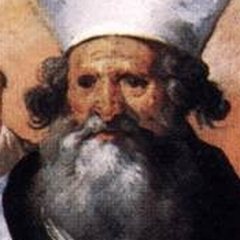 Basil the Great
In a sermon on the creation, Basil explained the Spirit moving over the waters (Genesis 1:2) as brooding, the way a bird warms her eggs with her body, and said he had the idea from a Syrian. Some scholars take the Syrian to be Ephrem, and Sozomen wrote that Basil admired Ephrem’s learning.
Sozomen 3.16; Basil, Hexaemeron 2.6 and its editors’ noteJacob was bishop of Nisibis while Ephrem was growing up. The city buried him inside its walls when he died in AD 338.
In AD 350 the Persians besieged Nisibis and turned a river against its walls. Afterwards Ephrem wrote a hymn on its bishops that credited the rescue to two of them. Vologeses was bishop that year, and the hymn says his prayers secretly mended the city’s breaches, while Jacob’s body within its walls became a wall around it.
Ephrem, Nisibene Hymns 13; John Gwynn (1898)Paulonas learned from Ephrem and became a gifted preacher who could speak well on the spot. Ephrem sensed that he kept reaching after new ideas about God, and often called him a new Bardaisan, after the teacher whose followers Ephrem opposed. After Ephrem died, Paulonas left the Church and wrote against its faith.
Gennadius, Lives of Illustrious Men 3The son of Ephrem’s sister, Absamya became a priest and wrote hymns like his uncle. About AD 404 he composed a set of them, with sermons, on the coming of the Huns into Roman lands.
The Chronicle of Edessa, entry 47how he died
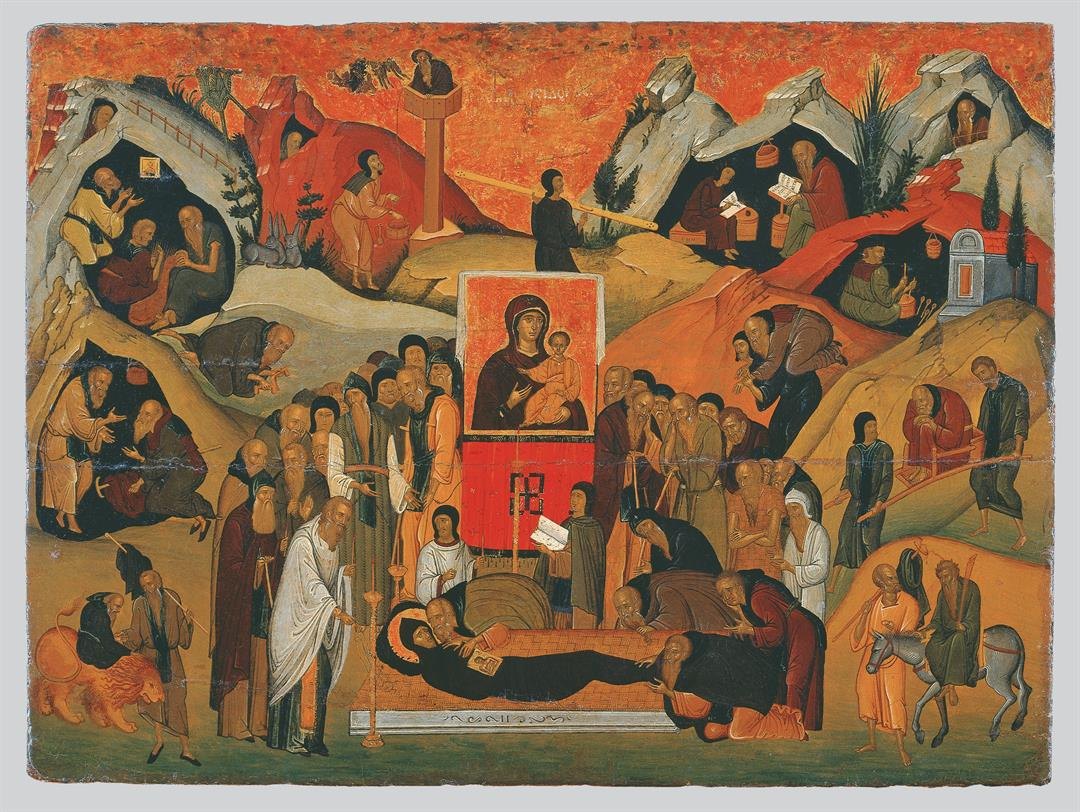
After a year spent nursing Edessa’s starving through a famine, Ephrem went back to his room and died there within a month, probably on 9 June AD 373.
No early source names the cause. About AD 420 the historian Palladius wrote that God had given Ephrem this last work of mercy just before his end, as a chance to gain a crown in heaven.
The Testament that bears his name asks for a poor man’s burial, with no spices, candles or shroud. It forbids his friends to lay him under an altar, beside the martyrs or in their family tombs, and asks to be buried among the foreigners: “I am a stranger, as they were: with them, O my brethren, lay me!”
To Paulonas, standing by his deathbed
See to it, Paulonas that you do not yield yourself to your own ideas, but when you shall think that you understand God wholly, believe that you have not known
As Gennadius reported it, writing about AD 480
is he a saint?
Every ancient church honours Ephrem as a saint.
- OrthodoxSaintHonoured as a monk on 28 January
- CatholicSaintAlso a Doctor of the Church, since 1920
- Syriac churchesSaintHis hymns shape their worship
- CopticSaintIn its calendar on 15 Abib (22 July)
- AnglicanRememberedChurch of England 9 June, Episcopal Church 10 June
He was honoured as a saint long before any church had a process for declaring saints. The Catholic Church gives the title Doctor to saints whose teaching it holds up to the whole Church. Pope Benedict XV gave it to Ephrem on 5 October 1920, after the Syrian Catholic, Maronite and Chaldean patriarchs asked him to.
a prayer he wrote
Ephrem wrote a hymn in the voice of Nisibis herself, probably in AD 359, when the Persian king Shapur invaded Roman lands again and the city’s defenders kept watch on its walls. In the two verses below, the city reminds Christ that He was once a child and begs mercy for her children, whose cries mix with the voices of the flock calling on the Shepherd to save them from every harm. The first is prayed today as St Ephrem’s prayer for children. His prayer for peace comes from the hymn’s last verses, where the city asks God to quiet the cries of terror on her walls with the voice of peace.
Have mercy, O Lord, on my children! in my children call to mind Thy childhood, Thou Who wast a child! Let them that are like Thy childhood, be saved by Thy grace!
Mingled in the midst of the flock, are the cry of the innocents, and the voice of the sheep, that call on the Shepherd of all, to deliver them from all.
what to read first
Hymns on the Nativity
Ephrem, tr. J. B. Morris (1847), revised by John Gwynn (1898)
His best-known hymns, on God born as a child in a cave at Bethlehem.
Read it freeThe Pearl
Ephrem, tr. J. B. Morris, revised by John Gwynn (1898)
Seven short hymns on faith, built around a pearl he turns in his hand.
Read it freeNisibene Hymns
Ephrem, tr. J. T. Sarsfield Stopford (1898)
The siege of AD 350, when the Persians turned a river against the walls, and the bishops of his city, in his own words.
Read it freeEcclesiastical History, book 3, chapter 16
Sozomen, about AD 443, tr. Chester D. Hartranft (1890)
The fullest early portrait, with his hymns, his temper and the famine.
Read it freetake the quizzes
 Quiz Which early Christian
thinks like you? And which would argue with you? Start
 Quiz Christian


Personality Test Which of eight types are you? Find your own. Start
people like him
 Ambrose of Milan
Ambrose also taught his people to sing their faith against the Arians. When the empress Justina took the Arians’ side and persecuted him at Milan, his people kept guard in the church, ready to die with him.
To keep them from wearing out in that long watch, they began to sing hymns and psalms “after the manner of the Eastern Church”, a custom that, Augustine wrote, almost every church had taken up since.
Augustine, Confessions 9.7 Isaac the Syrian
Writing in the 600s, Isaac urges readiness for death with an image he credits to Ephrem. The soul should always be like a ship made ready to sail, because it never knows when its wind will come. Both saints wrote in Syriac, and the Orthodox remember them on the same day, 28 January.
Isaac of Nineveh, Mystic Treatises 62; OCA, 28 Januarysources
His life
- Palladius, Lausiac History 40, about AD 420. Tr. W. K. Lowther Clarke, 1918.
- Sozomen, Ecclesiastical History 3.16, about AD 443. Tr. Chester D. Hartranft, 1890.
- Theodoret, Ecclesiastical History 2.26 and 4.26. Tr. Blomfield Jackson, 1892.
- Theodoret, Letters 145 and 151. Tr. Blomfield Jackson, 1892.
- Jerome, Lives of Illustrious Men 115, 392. Tr. Ernest Cushing Richardson, 1892.
- Gennadius, Lives of Illustrious Men 3 and 67, about AD 480. Tr. Ernest Cushing Richardson, 1892.
- The Chronicle of Edessa, about AD 540. English in the Journal of Sacred Literature, 1864.
- The Paradise of the Holy Fathers, chapter 58. The Syriac Palladius, tr. E. A. Wallis Budge, 1907.
- Sancti Ephraem Syri Hymni et Sermones, volume 2. The Syriac Life with T. J. Lamy’s Latin, 1886.
- Basil, Hexaemeron 2.6. Tr. Blomfield Jackson, 1895.
- Augustine, Confessions 9.7. Tr. J. G. Pilkington, 1886.
- Isaac of Nineveh, Mystic Treatises 62. Tr. A. J. Wensinck, 1923.
His words
- Ephraim Syrus, Nicene and Post-Nicene Fathers, second series, volume 13. Tr. John Gwynn and others, 1898, with Gwynn’s introduction and his translation of the Testament.
- Nisibene Hymns. Tr. J. T. Sarsfield Stopford, revised by John Gwynn.
- Hymns on the Nativity. Tr. J. B. Morris, revised by John Gwynn.
- The Pearl. Tr. J. B. Morris, revised by John Gwynn.
- Homily on Our Lord. Tr. A. Edward Johnston.
Reference
- Sebastian P. Brock, Ephrem, in the Gorgias Encyclopedic Dictionary of the Syriac Heritage, 2011.
- Joseph P. Amar, Ephrem, Life of, in the same, 2011.
- David G. K. Taylor, St. Ephraim’s Influence on the Greeks, Hugoye 1.2, 1998.
- Christine Shepardson, Exchanging Reed for Reed, Hugoye 5.1, 2002.
- J. Labourt, St. Ephraem, Catholic Encyclopedia, 1909.
- J. F. Fenlon, Codex Ephraemi Rescriptus, Catholic Encyclopedia, 1908.
- Benedict XV, Principi Apostolorum Petro, 5 October 1920.
- Ephrem Lash, on the Greek works under St Ephrem’s name, 1997.
- Irenei Steenberg, on the Lenten prayer, 2017.
- Thomas Ice, The Rapture in Pseudo-Ephraem, Pre-Trib Research Center.
- David Malcolm Bennett, Raptured or not raptured?, Evangelical Quarterly 80.2, 2008.
Calendars
- Orthodox Church in America, Venerable Ephraim the Syrian, 28 January.
- Vatican News, saints of 9 June.
- Church of England, Common Worship calendar, 9 June.
- The Episcopal Church, Lesser Feasts and Fasts 2022, 10 June.
- Coptic Synaxarium, 15 Abib.
Pictures
- St Ephrem, mosaic, 11th century. Monastery of Hosios Loukas, Greece. Photo: C messier, CC BY-SA 4.0. The band and the hub card.
- St Ephrem, fresco credited to Manuel Panselinos, early 1300s. Protaton church, Mount Athos. Public domain.
- Ephrem the Syrian (mosaic in Nea Moni), 11th century. Nea Moni monastery, Chios. Public domain.
- Dormition of Saint Ephraim the Syrian, Cretan icon, mid-1400s. Byzantine and Christian Museum, Athens. Public domain.