
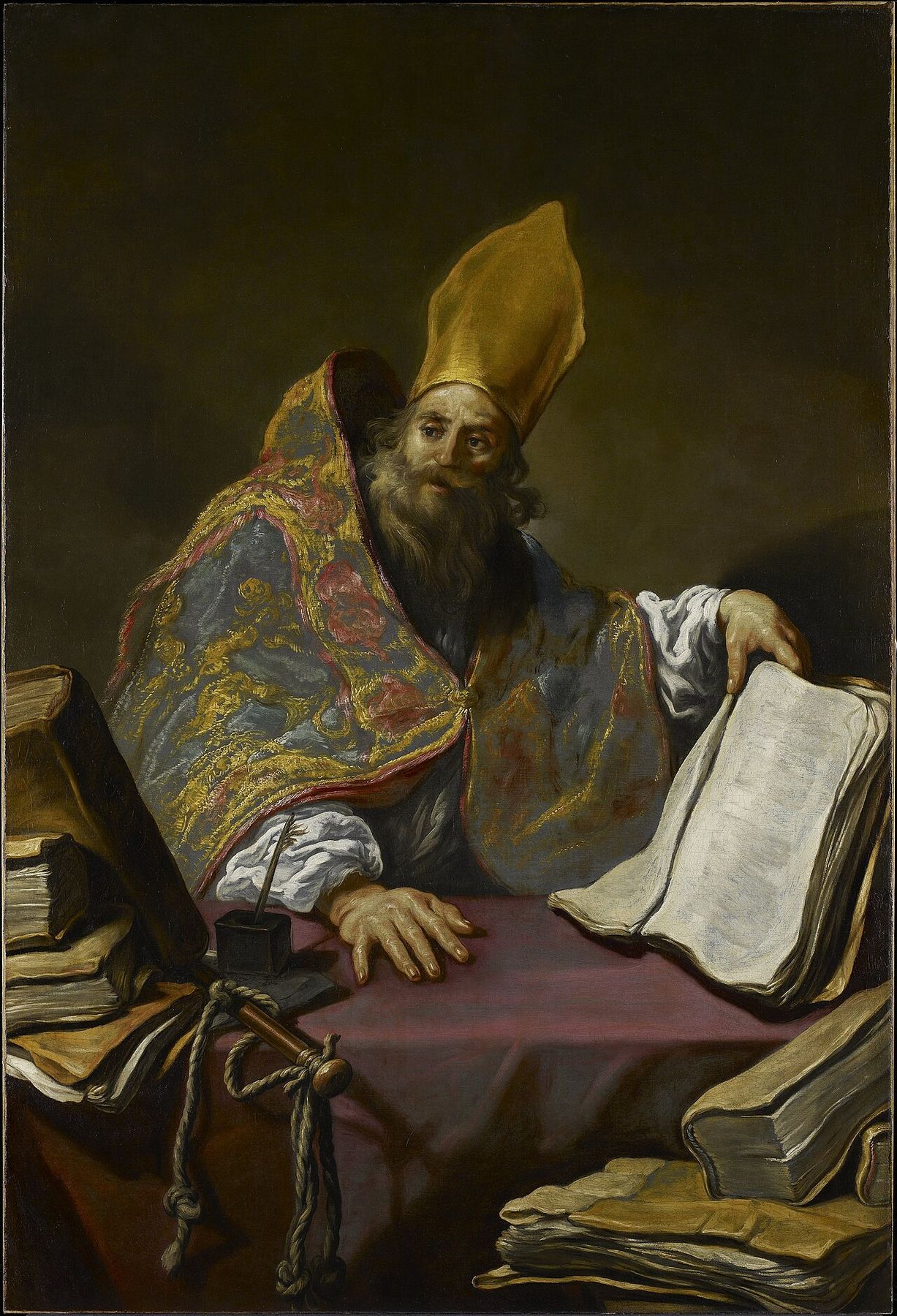
Ambrose of Milan
A Roman governor, made bishop by a crowd, who baptised Augustine and brought an emperor to public penance.
Picture: Saint Ambrose, Claude Vignon, 1623 or 1625. Minneapolis Institute of Art. Public domain.
Who was Ambrose?
Ambrose was the Roman governor at Milan in 374, when the city nearly rioted over its next bishop. He went to the church to keep the peace, and the crowd chose him, though he was not yet baptised. As bishop he preached, wrote hymns and baptised Augustine. He stood up to emperors, and brought one to public penance.
at a glance
His path, in order
- LawyerPleaded cases at the prefect's court
- GovernorOf Liguria and Aemilia, about 370
- BishopOf Milan, 374 to 397
in numbers
- Days from baptism to bishop8
- Made bishop on 7 December 374, still his feast day
- Said to have held every office of the Church in between
- Bishops it took to do his baptising5
- After he died, five bishops shared the baptising he had done alone
- Even the five of them, says his secretary Paulinus, found it hard
did you know?
-
When Augustine's mother Monica died, he held back his tears all day. Then he slept, and woke with Ambrose's hymn Deus Creator omnium in his mind. It praises God for sleep, which eases anxious grief. At last he let himself weep.
Augustine, Confessions, Book 9, chapter 12 -
Frigitil, a queen of the Marcomanni, heard of Ambrose and believed. She asked him to write out the faith for her. He did, and urged her to keep her husband at peace with Rome. She hurried to Milan to meet him, but he had died.
Paulinus, Life of St Ambrose, chapter 36 -
His handbook for his clergy, On the Duties, takes its title and plan from Cicero's book On Duties. Cicero wrote his for his son. Ambrose wrote his, he says, for his children in the Gospel.
On the Duties of the Clergy, Book 1, chapter 7, and its translators' introduction -
His hymns are built of short verses: four lines of eight syllables, easy to learn and sing. For centuries, almost every hymn in Latin worship kept that shape.
Catholic Encyclopedia, Ambrosian Hymnography
- Born
- About 339 or 340, probably at Trier, in today's Germany. His father, also called Ambrose, then ran the Roman prefecture of Gaul.
- Grew up
- At Rome, after his father died. His widowed mother raised him with his elder sister Marcellina and his elder brother Satyrus.
- Died
- 4 April 397, at Milan, before dawn, after an illness of many days. It was the Saturday before Easter.
- Buried
- In his own basilica at Milan, today Sant'Ambrogio, beside the martyrs Gervasius and Protasius. The three bodies were found together under the altar in 1864.
- Also called
- Ambrosius, in Latin. Sant'Ambrogio, in Italian. Greek and Russian calendars call him bishop of Mediolanum, the old name of Milan.
- Status
- A saint to Catholics and Orthodox, and a Doctor of the Church. Anglicans and Lutherans keep his day too.
- Patron of
- Milan, and beekeepers, says Britannica.
- In art
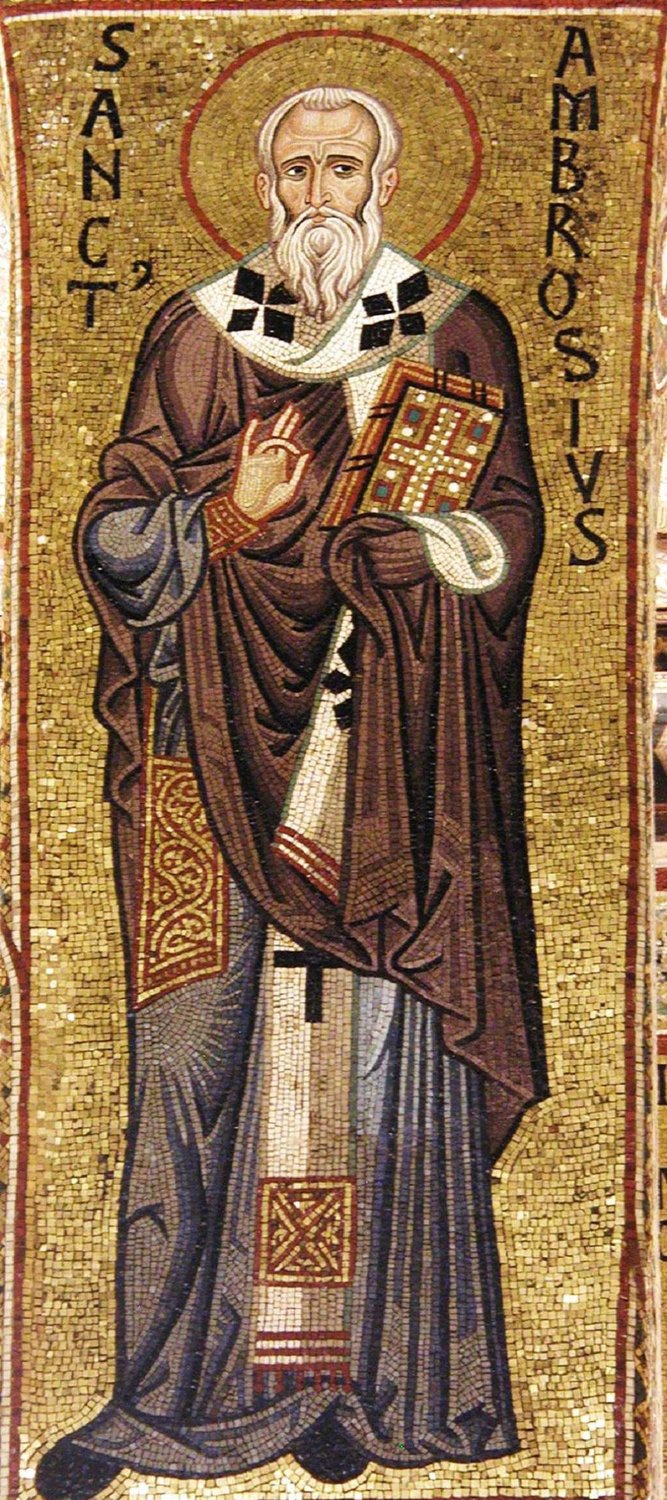
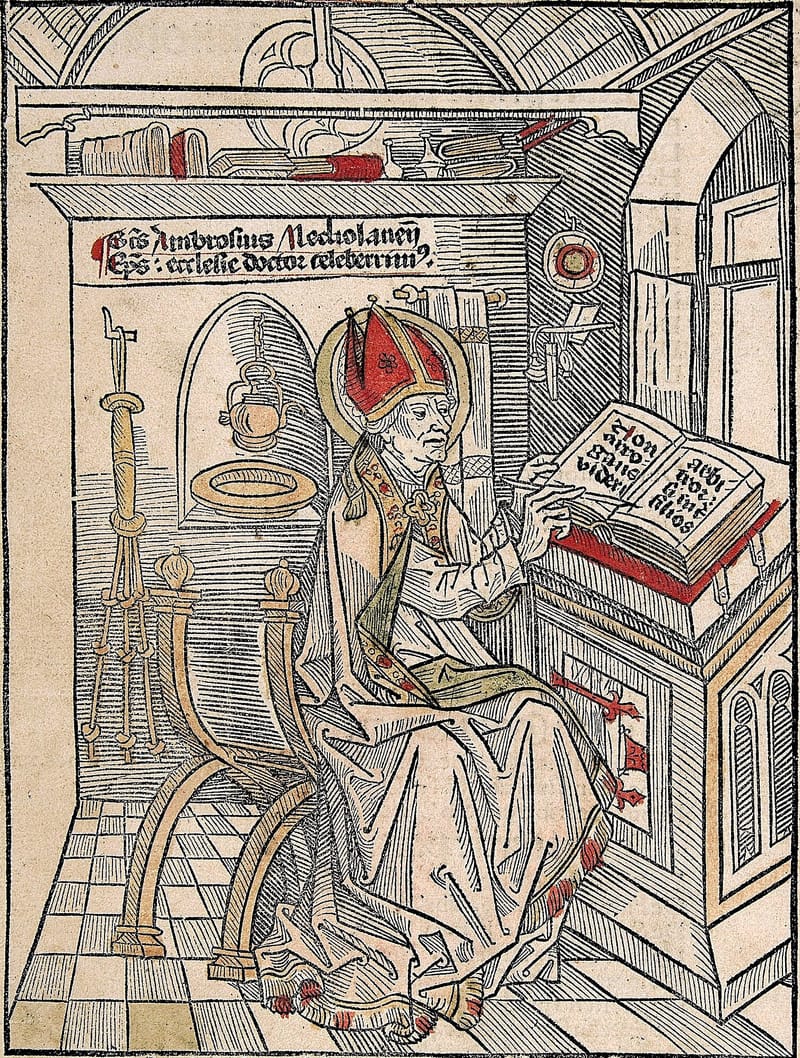
- A bishop. His signs are a beehive, a baby in a cradle and a scourge with three knots.
- Wrote
- A great deal: sermons worked up into books on Scripture, a handbook on Christian duty, books on the faith, letters, funeral speeches and hymns.
- Pronounced
- AM-brohz of muh-LAN.
feast days
East and West, side by side
West
- Apr4
In the 1916 Roman Martyrology: the day he died.
- Dec7
Catholic memorial, as Bishop and Doctor of the Church. Also the Church of England, the Episcopal Church, and Lutherans in the Missouri Synod and the ELCA.
East
- Dec7
The Orthodox Church in America and the Greek churches. Also the Russian Church, on the old calendar: that is 20 December on today's calendar.
Why 7 December? It is the day he was made bishop, in 374, and East and West keep it alike. Churches on the old calendar keep each date 13 days later, so 7 December falls on 20 December.
what was he like?
+respectful, but unbending
In his struggle with the emperor's court over a church for the Arians, he was ordered to leave Milan. He told his people he would not run, and he would not fight either. “You yourselves know that I am wont to show respect to our emperors, but not to yield to them, to offer myself freely to punishment, and not to fear what is prepared for me.”
Sermon against Auxentius+wept with sinners
When anyone confessed a sin to him, “he so wept that he compelled that one to weep”. He kept what he heard to himself. The sins confessed to him “he told to no one except to the Lord alone with Whom he pleaded”.
Paulinus, Life of St Ambrose, chapter 39+gave it away
When he became bishop he gave his gold and silver to the church and the poor. In 378 the Goths carried off crowds of captives, and he broke up the church's sacred vessels to buy them back. The Arians blamed him for it. He answered that the Lord Himself would ask why so many were left to die: “It had been better to preserve living vessels than gold ones.”
On the Duties of the Clergy, Book 2, chapter 28, with its translators' notes; Paulinus, chapter 38+busy, and quiet
Augustine could seldom get a word with him, for the “crowds of busy people, whose infirmities he devoted himself to”. In his few free moments he read in silence. “His eyes glanced over the pages, and his heart searched out the sense, but his voice and tongue were silent.” Visitors would sit a while and then leave. “For who dared interrupt one so intent?”
Augustine, Confessions, Book 6, chapter 3+ate little
His secretary Paulinus says he wore his body out with fasting. His “habit was never to take breakfast except on the day of Sabbath and the Lord's Day, or when the birthdays of the most celebrated martyrs occurred”.
Paulinus, Life of St Ambrose, chapter 38what others said of him
Augustine knew him best. Jerome, who mocked his writing, wrote about him while he lived. His secretary Paulinus wrote his Life between 412 and 422, at Augustine's request.
To him was I unknowingly led by You, that by him I might knowingly be led to You. That man of God received me like a father, and looked with a benevolent and episcopal kindliness on my change of abode.
…so that he would often, when he saw me, burst forth into her praises, congratulating me that I had such a mother
I withhold my judgment of him, because he is still alive, fearing either to praise or blame lest in the one event, I should be blamed for adulation, and in the other for speaking the truth.
I have learned after great difficulty the differences between an emperor and a priest. It is not easy to find a man capable of teaching me the truth. Ambrosius alone deserves the title of bishop.
his life in nine moments
Gaul, probably Trier
A babyThe bees
As a baby, Ambrose lay asleep in his cradle in the courtyard of his father's official residence, with his mouth open. A swarm of bees covered his face, going in and out of his mouth. His father stopped the nurse from driving them off. At last they flew up out of sight. His father said, “If this little child shall live he shall be something great.” His biographer Paulinus had the family's stories from Ambrose's sister Marcellina.
Paulinus, Life of St Ambrose, chapters 1 and 3Rome
A boyA bishop's hand
After his father died, the family moved to Rome. His sister had vowed herself to virginity, and another consecrated virgin lived with her. The boy saw the women of the house kiss the hands of bishops. So he would hold out his own right hand to his sister's companion, “because he said that he would be a bishop”. She pushed him away: he was a boy, and did not know what he was saying. Years later he came back to Rome a bishop, and found her still living with his sister. She kissed his hand, and he smiled: “Behold, as I used to tell you, you are kissing the hand of a bishop.”
Paulinus, Life of St Ambrose, chapters 4 and 9Milan
About 370Governor
He studied law and pleaded cases so well that the prefect Probus made him his adviser. Then he was sent to govern Liguria and Aemilia from Milan. Probus sent him off with words that came true: “Go, act not as judge but as bishop.”
Paulinus, Life of St Ambrose, chapters 5 and 8; Catholic EncyclopediaMilan
374“Ambrose Bishop!”
Auxentius, Milan's Arian bishop, had died, and Arians and Catholics each wanted a bishop of their own. Ambrose went to the church to keep the peace. As he spoke, “the voice of a child is said to have suddenly cried out among the people”, and the whole crowd took up the cry. He tried everything to put them off. He had people tortured from the judge's seat. He had prostitutes come to his house in public. The crowd only shouted, “Your sin be upon us.” He fled at midnight for Pavia, and in the morning was found at Milan's own Roman Gate. A report of the election went to the emperor. While it was pending, he fled again and hid on the estate of Leontius, a man of rank. When the emperor's answer came, Leontius gave him up. He was baptised, and on the eighth day, 7 December 374, he was made bishop. The Catholic Encyclopedia finds the tricks “difficult to believe”.
Paulinus, Life of St Ambrose, chapters 6 to 9; Catholic EncyclopediaMilan
384 to 387Augustine
A young teacher of rhetoric came from Rome, sent by the city's prefect, Symmachus. He went to hear the famous preacher, at first only to judge his style. Every Sunday he heard him, and he came to see that “all those knots of crafty calumnies, which those deceivers of ours had knit against the divine books, could be unravelled”. Ambrose baptised him at Easter in 387.
Augustine, Confessions, Books 5 and 6; Lesser Feasts and Fasts 2022Milan
385 and 386The church he would not hand over
The boy emperor Valentinian II and his mother Justina, an Arian, demanded a church in Milan for the Arians. Ambrose refused: “The palaces belong to the Emperor, the churches to the Bishop.” When soldiers ringed the church, his people stayed inside with him. To keep up their spirits he had hymns and psalms sung “after the manner of the Eastern Church”. Augustine's mother Monica was among them. His secretary Paulinus says the court's campaign only began to die down after the bodies of two martyrs were found.
Letter 20, to his sister Marcellina; Confessions, Book 9, chapter 7; Paulinus, chapters 13 and 15Milan
386Two martyrs found
He had built a new church, and the people asked him to consecrate it with relics. “Certainly I will if I find any relics of martyrs,” he said. He had the ground dug in front of the chancel screen in the church of Saints Felix and Nabor. “We found two men of marvellous stature, such as those of ancient days.” He names them as the martyrs Gervasius and Protasius, long forgotten. As they were carried to his new church, a blind man was healed.
Letter 22, to his sister MarcellinaCallinicum
388The burned synagogue
Christians burned a synagogue at Callinicum, a fortified town in the East, “at the instigation of the Bishop”, a report said. The emperor Theodosius ordered that bishop to rebuild it. Ambrose wrote to stop him, then preached at the emperor in church. “You spoke against us today, bishop,” Theodosius said. Ambrose would not go up to the altar until the emperor promised to drop the order. “Go on, with my promise,” said Theodosius.
Letter 40, to Theodosius; Paulinus, chapters 22 and 23Thessalonica
390The emperor's penance
After a riot at Thessalonica, the emperor Theodosius had promised Ambrose to pardon the city. But his officers talked with him in secret, and the city was “given to the sword for almost three hours and many innocent were slain”. Ambrose did not rebuke him in public. He wrote, “I am writing with my own hand that which you alone may read.” He said he dared not celebrate the Eucharist with the emperor present. Theodosius pleaded that King David had sinned too. The answer came back: “You who have followed him as he sinned, follow him as he corrected himself.” The emperor did public penance.
Letter 51, to Theodosius; Paulinus, chapter 24; Britannica
his miracles
Paulinus, his secretary, tells many wonders. He says he had them from Ambrose's sister Marcellina, from men who served Ambrose before him, from what he saw himself, and from people who saw Ambrose after his death. He begins with a plea.
I beseech you all, in whose hands this book will fall, to believe that what we say is true.
3 accounts of one blind man healed
-
Milan
386Ambrose
He wrote to his sister about finding the bodies of two martyrs, Gervasius and Protasius. A blind man was healed as the bodies were carried to his new church. In a sermon he named the man, “Severus, a butcher by trade”. Severus could call as witnesses the people who had supported him while he was blind.
“He declares that when he touched the hem of the robe of the martyrs, wherewith the sacred relics were covered, his sight was restored.”
Ambrose was there. It was his own procession.
Letter 22, to his sister Marcellina -
Milan
386Augustine
Augustine was living in Milan, not yet baptised. A man who had been blind many years, and was well known in the city, heard why the crowd was cheering and asked to be led there. He touched the martyrs' bier with his handkerchief and put it to his eyes, and they were opened.
“The miracle which was wrought at Milan when I was there, and by which a blind man was restored to sight”
Augustine adds that the emperor was in the city, and “the occurrence was witnessed by an immense concourse of people”.
Confessions, Book 9, chapter 7; City of God, Book 22, chapter 8 -
Milan
Years laterPaulinus
Ambrose's secretary Paulinus names the blind man too. He says Severus touched the martyrs' clothing and saw at once. When Paulinus wrote, Severus was still serving in the church where the martyrs were laid.
“Even a blind man, Severus by name, who to the present day devoutly serves in that same basilica which is called the Ambrosian … immediately received his sight.”
Paulinus, Life of St Ambrose, chapter 14
Augustine says the news of the healing held back the empress Justina's campaign against Ambrose. Her mind was “restrained from the fury of persecuting”. Confessions, Book 9, chapter 7
The paralysed woman at Rome
At a noble lady's house across the Tiber, Ambrose had come to celebrate the Eucharist. A woman who kept a bathhouse lay paralysed. She had herself carried there, and touched his clothes as he prayed and laid his hands on her. Then she kissed them. Paulinus heard it in Rome years later, “on the authority of holy men”.
“her health was restored immediately and she began to walk”Paulinus, Life of St Ambrose, chapter 10
A boy raised at Florence
At Florence, Ambrose stayed in the house of Decens. The little son of the house, Pansophius, fell ill and died. His mother laid the body on Ambrose's bed while he was out. When he came back, he lay down on the child and prayed. The prophet Elisha had once raised a dead boy in the same way. Paulinus notes that Ambrose never mentioned it in his writings. Paulinus names the boy's mother, Pansophia, as his source for another story from Florence.
“he laid himself down on the body of the child and through prayer succeeded in returning alive to the mother the child, whom he had found dead”Paulinus, Life of St Ambrose, chapters 28 and 50
Fire on his head
A few days before his last illness, Ambrose was dictating a commentary on Psalm 44 (43 in his Latin Bible), and his secretary Paulinus was taking it down. Paulinus saw fire cover Ambrose's head, and was so struck that he could not write. Ambrose stopped dictating that day, and he could not finish that psalm.
“suddenly a fire in the shape of a small shield covered his head, and gradually it entered through his mouth like a householder into his home, after which his face became like snow”Paulinus, Life of St Ambrose, chapter 42
The angel at his ear
A sharp Arian debater sat in church while Ambrose preached. He later said he saw an angel speaking into the bishop's ear, as if Ambrose were passing on the angel's words. He changed sides, and began to defend the faith he used to attack.
“saw, as he himself afterwards said, an angel speaking into the ears of the bishop as he preached”Paulinus, Life of St Ambrose, chapter 17
Nicentius's feet
Nicentius, a retired tribune, had such pain in his feet that he was rarely seen in public. At the altar, Ambrose stepped on his foot by accident, and he cried out. Then he heard Ambrose speak. His feet never troubled him again, and he told of it with tears when Ambrose died.
“Go, and henceforth you will be well.”Paulinus, Life of St Ambrose, chapter 44
A warning at Sirmium
At Sirmium the empress Justina's party tried to drive Ambrose out of the church. An Arian girl climbed onto the platform and seized his robe, to drag him off to be beaten. He told her it did not become her “to lay hands on any bishop”, and that she should fear the judgment of God. The next day she died. His secretary Paulinus tells two more stories of men who spoke against Ambrose after he died, and then died suddenly themselves.
“on the following day he conducted her dead to the grave repaying kindness for insult”Paulinus, Life of St Ambrose, chapters 11 and 54
his words
Ambrose wrote a great deal, mostly sermons worked up into books. These lines are from his books and letters, in the translation of 1896 by H. de Romestin and others, and from On Naboth, translated by Martin McGuire in 1927.
In the besieged church
For the Emperor is within the Church, not above it.
Preached while soldiers ringed the church the court wanted for the Arians. In Latin, Imperator enim intra Ecclesiam, non supra Ecclesiam est. It goes on: “For a good emperor seeks the aid of the Church and does not refuse it.”
Sermon against AuxentiusI shall be able to grieve, to weep, to groan; against weapons, soldiers, Goths, my tears are my weapons, for these are a priest's defense.
They declare also that the people have been led astray by the strains of my hymns. I certainly do not deny it.
Not from your own do you bestow upon the poor man, but you make return from what is his. For what has been given as common for the use of all, you appropriate to yourself alone. The earth belongs to all, not to the rich.
You cover your walls, you strip men naked. … The poor man seeks money and has it not; a man asks for bread, and your horse champs gold under his teeth.
The Church has gold, not to store up, but to lay out, and to spend on those who need.
Beasts do not drive out beasts, yet man shuts out man.
Now no one can repent to good purpose unless he hopes for mercy.
So it happened that I began to teach before I began to learn.
what he is criticised for
Some of what he did draws sharp criticism. Here it is, in his own words and in his critics'.
The synagogue at Callinicum
In 388 Christians burned a synagogue at Callinicum, and the emperor Theodosius ordered the local bishop to rebuild it. Ambrose's letter to the emperor called the synagogue “a home of unbelief, a house of impiety, a receptacle of folly, which God Himself has condemned”. He offered to take the blame in the local bishop's place. Paulinus tells the story as a win for the Church. The historian Peter Brown, writing in Britannica, sees in his clashes with the court “a sinister vein of demagoguery”.
“I declare that I set fire to the synagogue, or at least that I ordered those who did it, that there might not be a place where Christ was denied.”Letter 40, to Theodosius; Paulinus, chapters 22 and 23; Britannica
The Altar of Victory
In 384 pagan senators, led by Symmachus, the prefect of Rome, asked for the Altar of Victory to go back in the Senate, and for their rites to be paid for again. Ambrose argued against it, and won. In his view no pagan was being forced. Britannica puts it the other way: “In 384 he secured the rejection of an appeal for tolerance by pagan members of the Roman senate”.
“No one is injured because God is set before him. He keeps his own opinion. You do not compel a man against his will to worship what he dislikes.”Letter 17, to Valentinian II; Britannica
Daughters against their parents
He urged young women to vow themselves to virginity, even when their parents begged them not to. The Catholic Encyclopedia says “many a mother refused to permit her daughters to listen to his words”. He even had to answer the charge that he was emptying the empire of people.
“Conquer your affection first, O maiden. If you conquer your home, you conquer the world.”Concerning Virgins, Book 1, chapter 12; Catholic Encyclopedia
Borrowed from the Greeks
He drew heavily on Greek writers, “especially St. Basil the Great and Didymus of Alexandria, from whom no less a man than St. Jerome accused him of plagiarizing”, as his translators of 1896 put it. Without naming him, Jerome called his book on the Holy Spirit “flaccid and soft, sleek and pretty”. Rufinus, Jerome's former friend, took Ambrose's side: “You observe how he treats Ambrose.”
“I read some time ago the treatise of a certain person on the Holy Spirit, and I recognized then, according to the sentence of Terence, bad things in Latin taken from good things in Greek.”Jerome, as quoted by Rufinus, Apology against Jerome, Book 2
often misquoted
He and Augustine made up the Te Deum together, singing verse by verse, on the night of Augustine's baptism.
What the sources sayA legend first found about four hundred years later. The Catholic Encyclopedia says: “This tradition is now generally rejected by scholars.” Some old manuscripts name Nicetas, bishop of Remesiana, instead. Some church Lives still credit Ambrose with it.
Catholic Encyclopedia, Te Deum; OCA; azbyka.ruWhen in Rome, do as the Romans do is his saying.
What the sources sayHis real advice, as Augustine reports it, was about fasting on Saturdays: “When I visit Rome, I fast on Saturday; when I am here, I do not fast.” The proverb in its familiar words is not his.
Augustine, Letter 54, to JanuariusAfter the killings at Thessalonica, he met the emperor Theodosius at the church door, stopped him, and turned him away with a long speech.
What the sources sayThat scene and its speeches are Theodoret's, written about sixty years later. Ambrose's own account is a private letter. The Catholic Encyclopedia says the story “is shown by modern criticism to have been greatly exaggerated”.
Theodoret, Church History, Book 5, chapter 17; Letter 51; Catholic EncyclopediaHe died on Good Friday.
What the sources saySo says the Catholic Encyclopedia of 1907. But his secretary Paulinus says he died in the hour before daybreak, and that his body lay in the great church “the same night in which we kept the vigil of Easter”. That makes it the Saturday before Easter.
Paulinus, Life of St Ambrose, chapter 48; Catholic EncyclopediaEvery Ambrosian hymn is his.
What the sources say“Ambrosian” came to mean a style of hymn, not an author. Four are accepted by all as his. Augustine quotes three of them and names Ambrose as their author.
Catholic Encyclopedia, Ambrosian HymnographyHe wrote the commentary on Paul's letters that was printed with his works.
What the sources sayIts author is unknown, and scholars call him Ambrosiaster. Erasmus first doubted it was Ambrose's, in the 1500s.
Catholic Encyclopedia, Ambrosiasterwhere he stood
Every line shown is his own. Two come to us through others: Augustine quotes the line on effort, and the Catena Aurea, a collection of the Fathers made by Thomas Aquinas, keeps the line on riches. TapClick “Show his line” to read it.
Your answers are next to his. From your result on . See your result
“A good hearty laugh is good for the soul.”
Ambrose strongly disagrees.
You
Show his line
Do we seek for something to laugh at, that laughing here we may weep hereafter?On the Duties of the Clergy, Book 1, chapter 23
“Most of the time, it's better to say less.”
Ambrose strongly agrees.
You
Show his line
How many have I seen to fall into sin by speaking, but scarcely one by keeping silent; and so it is more difficult to know how to keep silent than how to speak.On the Duties of the Clergy, Book 1, chapter 2
“Wisdom is worth learning from anyone, even people who don't share your faith.”
Ambrose disagrees.
You
Show his line
But it was not by dialectic that it pleased God to save His people; for the kingdom of God consists in simplicity of faith, not in wordy contention.On the Christian Faith, Book 1, chapter 5
“Anger at real wrongdoing can be a good thing.”
Ambrose agrees.
You
On record in On the Duties of the Clergy. Not quoted here.
“There's nothing wrong with being rich, as long as you use it well.”
Ambrose agrees.
You
Show his line
Let the rich learn that guilt attaches not to the goods themselves, but to those who know not how to use them.Exposition of the Gospel of Luke, Book 8, as the Catena Aurea gives it
“If someone you know is doing wrong, it's your job to tell them.”
Ambrose strongly agrees.
You
Show his line
Should I keep silence? But then my conscience would be bound, my utterance taken away, which would be the most wretched condition of all.Letter 51, to the Emperor Theodosius
“Even if you believe you'll see them again, it's right to weep openly for someone you've lost.”
Ambrose agrees.
You
Show his line
But we have not incurred any grievous sin by our tears. Not all weeping proceeds from unbelief or weakness.On the Death of Satyrus, Book 1
“Giving to the poor isn't generosity. It's paying back what's already theirs.”
Ambrose strongly agrees.
You
Show his line
Not from your own do you bestow upon the poor man, but you make return from what is his.On Naboth, chapter 12
“Your body is a friend to look after, not an enemy to fight.”
Ambrose strongly disagrees.
You
Show his line
So they who do not chasten their body, and desire to preach to others, are themselves esteemed reprobates.Letter 63, to the Church at Vercelli
“Miracles still happen today, just as they did in the Bible.”
Ambrose strongly agrees.
You
Show his line
He says: I who could not see now see. He says: I ceased to be blind, and proves it by the fact.Letter 22, to his sister Marcellina
“Some questions about God are better left alone.”
Ambrose strongly agrees.
You
Show his line
No man calls in question one who is better than he is: to believe is enjoined upon you, without permission to question.On the Christian Faith, Book 1, chapter 12
“In many Bible stories, the deeper meaning matters more than the history.”
Ambrose strongly agrees.
You
On record in the Confessions. Not quoted here.
“If you believe God is calling you, follow, even if your family begs you not to.”
Ambrose strongly agrees.
You
Show his line
And the anxious entreaties of your parents are your first battles. Conquer your affection first, O maiden. If you conquer your home, you conquer the world.On Virgins, Book 1, chapter 12
“A church should keep out people who openly live in serious wrongdoing.”
Ambrose agrees.
You
Show his line
I dare not offer the sacrifice if you intend to be present. Is that which is not allowed after shedding the blood of one innocent person, allowed after shedding the blood of many? I do not think so.Letter 51, to the Emperor Theodosius
“A Christian can fight in a just war with a clear conscience.”
Ambrose strongly agrees.
You
Show his line
For courage, which in war preserves one's country from the barbarians, or at home defends the weak, or comrades from robbers, is full of justice.On the Duties of the Clergy, Book 1, chapter 27
“Governments should use their laws to promote the Christian faith.”
Ambrose strongly agrees.
You
Show his line
As all men who live under the Roman sway engage in military service under you, the Emperors and Princes of the world, so too do you yourselves owe service to Almighty God and our holy faith.Letter 17, to the Emperor Valentinian II
“Becoming a better person is mostly down to your own effort.”
Ambrose disagrees.
You
Show his line
For our heart and our thoughts are not in our own power.On Flight from the World, as Augustine quotes it in On the Gift of Perseverance, chapter 20
See where you stand beside him. Take the quiz
friends, family and rivals
 Augustine of Hippo
 He came to Milan to teach rhetoric, and went to hear Ambrose at first only for his style. Ambrose baptised him at Easter in 387. Years later Augustine asked Ambrose's secretary, Paulinus, to write Ambrose's Life.
Confessions, Books 5 and 6; Paulinus, chapter 1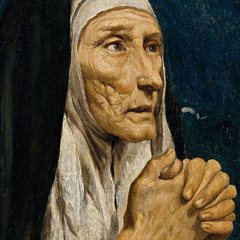 Monica
 Augustine's mother. She followed her son to Milan, and “she loved that man as an angel of God”. When Ambrose banned the African custom of bringing food and wine to the martyrs' shrines, she gave it up at once.
Confessions, Book 6, chapters 1 and 2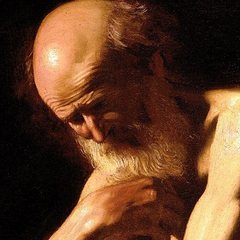 Jerome
 No friend. While Ambrose lived, Jerome would not judge him in his book of Christian writers. Elsewhere he mocked Ambrose's book on the Holy Spirit. Rufinus, Jerome's former friend, says Jerome called Ambrose a jackdaw dressed in other birds' feathers.
Lives of Illustrious Men, chapter 124; Rufinus, Apology, Book 2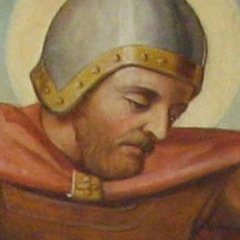 Martin of Tours
 Both men stood up to the usurper Maximus at Trier. Some bishops had urged him to put Priscillian, a bishop accused of heresy, to death. Ambrose would not share communion with the bishops “who sought the death of any one, even though they were heretics”, and was sent away. Martin begged Maximus to spare Priscillian's followers.
Letter 24; Sulpicius Severus, Sacred History, Book 2His elder sister, about ten years older, a consecrated virgin. She helped their widowed mother raise the boys. Ambrose's biographer Paulinus had many of his stories from her.
Catholic Encyclopedia; Paulinus, chapter 1His elder brother. When Ambrose was made bishop, Satyrus gave up his own post to run his brother's affairs. When Satyrus died, about 378, Ambrose preached two funeral speeches for him.
Catholic Encyclopedia; On the Death of SatyrusThe emperor he faced over a burned synagogue at Callinicum and over killings at Thessalonica. Theodosius died at Milan in 395, “with Ambrose at his bedside and the name of Ambrose on his lips”, says the Catholic Encyclopedia. Ambrose preached at his funeral.
Catholic Encyclopedia; BritannicaPrefect of Rome and a leading pagan. In 384 he asked for the Altar of Victory to go back in the Senate, and Ambrose defeated him. That same year Symmachus sent the young Augustine to teach at Milan.
Letters 17 and 18; Confessions, Book 5, chapter 13The next bishop of Milan, and an old man. As Ambrose lay dying, four deacons at the far end of the portico whispered about who should follow him. When they named Simplicianus, Ambrose called out three times, “Old but good.” The deacons fled in fright.
Paulinus, chapter 46how he died
He died at Milan before dawn on 4 April 397. It was the Saturday before Easter, and that night the church kept the Easter vigil.
He had said he would be with his people until Easter. He fell ill after ordaining a bishop for Pavia, and lay in bed for many days. Count Stilicho feared that Italy would be ruined without Ambrose. He sent Milan's leading men to beg him to pray for a longer life.
From late afternoon until he died, he prayed with his arms stretched out in the form of a cross. “We indeed saw his lips move but his voice we did not hear.”
Honoratus, bishop of Vercelli, was resting upstairs. He heard a voice call him three times: “Arise, hasten, because now he is about to depart.” He came down and gave Ambrose the Body of the Lord, and “when he took and swallowed it he breathed forth his spirit”.
On Easter morning his body was carried to his basilica, with Jews and pagans among the mourners. He was buried beside the martyrs Gervasius and Protasius, as he had wished.
His answer to the nobles
I have not so lived among you that I am ashamed to live nor do I fear to die, because we have a good Lord!
Milan's leading men had come to beg him to pray for a longer life. The Catholic Encyclopedia says his answer made a deep impression on Augustine.
is he a saint?
Yes. Catholics and Orthodox count him a saint, and Catholics a Doctor of the Church. Anglicans and Lutherans keep his day too.
- CatholicSaintA Doctor of the Church. Memorial on 7 December
- OrthodoxSaint7 December, or 20 December on the old calendar
- AnglicanSaintA Lesser Festival in the Church of England
- LutheranRememberedMissouri Synod and ELCA, 7 December
He is one of the four great Latin Doctors of the Church, with Jerome, Augustine and Gregory the Great. A decree of Pope Boniface VIII in 1298 honoured the four together. The Roman Martyrology of 1916 marks two of his days:
At Milan, the demise of St. Ambrose, bishop and confessor, through whose labors, learning and miracles, almost all Italy returned to the Catholic faith, at the time when the perfidious Arian heresy was widely diffused.
At Milan, the consecration of St. Ambrose, bishop and doctor of the Church, who has ennobled the universal Church by his holiness and teaching.
a prayer he wrote
He had been rushed from the judge's seat to the bishop's chair. In his book on repentance, he prays about it.
Preserve, O Lord, Thy work, guard the gift which Thou hast given even to him who shrank from it. For I knew that I was not worthy to be called a bishop, because I had devoted myself to this world, but by Thy grace I am what I am. And I am indeed the least of all bishops, and the lowest in merit; yet since I too have undertaken some labour for Thy holy Church, watch over this fruit, and let not him whom when lost Thou didst call to the priesthood, to be lost when a priest. And first grant that I may know how with inmost affection to mourn with those who sin … Grant that so often as the sin of any one who has fallen is made known to me I may suffer with him, and not chide him proudly, but mourn and weep, so that weeping over another I may mourn for myself.
what to read first
The Life of St Ambrose
Paulinus of Milan
By his secretary, at Augustine's request. Short, and full of stories. The free copy has the Latin with an English translation.
Read it freeLetter 51, to Theodosius
Ambrose
The private letter he wrote in his own hand after the killings at Thessalonica. It is short.
Read it freeSermon against Auxentius
Ambrose
Preached to his people while soldiers ringed their church, which the court wanted for the Arians.
Read it freeConfessions, Books 5, 6 and 9
Augustine
The best picture of him, by someone who knew him.
Read it freeOn Naboth
Ambrose
His sermon against greed, on the vineyard a king stole from a poor man.
Read it freetake the quizzes
 Quiz Which early Christian thinks like you? And which would argue with you? See where you stand beside Ambrose. Start
  Quiz Christian Personality Test Which of eight types are you? Find your own. Start
 sources
His life, and his words
- Paulinus of Milan, Life of St Ambrose. Tr. Sister Mary Simplicia Kaniecka, 1928.
- Ambrose, On the Duties of the Clergy. Tr. H. de Romestin, E. de Romestin and H. T. F. Duckworth, 1896.
- Ambrose, Sermon against Auxentius. Same translation.
- Ambrose, Letter 17, to Valentinian II. Same translation.
- Ambrose, Letter 20, to his sister Marcellina. Same translation.
- Ambrose, Letter 22, to his sister Marcellina. Same translation.
- Ambrose, Letter 40, to Theodosius. Same translation.
- Ambrose, Letter 51, to Theodosius. Same translation.
- Ambrose, Letter 63, to the Church at Vercelli. Same translation.
- Ambrose, Concerning Repentance, Book 1. Same translation.
- Ambrose, Concerning Repentance, Book 2. Same translation, unrevised.
- Ambrose, Concerning Virgins. Same translation.
- Ambrose, On the Christian Faith. Same translation.
- Ambrose, On the Death of Satyrus. Same translation.
- Ambrose, Letter 24. Library of the Fathers, Oxford, 1881.
- Ambrose, On Naboth. Tr. Martin R. P. McGuire, 1927.
- The Latin of the Sermon against Auxentius, Migne's edition.
- Augustine, Confessions. Tr. J. G. Pilkington, 1886.
- Augustine, City of God, Book 22. Tr. Marcus Dods, 1887.
- Augustine, Letter 54. Tr. J. G. Cunningham, 1886.
- Augustine, On the Gift of Perseverance. Tr. Holmes, Wallis and Warfield, 1887.
- Theodoret, Church History, Book 5. Tr. Blomfield Jackson, 1892.
- Jerome, Lives of Illustrious Men. Tr. E. C. Richardson, 1892.
- Rufinus, Apology against Jerome, Book 2. Same series, 1892.
- Thomas Aquinas, Catena Aurea on Luke 19. Ed. J. H. Newman, 1843.
Reference
- Catholic Encyclopedia, 1907, “St. Ambrose”
- Catholic Encyclopedia, “Ambrosian Hymnography”
- Catholic Encyclopedia, “Te Deum”
- Catholic Encyclopedia, “Ambrosiaster”
- Catholic Encyclopedia, “Doctors of the Church”
- Nicene and Post-Nicene Fathers, second series, volume 10, the translators' life of Ambrose, 1896
- Britannica, “St. Ambrose”, by Peter Brown
- Städel Museum, his signs in art
- Merriam-Webster, “Ambrose”, and
- “Milan”, for how to say it
Calendars
- USCCB, Memorial of Saint Ambrose, Bishop and Doctor of the Church
- The Roman Martyrology, 1916 edition
- OCA, Saint Ambrose, Bishop of Milan
- saint.gr, Greek
- azbyka.ru, Russian
- Church of England, Common Worship calendar
- The Episcopal Church, Lesser Feasts and Fasts 2022
- Concordia Publishing House, LCMS commemorations
- Evangelical Lutheran Worship, ELCA, the church year
Pictures
- Saint Ambrose, Claude Vignon, 1623 or 1625. Minneapolis Institute of Art. Public domain.
- St Ambrose of Milan, Cappella Palatina, mosaic, Palazzo dei Normanni, Palermo, about 1140. Public domain.
- Saint Ambrose, woodcut, possibly by Albrecht Dürer, about 1492. Metropolitan Museum of Art, New York, 1984.1201.26. CC0.