
Monica
The mother who wept and prayed for years over her son Augustine, and lived to see him baptised.
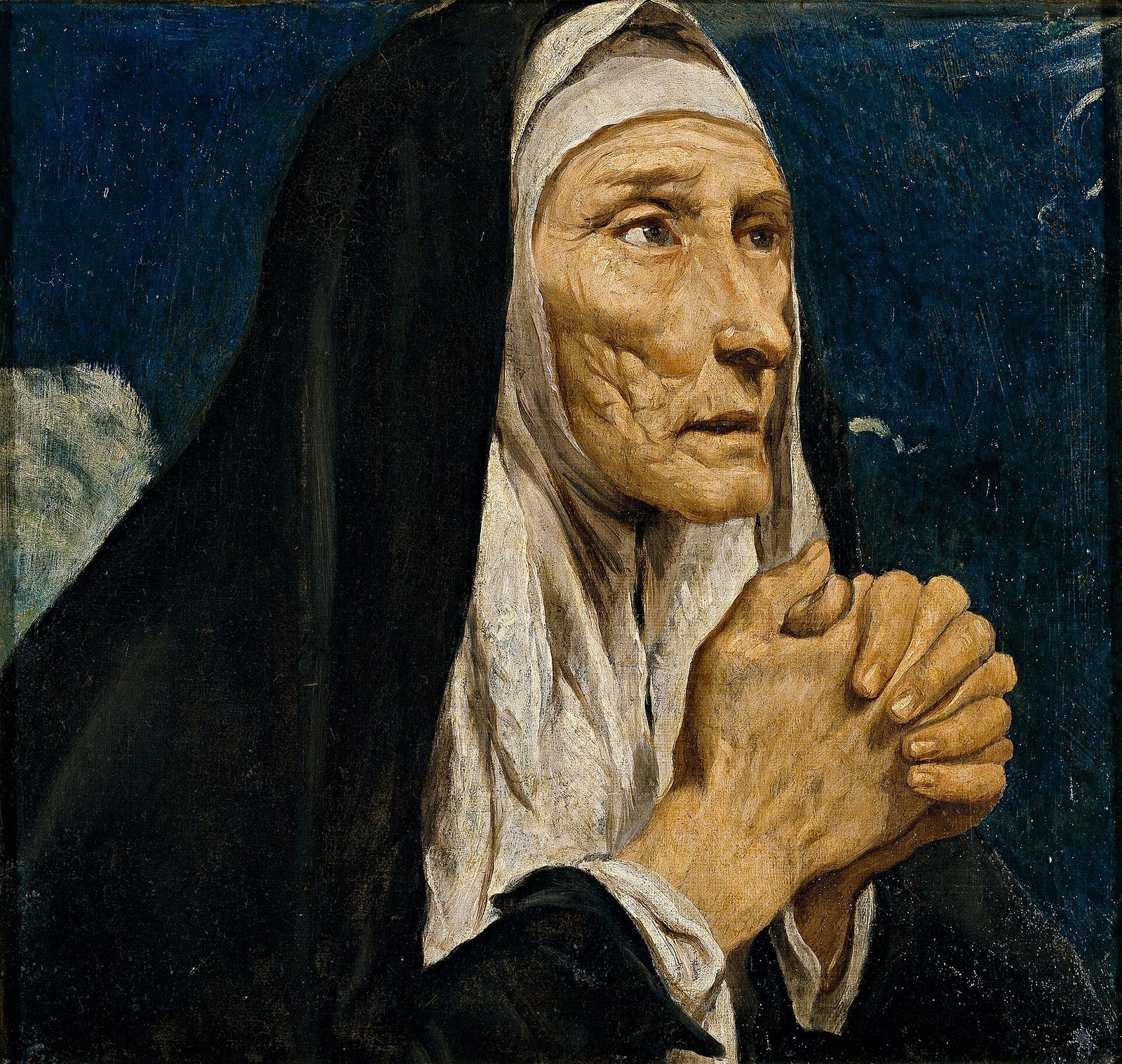
Picture: Saint Monica, Luis Tristán, 1616. Museo del Prado, Madrid. Public domain.
Who was Monica?
Monica was the mother of Augustine of Hippo. A Christian woman of North Africa, she was married to a pagan with a violent temper, and won him to the faith. For years she wept and prayed over her wayward son. She followed him to Italy, saw him baptised, and died at Ostia in 387.
at a glance
Her path, in order
- DaughterOf a Christian house in Africa
- WifeOf Patricius, a pagan of Thagaste
- MotherOf Augustine, Navigius and a daughter
- WidowFrom about 371, and never married again
- TravellerAfter her son, over sea to Milan
- PhilosopherAt her son's table at Cassiciacum
in numbers
- Years of tears, after her dream9
- “Nearly nine years”, says Augustine
- She never stopped praying
- Times a day she went to church2
- Morning and evening
- Not a day missed, her son says
- Her age when she died55
- In “the fifty-sixth year of her age”
- Augustine was 32
did you know?
-
In all 13 books of the Confessions, Augustine names her only once, asking readers to remember her at the altar. Elsewhere she is simply “my mother”.
Confessions, Book 9, chapter 13 -
Augustine held his dialogue On the Happy Life on his birthday, 13 November 386. They met in the baths of the country house at Cassiciacum, a quiet spot that suited the November weather. The first guest he names is his mother, “to whose merit I believe I owe all my life”. The English is our translation of his Latin.
On the Happy Life, chapter 1 -
One of her son's pupils, Licentius, once sang a psalm verse while he was in the privy, answering the call of nature. Monica scolded him for singing it in such a place. He joked, “As if, should some enemy shut me in here, God would not hear my voice!” (our translation).
On Order, Book 1, chapter 8
- Born
- About 331, counting back from her age at her death. Most likely at Thagaste in Numidia, today Souk Ahras in Algeria.
- Grew up
- In a Christian house, brought up strictly by an old servant of the family.
- Married
- Patricius, a pagan citizen of Thagaste of small means. He was baptised near the end of his life.
- Children
- Augustine, Navigius, and a daughter who led a community of nuns.
- Died
- 387, at Ostia, the port of Rome, on the ninth day of a fever. The day is not known.
- Buried
- At Ostia. Since 1430 her body has lain in the church of Sant'Agostino in Rome.
- Her name
- Monnica, with two n's, in the Latin of the Confessions.
- Status
- A saint to Catholics, Orthodox and Anglicans. Lutherans remember her too.
- Patron of
- In the West, wives and mothers whose husbands or sons have gone astray, says the OCA.
- In art
- An older woman in a widow's black veil, praying, often in tears. Ary Scheffer painted her with Augustine at the window at Ostia.
- Wrote
- Nothing. Her words come to us through her son.
 The Deep Well
 Her personality type
Serious by nature, and at her best when life is quiet.
In Gregory the Great's terms
- Serious
- Tranquil mind
Our reading, from the Christian Personality Test. The Christian Personality Test pairs her with her son as opposites. Augustine is its Spark: as a young man he loved friends, jokes and talk. Monica is its Deep Well: serious by nature, feeling things deeply, at her best when life is quiet.
See The Deep Wellfeast days
East and West, side by side
West
- Apr9
In the 1916 Roman Martyrology: the day her body was brought from Ostia to Rome under Pope Martin V and buried in the church of St Augustine.
- May4
Her day in the 1916 Roman Martyrology, and in the Roman calendar until 1969. Still kept by the Episcopal Church and the ELCA.
- Aug27
Catholic memorial, the day before Augustine's. Also the Church of England, and Lutherans in the Missouri Synod.
East
- May4
The OCA and the Greek churches.
Why two dates? No one knows the day she died. In the 1400s the Augustinian friars kept the conversion of Augustine on 5 May, so they chose the day before for his mother. Rome took 4 May into its calendar about 1550. In 1969 it moved her to 27 August, the day before Augustine's own feast. The East still keeps 4 May. Churches on the old calendar keep it 13 days later, on 17 May.
what was she like?
+quick with a joke
At Cassiciacum she asked her son to explain the Academics, the philosophers who held that nothing can be known for certain. When he had done, she said, “These men are caducarii.” It was the everyday word for epileptics, people the falling sickness throws to the ground. Then she got up to leave, and the whole party broke up laughing. Next day her son Navigius praised it as “a common word, and bad Latin, but a very apt one”. The English is our translation of the Latin.
On the Happy Life, chapters 2 and 3+a peacemaker
When two people had fallen out, each would pour out bitter words to her about the other. She passed on nothing but what might bring them together. Augustine knew too many people who did the opposite, and added what was never said. Of his mother he writes: “she would disclose nothing about the one unto the other, save what might avail to their reconcilement.”
Confessions, Book 9, chapter 9+sure of her dreams
She believed God spoke to her in visions, but she did not trust every dream. When she and her son prayed for a sign about his marriage, she saw things and told him of them, but she made light of them. She said that she could, “through some feeling which she could not express in words, discern the difference betwixt Thy revelations and the dreams of her own spirit.”
Confessions, Book 6, chapter 13+a mother to them all
After her son and his friends were baptised, they lived together as one household, and she looked after them all. Augustine says she cared for them as if she “had been mother of us all; served us as if she had been child of all.”
Confessions, Book 9, chapter 9+not afraid to ask
One day at Cassiciacum she came in on her son and his friends as they talked philosophy, and asked how far they had got. Augustine had her question written down, as they wrote down everything said there. She asked, “In those books you read, have I ever heard of women being brought into this kind of discussion?” He answered that women had done philosophy among the ancients, and “your philosophy pleases me very much.” The English is our translation.
On Order, Book 1, chapter 11+unafraid of death
Her son told her that she loved wisdom more than she loved him, and he knew how much she loved him. Neither misfortune nor death frightened her, he said, and all agree that this is the summit of philosophy. Then he asked, “Shall I not gladly make myself your pupil too?” The English is our translation.
On Order, Book 1, chapter 11what others said of her
Almost everything we know of her comes from her son. Most of it is in Book 9 of his Confessions. The rest is in the dialogues he wrote at Cassiciacum, where she takes part.
…in woman's garb truly, but with a man's faith, with the peacefulness of age, full of motherly love and Christian piety.
…he would often, when he saw me, burst forth into her praises, congratulating me that I had such a mother.
…whose mind is new to me every day.
…that mother who was for a while dead to mine eyes, who had for many years wept for me, that I might live in Thine eyes.
Here the most chaste mother of a son laid down her ashes: Augustine, a second light to your merits.
her life in 13 moments
Thagaste
A girlA little cup too many
She grew up in a Christian house. An old servant, who had carried Monica's father on her back when he was a baby, brought up the daughters of the house strictly. She would not even let them drink water between meals, so they would not get into the habit of drinking. But when Monica was sent to draw wine from the cask, she began to sip. A little more each day, until “she contracted such a habit as, to drink off eagerly her little cup nearly full of wine.” Then a maid who went down to the cellar with her quarrelled with her, and called her meribibula, a wine-bibber. “Stung by this taunt, she perceived her foulness, and immediately condemned and renounced it.” She told the story to her son herself.
Confessions, Book 9, chapter 8Thagaste
A young wifePatricius
She was married to Patricius, a pagan. Her son says that “as he was earnest in friendship, so was he violent in anger.” She never answered him back while he was angry. When he had calmed down, she would explain herself. Her mother-in-law at first turned against her, stirred up by the gossip of servants. Monica won her over with patience. In the end the old woman told Patricius which servants had been telling tales, and had them punished.
Confessions, Book 9, chapter 9Thagaste
About 370A warning he laughed at
In his sixteenth year, Augustine was home from school. Patricius saw him at the baths, saw he was becoming a man, and joyfully told Monica. “She then started up with a pious fear and trembling.” She took her son aside and warned him “not to commit fornication; but above all things never to defile another man's wife.” He did not listen. “These appeared to me but womanish counsels, which I should blush to obey.”
Confessions, Book 2, chapter 3Thagaste
About 371Her husband won
Near the end of his life Patricius became a Christian. “Finally, her own husband, now towards the end of his earthly existence, did she gain over unto Thee.” Once he was baptised, Augustine says, she never again had to bear from him what she had borne before. He died while Augustine was still in his teens. She never married again.
Confessions, Book 9, chapters 9 and 13; Book 3, chapter 4Thagaste
Her son a ManicheeThe dream of the wooden rule
At Carthage Augustine had joined a sect called the Manichees. Monica was so grieved that she would not have him at her table. Then she had a dream. “She saw herself standing on a certain wooden rule, and a bright youth advancing towards her, joyous and smiling upon her, whilst she was grieving and bowed down with sorrow.” A rule here means a ruler, a straight measuring rod. The youth told her to look, and see “that where she was, there was I also.” She looked, and there was her son standing beside her on the same rule. So she let him eat at her table again. When she told him the dream, he tried to twist it: she should not despair of one day being what he was. She answered at once: “No; for it was not told me that where he is, there shalt thou be, but where thou art, there shall he be.” He says her answer moved him more than the dream.
Confessions, Book 3, chapter 11Africa
Her son still a ManicheeThe son of these tears
She begged a bishop to talk with her son and argue him out of his errors. The bishop refused. The young man was still too full of the new sect, the Manichees, to be taught, he said. He himself had been handed to the Manichees as a boy, and had found his own way out by reading. “Leave him alone for a time,” he told her, “only pray God for him.” She would not let it go, and kept on begging him in tears. At last, “a little vexed at her importunity,” he said: “Go thy way, and God bless thee, for it is not possible that the son of these tears should perish.” She took it “as though it were a voice from heaven.”
Confessions, Book 3, chapter 12Carthage
383Left on the shore
Augustine decided to go and teach in Rome. His mother went with him to the sea and held on to him, to keep him or to go with him. He told her he was only waiting to see a friend off. “And I lied to my mother—and such a mother!—and got away.” He talked her into spending the night in a chapel of St Cyprian near the ship. She prayed and wept there all night. The wind rose and he sailed, “and she, wild with grief, was there on the morrow.” Then she went home, and went on praying for him.
Confessions, Book 5, chapter 8At sea, then Milan
Following himOver sea and land
She came after him to Italy, “following me over sea and land, in all perils feeling secure in Thee.” In a storm at sea it was she who comforted the sailors, “assuring them of a safe arrival, because she had been so assured by Thee in a vision.” In Milan he told her he was no longer a Manichee, though not yet a Catholic. She did not leap for joy. She said calmly that she was sure she would see him a Catholic believer before she died. At church she hung on the words of the bishop, Ambrose. “She loved that man as an angel of God.”
Confessions, Book 6, chapter 1Milan
In Ambrose's cityFood for the martyrs
In Africa she used to bring cakes, bread and wine to the shrines of the martyrs. She would taste a little, give the rest away, and never allow herself more than “one little cup of wine”, well watered. In Milan the doorkeeper stopped her: the bishop had forbidden it. Ambrose feared the custom led some to drunkenness, and that it was too like the pagans' feasts for the dead. She gave it up at once. “I myself marvelled how readily she could bring herself to accuse her own custom, rather than question his prohibition.” From then on she brought the martyrs “a heart full of more purified petitions”, and gave what she could to the poor.
Confessions, Book 6, chapter 2Milan
385 to 386A match for her son
She worked hard to find Augustine a wife. She hoped that once he was married, baptism would follow. Mother and son prayed every day for a vision about the marriage. None came. She saw only “vain and fantastic things”, and said so. A girl was found, two years too young to marry, and they agreed to wait. The woman Augustine had lived with for years was sent back to Africa. The hard parts, further down this page, tell it in full.
Confessions, Book 6, chapters 13 and 15Milan
386Keeping watch with Ambrose
Justina, mother of the boy emperor Valentinian, had been won over by the Arians. They taught that the Son of God was created by the Father. She was persecuting Ambrose to make him give up a church to them. His people kept guard in the church, ready to die with their bishop. Monica was among them. “There my mother, Thy handmaid, bearing a chief part of those cares and watchings, lived in prayer.” To keep their spirits up, hymns and psalms began to be sung there in the Eastern way.
Confessions, Book 9, chapter 7Milan
Late summer 386She leaps for joy
In a garden in Milan, Augustine heard a child's voice chanting, “Take up and read.” He opened Paul's letters, and his long struggle ended. He and his friend Alypius went straight in to tell his mother. “She leapeth for joy, and triumpheth, and blesseth Thee.” She had been given more than she had asked. He no longer wanted a wife, or anything else the world could give. Now he stood, he says, on “that rule of faith” where she had seen him standing in her dream so many years before.
Confessions, Book 8, chapter 12Cassiciacum
Autumn 386A philosopher at the table
Augustine gave up teaching and went with his friends to a country house near Milan, lent by a friend. His mother went too, with his brother Navigius, his son Adeodatus, his friend Alypius and two young pupils. They spent the days talking philosophy, and Augustine wrote the talks down. Monica took part. When he asked who is happy, she answered, “If he wants good things and has them, he is happy. If he wants bad things, even if he has them, he is wretched.” He smiled at her, delighted: “Mother, you have taken the very citadel of philosophy.” Then he showed them that Cicero had said the same in his Hortensius. The English is our translation of his Latin.
On the Happy Life, chapters 1 and 2; Confessions, Book 9, chapters 3 and 4
the window at ostia
Augustine was baptised by Ambrose at Easter 387. That year the family set out for home. At Ostia, the port of Rome, mother and son had the talk that made her famous. A few days later she fell ill.
At the window
Monica and Augustine were waiting at Ostia for a ship to Africa, and resting after a long journey. The two of them stood alone at a window that looked down on the garden of the house. They talked together about what the life of the saints would be like: a life that “eye hath not seen, nor ear heard”.
“…she and I stood alone, leaning in a certain window, from which the garden of the house we occupied at Ostia could be seen.”Confessions, Book 9, chapter 10
Beyond themselves
The talk of Monica and her son climbed past every pleasure of the senses, past sun and moon and stars, and past their own minds. For a moment, Augustine says, they touched eternal Wisdom “with the whole effort of our heart”. Then they sighed, and came back to the sound of their own voices. They tried to put into words what they had touched: a silence in which God alone would speak.
“If to any man the tumult of the flesh were silenced—silenced the phantasies of earth, waters, and air—silenced, too, the poles; yea, the very soul be silenced to herself, and go beyond herself by not thinking of herself…”Confessions, Book 9, chapter 10
What do I here?
When the talk at the window at Ostia was over, Monica spoke to her son. The one thing she had lived for was done.
“Son, for myself, I have no longer any pleasure in aught in this life. What I want here further, and why I am here, I know not, now that my hopes in this world are satisfied. There was indeed one thing for which I wished to tarry a little in this life, and that was that I might see thee a Catholic Christian before I died. My God has exceeded this abundantly, so that I see thee despising all earthly felicity, made His servant—what do I here?”Confessions, Book 9, chapter 10
her words
Monica wrote nothing that survives. Her words come to us through her son: in the Confessions, in J. G. Pilkington's translation, and in his dialogues at Cassiciacum, where the English is our own translation of his Latin.
At Ostia, to her son's friends
Nothing is far to God; nor need I fear lest He should be ignorant at the end of the world of the place whence He is to raise me up.
Her son's friends had asked if she was afraid to leave her body so far from her own city. In Latin, nihil longe est Deo.
Confessions, Book 9, chapter 11She believed in Christ, that before she departed this life, she would see me a Catholic believer.
I believe the soul is fed by nothing else than the understanding and knowledge of things.
It is one thing to have God, another not to be without God.
This, beyond any doubt, is the happy life, which is the perfect life. We must trust that, if we hurry toward it, we can be brought to it by a firm faith, a lively hope and a burning love.
often misquoted
Ambrose told her: when in Rome, do as the Romans do.
What the sources sayClose, but it was about fasting. At home in Thagaste the custom was to fast on Saturdays. The church of Milan did not, and she did not know which to follow. Augustine put the question to Ambrose for her. He answered, “When I am here I do not fast on Saturday; but when I am at Rome I do: whatever church you may come to, conform to its custom, if you would avoid either receiving or giving offence.” That satisfied her. A note in one English edition of the Confessions says the advice “has perhaps given origin to the proverb”.
Augustine, Letter 36, to Casulanus; note on Confessions, Book 6, chapter 2It was Ambrose who told her that the son of these tears would not perish.
What the sources sayIt was an African bishop whose name Augustine does not give, years before Milan. He had been a Manichee himself as a boy. He would not argue with her son, and grew “a little vexed at her importunity”. Ambrose came later, and praised her to her son.
Confessions, Book 3, chapter 12; Book 6, chapter 2She sailed to Rome with her son.
What the sources sayAugustine slipped away without her. He told her he was seeing a friend off, and sailed while she prayed through the night in St Cyprian's chapel. She came to him later, in Milan. The Catholic Encyclopedia has her follow him to Rome and find him gone to Milan. Augustine says nothing of her in Rome.
Confessions, Book 5, chapter 8; Book 6, chapter 1; Catholic Encyclopedia, 1911Augustine wrote a letter to his sister Perpetua about their mother's death.
What the sources sayA letter like that was once passed around under his name. The Catholic Encyclopedia calls it “undoubtedly spurious”. Neither the Confessions nor Possidius's Life of Augustine gives his sister's name. Later writers call her Perpetua.
Catholic Encyclopedia, 1911, “St. Monica”; Possidius, Life of St. Augustine, chapter 26Santa Monica in California was named when a Spanish friar saw its springs on her feast day, and thought of her tears.
What the sources sayA much-loved local story. The Santa Monica Conservancy tells it: Father Juan Crespí's diary says the water “reminded him of Saint Monica's tears”, “as that day was Saint Monica's name day”. But Crespí's expedition crossed what is now Los Angeles in the first days of August 1769, as its engineer's diary shows. In those years her feast fell on 4 May.
Santa Monica Conservancy, History of Santa Monica; Miguel Costansó, Diary (1911 edition), 1 to 9 August 1769; Roman Martyrology (1916)the hard parts
Some of what her son tells of her is hard to read today. Here it is plainly, in his words, in the words of those who hold her up, and in the words of those who question her.
Her advice to wives
Her husband Patricius had a violent temper, and he was unfaithful to her. “She so bore the wronging of her bed as never to have any dissension with her husband on account of it.” She waited for faith to make him chaste. Other wives in Thagaste, with gentler husbands, had bruises on their faces. They were amazed that Patricius had never been known to strike her, and asked her why. She told them to blame their own tongues. From the day their marriage contract was read, she said, gravely but as if in jest, they should think of themselves as their husbands' servants, and not stand up to their lords. Augustine reports how it went: “They who observed it experienced the wisdom of it, and rejoiced; those who observed it not were kept in subjection, and suffered.” OrthoChristian, an Orthodox site, holds her up as “a model of wifely forbearance”, who “tamed her husband's violent temper by her meekness”. The Episcopal Church's calendar says it plainly: “Patricius could be violent and abusive.” A Catholic blog, The True Dignity of Women, still counts her a friend in heaven to women who suffer abuse. But it adds: “Her coping mechanism is the last thing anyone would suggest today.” And: “She should not be set as an example of how to respond.”
“…while many matrons, whose husbands were more gentle, carried the marks of blows on their dishonoured faces, and would in private conversation blame the lives of their husbands, she would blame their tongues…”Confessions, Book 9, chapter 9; OrthoChristian.com; Lesser Feasts and Fasts 2022; The True Dignity of Women (2014)
The woman sent away
For years Augustine lived with a woman he never names, the mother of his son. When he was in his teens, Monica had not tried to find him a wife, “afraid lest a wife should prove a hindrance and a clog to my hopes”: his hopes of learning, he says. In Milan she worked hard to find him one. A girl was found, and the woman was “torn from my side as an impediment to my marriage”. Augustine does not say who sent her away. She went back to Africa and left their son with him. The historian James O'Donnell calls her “his wife in all but name”, and writes of “the hard-heartedness for which moderns reproach him as with one voice”. He quotes another scholar of Augustine, Peter Brown: the bond broke “under the glacial weight of the late Roman caste system”. The Episcopal Church's calendar says that in her earlier years Monica “was not without worldly ambitions and tastes”, until “Her ambition for her gifted son was transformed into a passionate desire for his conversion to Christ.”
“And she went back to Africa, making a vow unto Thee never to know another man, leaving with me my natural son by her.”Confessions, Book 2, chapter 3; Book 6, chapters 13 and 15; O'Donnell, commentary on Book 6 (1992); Lesser Feasts and Fasts 2022
The baptism put off
As a boy Augustine fell ill with pains in the stomach and was near death. He begged to be baptised, and his mother was ready to arrange it at once. Then he got better, and it was put off. In those days many held that sin after baptism was the worse danger: “the guilt contracted by sin would, after baptism, be greater and more perilous.” Augustine writes as if the choice was hers. She foresaw the storms of his youth, and “she preferred that the unformed clay should be exposed to them rather than the image itself.” Later he asked God “to what end my baptism was then deferred”, and wished he had been healed at once. Others lay it at his father's door. The Catholic Encyclopedia says Patricius agreed, “but on the boy's recovery withdrew his consent”. The Episcopal Church's calendar says her husband “insisted that nothing be done until they were adults and could decide for themselves”.
“How much better, then, had it been for me to have been cured at once…”Confessions, Book 1, chapter 11; Catholic Encyclopedia, 1911; Lesser Feasts and Fasts 2022
friends, family and rivals
 Augustine of Hippo
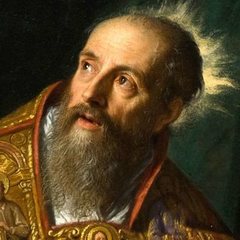
 Her son, and the reason the world knows her name. She wept and prayed over him for years, and lived to see him baptised. His Confessions and dialogues are almost all we know of her.
Confessions, Books 1 to 9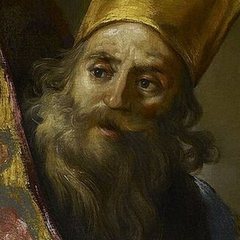 Ambrose of Milan
 The bishop who baptised her son. She “loved that man as an angel of God”, and gave up an old custom at his word. He often praised her to Augustine.
Confessions, Book 6, chapters 1 and 2; Letter 36Her husband, a pagan citizen of Thagaste of small means, warm to his friends and quick to anger. She won him to the faith near the end of his life.
Confessions, Book 2, chapter 3; Book 9, chapter 9Her other son. He sat in on the dialogue held on Augustine's birthday at Cassiciacum, and was with her at Ostia. He wished she could die in her own country, and not abroad.
On the Happy Life, chapter 1; Confessions, Book 9, chapter 11Augustine's sister. Possidius, his first biographer, calls her “a widow who had long served God and lived in charge of His handmaidens”, a community of nuns. He does not give her name.
Possidius, Life of St. Augustine, chapter 26Her grandson, the son of Augustine and the woman he lived with. He was the youngest at Cassiciacum. When she died, he “burst out into wailing”.
On the Happy Life, chapter 1; Confessions, Book 9, chapter 12The woman Augustine lived with for years, and never names. She was sent back to Africa so that he could marry, vowing never to know another man.
Confessions, Book 6, chapter 15An African bishop, well versed in the Scriptures. As a boy he had been handed to the Manichees, and he later left them of his own accord. He would not argue with her son, but promised her that the son of her tears would not perish.
Confessions, Book 3, chapter 12A servant of her father's family, who had carried her father on her back when he was a baby. Monica gave her more credit for her upbringing than she gave her own mother.
Confessions, Book 9, chapter 8A young man of Thagaste, once an imperial agent, who was baptised before Augustine and set out for home with the family. When she died, he took up the Psalter and began a psalm, and the whole house sang the answers.
Confessions, Book 9, chapters 8 and 12how she died
She died of a fever at Ostia, the port of Rome, in 387, on the ninth day of her illness. She was 55, and Augustine 32.
About five days after her talk with Augustine at the window, she fell ill. One day she fainted. When she came round she looked at her two sons and asked, “Where was I?” Then she told them, “Here shall you bury your mother.”
Her son Navigius wished she might die in her own country, not abroad, and she gave him a look for it. Augustine was amazed. For years she had worried about her grave, and had made one ready beside her husband's. Now she did not care where she lay.
Augustine closed her eyes. His son Adeodatus burst into tears, and they hushed him. Evodius, a young man of Thagaste, began a psalm, and the house sang the answers. Augustine held back his tears all through the funeral, and even went to the baths to ease his grief. It did not help. Then he slept, and woke with a hymn of Ambrose in his mind. At last he wept, “for her and for me”.
To her two sons
Lay this body anywhere, let not the care for it trouble you at all. This only I ask, that you will remember me at the Lord's altar, wherever you be.
is she a saint?
Yes. Catholics, Orthodox and Anglicans count her a saint, and Lutherans remember her too.
- CatholicSaintA memorial on 27 August
- OrthodoxSaint4 May, in the OCA and the Greek churches
- AnglicanSaintA Lesser Festival in the Church of England
- LutheranRememberedMissouri Synod 27 August, ELCA 4 May
For centuries she was hardly honoured at all. The Catholic Encyclopedia says that she “at first seems to have been almost forgotten”. Devotion to her spread from about the 1200s, and her feast came into the Roman calendar about 1550. In 1850 a society of Christian mothers was founded in Paris under her patronage, for “mutual prayer for sons and husbands who had gone astray”. Within six years it was an archconfraternity, with branches as far off as Dublin and Buenos Aires.
Her son asked for her to be remembered, and prayed for. He ends Book 9 of the Confessions by asking every reader to remember his parents at the altar. It is the only place in the whole Confessions where he gives her name:
…inspire Thy servants my brethren, Thy sons my masters, who with voice and heart and writings I serve, that so many of them as shall read these confessions may at Thy altar remember Monica, Thy handmaid, together with Patricius, her sometime husband.
At Ostia, the birthday of St. Monica, mother of blessed Augustine, who has left us in the ninth book of his Confessions a beautiful sketch of her life.
what to read first
The Confessions, Book 9
Augustine
Chapters 8 to 13 tell her girlhood, her marriage, the window at Ostia and her death.
Read it freeThe Confessions, Books 3, 5 and 6
Augustine
Her dream, a bishop's promise, the night on the shore at Carthage and her years in Milan.
Read them freeOn the Happy Life
Augustine
His birthday dialogue at Cassiciacum, where she takes part. Short, and free in Latin.
Read the Latin freeLetter 36, to Casulanus
Augustine
Near the end, Ambrose's answer to her question about fasting on Saturdays.
Read it freetake the quizzes
 Quiz Which early Christian thinks like you? And which would argue with you? Start
  Quiz Christian Personality Test Monica reads as The Deep Well. Find your own type. Start
 people like her
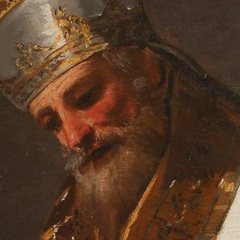 Gregory the GreatThe Deep Well
 The man whose book the Christian Personality Test is built on. His Dialogues begin with him sitting alone in a quiet place. He says it suited “a sad and melancholy disposition”. He also wrote that he loved the quiet life and had the busy one forced on him.
Gregory, Dialogues; Letters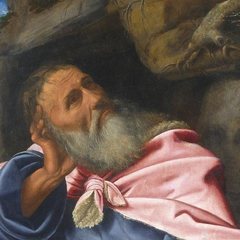 ElijahThe Deep Well
 After his great victory on Carmel he ran into the wilderness and sat under a tree. “I have had enough, LORD,” he said. The desert fathers remembered him as the one who “loved silence”.
1 Kings 19:4; Abba Nastirsources
Her life, and her words
- Augustine, Confessions. Tr. J. G. Pilkington, in Schaff's Nicene and Post-Nicene Fathers.
- The Latin text of the Confessions, Book 9. For her name, and for “meribibula”.
- Augustine, On the Happy Life, in Latin. The English on this page is our translation.
- Augustine, On Order, in Latin. The English on this page is our translation.
- Augustine, Letter 36, to Casulanus. Tr. J. G. Cunningham.
- Possidius, Life of St. Augustine. Tr. Herbert T. Weiskotten, 1919.
Reference
- Catholic Encyclopedia, 1911, “St. Monica”
- James J. O'Donnell, Augustine: Confessions, commentary on Book 6, 1992. Also Book 9.
- Ostia: Harbour City of Ancient Rome, “Church of Sant'Aurea”, for the epitaph
- Treasures of the Ancient Church, “The Discovery of the Epitaph of Augustine's Mother”, 2026
- OrthoChristian.com, “St. Monica: Model of Wifely Forbearance”
- The True Dignity of Women, “Woman Saint of the Week: St. Monica”, 2014
- Santa Monica Conservancy, History of Santa Monica
- Miguel Costansó, The Portolá Expedition of 1769-1770. Ed. Frederick J. Teggart, 1911.
Calendars
- USCCB, Liturgical Calendar 2026
- The Roman Martyrology, 1916 edition
- Calendarium Romanum, 1969, on why 4 May and the move to 27 August
- OCA, Saint Monica
- saint.gr, Greek
- OrthoChristian.com, 4 May on the old calendar, which is 17 May
- Church of England, Common Worship calendar
- The Episcopal Church, Lesser Feasts and Fasts 2022
- LCMS, Commemorations
- Evangelical Lutheran Worship, ELCA, the church year
Pictures
- Santa Mónica, Luis Tristán, 1616. Museo del Prado, Madrid. Public domain.
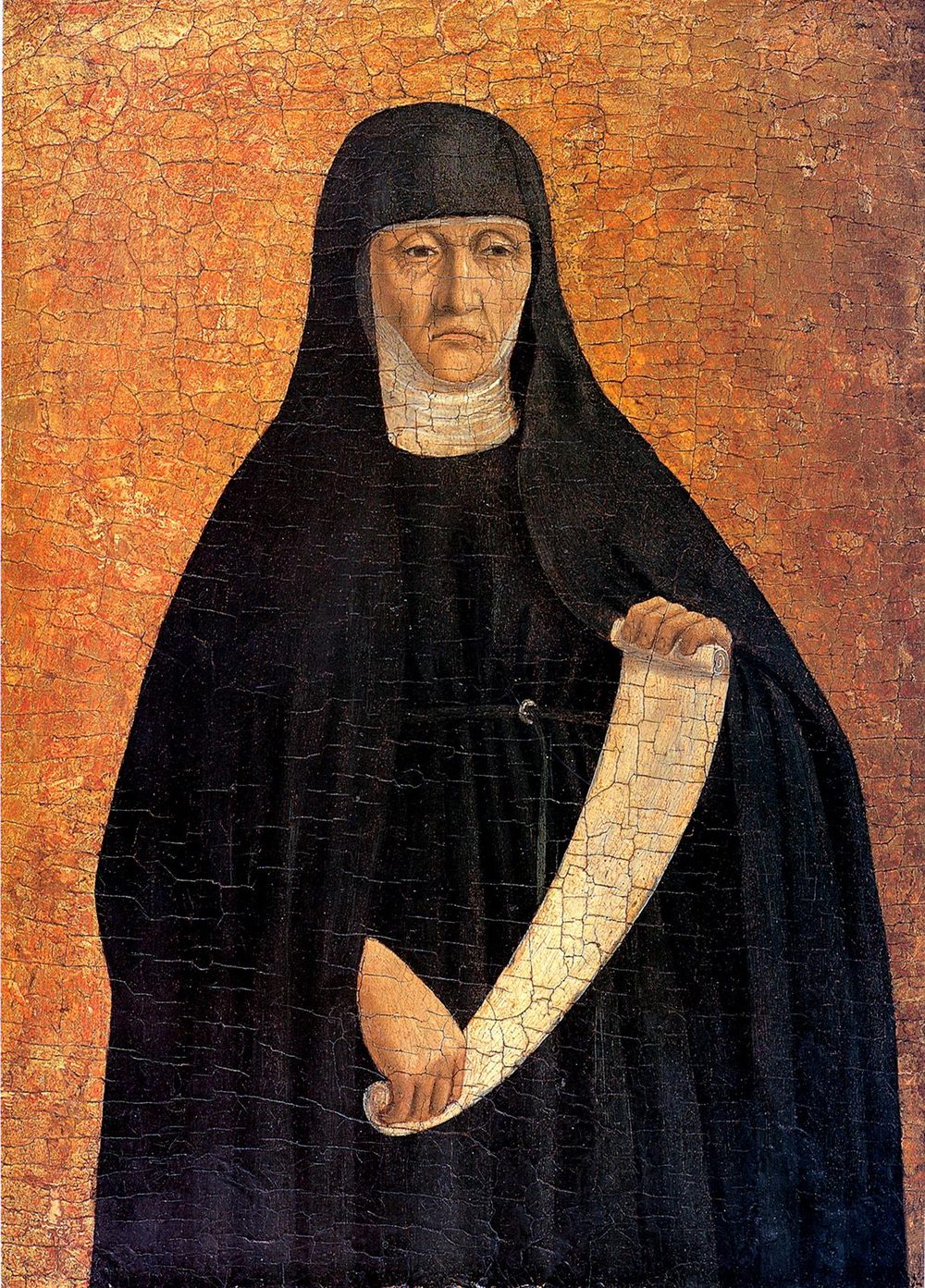
- An Augustinian Nun (Saint Monica), Piero della Francesca, about 1455 to 1460. The Frick Collection, New York. Public domain.
- Saint Augustine and his Mother Saint Monica, Ary Scheffer, 1855. Musée du Louvre. Public domain. Her face on the Saints page and in the personality test.