
Elijah
The prophet of fire and rain. He faced down King Ahab and the prophets of Baal, and a whirlwind took him up to heaven.
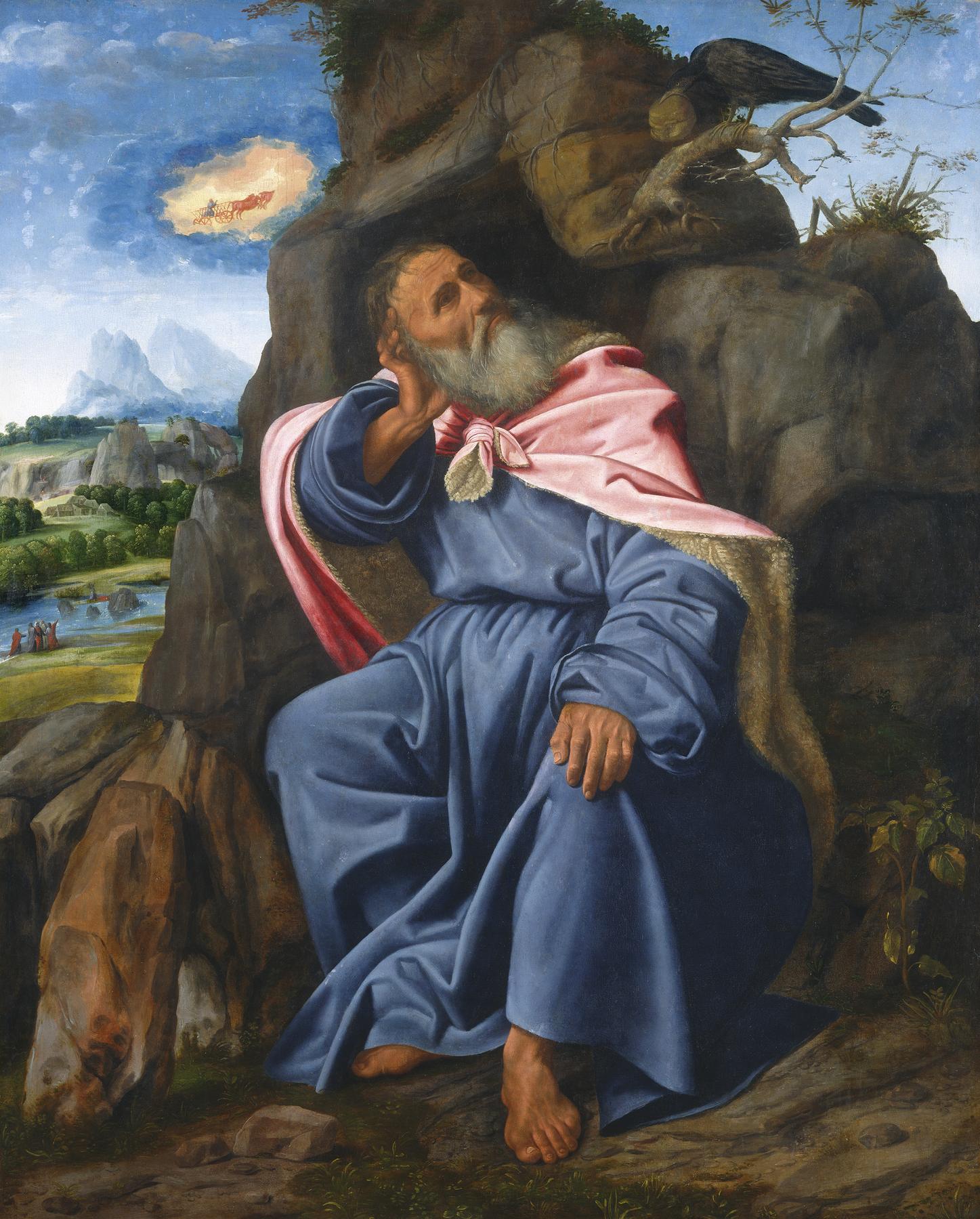
Picture: Elijah Fed by the Raven, Giovanni Girolamo Savoldo, about 1510. National Gallery of Art, Washington. CC0.
Who was Elijah?
Elijah was a prophet of Israel in the 800s BC, under King Ahab and Queen Jezebel. He stood almost alone against the worship of Baal. He prayed down fire on Mount Carmel and rain after years of drought, and heard God in a still, small voice. The Bible records no death: a whirlwind took him up to heaven.
at a glance
His path, in order
- ProphetOf the LORD, in Ahab's Israel
- GuestOf a widow in Zarephath, in the famine
- ChallengerOf 450 prophets of Baal, on Carmel
- FugitiveFrom Jezebel, to the wilderness and Horeb
- MentorTo Elisha, who took his place
- Taken upIn a whirlwind, beyond the Jordan
in numbers
- Years without rain3½
- The number Jesus and James both give
- Then he prayed, and the rain came
- Prophets of Baal on Carmel450
- And 400 prophets of Asherah
- Against one prophet of the LORD
- Jars of water on his altar12
- Four jars, poured three times
- In the third year of a drought
- Times he sent his servant to look7
- At first his servant said, “There is nothing there”
- Then a cloud as small as a man's hand
did you know?
-
A pagan writer, Menander, may remember Elijah's drought. He says that under Ethbaal, king of Tyre and Jezebel's father, there was “a want of rain” for a year, until the king prayed and “there came great thunders”. The Jewish historian Josephus quotes him.
Josephus, Antiquities, book 8, chapter 13; 1 Kings 16:31 -
The Hebrew behind “still” in Elijah's “still, small voice” is demamah: silence, stillness, calm. In Psalm 107 it is a storm gone quiet: “He calmed the storm to a whisper.”
1 Kings 19:12; Psalm 107:29; Strong's Hebrew 1827, at Bible Hub -
When a Samaritan village turned Jesus away, James and John asked Him, “Lord, do You want us to call down fire from heaven to consume them?” The King James Version, which calls Elijah Elias, adds “even as Elias did”. Jesus turned and rebuked them.
Luke 9:51-55; the King James Version -
The Orthodox pass on a story from Epiphanius of Cyprus, a bishop of the 300s. When Elijah was born, his father Sobach saw angels wrap him in fire and feed him with flames.
OCA, the Holy, Glorious Prophet Elijah
- Name
- Elijah means my God is the LORD.
- Also called
- Elias, the Greek form, in the King James New Testament. Elijah the Tishbite. Man of God, as the widow and King Ahaziah's captains called him. Troubler of Israel, as Ahab called him.
- From
- Tishbe, among the settlers of Gilead, east of the Jordan. Where Tishbe was is not certain, says the Catholic Encyclopedia.
- When
- The reigns of Ahab and his son Ahaziah, kings of Israel, in the 800s BC.
- Family
- The Bible names no parents, wife or children. A later story names his father Sobach. The monk John Cassian and the Orthodox honour him as a man who stayed unmarried for God.
- How he looked
- A hairy man with a leather belt around his waist. From that alone, King Ahaziah knew who had turned his messengers back.
- His cloak
- He threw it around Elisha to call him as his successor, and rolled it up to strike the Jordan. When he was taken up, it fell, and Elisha took it.
- Wrote
- No book. The Bible keeps one letter from him, to King Jehoram of Judah, in 2 Chronicles 21.
- Taken up
- Beyond the Jordan, near Jericho, in a whirlwind. Fifty men searched for him for three days.
- Honoured by
- Christians, East and West, and Jews, who still look for him to come again, as the prophet Malachi promised. The Carmelite order calls him its father.
- Patron of
- Rain and good weather: the Orthodox pray to him in drought. The Carmelite order long hailed him as its founder.
- In art
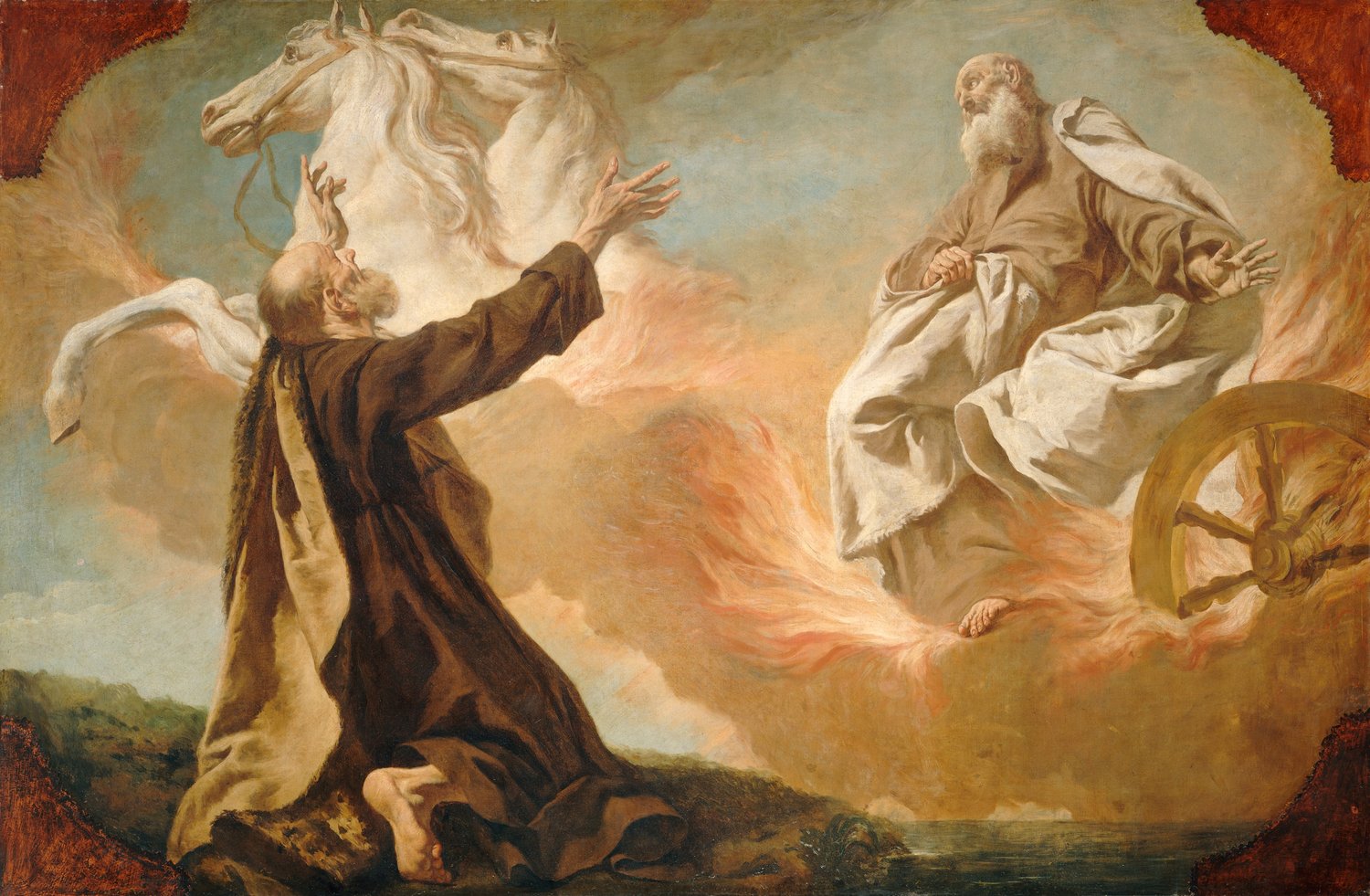
- Rising in a fiery chariot, letting his cloak fall to Elisha. Or in the wilderness, with a raven bringing him bread.
 The Deep Well
 His personality type
Serious by nature, and at his best when life is quiet.
In Gregory the Great's terms
- Serious
- Tranquil mind
Our reading, from the Christian Personality Test. The Christian Personality Test bases his type on what came after his victory on Carmel. He ran into the wilderness, sat down under a broom tree and prayed, “I have had enough, LORD.” The desert fathers remembered him as a man who “loved silence”, and in the monk John Cassian's Conferences he is the first example of The Watcher, one of the test's seven roles.
See The Deep Wellfeast days
East and West, side by side
West
- Jul20
His day in the 1916 Roman Martyrology, and in the whole Carmelite order since 1551. Lutherans in the Missouri Synod commemorate him too.
East
- Jul20
The Holy, Glorious Prophet Elijah, for the Orthodox Church in America and the Greek churches. The Russian Church keeps the day on the old calendar, which is 2 August on today's.
East and West both keep him on 20 July, the Catholic Encyclopedia notes. Churches on the old calendar keep each date 13 days later.
what others said of him
Jesus, His apostles, Ben Sira and the early Church, in their own words.
But I tell you truthfully that there were many widows in Israel in the time of Elijah, when the sky was shut for three and a half years and great famine swept over all the land. Yet Elijah was not sent to any of them, but to the widow of Zarephath in Sidon.
Elijah was a man just like us. He prayed earnestly that it would not rain, and it did not rain on the land for three and a half years. Again he prayed, and the heavens gave rain, and the earth yielded its crops.
Then Elijah arose, the prophet like fire. His word burnt like a torch.
Let us be imitators also of those who in goat-skins and sheep-skins went about proclaiming the coming of Christ; I mean Elijah, Elisha, and Ezekiel among the prophets.
From the life of the great Elias the hermit ought to see his own as in a mirror.
Abraham was a lover of strangers, David was a humble man, Elijah loved silence, and God accepted the work of all of them.
his life in eleven moments
Samaria
Ahab's reign“Neither dew nor rain”
King Ahab of Israel married Jezebel, a king's daughter from Sidon, and served Baal. He built Baal a temple and an altar in Samaria. Then Elijah the Tishbite stood before him. “As surely as the LORD, the God of Israel, lives, before Whom I stand, there will be neither dew nor rain in these years except at my word!”
1 Kings 16:29-33; 17:1The Brook of Cherith
During the droughtFed by ravens
God sent him to hide by a brook east of the Jordan: “I have commanded the ravens to feed you there.” So he went. “The ravens would bring him bread and meat in the morning and evening, and he would drink from the brook.” Then the brook dried up, because there had been no rain.
1 Kings 17:2-7The road
In the third yearObadiah
In the third year of the drought, God sent Elijah back to Ahab. On the way he met Obadiah, who ran the king's palace. Obadiah feared the LORD. When Jezebel was killing the LORD's prophets, he had hidden a hundred of them in caves, and fed them. Now he was afraid. Ahab had searched every kingdom for Elijah. What if the Spirit carried Elijah off, and Ahab killed the man who brought the news? Elijah swore to him, “I will present myself to Ahab today.”
1 Kings 18:1-16Mount Carmel
One whole dayFire on the mountain
King Ahab met Elijah with, “Is that you, O troubler of Israel?” Elijah had all Israel gathered on Mount Carmel, with the prophets of Baal. Each side would offer a bull and call on its god. Elijah said, “The God Who answers by fire, He is God.” Baal's prophets called from morning until evening. “But there was no sound, and no one answered.” Elijah rebuilt the LORD's altar with twelve stones, and had it soaked with water three times. Then he prayed, and “the fire of the LORD fell and consumed the sacrifice, the wood, the stones, and the dust, and it licked up the water in the trench.” The people fell facedown: “The LORD, He is God!” Then Elijah had the prophets of Baal seized. He took them down to the Kishon Valley and put them to death there.
1 Kings 18:17-40The top of Carmel
That eveningA cloud like a man's hand
Elijah told Ahab, “Go up, eat and drink, for there is the sound of a heavy rain.” Then he climbed to the top of Carmel, bent down to the ground and put his face between his knees. Seven times he sent his servant to look toward the sea. The seventh time the servant said, “There is a cloud as small as a man's hand rising from the sea.” The sky grew dark, and a heavy rain began to fall. Elijah tucked his cloak into his belt and ran ahead of Ahab's chariot all the way to Jezreel.
1 Kings 18:41-46The wilderness
A day past BeershebaUnder the broom tree
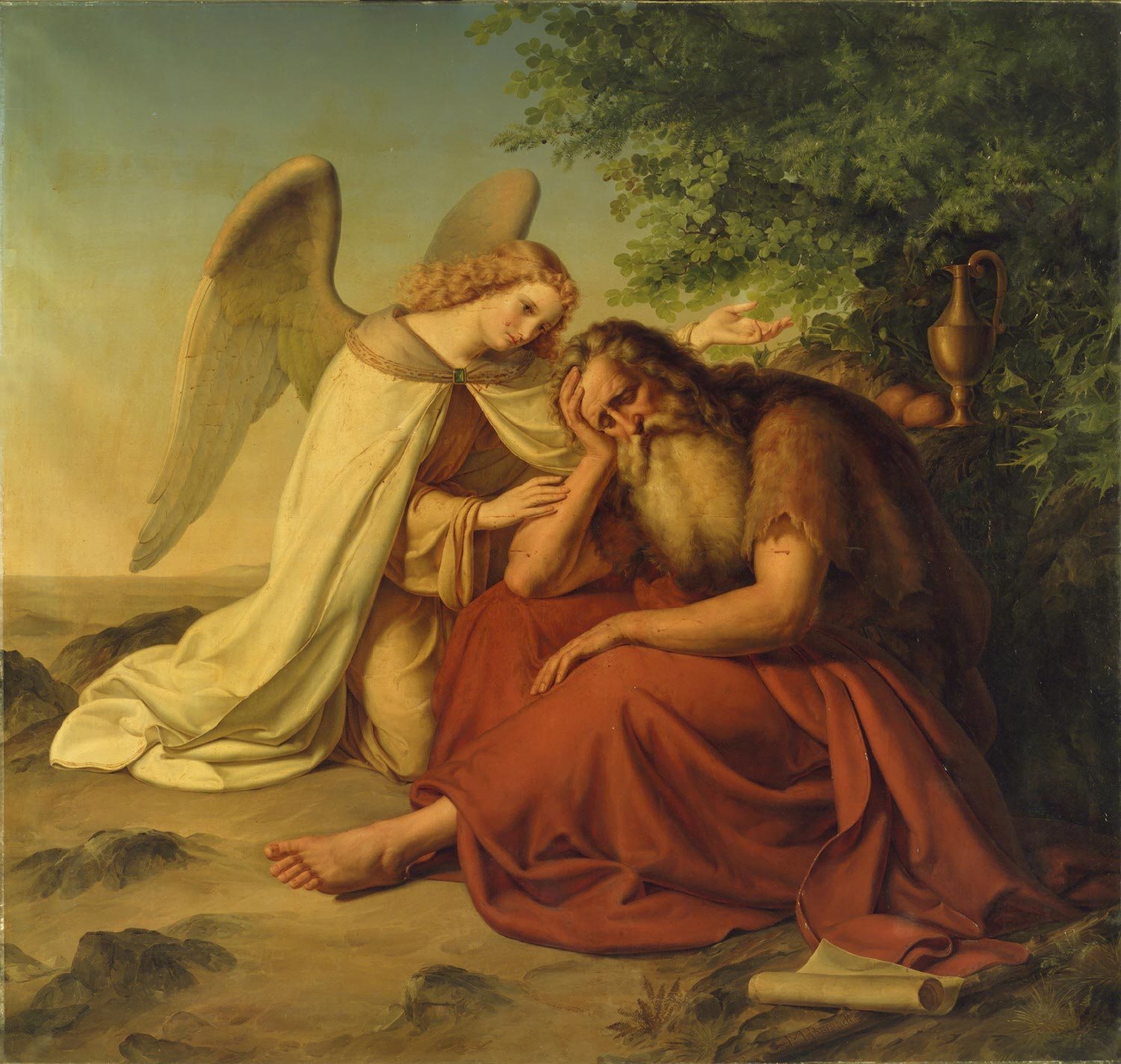
After his victory on Carmel, Queen Jezebel swore to kill him within a day. Elijah was afraid and ran for his life. He went a day's journey into the wilderness, sat down under a broom tree, and prayed that he might die. “I have had enough, LORD.” He fell asleep. An angel touched him: “Get up and eat.” By his head were a cake of bread baked over hot coals and a jar of water. He ate, and lay down again. The angel came a second time: “Get up and eat, or the journey will be too much for you.”
1 Kings 19:1-8Mount Horeb
Forty days laterThe still, small voice
He walked forty days and forty nights to Horeb, the mountain of God, and spent the night in a cave. God asked, “What are you doing here, Elijah?” He answered, “I am the only one left, and they are seeking my life as well.” He was told to stand on the mountain, for the LORD was about to pass by. A great wind tore at the mountains, “but the LORD was not in the wind.” Then came an earthquake, and a fire, but the LORD was not in them. “And after the fire came a still, small voice.” Elijah wrapped his face in his cloak and went out. God sent him back with work to do, and told him seven thousand in Israel had never bowed to Baal.
1 Kings 19:8-18A field
On his way backThe cloak on Elisha
Elijah found Elisha son of Shaphat ploughing with twelve teams of oxen. He passed by him and threw his cloak around him. Elisha ran after him: “Please let me kiss my father and mother goodbye, and then I will follow you.” “Go on back,” Elijah replied, “for what have I done to you?” Elisha slaughtered his oxen, burned their gear to cook the meat, and fed the people. Then he followed Elijah and served him.
1 Kings 19:19-21Jezreel
Some years laterNaboth's vineyard
Naboth would not sell Ahab the vineyard beside his palace: “The LORD forbid that I should give you the inheritance of my fathers.” Ahab sulked on his bed. So Jezebel wrote letters in his name. Two scoundrels swore that Naboth had cursed God and the king, and he was stoned to death. When Ahab went down to take the vineyard, Elijah was there. “So you have found me out, my enemy,” said the king. Elijah answered, “I have found you out because you have sold yourself to do evil in the sight of the LORD.” Ahab tore his clothes and put on sackcloth. God saw it, and put off the disaster Elijah had foretold until his son's days.
1 Kings 21The road from Samaria
Ahaziah's reignThe king who asked Baal-zebub
Ahab's son Ahaziah fell through a lattice in his upper room. He sent messengers to ask Baal-zebub, the god of Ekron, if he would get well. Elijah met them on the road: “Is it because there is no God in Israel that you are on your way to inquire of Baal-zebub, the god of Ekron?” They went back and told the king. The king asked what sort of man he was. A hairy man, they said, “with a leather belt around his waist.” The king knew at once: “It was Elijah the Tishbite.” Ahaziah died, as Elijah had said.
2 Kings 1:1-17A high mountain
Centuries laterWith Jesus, transfigured
Jesus took Peter, James and John up a high mountain, and His face shone like the sun. “Suddenly Moses and Elijah appeared before them, talking with Jesus.” Luke says they spoke “about His departure, which He was about to accomplish at Jerusalem.” Peter offered to put up three shelters, “one for You, one for Moses, and one for Elijah.” Then a voice from a bright cloud said, “This is My beloved Son, in Whom I am well pleased. Listen to Him!”
Matthew 17:1-8; Luke 9:30-33
his miracles
The ravens, the fire on Carmel and the rain are told in his life, above. These are the other wonders. At the altar on Carmel, he said where the power came from:
O LORD, God of Abraham, Isaac, and Israel, let it be known this day that You are God in Israel and that I am Your servant and have done all these things at Your command.
2 wonders for a widow in Zarephath
-
Zarephath, near Sidon
In the famineThe flour and the oil
When the brook where the ravens fed him dried up, God sent Elijah beyond Israel, to a widow. At the town gate she was gathering sticks. He asked her for water, then for bread. She had only a handful of flour and a little oil, and was about to make a last meal for herself and her son. “Do not be afraid,” he said. He told her to bake him a small cake first. God had promised that her flour and oil would last until the rain came.
“The jar of flour was not exhausted and the jug of oil did not run dry”
There was food every day for Elijah, the woman and her household.
1 Kings 17:8-16 -
Her upper room
LaterHer son raised
The son of the widow in Zarephath fell ill, until no breath was left in him. She cried out to Elijah, “What have you done to me?” He took the boy from her arms, carried him up to his room and laid him on his own bed. He stretched himself out over the child three times and cried out to the LORD.
“O LORD my God, please let this boy's life return to him!”
The boy lived. Elijah brought him down to his mother: “Look, your son is alive.” She said, “Now I know that you are a man of God.”
1 Kings 17:17-24
Fire on the king's soldiers
King Ahaziah sent a captain with fifty men to bring Elijah down from a hilltop. Elijah answered with the words below, and fire came down from heaven and consumed them. It happened again with a second captain and his fifty. The third captain fell on his knees and begged for their lives. Then the angel of the LORD told Elijah to go down with him, and not to be afraid.
“If I am a man of God, may fire come down from heaven and consume you and your fifty men.”2 Kings 1:9-15
The Jordan parted
On his last day, Elijah rolled up his cloak and struck the water of the Jordan. It parted to the right and to the left, and he and Elisha crossed on dry ground. When Elijah was gone, Elisha took up the fallen cloak and struck the water the same way, with the question below. It parted again.
“Where now is the LORD, the God of Elijah?”2 Kings 2:8, 13-14
his words
He wrote no book. His words are kept in 1 and 2 Kings, with one letter in 2 Chronicles. Outside the section on where the Bible figure quiz places him, every Bible line on this page is from the Berean Standard Bible. The exceptions are Sirach, from the World English Bible, and one King James line, named where it stands.
On Mount Carmel
How long will you waver between two opinions? If the LORD is God, follow Him. But if Baal is God, follow him.
All Israel had gathered on the mountain, with the prophets of Baal. “But the people did not answer a word.”
1 Kings 18:21I have not troubled Israel, but you and your father's house have, for you have forsaken the commandments of the LORD and have followed the Baals.
Shout louder, for he is a god! Perhaps he is deep in thought, or occupied, or on a journey. Perhaps he is sleeping and must be awakened!
Answer me, O LORD! Answer me, so that this people will know that You, the LORD, are God, and that You have turned their hearts back again.
I have had enough, LORD. Take my life, for I am no better than my fathers.
I have been very zealous for the LORD, the God of Hosts, but the Israelites have forsaken Your covenant, torn down Your altars, and killed Your prophets with the sword. I am the only one left, and they are seeking my life as well.
often misquoted
A chariot of fire carried Elijah up to heaven.
What the sources sayNot in 2 Kings. There a chariot of fire with horses of fire came between Elijah and Elisha, “and Elijah went up into heaven in a whirlwind.” The chariot ride is an old retelling. Ben Sira, in the book of Sirach, already has it: “You were taken up in a tempest of fire, in a chariot of fiery horses.” The icons paint it that way too.
2 Kings 2:11; Sirach 48:9, World English BibleElijah was the last faithful believer left in Israel.
What the sources sayHe said so, twice: “I am the only one left.” God answered that He had kept seven thousand “whose knees have not bowed to Baal”. Ahab's steward Obadiah had already hidden a hundred of the LORD's prophets in caves. Paul reads it as hope: “In the same way, at the present time there is a remnant chosen by grace.”
1 Kings 18:13; 19:10-18; Romans 11:2-5friends, family and rivals
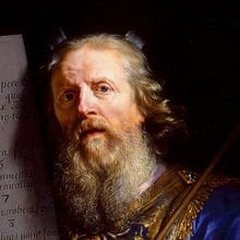 Moses
Moses Both met God on Horeb, the mountain of God. Both appeared with Jesus at the Transfiguration. Malachi names them side by side in the last lines of the prophets.
Exodus 3:1; 1 Kings 19:8; Matthew 17:3; Malachi 4:4-5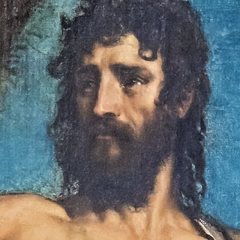 John the Baptist
 He came “in the spirit and power of Elijah”, and dressed like him, with “a leather belt around his waist”. As Elijah stood up to Ahab and Jezebel, John stood up to Herod and Herodias.
Luke 1:17; Matthew 3:4; 2 Kings 1:8; Mark 6:17-18King of Israel. He married Jezebel and served Baal. He called Elijah the “troubler of Israel”, and his enemy. After Naboth's death he humbled himself, and God put off the disaster Elijah had foretold to his son's days.
1 Kings 16:30-31; 18:17; 21:20-29Ahab's queen, a daughter of the king of the Sidonians. She killed the prophets of the LORD and swore to take Elijah's life. She arranged Naboth's death with letters in the king's name. Years later she died at Jezreel, as Elijah had said she would.
1 Kings 16:31; 18:4; 19:2; 21:8-23; 2 Kings 9:36Ahab's palace steward, who feared the LORD. He hid a hundred prophets in caves, fifty to a cave, and brought them food and water.
1 Kings 18:3-4A widow near Sidon, down to her last handful of flour. She fed him first, and he stayed in her upper room. Jesus spoke of her at Nazareth.
1 Kings 17:8-24; Luke 4:26His successor, called from the plough. On Elijah's last day he would not leave him. He asked for a double portion of Elijah's spirit, and took up his fallen cloak.
1 Kings 19:16-21; 2 Kings 2:1-15Ahab's son and heir. After a fall, he sent to ask Baal-zebub, the god of Ekron, whether he would recover. Elijah turned his messengers back, and the king died as Elijah had said.
2 Kings 1A man of Jezreel who would not sell King Ahab his family's vineyard. False witnesses had him stoned, and Elijah went to meet Ahab in the vineyard.
1 Kings 21how he was taken up
The Bible records no death. On his last walk with Elisha, a whirlwind took him up into heaven.
Others knew Elijah's last day had come. From Gilgal to Bethel, to Jericho and the Jordan, Elijah told Elisha three times to stay behind. Three times Elisha answered, “As surely as the LORD lives and as you yourself live, I will not leave you.” At Bethel and Jericho lived communities of men who served God together, called the sons of the prophets. They asked Elisha if he knew his master would be taken that day. “Yes, I know,” he said. “Do not speak of it.”
Elijah and Elisha crossed the Jordan on dry ground, and Elisha asked for a double portion of Elijah's spirit. Then, “as they were walking along and talking together, suddenly a chariot of fire with horses of fire appeared and separated the two of them, and Elijah went up into heaven in a whirlwind.”
Elisha cried out, “My father, my father, the chariots and horsemen of Israel!” He saw Elijah no more, and tore his clothes in two.
Fifty men searched for Elijah for three days, in case the Spirit had set him down on a mountain or in a valley. They did not find him.
The Jewish historian Josephus, writing in the first century, puts it plainly: “Elijah disappeared from among men, and no one knows of his death to this very day.”
Across the Jordan, to Elisha
Tell me, what can I do for you before I am taken away from you?
When Elisha asked for a double portion of his spirit
You have requested a difficult thing. Nevertheless, if you see me as I am taken from you, it will be yours. But if not, then it will not be so.
the promise of his return
The books of the prophets end with a promise: “Behold, I will send you Elijah the prophet before the coming of the great and awesome Day of the LORD” (Malachi 4:5). Here is how that promise was read.
John the Baptist
An angel told Zechariah that his son John would go before the Lord “in the spirit and power of Elijah”. Asked, “Are you Elijah?”, John said, “I am not.” Yet Jesus said of him, “if you are willing to accept it, he is the Elijah who was to come.” Some teachers in Tertullian's day read this as Elijah's soul born again in John. Tertullian, a Christian writer of Carthage, answered that John had Elijah's spirit and power,
“not (observe) in his soul and his body.”Luke 1:17; John 1:21; Matthew 11:14; Tertullian, A Treatise on the Soul, chapter 35
“Elijah must come first”
Coming down from the Transfiguration, the disciples asked, “Why then do the scribes say that Elijah must come first?” Jesus answered, “Elijah does indeed come, and he will restore all things. But I tell you that Elijah has already come.” John Chrysostom read it as two comings. John the Baptist came before Christ's first coming, doing Elijah's work. Elijah himself, the man from Tishbe, will come before the second:
“In this sense Elias is come: but if thou wouldest seek the Tishbite, he is coming.”Matthew 17:10-13; John Chrysostom, Homilies on Matthew, Homily 57
At the cross
When Jesus cried out, “Eli, Eli, lema sabachthani?”, some who stood there said, “He is calling Elijah.” Others said, “Leave Him alone. Let us see if Elijah comes to save Him.”
Matthew 27:46-49The two witnesses
Revelation tells of two witnesses who will prophesy before the end. They “have power to shut the sky so that no rain will fall during the days of their prophecy”, the power Elijah once had. The hope of the early Church that he will come back is told in the section on how he was taken up.
Jewish Encyclopedia, “Elijah's Chair”, 1906is he a saint?
Yes. He is honoured as a saint in the Orthodox and Catholic calendars, on 20 July. Lutherans in the Missouri Synod keep his day too.
- OrthodoxSaintThe Holy, Glorious Prophet, 20 July
- CatholicSaintIn the Roman Martyrology, 20 July
- LutheranCommemoratedMissouri Synod, 20 July
- AnglicanNot on the calendarChurch of England and Episcopal Church
The Carmelites long held that their order went back to Elijah himself. A notice of theirs from the 1200s says that “from the days of Elias and Eliseus the holy fathers of the Old and the New Dispensation dwelt on Mount Carmel”. Historians doubted it, and a long quarrel followed. In 1698 Pope Innocent XII told both sides to be silent. The whole order has kept his feast since 1551.
The Litany of the Saints printed in Rome's calendar of 1969 calls on him by name, after Abraham and Moses.
The Orthodox sing of him on his day, and Rome's book of martyrs, in its 1916 edition, gives him one line:
An angel in the flesh, the foundation of the prophets, the second forerunner of the coming of Christ, glorious Elijah.
On Mount Carmel, the holy prophet Elias.
what to read first
1 Kings 17 to 19
The First Book of Kings
The drought, the ravens, the widow, Carmel and Horeb. Three chapters.
Read it free1 Kings 21
The First Book of Kings
Naboth's vineyard, and Elijah's word to Ahab. One chapter.
Read it free2 Kings 1 and 2
The Second Book of Kings
The king who asked Baal-zebub, and the whirlwind. Two chapters.
Read it freeSirach 48
The book of Sirach
Ben Sira's praise of Elijah, in Catholic and Orthodox Bibles. Free in the World English Bible.
Read it freewhere the quiz places him
The record, drawn
Each arm is one axis; length is how far from the centre the recorded acts sit. An axis the text does not place Elijah on has no arm.
In the quiz's own words
Says it, confronts, more in front than alongside
The six axes
Your answers are marked. From your result on . See your result
In the hatched middle the quiz names neither pole.
The moments behind each axis
Each line is one recorded act and the reference it is taken from. The sentence says what the person did; where it is in quotation marks it is verbatim from the World English Bible British Edition. An act listed here is evidence of how this person moved, not approval of it; read the passage for how it was received. On 1 the text shows both ends and they do not settle, so that axis is left out too — the acts for each end are printed under it.
Pace Acts first ↔ Weighs first
quick to move
-
1 Kings 19:3 toward Acts first
When he saw it he arose and ran for his life to Beersheba, and left his servant there.
Voice Says it ↔ Holds it
says it
-
1 Kings 18:21 toward Says it
He put the choice to the assembled people out loud.
How long will you waver between the two sides?
-
1 Kings 18:27 toward Says it
At noon he mocked the prophets of Baal in front of the crowd.
Lead Out in front ↔ Alongside
more in front than alongside
-
1 Kings 18:30 toward Out in front
He called all the people over to him and repaired the altar in front of them.
-
1 Kings 19:19 toward Alongside
He went over to Elisha at the plough and put his own mantle on him.
Conflict Confronts ↔ Reconciles
confronts
-
1 Kings 18:21 toward Confronts
He came near to all the people and put the choice between the LORD and Baal to them.
-
1 Kings 21:20 toward Confronts
He met Ahab after Naboth's death and told him to his face what he had done.
Reasons Asks why ↔ Takes it on trust
recorded at both ends
The text shows both ends. The recorded acts go one way and the other and do not settle, so this axis is left out when a reader is matched rather than counted as a position in the middle. Both ends are below.
Toward Asks why
-
1 Kings 17:20 toward Asks why
He asked God why evil had come on the widow he was staying with.
Toward Takes it on trust
-
1 Kings 17:5 toward Takes it on trust
He went to the brook Cherith and lived there as he had been told.
Plans Plans ahead ↔ Meets the day
leans to meeting the day
-
1 Kings 17:6 toward Meets the day
At the brook, where he had been told to go, he lived on bread and meat brought to him morning and evening.
The ravens brought him bread and meat in the morning, and bread and meat in the evening
-
1 Kings 17:10-11 toward Meets the day
Sent on to Zarephath, he came to the city gate and asked a widow gathering sticks for water and a morsel of bread.
Nearest on the map
Distance between two sets of coordinates across every axis, on the same scale a reader's answers are measured on. No number is shown against a person, and nearness is not likeness: two people can land in the same band for different reasons.
Suggest a correction. Corrections that are applied are recorded in the public changelog.
 Quiz Who in the Bible are you most like? Answer eighteen plain statements about you, none of them about the Bible, and see how near you land to Elijah. Start
  Quiz Christian Personality Test Elijah reads as The Deep Well. Find your own type. Start
 people like him
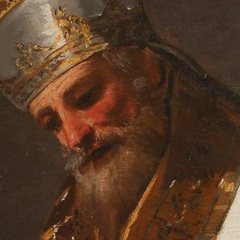 Gregory the GreatThe Deep Well
 Like Elijah under the broom tree, he knew weariness and the pull of quiet. His Dialogues open with him alone in “a solitary place, very fit for a sad and melancholy disposition”.
Gregory the Great, Dialogues, Book 1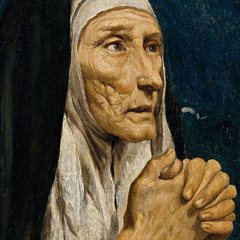 MonicaThe Deep Well
 Like Elijah on the top of Carmel, she kept on praying when nothing seemed to change. She wept and prayed for her son Augustine for years, until he came to faith.
Augustine, Confessionssources
His life, and his words
- The Berean Standard Bible, public domain. Every Bible line on this page outside the section on where the Bible figure quiz places him, except Sirach and one King James line.
- The World English Bible, British Edition, Sirach 48, public domain.
- The King James Version, for Luke 9:54.
- Josephus, Antiquities of the Jews, books 8 and 9. Tr. William Whiston. With Menander on the drought.
- 1 Clement, chapter 17. Tr. Alexander Roberts and James Donaldson. Ante-Nicene Fathers, volume 1, 1885.
- Tertullian, A Treatise on the Soul, chapters 35 and 50. Tr. Peter Holmes. Ante-Nicene Fathers, volume 3.
- Athanasius, Life of Antony, chapter 7. Nicene and Post-Nicene Fathers, second series, volume 4.
- John Cassian, Institutes, Book 1, and Conferences, Conference 14. Tr. Edgar Gibson. Nicene and Post-Nicene Fathers, second series, volume 11.
- John Chrysostom, Homilies on Matthew, Homily 57. Nicene and Post-Nicene Fathers, first series, volume 10.
- The Paradise or Garden of the Holy Fathers, volume 2. Tr. E. A. Wallis Budge, 1907. The saying of Abba Nastir.
Reference
- Catholic Encyclopedia, 1909, “Elijah”
- Catholic Encyclopedia, 1908, “The Carmelite Order”
- Jewish Encyclopedia, 1906, “Elijah's Chair”
- OCA, “Holy, Glorious Prophet Elijah”
- Bible Hub, Strong's Hebrew 1827, for the word behind the still, small voice
Calendars
- The Roman Martyrology, 1916 edition, 20 July
- Calendarium Romanum, 1969, with its Litany of the Saints
- OCA, 20 July
- azbyka.ru, Russian, 2 August, with the troparion
- The Lutheran Church–Missouri Synod, Commemorations
- Church of England, Common Worship calendar
- The Episcopal Church, Lesser Feasts and Fasts 2022
Pictures
- Elijah Fed by the Raven, Giovanni Girolamo Savoldo, about 1510. National Gallery of Art, Washington. CC0.
- Elijah Taken Up in a Chariot of Fire, Giuseppe Angeli, about 1740. National Gallery of Art, Washington. Public domain.