
Tobit
An exile who buried the dead, went blind, and sent his son on a journey with an angel.
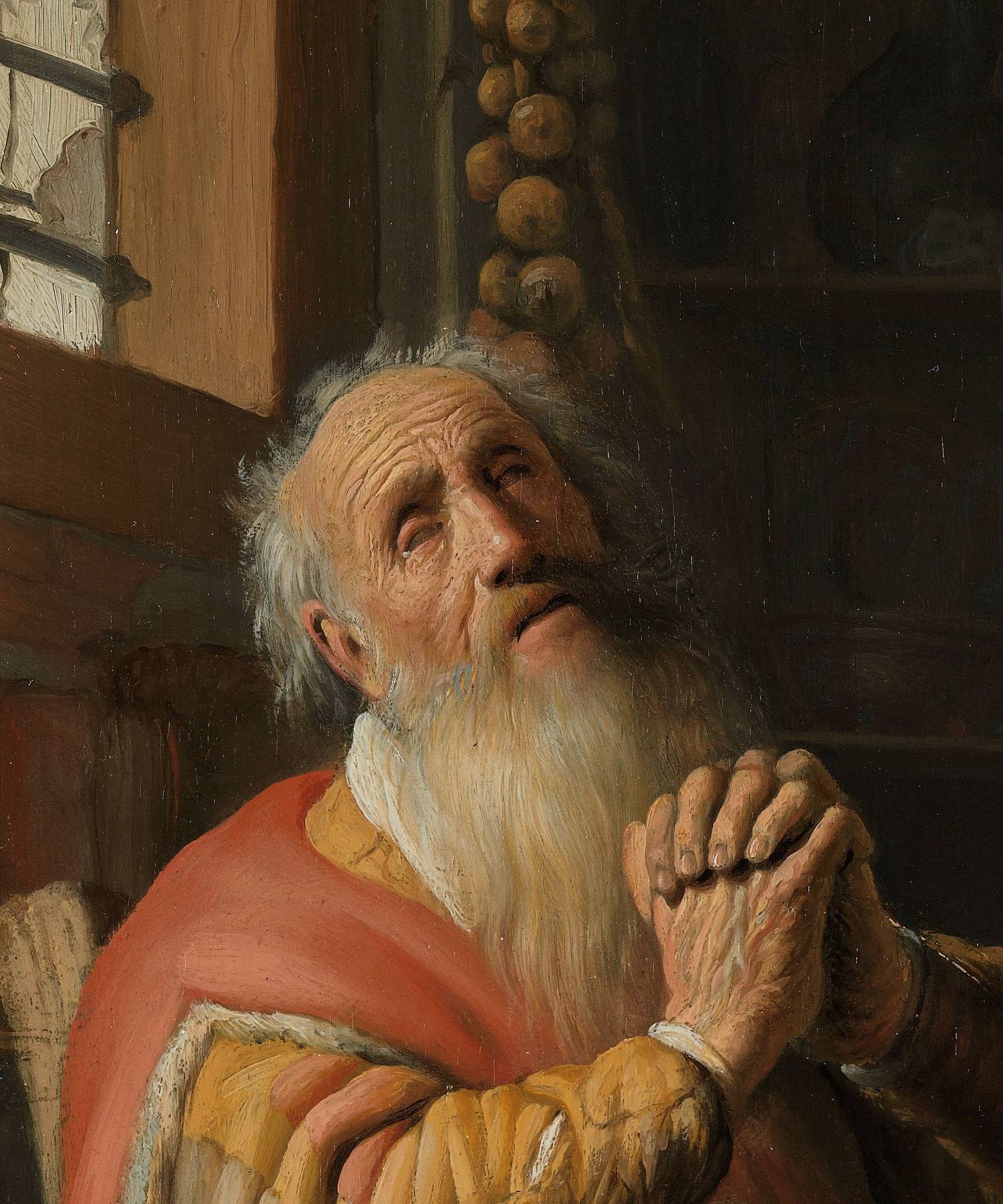
Picture: Tobit and Anna with the Kid (detail), Rembrandt, 1626. Rijksmuseum, Amsterdam. Public domain.
Who was Tobit?
Tobit was an Israelite of the tribe of Naphtali, carried off as a captive to Nineveh. There he fed the hungry and buried the dead, even when the king hunted him for it. Then he went blind. His son Tobias set out on a journey with a stranger, who turned out to be the angel Raphael.
at a glance
His path, in order
- PilgrimAlone of his tribe, to Jerusalem
- CaptiveCarried off to Nineveh
- King's buyerFor the king of Assyria
- FugitiveHunted for burying the dead
- BlindFor eight years
- HealedBy his son and an angel
in numbers
- Years he was blind8
- White films over his eyes
- Until his son came home
- Tenths of his harvest set apart3
- One to the Levites, one spent in Jerusalem
- The third given away, as his grandmother taught him
- Talents of silver in trust10
- Left with a man named Gabael, in Media
- The reason for his son's journey
did you know?
-
A dog went with his son Tobias and the angel Raphael, and came home with them. Jerome's Latin translation adds that it ran on ahead, “as if he had brought the news”, wagging its tail.
Tobit 5:16 and 11:4; Tobias 11:9, in the Douay Bible -
The name of the angel in his story, Raphael, means “God has healed”.
Catholic Encyclopedia, “St. Raphael” -
Jerome translated Tobit's book into Latin in one day. A scholar read the book aloud in Hebrew, and Jerome dictated it in Latin to a secretary. He called it “one day's hasty labour”.
Jerome, preface to Tobit, in the Nicene and Post-Nicene Fathers -
His nephew Achiacharus is Ahikar, hero of another famous old tale. Tobit's dying words recall how Ahikar was betrayed by the young man he raised.
Tobit 1:21-22 and 14:10; Jewish Encyclopedia, “Tobit, Book of” -
England's first Book of Common Prayer, in 1549, blessed every new couple with his son's story: God had sent “thy Aungell Raphaell to Thobie” and his bride Sarah.
The Book of Common Prayer (1549), the marriage service
- Tribe
- Naphtali, one of the northern tribes of Israel. He came from Thisbe, in Galilee.
- Lived
- In exile in Nineveh, the capital of Assyria. His book sets him under three kings: Enemessar, Sennacherib and Sarchedonus, the Esarhaddon of history.
- Family
- His wife Anna, of his own family, and one son, Tobias. He lived to see six grandsons. His nephew Achiacharus served the king.
- Work
- The king's buyer, until the roads to Media became unsafe under Sennacherib.
- Known for
- Giving alms and burying the dead of his people, even when the king wanted him killed for it.
- Also called
- Tobias, the same name as his son, in Jerome's Latin and the Douay Bible. Older books call him Tobias the elder. Both names come from the Hebrew word for good.
- Died
- In Nineveh, in his bed, very old. The Greek text used on this page says he was 158. Jerome's Latin says 102. Anna was buried beside him.
- His book
- The Book of Tobit, 14 short chapters. It is in Catholic and Orthodox Bibles, but not in the Hebrew Bible. Protestant Bibles that print it put it among the Apocrypha.
- Written
- By an unknown writer, at a date still argued over. The Jewish Encyclopedia of 1906 thought between 200 and 50 BC most likely.
- In art
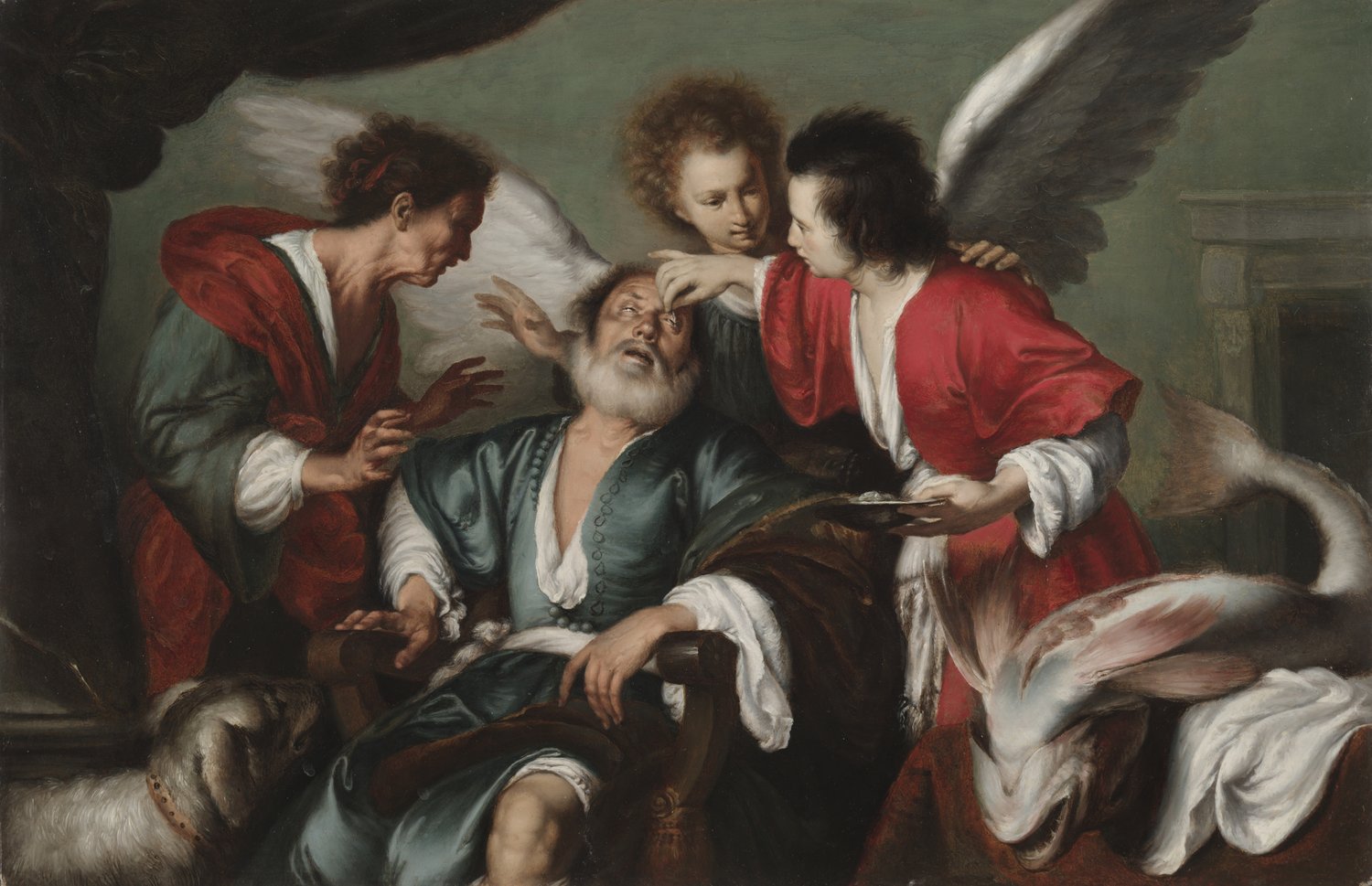
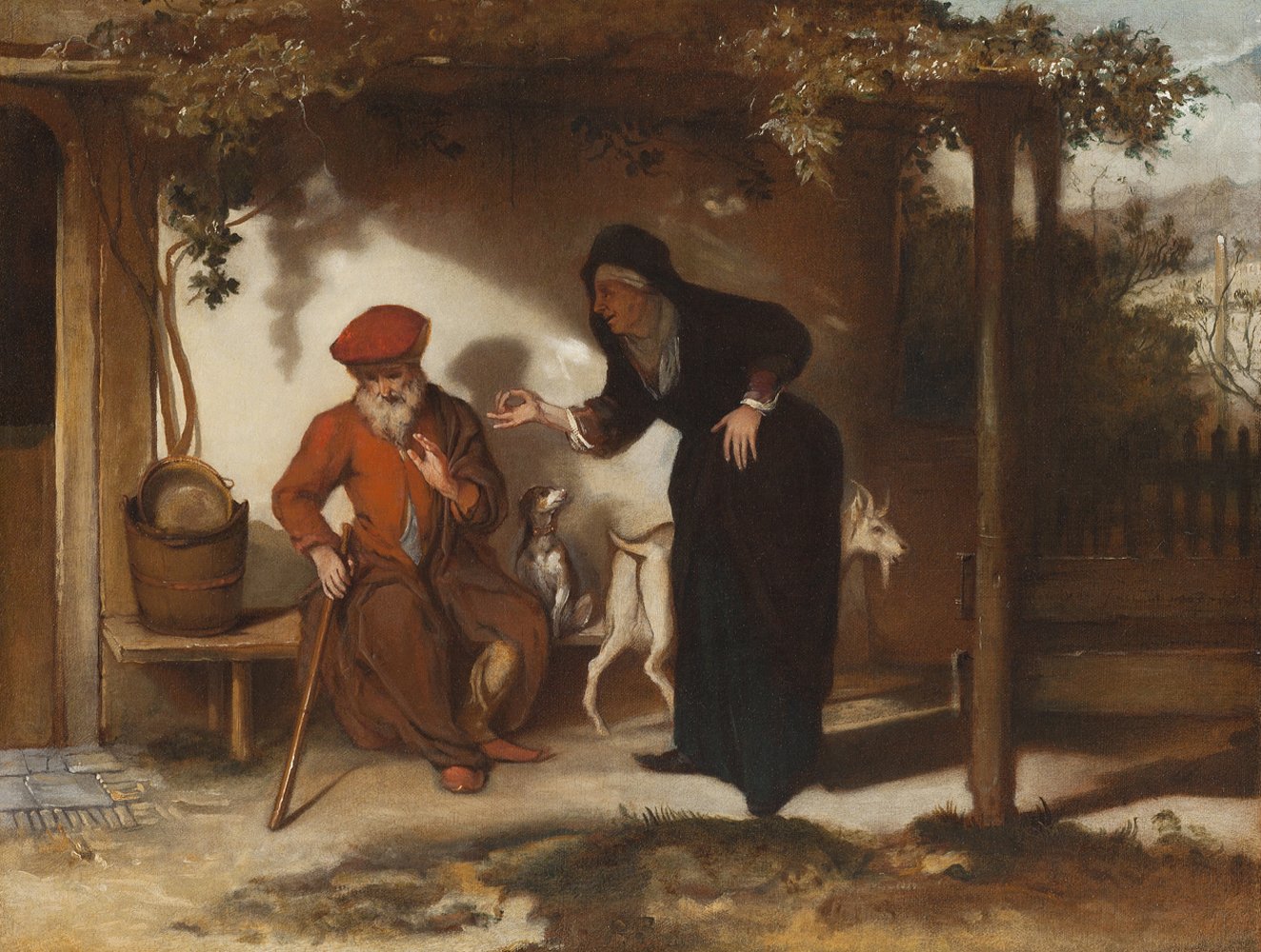
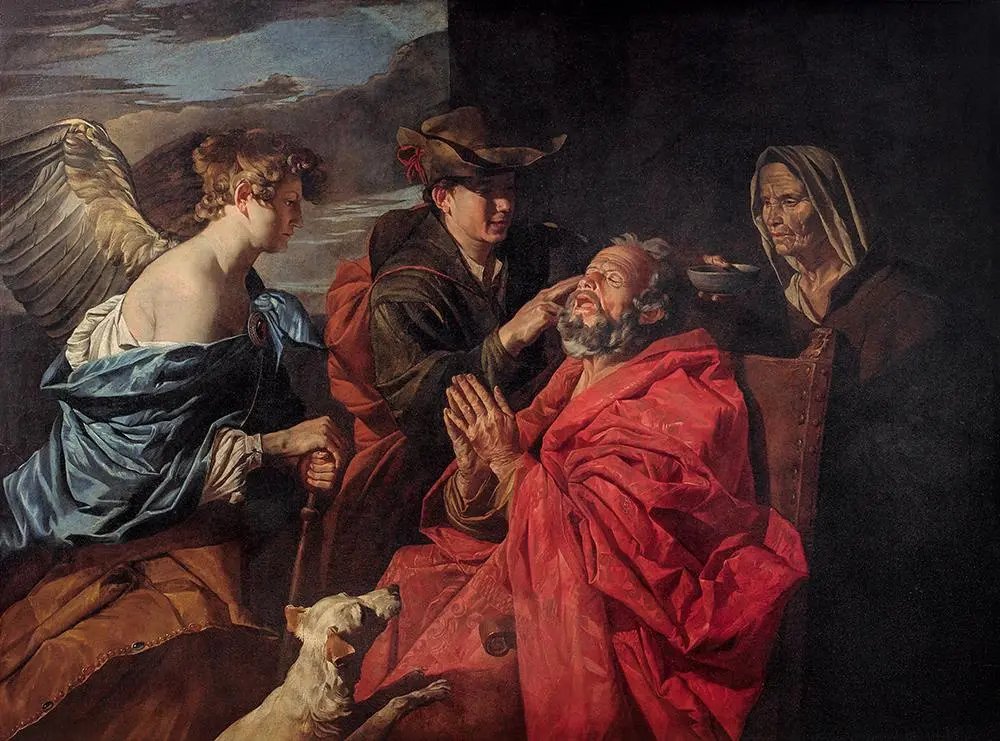
- Blind, with his wife Anna and a kid goat, or having his eyes healed with a fish's gall. Rembrandt painted his story again and again.
what others said of him
An angel, and two Fathers of the Church, in their own words.
When you buried the dead, I was with you likewise. And when you didn't delay to rise up, and leave your dinner, that you might go and cover the dead, your good deed was not hidden from me. I was with you.
Tobit also clearly portrayed in his life true virtue, when he left the feast and buried the dead, and invited the needy to the meals at his own poor table.
She rejoiced outwardly in the light of the sun; he inwardly in the light of Righteousness. Which of them was in the better light?
The son held out his hand to his father, to enable him to walk on earth; and the father to the son, to enable him to dwell in heaven.
his life in twelve moments
Galilee and Jerusalem
As a young manAlone to Jerusalem
Tobit grew up in Galilee, in the tribe of Naphtali. His father died and left him an orphan. When his whole tribe turned away from the temple in Jerusalem, he did not. “I alone went often to Jerusalem at the feasts.” He brought his first fruits to the priests, and gave a tenth of his harvest to the Levites. He spent a second tenth in Jerusalem every year, and gave away a third, as his grandmother Deborah had taught him.
Tobit 1:1-8Nineveh
In exileBread for the hungry
Tobit married Anna, of his own family, and they had a son, Tobias. Then the Assyrians carried Tobit off to Nineveh. His relatives there ate the food of the Gentiles, but he kept himself from it, “because I remembered God with all my soul.” He rose to be the king's buyer, and on a journey to Media he left ten talents of silver in trust with a man named Gabael. At home he cared for his own people. “I gave my bread to the hungry, and my garments to the naked.” If he saw one of them dead and thrown out on the wall of Nineveh, he buried him.
Tobit 1:9-17Nineveh
Under King SennacheribHunted by the king
King Sennacherib came back fleeing from Judea, and in his rage he killed many of the exiles. Tobit buried them in secret, and when the king looked for the bodies, they could not be found. Then a man of Nineveh told the king who had buried them. Tobit hid, and fled for his life. Everything he owned was taken, “save my wife Anna and my son Tobias.” Within fifty-five days, Sennacherib was killed by two of his own sons. The new king put Tobit's nephew Achiacharus over all his accounts, and Achiacharus spoke up for Tobit. So Tobit came home to Nineveh.
Tobit 1:18-22Nineveh
The feast of PentecostThe dinner he left
At Pentecost a good dinner was set before Tobit. Seeing so much food, he sent his son Tobias out to bring home a poor man of their people to share it. “Behold, I wait for you.” Tobias came back with news. One of their people had been strangled and thrown out in the marketplace. “Before I had tasted anything, I sprang up.” Tobit carried the body into a room, and ate his bread in sorrow. After sunset he dug a grave and buried the man. His neighbours laughed at him. “He is no longer afraid to be put to death for this matter; and yet he fled away. Behold, he buries the dead again.”
Tobit 2:1-8His courtyard
That same nightThe sparrows
Unclean after burying a dead man, Tobit slept that night by the wall of his courtyard, with his face uncovered. He did not know there were sparrows in the wall. Their warm droppings fell into his open eyes, and “white films came over my eyes.” The doctors could not help him. His nephew Achiacharus looked after him for a time.
Tobit 2:9-10His house
Blind and poorThe young goat
With Tobit blind, his wife Anna earned their keep by weaving cloth for others. One day her employers paid her wages and gave her a young goat as well. Tobit heard it bleat. “Where did this kid come from? Is it stolen? Give it back to the owners.” She told him it was a gift. He did not believe her, and he was ashamed of her. She answered him back: “Where are your alms and your righteous deeds? Behold, you and all your works are known.”
Tobit 2:11-14Nineveh and Ecbatana
The same dayTwo prayers
Grieved by his wife's words, Tobit wept and prayed to die. “Command my spirit to be taken from me, that I may be released, and become earth.” That same day, far away in Ecbatana in Media, a young woman named Sarah prayed too. She had been given to seven husbands, and a demon, Asmodaeus, had killed each one before the marriage began. Her father's maids mocked her for it. Both prayers were heard “before the glory of the great God.” God sent the angel Raphael to heal them both.
Tobit 3:1-17Nineveh
Setting outA guide for the road
Sure he would die soon, Tobit remembered the silver he had left in Media. He gave his son Tobias a father's advice, and sent him to fetch it. Tobias found a man who knew the way, and brought him in. Tobit wanted to know the man's family first. The stranger said he was Azarias, a kinsman, and Tobit offered him a drachma a day. He did not know he was hiring an angel. His wife Anna wept to see her son go. “Don't worry, my sister,” Tobit told her. “For a good angel will go with him.” So they set off, and the young man's dog went with them.
Tobit 4:1 to 5:22The Tigris, then Ecbatana
On the journeyThe fish and the bride
At the river Tigris a fish leaped out of the water at Tobit's son Tobias. The angel Raphael told him to catch it, and to keep its heart, liver and gall. At Ecbatana they stayed with Raguel, Tobit's kinsman, whose only daughter was Sarah. Raguel kissed Tobias and wept. “You are the son of an honest and good man.” He gave Tobias his daughter, though a demon had killed seven husbands before him. On the wedding night Tobias burned the heart and liver, and the demon fled “into the uppermost parts of Egypt, and the angel bound him.” Tobias and Sarah rose and prayed. That night Raguel dug a grave, afraid for Tobias: “Lest he also should die.” A maid found them both asleep, and Raguel had the grave filled in.
Tobit 6:1 to 8:18Nineveh
While his son was awayCounting the days
Tobias had married in Ecbatana, and his bride's father, Raguel, kept him there for the fourteen days of the wedding feast. At home, Tobit counted every day. Had his son been held up? Was Gabael, who held the silver, dead? Anna was sure her son had died. She went out every day to watch the road he had taken, and ate nothing all day long. “Hold your peace,” Tobit told her. “Don't worry. He is in good health.”
Tobit 8:19 to 10:7The door of his house
The homecomingHis eyes opened
Tobit's wife Anna, watching the road, saw Tobias coming, and ran to throw her arms around her son. Tobit went toward the door and stumbled, and his son ran and caught hold of him. As the angel Raphael had told him, Tobias rubbed the gall of the fish he had caught on his father's eyes. “Cheer up, my father.” The white films that had blinded him peeled away from the corners of his eyes, and he saw his son. He fell on his neck and wept. “Blessed are You, O God, and blessed is Your name forever! Blessed are all Your holy angels! For You scourged, and had mercy on me. Behold, I see my son Tobias.” He went out to the gate of Nineveh to meet his new daughter-in-law, and all who saw him marvelled.
Tobit 11:1-17His house
Paying the guide“I am Raphael”
Tobit told his son to pay the guide well, and they offered him half of all they had brought home. Then the guide took them both aside. He told them to bless God and give thanks, and to give alms. God had sent him, he said, to heal Tobit and his son's bride, Sarah. “I am Raphael, one of the seven holy angels which present the prayers of the saints and go in before the glory of the Holy One.” Father and son fell on their faces in fear. “Don't be afraid,” he said. “Write in a book all the things which have been done.” Then he rose, and they saw him no more.
Tobit 12:1-22
his words
Tobit's words are all in his own book. Most lines from it on this page are from the World English Bible. Lines from Jerome's Latin translation are in the English of the Douay-Rheims Bible. Other Bible lines are from the Berean Standard Bible.
His song of thanks
For He scourges, and shows mercy. He leads down to the grave, and brings up again.
After his eyes were opened and the angel Raphael had gone, Tobit wrote a prayer of rejoicing.
Tobit 13:1-2Give alms from your possessions. When you give alms, don't let your eye be envious. Don't turn away your face from any poor man, and the face of God won't be turned away from you.
If you have little, don't be afraid to give alms according to that little.
And what you yourself hate, do to no man.
Don't let the wages of any man who works for you wait with you, but give it to him out of hand.
In idleness is decay and great lack; for idleness is the mother of famine.
Ask counsel of every man who is wise, and don't despise any counsel that is profitable.
often misquoted
Tobit is the one who travels with the angel and catches the fish.
What the sources sayIt is his son, Tobias. Tobit stayed at home in Nineveh, blind, while the boy made the journey with Raphael and his dog, and caught the fish. Orthodox icons of the archangel show the same scene: Raphael leading Tobias, who carries the fish.
Tobit 5:16 to 6:5; OCA, Synaxis of the Archangel Michael and the Other Bodiless PowersTobit and Tobias are two spellings of one man.
What the sources sayThey are father and son. The Greek copies call the father Tobit and the son Tobias. But Jerome's Latin, and the Douay Bible made from it, call them both Tobias. That is why older books speak of the elder and the younger Tobias.
Catholic Encyclopedia, “Tobias”God struck him blind for his sins.
What the sources sayHis book says sparrows' droppings fell into his eyes, the night after a burial. His wife Anna's taunt and his own prayer both wonder about sin, and Augustine heard people say of any blind man, “God is angry with him”. Jerome's Latin translation gives a different reason. God allowed the trial so that “an example might be given to posterity of his patience, as also of holy Job.” The angel Raphael tells him, “because thou wast acceptable to God, it was necessary that temptation should prove thee.”
Tobit 2:9-14 and 3:3; Augustine, Sermon 38 on the New Testament; Tobias 2:12 and 12:13, in the Douay BibleRaphael is in every Bible, like Michael and Gabriel.
What the sources sayHe is named only in the Book of Tobit, so a Bible without it never names him. There he calls himself “one of the seven holy angels”, and Revelation too speaks of “the seven angels who stand before God”. Of those seven, says the Catholic Encyclopedia, only Michael, Gabriel and Raphael are named in Scripture. The other names come from the Book of Enoch and later writings.
Tobit 12:15; Revelation 8:2; Catholic Encyclopedia, “St. Raphael”his book
The Book of Tobit is in Catholic and Orthodox Bibles, but not in the Hebrew Bible or most Protestant ones. Whether its story is history is argued over too. Here each side speaks for itself.
Catholic: part of the Bible
The Catholic Church counts Tobit among the books of the Old Testament. It calls such books deuterocanonical: books of the Greek Old Testament that are not in the Hebrew Bible. The councils of Hippo, in 393, and Carthage, in 397, listed Tobit, and the Council of Trent settled it for Catholics in 1546.
“Despite the rejection of Tobias from the Protestant Canon, its place in the Christian Canon of Holy Writ is undoubted.”Catholic Encyclopedia, “Tobias”
Orthodox: read in the Church
The Orthodox Old Testament follows the Greek, so Tobit is in it. Orthodox voices describe it in two ways. The Longer Catechism of Philaret of Moscow cites Athanasius: such books were appointed “to be read by proselytes who are preparing for admission into the Church.” The Synod of Jerusalem in 1672 went further, and named Tobit as Scripture:
“For we judge these also to be with the other genuine Books of Divine Scripture genuine parts of Scripture.”The Confession of Dositheus, question 3, tr. J. N. W. B. Robertson (1899); the Longer Catechism, question 36, tr. R. W. Blackmore
Protestant: useful, not binding
Luther printed Tobit among the Apocrypha, and called it useful and good for Christians to read. The Church of England reads such books “for example of life and instruction of manners”, but not to establish any doctrine. The Westminster Confession of 1647 is sharper:
“The books commonly called Apocrypha, not being of divine inspiration, are no part of the Canon of the Scripture; and therefore are of no authority in the Church of God, nor to be any otherwise approved, or made use of, than other human writings.”The Westminster Confession, chapter 1; the Thirty-Nine Articles, Article 6, in Philip Schaff's The Creeds of Christendom
Jewish: never in the Hebrew Bible
The rabbis never counted Tobit among their holy books, though Jews copied it in Aramaic and Hebrew: pieces of five copies were found among the Dead Sea Scrolls. The Jewish Encyclopedia of 1906 describes it:
“A late Jewish work, never received into the Jewish canon”Jewish Encyclopedia, “Tobit, Book of”
Read as history
The Fathers of the Church told Tobit's story as fact. In 1912 the Catholic Encyclopedia still defended it. The trouble with some names and dates, it said, comes from a text that has reached us in poor shape, and the arguments against its history are “mere conjectures”.
“Until recently there never was question among Catholics in regard to the historicity of Tobias.”Catholic Encyclopedia, “Tobias”
Read as a story that teaches
Many scholars read the Book of Tobit as a story told to teach, not as a record. Its opening is already a puzzle: 2 Kings says Tiglath-pileser carried Naphtali away, not the king Tobit names. The Jewish Encyclopedia praised it as one of “the most delightful of short stories”. Luther had left the question open. Our translation:
“If it is history, it is a fine and holy history. If it is a poem, it is truly a good, beautiful, wholesome and useful poem and play, by a gifted poet.”Luther, preface to Tobit, 1534; 2 Kings 15:29; Catholic Encyclopedia, “Tobias”; Jewish Encyclopedia, “Tobit, Book of”
friends, family and rivals
She kept them by weaving when he went blind, and gave him a sharp answer over a young goat. When Tobias left she wept, and every day she watched the road. She saw him coming first.
Tobit 2:11-14; 5:17-22; 10:4-7; 11:5-9He made the journey to Media, married Sarah and healed his father's eyes. He buried both his parents, and died at Ecbatana at 127, glad to hear that Nineveh had fallen.
Tobit 5 to 11; 14:11-15A demon had killed her first seven husbands, each before the marriage began. Tobit went out to the gate of Nineveh to meet her, and blessed her: “Welcome, daughter!”
Tobit 3:7-15; 11:16-17He went with Tobias as Azarias, a kinsman hired for a drachma a day. He told Tobit that he had been with him each time he buried the dead.
Tobit 5:4-14; 12:12-15The king's cupbearer and keeper of the accounts. After Tobit fled the king, he brought him home. He cared for Tobit when he went blind, and came to Tobias's wedding feast.
Tobit 1:21-22; 2:10; 11:18His father's mother. Tobit was left an orphan, and she taught him to give a third tenth of his harvest away.
Tobit 1:8The man in Rages of Media who kept Tobit's ten talents of silver, sealed in their bags, until the angel Raphael came for them.
Tobit 1:14; 9:1-5He killed many exiles in his rage, looked for Tobit to put him to death, and took everything he had. Two of his own sons killed him.
Tobit 1:15-21how he died
He died in Nineveh, very old, in his bed, with his son and grandsons around him.
He called his son Tobias and his six grandsons. He told them to leave Nineveh, for he believed what the prophet Jonah had said against it. Jerusalem would be laid waste and its temple burned, he said. But God would bring His people home, and all the nations would turn to Him.
“Bury me decently, and your mother with me. Don't stay at Nineveh.” He went on to speak of alms. While he was still speaking, “he gave up the ghost in the bed.” The Greek text on this page gives his age as 158; Jerome's Latin says 102.
Tobias gave him a great funeral, and later buried Anna beside him. Then he took his family to Ecbatana, to Sarah's parents. Before he died, he heard that Nineveh had fallen.
To his son and grandsons
My child, take your sons. Behold, I have grown old, and am ready to depart out of this life.
His last words
And now, my children, consider what alms does, and how righteousness delivers.
is he a saint?
No church calendar we checked gives him a day of his own. Catholic and Orthodox Christians read his book as Scripture, and honour the angel of his story.
- CatholicNo feast dayHis book is in the Catholic Bible
- OrthodoxNo feast dayHis book is in the Orthodox Bible
- AnglicanNo feast dayA canticle from his song of thanks
- LutheranNo feast dayHis book is among the Apocrypha
Rome's book of martyrs, in its 1916 edition, does keep a Tobias on 2 November. He is a different man: a martyr of Sebaste, under the emperor Licinius.
The angel of his story has days of his own. Rome kept St Raphael on 24 October from 1921, and since 1969 he shares 29 September with Michael and Gabriel. The Orthodox keep him on 8 November with the other archangels.
Anglicans still pray Tobit's words. The Church of England's Common Worship sets verses of his song as a canticle, “A Song of Tobit”. The Episcopal Church reads from his book on the days of Hugh of Lincoln and Elizabeth of Hungary, 17 and 19 November.
what to read first
The Book of Tobit
The World English Bible
Fourteen short chapters: a blind father, a journey, a fish, a bride and an angel in disguise.
Read it freeTobit 11 and 12
The World English Bible
The homecoming, the healing and the angel's farewell. Two chapters.
Read it freeSermon 38 on the New Testament
Augustine of Hippo
A sermon on the two blind men of Matthew 20, which turns to Tobit and Anna, and asks which of them saw more clearly.
Read it freewhere the quiz places him
The record, drawn
Each arm is one axis; length is how far from the centre the recorded acts sit. An axis the text does not place Tobit on has no arm.
In the quiz's own words
Quick to question, quick to move, leans to planning
The six axes
Your answers are marked. From your result on . See your result
In the hatched middle the quiz names neither pole.
The moments behind each axis
Each line is one recorded act and the reference it is taken from. The sentence says what the person did; where it is in quotation marks it is verbatim from the World English Bible British Edition. An act listed here is evidence of how this person moved, not approval of it; read the passage for how it was received. On 1 the text shows both ends and they do not settle, so that axis is left out too — the acts for each end are printed under it.
Pace Acts first ↔ Weighs first
quick to move
-
Tobit 2:3-4 toward Acts first
Told that one of his people had been strangled and cast out in the marketplace, he sprang up before he had tasted anything and took him up into a chamber until sunset.
Before I had tasted anything, I sprang up
-
Tobit 1:19 toward Acts first
When he knew that he was being sought to be put to death, he withdrew himself for fear.
Voice Says it ↔ Holds it
quick to speak up
-
Tobit 3:1-6 toward Says it
He wept and prayed in his sorrow, and asked that his spirit be taken from him.
Command my spirit to be taken from me, that I may be released
-
Tobit 14:3 toward Says it
Grown very old, he called his son with his son's six sons and told him he was ready to depart out of this life.
-
Tobit 1:18 toward Holds it
He buried privately those whom King Sennacherib killed; the king sought for the bodies and they were not found.
I buried them privately
Lead Out in front ↔ Alongside
more in front than alongside
-
Tobit 2:2 toward Out in front
Seeing an abundance of meat, he told his son to go and bring whatever poor man of their kindred he could find, and said he would wait for him.
Behold, I wait for you.
-
Tobit 5:3 toward Out in front
He gave his son the handwriting, told him to seek a man to go with him and said he would give the man wages.
Seek a man who will go with you, and I will give him wages
Conflict Confronts ↔ Reconciles
recorded at both ends
The text shows both ends. The recorded acts go one way and the other and do not settle, so this axis is left out when a reader is matched rather than counted as a position in the middle. Both ends are below.
Toward Confronts
-
Tobit 2:13 toward Confronts
When the kid began to cry in his house, he asked his wife where it had come from and whether it was stolen, and told her to give it back to the owners.
Where did this kid come from? Is it stolen? Give it back to the owners
Toward Reconciles
-
Tobit 5:13 toward Reconciles
He welcomed the man as a brother and asked him not to be angry that he had sought to know his tribe and family.
because I sought to know your tribe and family
-
Tobit 5:17-22 toward Reconciles
When his wife wept and asked why he had sent their child away, he told her not to worry and that the boy would return safe and sound, and she stopped weeping.
So she stopped weeping.
Reasons Asks why ↔ Takes it on trust
quick to question
-
Tobit 5:8 toward Asks why
Told that his son had found someone to go with him, he said to call the man to him so that he might know his tribe and whether he was trustworthy.
Call him to me, that I may know of what tribe he is, and whether he be a trustworthy man to go with you.
-
Tobit 5:10-11 toward Asks why
He asked the man his tribe and family, and when the man answered with a question of his own he said that he wanted to know his kindred and his name.
I want to know, brother, your kindred and your name.
-
Tobit 2:14 toward Asks why
When his wife said the kid had been given to her as a gift on top of her wages, he did not believe her and asked her to return it to the owners.
I didn’t believe her, and I asked her to return it to the owners
Plans Plans ahead ↔ Meets the day
leans to planning
-
Tobit 1:14 toward Plans ahead
On a journey into Media he left ten talents of silver in trust with Gabael at Rages.
-
Tobit 4:1-2 toward Plans ahead
Having asked for death, he remembered the money left in trust and said to himself that he should call his son and explain about it before he died.
why do I not call my son Tobias, that I may explain to him about the money before I die?
-
Tobit 2:1-4 toward Meets the day
He had sat down to a good dinner at the feast of Pentecost; when news came that one of his people lay strangled in the marketplace he left it untasted and took the man up into a chamber.
Nearest on the map
Distance between two sets of coordinates across every axis, on the same scale a reader's answers are measured on. No number is shown against a person, and nearness is not likeness: two people can land in the same band for different reasons.
Suggest a correction. Corrections that are applied are recorded in the public changelog.
 Quiz Who in the Bible are you most like? Answer eighteen plain statements about you, none of them about the Bible, and see how near you land to Tobit. Start
  Quiz Christian Personality Test Which of eight types are you? Find your own. Start
 people like him
 Abraham
 He sent his servant to find a wife for his son among his own kin, sure that God “will send His angel before you”. Tobit sent his son off with the same hope: “May His angel go with you.”
Genesis 24:7; Tobit 5:16 Martin of Tours
 A young soldier who cut his cloak in two for a freezing beggar. Tobit too gave “my garments to the naked.”
Sulpicius Severus, Life of St Martin, chapter 3; Tobit 1:17 Judith
 Her book stands beside his in Catholic and Orthodox Bibles. Luther called hers a tragedy, and Tobit's a comedy.
Luther, prefaces to Judith and Tobitsources
His life, and his words
- The World English Bible, the Book of Tobit, public domain. Every line from his book on this page.
- The Berean Standard Bible, public domain. The other Bible lines on this page.
- The Douay-Rheims Bible, the Book of Tobias, the English of Jerome's Latin, chapters 2, 11, 12 and 14.
- Ambrose, On the Duties of the Clergy, Book 3, chapter 16. Tr. H. de Romestin. Nicene and Post-Nicene Fathers, second series, volume 10.
- Augustine, Sermon 38 on the New Testament. Tr. R. G. MacMullen. Nicene and Post-Nicene Fathers, first series, volume 6.
- Jerome, preface to Tobit and Judith. Nicene and Post-Nicene Fathers, second series, volume 6.
His book
- Catholic Encyclopedia, 1912, “Tobias”
- Jewish Encyclopedia, 1906, “Tobit, Book of”, by Crawford Howell Toy
- Martin Luther, Vorrede auffs Buch Tobie, in German. The English on this page is ours.
- The Confession of Dositheus, the Synod of Jerusalem, 1672. Tr. J. N. W. B. Robertson, 1899.
- The Longer Catechism of the Orthodox, Catholic, Eastern Church. Tr. R. W. Blackmore, in Philip Schaff's The Creeds of Christendom, volume 2.
- The Thirty-Nine Articles, 1571, Article 6. In the same work, volume 3.
- The Westminster Confession of Faith, 1647, chapter 1. In the same volume.
- Leon Levy Dead Sea Scrolls Digital Library, the Tobit manuscripts 4Q196 to 4Q200
Reference
- Catholic Encyclopedia, 1911, “St. Raphael”
- Nicene and Post-Nicene Fathers, second series, volume 10, the introduction to Ambrose's works, on On Tobit
- The Book of Common Prayer, 1549, the Form of Solemnization of Matrimony
Calendars
- The Roman Martyrology, 1916 edition
- Calendarium Romanum, 1969, on the feasts of St Raphael
- USCCB, Liturgical Calendar 2026, 29 September
- OCA, Synaxis of the Archangel Michael and the Other Bodiless Powers, 8 November
- Church of England, Common Worship, canticle 44, A Song of Tobit
- The Episcopal Church, Lesser Feasts and Fasts 2022, 17 and 19 November
Pictures
- Tobit and Anna with the Kid, Rembrandt, 1626. Rijksmuseum, Amsterdam. Public domain.
- The Healing of Tobit, Bernardo Strozzi, about 1625. Cleveland Museum of Art. CC0.
- Tobit and Anna with the Kid, Barent Fabritius, 1667. Agnes Etherington Art Centre, Kingston, Ontario. Public domain.
- The Healing of Tobit, Matthias Stom, about 1640. Fondazione Roberto Longhi, Florence. Public domain.