
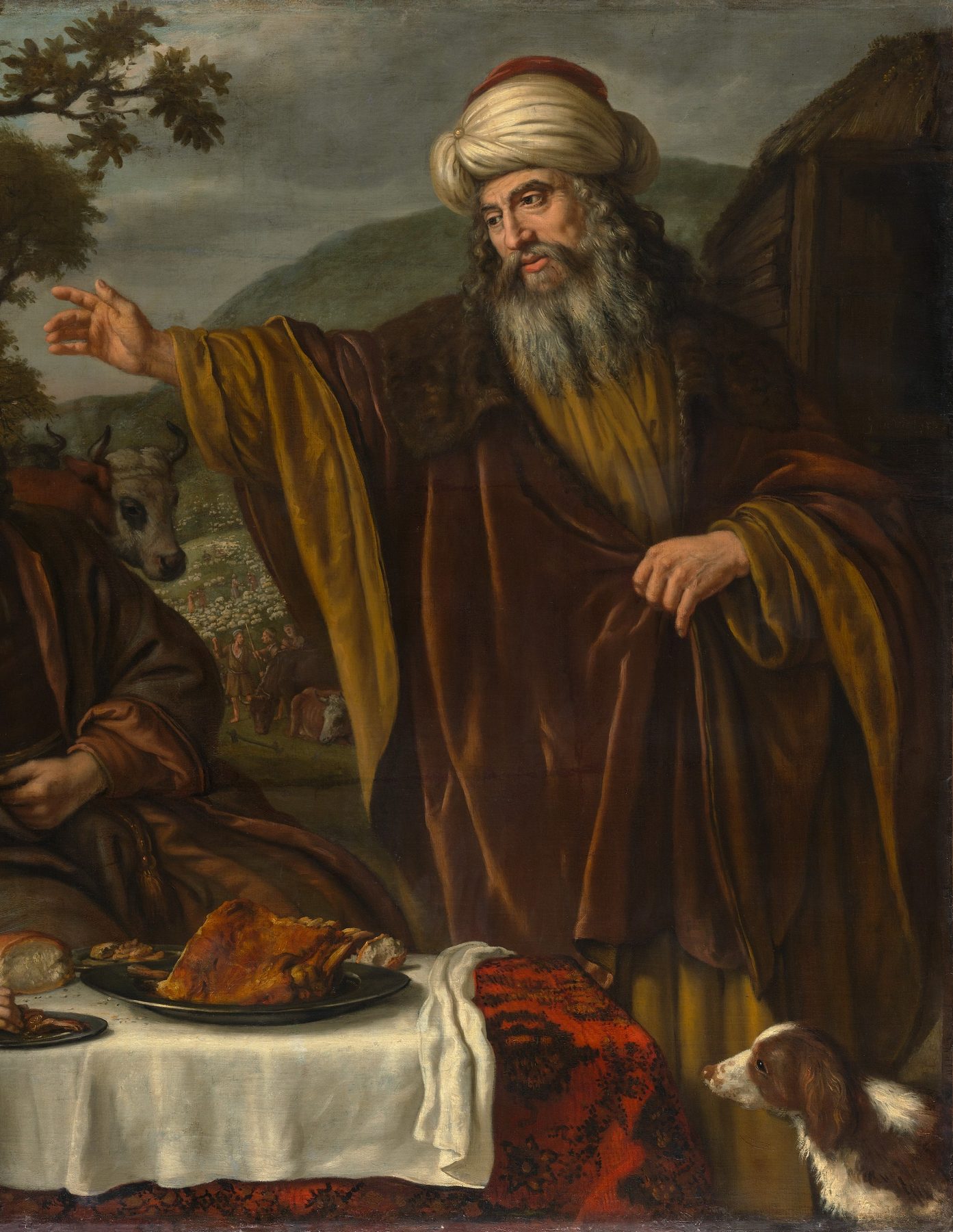
Abraham
The herdsman whom God called out of Ur. He believed the promise of a son and a land, and became the father of many nations.
Picture: Abraham's Parting from the Family of Lot (detail), Jan Victors, about 1655 to 1665. The Metropolitan Museum of Art, New York. CC0.
Who was Abraham?
Abraham was a herdsman from Ur, in Mesopotamia. God called him to leave his home for a land He would show him, and promised to make him a great nation. At seventy-five he went, still childless. At a hundred, he and Sarah had Isaac, the son God had promised. Jews, Christians and Muslims all honour him.
at a glance
His path, in order
- HerdsmanFrom Ur, in Mesopotamia
- PilgrimCalled out of Haran at 75
- WarriorRescued his nephew Lot with 318 men
- HostWelcomed three strangers at Mamre
- FatherOf Isaac, at a hundred
- PatriarchBuried at Machpelah, at 175
in numbers
- His age when he set out75
- For a land he had never seen
- He lived another hundred years
- His age when Isaac was born100
- His wife Sarah was ninety
- He and Sarah had both laughed at the promise of a son
- Men he led to rescue his nephew Lot318
- All born in his own household
- He chased Lot's captors as far as Dan
- Shekels of silver for Sarah's grave400
- The cave of Machpelah, at Hebron
- The first land he owned in Canaan
did you know?
-
He is the first person the Bible calls a prophet. God tells King Abimelech, “he is a prophet; he will pray for you.” He is the first it calls a Hebrew, too.
Genesis 20:7; 14:13; Strong's Hebrew 5030 and 5680, at Bible Hub -
The Bible calls him God's friend three times: in Isaiah, in James, and in a king's prayer, “Abraham Your friend”.
2 Chronicles 20:7; Isaiah 41:8; James 2:23 -
Moriah, where God told him to offer up Isaac, is named only once more in the Bible. Solomon built the temple “in Jerusalem on Mount Moriah”.
Genesis 22:2; 2 Chronicles 3:1
- Born
- In Ur of the Chaldeans, in Mesopotamia, in a year no one recorded. Most scholars take it to be the Sumerian city of Ur, in southern Iraq, says Britannica. The Orthodox Church in America dates his life to about 2000 BC.
- Home
- A tent. He moved from Haran to Shechem and Bethel, to the Oaks of Mamre at Hebron, and to Beersheba.
- Family
- His father was Terah, and his brothers were Nahor and Haran. His wife Sarah was his half-sister. His sons were Ishmael by Sarah's servant Hagar and Isaac by Sarah, and six more by a later wife, Keturah. Lot was his nephew.
- Work
- A herdsman, “extremely wealthy in livestock and silver and gold”.
- Also called
- Abram, until he was 99. The Hebrew. God's friend. The father of all who believe, in Paul's words. The Forefather, in the Orthodox Church.
- Died
- At 175, “old and contented”.
- Buried
- In the cave of Machpelah, near Mamre at Hebron, beside Sarah. He had bought it for her grave.
- Honoured by
- Jews, Christians and Muslims, says Britannica. Jews and Christians trace God's promise through Isaac. In Islam it passes through Ishmael, and Muhammad is Ishmael's descendant.
- In art
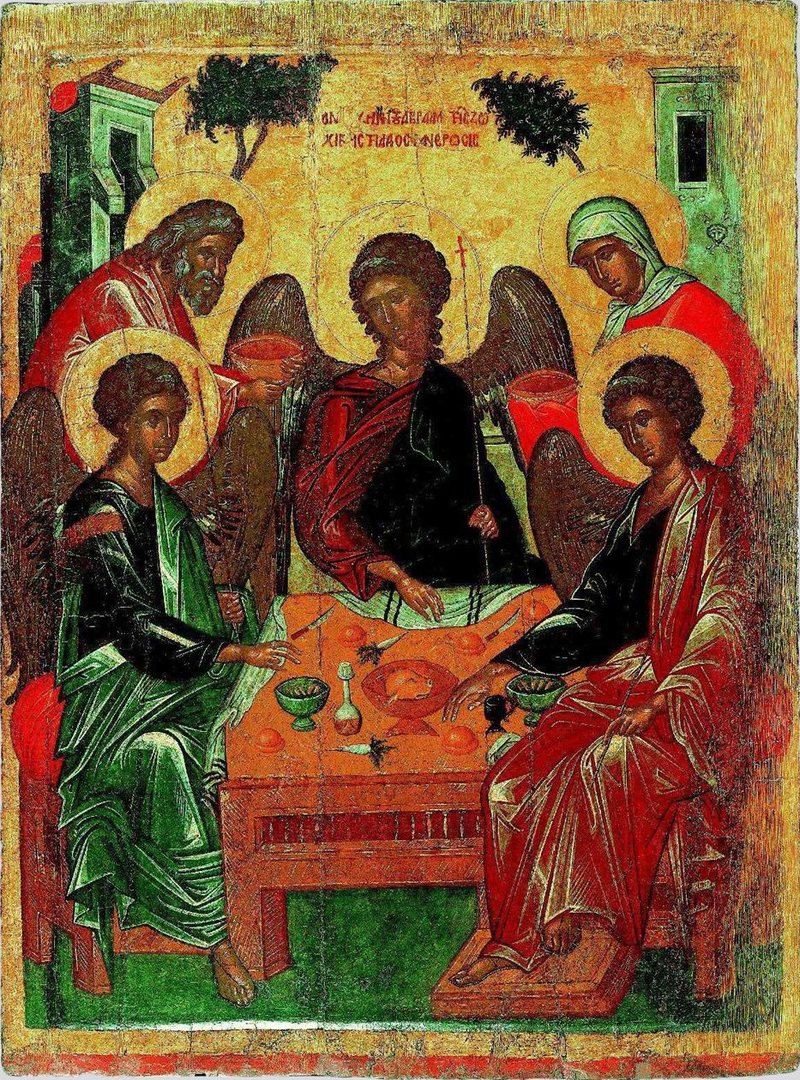
- At his tent, serving three visitors. Or on the mountain with Isaac, as an angel stops his hand. The Orthodox icon of the three visitors is the Hospitality of Abraham.
feast days
East and West, side by side
West
- Oct9
The holy patriarch Abraham, in the 1916 Roman Martyrology. Lutherans in the Missouri Synod keep the same day.
East
- Sep3
The Coptic Church, on 28 Mesra in its own calendar, with Isaac and Jacob.
- Oct9
The Righteous Forefather Abraham, with his nephew Lot, in the Orthodox Church in America.
The Orthodox also keep him on the Sunday of the Holy Forefathers, between 11 and 17 December, and on the Sunday before Christmas with all the forefathers of Christ. Churches on the old calendar keep his 9 October feast on 22 October, 13 days later.
what others said of him
God, Jesus and the early Church, in their own words.
But you, O Israel, My servant, Jacob, whom I have chosen, descendant of Abraham My friend
Your father Abraham rejoiced that he would see My day. He saw it and was glad.
By faith Abraham, when called to go to a place he would later receive as his inheritance, obeyed and went, without knowing where he was going.
Abraham, styled ‘the friend,’ was found faithful, inasmuch as he rendered obedience to the words of God.
Isaac, when led by his father as a victim, and himself bearing his own ‘wood,’ was even at that early period pointing to Christ's death
All rules of conduct are not alike. Abraham was a lover of strangers, David was a humble man, Elijah loved silence, and God accepted the work of all of them.
his life in 16 moments
Ur and Haran
His father's journeyOut of Ur
Abram grew up in Ur of the Chaldeans, the son of Terah. His brother Haran died there, leaving a son, Lot. Abram's wife Sarai “was barren; she had no children.” Terah set out with Abram, Sarai and Lot for the land of Canaan. “But when they arrived in Haran, they settled there.” Terah died in Haran. Joshua later said Terah and his fathers had “worshiped other gods.” Stephen, in Acts, says God first appeared to Abraham “while he was still in Mesopotamia, before he lived in Haran”.
Genesis 11:26-32; Joshua 24:2; Acts 7:2Haran
At seventy-five“Go to the land I will show you”
The LORD said to Abram, “Leave your country, your kindred, and your father's household, and go to the land I will show you.” He promised to make him a great nation, and more: “all the families of the earth will be blessed through you.” “So Abram departed, as the LORD had directed him.” He was seventy-five. He took Sarai, Lot and all they had into Canaan. At Shechem the LORD appeared to him: “I will give this land to your offspring.” Abram built an altar there. Hebrews says he went “without knowing where he was going.”
Genesis 12:1-7; Hebrews 11:8Egypt
A famine“Say you are my sister”
Famine drove Abram down to Egypt. At the border he said to Sarai, “Look, I know that you are a beautiful woman.” He was afraid the Egyptians would kill him to take her. “Please say you are my sister.” Pharaoh took her into his palace, and treated Abram well for her sake. Then the LORD struck Pharaoh's household with plagues. Pharaoh summoned Abram: “What have you done to me? Why didn't you tell me she was your wife?” He sent them away with all they had. Years later, at Gerar, Abraham did the same again.
Genesis 12:10-20; 20:1-2Near Bethel
Too many flocksParting from Lot
Abram came back from Egypt “extremely wealthy in livestock and silver and gold.” Lot had flocks and herds too, and their herdsmen quarrelled. Abram let his nephew choose first. “Is not the whole land before you? Now separate yourself from me. If you go to the left, I will go to the right.” Lot chose the well-watered plain of the Jordan, and pitched his tent toward Sodom. Then the LORD told Abram to look north, south, east and west: “for all the land that you see, I will give to you and your offspring forever.” Abram moved his tent to the Oaks of Mamre, at Hebron.
Genesis 13:1-18Dan, and the King's Valley
A war of kingsThe rescue, and Melchizedek
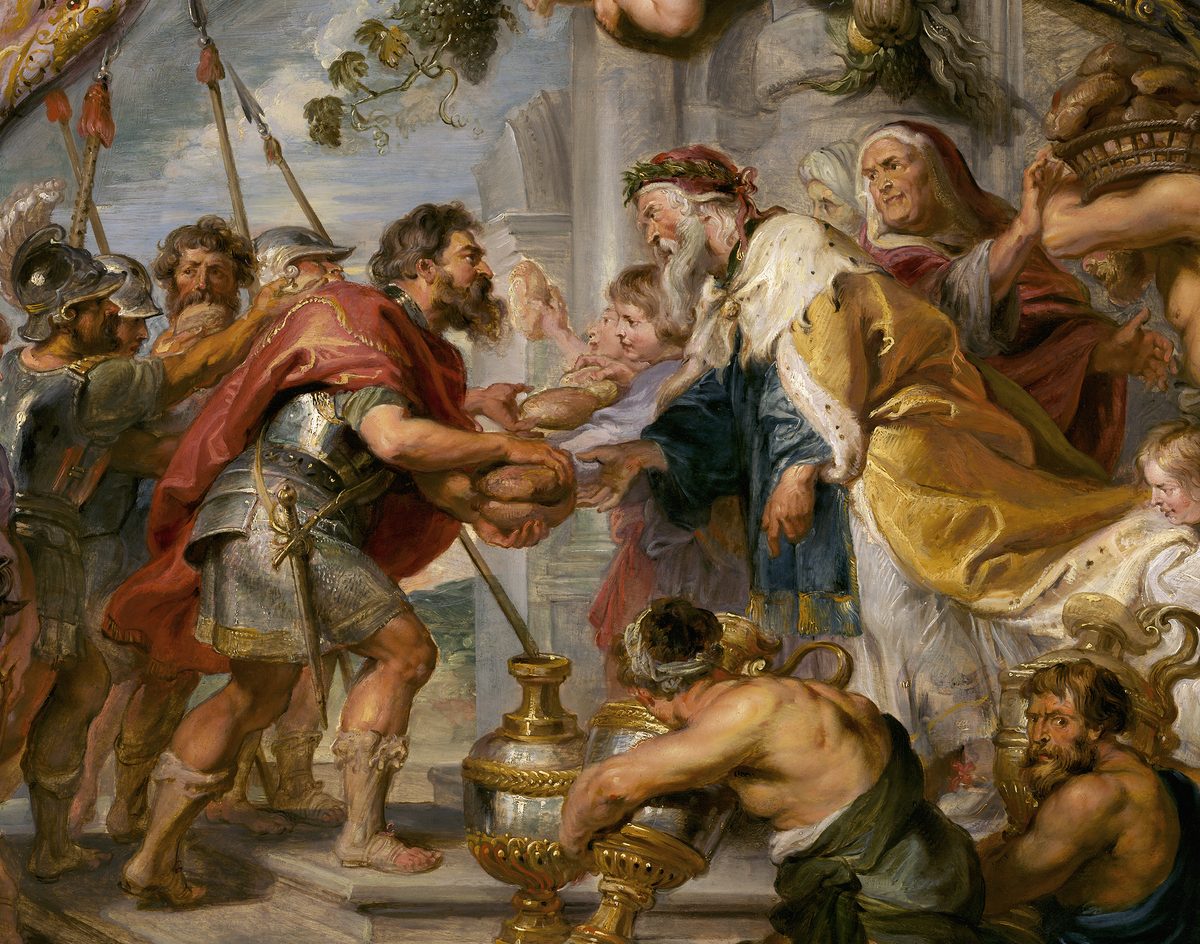
Four kings raided the cities of the Jordan plain and carried off Abram's nephew Lot. Abram “mobilized the 318 trained men born in his household.” He chased the raiders as far as Dan, attacked by night, and brought back Lot, the people and the goods. As Abram came home, Melchizedek, king of Salem, came out to meet him with bread and wine. He was “priest of God Most High”, and he blessed Abram. Abram gave him a tenth of everything. The king of Sodom offered him the spoils, but Abram would not take so much as a thread.
Genesis 14:1-24Canaan
One nightCount the stars
The word of the LORD came to Abram in a vision: “Do not be afraid, Abram. I am your shield, your very great reward.” Abram answered that he had no child. His heir would be a servant, Eliezer of Damascus. The LORD took him outside. “Now look to the heavens and count the stars, if you are able.” Then He told him, “So shall your offspring be.” And “Abram believed the LORD, and it was credited to him as righteousness.”
Genesis 15:1-6Canaan
At sunsetThe smoking firepot
When the LORD promised him the land, Abram asked, “Lord GOD, how can I know that I will possess it?” The LORD told him to bring a heifer, a goat, a ram, a turtledove and a young pigeon. Abram split the animals and laid the halves opposite each other, and drove the birds of prey away. As the sun set, “great terror and darkness overwhelmed him.” God told him his descendants would be strangers and slaves for four hundred years, and then come back. After dark, “a smoking firepot and a flaming torch appeared and passed between the halves”. That day the LORD made a covenant with Abram.
Genesis 15:7-18A spring on the road to Shur
Ten years in CanaanHagar
Abram's wife Sarai was still childless. She gave Abram her Egyptian servant Hagar: “perhaps I can build a family by her.” Hagar conceived, and began to despise her mistress. Sarai treated her so harshly that she fled. The angel of the LORD found her by a spring in the desert and sent her back with a promise. Her son would be called Ishmael, “for the LORD has heard your cry of affliction.” Hagar gave the LORD a name: “You are the God who sees me.” Abram was eighty-six when Ishmael was born.
Genesis 16:1-16Canaan
At ninety-nineA new name
The LORD appeared to Abram again. “I am God Almighty. Walk before Me and be blameless.” Then: “No longer will you be called Abram, but your name will be Abraham, for I have made you a father of many nations.” Sarai would be Sarah, and she would bear him a son. Abraham fell facedown and laughed. “Can a child be born to a man who is a hundred years old?” He pleaded for the son he had: “O that Ishmael might live under Your blessing!” God promised to bless Ishmael, but the covenant would pass through Isaac. That same day Abraham, Ishmael and every male in his household were circumcised.
Genesis 17:1-27The Oaks of Mamre
In the heat of the dayThree visitors
“The LORD appeared to Abraham by the Oaks of Mamre in the heat of the day, while he was sitting at the entrance of his tent.” He looked up and saw three men. He ran to meet them and bowed low. “Let a little water be brought, that you may wash your feet and rest yourselves under the tree.” He hurried to Sarah for fresh bread, ran to the herd for a choice calf, and brought curds and milk. He stood by them under the tree while they ate. Then the LORD said Sarah would have a son within a year. Listening at the tent door, she laughed to herself. The LORD asked, “Is anything too difficult for the LORD?”
Genesis 18:1-15Above Sodom
As the guests leftThe plea for Sodom
The LORD told Abraham of the outcry against Sodom and Gomorrah. Abraham stepped forward. “Will You really sweep away the righteous with the wicked?” He asked for the city to be spared for fifty righteous people. Then for forty-five, and forty, and thirty, and twenty. “May the Lord not be angry, but let me speak once more. Suppose ten are found there?” The answer came: “On account of the ten, I will not destroy it.” Early next morning he looked down toward Sodom and saw the smoke rising “like smoke from a furnace.” God had destroyed Sodom and Gomorrah. But He “remembered Abraham”, and brought out his nephew Lot.
Genesis 18:16-33; 19:24-29The Negev
At a hundredIsaac
“The LORD did for Sarah what He had promised.” She bore Abraham a son in his old age, at the very time God had said, and he named him Isaac. Abraham was a hundred years old. Sarah said, “God has made me laugh, and everyone who hears of this will laugh with me.” When the boy was weaned, Abraham held a great feast.
Genesis 21:1-8The Wilderness of Beersheba
Early in the morningHagar and Ishmael sent away
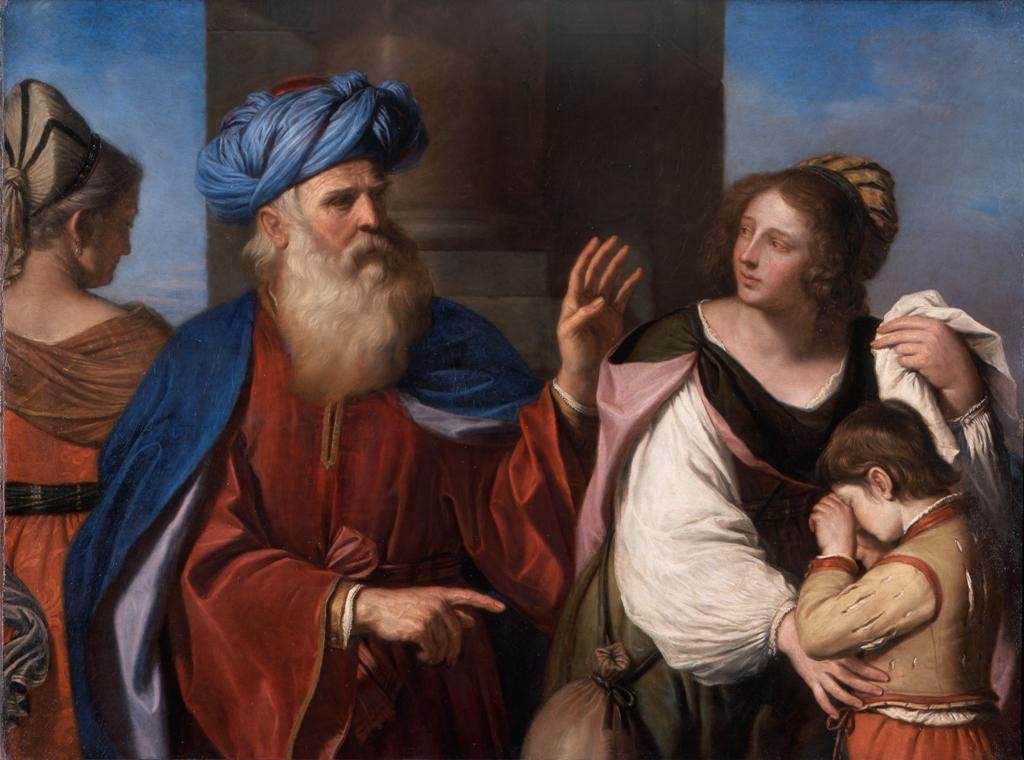
At the feast held when Isaac was weaned, Sarah saw Hagar's son mocking Isaac. “Expel the slave woman and her son,” she told Abraham. “Now this matter distressed Abraham greatly because it concerned his son Ishmael.” God told him to listen to Sarah, and promised to make a nation of Ishmael too. Early in the morning Abraham put bread and a skin of water on Hagar's shoulders, and sent her away with the boy. When the water ran out in the desert, she sat down a bowshot away and wept. God heard the boy's voice, and opened her eyes to a well. “And God was with the boy.”
Genesis 21:8-21Mount Moriah
A three-day journeyThe binding of Isaac
“Some time later God tested Abraham.” He said, “Take your son, your only son Isaac, whom you love, and go to the land of Moriah. Offer him there as a burnt offering.” Abraham got up early, saddled his donkey, split the wood and set out. On the third day he saw the place in the distance. He told his servants, “The boy and I will go over there to worship, and then we will return to you.” On the way up, Isaac carried the wood and asked where the lamb was. Abraham built the altar, bound his son, laid him on the wood and took the knife. The angel of the LORD called from heaven, “Abraham, Abraham!” “Do not lay a hand on the boy.” Abraham saw a ram caught by its horns in a thicket, and offered it in his son's place. He named the place The LORD Will Provide. Hebrews says he “reasoned that God could raise the dead”.
Genesis 22:1-14; Hebrews 11:17-19Hebron
Sarah's deathA grave for Sarah
Sarah died at Hebron, aged 127, “and Abraham went out to mourn and to weep for her.” He owned no land. He said to the Hittites of the town, “I am a foreigner and an outsider among you.” He asked to buy the cave of Machpelah from its owner, Ephron. Ephron offered it as a gift, then named its worth: “four hundred shekels of silver, but what is that between you and me?” Abraham weighed out the full price in front of them all, and buried Sarah there.
Genesis 23:1-20Canaan
His last chargeA wife for Isaac
Abraham was old, and “the LORD had blessed him in every way.” He made his chief servant swear to find Isaac a wife from his own kindred, not from the Canaanites. Isaac must never be taken back to the old country. “The LORD, the God of heaven, who brought me from my father's house and my native land ... He will send His angel before you.” The servant went, and came back with Rebekah. “And Isaac loved her and was comforted after his mother's death.”
Genesis 24:1-9, 67
his words
He wrote nothing. Genesis records what he said, to God and to others. Outside the section on where the Bible figure quiz places him, every Bible line on this page is from the Berean Standard Bible.
On the way up Mount Moriah
God Himself will provide the lamb for the burnt offering, my son.
God had told him to offer his son Isaac as a burnt offering. Isaac had asked him, “The fire and the wood are here, but where is the lamb for the burnt offering?” The two walked on together.
Genesis 22:7-8Please let there be no contention between you and me, or between your herdsmen and my herdsmen. After all, we are kinsmen.
I have raised my hand to the LORD God Most High, Creator of heaven and earth, that I will not accept even a thread, or a strap of a sandal, or anything that belongs to you, lest you should say, ‘I have made Abram rich.’
O Lord GOD, what can You give me, since I remain childless, and the heir of my house is Eliezer of Damascus?
Far be it from You! Will not the Judge of all the earth do what is right?
Now that I have ventured to speak to the Lord—though I am but dust and ashes—suppose the fifty righteous ones lack five. Will You destroy the whole city for the lack of five?
often misquoted
Abraham smashed the idols in his father's shop.
What the sources sayNot in the Bible. It says only that Terah, his father, “worshiped other gods.” The shop is a later Jewish legend, told in the midrash Genesis Rabbah. There a man comes to buy an idol, and Abraham asks his age. Seventy, says the man. Abraham answers, “how canst thou adore a god so much younger than thou?” An older book, Jubilees, from the second century BC, has him set fire to the house of idols.
Joshua 24:2; Jewish Encyclopedia (1906), “Abraham”Isaac was a little boy on the mountain.
What the sources sayGenesis never gives his age. It calls him “the boy”, and he was old enough to carry the wood up the mountain. The Jewish historian Josephus, writing about 93, says, “Isaac was twenty-five years old.” Clement of Rome says Isaac “cheerfully yielded himself as a sacrifice.”
Genesis 22:5-6; Josephus, Antiquities, book 1, chapter 13; 1 Clement, chapter 31Abraham welcomed three angels.
What the sources sayGenesis says “the LORD appeared to Abraham”, and he saw three men. Two of them went on to Sodom, and Genesis then calls them “the two angels”. Abraham “remained standing before the LORD.” Justin Martyr, about 155, read the One Who stayed as God, “sent with the two angels in His company”. Orthodox icons of the scene paint all three as angels at his table. Andrei Rublev's icon of them, painted in the 1400s, is known simply as the Trinity.
Genesis 18:1-22; 19:1; Justin Martyr, Dialogue with Trypho, chapter 56When he said Sarah was his sister, it was simply a lie.
What the sources sayBy his own account it was half true: “she really is my sister, the daughter of my father—though not the daughter of my mother—and she became my wife.” But he said it to hide that she was his wife, because he was afraid: “They will kill me on account of my wife.” He did it twice, and both kings rebuked him. Pharaoh asked, “What have you done to me?”
Genesis 12:18; 20:11-12faith and works
Paul and James both quote the same verse about him: “Abraham believed God, and it was credited to him as righteousness.” Paul uses it to show that God counts faith as righteousness, apart from works. James sets it beside the day Abraham offered Isaac, to show that faith must act. Christians have long read the two together. Here each side speaks for itself.
Paul, in Romans
Paul points out that God counted Abraham righteous before he was circumcised. So Abraham is “the father of all who believe”, Jew or Gentile.
“However, to the one who does not work, but believes in Him who justifies the ungodly, his faith is credited as righteousness.”Romans 4:1-11
James, in his letter
James asks what good faith is if it does nothing. He points to the day Abraham offered Isaac on the altar, and draws his lesson: “a man is justified by his deeds and not by faith alone.”
“You see that his faith was working with his actions, and his faith was perfected by what he did.”James 2:14-24
The Catholic reading
The Council of Trent, in 1547, taught that nothing before justification, “whether faith or works”, earns it. It is given freely. Once justified, believers grow in it, “faith co-operating with good works”, and here Trent quotes James. Of faith it said:
“we are therefore said to be justified by faith, because faith is the beginning of human salvation, the foundation, and the root of all Justification”Council of Trent, Decree on Justification, chapters 8 and 10, in Philip Schaff's The Creeds of Christendom
A Protestant reading
The Westminster Confession of 1646, the standard of Presbyterian churches, answers James this way. Faith alone justifies, but the faith that justifies is never alone:
“Faith, thus receiving and resting on Christ and His righteousness, is the alone instrument of justification; yet is it not alone in the person justified, but is ever accompanied with all other saving graces, and is no dead faith, but worketh by love.”The Westminster Confession, chapter 11, in Philip Schaff's The Creeds of Christendom
The Orthodox reading
The Longer Catechism of Philaret of Moscow, approved by the Russian Church's Holy Synod, asks whether faith alone is enough for a Christian, without love and good works. It answers:
“No; for faith without love and good works is inactive and dead, and so can not lead to eternal life.”The Longer Catechism, question 482, tr. R. W. Blackmore, in Philip Schaff's The Creeds of Christendom
friends, family and rivals
His wife, and his half-sister, the daughter of his father by another mother. She was barren for most of her life. At ninety she laughed at the promise of a son, and then bore Isaac. She died at 127, and he wept for her. Isaiah says, “Look to Abraham your father, and to Sarah who gave you birth.”
Genesis 18:12; 20:12; 21:1-7; 23:1-2; Isaiah 51:2The son of the promise, born when Abraham was a hundred. He carried the wood up Mount Moriah. He married Rebekah, and “was comforted after his mother's death.” With Ishmael, he buried his father.
Genesis 21:1-5; 22:6; 24:67; 25:9His firstborn, by Hagar, born when Abraham was 86. When Sarah wanted him gone, “this matter distressed Abraham greatly”. God promised to make him a great nation too, and he grew up in the wilderness and “became a great archer.”
Genesis 16:16; 21:11-20Sarah's Egyptian servant, who bore him Ishmael. Twice she ended up in the desert, and twice God met her there. She gave the LORD a name of her own: “You are the God who sees me.”
Genesis 16:1-13; 21:14-19His nephew, the son of his dead brother Haran. He came with Abraham from the town of Haran, then chose the green plain of the Jordan and settled near Sodom. Abraham rescued him from four kings and pleaded for Sodom. Peter's second letter calls him “a righteous man”. The Orthodox remember them together on 9 October.
Genesis 11:27; 13:10-12; 14:12-16; 2 Peter 2:7; OCAKing of Salem, and “priest of God Most High”. He met Abraham with bread and wine after the battle to rescue Lot, and blessed him. Abraham gave him a tenth of everything. Hebrews calls him “like the Son of God”, a priest for all time.
Genesis 14:18-20; Hebrews 7:1-3His father, who “worshiped other gods”, says Joshua. He led the family out of Ur toward Canaan, but they stopped at Haran, and he died there at 205.
Genesis 11:31-32; Joshua 24:2The king of Gerar. He took Sarah, believing she was Abraham's sister, until God warned him in a dream. Later he came to make peace: “God is with you in all that you do.” The two swore an oath at Beersheba.
Genesis 20:1-18; 21:22-31“The chief servant of his household, who managed all he owned.” He swore to find Isaac a wife in the land Abraham had come from, and brought back Rebekah. Genesis never names him. Some later writers call him Eliezer of Damascus, the servant Abraham had once named as his heir.
Genesis 15:2; 24:2-67The wife he took later in life. She bore him six sons, Midian among them. He gave them gifts and sent them east, away from Isaac.
Genesis 25:1-6how he died
He died at 175, “old and contented”. Isaac and Ishmael buried him beside Sarah, in the cave of Machpelah.
God had told him long before, “You, however, will go to your fathers in peace and be buried at a ripe old age.”
Before he died, he left everything he owned to Isaac. He gave gifts to the sons of his other wives, and sent them away to the east. “And at a ripe old age he breathed his last and died, old and contented, and was gathered to his people.”
“His sons Isaac and Ishmael buried him in the cave of Machpelah near Mamre.” He had bought it for Sarah's grave. Stephen, in Acts, says God gave him “not even a foot of ground” in Canaan as an inheritance, only the promise.
The Jewish historian Josephus, writing about 93, closes his account of Abraham: “He was a man of incomparable virtue, and honored by God in a manner agreeable to his piety towards him.”
Hebrews says of him and his family that they “died in faith, without having received the things they were promised. However, they saw them and welcomed them from afar.” Jesus spoke of him as alive to God. God is “the God of Abraham, the God of Isaac, and the God of Jacob”, and “He is not the God of the dead, but of the living.”
is he a saint?
Yes. He is honoured as a saint in the Orthodox and Catholic calendars, on 9 October.
- OrthodoxSaintRighteous Forefather, 9 October
- CatholicSaintIn the Roman Martyrology, 9 October
- CopticSaint28 Mesra, which is 3 September
- LutheranRememberedMissouri Synod, 9 October
- AnglicanNot on the calendarNot in the English or Episcopal calendars
The Orthodox call him the Forefather. The Orthodox Church in America keeps his day on 9 October, with his nephew Lot. He is honoured again on the Sunday of the Holy Forefathers, two Sundays before Christmas. It remembers the ancestors of Christ, “especially the Patriarch Abraham”.
For Catholics his day is kept in the Roman Martyrology, Rome's book of martyrs. It is not a feast with its own Mass. But the Litany of the Saints, in the form Rome published in 1969, calls on him by name, first among the patriarchs and prophets.
The Coptic Church keeps him on one day with Isaac and Jacob. Its synaxarium, a book of saints' lives, asks, “Who can describe the virtues of he who became father to many nations?” The Lutheran Missouri Synod's calendar remembers him on 9 October as Abraham, Patriarch.
Rome's book of martyrs, in its 1916 edition, gives his day like this:
The same day, the commemoration of the holy patriarch Abraham, father of all believers.
what to read first
Genesis, chapters 12 to 25
The book of Genesis
His whole story, from the call at Haran to his burial at Machpelah, in fourteen chapters.
Read it freeRomans 4
Paul
Paul on Abraham's faith, and why he calls him “the father of all who believe”.
Read it freeHebrews 11
The Letter to the Hebrews
The Bible's roll call of faith. Abraham has more verses in it than anyone else.
Read it freeAntiquities of the Jews, book 1
Josephus, tr. William Whiston
The same story retold by a Jewish historian writing about 93, with details Genesis does not give. Chapters 7 to 17.
Read it freewhere the quiz places him
The record, drawn
Each arm is one axis; length is how far from the centre the recorded acts sit. An axis the text does not place Abraham on has no arm.
In the quiz's own words
Quick to move, quick to speak up, quick to reconcile
The six axes
Your answers are marked. From your result on . See your result
In the hatched middle the quiz names neither pole.
The moments behind each axis
Each line is one recorded act and the reference it is taken from. The sentence says what the person did; where it is in quotation marks it is verbatim from the World English Bible British Edition. An act listed here is evidence of how this person moved, not approval of it; read the passage for how it was received. On 1 the text shows both ends and they do not settle, so that axis is left out too — the acts for each end are printed under it.
Pace Acts first ↔ Weighs first
quick to move
-
Genesis 12:4 toward Acts first
He went from Haran when he was told to go, and Lot went with him.
-
Genesis 22:3 toward Acts first
He rose early in the morning, saddled his donkey and set out for the place he had been told of.
Abraham rose early in the morning, and saddled his donkey
Voice Says it ↔ Holds it
quick to speak up
-
Genesis 18:23-25 toward Says it
He came near and put his objection about Sodom to God out loud.
-
Genesis 18:32 toward Says it
He asked once more, about ten, saying he would speak just this once more.
Lead Out in front ↔ Alongside
more in front than alongside
-
Genesis 14:14-16 toward Out in front
He led out three hundred and eighteen of his own men, pursued as far as Dan and brought back Lot and the goods.
-
Genesis 13:9 toward Alongside
He told Lot to choose a direction and said he would take the other.
Conflict Confronts ↔ Reconciles
quick to reconcile
-
Genesis 13:8 toward Reconciles
He proposed a separation to Lot to end the quarrel between their herdsmen.
Please, let there be no strife between you and me
-
Genesis 18:23-25 toward Reconciles
He came near and argued for Sodom, asking whether the Judge of all the earth would destroy the righteous with the wicked.
Reasons Asks why ↔ Takes it on trust
quick to question
-
Genesis 15:8 toward Asks why
He asked for something to go on before accepting the promise of the land.
Lord GOD, how will I know that I will inherit it?
-
Genesis 17:17 toward Asks why
He fell on his face and laughed, asking whether a hundred-year-old man would have a child.
Plans Plans ahead ↔ Meets the day
recorded at both ends
The text shows both ends. The recorded acts go one way and the other and do not settle, so this axis is left out when a reader is matched rather than counted as a position in the middle. Both ends are below.
Toward Plans ahead
-
Genesis 22:3 toward Plans ahead
He split the wood for the offering and saddled the donkey before leaving.
Toward Meets the day
-
Genesis 22:7-8 toward Meets the day
He went up with the fire and the wood and no lamb, and told Isaac that God would provide the lamb.
Nearest on the map
Distance between two sets of coordinates across every axis, on the same scale a reader's answers are measured on. No number is shown against a person, and nearness is not likeness: two people can land in the same band for different reasons.
Suggest a correction. Corrections that are applied are recorded in the public changelog.
 Quiz Who in the Bible are you most like? Answer eighteen plain statements about you, none of them about the Bible, and see how near you land to Abraham. Start
  Quiz Christian Personality Test Which of eight types are you? Find your own. Start
 people like him
 Ruth
Ruth Like him, she left her own land for a people she did not know. Boaz, the man she later married, praised her for how she “left your father and mother and the land of your birth”.
Ruth 2:11; 4:13 Rahab
Rahab James names her straight after Abraham, as one whose faith showed in what she did: she “welcomed the spies and sent them off on another route”.
James 2:21-25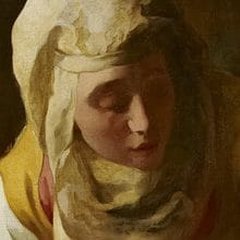 Martha
 Jesus came, and she “welcomed Him into her home”. She was soon busy with all the serving, just as Abraham hurried to feed his three guests.
Luke 10:38-40sources
His life, and his words
- The Berean Standard Bible, public domain. Every Bible line on this page outside the section on where the Bible figure quiz places him.
- 1 Clement, chapters 10 and 31. Tr. Alexander Roberts and James Donaldson. Ante-Nicene Fathers, volume 1, 1885.
- Justin Martyr, Dialogue with Trypho, chapter 56. Same edition.
- Tertullian, An Answer to the Jews, chapter 10. Tr. S. Thelwall. Ante-Nicene Fathers, volume 3.
- Josephus, Antiquities of the Jews, book 1. Tr. William Whiston.
- Josephus, The Wars of the Jews, book 4. Tr. William Whiston.
- The Paradise of the Holy Fathers, volume 2. Tr. E. A. Wallis Budge, 1907. The saying of Abba Nastir.
Faith and works
- Philip Schaff, The Creeds of Christendom, volume 2. The Council of Trent's Decree on Justification, and the Longer Catechism tr. R. W. Blackmore.
- Philip Schaff, The Creeds of Christendom, volume 3. The Westminster Confession of Faith.
Reference
- Britannica, “Abraham”
- Catholic Encyclopedia, 1907, “Abraham”
- Jewish Encyclopedia, 1906, “Abraham”, for the later legends
- Bible Hub, Strong's Hebrew 5030 and 5680, for the first prophet and the first Hebrew
Calendars
- The Roman Martyrology, 1916 edition, 9 October
- Calendarium Romanum, 1969, for the Litany of the Saints
- OCA, Righteous Forefather Abraham
- OCA, Sunday of the Forefathers
- OCA, Sunday before the Nativity
- CopticChurch.net, the Coptic synaxarium, 28 Mesra
- The Lutheran Church–Missouri Synod, Commemorations
Pictures
- Abraham's Parting from the Family of Lot, Jan Victors, about 1655 to 1665. The Metropolitan Museum of Art, New York. CC0.
- Abraham Casting Out Hagar and Ishmael, Guercino, 1657. Pinacoteca di Brera, Milan. Public domain.
- The Hospitality of Abraham, a Cretan icon of the early 1400s, from Zakynthos. Byzantine and Christian Museum, Athens. Public domain.
- The Meeting of Abraham and Melchizedek, Peter Paul Rubens, about 1626. National Gallery of Art, Washington. CC0.