
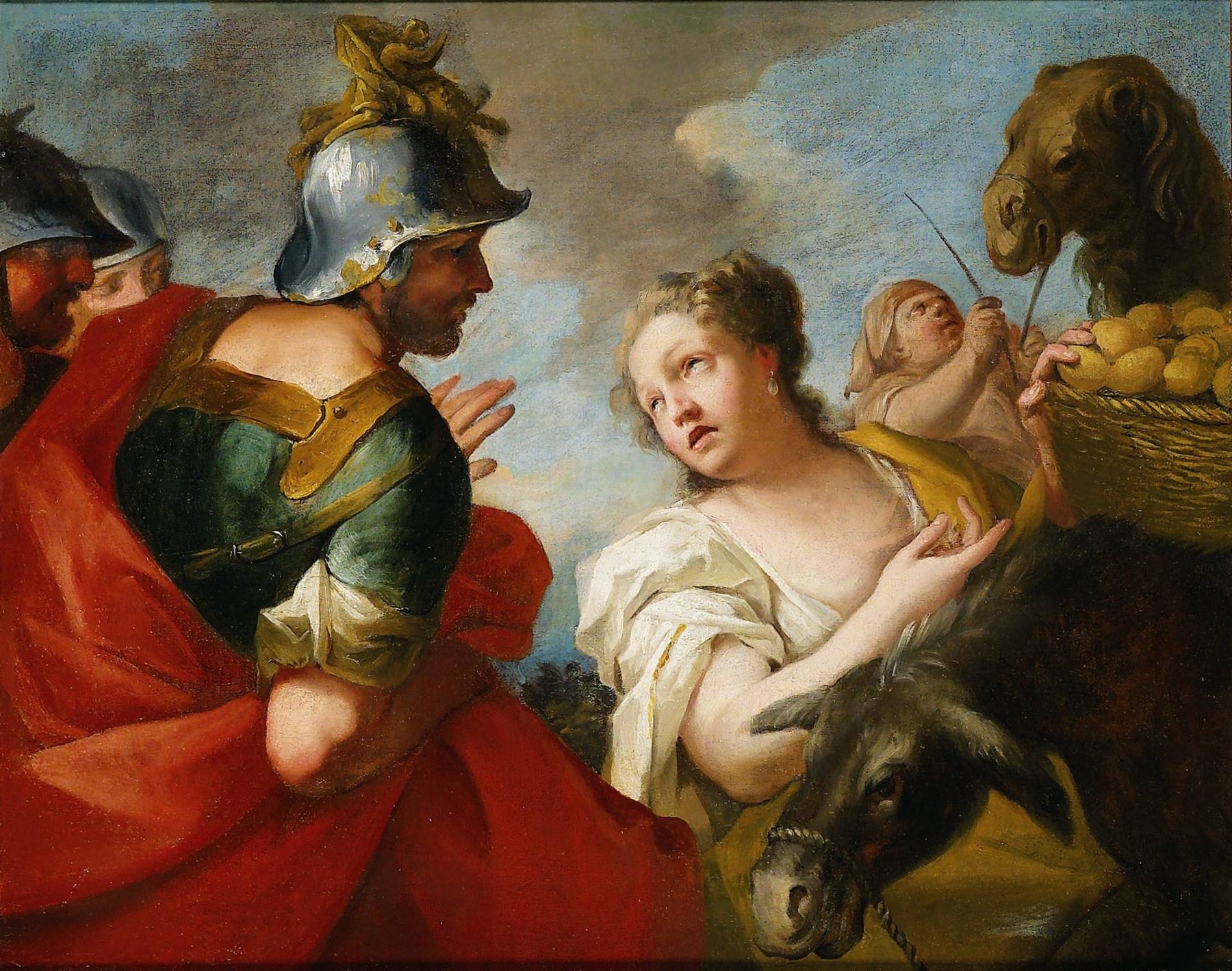
Abigail
She rode out with bread and wine to meet David and his 400 swords. Her words kept him from bloodshed, and he blessed her for it.
Picture: David and Abigail, Antonio Molinari, Venice, late 1600s. Public domain.
Who was Abigail?
Abigail was the wife of Nabal, a rich and harsh sheep farmer at Carmel, in Judah. When Nabal insulted David, David set out with 400 armed men to kill every male in Nabal's house. Abigail rode out to meet him with gifts, fell at his feet and talked him out of it. After Nabal died, she married David.
at a glance
Her path, in order
- Wife of NabalMarried to a rich, harsh farmer at Carmel
- PeacemakerShe kept David from bloodshed
- Wife of DavidMarried while he was an outlaw
- CaptiveCarried off from Ziklag, and rescued
- MotherOf Chileab, born at Hebron
in numbers
- Armed men David led against Nabal400
- She met them in a ravine
- and talked David down
- Loaves she loaded on donkeys200
- With 200 cakes of figs,
- 5 sheep and 2 skins of wine
did you know?
-
An “abigail” was once English for a lady's maid. Merriam-Webster traces the word to a maid in a play of 1616. The 1911 Britannica traces it to the Bible's Abigail, who called herself David's “handmaid”.
Merriam-Webster, “abigail”; Encyclopaedia Britannica (1911), “Abigail” -
The rabbis counted her one of the four most beautiful women who ever lived, with Sarah, Rahab and Esther.
Jewish Encyclopedia (1906), “Abigail”, on the Talmud, Megillah 15a -
In the 1560s Maarten van Heemskerck designed prints of the eight Beatitudes. For “Blessed are the peacemakers” he chose Abigail at David's feet.
Rijksmuseum, David and Abigail, engraved by Harmen Jansz Muller after Maarten van Heemskerck, 1564 to 1568
- In the Bible
- One chapter, 1 Samuel 25. After it she is named only in lists: as David's wife in 1 Samuel 27 and 30 and 2 Samuel 2, and as a mother in 2 Samuel 3 and 1 Chronicles 3.
- Home
- Carmel, a town in the hill country of Judah, near Maon. It is not the Mount Carmel of Elijah.
- Her name
- Hebrew Abigayil, probably “my father is joy”.
- Husbands
- Nabal, a rich sheep farmer, harsh to everyone. Then David, still an outlaw hiding from King Saul when he married her.
- Son
- Chileab, David's second son, born at Hebron. Chronicles calls him Daniel.
- Also called
- Abigail of Carmel, and the widow of Nabal. A prophetess, in the Talmud.
- Died
- The Bible does not say when or where. It leaves her at Hebron, the mother of David's second son.
- In art
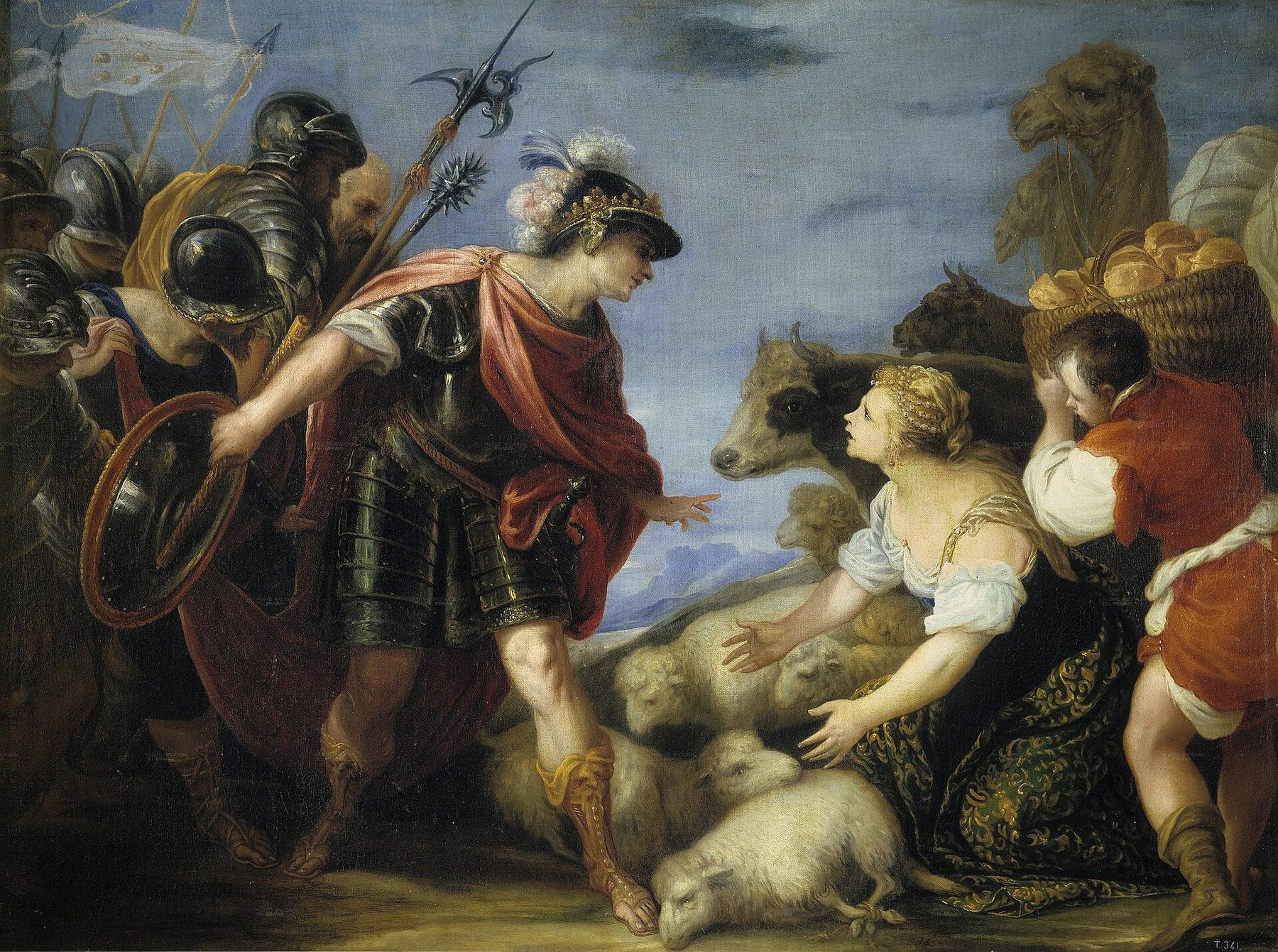
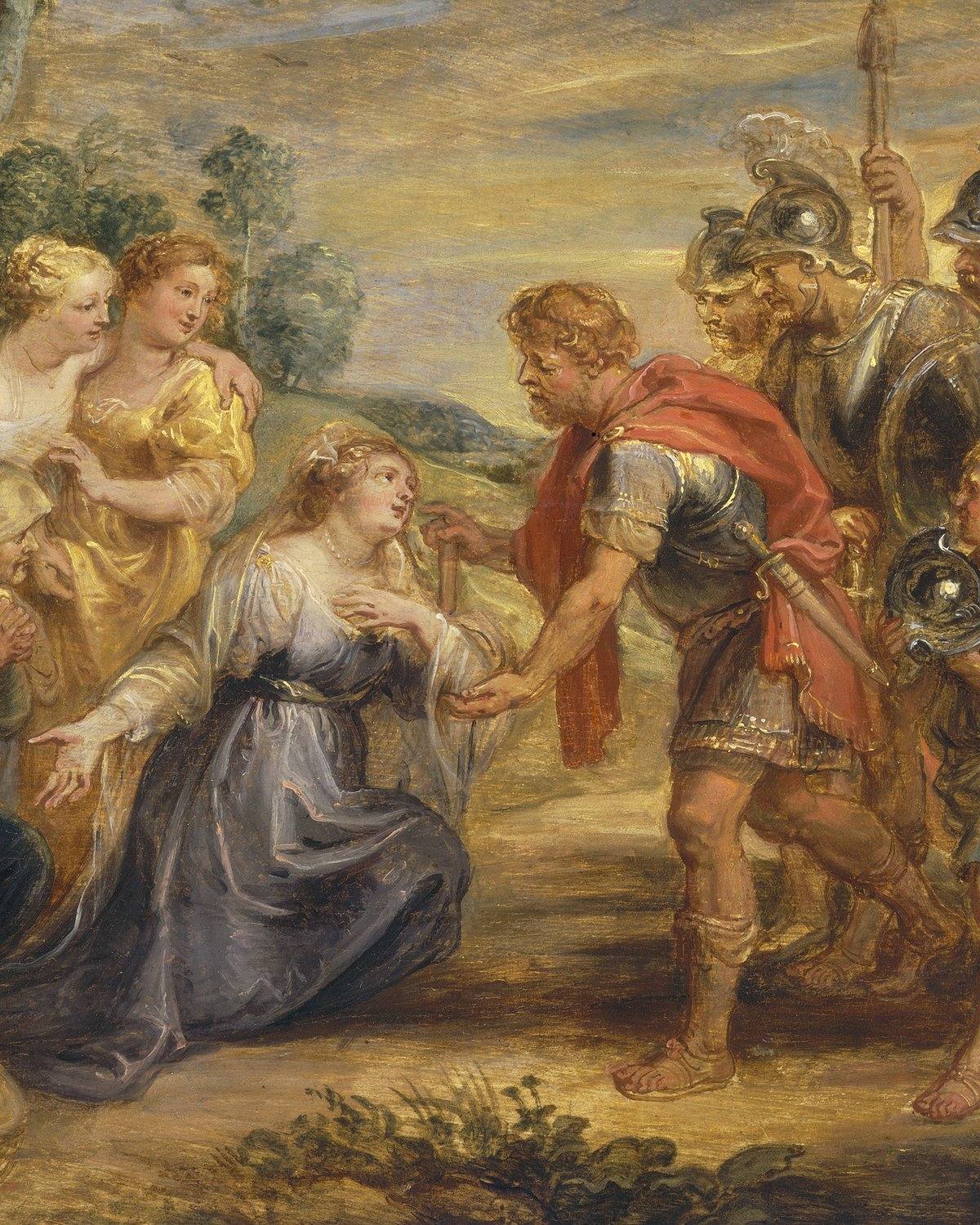
- Painters show her before David, with her loaves and wine loaded on donkeys, as at the top of this page. Most have her kneeling.
what others said of her
David, the historian Josephus, three Church Fathers and the Jewish Encyclopedia, in their own words.
Blessed be the LORD, the God of Israel, Who sent you to meet me this day! Blessed is your discernment, and blessed are you, because today you kept me from bloodshed and from avenging myself by my own hand.
She replied to those that came, that she was not worthy to touch his feet; however, she came, with all her servants, and became his wife, having received that honor on account of her wise and righteous course of life.
So much was David pleased that he blessed her who intervened, because he was restrained from his desire for revenge.
He gave up his threats, lightened the sentence, and preferred to be regarded as a breaker of his word rather than to keep his pledged oath by cruelly executing it
Whence to Nabal when he was drunk Abigail laudably kept silence about his fault, but, when he had digested his wine, as laudably told him of it
The Haggadah regards Abigail as one of the most remarkable women in Jewish history.
her life in eight moments
Carmel, in Judah
Sheep-shearing time“Who is David?”
Nabal of Maon was very rich, with three thousand sheep and a thousand goats. His wife was Abigail. “She was an intelligent and beautiful woman, but her husband, a Calebite, was harsh and evil in his dealings.” David, hiding from King Saul in the wilderness, sent ten young men to Nabal at shearing time. David's men had guarded Nabal's shepherds, and he asked for whatever Nabal could spare. Nabal answered, “Who is David? Who is this son of Jesse?” So David told his men, “Strap on your swords!” About four hundred went with him.
1 Samuel 25:2-13Nabal's house
The day of Nabal's insult“Consider carefully what you must do”
One of Nabal's young men went to Abigail, not to his master. David's men had been very good to them, he told her. “They were a wall around us, both day and night.” But Nabal had screamed at David's messengers. “Now consider carefully what you must do,” the young man said, “because disaster looms over our master and all his household. For he is such a scoundrel that nobody can speak to him!”
1 Samuel 25:14-17The road to David
At onceShe hurried
“Then Abigail hurried.” She took two hundred loaves of bread, two skins of wine, five butchered sheep, five measures of roasted grain, a hundred clusters of raisins and two hundred cakes of figs, and loaded them on donkeys. She sent her young men on first: “Go ahead of me. I will be right behind you.” “But she did not tell her husband Nabal.” Meanwhile David was swearing that by morning not one male of Nabal's house would be left alive.
1 Samuel 25:18-22A mountain ravine
The day of Nabal's insultAt David's feet
Riding down into a ravine, she met David and his men coming toward her. She got off the donkey, fell facedown and bowed. Then she took the blame on herself and pleaded. The LORD had held David back from bloodshed, she said. One day He would make him ruler over Israel, and then he would have no needless killing on his conscience. Her words are below. David blessed her, and took her gift. “Go home in peace,” he said. “See, I have heeded your voice and granted your request.”
1 Samuel 25:20-35Nabal's house
The night she came home, and the morning after“Like a stone”
When she came home, Nabal was holding “a feast fit for a king,” in high spirits and very drunk. “So she told him nothing until morning light.” In the morning, sober, he heard it all from her. “His heart failed within him, and he became like a stone.” About ten days later, “the LORD struck Nabal dead.”
1 Samuel 25:36-38Carmel
After Nabal's deathDavid's wife
When David heard that Nabal was dead, he blessed the LORD, Who had “restrained His servant from evil.” Then he sent word to Abigail at Carmel, asking her to become his wife. She bowed facedown and called herself his servant, ready to wash his servants' feet. Then she hurried onto a donkey and, with five of her maidens, followed his messengers. David had also married Ahinoam of Jezreel.
1 Samuel 25:39-43Gath and Ziklag
David's years among the PhilistinesTaken captive
With Saul still hunting him, David took his men and their families to Achish, the Philistine king of Gath, who gave him the town of Ziklag. Abigail and his other wife, Ahinoam, went with him. While the men were away, Amalekites raided Ziklag, burned it and carried off the women and children. David's men wept “until they had no strength left to weep,” and spoke of stoning him. “But David found strength in the LORD his God.” He pursued the raiders and recovered everything, “including his two wives.”
1 Samuel 27:1-7; 30:1-19Hebron
David made kingThe mother of Chileab
After Saul died, David went up to Hebron with his two wives, and the men of Judah anointed him king. There Abigail bore his second son, Chileab. Here the Bible's story of her ends.
2 Samuel 2:1-4; 3:2-3
her words
Abigail wrote nothing. These are her words as 1 Samuel records them. Outside the section on where the Bible figure quiz places her, every Bible line on this page is from the Berean Standard Bible.
To David, pleading at his feet
Should someone pursue you and seek your life, then the life of my lord will be bound securely by the LORD your God in the bundle of the living.
Jewish gravestones most often end with five Hebrew letters that echo this line: “May his soul be bound in the bundle of life.”
1 Samuel 25:29My lord, may the blame be on me alone, but please let your servant speak to you; hear the words of your servant.
My lord should pay no attention to this scoundrel Nabal, for he lives up to his name: His name means Fool, and folly accompanies him.
Please forgive your servant's offense, for the LORD will surely make a lasting dynasty for my lord, because he fights the LORD's battles. May no evil be found in you as long as you live.
When the LORD has done for my lord all the good He promised, and when He has appointed you ruler over Israel, then my lord will have no remorse or guilt of conscience over needless bloodshed and revenge. And when the LORD has dealt well with my lord, may you remember your servant.
Here is your servant, ready to serve and to wash the feet of my lord's servants.
often misquoted
Abigail was David's sister.
What the sources sayTwo women in the Bible are called Abigail. This one was Nabal's wife, then David's. The other was David's sister, the mother of Amasa. Absalom, the son who rebelled against David, made Amasa commander of his army. Chronicles lists her with her sister: “Their sisters were Zeruiah and Abigail.”
1 Chronicles 2:16-17; 2 Samuel 15:10-14; 17:25She kept what she had done from her husband.
What the sources sayShe set out without a word to him. But she did not keep it from him. That night he was very drunk, so she waited, and in the morning she told him everything. Gregory the Great praised her twice for it: she “laudably kept silence about his fault” while he was drunk, and “as laudably told him of it” once he was sober.
1 Samuel 25:19, 36-37; Gregory the Great, Pastoral Rule, Part III, chapter 16friends, family and rivals
 David
David The outlaw she met in a ravine. He blessed her for stopping him, married her after Nabal's death, and was made king at Hebron with her beside him.
1 Samuel 25:32-42; 2 Samuel 2:2-4Her first husband, a rich sheep farmer of Maon. His name means Fool, she told David, and he lived up to it. He died about ten days after she told him what she had done.
1 Samuel 25:2-3, 25, 37-38One of Nabal's shepherds. When his master screamed at David's men, he went to Abigail instead, because “nobody can speak to him.”
1 Samuel 25:14-17David's other wife. She and Abigail were carried off together from Ziklag and rescued together. Her son Amnon was David's firstborn.
1 Samuel 30:5, 18; 2 Samuel 3:2Her son, David's second, born at Hebron. Chronicles calls him Daniel. The Bible tells nothing more of him.
2 Samuel 3:3; 1 Chronicles 3:1is she a saint?
No church keeps a feast day for her. She has no day in the Catholic or Orthodox calendars of saints, and none in the Anglican or Lutheran calendars.
- CatholicNot on the calendarNot in the 1916 Roman Martyrology
- OrthodoxNot on the calendarNo day of her own
- ProtestantNo feast dayNot in the Anglican or Lutheran calendars
Jewish tradition honours her more than the churches do. The Talmud counts her among the seven prophetesses of Israel, with Sarah, Miriam, Deborah, Hannah, Huldah and Esther.
what to read first
1 Samuel 25
The First Book of Samuel
Her whole story: the insult, the ride, the plea and the wedding. One chapter.
Read it free1 Samuel 30
The First Book of Samuel
The raid on Ziklag, the captives, and David's pursuit to bring them back.
Read it freeAntiquities of the Jews, book 6, chapter 13
Josephus
The Jewish historian's retelling, from the 90s AD, with speeches of his own for Abigail and David.
Read it freewhere the quiz places her
The record, drawn
Each arm is one axis; length is how far from the centre the recorded acts sit. An axis the text does not place Abigail on has no arm.
In the quiz's own words
Acts first, reconciles, plans ahead
The six axes
Your answers are marked. From your result on . See your result
In the hatched middle the quiz names neither pole.
The moments behind each axis
Each line is one recorded act and the reference it is taken from. The sentence says what the person did; where it is in quotation marks it is verbatim from the World English Bible British Edition. An act listed here is evidence of how this person moved, not approval of it; read the passage for how it was received. On 1 of the six the text does not show this, and that axis is left out of the match rather than filled in.
Pace Acts first ↔ Weighs first
acts first
-
1 Samuel 25:18 toward Acts first
She hurried and took bread, wine, sheep, grain, raisins and figs, and laid them on donkeys.
Then Abigail hurried and took two hundred loaves of bread
-
1 Samuel 25:23 toward Acts first
She got down off the donkey as soon as she saw David and went to the ground in front of him.
Voice Says it ↔ Holds it
quick to speak up
-
1 Samuel 25:24-25 toward Says it
She asked David to hear her and then made her whole case to him.
-
1 Samuel 25:36 toward Holds it
She told Nabal nothing about it until the next morning.
Lead Out in front ↔ Alongside
more in front than alongside
-
1 Samuel 25:19 toward Out in front
She sent her young men on before her and came after them.
Conflict Confronts ↔ Reconciles
reconciles
-
1 Samuel 25:23-25 toward Reconciles
She put herself between David's four hundred men and her husband's household and took the blame on herself.
Reasons Asks why ↔ Takes it on trust
not shown in the text
The text does not show this. Nothing in the record puts Abigail at either end of this axis, so it is left out when a reader is matched, rather than counted as a position in the middle.
-
No record
The text does not show this.
Plans Plans ahead ↔ Meets the day
plans ahead
-
1 Samuel 25:18 toward Plans ahead
She gathered and loaded a full train of provisions before setting out to meet David.
Nearest on the map
Distance between two sets of coordinates across every axis, on the same scale a reader's answers are measured on. No number is shown against a person, and nearness is not likeness: two people can land in the same band for different reasons.
Suggest a correction. Corrections that are applied are recorded in the public changelog.
 Quiz Who in the Bible are you most like? Answer eighteen plain statements about you, none of them about the Bible, and see how near you land to Abigail. Start
  Quiz Christian Personality Test Which of eight types are you? Find your own. Start
 people like her
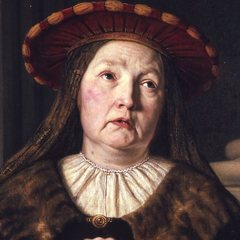 Hannah
 In 1 Samuel, the book that tells Abigail's story, she too called herself a servant and asked to be remembered: “remember me, not forgetting Your maidservant.”
1 Samuel 1:11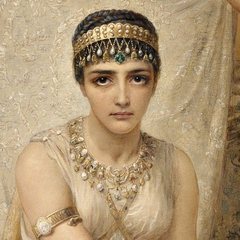 Esther
 She too went before a man with power over life and death, to plead for lives: “And if I perish, I perish!”
Esther 4:16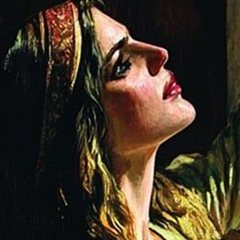 Rahab
Rahab She too acted on her own to save a household. She hid two Israelite spies in Jericho, then asked them to “spare the lives of my father and mother.”
Joshua 2:1-13sources
Her life, and her words
- The Berean Standard Bible, public domain. Every Bible line on this page outside the section on where the Bible figure quiz places her.
- Josephus, Antiquities of the Jews, book 6, chapter 13. Tr. William Whiston, 1737.
- Ambrose, On the Duties of the Clergy, Book 1. Tr. H. de Romestin. Nicene and Post-Nicene Fathers, second series, volume 10.
- John Cassian, Conferences, Conference 17. Tr. Edgar C. S. Gibson. Nicene and Post-Nicene Fathers, second series, volume 11, 1894.
- Gregory the Great, Pastoral Rule, Part III. Tr. James Barmby, 1895.
Reference
- The Talmud, Megillah 14a, for the seven prophetesses
- Jewish Encyclopedia, 1906, “Abigail”
- Encyclopaedia Britannica, 1911, “Abigail”
- Bible Hub, Strong's Hebrew 26, for her name
- Merriam-Webster, “abigail”
- Pealim, The definitive guide to reading Hebrew headstones, for the line on gravestones
- Rijksmuseum, David and Abigail, from the eight Beatitudes, after Maarten van Heemskerck, 1564 to 1568
Calendars
- The Roman Martyrology, 1916 edition
- OCA, lives of the saints
- Church of England, Common Worship calendar
- The Episcopal Church, Lesser Feasts and Fasts 2022
- The Lutheran Church–Missouri Synod, Commemorations
- Evangelical Lutheran Worship, ELCA, the church year (final draft, 2006)
Pictures
- David and Abigail, Antonio Molinari, Venice, late 1600s. Public domain.
- The Meeting of David and Abigail, Peter Paul Rubens, about 1630. Oil on panel. National Gallery of Art, Washington. CC0.
- The Prudent Abigail, Juan Antonio de Frías y Escalante, 1667. Oil on canvas. Museo del Prado, Madrid. Public domain.