
Gideon
The farmer God called out of hiding. With 300 men, jars and torches, he routed Midian. Then he refused a crown.
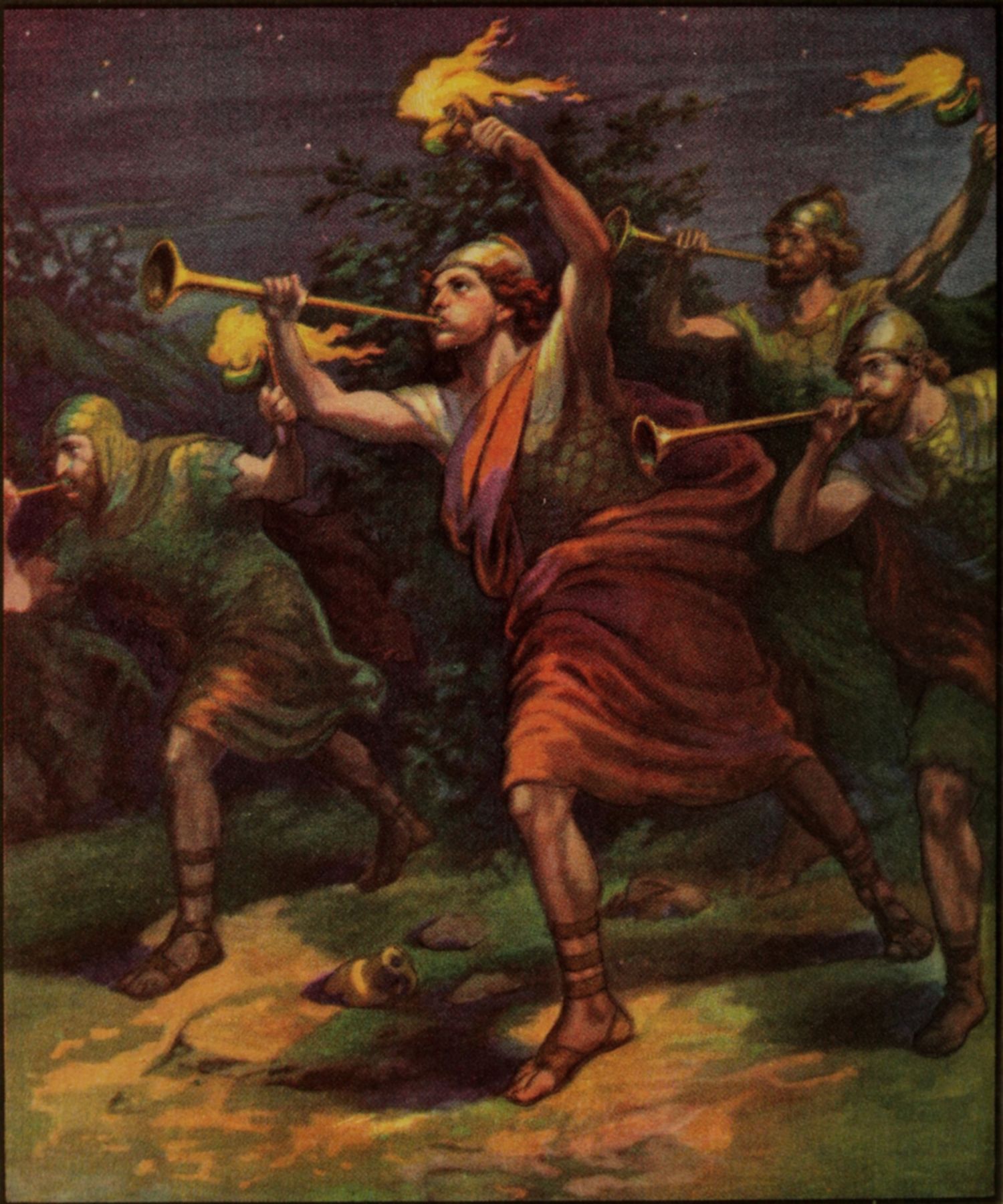
Picture: Gideon and the Trumpets, a colour plate in Adolf Hult's Bible Primer, Old Testament, Augustana Book Concern, Rock Island, Illinois, 1919. Library of Congress scan. Public domain.
Who was Gideon?
Gideon was a farmer of the tribe of Manasseh, in the time of the Judges. An angel found him threshing wheat in hiding and sent him to save Israel from Midian. He asked God for signs, then routed Midian with 300 men. He refused to be king, but Israel came to worship the gold ephod he made.
at a glance
His path, in order
- FarmerThreshing wheat in a winepress
- CalledBy an angel, under an oak
- CommanderOf the three hundred
- JudgeForty years of rest
in numbers
- Men who came to fight32k
- 22,000 went home afraid
- God kept 300 of the rest
- Midian's fighting men135k
- 120,000 fell in the rout
- 15,000 survived with their two kings
- Shekels of gold earrings1,700
- Given gladly from the plunder
- He made them into an ephod that Israel worshipped
- His sons70
- “since he had many wives”
- And one more, Abimelech, by a concubine
did you know?
-
His name comes from a Hebrew word for cutting down. His first task was to cut down the Asherah pole beside his father's altar to Baal.
Strong's Hebrew 1439, at Bible Hub; Judges 6:25 -
He turned down a crown. Yet he named one of his sons Abimelech, which means “father is king”.
Judges 8:31; Strong's Hebrew 40, at Bible Hub -
The Gideons, who put Bibles in hotel rooms, were founded by three travelling salesmen in 1899. Their emblem is a two-handled pitcher and torch, for Gideon's night attack.
Britannica, “Gideons International”
- Home
- Ophrah, his hometown, in the land of the tribe of Manasseh. His father's oak stood there, and later the altar and the ephod Gideon made.
- Clan
- Abiezer, of the tribe of Manasseh. “My clan is the weakest in Manasseh,” he said.
- Family
- His father was Joash the Abiezrite. His brothers, “the sons of my mother”, were killed by the kings of Midian at Tabor. He had many wives and seventy sons: Jether was the eldest, Jotham the youngest. A concubine in Shechem bore him Abimelech.
- Work
- A farmer: an angel found him threshing wheat. Then a judge of Israel, one of the leaders God raised up to save it.
- Also called
- Jerubbaal, “Let Baal contend with him”, after he tore down Baal's altar. Jerubbesheth, in 2 Samuel. Gedeon, in older Catholic books.
- His enemy
- Midian, with the Amalekites and other peoples of the east. For seven years they came up at harvest and stripped the land.
- Died
- “At a ripe old age”, says Judges. He was buried in the tomb of his father Joash, at Ophrah.
- In the New Testament
- Named first in the list of judges in Hebrews 11, among those “who through faith conquered kingdoms”.
- In art
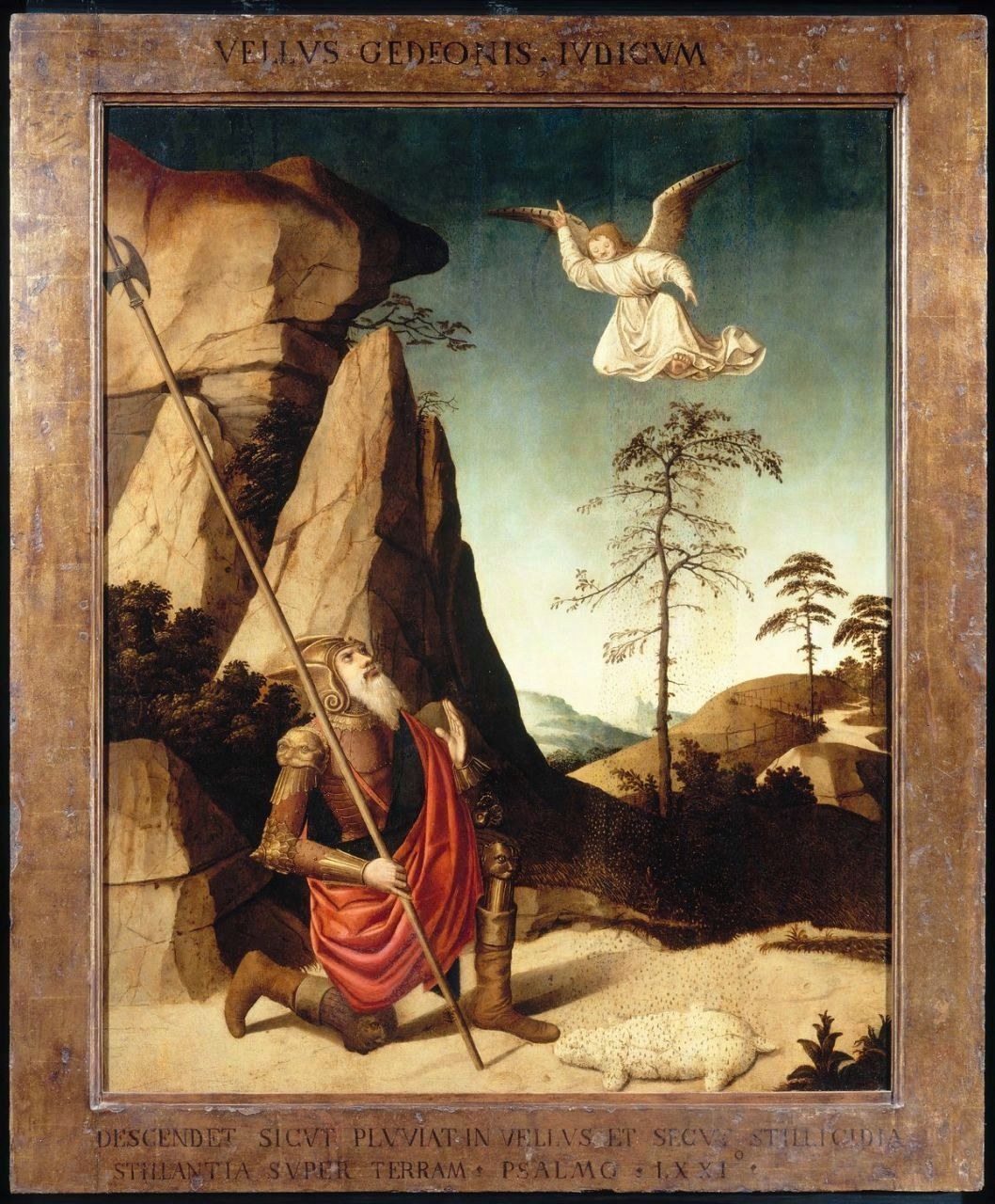
- Kneeling by the fleece he put out as a sign, often in armour, with an angel above, as in the panel here. In Russian icons he stands among the prophets, holding a scroll.
 The Lookout
 His personality type
Careful by nature, and at his best when there is something to do.
In Gregory the Great's terms
- Careful
- Restless mind
Our reading, from the Christian Personality Test. The personality test names him for his fear, and for what he did with it. “My clan is the weakest in Manasseh, and I am the youngest in my father’s house,” he said. He was afraid of his family and his town, but he still tore down Baal's altar. He did it at night.
See The Lookoutfeast days
East and West, side by side
West
- Sep1
With Joshua, in the 1916 Roman Martyrology. He has no day in the calendar used at Mass today.
East
- Sep26
Gideon the Righteous, in the Greek synaxarion.
- Nov26
The Righteous Gideon, in the Orthodox Church in America.
- Dec25
The Coptic Church marks his death on 16 Kiahk, in its own calendar.
Orthodox churches on the old calendar keep 26 September and 26 November 13 days later. The Coptic 16 Kiahk falls on 26 December in the year before a leap year.
what others said of him
His son Jotham, Samuel, Isaiah, the letter to the Hebrews and later writers, in their own words.
for my father fought for you and risked his life to deliver you from the hand of Midian
So the LORD sent Jerubbaal, Barak, Jephthah, and Samuel, and He delivered you from the hands of your enemies on every side, and you dwelt securely.
For as in the day of Midian You have shattered the yoke of their burden, the bar across their shoulders, and the rod of their oppressor.
Time will not allow me to tell of Gideon, Barak, Samson, Jephthah, David, Samuel, and the prophets, who through faith conquered kingdoms, administered justice, and gained what was promised
Gideon, as a man of temper, and that excelled in every virtue
For do not tell me of the rest of their life, but only whether they did not believe and shine in Faith.
his life in nine moments
Ophrah
Under the oakThe angel at the winepress
For seven years Midian had raided Israel at every harvest, “like a great swarm of locusts”. Gideon was threshing wheat in a winepress, to hide it from them. The angel of the LORD sat down under the oak and said, “The LORD is with you, O mighty man of valor.” Gideon answered, “If the LORD is with us, why has all this happened to us?” The LORD said, “Go in the strength you have and save Israel from the hand of Midian. Am I not sending you?” Gideon said his clan was the weakest in Manasseh, and he the youngest in his family. “Surely I will be with you,” the LORD replied.
Judges 6:1-16His father's altar
The night of his callBaal's altar, torn down by night
On the night of his call, the LORD told Gideon to tear down his father's altar to Baal and cut down the Asherah pole beside it. Gideon took ten of his servants and did it. But he was too afraid of his father's household and the men of the town to do it by day, so he did it by night. In the morning the town found out who had done it. They told his father, “Bring out your son. He must die.” Joash stood by his son. “If Baal is a god, let him contend for himself with the one who has torn down his altar.” So Gideon was called Jerubbaal: “Let Baal contend with him.”
Judges 6:25-32The Valley of Jezreel
The armies gatherThe ram's horn
Midian and its allies crossed the Jordan and camped in the Valley of Jezreel. Then the Spirit of the LORD came upon Gideon. He blew the ram's horn, and his own clan rallied behind him. He sent messengers through Manasseh, Asher, Zebulun and Naphtali, and they came up to meet him. Before he fought, he asked God for a sign with a fleece of wool. It is told with the miracles, below.
Judges 6:33-40The spring of Harod
Before the battleFrom 32,000 to 300
Gideon camped by the spring of Harod. The LORD said to him, “You have too many men for Me to deliver Midian into their hands, lest Israel glorify themselves over Me, saying, ‘My own hand has saved me.’” Anyone afraid could go home. Twenty-two thousand left, and ten thousand stayed. The LORD said, “There are still too many men.” Gideon took them down to the water. Three hundred lapped it with their hands to their mouths. All the others knelt to drink. Then the LORD said, “With the three hundred men who lapped the water I will save you.”
Judges 7:1-8The Midianite camp
Before the attackThe barley loaf
The night the three hundred were chosen, the LORD told Gideon to attack. “But if you are afraid to do so, then go down to the camp with your servant Purah.” So he went. The enemy filled the valley like locusts, with camels “as countless as the sand on the seashore.” Gideon crept close and heard a man telling his friend a dream. In the dream, a loaf of barley bread had come tumbling into the camp and knocked a tent flat. His friend said, “This is nothing less than the sword of Gideon son of Joash.” Gideon bowed in worship, and went back to wake his men.
Judges 7:9-15Around the camp
The middle watchJars, torches and horns
He split the three hundred into three companies. Each man carried a ram's horn in one hand and a large jar in the other, with a torch inside it. “Watch me and do as I do,” Gideon said. Just after the changing of the guard, they blew their horns and smashed their jars. Holding up the torches, they shouted, “A sword for the LORD and for Gideon!” The whole Midianite army fled, crying out as they ran, and the LORD set them against one another with their swords.
Judges 7:16-22The fords of the Jordan
The men of EphraimA soft answer
Gideon called out the tribe of Ephraim to hold the fords of the Jordan. They caught Oreb and Zeeb, the two princes of Midian. Then they turned on Gideon. “Why did you fail to call us when you went to fight against Midian?” They argued with him hotly. Gideon made little of his own part. He said Ephraim had done more than his own clan, Abiezer: “Are not the gleanings of Ephraim better than the grape harvest of Abiezer?” When he said this, their anger died down.
Judges 7:24 to 8:3Across the Jordan
The long pursuitExhausted, yet still in pursuit
Gideon crossed the Jordan with his three hundred, “exhausted yet still in pursuit.” He asked the town of Succoth for bread. Its leaders mocked him: had he caught the kings of Midian yet? The town of Penuel gave the same answer. He caught the two kings, Zebah and Zalmunna, and on the way back he turned on both towns. He punished the elders of Succoth with thorns and briers, pulled down the tower of Penuel and killed its men. The kings had killed his brothers at Tabor. Gideon told them, “If you had let them live, I would not kill you.” He told his eldest son, Jether, to kill them. The boy was afraid and did not draw his sword, so Gideon killed them himself.
Judges 8:4-21Ophrah
After the victoryA crown refused, an ephod made
The Israelites asked him to rule over them, and his son and grandson after him. He turned them down. Then he made one request: a gold earring from each man's plunder. They spread out a garment and threw the earrings on it, 1,700 shekels of gold, besides the kings' ornaments and purple robes. From all this Gideon made an ephod and set it up in Ophrah. “But soon all Israel prostituted themselves by worshiping it there, and it became a snare to Gideon and his household.” Judges does not say what the ephod looked like. In Exodus an ephod is a garment of the high priest. Britannica calls Gideon's an idolatrous image.
Judges 8:22-27; Exodus 28:6; Britannica
his miracles
Gideon's first words to the angel who called him were a question. Where had God's wonders gone?
And where are all His wonders of which our fathers told us, saying, ‘Has not the LORD brought us up out of Egypt?’
3 signs he asked God for
-
Under the oak at Ophrah
The day he was calledFire from the rock
When an angel came to call Gideon, he asked for a sign that it was really God speaking to him. He brought out a young goat, unleavened bread and broth. The angel told him to lay the meat and bread on a rock and pour out the broth. Then the angel touched them with the tip of his staff.
“And fire flared from the rock and consumed the meat and the unleavened bread.”
Then the angel vanished. Gideon built an altar on the spot and called it The LORD Is Peace.
Judges 6:17-24 -
The threshing floor
Before the battleDew on the fleece
Gideon said to God, “If You are going to save Israel by my hand, as You have said,” then let there be dew on a fleece of wool, and all the ground dry. He laid the fleece on the threshing floor overnight.
“he squeezed the fleece and wrung out the dew—a bowlful of water”
Judges 6:36-38 -
The threshing floor
The next nightThe dry fleece
Then he asked for one more test, begging God not to be angry. This time, let the fleece be dry and the ground wet.
“And that night God did so. Only the fleece was dry, and dew covered the ground.”
Judges 6:39-40
the fleece
The two nights of the fleece are the best-known part of his story. The early Church read them as a picture of things to come. Here are three readings, each in its own words.
Israel and the nations
Irenaeus, bishop of Lyons about 180, saw the wet fleece as Israel, which had the dew of the Spirit first. The second sign, dew on all the ground, showed the Spirit poured out on the whole world. Augustine read the two signs as grace: in the old covenant it was “hidden in a cloud, as the rain in the fleece”, and now “the whole world, like that floor, is full of grace”.
“the dew, which is the Spirit of God, Who descended upon the Lord, should be diffused throughout all the earth”Irenaeus, Against Heresies, Book 3, chapter 17; Augustine, Sermon 81 on the New Testament
Not doubt, but care
Did Gideon show a weak faith by asking for a sign twice? Ambrose of Milan put that question in 381, at the start of his book On the Holy Spirit. His answer was no. Gideon was “speaking in mysteries”, and “the words of God come down like the dew.”
“He was not then doubtful, but careful that we should not doubt.”Ambrose, On the Holy Spirit, Book 1, introduction
Mary and the dew
In the Greek and Latin Bibles, Psalm 72 says the King “shall come down like rain upon a fleece”. Ambrose joined that verse to Gideon's fleece. Later hymns made the fleece a picture of Mary, who received the Word as the fleece received the dew. The Akathist Hymn greets her as the fleece Gideon saw beforehand. The Orthodox Church in America's life of Gideon quotes a hymn for her Entry into the Temple. It calls her the bright cloud through which the Lord came down, as dew falls on a fleece. Dipre's panel, above, has the psalm verse in Latin at its foot.
Ambrose, Concerning Widows, chapter 3; Cyril of Jerusalem, Catechetical Lecture 12; the OCA, “The Righteous Gideon”; the Akathist Hymn, as quoted by John Sanidopouloshis words
Judges records what he said. Outside the section on where the Bible figure quiz places him, every Bible line on this page is from the Berean Standard Bible.
When Israel offered him a crown
I will not rule over you, nor will my son. The LORD shall rule over you.
After the victory, the Israelites said to him, “Rule over us—you and your son and grandson—for you have saved us from the hand of Midian.”
Judges 8:22-23Oh no, Lord GOD! I have seen the angel of the LORD face to face!
Get up, for the LORD has delivered the camp of Midian into your hand.
God has delivered Oreb and Zeeb, the two princes of Midian, into your hand. What was I able to do compared to you?
often misquoted
Putting out a fleece is the Bible's way to find out God's will.
What the sources sayGideon was not asking what God wanted. God had already told him, and Gideon says so twice: “as You have said”. He asked for the sign to be sure of it. The second time, he began, “Do not be angry with me”. Judges tells what he did. It never tells anyone to do the same. For how the early Church read the fleece, see the section on the fleece, above.
Judges 6:14-16, 36-40God chose the 300 because they lapped like alert soldiers, with their eyes up.
What the sources sayJudges gives one reason for making the army small, and it is about God, not the men: so that Israel could not say its own hand had saved it. It never says why the lappers were the ones kept. Ancient readers took it both ways. Gregory of Nazianzus praised “the three hundred men with Gideon, who bravely lapped”. The Jewish historian Josephus, writing about 93, says the opposite. In his telling, God told Gideon that those who drank “tumultuously” did it “out of fear”, and those were the three hundred.
Judges 7:2-7; Gregory of Nazianzus, Oration 42; Josephus, Antiquities of the Jews, book 5, chapter 6friends, family and rivals
His father. The altar to Baal was his. When the town wanted Gideon dead, Joash told them Baal could fight for himself.
Judges 6:25-31His servant, who went down with him by night to listen at the edge of the Midianite camp.
Judges 7:10-11His eldest son. Told to kill the captured kings, he did not draw his sword: “he was fearful because he was still a youth.”
Judges 8:20His son by a concubine in Shechem. After Gideon died, he killed his seventy brothers and made himself king. At Thebez a woman dropped a millstone on his head, and his armour-bearer ran him through.
Judges 8:31; 9:1-57His youngest son, the only one to escape Abimelech. From Mount Gerizim he told the men of Shechem the fable of the trees that went looking for a king. Only the thornbush would take the job.
Judges 9:5-21The two kings of Midian. They had killed his brothers at Tabor, men “each one resembling the son of a king.”
Judges 8:18-21The two princes of Midian, caught by the men of Ephraim at the rock of Oreb and the winepress of Zeeb. Psalm 83 still prays, “Make their nobles like Oreb and Zeeb”.
Judges 7:25; Psalm 83:11how he died, and after
He died “at a ripe old age” and was buried in his father's tomb at Ophrah.
Midian “did not raise its head again”. The land had rest for forty years in his days, and he went home to Ophrah and settled down.
As soon as he was dead, Israel turned back to the Baals. They “did not show kindness to the house of Jerubbaal (that is, Gideon) for all the good things he had done for Israel.”
His son Abimelech hired “worthless and reckless men”, went to his father's house at Ophrah and killed his seventy brothers “on one stone”. Only Jotham, the youngest, hid and lived. The leaders of Shechem made Abimelech king.
Abimelech ruled for three years. Attacking a tower at Thebez, he came up to its entrance to burn it, and a woman dropped a millstone on his head. Judges closes the story: “In this way God repaid the wickedness that Abimelech had done to his father in murdering his seventy brothers.”
is he a saint?
He is honoured as a saint in the Orthodox and Catholic calendars, among the righteous of the Old Testament. Protestant churches keep no day for him, but Hebrews 11 names him among the faithful.
- CatholicSaint1 September, with Joshua (1916)
- OrthodoxRighteous26 September; 26 November in the Orthodox Church in America
- CopticRighteous16 Kiahk, usually 25 December
- ProtestantNo feast dayNamed in Hebrews 11 among the faithful
Rome's book of martyrs, in its 1916 edition, keeps him on 1 September together with Joshua, “In Palestine”.
The Greek synaxarion, a book of saints' days, keeps his day on 26 September. The Orthodox Church in America keeps it on 26 November, and its life of him quotes a hymn to Mary that speaks of the fleece.
The Coptic Church's book of saints, the synaxarium, remembers his death on 16 Kiahk, as one of the judges of Israel.
what to read first
Judges 6 to 8
The Book of Judges
His whole story, from the winepress to his grave, in three chapters.
Read it freeJudges 9
The Book of Judges
What became of his sons: Abimelech, Jotham, and the fable of the trees.
Read it freeHebrews 11
The Letter to the Hebrews
The roll call of faith, from Abel to the prophets, with Gideon among them.
Read it freeOn the Holy Spirit, Book 1
Ambrose of Milan
Its first pages read the fire, the fleece and the three hundred as signs of Christ.
Read it freewhere the quiz places him
The record, drawn
Each arm is one axis; length is how far from the centre the recorded acts sit. An axis the text does not place Gideon on has no arm.
In the quiz's own words
Asks why, plans ahead, quick to speak up
The six axes
Your answers are marked. From your result on . See your result
In the hatched middle the quiz names neither pole.
The moments behind each axis
Each line is one recorded act and the reference it is taken from. The sentence says what the person did; where it is in quotation marks it is verbatim, from the translation named under it. An act listed here is evidence of how this person moved, not approval of it; read the passage for how it was received. On 1 the text shows both ends and they do not settle, so that axis is left out too — the acts for each end are printed under it.
Pace Acts first ↔ Weighs first
takes time to decide
-
Judges 6:27 toward Weighs first
He took ten of his servants and pulled down the altar by night rather than by day, because he feared his father’s household and the men of the city.
Voice Says it ↔ Holds it
quick to speak up
-
Judges 6:13 toward Says it
He asked why all this had happened to them if the LORD was with them, and where His wondrous works were.
-
Judges 6:15 toward Says it
He said his family was the poorest in Manasseh and he was the least in his father’s house.
Lead Out in front ↔ Alongside
more in front than alongside
-
Judges 6:34 toward Out in front
He blew a trumpet, and Abiezer was gathered together to follow him.
-
Judges 7:17 toward Out in front
He told the three hundred to watch him and do likewise, and to do as he did when he came to the outermost part of the camp.
Watch me, and do likewise.
World English Bible British Edition
-
Judges 8:23 toward Alongside
When the men of Israel asked him to rule over them he said he would not rule over them, nor would his son.
Conflict Confronts ↔ Reconciles
recorded at both ends
The text shows both ends. The recorded acts go one way and the other and do not settle, so this axis is left out when a reader is matched rather than counted as a position in the middle. Both ends are below.
Toward Confronts
-
Judges 8:16-17 toward Confronts
He took the elders of Succoth and taught the men of the city with thorns and briers, and broke down the tower of Penuel.
Toward Reconciles
-
Judges 8:1-3 toward Reconciles
When the men of Ephraim rebuked him sharply he answered them by comparing their gleaning with his vintage, and their anger was abated towards him.
Reasons Asks why ↔ Takes it on trust
asks why
-
Judges 6:17 toward Asks why
He asked for a sign that it was really the One speaking with him.
give me a sign that it is You speaking with me
Berean Standard Bible
-
Judges 6:36-40 toward Asks why
He put a fleece on the threshing floor and asked for dew on it alone, then asked once more for the reverse.
Plans Plans ahead ↔ Meets the day
plans ahead
-
Judges 6:11 toward Plans ahead
He was beating out wheat in the wine press, to hide it from the Midianites.
-
Judges 7:16 toward Plans ahead
He divided the three hundred into three companies and put trumpets and empty pitchers with torches inside them into the hands of all of them.
Nearest on the map
Distance between two sets of coordinates across every axis, on the same scale a reader's answers are measured on. No number is shown against a person, and nearness is not likeness: two people can land in the same band for different reasons.
Suggest a correction. Corrections that are applied are recorded in the public changelog.
 Quiz Who in the Bible are you most like? Answer eighteen plain statements about you, none of them about the Bible, and see how near you land to Gideon. Start
  Quiz Christian Personality Test Gideon reads as The Lookout. Find your own type. Start
 people like him
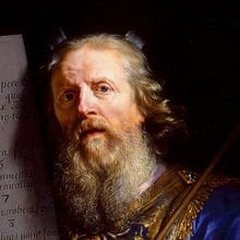 MosesThe Lookout
 When God called him, he begged, “Please, Lord, send someone else.” He too was given signs to show he had been sent.
Exodus 4:1-13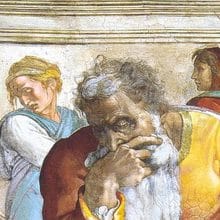 JeremiahThe Lookout
 When God called him, he said, “I surely do not know how to speak, for I am only a child!”
Jeremiah 1:6sources
His life, and his words
- The Berean Standard Bible, public domain. Every Bible line on this page outside the section on where the Bible figure quiz places him.
- Josephus, Antiquities of the Jews, book 5, chapter 6. Tr. William Whiston, 1737.
- Irenaeus, Against Heresies, Book 3, chapter 17. Tr. Alexander Roberts and W. H. Rambaut. Ante-Nicene Fathers, volume 1, 1885.
- Ambrose, On the Holy Spirit, Book 1, introduction. Tr. H. de Romestin. Nicene and Post-Nicene Fathers, second series, volume 10.
- Ambrose, Concerning Widows, chapter 3. Same edition.
- Augustine, Sermon 81 on the New Testament. Tr. R. G. MacMullen. Nicene and Post-Nicene Fathers, first series, volume 6.
- Gregory of Nazianzus, Oration 42. Nicene and Post-Nicene Fathers, second series, volume 7.
- John Chrysostom, Homilies on Hebrews, Homily 27. Nicene and Post-Nicene Fathers, first series, volume 14.
Reference
- Catholic Encyclopedia, 1909, “Gideon”
- Britannica, “Gideon”
- Britannica, “Gideons International”
- Bible Hub, Strong's Hebrew 1439 and 40, for the meanings of Gideon and Abimelech
Calendars
- The Roman Martyrology, 1916 edition, 1 September
- USCCB, Liturgical Calendar 2026, the calendar used at Mass
- Synaxarion.gr, Greek, 26 September
- OCA, “The Righteous Gideon”, 26 November
- St-Takla.org, the Coptic synaxarium, 16 Kiahk
- John Sanidopoulos, “Righteous Gideon the Judge”, with the line of the Akathist Hymn
Pictures
- Gideon and the Trumpets, a colour plate in Adolf Hult's Bible Primer, Old Testament, Augustana Book Concern, Rock Island, Illinois, 1919. Public domain.
- The Fleece of Gideon, Nicolas Dipre, about 1500. Musée du Petit Palais, Avignon. Public domain.