
Moses
The shepherd whom God called from a burning bush. He led Israel out of Egypt and brought the Law down from Sinai.
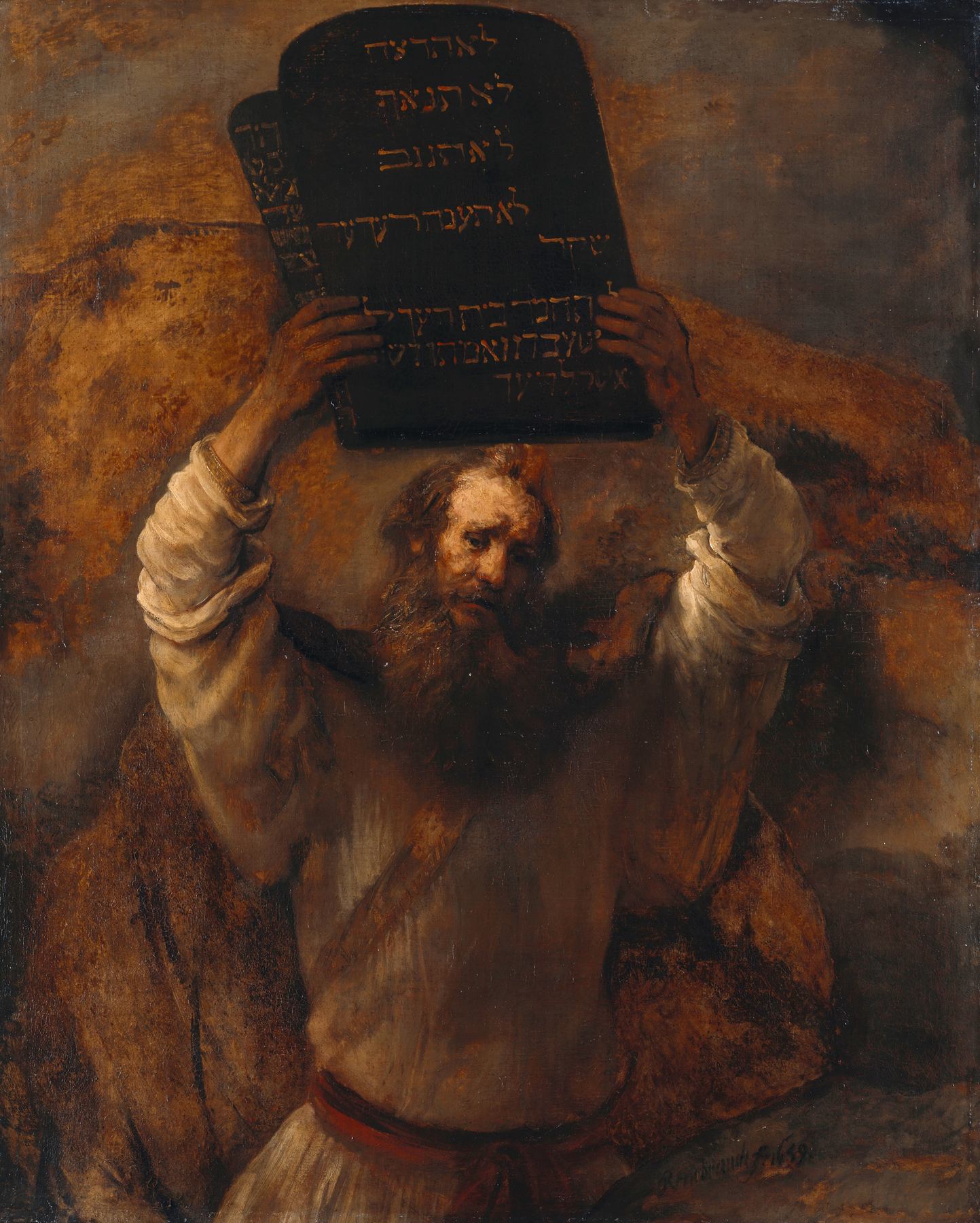
Picture: Moses Smashing the Tablets of the Law, Rembrandt, 1659. Gemäldegalerie, Berlin. Public domain.
Who was Moses?
Moses was a Hebrew born in Egypt and raised in Pharaoh's household. God called him from a burning bush to bring Israel out of slavery. He led them through the sea and the desert for forty years. On Mount Sinai he received the Ten Commandments. He died within sight of the promised land.
at a glance
His path, in order
- FoundlingDrawn from the Nile by Pharaoh's daughter
- ShepherdForty years in Midian
- ProphetCalled from the burning bush
- DelivererLed Israel out of Egypt
- LawgiverBrought the tablets down from Sinai
- LeaderForty years in the desert
in numbers
- Years he lived120
- Forty each in Egypt, Midian and the desert
- And at the end, “his eyes were not weak”
- Days and nights on Sinai40
- Twice, once for each pair of tablets
- “without eating bread or drinking water”
- Men on foot who left Egypt600k
- “besides women and children”
- After 430 years in Egypt
- Elders who shared his load70
- When he could not carry the people alone
- The Spirit that was on him rested on them too
did you know?
-
The Jewish historian Josephus says the name Moses is Egyptian: “the Egyptians call water by the name of Mo, and such as are saved out of it, by the name of Uses”. Britannica hears mose, “is born”, as in Thutmose.
Josephus, Antiquities, book 2, chapter 9; Britannica -
The Book of Numbers calls him “a very humble man, more so than any man on the face of the earth.”
Numbers 12:3 -
King Hezekiah broke up the bronze snake Moses made, “for up to that time the Israelites had burned incense to it.” They called it Nehushtan.
2 Kings 18:4 -
Justin Martyr, writing about 155, argued that Plato had learned from Moses, “the first prophet, and of greater antiquity than the Greek writers”.
Justin Martyr, First Apology, chapter 59
- Born
- In Egypt, to Amram and Jochebed, of the tribe of Levi. The year is argued over. Read literally, 1 Kings 6:1 puts the Exodus about 1440 BC. Britannica prefers about 1290 BC, under Ramses II. He was eighty at the Exodus.
- Raised
- In Pharaoh's household, as the son of Pharaoh's daughter. In Acts, Stephen says he was “educated in all the wisdom of the Egyptians”.
- Family
- His brother Aaron was three years older. His sister was Miriam. He married Zipporah, a daughter of the priest of Midian, and they had two sons, Gershom and Eliezer. The Book of Numbers also speaks of a Cushite wife.
- Work
- A shepherd in Midian, keeping his father-in-law's flock. Then the leader of Israel for forty years.
- Also called
- Moshe, in Hebrew. The man of God, in Deuteronomy and Psalm 90. The servant of the LORD, at his death. The God-seer, in the Orthodox Church. The lawgiver, in the Roman Martyrology.
- Died
- On Mount Nebo, in Moab, at 120, within sight of the promised land.
- Buried
- By God Himself, “in a valley in the land of Moab facing Beth-peor”. And “no one to this day knows the location of his grave.”
- Wrote
- Jewish and Christian tradition gives him the first five books of the Bible, the Torah. Jesus called it “the Book of Moses”. Psalm 90 is headed with his name. In 1651 Thomas Hobbes doubted that he wrote it all, and many scholars have since. See Often misquoted.
- In art
- Holding the two tablets of the Law. Often with rays of light from his head, or horns, from a word in the Latin Bible (see Often misquoted).
 The Lookout
 His personality type
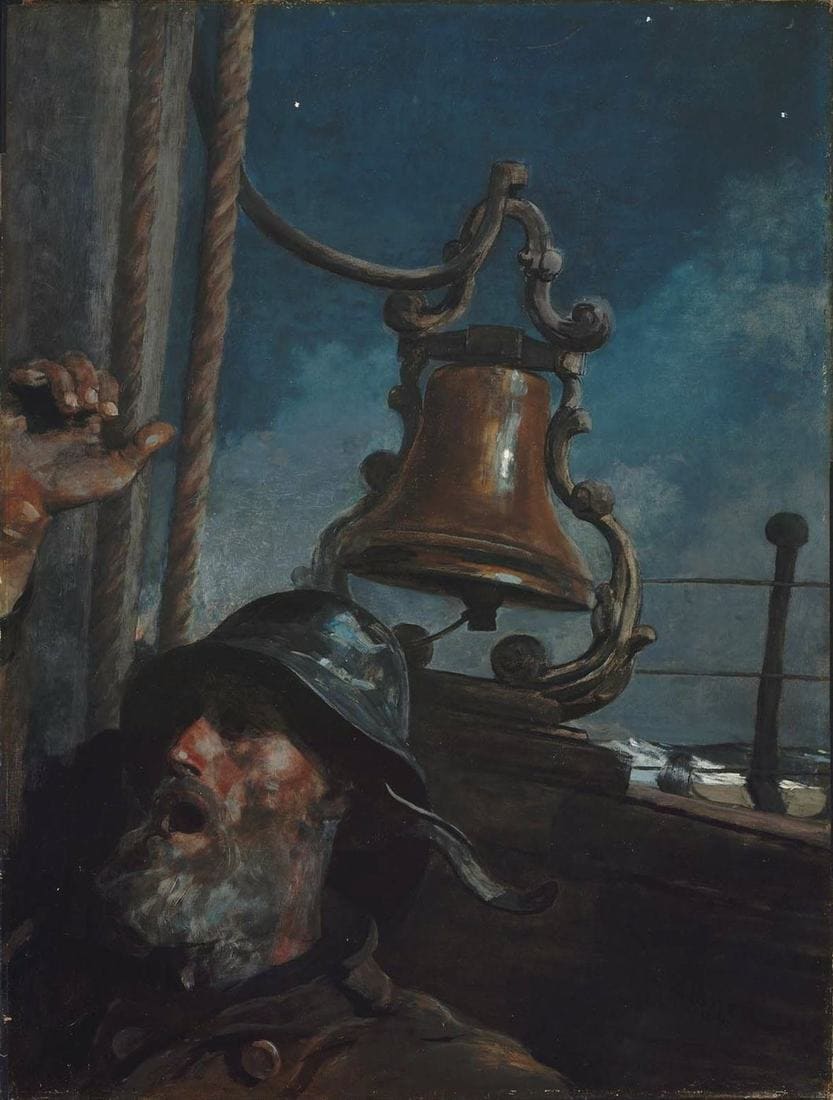
Careful by nature, and at his best when there is something to do.
In Gregory the Great's terms
- Careful
- Restless mind
Our reading, from the Christian Personality Test. The test names him for his answer at the burning bush. “I am slow of speech and tongue,” he said, and begged God to send someone else. Then he led a whole people through the desert for forty years.
See The Lookoutfeast days
East and West, side by side
West
- Sep4
Moses, in the 1916 Roman Martyrology, which places him on Mount Nebo. Lutherans in the Missouri Synod keep the same day.
East
- Sep4
The Prophet and God-seer Moses, in the Orthodox Church in America.
- Sep18
The Coptic Church, on 8 Tout in its own calendar: the departure of Moses the Prophet.
Churches on the old calendar keep 4 September 13 days later, on 17 September. The Coptic 8 Tout falls on 19 September in the year before a leap year.
what others said of him
God Himself, the New Testament, the early Church and the historian Josephus, in their own words.
But this is not so with My servant Moses; he is faithful in all My house. I speak with him face to face, clearly and not in riddles; he sees the form of the LORD.
Since that time, no prophet has risen in Israel like Moses, whom the LORD knew face to face
If you had believed Moses, you would believe Me, because he wrote about Me.
For the law was given through Moses; grace and truth came through Jesus Christ.
He chose to suffer oppression with God's people rather than to experience the fleeting enjoyment of sin. He valued disgrace for Christ above the treasures of Egypt
O marvellous love! O insuperable perfection! The servant speaks freely to his Lord, and asks forgiveness for the people, or begs that he himself might perish along with them.
He was one that exceeded all men that ever were in understanding, and made the best use of what that understanding suggested to him.
his life in 16 moments
Egypt
At his birthThe basket in the reeds
Pharaoh had ordered every Hebrew baby boy thrown into the Nile. A Levite woman hid her son for three months. When she could hide him no longer, she coated a papyrus basket with tar and pitch and set it among the reeds by the river. His sister watched from a distance. Pharaoh's daughter came down to bathe and found the boy crying, and she had compassion on him. His sister offered to fetch a Hebrew nurse, and brought his own mother. When he was older, Pharaoh's daughter took him as her son. She named him Moses: “I drew him out of the water.”
Exodus 1:22 to 2:10Egypt, then Midian
At fortyA killing, and a flight
When Moses was forty, says Stephen in Acts, he went out to see his own people at their hard labour. He saw an Egyptian beating a Hebrew. He looked this way and that, struck the Egyptian down, and hid his body in the sand. The next day two Hebrews were fighting, and one of them threw the killing back at him: “Who made you ruler and judge over us?” Pharaoh sought to kill him, and Moses fled to Midian. At a well there, shepherds drove seven sisters away from the troughs. Moses rose up to help them and watered their flock. Their father gave him one of them, Zipporah, as his wife. He named his first son Gershom: “I have become a foreigner in a foreign land.”
Exodus 2:11-22; Acts 7:23-29Horeb, the mountain of God
After forty years in MidianThe burning bush
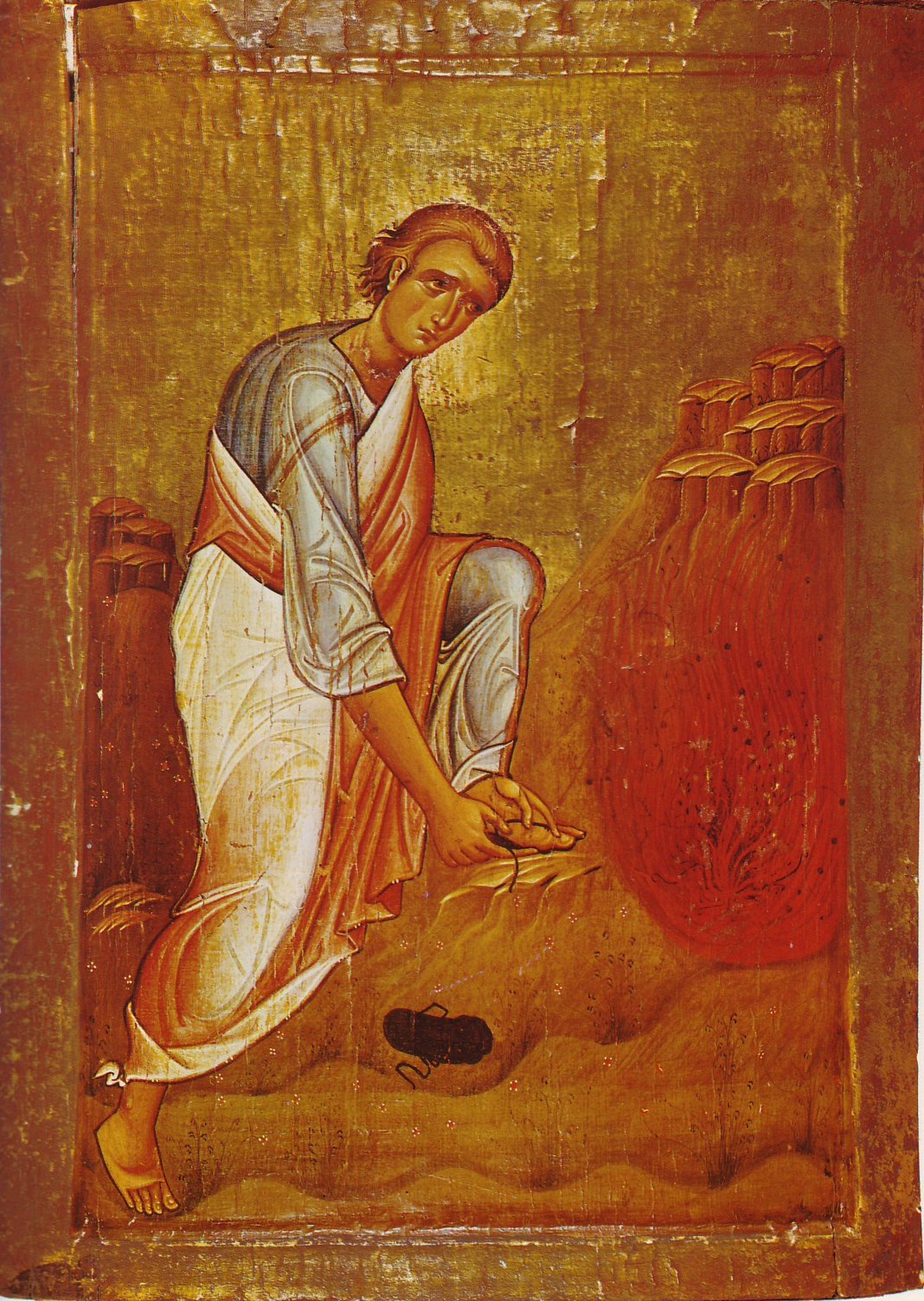
Moses was keeping his father-in-law's flock when he came to Horeb. There a bush was ablaze with fire, “but it was not consumed.” When he went over to look, God called to him from the bush: “Moses, Moses!” He answered, “Here I am.” “Take off your sandals, for the place where you are standing is holy ground.” Moses hid his face, for he was afraid to look at God. God said He had seen the affliction of His people, and He was sending Moses to Pharaoh. Moses asked, “Who am I, that I should go to Pharaoh?” And what should he tell the people if they asked God's name? God answered, “I AM WHO I AM.”
Exodus 3:1-14; Acts 7:30Horeb
At the bush“Send someone else”
At the burning bush, Moses kept objecting. What if the people would not believe him? God gave him signs: his staff became a snake, and his hand turned leprous and was healed. Then Moses tried again. “I have never been eloquent, neither in the past nor since You have spoken to Your servant, for I am slow of speech and tongue.” God answered, “Who gave man his mouth?” and “Now go! I will help you as you speak, and I will teach you what to say.” But Moses replied, “Please, Lord, send someone else.” The LORD's anger burned against him. Yet He gave him his brother Aaron, who could speak well, to be his spokesman.
Exodus 4:1-17Pharaoh's court
At eighty“Let My people go”
Moses was eighty, and Aaron eighty-three, when they stood before Pharaoh. “This is what the LORD, the God of Israel, says: ‘Let My people go, so that they may hold a feast to Me in the wilderness.’” Pharaoh replied, “Who is the LORD that I should obey His voice and let Israel go?” He made the Hebrews gather their own straw, for the same quota of bricks. The Hebrew foremen turned on Moses, and Moses turned to God: “Lord, why have You brought trouble upon this people? Is this why You sent me?”
Exodus 5:1-23; 7:7Egypt
At midnightThe Passover
After nine plagues, God sent a tenth. Each Israelite household killed a lamb and put its blood on the doorframes. At midnight the firstborn of Egypt died, from Pharaoh's son to a prisoner's, “for there was no house without someone dead.” Pharaoh summoned Moses and Aaron by night: “Get up, leave my people, both you and the Israelites!” About 600,000 men on foot went out, with women and children, after 430 years in Egypt. Moses also carried out the bones of Joseph, Jacob's son. Joseph had made the Israelites swear to take his bones with them.
Exodus 12:1-42; 13:19Rephidim
In the desertHands held up
The Amalekites attacked Israel at Rephidim. Joshua led the fighting, while Moses stood on a hilltop with the staff of God. “As long as Moses held up his hands, Israel prevailed; but when he lowered them, Amalek prevailed.” When his hands grew heavy, Aaron and a man named Hur sat him on a stone and held his hands up, one on each side, until the sun went down. Moses built an altar and named it The LORD Is My Banner.
Exodus 17:8-16The mountain of God
A visit from JethroAdvice from his father-in-law
Moses sat as judge for the people from morning until evening. His father-in-law Jethro watched, and said, “What you are doing is not good. Surely you and these people with you will wear yourselves out, because the task is too heavy for you. You cannot handle it alone.” Choose capable, God-fearing men, he said, and set them over thousands, hundreds, fifties and tens. Let them judge the small cases, and bring only the hard ones to you. “Moses listened to his father-in-law and did everything he said.”
Exodus 18:5-27Mount Sinai
The third month out of EgyptThe mountain of fire
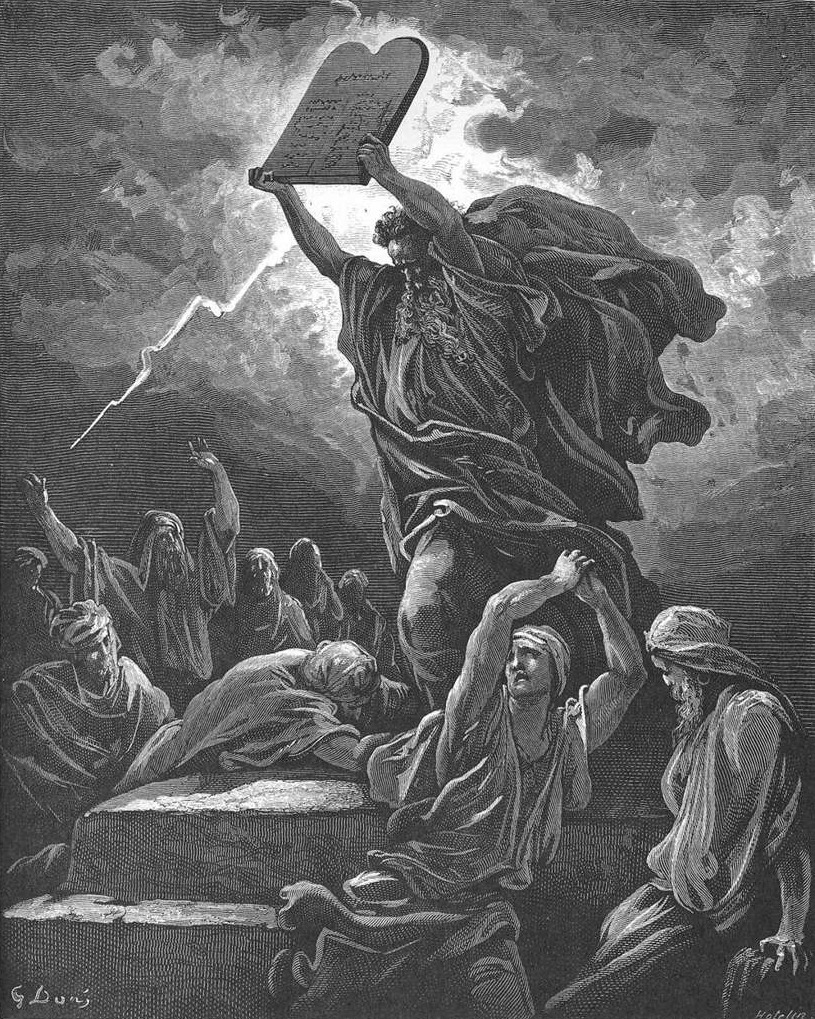
In the third month out of Egypt, Israel camped at Sinai. On the third day there was thunder and lightning, a thick cloud, and a loud blast of the ram's horn. “Mount Sinai was completely enveloped in smoke, because the LORD had descended on it in fire.” God spoke the Ten Commandments. The people trembled and begged Moses, “Speak to us yourself and we will listen.” Later Moses entered the cloud on the mountain, and stayed there forty days and forty nights. There God gave him the two tablets of stone. How the ten are counted is under The Ten Commandments, below.
Exodus 19:1 to 20:21; 24:12-18; 31:18The foot of Sinai
While Moses was on the mountainThe golden calf
Moses was gone so long that the people gave up on him. “As for this Moses who brought us up out of the land of Egypt, we do not know what has happened to him!” Aaron melted their gold earrings into a calf. On the mountain, God told Moses to leave Him alone, so that He could destroy them and make a great nation from Moses instead. Moses pleaded for them, and the LORD relented. Then Moses came down with the tablets. When he saw the calf and the dancing, he threw the tablets down and shattered them. He burned the calf, ground it to powder, and made the people drink it. The next day he went back up to God, to ask forgiveness for them, or else to be blotted out with them.
Exodus 32:1-32The tent and the mountain
After the golden calf“Show me Your glory”
Moses used to pitch a tent outside the camp, and the pillar of cloud would come down at its entrance. “Thus the LORD would speak to Moses face to face, as a man speaks to his friend.” Once he asked for more: “Please show me Your glory.” God said, “You cannot see My face, for no one can see Me and live.” On the mountain He would set Moses in a cleft of the rock, and cover him with His hand as His glory passed. Then Moses would see His back. So the LORD passed by, calling out, “The LORD, the LORD God, is compassionate and gracious, slow to anger, abounding in loving devotion and faithfulness”.
Exodus 33:7-23; 34:4-8Coming down from Sinai
The second tabletsThe shining face
Moses cut two new tablets and went up again for forty days and nights. When he came down, “he was unaware that his face had become radiant from speaking with the LORD.” Aaron and the people were afraid to come near him. So after he spoke to them, he covered his face with a veil. He took it off whenever he went in to speak with the LORD. Paul later took the veil as a picture: “whenever anyone turns to the Lord, the veil is taken away.”
Exodus 34:1-35; 2 Corinthians 3:13-16The wilderness
Tired of manna“I cannot carry all these people”
The people wept for meat. “We remember the fish we ate freely in Egypt, along with the cucumbers, melons, leeks, onions, and garlic.” Moses had had enough. “I cannot carry all these people by myself; it is too burdensome for me.” If this was how it would be, he asked God to kill him now. God told him to gather seventy elders. He would put some of the Spirit that was on Moses on them. Two of the seventy, Eldad and Medad, prophesied in the camp instead of at the tent. Joshua wanted them stopped. Moses would not stop them.
Numbers 11:4-30Kadesh
At the edge of the landTwelve spies
Moses sent twelve men to spy out Canaan. After forty days they came back with grapes, pomegranates and figs, and with fear. The people there were giants, they said: “We seemed like grasshoppers in our own sight.” Only two of the spies, Caleb and Joshua, disagreed: “The land we passed through and explored is an exceedingly good land.” The people wept all night, talked of choosing a leader to take them back to Egypt, and threatened to stone Joshua and Caleb. Moses pleaded for them again, and God pardoned them. But that generation would not enter the land. Israel would wander forty years, “a year for each day”.
Numbers 13:1 to 14:35Kadesh
The last yearsThe rock at Meribah
At Kadesh his sister Miriam died, and again there was no water. God told Moses and Aaron to take the staff and speak to the rock in front of the people. Instead Moses said, “Listen now, you rebels, must we bring you water out of this rock?” and struck the rock twice with his staff. Water gushed out. But God said, “Because you did not trust Me to show My holiness in the sight of the Israelites, you will not bring this assembly into the land that I have given them.”
Numbers 20:1-13A mountain
Centuries laterWith Jesus, transfigured
The Gospels bring Moses back once more. Jesus took Peter, John and James up a mountain to pray. His face changed, and His clothes became radiantly white. “Suddenly two men, Moses and Elijah, began talking with Jesus.” Luke says they “spoke about His departure, which He was about to accomplish at Jerusalem.” The Greek word for departure is exodos. Peter offered to put up three shelters, one of them for Moses. Then a voice came from a cloud: “This is My Son, Whom I have chosen. Listen to Him!”
Luke 9:28-36; Matthew 17:1-8; Strong's Greek 1841, at Bible Hub
his miracles
Exodus and Numbers tell of signs and wonders in Egypt and in the desert. Moses said plainly whose doing they were:
This is how you will know that the LORD has sent me to do all these things, for it was not my own doing
10 plagues on Egypt
-
The Nile
The first plagueWater to blood
Moses and Aaron went to meet Pharaoh at the river. In front of him and his officials, Aaron raised the staff and struck the water of the Nile.
“and all the water was turned to blood”
The fish died, and the river smelled so bad that the Egyptians could not drink from it.
Exodus 7:14-24 -
All Egypt
The third plagueGnats
Pharaoh's magicians had copied the first signs by their magic arts. Then Aaron struck the dust with his staff, and it turned into gnats on man and beast. The magicians tried to do the same, and could not.
“This is the finger of God”
So the magicians told Pharaoh. But his heart was hardened, and he would not listen.
Exodus 7:22; 8:16-19 -
All Egypt
The ninth plagueDarkness you could touch
Moses stretched out his hand toward heaven, and a “palpable darkness” covered the land of Egypt for three days. No one could see anyone else, and no one left his place.
“Yet all the Israelites had light in their dwellings.”
Exodus 10:21-23
The ten, in order: the Nile turned to blood, frogs, gnats, flies, the death of the livestock, boils, hail, locusts, darkness, and the death of the firstborn. The last is told in his life, above. Exodus 7 to 12
The sea divided
Pharaoh's army trapped Israel against the sea. Moses stretched out his hand over it, “and all that night the LORD drove back the sea with a strong east wind that turned it into dry land.” When the Egyptians followed, the waters flowed back over them. Then Moses and Miriam led the people in song.
“the Israelites went through the sea on dry ground, with walls of water on their right and on their left.”Exodus 14:10 to 15:21
Bread from heaven
In the desert the people grumbled that they would starve. God said, “I will rain down bread from heaven for you.” Each morning thin flakes lay on the ground. This bread was white like coriander seed and tasted like wafers made with honey. They called it manna, and ate it for forty years.
“It is the bread that the LORD has given you to eat.”Exodus 16:1-35
Water from the rock
At Rephidim there was no water, and the people were ready to stone Moses. God told him to strike the rock at Horeb with his staff, and water came out for the people to drink. Moses named the place Massah and Meribah, because they quarrelled and tested the LORD. Years later, at Kadesh, water came from a rock again, and that time it cost him the promised land.
“Is the LORD among us or not?”Exodus 17:1-7; Numbers 20:1-13
The bronze snake
Venomous snakes bit the people, and many died. God told Moses to make a serpent and set it on a pole. Jesus later said, “Just as Moses lifted up the snake in the wilderness, so the Son of Man must be lifted up”.
“If anyone who was bitten looked at the bronze snake, he would live.”Numbers 21:4-9; John 3:14
The ground opens
Korah, a cousin of Moses, and 250 leaders rose against him. Moses said that if these men died a natural death, the LORD had not sent him. “As soon as Moses had finished saying all this, the ground beneath them split open”.
“the earth opened its mouth and swallowed them and their households”Numbers 16:1-35
his words
Tradition gives Moses the first five books of the Bible, and Psalm 90 is headed with his name. Outside the section on where the Bible figure quiz places him, every Bible line on this page is from the Berean Standard Bible, except the Latin and Douay-Rheims lines on his horns, named where they stand.
The greatest commandment
Hear, O Israel: The LORD our God, the LORD is One. And you shall love the LORD your God with all your heart and with all your soul and with all your strength.
Moses taught it to Israel before they crossed the Jordan. When a scribe asked Jesus, “Which commandment is the most important of all?”, He answered with these words.
Deuteronomy 6:4-5; Mark 12:28-30Do not be afraid. Stand firm and you will see the LORD's salvation, which He will accomplish for you today; for the Egyptians you see today, you will never see again. The LORD will fight for you; you need only to be still.
Yet now, if You would only forgive their sin.... But if not, please blot me out of the book that You have written.
Are you jealous on my account? I wish that all the LORD's people were prophets and that the LORD would place His Spirit on them!
man does not live on bread alone, but on every word that comes from the mouth of the LORD.
I have set before you life and death, blessing and cursing. Therefore choose life, so that you and your descendants may live
Be strong and courageous; do not be afraid or terrified of them, for it is the LORD your God Who goes with you; He will never leave you nor forsake you.
So teach us to number our days, that we may present a heart of wisdom.
the ten commandments
On Sinai, God gave Moses two tablets of stone, “inscribed by the finger of God”. Exodus calls their words “the Ten Commandments”, but it never numbers them, or says how they were shared between the two tablets. The Jewish historian Josephus has “five upon each table”. So Jews and Christians count the ten in different ways. Here each tradition speaks for itself.
The Jewish count
In Jewish tradition the first of the Ten Words is not a command at all. It is God's own introduction, at the head of the ten. The commands against other gods and against idols together make the second word, says the Jewish Encyclopedia. The command not to covet, all of it, is the tenth.
“I am the LORD your God, Who brought you out of the land of Egypt, out of the house of slavery.”Exodus 20:2; Jewish Encyclopedia, “Decalogue”
Catholic and Lutheran
In the 400s Augustine made the commands against other gods and against idols a single commandment. To keep the number ten, he split the last in two: not coveting a neighbour's wife, and not coveting his goods. The Council of Trent kept his count, and so did the Lutherans. In Luther's Small Catechism the second commandment is “Thou shalt not take the name of thy God in vain.” The Catholic Encyclopedia explains why idols are not counted apart:
“the reference to idols being regarded as mere application of the precept to adore but one God”Catholic Encyclopedia, “Commandments of God”; Luther, Small Catechism, in Schaff's The Creeds of Christendom
Orthodox
The Orthodox count as the Jewish writers Philo and Josephus did: the command against idols is the second commandment on its own, and coveting is a single commandment. Josephus put it plainly: “The second commands us not to make the image of any living creature to worship it.” The Orthodox Longer Catechism then asks whether icons break it. Its answer:
“it is not in the least contrary to this commandment to honor icons as sacred representations”Josephus, Antiquities, book 3, chapter 5; the Longer Catechism, question 521, tr. R. W. Blackmore
Reformed and Anglican
The churches of England and Switzerland count as the Orthodox do, says the Catholic Encyclopedia, following the Jewish writers Philo and Josephus and the early Christian scholar Origen. But the Reformed read the second commandment more strictly. The Westminster Shorter Catechism of 1647 teaches:
“The second commandment forbiddeth the worshiping of God by images, or any other way not appointed in His Word.”Westminster Shorter Catechism, question 51, in Schaff's The Creeds of Christendom; Catholic Encyclopedia, “Commandments of God”
often misquoted
Moses had horns.
What the sources sayExodus says that when he came down from Sinai, “his face was radiant”. The Hebrew verb, qaran, comes from the word for a horn, and means to send out rays. Jerome's Latin Bible put it as cornuta esset facies sua: his face was horned. The Douay-Rheims Bible kept the word: “he knew not that his face was horned from the conversation of the Lord.” Its own note explains, “That is, shining, and sending forth rays of light like horns.” Artists took the word as it stood. Michelangelo's marble Moses, carved about 1513 for the tomb of Pope Julius II, has two horns.
Exodus 34:29-30; Strong's Hebrew 7160, at Bible Hub; the Vulgate and the Douay-Rheims, Exodus 34; BritannicaMoses had a stutter.
What the sources sayThe Bible never says so. He said he was “slow of speech and tongue”, and did not say why. In Acts, Stephen calls him “powerful in speech and action”. The Jewish historian Josephus says “He had a very graceful way of speaking and addressing himself to the multitude”. The stutter comes from a later Jewish legend, told in the Midrash. As a small child, it says, Moses was tested with a precious stone and a live coal, and an angel guided his hand to the coal. The Jewish Encyclopedia of 1906 tells how it ends: “This burned his tongue, causing him to stutter”.
Exodus 4:10; Acts 7:22; Josephus, Antiquities, book 4, chapter 8; Jewish Encyclopedia, “Moses”Moses parted the Red Sea.
What the sources sayThe Hebrew name is Yam Suph. Suph means reeds: it is the word for the reeds where his basket was set. Britannica reads it as the Sea of Reeds, “most probably a shallow lake in the far northeastern corner of Egypt”, and calls the Red Sea an “erroneous interpretation”. Others keep the Red Sea. The New Testament, written in Greek, calls it the Red Sea. The same Hebrew name is used for the gulf at Eloth, which is an arm of the Red Sea. The Catholic Encyclopedia of 1911 has him cross the Red Sea “at a point today unknown”. Exodus itself says it was the LORD Who drove the sea back, “with a strong east wind”.
Exodus 2:3; 14:21; Acts 7:36; Hebrews 11:29; 1 Kings 9:26; Strong's Hebrew 5488, at Bible Hub; Britannica; Catholic Encyclopedia, “Moses”Moses wrote the account of his own death.
What the sources sayDeuteronomy ends with his death and burial. Who wrote that page has been asked for two thousand years. Philo, a Jewish writer of Jesus' day, says Moses foresaw it: “he prophesied admirably what should happen to himself after his death”. The Talmud records two views. One asks, “Is it possible that Moses himself should have written ‘and he died’?”, and gives the last eight verses to Joshua. The other says God dictated them, “and Moses with tears in his eyes wrote it down.” In 1651 Thomas Hobbes took the line about the unknown grave as proof of a later hand: “it were a strange interpretation, to say Moses spake of his own sepulcher (though by Prophecy), that it was not found to that day, wherein he was yet living.”
Deuteronomy 34:5-12; Philo, On the Life of Moses, book 2, tr. C. D. Yonge; the Talmud, Baba Bathra, chapter 1, tr. Michael L. Rodkinson; Thomas Hobbes, Leviathan, chapter 33friends, family and rivals
 Elijah
 The prophet who, centuries later, walked forty days and forty nights to Horeb, the mountain of God, where Moses had met God. At the Transfiguration the two appeared together, talking with Jesus.
1 Kings 19:8; Matthew 17:3His brother, three years older, and his spokesman before Pharaoh. While Moses was on the mountain, Aaron made the golden calf. His excuse: “when I threw it into the fire, out came this calf!” He became the first high priest, and died on Mount Hor.
Exodus 4:14-16; 7:7; 32:24; Numbers 20:28His sister. After the crossing of the sea she led the women with a tambourine. Later she and Aaron spoke against him, and she became leprous. Moses cried out, “O God, please heal her!” She died at Kadesh.
Exodus 15:20-21; Numbers 12:1-15; 20:1; 26:59His father-in-law, the priest of Midian, also called Reuel. He watched Moses judge the people alone from morning till evening and told him, “What you are doing is not good.”
Exodus 2:18; 3:1; 18:13-24His wife, a daughter of the priest of Midian, whom he met at a well. She bore him two sons, Gershom and Eliezer.
Exodus 2:16-22; 18:2-4His young assistant, who went up Sinai with him and would not leave the tent where the LORD spoke with Moses. Moses renamed him: Hoshea became Joshua. Moses laid his hands on him, and he led Israel into the land.
Exodus 24:13; 33:11; Numbers 13:16; Deuteronomy 34:9She found him crying in a basket among the reeds and had compassion on him. She paid his own mother to nurse him, raised him as her son, and named him. The Jewish historian Josephus calls her Thermuthis.
Exodus 2:5-10; Josephus, Antiquities, book 2, chapter 9The king who would not let Israel go. “Who is the LORD that I should obey His voice?” he asked. After the tenth plague he summoned Moses by night: “Get up, leave my people”. The Bible never gives his name.
Exodus 5:2; 12:31His cousin, a Levite, who led 250 leaders against him: “You have taken too much upon yourselves!” The ground split open beneath the rebels.
Exodus 6:18-21; Numbers 16:1-33how he died
He died on Mount Nebo, in Moab, at 120. From the top God showed him the whole promised land, but he never crossed into it.
He begged to go in. “Please let me cross over and see the good land beyond the Jordan.” The answer was no. “That is enough,” the LORD said. “Do not speak to Me again about this matter.” The reason went back to Meribah, where he struck the rock instead of speaking to it.
He laid his hands on Joshua and blessed the tribes. Then he climbed Mount Nebo, to the top of Pisgah, facing Jericho. The LORD showed him the land, from Gilead as far as Dan and the Negev, and said, “I have let you see it with your own eyes, but you will not cross into it.”
“So Moses the servant of the LORD died there in the land of Moab, as the LORD had said.” God Himself buried him, in a valley facing Beth-peor, “and no one to this day knows the location of his grave.” He was 120, and “his eyes were not weak”. Israel wept for him thirty days. The Coptic book of saints' lives, the synaxarium, gives a reason for the hidden grave: God hid his body “so the children of Israel would not find it and worship it”.
The Letter of Jude remembers a quarrel over his body. The archangel Michael “disputed with the devil over the body of Moses”, and said only, “The Lord rebuke you!” The early Christian scholar Origen says Jude took this from a book called The Ascension of Moses, “a little treatise, of which the Apostle Jude makes mention in his Epistle”.
is he a saint?
Yes, as a prophet. The Orthodox and Catholic churches honour him as a saint on 4 September.
- OrthodoxSaintProphet and God-seer, 4 September
- CatholicSaintIn the Roman Martyrology, 4 September
- CopticSaint8 Tout, which is 18 September
- LutheranRememberedMissouri Synod, 4 September
- AnglicanNot on the calendarNot in the English or Episcopal calendars
The Orthodox call him the God-seer. On Sinai he saw God's glory pass by, and on another mountain he stood with the transfigured Christ. The Orthodox Church in America tells a later story from Sinai. When John of the Ladder became abbot there, a stranger was seen giving orders to the cooks. John said it was Moses: “Our lord Moses does nothing strange by serving in the place which belongs to him.”
Rome's book of martyrs, in its 1916 edition, opens 4 September with “the holy lawgiver and prophet Moses”, on Mount Nebo in the land of Moab. There is no Mass for him in the Roman calendar, but the Litany of the Saints, in the form Rome published in 1969, calls on him by name among the patriarchs and prophets.
The calendar of the Lutheran Missouri Synod remembers him on 4 September too, as the lawgiver and prophet to whom the first five books of the Bible are attributed.
what to read first
Exodus, chapters 1 to 20
The Book of Exodus
His birth, the burning bush, the plagues, the sea, the manna and Sinai, ending with the Ten Commandments.
Read it freeExodus 32 to 34
The Book of Exodus
The golden calf, the broken tablets, the glory passing by and the shining face. Three chapters.
Read it freeDeuteronomy 34
The last chapter of the Torah
His death on Mount Nebo, in twelve verses.
Read it freeActs 7
Stephen, before the Council
Stephen tells the whole story again, in its three spans of forty years, just before he is stoned.
Read it freewhere the quiz places him
The record, drawn
Each arm is one axis; length is how far from the centre the recorded acts sit. An axis the text does not place Moses on has no arm.
In the quiz's own words
Asks why, quick to speak up, more in front than alongside
The six axes
Your answers are marked. From your result on . See your result
In the hatched middle the quiz names neither pole.
The moments behind each axis
Each line is one recorded act and the reference it is taken from. The sentence says what the person did; where it is in quotation marks it is verbatim from the World English Bible British Edition. An act listed here is evidence of how this person moved, not approval of it; read the passage for how it was received. On 1 the text shows both ends and they do not settle, so that axis is left out too — the acts for each end are printed under it.
Pace Acts first ↔ Weighs first
recorded at both ends
The text shows both ends. The recorded acts go one way and the other and do not settle, so this axis is left out when a reader is matched rather than counted as a position in the middle. Both ends are below.
Toward Acts first
-
Exodus 2:12 toward Acts first
He looked both ways, killed the Egyptian he had seen striking a Hebrew and hid the body in the sand.
Toward Weighs first
-
Exodus 4:13 toward Weighs first
At the bush he asked that someone else be sent.
Oh, Lord, please send someone else.
Voice Says it ↔ Holds it
quick to speak up
-
Exodus 3:11 toward Says it
He answered his sending by asking who he was to go to Pharaoh.
Who am I, that I should go to Pharaoh
-
Exodus 32:11 toward Says it
He begged the LORD and asked out loud why His wrath burnt hot against His people.
Lead Out in front ↔ Alongside
more in front than alongside
-
Exodus 5:1 toward Out in front
He and Aaron went to Pharaoh with the demand to let the people go.
-
Exodus 18:25-26 toward Alongside
He chose able men, made them rulers over thousands, hundreds, fifties and tens, and let them judge the small cases.
Conflict Confronts ↔ Reconciles
quick to confront
-
Exodus 5:1 toward Confronts
He and Aaron carried the demand to Pharaoh to his face.
-
Exodus 32:19-20 toward Confronts
He threw down the tablets, burnt the calf, ground it to powder and made the people drink it.
-
Exodus 32:11 toward Reconciles
He begged the LORD, asking why His wrath burnt hot against the people He had brought out of Egypt.
Reasons Asks why ↔ Takes it on trust
asks why
-
Exodus 4:1 toward Asks why
He said the people would not believe him and would say the LORD had not appeared to him.
-
Numbers 11:21-22 toward Asks why
He asked how flocks and herds or all the fish of the sea could feed six hundred thousand men for a month.
Plans Plans ahead ↔ Meets the day
leans to planning
-
Exodus 18:25-26 toward Plans ahead
He set up a standing order of rulers so that cases were judged at all times and only hard ones came to him.
Nearest on the map
Distance between two sets of coordinates across every axis, on the same scale a reader's answers are measured on. No number is shown against a person, and nearness is not likeness: two people can land in the same band for different reasons.
Suggest a correction. Corrections that are applied are recorded in the public changelog.
 Quiz Who in the Bible are you most like? Answer eighteen plain statements about you, none of them about the Bible, and see how near you land to Moses. Start
  Quiz Christian Personality Test Moses reads as The Lookout. Find your own type. Start
 people like him
 GideonThe Lookout
 When an angel called him, he answered, “my clan is the weakest in Manasseh, and I am the youngest in my father's house.” He asked for signs before he went. Then God sent him against Midian with three hundred men.
Judges 6:15, 36-40; 7:7 MarthaThe Lookout
 Busy with all the preparations while Jesus taught, she asked Him to tell her sister to help. “You are worried and upset about many things,” He said. When her brother died, she was the one who went out to meet Him.
Luke 10:40-41; John 11:20sources
His life, and his words
- The Berean Standard Bible, public domain. Every Bible line on this page outside the section on where the Bible figure quiz places him.
- 1 Clement, chapter 53. Tr. Alexander Roberts and James Donaldson. Ante-Nicene Fathers, volume 1, 1885.
- Justin Martyr, First Apology, chapter 59. Same edition.
- Origen, On First Principles, book 3, chapter 2. Tr. Frederick Crombie. Ante-Nicene Fathers, volume 4.
- Josephus, Antiquities of the Jews, books 2 to 4. Tr. William Whiston, 1737.
- Philo, On the Life of Moses, books 1 and 2. Tr. C. D. Yonge, 1855.
- The Talmud, Baba Bathra, chapter 1. Tr. Michael L. Rodkinson.
- Thomas Hobbes, Leviathan, chapter 33, 1651.
- The Vulgate, Exodus 34, for cornuta esset facies sua
- The Douay-Rheims Bible, Exodus 34, with Challoner's note
The Ten Commandments
- Catholic Encyclopedia, 1908, “Commandments of God”
- Jewish Encyclopedia, 1906, “Decalogue”
- Philip Schaff, The Creeds of Christendom, volume 2. The Longer Catechism of the Eastern Church, tr. R. W. Blackmore.
- Philip Schaff, The Creeds of Christendom, volume 3. Luther's Small Catechism and the Westminster Shorter Catechism.
Reference
- Catholic Encyclopedia, 1911, “Moses”
- Jewish Encyclopedia, 1906, “Moses”
- Britannica, “Moses”, with its pages on his early years and the way from Goshen to Sinai
- Britannica, Michelangelo's Moses
- Bible Hub, Strong's Hebrew 7160 and 5488, and Greek 1841, for the shining face, the reeds and the word exodus
Calendars
- OCA, “Holy Prophet and God-seer Moses”
- CopticChurch.net, the Coptic synaxarium, 8 Tout
- The Roman Martyrology, 1916 edition
- Calendarium Romanum, 1969, with the Litany of the Saints
- The Lutheran Church–Missouri Synod, Commemorations
- Church of England, Common Worship calendar
- The Episcopal Church, Lesser Feasts and Fasts 2022
Pictures
- Moses Smashing the Tablets of the Law, Rembrandt, 1659. Gemäldegalerie, Berlin. Public domain.
- Moses and the Burning Bush, an icon of the 1100s or 1200s. St Catherine's Monastery, Mount Sinai. Public domain.