
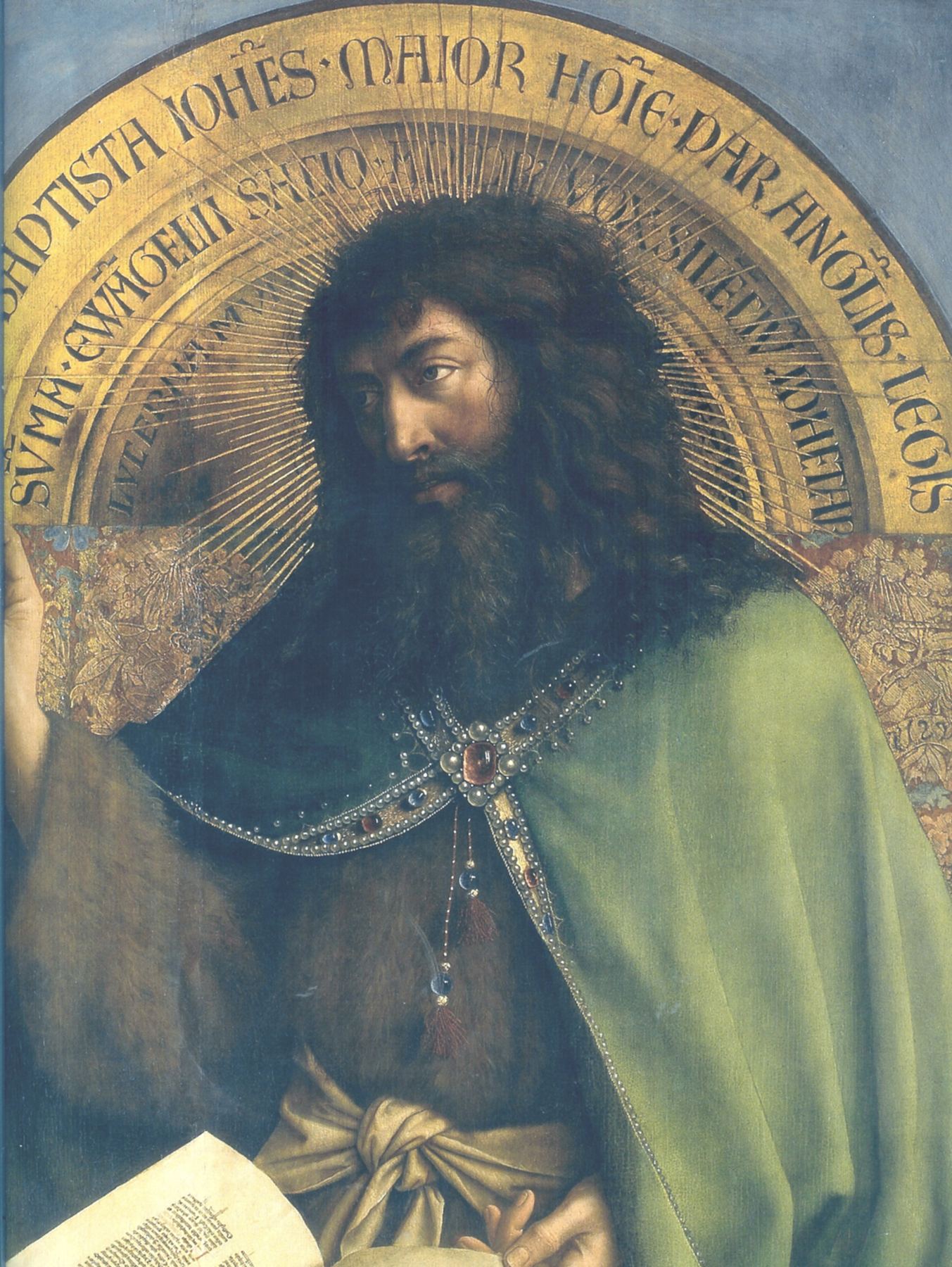
John the Baptist
The voice in the wilderness. He baptised Jesus, pointed his own followers to Him, and was beheaded for telling a ruler the truth.
Picture: John the Baptist, from the Ghent Altarpiece, Jan van Eyck, 1432. St Bavo's Cathedral, Ghent. Public domain.
Who was John?
John was a prophet, the son of an old priest named Zechariah. He lived in the wilderness and baptised crowds in the Jordan River. He called people to turn back to God. He baptised Jesus, and pointed his own followers to Him. For condemning the marriage of Herod, ruler of Galilee, he was beheaded.
at a glance
His path, in order
- Priest's sonBorn to Zechariah and Elizabeth in old age
- HermitIn the wilderness from his youth
- ProphetThe word of God came to him in the wilderness
- BaptiserOf crowds in the Jordan, and of Jesus
- Witness“Look, the Lamb of God!”
- MartyrBeheaded in Herod's prison
in numbers
- Months older than Jesus6
- Elizabeth was in her sixth month
- When Gabriel came to Mary
- Disciples he pointed to Jesus2
- He told them, “Look, the Lamb of God!”
- They followed Him. One was Andrew, Peter's brother
- Men who knew only his baptism12
- Paul met them at Ephesus, years later
- “About twelve men in all”
did you know?
-
The names of the musical notes come from a hymn to him, Ut queant laxis. Its first six lines start on rising notes: ut, re, mi, fa, sol, la. The monk Guido of Arezzo used them to teach singing in the 1000s. Ut later became do.
Britannica, “Solmization”; Catholic Encyclopedia, “St. John the Baptist” -
His feast falls at midsummer, and Christmas at midwinter. Augustine saw in that John's own saying, that Christ must increase and he must decrease. Christ, Augustine said, “was born when the days were just beginning to lengthen; John was born when they began to shorten.”
Augustine, Tractates on the Gospel of John, Tractate 14 -
The Orthodox keep the day of his beheading as a strict fast. In some places people will not eat from a flat plate, use a knife, or eat anything round that day.
OCA, The Beheading of John the Baptist
- Born
- In “a town in the hill country of Judah”, Luke says, without naming it. Tradition has placed it at Ein Karem, near Jerusalem, since at least 530, says Britannica.
- Parents
- Zechariah, a priest of the division of Abijah, and Elizabeth, a descendant of Aaron. They had long been childless, and were “both well along in years”.
- Home
- The wilderness of Judea, from his youth until he began to preach.
- Work
- A prophet and baptiser. He preached and baptised along the Jordan, at Bethany beyond the Jordan and at Aenon near Salim.
- Dress and food
- A garment of camel's hair with a leather belt. He lived on locusts and wild honey, and never drank wine.
- Also called
- John the Baptizer, which is what “the Baptist” means. The Forerunner, in the Orthodox Church. The Precursor, in older Catholic writing.
- Died
- Beheaded in prison on the order of Herod Antipas, ruler of Galilee, some time between 28 and 36. The Jewish historian Josephus names the place: the fortress of Machaerus, on Herod's border with the king of Arabia.
- Buried
- His disciples laid his body in a tomb. His tomb has been shown at Sebaste, in Samaria, since about 360, says Britannica.
- Patron of
- Baptism, monks, hermits, converts, tailors and prisoners, among others, says Britannica.
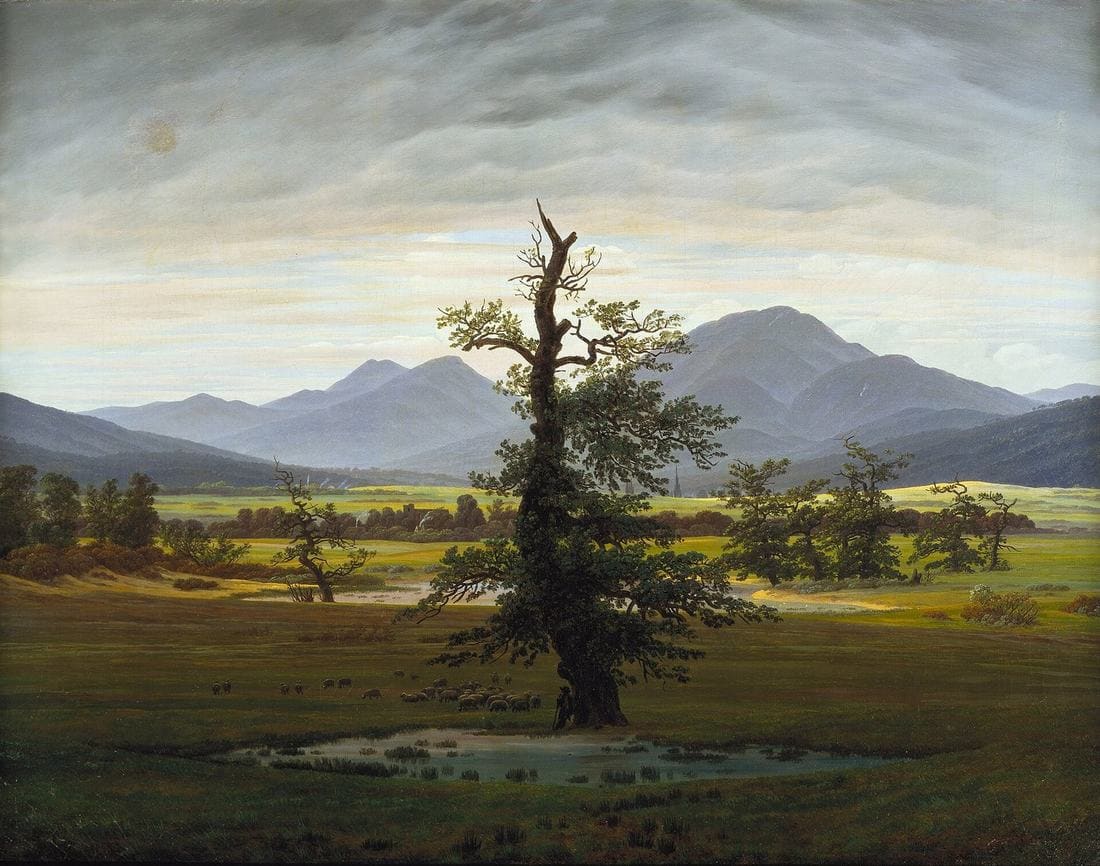 The Oak
 His personality type
Sure of himself, and at his best when life is quiet.
In Gregory the Great's terms
- Confident
- Tranquil mind
Our reading, from the Christian Personality Test. The personality test names him for his steadiness. He lived in the wilderness until the day he began to preach. Jesus asked if the crowds had gone out to see “a reed swaying in the wind”. Gregory the Great says a reed bends to praise or blame, but “no variety of circumstance bent him from his uprightness”.
See The Oakfeast days
East and West, side by side
West
- Jun24
His birth, a Catholic solemnity. A Festival in the Church of England. Also the Episcopal Church, and Lutherans in the Missouri Synod and the ELCA.
- Aug29
His beheading. For Catholics it is the Passion of Saint John the Baptist, a memorial. Also the Church of England, the Episcopal Church and the Missouri Synod.
East
- Jan7
The Synaxis of John, a gathering in his honour the day after Theophany, the feast of Jesus' baptism. OCA.
- Feb24
The first and second finding of his head. OCA.
- May25
The third finding of his head, about 850. OCA.
- Jun24
His birth. OCA.
- Jul7
The Coptic Church keeps his birth on 30 Paoni, which falls on this day.
- Aug29
His beheading, a strict fast day. OCA.
- Sep12
The Coptic Church keeps his martyrdom on 2 Tout: 12 September, or 13 September in the year before a leap year.
- Sep23
His conception. OCA.
Why 24 June? Luke says Elizabeth was six months pregnant when Gabriel came to Mary, so John's birth is kept six months before Christmas. The Catholic Encyclopedia calls it perhaps the oldest feast of any saint. Rome's 1916 book of martyrs says he was killed “about the feast of Easter”. It keeps 29 August as the day his head “was found for the second time”. Churches on the old calendar keep each date 13 days later: his birth on 7 July, his beheading on 11 September.
what others said of him
An angel, his father, Jesus, a Jewish historian and a pope, in their own words.
He will be great in the sight of the Lord. He shall never take wine or strong drink, and he will be filled with the Holy Spirit even from his mother's womb.
And you, child, will be called a prophet of the Most High; for you will go on before the Lord to prepare the way for Him.
Truly I tell you, among those born of women there has risen no one greater than John the Baptist. Yet even the least in the kingdom of heaven is greater than he.
John was a lamp that burned and gave light, and you were willing for a season to bask in his light.
Herod slew him, who was a good man, and commanded the Jews to exercise virtue, both as to righteousness towards one another, and piety towards God, and so to come to baptism.
John therefore is more than a prophet, because Him whom he had foretold by going before Him, the same he shewed as present by pointing Him out.
his life in ten moments
The temple in Jerusalem
Before he was bornAn angel at the altar
His parents, Zechariah and Elizabeth, were righteous, old and childless. Zechariah was a priest. One day he was chosen by lot to burn incense in the temple. An angel appeared beside the altar. “Do not be afraid, Zechariah, because your prayer has been heard. Your wife Elizabeth will bear you a son, and you are to give him the name John.” Zechariah asked, “How can I be sure of this?” The angel answered, “I am Gabriel.” Because Zechariah did not believe, he would be silent until it came to pass. He came out unable to speak, and could only make signs to the people.
Luke 1:5-25The hill country of Judah
Six months laterThe leap in the womb
In Elizabeth's sixth month, Gabriel was sent to Mary at Nazareth. He told her that her relative Elizabeth was expecting a son. Mary hurried to the hill country to see her. When Elizabeth heard Mary's greeting, the baby leaped in her womb. Elizabeth was filled with the Holy Spirit and cried out, “Blessed are you among women, and blessed is the fruit of your womb!” She asked why “the mother of my Lord” should come to her. “As soon as the sound of your greeting reached my ears, the baby in my womb leaped for joy.” Mary stayed with her about three months.
Luke 1:26-56Zechariah's home
The eighth day“His name is John”
Elizabeth gave birth to a son, and her neighbours rejoiced with her. On the eighth day they were going to name him Zechariah, after his father. His mother said no: “He shall be called John.” They answered, “There is no one among your relatives who bears this name.” So they made signs to his father. Zechariah asked for a tablet and wrote, “His name is John.” At once he could speak again, and he began to praise God. People all over the hill country asked, “What then will this child become?”
Luke 1:57-66The wilderness of Judea
The fifteenth year of TiberiusThe voice in the wilderness
John grew up in the wilderness. Then, in the fifteenth year of the emperor Tiberius, “the word of God came to John son of Zechariah in the wilderness.” He went all through the Jordan valley, preaching a baptism of repentance. Isaiah had written of him: “A voice of one calling in the wilderness, ‘Prepare the way for the Lord.’” He wore a garment of camel's hair and a leather belt. His food was locusts and wild honey. People went out to him from Jerusalem and all Judea. Confessing their sins, they were baptised by him in the Jordan.
Luke 1:80; 3:1-6; Matthew 3:1-6The Jordan
To the crowds“What then should we do?”
John did not flatter the crowds who came out to him. “You brood of vipers, who warned you to flee from the coming wrath?” he asked. “Produce fruit, then, in keeping with repentance.” The crowds asked him, “What then should we do?” He told them to share their food and their clothes. Even tax collectors came. “Collect no more than you are authorized,” he said. The people began to wonder if John might be the Christ. He told them that One more powerful was coming, “the straps of Whose sandals I am not worthy to untie.”
Luke 3:7-18The Jordan River
Jesus comes from GalileeThe baptism of Jesus
Jesus came from Galilee to the Jordan to be baptised by John. John tried to stop Him. “I need to be baptized by You, and do You come to me?” “Let it be so now,” Jesus replied. “It is fitting for us to fulfill all righteousness in this way.” So John baptised Him. As Jesus came up out of the water, the heavens opened. John later told what he saw: “I saw the Spirit descending from heaven like a dove and resting on Him.” And a voice from heaven said, “This is My beloved Son, in Whom I am well pleased!”
Matthew 3:13-17; John 1:32-34Bethany beyond the Jordan
Priests from Jerusalem“Who are you?”
The leaders in Jerusalem sent priests and Levites to ask John who he was. He did not dodge the question: “I am not the Christ.” “Are you Elijah?” “I am not.” Then they asked if he was the Prophet whom Moses had foretold. “No.” At last they asked, “What do you say about yourself?” He answered in the words of Isaiah: “I am a voice of one calling in the wilderness, ‘Make straight the way for the Lord.’” Jesus would say something else about Elijah, as the section on Elijah below explains.
John 1:19-28; Deuteronomy 18:15Bethany beyond the Jordan
The next two days“Look, the Lamb of God!”
The day after the priests' visit, John saw Jesus coming toward him. “Look, the Lamb of God, Who takes away the sin of the world!” The day after, he was standing with two of his own disciples. As Jesus walked by, John said it again: “Look, the Lamb of God!” The two left John and followed Jesus. One of them was Andrew. He went and found his brother Simon: “We have found the Messiah.”
John 1:29-42Herod's prison
After he rebuked a rulerArrested
Herod Antipas, the ruler of Galilee, had married Herodias, the wife of his brother Philip. John kept telling him, “It is not lawful for you to have your brother's wife!” So Herod had him arrested, bound and put in prison. Herodias held a grudge against John and wanted him dead. But Herod feared John, “knowing that he was a righteous and holy man.” When he heard John speak, he was greatly perplexed, “yet he listened to him gladly.”
Mark 6:17-20; Luke 3:19-20Herod's prison
Near the endA question from prison
In prison, John heard about the works of Christ. He sent two of his disciples to ask Him, “Are You the One Who was to come, or should we look for someone else?” Jesus sent them back with an answer: “The blind receive sight, the lame walk, the lepers are cleansed, the deaf hear, the dead are raised, and the good news is preached to the poor.” As they left, He turned to the crowds. “What did you go out into the wilderness to see? A reed swaying in the wind?” Did John doubt? The Church Fathers Hilary, Jerome and Chrysostom all say no. He asked for his disciples' sake, so that they would see for themselves.
Matthew 11:2-11; Luke 7:18-28; Hilary, Jerome and Chrysostom, in the Catena Aurea on Matthew 11
his words
John wrote nothing. The four Gospels record his words. Outside the section on where our quiz places him, every Bible line on this page is from the Berean Standard Bible.
When the crowds went to Jesus
He must increase; I must decrease.
John was still baptising at Aenon, where the water was plentiful. His disciples came to him upset about Jesus: “He is baptizing, and everyone is going to Him.” John answered that Jesus was the bridegroom, and he was only the bridegroom's friend. The friend “is overjoyed to hear the bridegroom's voice. That joy is mine, and it is now complete.”
John 3:22-30Repent, for the kingdom of heaven is near.
Whoever has two tunics should share with him who has none, and whoever has food should do the same.
Do not take money by force or false accusation. Be content with your wages.
The axe lies ready at the root of the trees, and every tree that does not produce good fruit will be cut down and thrown into the fire.
I baptize with water, but among you stands One you do not know.
A man can receive only what is given him from heaven.
was he elijah?
The book of Malachi ends with a promise: “I will send you Elijah the prophet before the coming of the great and awesome Day of the LORD” (Malachi 4:5). Was John that Elijah? The Gospels seem to answer both ways. Here each answer speaks in its own words.
Yes, said Jesus
Jesus told the crowds that John was the one Malachi promised. After the Transfiguration He said it again, that Elijah had already come and was not recognised. Then “the disciples understood that He was speaking to them about John the Baptist.”
“And if you are willing to accept it, he is the Elijah who was to come.”Matthew 11:14; 17:10-13
No, said John
When the priests and Levites asked him, “Are you Elijah?”, he would not take the title. He called himself only “a voice of one calling in the wilderness”.
“I am not.”John 1:21-23
In the spirit of Elijah
Before John was born, Gabriel said he would go before the Lord “in the spirit and power of Elijah”. Jerome read Jesus' words that way. John is called Elijah, he says, not because a soul passed into a new body, as some taught, but because he came in Elijah's spirit and power. And the two lives rhymed. Both lived in the wilderness, and both wore a leather belt. An old English translation of Jerome spells Elijah as Elias:
“because he reproved Ahab and Jezebel for their wickedness, Elias was compelled to fly; because he condemned the unlawful union of Herod and Herodias, John is beheaded.”Luke 1:17; 2 Kings 1:8; Jerome, Commentary on Matthew, in the Catena Aurea on Matthew 11, tr. 1841
Two forerunners
John Chrysostom read Malachi's two promises as one: God's messenger who prepares the way, and Elijah the prophet. Each was to come before the Lord. So he could say it either way round:
“John the Baptist is Elias, and Elias is John, because both were forerunners of Christ.”Malachi 3:1 and 4:5; John Chrysostom, in the Catena Aurea on Matthew 11, tr. 1841
often misquoted
His “locusts” were really carob pods.
What the sources sayThe Gospels say his food was “locusts and wild honey”. The law of Moses allowed locusts as food: “you may eat any kind of locust, katydid, cricket, or grasshopper.” The carob idea is a belief, not what the text says. It gave the carob tree two English names, locust bean and St John's bread, says Britannica.
Matthew 3:4; Mark 1:6; Leviticus 11:22; Britannica, “Carob”The dancer was Salome, and she danced the dance of the seven veils.
What the sources sayThe Gospels never name her. They call her “the daughter of Herodias”. The name comes from the Jewish historian Josephus, who says Herodias had a daughter named Salome, later married to Philip the tetrarch. He says nothing of a dance. The seven veils come from Oscar Wilde's play Salomé, written in French in 1892. Its stage direction reads, “Salomé dances the dance of the seven veils.”
Mark 6:22; Josephus, Antiquities, book 18, chapter 5; Oscar Wilde, Salomé, tr. Alfred Douglas (1894)John the Baptist was a Baptist.
What the sources say“Baptist” was his title, not his church. It means the one who baptises, and the historian Josephus already calls him “John, that was called the Baptist”. The Baptist churches came some 1,600 years later. Most scholars, says Britannica, trace them to 17th-century Puritanism. They hold that only believers should be baptised, by immersion.
Josephus, Antiquities, book 18, chapter 5; Catholic Encyclopedia; Britannica, “Baptist”The Herod who killed John also killed the babies of Bethlehem.
What the sources sayThey were two Herods, father and son. King Herod, called the Great, died while Jesus was still a child. The Herod who killed John was his son, Herod Antipas, “Herod the tetrarch”, ruler of Galilee. He was the Herod to whom Pilate later sent Jesus. He questioned Jesus at length, then mocked Him and sent Him back.
Matthew 2:19-22; 14:1-12; Luke 23:6-12; Josephus, Antiquities, book 18, chapter 5friends, family and rivals
His father, a priest. He doubted the angel and was struck silent until John was named. Then he sang the song the Church calls the Benedictus.
Luke 1:5-25, 57-79; Lesser Feasts and Fasts 2022His mother, a descendant of Aaron. Long childless, she kept to herself for five months and said, “The Lord has done this for me.”
Luke 1:5-7, 24-25Elizabeth's relative. Luke never says how they were related, so John and Jesus were kin, but not certainly cousins. When Mary came to visit, the unborn John leaped for joy. She stayed about three months.
Luke 1:36-56John baptised Him in the Jordan and pointed his own disciples to Him. Jesus said no one born of women was greater than John. When He heard John had been killed, He withdrew by boat to a solitary place.
Matthew 3:13-17; 11:11; 14:13One of John's disciples. He heard John call Jesus the Lamb of God, followed Jesus, and brought his brother Simon Peter.
John 1:35-42They fasted often, and John taught them to pray. After his death they took his body, buried it, and went and told Jesus.
Mark 2:18; Luke 11:1; Matthew 14:12Ruler of Galilee. He jailed John for condemning his marriage, yet liked to listen to him. He had him beheaded rather than break an oath made before his guests.
Mark 6:14-29Herod's wife, who had been his brother Philip's wife. She held a grudge against John and told her daughter to ask for his head.
Mark 6:17-24She danced at Herod's birthday banquet, and asked for John's head at her mother's word. The Gospels do not name her. The historian Josephus names Herodias's daughter as Salome.
Mark 6:21-28; Josephus, Antiquities, book 18, chapter 5how he died
Herod Antipas had him beheaded in prison, at the wish of Herodias. The Jewish historian Josephus says it was at the fortress of Machaerus.
On his birthday, Herod gave a banquet for his nobles and commanders and the leading men of Galilee. The daughter of Herodias danced, and pleased Herod and his guests. He swore to give her whatever she asked, “up to half my kingdom!” She went out and asked her mother, “What should I request?” Herodias answered, “The head of John the Baptist.” The king was consumed with sorrow. But because of his oaths and his guests, he did not want to refuse her. He sent an executioner, who beheaded John in the prison.
When John's disciples heard, they came and took his body and laid it in a tomb. Then they went and told Jesus. When Jesus heard about John, “He withdrew by boat privately to a solitary place.”
Afterwards, when Herod heard what Jesus was doing, he was sure he knew who it was: “John, whom I beheaded, has risen from the dead!”
The Jewish historian Josephus tells of John's death without the dance. Herod feared “lest the great influence John had over the people might put it into his power and inclination to raise a rebellion”. So John was sent in chains to Machaerus, “and was there put to death.” Later, Herod's army was destroyed in a war with Aretas, king of Arabia. Some of the Jews thought that “came from God, and that very justly, as a punishment of what he did against John”.
His tomb was later shown at Sebaste, in Samaria. The church historian Theodoret says that under the emperor Julian, pagans opened it: “his bones burnt, and the ashes scattered abroad.”
is he a saint?
Yes. Every church that keeps saints' days honours him. His is one of only three births kept as a feast, with Christ's and Mary's.
- CatholicSaintA solemnity for his birth, 24 June
- OrthodoxSaintThe Forerunner, six feast days
- CopticSaint30 Paoni and 2 Tout
- AnglicanSaintA Festival in the Church of England
- LutheranSaintMissouri Synod and ELCA, 24 June
Is he an Old Testament saint or a New Testament one? He stands on the line between them. Jesus said, “all the Prophets and the Law prophesied until John.”
The Orthodox call him the Forerunner, Prodromos: the one who runs ahead. The Orthodox Church in America (OCA) puts his place like this:
Saint John, the holy Forerunner and Baptist of the Lord, whom the Lord called the greatest of the prophets, concludes the history of the Old Testament and opens the era of the New Testament.
what to read first
Luke 1
The Gospel of Luke
The angel in the temple, the leap in the womb, the naming and his father's song. One long chapter.
Read it freeLuke 3
The Gospel of Luke
His preaching in the wilderness, and what he told the crowds, the tax collectors and the soldiers to do.
Read it freeJohn 1 and 3
The Gospel of John
The voice in the wilderness, the Lamb of God, and “He must increase”. Read chapter 1, then chapter 3 from verse 22.
Read it freeMark 6:14-29
The Gospel of Mark
How Herod came to have him killed, told in sixteen verses.
Read it freeAntiquities of the Jews, book 18, chapter 5
Josephus, tr. William Whiston
A few paragraphs from a Jewish historian of the first century, on why Herod had him killed.
Read it freewhere the quiz places him
The record, drawn
Each arm is one axis; length is how far from the centre the recorded acts sit. An axis the text does not place John the Baptist on has no arm.
In the quiz's own words
Says it, confronts, alongside
The six axes
Your answers are marked. From your result on . See your result
In the hatched middle the quiz names neither pole.
The moments behind each axis
Each line is one recorded act and the reference it is taken from. The sentence says what the person did; where it is in quotation marks it is verbatim, from the translation named under it. An act listed here is evidence of how this person moved, not approval of it; read the passage for how it was received. On 2 of the six the text does not show this, and that axis is left out of the match rather than filled in.
Pace Acts first ↔ Weighs first
not shown in the text
The text does not show this. Nothing in the record puts John the Baptist at either end of this axis, so it is left out when a reader is matched, rather than counted as a position in the middle.
-
No record
The text does not show this.
Voice Says it ↔ Holds it
says it
-
Matthew 3:7 toward Says it
He said what he thought of the Pharisees and Sadducees to their faces as they came.
You offspring of vipers
World English Bible British Edition
-
Matthew 14:4 toward Says it
He told Herod that his marriage to Herodias was not lawful.
It is not lawful for you to have her.
World English Bible British Edition
Lead Out in front ↔ Alongside
alongside
-
John 1:35-37 toward Alongside
He pointed two of his own disciples at Jesus and they left him and followed Jesus.
-
John 3:30 toward Alongside
He said his own part was to become less as the other became greater.
He must increase, but I must decrease.
World English Bible British Edition
Conflict Confronts ↔ Reconciles
confronts
-
Matthew 3:7 toward Confronts
He challenged the Pharisees and Sadducees who had come out to him.
-
Matthew 14:3-4 toward Confronts
He told the king to his face that he was in the wrong, and was arrested for it.
Reasons Asks why ↔ Takes it on trust
quick to question
-
Matthew 11:2-3 toward Asks why
From prison he sent two disciples to ask Jesus directly whether He was the One to come.
Are You the One
Berean Standard Bible
Plans Plans ahead ↔ Meets the day
not shown in the text
The text does not show this. Nothing in the record puts John the Baptist at either end of this axis, so it is left out when a reader is matched, rather than counted as a position in the middle.
-
No record
The text does not show this.
Nearest on the map
Distance between two sets of coordinates across every axis, on the same scale a reader's answers are measured on. No number is shown against a person, and nearness is not likeness: two people can land in the same band for different reasons.
Suggest a correction. Corrections that are applied are recorded in the public changelog.
 Quiz Who in the Bible are you most like? Answer eighteen plain statements about you, none of them about the Bible, and see how near you land to John the Baptist. Start
  Quiz Christian Personality Test John reads as The Oak. Find your own type. Start
 people like him
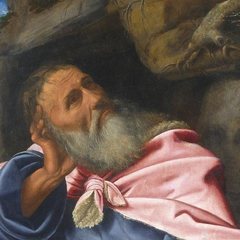 ElijahThe Oak
 John came “in the spirit and power of Elijah”. Both lived in the wild, both wore a leather belt, and both stood up to a ruler and his wife.
Luke 1:17; 2 Kings 1:8; 1 Kings 21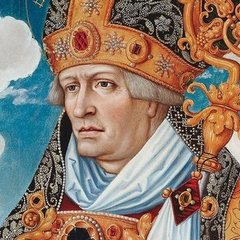 John ChrysostomThe Oak
 He was bishop of Constantinople. When the Empress Eudoxia turned against him, he preached a sermon that began, “Again Herodias raves; again she is troubled; she dances again; and again desires to receive John's head in a charger.”
Socrates, Church History, book 6, chapter 18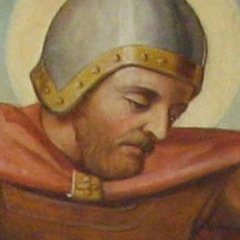 Martin of ToursThe Oak
 At court, the other bishops flattered the emperor. His biographer, Sulpicius Severus, says that “in Martin alone, apostolic authority continued to assert itself.”
Sulpicius Severus, Life of St Martin, chapter 20sources
His life, and his words
- The Berean Standard Bible, public domain. Every Bible line on this page outside the section on where the Bible figure quiz places him.
- Josephus, Antiquities of the Jews, book 18, chapter 5. Tr. William Whiston, 1737.
- Thomas Aquinas, Catena Aurea on Matthew 11. Tr. under J. H. Newman, 1841. With Gregory the Great, Jerome, Hilary and John Chrysostom.
- Augustine, Tractates on the Gospel of John, Tractate 14. Tr. John Gibb. Nicene and Post-Nicene Fathers, first series, volume 7.
- Theodoret, Church History, book 3, chapter 3. Tr. Blomfield Jackson. Nicene and Post-Nicene Fathers, second series, volume 3.
- Socrates, Church History, book 6, chapter 18. Tr. A. C. Zenos. Nicene and Post-Nicene Fathers, second series, volume 2.
- Sulpicius Severus, Life of St Martin, chapter 20. Tr. Alexander Roberts. Nicene and Post-Nicene Fathers, second series, volume 11.
- Oscar Wilde, Salomé. Tr. Alfred Douglas, 1894.
Reference
- Catholic Encyclopedia, 1910, “St. John the Baptist”
- Britannica, “St. John the Baptist”
- Britannica, “Carob”
- Britannica, “Solmization”
- Britannica, “Baptist”
Calendars
- USCCB, Liturgical Calendar 2026, 24 June and 29 August
- Calendarium Romanum, 1969
- The Roman Martyrology, 1916 edition, 24 June and 29 August
- OCA, Synaxis of John, 7 January
- OCA, First and Second Finding of the Head, 24 February
- OCA, Third Finding of the Head, 25 May
- OCA, Nativity of John, 24 June
- OCA, The Beheading of John, 29 August
- OCA, Conception of John, 23 September
- CopticChurch.net, the Coptic synaxarium, 30 Paoni
- CopticChurch.net, the Coptic synaxarium, 2 Tout
- Church of England, Common Worship calendar
- The Episcopal Church, Lesser Feasts and Fasts 2022
- The Lutheran Church–Missouri Synod, Commemorations
- Evangelical Lutheran Worship, ELCA, the church year (final draft, 2006)
Pictures
- John the Baptist, from the Ghent Altarpiece, Jan van Eyck, 1432. St Bavo's Cathedral, Ghent. Public domain.
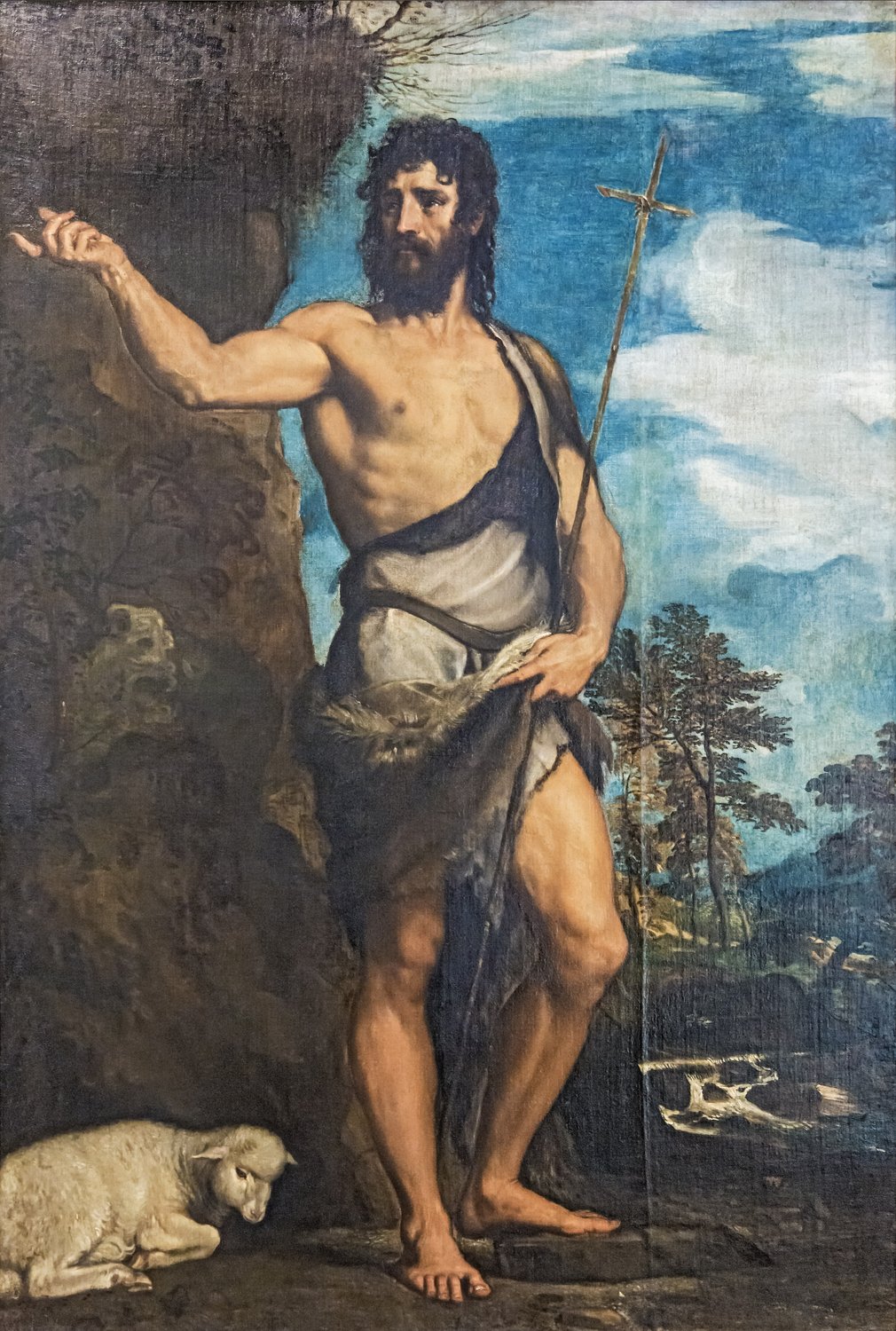
- Saint John the Baptist, Titian, about 1540. Gallerie dell'Accademia, Venice. Photograph by Didier Descouens. Public domain.