
Daniel
Taken from Judah to Babylon as a young man, he explained the dreams of kings. He kept on praying when the law forbade it, and was thrown to the lions.
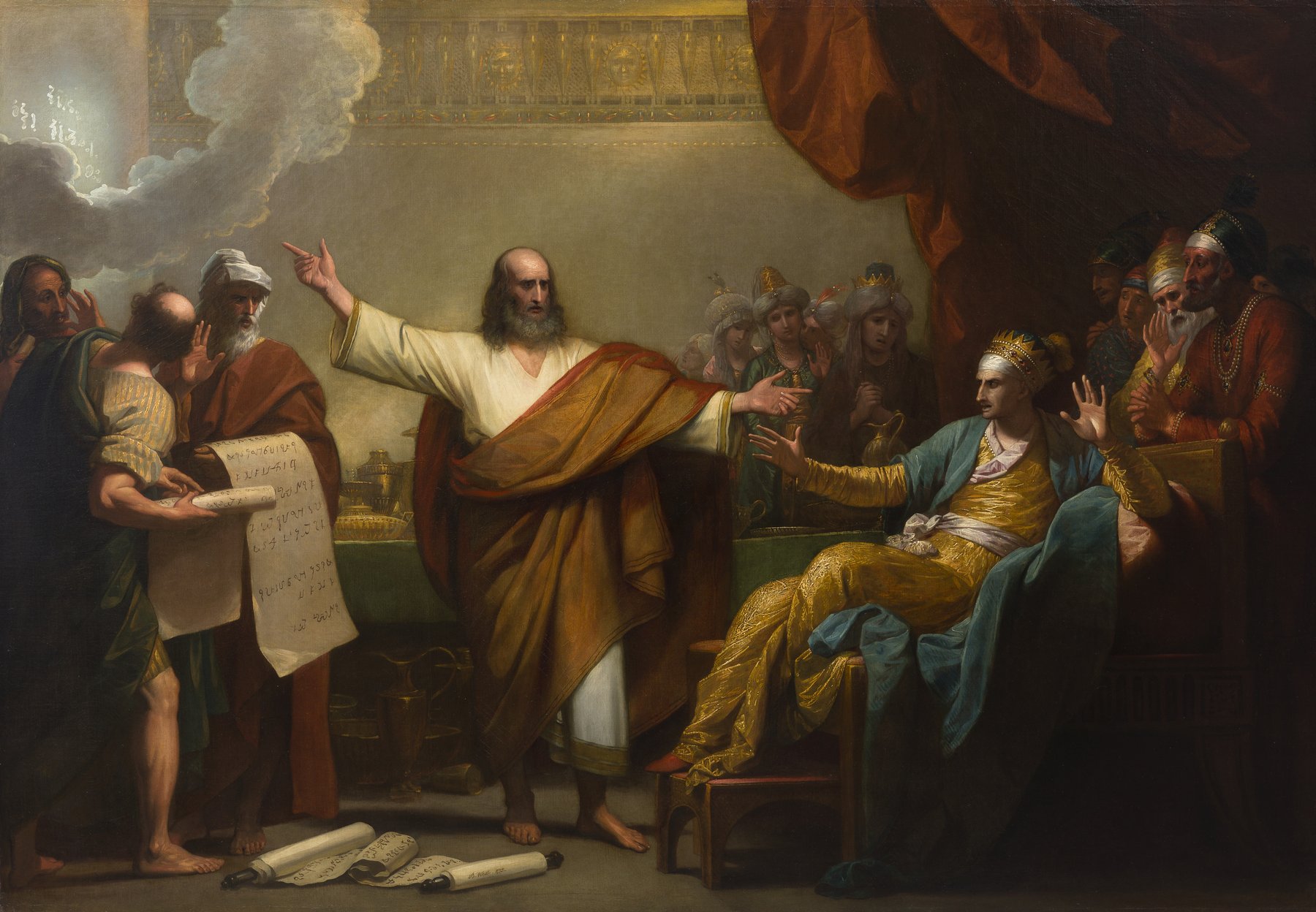
Picture: Daniel Interpreting to Belshazzar the Writing on the Wall, Benjamin West, 1775. Saint Louis Art Museum. Public domain.
Who was Daniel?
Daniel was a young man of Judah, taken to Babylon. He rose high at the court of its kings, and of Persia's after them. He explained Nebuchadnezzar's dreams and the writing on the wall. He kept praying three times a day when the law forbade it, and God shut the lions' mouths.
at a glance
His path, in order
- ExileTaken young from Judah to Babylon
- Wise manTrained for the court of Babylon
- InterpreterOf the dreams of Nebuchadnezzar
- GovernorUnder the kings of Babylon and Persia
- ProphetOf visions of the end
in numbers
- Times a day he prayed3
- On his knees, windows open toward Jerusalem
- Even when a decree forbade praying to God
- Days of vegetables and water10
- Instead of the king's food and wine
- Then he looked healthier than the other young men
- Years Jeremiah said Jerusalem's ruin would last70
- Daniel read Jeremiah's prophecy in the sacred books
- Then he fasted, and prayed
- Days an angel was held up on the way21
- He mourned and fasted three weeks
- Then the angel came, held back by the prince of Persia
did you know?
-
The Jewish historian Josephus says Alexander the Great was shown the book of Daniel, which foretold that a Greek would destroy the Persian empire. Alexander “supposed that himself was the person intended.”
Josephus, Antiquities, book 11, chapter 8 -
In the Hebrew Bible, the angels Gabriel and Michael are named only in Daniel. Gabriel comes back in Luke. He speaks to Zechariah, the father of John the Baptist, and to Mary. Michael comes back in Jude and Revelation.
Daniel 8:16; 9:21; 10:13; 12:1; Luke 1:13, 19, 26; Jude 9; Revelation 12:7 -
In Greek, Daniel's questioning of the two elders who accused Susanna turns on puns. The one who names a mastic tree, a schinos, will be cut, schisei, in two. The Christian chronicler Julius Africanus told the Bible scholar Origen that the puns showed the story was first written in Greek. Origen was “still in doubt”.
Susanna 54-59; Origen, Letter to Africanus, chapter 6 -
The song Daniel's three friends sang in the fiery furnace is one of the pieces of his book kept in Greek. The Church of England's Book of Common Prayer sets it at Morning Prayer, as the Benedicite: “O all ye Works of the Lord, bless ye the Lord”.
Daniel 3:57-90 in Catholic Bibles; the Book of Common Prayer, Morning Prayer
- Name
- Daniel means God is my judge. At court he was renamed Belteshazzar, “after the name of my god”, said Nebuchadnezzar. The Catholic Encyclopedia reads it as Bel protect his life.
- From
- Judah. He was one of the young men taken from “the royal family and the nobility”. The Jewish historian Josephus says he and his three friends were kin of Zedekiah, the last king of Judah.
- Taken
- To Babylon, by Nebuchadnezzar, in the third year of King Jehoiakim. The Catholic Encyclopedia dates it to 605 BC, when he was probably about fourteen.
- Served
- Four kings: Nebuchadnezzar, Belshazzar, Darius the Mede and Cyrus the Persian. When Babylon fell to the Medes and Persians, he kept his high place.
- Family
- The Bible names no wife or children. A Jewish tradition, accepted by many of the Church Fathers, held that he was made a eunuch at court. The Catholic Encyclopedia notes the text does not say so.
- Wrote
- The book of Daniel. Chapters 1 to 6 tell of him. Chapters 7 to 12 are four visions, in his own words. When it was written is argued over: see below.
- Languages
- Two. His book is in Hebrew, with Aramaic from chapter 2 verse 4 to the end of chapter 7. The switch comes mid-verse, when the king's astrologers answer him “in Aramaic”.
- Greek chapters
- Catholic and Orthodox Bibles hold three more pieces, kept in Greek: the prayer and song of the three young men in the fire, Susanna, and Bel and the Dragon. The Hebrew Bible and most Protestant Bibles leave them out.
- Buried
- No one knows. One tradition says in the royal vault at Babylon. The rabbis said he went home to Jerusalem. Since at least the 1100s, his tomb has been shown at Susa, in Persia.
- In art
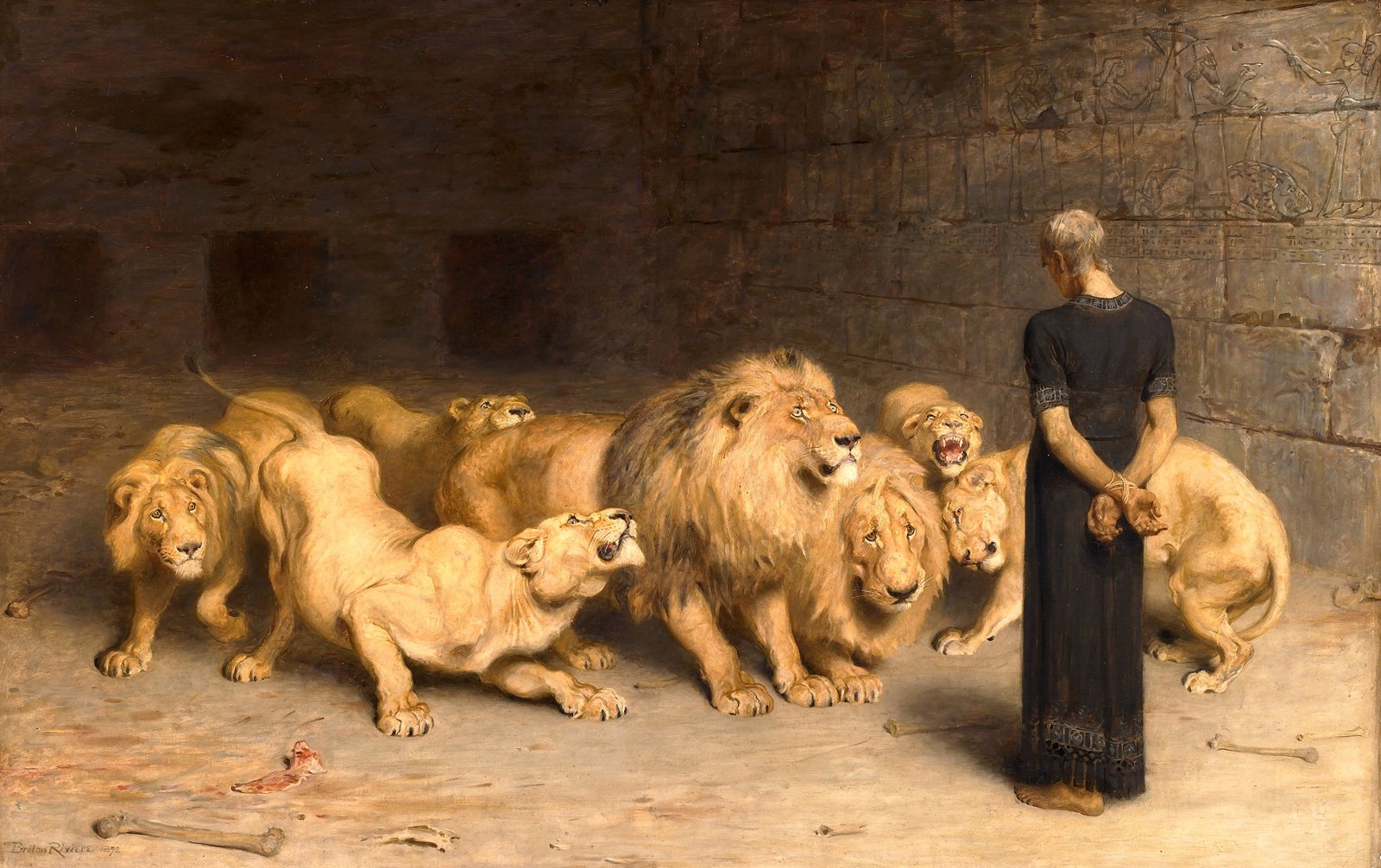
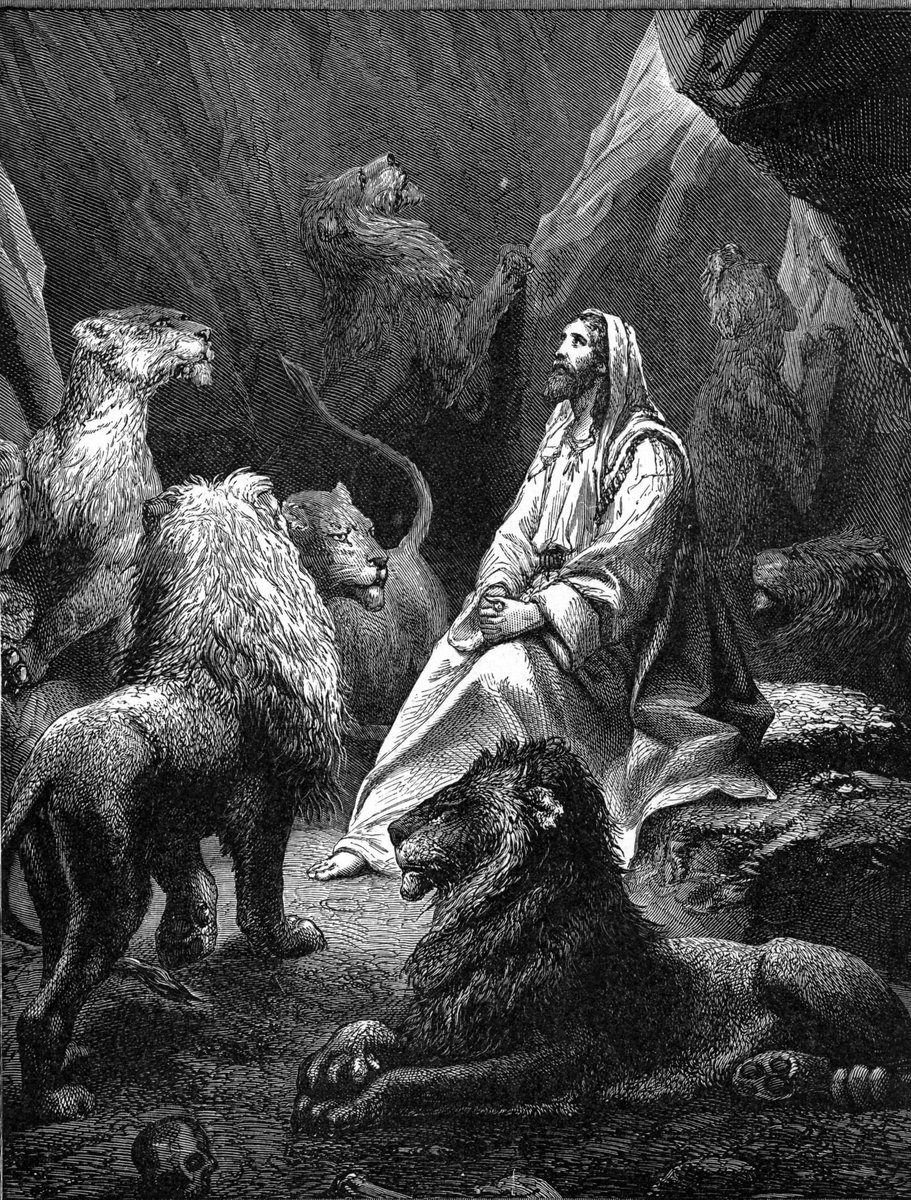
- In the lions' den, praying among the lions. On the Sistine Chapel ceiling, Michelangelo painted him among the prophets, with a great book.
feast days
East and West, side by side
West
- Jul21
His day in the 1916 Roman Martyrology.
- Dec17
Daniel the Prophet and the Three Young Men, for Lutherans in the Missouri Synod.
East
- Apr1
The Coptic Church, on 23 Baramhat in its own calendar: the departure of the great prophet Daniel.
- Dec17
The Holy Prophet Daniel and the three holy youths, Ananias, Azarias and Misael, for the Orthodox Church in America and the Greek churches. The Russian Church keeps the day on the old calendar, which is 30 December on today's.
Churches on the old calendar keep the 17 December feast 13 days later, on 30 December.
what others said of him
Ezekiel, Jesus, and the Jews and Christians after them, in their own words.
Behold, you are wiser than Daniel; no secret is hidden from you!
So when you see standing in the holy place ‘the abomination of desolation,’ spoken of by the prophet Daniel (let the reader understand)
Daniel was delivered from the mouth of lions for his innocence.
He did not only prophesy of future events, as did the other prophets, but he also determined the time of their accomplishment.
Was Daniel cast into the den of lions by such as feared God? Were Ananias, and Azarias, and Mishael shut up in a furnace of fire by those who observed the great and glorious worship of the Most High? Far from us be such a thought!
How unconquerable was Daniel, who feared not the lions raging round about him. The beasts roared, whilst he was eating.
None of the prophets has so clearly spoken concerning Christ as has this prophet Daniel.
his life in ten moments
Babylon
As a young manThe king's food
King Nebuchadnezzar of Babylon took Jerusalem and carried off young men “from the royal family and the nobility”. For three years they would learn the language and literature of the Chaldeans. Among them were Daniel, Hananiah, Mishael and Azariah. They were given new names: Belteshazzar, Shadrach, Meshach and Abednego. Daniel “made up his mind that he would not defile himself with the king's food or wine.” He asked the steward for a test. “Please test your servants for ten days. Let us be given only vegetables to eat and water to drink.” After ten days they looked healthier than all the rest. In time the king found them “ten times better than all the magicians and enchanters in his entire kingdom.”
Daniel 1A garden in Babylon
In the Greek chapters of DanielSusanna
Catholic and Orthodox Bibles tell of a young Daniel in the story of Susanna. She was the wife of Joakim, “a very fair woman, and one who feared the Lord.” Two elders, made judges that year, lusted after her. They caught her alone in her garden and told her to lie with them, or they would swear a young man had been with her. She refused: “It is better for me to fall into your hands, and not do it, than to sin in the sight of the Lord.” The people believed the elders, and she was led away to die. Then Daniel cried out, “Are you all such fools, you sons of Israel, that without examination or knowledge of the truth you have condemned a daughter of Israel?” He questioned the elders apart. He asked each under which tree he had seen her with the young man. One said a mastic tree, the other an oak. Their own words convicted them, and Susanna was saved.
Susanna (Daniel 13 in Catholic Bibles), World English BibleBabylon
Nebuchadnezzar's second yearThe king's dream
Nebuchadnezzar had dreams that troubled him. He ordered his wise men to tell him the dream itself, and then what it meant. They could not. “No one on earth can do what the king requests!” So he ordered every wise man in Babylon put to death, Daniel and his friends among them. Daniel asked the king for time, and asked his friends to plead with God for mercy. That night the mystery was revealed to him in a vision. He told the king his dream: a great statue, with a head of gold, a chest of silver, a belly of bronze, legs of iron, and feet part iron and part clay. A stone was “cut out, but not by human hands.” It struck the statue's feet, and became a mountain that filled the whole earth. Nebuchadnezzar fell on his face before Daniel, and made him ruler over the province of Babylon.
Daniel 2The palace of Babylon
Later in Nebuchadnezzar's reignThe tree cut down
Chapter 4 of Daniel is told by Nebuchadnezzar himself, as a letter to every nation. He dreamed of a great tree cut down to its stump, and called for Daniel. Daniel was alarmed at what it meant. “My lord,” he said, “may the dream apply to those who hate you, and its interpretation to your enemies!” But he told him the truth. The king would be driven away to live with the beasts, until he knew that the Most High rules over the kingdoms of men. Twelve months later, the king walked on his palace roof and boasted, “Is this not Babylon the Great, which I myself have built”. While the words were still in his mouth, a voice came from heaven. He was driven away, and ate grass like an ox. At the end of those days he looked up to heaven, and his sanity was restored. “Now I, Nebuchadnezzar, praise and exalt and glorify the King of heaven”.
Daniel 4Belshazzar's banquet hall
The last night of BabylonThe writing on the wall
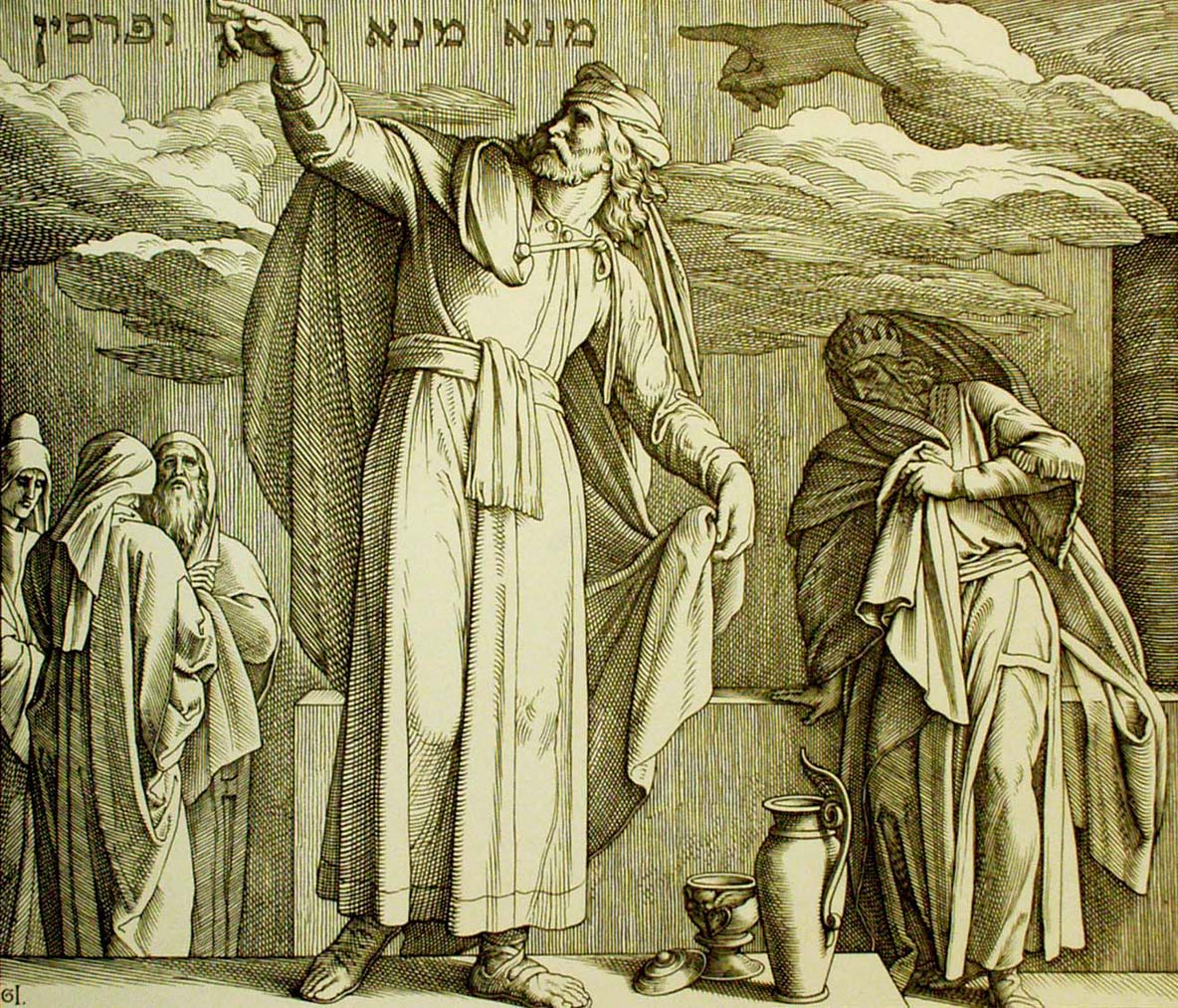
King Belshazzar held a feast for a thousand of his nobles. They drank from the gold and silver vessels taken from the temple in Jerusalem, and praised their gods of gold and silver. At that moment the fingers of a human hand wrote on the plaster of the wall. The king's knees knocked together. None of his wise men could read it. The queen remembered Daniel. “There is a man in your kingdom who has the spirit of the holy gods in him.” Daniel, by now an old man, read the words: MENE, MENE, TEKEL, PARSIN. God had numbered the days of the king's reign. “You have been weighed on the scales and found deficient.” His kingdom would go to the Medes and Persians. “That very night Belshazzar king of the Chaldeans was slain”.
Daniel 5Babylon, under Darius
An old manThree times a day
Darius the Mede made Daniel one of three men over the kingdom's governors, and planned to set him over the whole kingdom. The other officials looked for a charge against him, and found none. “We will never find any charge against this Daniel unless we find something against him concerning the law of his God.” So they had the king sign a decree. For thirty days, anyone who prayed to any god or man but the king would be thrown to the lions. Daniel went home. In his upper room, with the windows open toward Jerusalem, he knelt three times a day and prayed, “just as he had done before.” The king tried until sundown to save him, but his own law could not be changed. “May your God, Whom you serve continually, deliver you!” A stone was sealed over the mouth of the den, and the king spent the night fasting. What he found at dawn is told below, with the wonders.
Daniel 6:1-18Babylon
Belshazzar's first yearOne like the Son of Man
Daniel dreamed of four great beasts coming up out of the sea, each different from the others. Then thrones were set in place, “and the Ancient of Days took His seat.” His clothing was white as snow. “I saw One like the Son of Man coming with the clouds of heaven.” He was given a kingdom, and “His kingdom is one that will never be destroyed.” Daniel's face turned pale. “But I kept the matter to myself.” Jesus took these words for His own. At His trial, the high priest asked if He was the Christ. He answered, “I am,” and added, “you will see the Son of Man sitting at the right hand of Power and coming with the clouds of heaven.” The high priest tore his clothes.
Daniel 7; Mark 14:61-63Babylon
The first year of DariusSeventy years
Daniel read in the prophet Jeremiah that the ruin of Jerusalem would last seventy years. So he turned to God “by prayer and petition, with fasting, sackcloth, and ashes.” He confessed his people's sins as his own: his prayer is below. “While I was still praying,” the angel Gabriel came to him in swift flight, about the time of the evening sacrifice. An answer had gone out at the start of his prayer, Gabriel said, “for you are highly precious.” Then he told him of seventy weeks decreed for his people and his city, until “the Messiah, the Prince”. What the weeks mean has been argued over ever since.
Daniel 9Babylon, under Cyrus
In the Greek chapters of DanielFootprints in the ashes
Catholic and Orthodox Bibles tell the story of Bel and the Dragon. In it, Daniel lives at the court of Cyrus the Persian. Every day the Babylonians gave their idol Bel twelve great measures of flour, forty sheep and six firkins of wine. The king asked Daniel why he did not worship it. “Don't you see how much he eats and drinks every day?” Daniel laughed. “O king, don't be deceived; for this is just clay inside, and brass outside, and never ate or drank anything.” The food was set out and the temple sealed with the king's ring. Daniel had his servants scatter ashes over the floor. In the morning the food was gone, and Daniel laughed again. “Behold now the pavement, and mark well whose footsteps these are.” The priests had come in by a secret door with their wives and children, and eaten it all.
Bel and the Dragon 1-22 (Daniel 14 in Catholic Bibles), World English BibleThe bank of the Tigris
The third year of CyrusThe man in linen
Daniel mourned for three full weeks, with no rich food, meat or wine. Then, on the bank of the Tigris, he saw “a certain man dressed in linen”. His face was “like the brilliance of lightning”. The men with Daniel ran and hid, and he fell to the ground. A hand touched him and set him trembling on his hands and knees. “Do not be afraid, Daniel,” the man said. Daniel's words had been heard from the first day. But “the prince of the kingdom of Persia opposed me for twenty-one days,” until Michael came to help. “Peace be with you! Be strong now; be very strong!”
Daniel 10
his miracles
The book of Daniel tells of no wonder done by Daniel's own hand. It tells of wonders God did for him and for his friends. He was quick to say where the power came from:
No wise man, enchanter, medium, or magician can explain to the king the mystery of which he inquires. But there is a God in heaven Who reveals mysteries.
2 times he was thrown to the lions
-
Babylon, under Darius
At first lightThe mouths of the lions
King Darius had Daniel thrown to the lions for praying, and sealed the den with his own ring. At the first light of dawn he hurried to it, and cried out in anguish. “O Daniel, servant of the living God, has your God, Whom you serve continually, been able to deliver you from the lions?” Daniel answered from the den.
“My God sent His angel and shut the mouths of the lions. They have not hurt me, for I was found innocent in His sight.”
Daniel was lifted out, and no wounds whatsoever were found on him, “because he had trusted in his God.” Darius wrote to every nation that men must fear “the God of Daniel”.
Daniel 6:19-27 -
Babylon, under Cyrus
Six days, in the Greek chapters of DanielSeven lions, and a dinner
Daniel killed a great dragon the Babylonians worshipped. He fed it lumps of pitch, fat and hair, and it burst. “The king has become a Jew,” the people said, and they made the king hand Daniel over. He was thrown into a den of seven lions, left unfed so they would devour him. In Judea, the prophet Habakkuk was taking stew and bread to his reapers. The angel of the Lord lifted him “by the hair of his head” and set him in Babylon, over the den. “O Daniel, Daniel, take the dinner which God has sent you.”
“You have remembered me, O God! You haven't forsaken those who love You!”
On the seventh day the king came to mourn for him, and found Daniel sitting there. From Bel and the Dragon, in Catholic and Orthodox Bibles.
Bel and the Dragon 23-42 (Daniel 14 in Catholic Bibles), World English Bible
The fourth man in the fire
This is the story of Daniel's three friends, and he is not in it. Shadrach, Meshach and Abednego would not bow to the king's golden statue. Their God was able to save them, they told him. “But even if He does not, let it be known to you, O king, that we will not serve your gods or worship the golden statue you have set up.” The furnace was heated seven times hotter, and they were thrown in, bound. Then the king jumped up in amazement. When they came out, “Not a hair of their heads was singed”. Catholic and Orthodox Bibles add the prayer and the song they sang in the flames.
“I see four men, unbound and unharmed, walking around in the fire—and the fourth looks like a son of the gods!”Daniel 3
his words
He left no letters. Chapters 7 to 12 of his book are in his own voice, and the stories before them keep his words. Outside the section on where the Bible figure quiz places him, every Bible line on this page is from the Berean Standard Bible. The Greek chapters and 1 Maccabees are from the World English Bible, named where they stand.
The night Nebuchadnezzar's dream was revealed
Blessed be the name of God forever and ever, for wisdom and power belong to Him. He changes the times and seasons; He removes kings and establishes them. He gives wisdom to the wise and knowledge to the discerning. He reveals the deep and hidden things; He knows what lies in darkness, and light dwells with Him.
King Nebuchadnezzar had ordered every wise man in Babylon put to death, because none could tell him his dream. During the night the mystery was revealed to Daniel in a vision, “and he blessed the God of heaven”.
Daniel 2:19-22Break away from your sins by doing what is right, and from your iniquities by showing mercy to the oppressed.
You may keep your gifts for yourself and give your rewards to someone else. Nevertheless, I will read the inscription for the king and interpret it for him.
Speak, my lord, for you have strengthened me.
Because I may not honor idols made with hands, but only the living God, Who has created the sky and the earth, and has sovereignty over all flesh.
often misquoted
Daniel was a young man in the lions' den.
What the sources sayHe was taken to Babylon as a youth, probably about fourteen, says the Catholic Encyclopedia. The lions' den came decades later, after Babylon fell to the Medes and Persians. By the night of the writing on the wall, the same encyclopedia reckons, he was “now at least eighty years of age”.
Daniel 1:1-6; 5:30 to 6:16; Catholic Encyclopedia, “Daniel”Daniel was thrown into the fiery furnace.
What the sources sayThat was his three friends, Shadrach, Meshach and Abednego. Daniel is not named in that story, and the book does not say where he was. Later Jewish stories explained that the king had sent him away, says the Catholic Encyclopedia, because he knew Daniel would never bow to the golden statue.
Daniel 3; Catholic Encyclopedia, “Daniel”Daniel never ate meat.
What the sources sayAs a young man he asked for vegetables and water, so as not to defile himself with the king's food and wine. Decades later he tells of three weeks of mourning: “I ate no rich food, no meat or wine entered my mouth”. So going without meat and wine was a fast for him, not a rule for life.
Daniel 1:8-16; 10:2-3Daniel was Babylon's chief magician.
What the sources sayThe king did call him “chief of the magicians”. But Daniel told Nebuchadnezzar that no magician could reveal his dream: only God could. Cyril of Jerusalem, a bishop of the 300s, said the king was right that the Holy Spirit was in him, “but he was not the master of the magicians, for he was no magician, but was wise through the Holy Ghost.”
Daniel 2:27-28; 4:9; Cyril of Jerusalem, Catechetical Lectures, Lecture 16Daniel is one of the Prophets in the Hebrew Bible.
What the sources sayChristian Bibles put Daniel among the prophets, after Ezekiel. The Hebrew Bible does not. It places his book in its third part, the Writings, “between Ezra and Esther”, as the 1911 Britannica puts it. Jesus still called him “the prophet Daniel”, and Josephus called him “one of the greatest of the prophets”.
Matthew 24:15; Josephus, Antiquities, book 10, chapter 11; the 1911 Britannica, “Daniel, Book of”when was it written?
Daniel's visions grow more and more detailed as they come down to one king: Antiochus IV Epiphanes, who ruled from 175 to 164 BC and tried to stamp out the worship of the LORD. Was the book written by Daniel in the exile, or by a later author in the days of Antiochus? The question is very old. Here each side speaks for itself.
Porphyry's attack
Porphyry, a pagan philosopher who wrote against the Christians, gave the twelfth book of his work to Daniel. Jerome sums up his case. Porphyry denied that the book was written by Daniel,
“but rather by some individual living in Judaea at the time of the Antiochus who was surnamed Epiphanes.”Jerome, Commentary on Daniel, prologue, tr. Gleason Archer
Jerome's answer
Jerome answered that Porphyry's attack proved Daniel right. Porphyry had seen how exactly the prophecies came true, and could not deny it.
“But this very attack testifies to Daniel's accuracy. For so striking was the reliability of what the prophet foretold, that he could not appear to unbelievers as a predicter of the future, but rather a narrator of things already past.”Jerome, Commentary on Daniel, prologue, tr. Gleason Archer
By Daniel, in the exile
That Daniel wrote the book in the exile is the traditional view, held by Jews and Christians for most of history. Its first witness is Jesus, Who spoke of “the prophet Daniel”. Josephus tells that the book was shown to Alexander the Great, and 1 Maccabees already knows its stories. The Catholic Encyclopedia of 1908 sums it up:
“Christian tradition, both in the East and in the West, has been practically unanimous from Christ's time to the present day in admitting the genuineness of the Book of Daniel.”Matthew 24:15; 1 Maccabees 2:59-60; Catholic Encyclopedia, “Book of Daniel”
In the days of Antiochus
Most modern scholars date the book to the reign of Antiochus. They point to its late Hebrew, to Persian and Greek words in it, and to visions that are exact up to Antiochus and go astray after him. Jesus, says the 1911 Britannica, was simply naming a book by its usual title. It added:
“The Book of Daniel loses none of its beauty and force because we are bound, in the light of modern criticism, to consider it as a production of the reign of Antiochus Epiphanes.”The 1911 Britannica, “Daniel, Book of”; Catholic Encyclopedia, “Book of Daniel”
friends, family and rivals
His three friends from Judah, trained with him at court. Babylon called them Shadrach, Meshach and Abednego. When Nebuchadnezzar ordered the wise men of Babylon killed, Daniel asked them to plead with God for mercy. At his request they were set over the province of Babylon. Their own story is the fiery furnace.
Daniel 1:6-7; 2:17-18, 49; 3King of Babylon, who took Jerusalem and carried Daniel off. He fell on his face before Daniel, and later ate grass like an ox. His last words in the book praise “the King of heaven”.
Daniel 1:1-2; 2:46; 4:33-37King at Babylon's last feast, who drank from the vessels of the temple in Jerusalem. He was slain the night Daniel read the writing on the wall.
Daniel 5He received the kingdom at sixty-two, and set Daniel high in it. Tricked into signing a decree that sent Daniel to the lions, he fasted all night, and ran to the den at dawn.
Daniel 5:31; 6Daniel prospered in his reign. Catholic and Orthodox Bibles add a story in which Cyrus asks him why he will not worship the idol Bel.
Daniel 6:28; 10:1; Bel and the Dragon 1-5Chief of Nebuchadnezzar's court officials. He gave Daniel and his three friends their new names, and God gave Daniel “favor and compassion” in his eyes.
Daniel 1:3-10Commander of the king's guard, sent to put the wise men of Babylon to death. Daniel answered him “with discretion and tact”, and Arioch brought him to the king.
Daniel 2:14-25She remembered Daniel when no one could read the writing on the wall, and told the king to send for him.
Daniel 5:10-12The angel who explained his visions. He came in swift flight while Daniel was still praying.
Daniel 8:16; 9:21-23The woman he saved from a false charge. Her story is in Catholic and Orthodox Bibles.
SusannaThe prophet an angel carried from Judea to bring Daniel his dinner in the lions' den. The story is in Catholic and Orthodox Bibles.
Bel and the Dragon 33-39how the record leaves him
The Bible does not tell of his death. Its last words to him are a promise of rest, and of rising again.
The last date his book gives is the third year of Cyrus king of Persia. By the Tigris, Daniel saw his last vision.
He did not understand all of the vision, and asked what the end would be. “Go on your way, Daniel,” came the answer, “for the words are closed up and sealed until the time of the end.”
The Coptic Church's book of saints, the synaxarium, says he “remained in Babylon for seventy years, then departed in peace.” The Orthodox Church in America says he lived to old age and died in captivity. Rome's book of martyrs keeps his day “At Babylon”.
His last question
My lord, what will be the outcome of these things?
The book's last words to him
But as for you, go on your way until the end. You will rest, and then you will arise to your inheritance at the end of the days.
is he a saint?
Yes. He is honoured as a saint in the Orthodox and Catholic calendars. The Orthodox keep his day with his three friends, on 17 December.
- OrthodoxSaintThe Holy Prophet, 17 December
- CatholicSaintIn the Roman Martyrology, 21 July
- CopticSaint23 Baramhat, which is 1 April
- LutheranCommemoratedMissouri Synod, 17 December
- AnglicanNot on the calendarChurch of England and Episcopal Church
The Orthodox also remember him on the two Sundays before Christmas, the Sunday of the Holy Forefathers and the Sunday of the Holy Fathers, says the Orthodox Church in America.
The Orthodox sing of him and his three friends on their day. Rome's book of martyrs, in its 1916 edition, gives him one line.
Great are the achievements of faith! In the fountain of flame, as by the water of rest, the three holy youths rejoiced. And the prophet Daniel was shown a shepherd of lions, as of sheep. By their prayers, O Christ God, save our souls!
At Babylon, the holy prophet Daniel.
his prayer
He prayed in sackcloth and ashes, after reading Jeremiah's prophecy that Jerusalem's ruin would last seventy years. His prayer confesses his people's sins as his own, and it ends like this:
So now, our God, hear the prayers and petitions of Your servant. For Your sake, O Lord, cause Your face to shine upon Your desolate sanctuary. Incline Your ear, O my God, and hear; open Your eyes and see the desolation of the city that bears Your name. For we are not presenting our petitions before You because of our righteous acts, but because of Your great compassion. O Lord, listen! O Lord, forgive! O Lord, hear and act! For Your sake, O my God, do not delay, because Your city and Your people bear Your name.
what to read first
Daniel 1 to 6
The book of Daniel
The stories: the king's food, the dreams, the furnace, the writing on the wall and the lions' den. Six short chapters.
Read it freeDaniel 7
The book of Daniel
The four beasts, the Ancient of Days, and One like the Son of Man. One chapter.
Read it freeDaniel 9
The book of Daniel
His prayer, Gabriel's answer and the seventy weeks. One chapter.
Read it freeSusanna, and Bel and the Dragon
The Greek chapters of Daniel
Daniel 13 and 14 in Catholic and Orthodox Bibles. Free in the World English Bible.
Read it freewhere the quiz places him
The record, drawn
Each arm is one axis; length is how far from the centre the recorded acts sit. An axis the text does not place Daniel on has no arm.
In the quiz's own words
Takes time to decide, leans to planning, more alongside than in front
The six axes
Your answers are marked. From your result on . See your result
In the hatched middle the quiz names neither pole.
The moments behind each axis
Each line is one recorded act and the reference it is taken from. The sentence says what the person did; where it is in quotation marks it is verbatim from the World English Bible British Edition. An act listed here is evidence of how this person moved, not approval of it; read the passage for how it was received. On 2 the text shows both ends and they do not settle, so that axis is left out too — the acts for each end are printed under it.
Pace Acts first ↔ Weighs first
takes time to decide
-
Daniel 2:16 toward Weighs first
He went in and asked the king to appoint him a time before he would give the interpretation.
-
Daniel 1:11-14 toward Weighs first
He asked the steward for a ten-day test of vegetables and water.
Voice Says it ↔ Holds it
recorded at both ends
The text shows both ends. The recorded acts go one way and the other and do not settle, so this axis is left out when a reader is matched rather than counted as a position in the middle. Both ends are below.
Toward Says it
-
Daniel 4:27 toward Says it
He told Nebuchadnezzar to his face to break off his sins.
-
Daniel 5:17 toward Says it
He refused Belshazzar's gifts and read the writing anyway.
Toward Holds it
-
Daniel 7:28 toward Holds it
He was troubled by the vision and said nothing of it to anyone.
I kept the matter in my heart
Lead Out in front ↔ Alongside
more alongside than in front
-
Daniel 2:17-18 toward Alongside
He went home and told Hananiah, Mishael and Azariah so they would ask for mercy along with him.
-
Daniel 2:49 toward Alongside
He asked the king to put Shadrach, Meshach and Abednego over the affairs of the province.
Conflict Confronts ↔ Reconciles
recorded at both ends
The text shows both ends. The recorded acts go one way and the other and do not settle, so this axis is left out when a reader is matched rather than counted as a position in the middle. Both ends are below.
Toward Confronts
-
Daniel 4:27 toward Confronts
He gave the king counsel the king had not asked for.
Toward Reconciles
-
Daniel 1:11-14 toward Reconciles
He offered the steward a ten-day test that could be settled by looking at their faces.
Reasons Asks why ↔ Takes it on trust
quick to question
-
Daniel 7:16 toward Asks why
He went up to one of those standing by and asked what the vision meant.
-
Daniel 8:15 toward Asks why
When he had seen the vision he sought to understand it.
-
Daniel 12:8 toward Asks why
He said he had heard and had not understood, and asked what the outcome of these things would be.
I heard, but I didn’t understand.
Plans Plans ahead ↔ Meets the day
leans to planning
-
Daniel 1:8 toward Plans ahead
He settled beforehand what he would not eat and then made his request.
Nearest on the map
Distance between two sets of coordinates across every axis, on the same scale a reader's answers are measured on. No number is shown against a person, and nearness is not likeness: two people can land in the same band for different reasons.
Suggest a correction. Corrections that are applied are recorded in the public changelog.
 Quiz Who in the Bible are you most like? Answer eighteen plain statements about you, none of them about the Bible, and see how near you land to Daniel. Start
  Quiz Christian Personality Test Which of eight types are you? Find your own. Start
 people like him
 Joseph
 Another young Hebrew who rose at a foreign court by reading the king's dreams. He too gave God the credit. “I myself cannot do it,” he told Pharaoh, “but God will give Pharaoh a sound answer.”
Genesis 41:16 Esther
 A Jew at the Persian court who, like Daniel, faced a king's law. She went in to the king, “even though it is against the law. And if I perish, I perish!”
Esther 4:16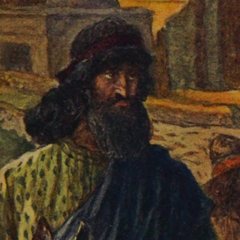 Nehemiah
 Cupbearer to a Persian king. Like Daniel, he fasted and confessed his people's sins as his own before he asked God for anything. “Both I and my father's house have sinned.”
Nehemiah 1:4-11sources
His life, and his words
- The Berean Standard Bible, public domain. Every Bible line on this page outside the section on where the Bible figure quiz places him, except the Greek chapters and 1 Maccabees.
- The World English Bible, British Edition, public domain. Susanna, Bel and the Dragon, the song in the fire, and 1 Maccabees.
- Josephus, Antiquities of the Jews, books 10 and 11. Tr. William Whiston, 1737.
- 1 Clement, chapter 45. Tr. Alexander Roberts and James Donaldson. Ante-Nicene Fathers, volume 1, 1885.
- Origen, Letter to Africanus. Tr. Frederick Crombie. Ante-Nicene Fathers, volume 4.
- Cyril of Jerusalem, Catechetical Lectures, Lecture 16. Tr. Edwin Hamilton Gifford. Nicene and Post-Nicene Fathers, second series, volume 7.
- Ambrose, On the Duties of the Clergy, book 1. Tr. H. de Romestin. Nicene and Post-Nicene Fathers, second series, volume 10.
- Jerome, Commentary on Daniel. Tr. Gleason L. Archer, 1958, transcribed by Roger Pearse and in the public domain.
- Benjamin of Tudela, The Itinerary. Tr. Marcus Nathan Adler, 1907.
Reference
- Catholic Encyclopedia, 1908, “Daniel”
- Catholic Encyclopedia, 1908, “Book of Daniel”
- The 1911 Encyclopaedia Britannica, “Daniel” and “Daniel, Book of”, by John Dyneley Prince and R. H. Charles
- The Book of Common Prayer, The Order for Morning Prayer, at the Church of England
Calendars
- The Roman Martyrology, 1916 edition, 21 July
- OCA, “Prophet Daniel”, 17 December
- Great Synaxaristes, Greek, 17 December
- azbyka.ru, Russian, 30 December, with the troparion
- CopticChurch.net, the Coptic synaxarium, 23 Baramhat
- The Lutheran Church–Missouri Synod, Commemorations
Pictures
- Daniel Interpreting to Belshazzar the Writing on the Wall, Benjamin West, 1775. Saint Louis Art Museum. Public domain.
- Daniel in the Lions' Den, Briton Rivière, 1872. Walker Art Gallery, Liverpool. Public domain. This copy's colours are warmed.
- The Prophet Daniel, Julius Schnorr von Carolsfeld, 1860. Public domain.
- Daniel in the Den of Lions, from Charles Foster's Bible Pictures, Philadelphia, 1897. Public domain.