
Nehemiah
The Persian king's cupbearer who wept for a ruined city. He rode round its broken walls by night, then rebuilt them in 52 days, every builder with a sword at his side.
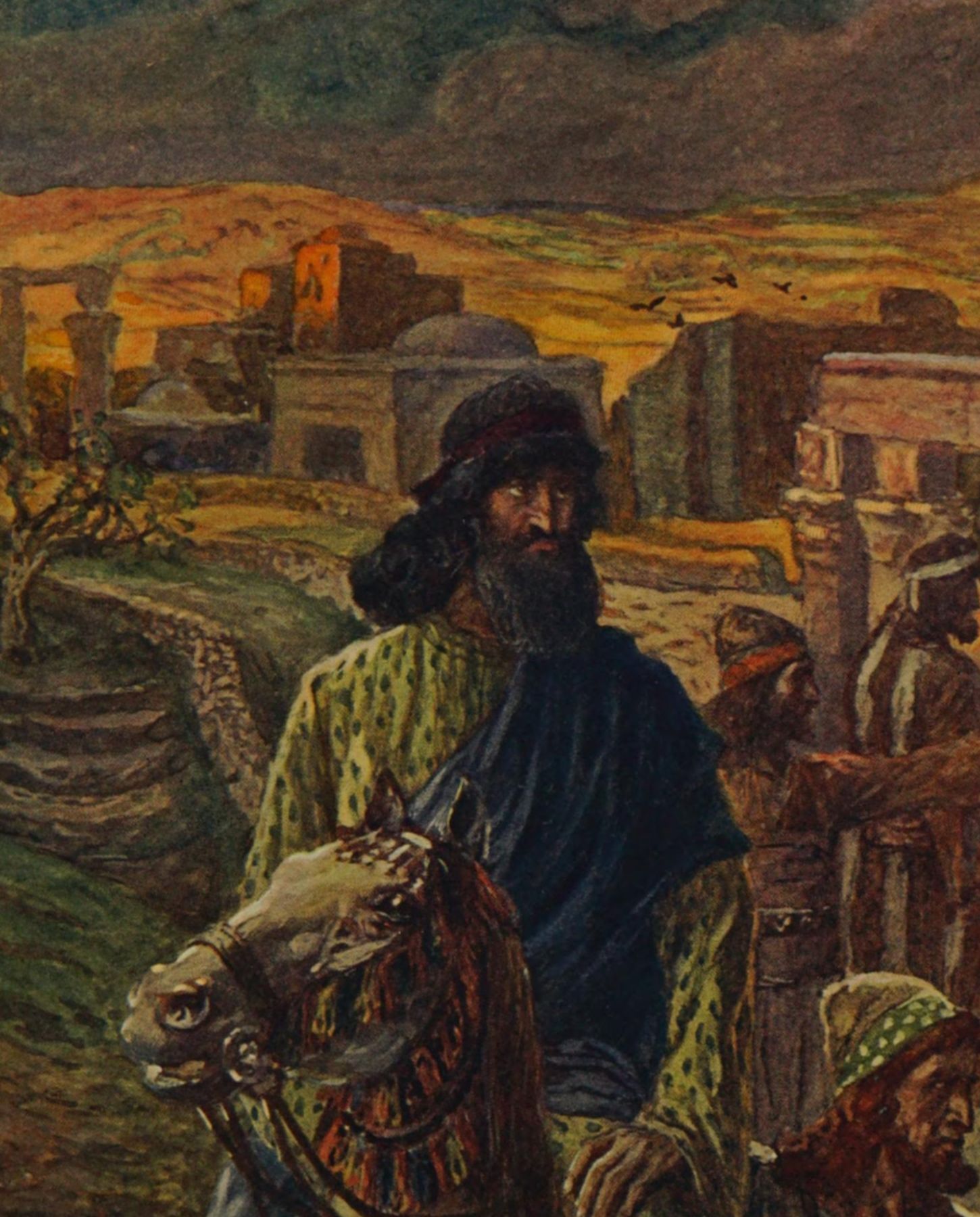
Picture: Nehemiah looks upon the ruins of Jerusalem, a plate after James Tissot, published by de Brunoff, 1904. Public domain.
Who was Nehemiah?
Nehemiah was a Jew at the Persian court, cupbearer to King Artaxerxes. When he heard that Jerusalem's wall lay in ruins, he wept and prayed, then asked the king to send him. As governor of Judah he rebuilt the wall in 52 days, through mockery and plots, and stood beside Ezra when the Law was read.
at a glance
His path, in order
- CupbearerTo the Persian king, at Susa
- BuilderJerusalem's wall, in 52 days
- GovernorOf Judah, for twelve years
- ReformerOn his second stay in Jerusalem
in numbers
- Days to rebuild the wall52
- Finished on the 25th of Elul
- When it was done, his enemies lost heart
- Years as governor12
- He never took the governor's food allowance
- His reason: “because of my fear of God”
- Jews and officials at his table150
- Besides guests from the nations
- One ox and six sheep a day
- Times he prays “Remember me”4
- His book ends on the fourth
- Twice he asks God to remember what his enemies did
did you know?
-
His name means “Yah comforts”.
Strong's Hebrew 5166, at Bible Hub -
Chapter 3 of his book walks right round the city, gate by gate. It names ten gates, from the Sheep Gate back to the Sheep Gate, and who built each stretch in between.
Nehemiah 3:1-32 -
The book of 2 Maccabees says he founded a library. He gathered “the books about the kings and prophets, and the writings of David”.
2 Maccabees 2:13 -
The Jewish historian Josephus tells his story differently. In his Antiquities the wall takes two years and four months, and the king is Xerxes.
Josephus, Antiquities of the Jews, book 11, chapter 5
- Home
- The citadel of Susa, at the Persian court. His fathers were buried in Jerusalem, “the city where my fathers are buried”.
- Family
- The son of Hacaliah. His brother Hanani brought him the news from Judah.
- Work
- Cupbearer to King Artaxerxes of Persia. Then governor of Judah for twelve years.
- When
- King Artaxerxes' twentieth year: 445 or 444 BC, the date the Orthodox Church in America gives.
- Title
- Tirshatha, in the Hebrew of Nehemiah 8:9 and 10:1: a Persian title for a governor. It may mean “His Excellency”. The King James Version keeps the word.
- His enemies
- Sanballat the Horonite, Tobiah the Ammonite official and Geshem the Arab.
- His book
- The Book of Nehemiah, much of it told by him, as “I”. The Hebrew Bible counts it as one book with Ezra.
- The covenant
- His name heads the list of those who sealed the people's covenant: “Nehemiah the governor, son of Hacaliah”.
- Also called
- Nehemias, in Latin. Older Catholic Bibles call his book the Second Book of Esdras.
- Died
- The Bible does not say. The Jewish historian Josephus says he lived to “a great age”.
- In art
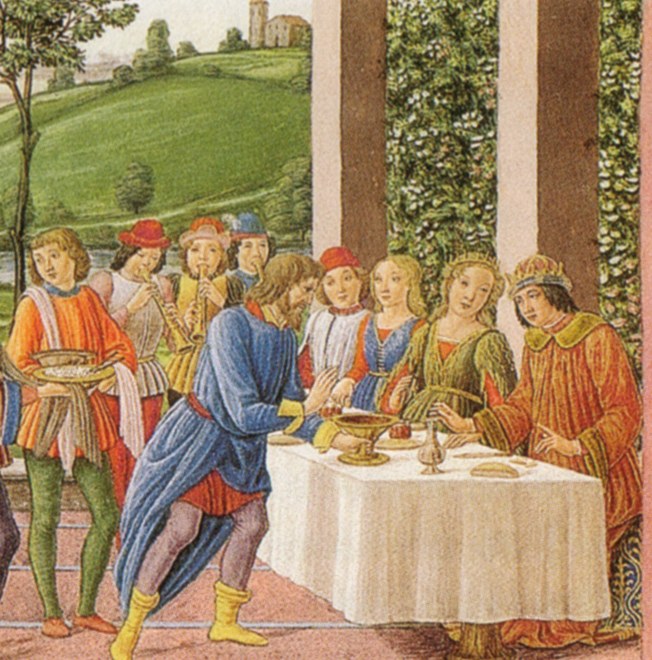
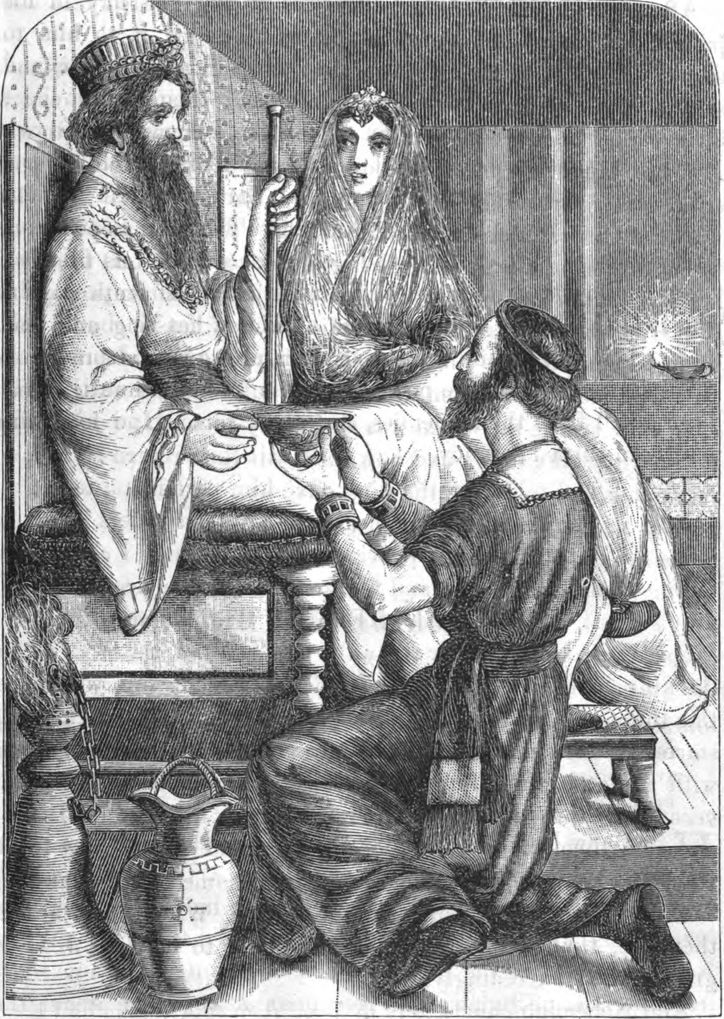
- Most often as the cupbearer, handing the king his cup, as in the Urbino Bible here. Doré engraved his ride round the ruins, and Tissot painted it.
what others said of him
Scripture, his enemies, a Jewish historian and two Latin writers, in their own words.
Also of Nehemiah the memory is great. He raised up for us fallen walls, set up the gates and bars, and rebuilt our houses.
It is reported among the nations—and Geshem agrees—that you and the Jews are plotting to revolt, and this is why you are building the wall. According to these reports, you are to become their king
He was a man of a good and righteous disposition, and very ambitious to make his own nation happy; and he hath left the walls of Jerusalem as an eternal monument for himself.
Ezra and Nehemiah, that is the Lord's helper and His consoler, are united in a single book. They restore the Temple and build up the walls of the city.
But Nehemiah, having stationed guards against those making assaults upon the people, was in no degree alarmed, and carried out what he had begun.
his life in eleven moments
The citadel of Susa
The month of ChislevNews from Jerusalem
Nehemiah served the Persian king in the citadel of Susa. His brother Hanani came with men from Judah, and Nehemiah asked them about the Jews who had survived the exile, and about Jerusalem. They answered: “The wall of Jerusalem is broken down, and its gates have been burned with fire.” When he heard it, he sat down and wept. “I mourned for days, fasting and praying before the God of heaven.” His prayer is further down this page.
Nehemiah 1:1-4The king's table
The month of NisanThe king's cup
Four months after the news came, he was serving wine to King Artaxerxes. He had never been sad in front of the king. Now he was, and the king saw it at once. “Why is your face sad, though you are not ill? This could only be sadness of the heart.” Nehemiah was “overwhelmed with fear”. He said the city of his fathers lay in ruins. “What is your request?” asked the king. “So I prayed to the God of heaven and answered the king.” He asked to be sent to rebuild it. The king, “with the queen seated beside him”, asked how long he would be gone. Nehemiah named a time, and asked for letters and timber too. The king granted it all.
Nehemiah 2:1-8Around the ruins
Three days after he arrivedThe night ride
King Artaxerxes sent army officers and horsemen with him. In Jerusalem he waited three days. Then he went out at night with a few men, and told no one what God had laid on his heart. “The only animal with me was the one on which I was riding.” He rode out by the Valley Gate and looked at the broken walls and the burned gates. At the King's Pool the rubble left no room for his animal to pass. So he went up the valley in the dark and looked at the wall from there. “The officials did not know where I had gone or what I was doing.”
Nehemiah 2:9-16The whole city
The work beginsEvery family a stretch of wall
Nehemiah spoke to the priests, the nobles and the officials. “Come, let us rebuild the wall of Jerusalem, so that we will no longer be a disgrace.” He told them how the hand of God had been on him, and what the king had said. “Let us start rebuilding,” they replied. His book lists who built each part. The high priest and his fellow priests rebuilt the Sheep Gate. Goldsmiths and perfumers took their stretches. Shallum, ruler of a half-district of Jerusalem, built his “with the help of his daughters”. Priests repaired the wall in front of their own houses. Only the nobles of Tekoa “did not put their shoulders to the work”.
Nehemiah 2:17 to 3:32On the wall
Half builtA sword at every side
Nehemiah's enemy Sanballat laughed at the “feeble Jews”. Tobiah, another enemy, joked that a fox could knock their wall down. When the wall reached half its height, they plotted an attack. Nehemiah prayed and set a guard day and night. He placed families behind the low places with swords, spears and bows. “Do not be afraid of them,” he told them. From then on half his men worked and half stood guard. A trumpeter stayed beside him, to call everyone to the place of attack. At night, he writes, “neither I nor my brothers nor my servants nor the guards with me changed out of our clothes”.
Nehemiah 4:1-23A great assembly
In a famineThe cry of the poor
Then a great outcry rose from the people against their own kin. To buy grain in the famine they had mortgaged their fields and vineyards. Some of their daughters were already slaves. Nehemiah was “extremely angry”. He called a large assembly and faced the nobles and officials. “You are exacting usury from your own brothers!” They had nothing to say. He told them to give back the fields, vineyards and houses at once, and they swore to do it. Then he shook out the folds of his robe. “May God likewise shake out of his house and possessions every man who does not keep this promise.” The whole assembly said, “Amen.”
Nehemiah 5:1-13The plain of Ono
The wall almost doneFour invitations and a trap
With only the doors of the gates left to hang, his enemies Sanballat and Geshem asked him to meet them on the plain of Ono. “But they were planning to harm me.” He said no four times. The fifth message came as an open letter, saying he meant to make himself king. “There is nothing to these rumors you are spreading,” he replied. Then a man named Shemaiah told him to hide inside the temple, because killers were coming that night. Nehemiah saw that Tobiah and Sanballat had hired him. “Should a man like me run away?”
Nehemiah 6:1-14Jerusalem
The 25th of ElulFifty-two days
“So the wall was completed in fifty-two days, on the twenty-fifth of Elul.” When the Jews' enemies heard, all the nations around them “were afraid and disheartened, for they realized that this task had been accomplished by our God.” Nehemiah set the doors in the gates and put his brother Hanani in charge of the city. He told the guards not to open the gates each morning “until the sun is hot”.
Nehemiah 6:15 to 7:3The Water Gate
The seventh monthThe Law read aloud
All the people gathered in the square before the Water Gate. Ezra the scribe stood on a high wooden platform and read the Law of Moses aloud, from daybreak until noon. When he opened the book, all the people stood up. The Levites explained it so that all could understand, and the people wept as they heard it. Nehemiah the governor, Ezra and the Levites told them, “This day is holy to the LORD your God. Do not mourn or weep.” They sent them home to feast. Then the city kept the Feast of Booths, in shelters of branches on the rooftops. “From the days of Joshua son of Nun until that day, the Israelites had not celebrated like this.”
Nehemiah 8:1-18On top of the wall
The dedicationTwo choirs on the wall
For the dedication of the wall, the Levites and singers came in from their villages with cymbals, harps and lyres. Nehemiah brought the leaders of Judah up onto the wall and set two great choirs of thanksgiving on it. One went to the right, with Ezra leading. Nehemiah followed the other to the left. The two met in the house of God. “The women and children also rejoiced, so that the joy of Jerusalem was heard from afar.”
Nehemiah 12:27-43The temple courts
His second stayTobiah's room
In the king's thirty-second year Nehemiah went back to Artaxerxes. When he returned to Jerusalem, he found that a priest had given his enemy Tobiah a large room in the temple courts, where the offerings used to be kept. “I was greatly displeased and threw all of Tobiah’s household goods out of the room.” The Levites had gone home to their fields, unpaid, and he brought them back. He shut the city gates for the Sabbath and warned off the traders camped outside the wall. He found men married to women of Ashdod, Ammon and Moab. Their children could not speak the language of Judah. He rebuked them, beat some and pulled out their hair.
Nehemiah 13:4-28
his miracles
His own book tells no miracle. 2 Maccabees, a book in Catholic and Orthodox Bibles, tells one from his time. It comes in a letter from the Jews of Jerusalem to the Jews in Egypt.
remember the fire which was given when Nehemiah offered sacrifices, after he had built both the temple and the altar
Fire from a dry well
Before the exile, says a letter in 2 Maccabees, godly priests hid some of the altar's fire in a dry well. Years later Nehemiah sent their descendants to find it. They found no fire, only a thick liquid. He had the priests sprinkle it on the wood and the sacrifice. Then they waited.
“and the sun shone out, which before was hidden with clouds, a great blaze was kindled, so that all men marveled.”2 Maccabees 1:19-22
A flame on the stones
The priests prayed while the sacrifice burned. Then Nehemiah had the rest of the thick liquid from the well poured on large stones. The king of Persia heard of it, fenced the place off and made it holy. Nehemiah's men called the liquid Nephthar, which means “Cleansing”.
“When this was done, a flame was kindled; but when the light from the altar shone back, it went out.”2 Maccabees 1:23-36
his words
Much of his book is told in his own voice, as “I”. Outside the section on where the Bible figure quiz places him, Bible lines on this page are from the Berean Standard Bible. Sirach and 2 Maccabees, which it does not include, are from the World English Bible.
When his enemies asked him to come down and talk
I am doing a great work and cannot come down. Why should the work stop while I leave it to go down to you?
Sanballat and Geshem wanted to meet him on the plain of Ono. Four times they sent, and four times he gave this answer.
Nehemiah 6:2-4Why should I not be sad when the city where my fathers are buried lies in ruins, and its gates have been destroyed by fire?
The God of heaven is the One Who will grant us success. We, His servants, will start rebuilding, but you have no portion, right, or claim in Jerusalem.
Do not be afraid of them. Remember the Lord, Who is great and awesome, and fight for your brothers, your sons and your daughters, your wives and your homes.
What you are doing is not right. Shouldn’t you walk in the fear of our God to avoid the reproach of our foreign enemies?
Should a man like me run away? Should one like me go into the temple to save his own life? I will not go!
Go and eat what is rich, drink what is sweet, and send out portions to those who have nothing prepared, since today is holy to our Lord. Do not grieve, for the joy of the LORD is your strength.
often misquoted
The builders worked with a trowel in one hand and a sword in the other.
What the sources sayNehemiah 4 tells of three groups. Half of his own men stood guard with spears, shields and bows. Those who carried loads “worked with one hand and held a weapon with the other.” The builders needed both hands, so each worked “with his sword strapped at his side.” No trowel is named. The Jewish historian Josephus tells it the same way: “the mason had his sword on, as well as he that brought the materials”.
Nehemiah 4:16-18; Josephus, Antiquities of the Jews, book 11, chapter 5Nehemiah rebuilt the Temple.
What the sources sayHis own book is about the wall and its gates. According to the Book of Ezra, the Temple had been finished long before, “in the sixth year of the reign of King Darius.” Two later writers say more. 2 Maccabees speaks of the fire given when Nehemiah sacrificed, “after he had built both the temple and the altar”. In Josephus he asks the king for leave “to finish the building of the temple”.
Ezra 6:15; 2 Maccabees 1:18; Josephus, Antiquities of the Jews, book 11, chapter 5His Catholic feast day is 13 July.
What the sources sayA German dictionary of saints of 1875 does list him under 13 July, but only to say he has no feast. Under that date, the Bollandists, the Jesuit editors of the lives of the saints, passed Nehemiah over, because he was not venerated. The Roman Martyrology of 1916 has no entry for him, and neither does its 2004 edition. In both, 13 July is the day of Ezra.
Vollständiges Heiligen-Lexikon, volume 4, 1875, “Neemias”; the Roman Martyrology, 1916 and 2004friends, family and rivals
One of his brothers. He brought the news that the wall was down. Later Nehemiah put him in charge of Jerusalem.
Nehemiah 1:2; 7:2The Persian king he served. He noticed Nehemiah's sad face, and gave him leave, letters, timber and an escort. He made him governor of Judah.
Nehemiah 2:1-9; 5:14The priest and scribe who read the Law to the people at the Water Gate, with Nehemiah the governor beside him. At the dedication he led one of the two choirs along the wall.
Nehemiah 8:1-9; 12:36Commander of the fortress in Jerusalem. Nehemiah put him in charge of Jerusalem with Hanani, “because he was a faithful man who feared God more than most.”
Nehemiah 7:2His chief enemy. He mocked the builders, plotted an attack and spread the rumour that Nehemiah meant to be king. A grandson of the high priest married his daughter, and Nehemiah drove the young man away.
Nehemiah 4:1-8; 6:5-7; 13:28Sanballat's ally, with friends among the nobles of Judah. He wrote letters to frighten Nehemiah. Later he moved into a room in the temple, until Nehemiah threw his things out.
Nehemiah 4:3; 6:17-19; 13:4-8The third of his enemies. He joined the mocking, and Sanballat's open letter named him as the source of the rumour of revolt.
Nehemiah 2:19; 6:6A prophet hired by Tobiah and Sanballat. He urged Nehemiah to hide in the temple, so that he would sin and lose his good name.
Nehemiah 6:10-13how his story ends
The Bible does not say how or when he died. His book simply stops, on a prayer.
His book ends on his second stay in Jerusalem. He set the priests and Levites to their duties, and arranged for wood for the altar and for the firstfruits. Then he wrote his last line.
The Jewish historian Josephus, writing in about AD 93, gives the only account of his end: “he came to a great age, and then died.”
The last words of his book
Remember me, O my God, with favor.
The fourth time he asks God to remember him. The first came after his twelve years as governor: “Remember me favorably, O my God, for all that I have done for this people.”
is he a saint?
The Orthodox honour him as a saint, the Prophet Nehemiah, on the Sunday of the Holy Forefathers. He has no day in the Catholic calendar, and Protestant churches keep none.
- OrthodoxProphetSunday of the Forefathers, in December
- CatholicNo feast dayNot in the Roman Martyrology
- ProtestantNo feast dayHis prayer is read on a Lutheran day of penitence
The Orthodox Church in America lists the Prophet Nehemiah on the Sunday of the Holy Forefathers, the Sunday between 11 and 17 December. The Russian calendar Azbuka Very keeps him on the same Sunday, so his day moves each year.
Ambrose of Milan calls him “holy Nehemiah”. The Roman Martyrology gives him no day, in its 1916 edition or its 2004 one.
Lutherans of the Evangelical Lutheran Church in America read his prayer from Nehemiah 1 on their Day of Penitence.
his prayer in susa
When the news came that Jerusalem's wall lay in ruins, he wept, fasted and prayed for days. His prayer confesses the sins of Israel, his own family's among them. It holds God to His promise to Moses to gather the scattered. It ends with a request about the king:
O Lord, may Your ear be attentive to my prayer and to the prayers of Your servants who delight to revere Your name. Give Your servant success this day, I pray, and grant him mercy in the sight of this man.
what to read first
Nehemiah 1 and 2
The Book of Nehemiah
The news from Jerusalem, the king's cup and the night ride.
Read it freeNehemiah 4 to 6
The Book of Nehemiah
The wall built under threat, the cry of the poor, and the plots against him.
Read it freeNehemiah 8
The Book of Nehemiah
Ezra reads the Law at the Water Gate, and the city keeps the Feast of Booths.
Read it freeNehemiah 13
The Book of Nehemiah
His second stay, and the last of his prayers for God to remember him.
Read it freewhere the quiz places him
The record, drawn
Each arm is one axis; length is how far from the centre the recorded acts sit. An axis the text does not place Nehemiah on has no arm.
In the quiz's own words
Confronts, plans ahead, out in front
The six axes
Your answers are marked. From your result on . See your result
In the hatched middle the quiz names neither pole.
The moments behind each axis
Each line is one recorded act and the reference it is taken from. The sentence says what the person did; where it is in quotation marks it is verbatim from the World English Bible British Edition. An act listed here is evidence of how this person moved, not approval of it; read the passage for how it was received. On 1 the text shows both ends and they do not settle, so that axis is left out too — the acts for each end are printed under it.
Pace Acts first ↔ Weighs first
takes time to decide
-
Nehemiah 1:4 toward Weighs first
On hearing about the wall he sat down, wept and mourned for several days before doing anything.
-
Nehemiah 2:11-15 toward Weighs first
He was in Jerusalem three days, then rode out at night to inspect the broken walls before saying a word about his plan.
Voice Says it ↔ Holds it
recorded at both ends
The text shows both ends. The recorded acts go one way and the other and do not settle, so this axis is left out when a reader is matched rather than counted as a position in the middle. Both ends are below.
Toward Says it
-
Nehemiah 5:7 toward Says it
He called a great assembly and charged the nobles and rulers with usury in front of it.
Toward Holds it
-
Nehemiah 2:12 toward Holds it
He kept his intention for Jerusalem to himself while he surveyed the ground.
I didn’t tell anyone what my God put into my heart to do for Jerusalem
-
Nehemiah 2:16 toward Holds it
The rulers, priests, nobles and workers were still not told where he had been or what he had done.
Lead Out in front ↔ Alongside
out in front
-
Nehemiah 4:13-14 toward Out in front
He stationed the people by family with swords, spears and bows and addressed the nobles, rulers and the rest himself.
-
Nehemiah 4:16-18 toward Out in front
He split his servants between the work and the weapons and kept the trumpeter beside him.
Conflict Confronts ↔ Reconciles
confronts
-
Nehemiah 5:7 toward Confronts
He contended with the nobles and rulers over what they were charging their brothers.
-
Nehemiah 13:25 toward Confronts
He contended with the men who had married foreign wives and struck some of them.
I contended with them, cursed them, struck certain of them, plucked off their hair
-
Nehemiah 6:3 toward Confronts
He sent messengers to say he was doing a great work and could not come down.
Reasons Asks why ↔ Takes it on trust
quick to question
-
Nehemiah 1:2 toward Asks why
He questioned the men who came from Judah about the survivors and about Jerusalem before acting.
-
Nehemiah 2:20 toward Takes it on trust
He answered the opposition by saying that they, the servants of God, would arise and build.
Plans Plans ahead ↔ Meets the day
plans ahead
-
Nehemiah 2:6-8 toward Plans ahead
He set the king a return date and asked in advance for letters to the governors and timber from the king's forest.
-
Nehemiah 4:16 toward Plans ahead
He arranged the work so half the men built while half stood armed.
Nearest on the map
Distance between two sets of coordinates across every axis, on the same scale a reader's answers are measured on. No number is shown against a person, and nearness is not likeness: two people can land in the same band for different reasons.
Suggest a correction. Corrections that are applied are recorded in the public changelog.
 Quiz Who in the Bible are you most like? Answer eighteen plain statements about you, none of them about the Bible, and see how near you land to Nehemiah. Start
  Quiz Christian Personality Test Which of eight types are you? Find your own. Start
 people like him
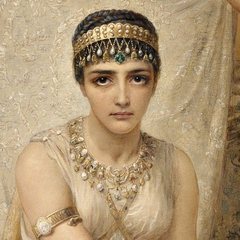 Esther
 Another Jew at the Persian court in the citadel of Susa. She too went before the king for her people: “And if I perish, I perish!”
Esther 1:2; 4:16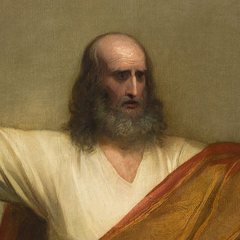 Daniel
 A Jew who served foreign kings. He prayed three times a day at windows that “opened toward Jerusalem”.
Daniel 6:10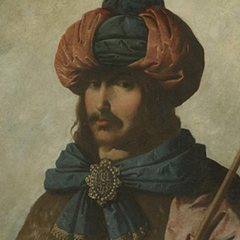 Joseph
 A Hebrew raised high in a foreign court, who used it to save his people: “God sent me before you to preserve you as a remnant on the earth”.
Genesis 45:7sources
His life, and his words
- The Berean Standard Bible, public domain. Every Bible line on this page outside the section on where the Bible figure quiz places him, apart from Sirach and 2 Maccabees.
- The World English Bible, public domain. Sirach 49 and 2 Maccabees 1 and 2.
- Josephus, Antiquities of the Jews, book 11, chapter 5. Tr. William Whiston, 1737.
- Jerome, Letter 53, to Paulinus. Tr. W. H. Fremantle, G. Lewis and W. G. Martley. Nicene and Post-Nicene Fathers, second series, volume 6, 1893.
- Sulpicius Severus, Sacred History, Book 2. Tr. Alexander Roberts. Nicene and Post-Nicene Fathers, second series, volume 11.
- Ambrose, On the Duties of the Clergy, Book 3. Tr. H. de Romestin, E. de Romestin and H. T. F. Duckworth. Nicene and Post-Nicene Fathers, second series, volume 10, 1896.
Reference
- Catholic Encyclopedia, 1911, “Book of Nehemiah”, by A. Van Hoonacker
- Bible Hub, Strong's Hebrew 5166, for the meaning of his name
- Bible Hub, Strong's Hebrew 8660, for the title Tirshatha
- Vollständiges Heiligen-Lexikon, volume 4, 1875, “Neemias”, on the Bollandists and 13 July
Calendars
- OCA, “Prophet Nehemiah”
- OCA, the saints of the Sunday of the Forefathers, 2026
- Azbuka Very, “Nehemiah, leader of the Jews”, in Russian
- The Roman Martyrology, 1916 edition
- GCatholic, the Roman Martyrology of 2004, July, with Ezra on 13 July
- Evangelical Lutheran Worship, the church year, final draft, 2006: the Day of Penitence
Pictures
- Nehemiah looks upon the ruins of Jerusalem, after James Tissot. The Old Testament, volume 2, M. de Brunoff, Paris, 1904. Public domain.
- Nehemiah at the court of Artaxerxes, attributed to Davide Ghirlandaio. The Bible of Federico da Montefeltro, Vatican Library, Urb. lat. 1. Public domain.
- Nehemiah the cup bearer, an engraving in The Story of the Bible from Genesis to Revelation, 1873. Public domain.