
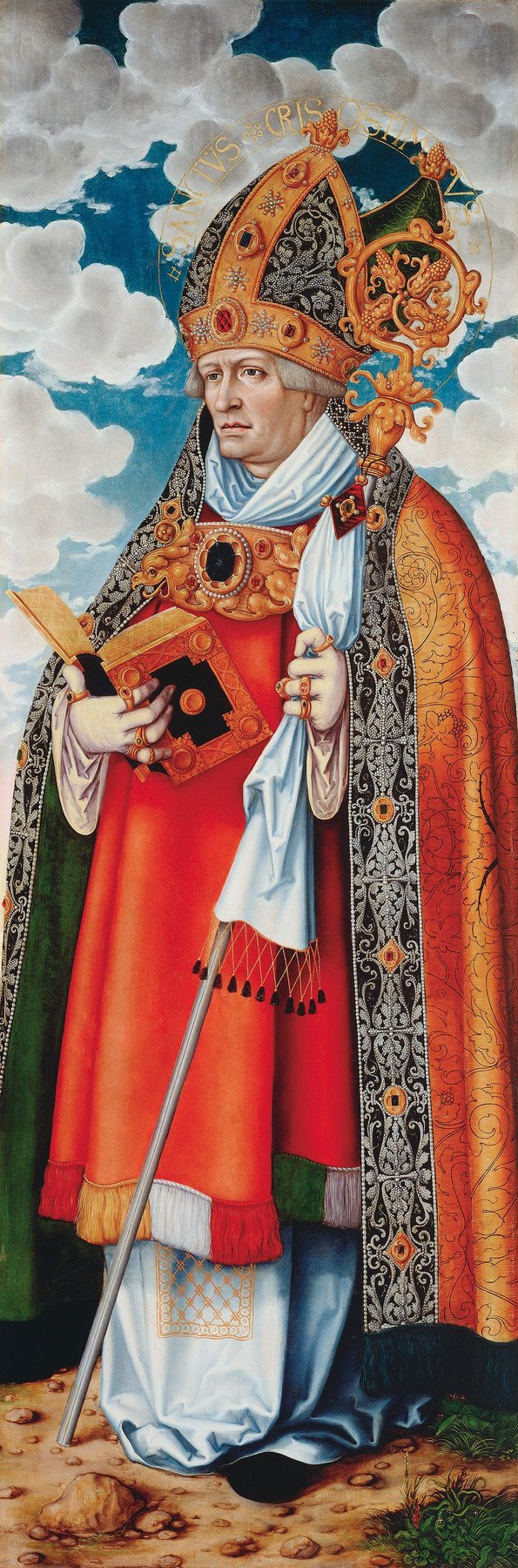
John Chrysostom
The preacher known as Golden Mouth, who told the rich that the poor had a claim on their money and died in exile.
Picture: Saint John Chrysostom, from the Magdalen Altar, workshop of Lucas Cranach the Elder, about 1520-1525. Bavarian State Painting Collections. Public domain.
Who was John?
John was a preacher at Antioch, and then archbishop of Constantinople. His sermons later earned him the name Chrysostom, “golden-mouthed”. He told the rich that the poor had a claim on their money. He angered the empress, was exiled twice, and died on a forced march. More of his writings survive than of any other Greek Father.
at a glance
His path, in order
- MonkFour years with a hermit, two alone in a cave
- DeaconAt Antioch, from 381
- PriestPreaching at Antioch, 386 to 398
- ArchbishopOf Constantinople, from 398
- ExileSent away in 404, died on the road in 407
in numbers
- Sermons that survive600
- About that many, counting commentaries
- 90 on Matthew alone
- Widows and virgins Antioch's church helped daily3k
- The church's income was that of one of the less wealthy rich men
- If ten rich men did as much, he said, no one would be poor
- Letters to Olympias17
- To his closest friend, from exile
- About 240 of his letters survive
- Times he was exiled2
- 403, called back within days
- 404, never came back
did you know?
-
Some people in his day called another bishop Chrysostom for his fine voice: Antiochus of Ptolemais. In 404 Antiochus was one of four bishops who pressed the emperor to drive John out.
Sozomen, Church History, Book 8, chapter 10; Palladius, Dialogue, chapter 10 -
Crowds at Constantinople pushed so hard to hear him that people were in danger. So he sat on the readers' platform, in among them, and taught from there.
Sozomen, Church History, Book 8, chapter 5 -
Some parents in his day lit lamps, gave each a name, and picked the name of the one that burned longest, for a long life. He wanted children named after the saints instead.
Homilies on First Corinthians, Homily 12
- Born
- About 347, at Antioch in Syria, today Antakya in Turkey.
- Grew up
- In Antioch, raised by his widowed mother Anthusa. He studied rhetoric under Libanius, the most famous pagan orator of the day.
- Died
- 14 September 407, at a martyr's chapel near Comana in Pontus, in today's northern Turkey. He was about 60.
- Buried
- Beside the martyr Basiliscus, at Comana. In 438 his body was brought to the Church of the Holy Apostles in Constantinople. Some relics later went to St Peter's in Rome, and in 2004 Pope John Paul II gave some back to the Patriarch of Constantinople.
- Also called
- Chrysostom, “golden-mouthed”, a name first found in writing in 553. Ioann Zlatoust in Russian. One of the Three Holy Hierarchs.
- Status
- A saint to Catholics, Orthodox and Copts, and a Doctor of the Church to Catholics. Anglicans and Lutherans remember him too.
- Patron of
- Preachers, named by Pope Pius X. Britannica adds orators, education and people with epilepsy.
- In art
- In icons, a bishop with a short dark beard and a high forehead, holding a Gospel book. In the West, a Latin bishop in a mitre.
- Wrote
- More than any other Greek Father: about 600 sermons and commentaries, books such as On the Priesthood, and about 240 letters, nearly all from exile.
- Pronounced
- KRIS-uh-stum. Also kri-SAH-stum.
 The Forge
 His personality type
Serious by nature, and at his best when there is something to do.
In Gregory the Great's terms
- Serious
- Restless mind
Our reading, from the Christian Personality Test. Serious here means he took people and things to heart, not that he was gloomy. The test names him first among the saints of The Forge.
See The Forgefeast days
East and West, side by side
West
- Jan27
The Episcopal Church, and Lutherans in the Missouri Synod. It was the Catholic feast too, from the 13th century until 1969, and it is his day in the 1916 Roman Martyrology.
- Sep13
Catholic memorial since 1969. Also the Church of England and the ELCA.
East
- Jan27
The return of his body to Constantinople in 438. Greek and Russian churches, and the OCA.
- Jan30
The Three Holy Hierarchs, with Basil the Great and Gregory the Theologian. Greek and Russian churches, and the OCA.
- Sep14
The day of his death, kept beside the Feast of the Cross. The Russian Church.
- Nov13
The day of his death, moved from 14 September. Greek and Russian churches, and the OCA.
Why so many dates? He died on 14 September, the Feast of the Cross, so the Greek Church moved him to 13 November. The Russian Church keeps both days. Rome kept 27 January, the day his body came home, until 1969. Then it took 13 September, the day the Syrians keep. Churches on the old calendar keep each Orthodox date 13 days later. The Coptic Church keeps him on 17 Hator, in its own calendar.
what was he like?
+a temper he kept in check
He knew he had a temper. In On the Priesthood his friend Basil protests that John is far from anger. John asks why he wants “to provoke the wild beast when he is tranquil”. His calm came, he said, “not by any innate virtue, but by my love of retirement”. A friend from his youth said he showed “a proneness to irritability, rather than to modesty”.
On the Priesthood, Book 3; Socrates, Church History, Book 6, chapter 3+would not stop saying it
He knew some of his sermons annoyed people, and he preached them anyway: “And I know that I am giving disgust to my hearers. But what must I do? For this I am set, and I shall not cease to say these things, whether anything comes of them or not.” A historian who admired him says he was “naturally disposed to reprehend the misconduct of others”.
Homilies on First Corinthians, Homily 40; Sozomen, Church History, Book 8, chapter 3+ate alone, gave to the poor
As archbishop he cut his own spending and built hospitals, with doctors and cooks. He gave no dinner parties. “I admit that he used to eat alone,” says his friend Palladius. He drank no wine, and he counted money spent on feasts for men of pleasure as sacrilege. His enemies made his eating alone a charge against him.
Palladius, Dialogue, chapters 5 and 12; Socrates, Church History, Book 6, chapter 4+tender with a friend in trouble
From exile he wrote long letters to lift his friend Olympias out of despair: “pray do not deceive me by saying that you have thrown off all despondency”. He begged her to see good doctors, and sent word of a medicine that had cured him.
Letters to Olympias+not above a trick
His friend Basil wanted them to face being made bishops together. When the day came, John hid, and Basil was taken and ordained. Basil came to him in tears, and John laughed: “I laughed for joy, and, seizing his right hand, I forced a kiss on him”. He wrote On the Priesthood to defend the trick.
On the Priesthood, Book 1what others said of him
Palladius, a bishop who stood by him, wrote an account of his life soon after he died. The historians Socrates and Sozomen wrote about a generation later. Not all of it is praise.
It would have been John, had not the Christians taken him from us.
In public teaching he was powerful in reforming the morals of his auditors; but in private conversation he was frequently thought haughty and assuming by those who did not know him.
This most distressing journey took three months; yet the saint among all these annoyances was always the same shining star.
Here is a formidable dead man, who frightens living men, and men in authority too, as bogies frighten children.
his life in seven moments
Antioch
A young manHis mother's plea
His mother was widowed at twenty and raised him alone. His pagan teacher Libanius heard her story and cried out, “Heavens! what women there are amongst the Christians.” When his friend Basil urged John to leave home and share a house with him, she took him into her room. She sat by him on the bed where she had given birth to him, and begged him in tears. “Do not plunge me into a second widowhood,” she said. “Wait for my death.” For the time being, he stayed.
On the Priesthood, Book 1; Letter to a Young WidowThe hills near Antioch
As a monkTwo years in a cave
He went up into the hills to live with an old hermit named Syrus, and stayed four years. Then he lived alone in a cave for two years, hardly sleeping and never lying down. It wrecked his stomach, and the cold harmed his kidneys. He had to come back to the city. His biographer calls his return the Saviour's providence, “for the good of the Church”.
Palladius, Dialogue, chapter 5Antioch
387The statues
Angry at new taxes, a crowd in Antioch pulled down the statues of the emperor Theodosius. The city waited in terror for his revenge. All through that Lent John preached to calm and warn his people. About twenty of those sermons survive. Then Bishop Flavian came back from the capital with the emperor's pardon.
Homilies on the Statues; Catholic EncyclopediaAntioch to Constantinople
398Taken by stealth
The emperor's chamberlain Eutropius wanted John as archbishop of the capital. But the people of Antioch would probably have rioted rather than let him go. So the governor called him to a martyrs' shrine outside the city, put him in a carriage and sent him off under guard. He was consecrated on 26 February 398.
Palladius, Dialogue, chapter 5; Sozomen, Church History, Book 8, chapter 2Constantinople
399A consul at the altar
Eutropius was the emperor's chamberlain, and consul that year. He had tried to end the right of churches to shelter people. Then he fell from power, and ran to the church himself. He clung to the altar while soldiers and people called for his death. The next day John preached over him: “Vanity of vanities, all is vanity.” Eutropius was spared that day. He was caught later, outside the church, and put to death.
Homily 1 on Eutropius, with its introduction; Socrates, Church History, Book 6, chapter 5The Oak, near Chalcedon
403 and 404Deposed twice
Bishop Theophilus of Alexandria gathered bishops at an estate called The Oak. They deposed John for refusing to come before judges who were his open enemies. He was sent away, and called back within days after a disaster in the palace frightened the empress. Months later he spoke against noisy games at her new silver statue, and she took it personally. In 404 the emperor told him to leave his church. John sent back: “I have received this Church from God our Saviour, for the care of the salvation of the people, and I cannot desert it; if, then, this is your will—for the city is yours—thrust me out by force.”
Palladius, Dialogue, chapters 8 and 9; Socrates, Church History, Book 6, chapters 15 to 18; Catholic EncyclopediaCucusus, in Armenia
404 to 407The long road
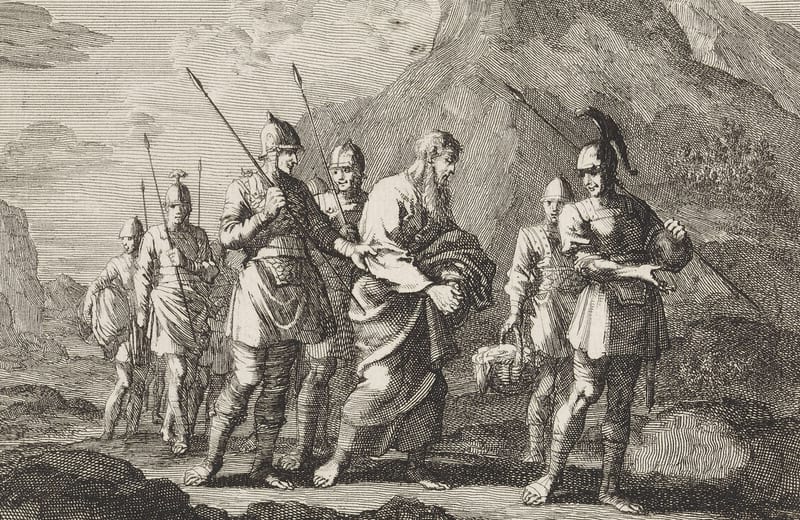
He was sent to Cucusus, a lonely village in Armenia that bandits raided. From there he wrote to friends everywhere, helped the needy and bought back captives. His enemies thought he still had too much influence. So they had him marched towards Pityus, on the far shore of the Black Sea. He died on the way.
Palladius, Dialogue, chapter 11; Sozomen, Church History, Book 8, chapters 27 and 28
signs, as the historians tell them
The early sources credit him with no healings. They tell of signs around him instead, and the historians admit plainly what they could not know.
The earthquake
The night after he was first sent away, says the historian Theodoret, a great earthquake shook the city and terrified the empress. At daybreak envoys went to beg him back, and the people filled the strait with boats and torches to bring him home. His friend Palladius speaks only of a disaster in the palace.
“In the night there was a great earthquake and the empress was struck with terror.”Theodoret, Church History, Book 5, chapter 34
The fire
As he was led away for the last time, a flame broke out from his bishop's throne. It burned the great church, passed over the crowd in the street, and caught the Senate house. His friend Palladius saw the hand of God in it. The fire spared the small building that held the church's treasures, he notes, so no one could say John had stolen them.
“This clearly showed that the marvel was heaven-sent”Palladius, Dialogue, chapter 10
Hail, and the empress
On 30 September 404, hailstones of huge size fell on Constantinople. Four days later the empress Eudoxia died. Bishop Cyrinus, one of John's loudest accusers, had already lost both feet after another bishop trod on one by accident. Many took it all as a judgment.
“These occurrences were by many regarded as indications of Divine wrath on account of the persecution that had been carried on against John.”Sozomen, Church History, Book 8, chapter 27; Socrates, Book 6, chapter 19
The martyr in the night
On the last night of his march he and his guards lodged at the chapel of Basiliscus, a bishop of Comana who died a martyr. That night, says his friend Palladius, the martyr stood beside John and spoke to him. John took it as a sure warning. He died there the next day.
“Be of good cheer, brother; to-morrow we shall be together.”Palladius, Dialogue, chapter 11
Doubted from the start
The historians admit what they could not know. Socrates ends his account of the hail: “God only knows, Who is the discerner of secrets, and the just judge of truth itself. I have simply recorded the reports which were current at that time.” On the fire, he writes that “some of the Johannites set fire to the church”, meaning some of John's own supporters. Sozomen says each side blamed the other.
Socrates, Church History, Book 6, chapters 18 and 19; Sozomen, Book 8, chapter 22his words
He left more writing than any other Greek Father. Most of these lines are from the Nicene and Post-Nicene Fathers, translated in the 1880s.
A sermon at Antioch, about 390
Would you do honor to Christ's body? Neglect Him not when naked; do not while here you honor Him with silken garments, neglect Him perishing without of cold and nakedness.
On how to honour Christ at the Eucharist. A little later he adds: “Do not therefore while adorning His house overlook your brother in distress, for he is more properly a temple than the other.”
Homilies on Matthew, Homily 50Remember constantly that not to share our own riches with the poor is a robbery of the poor, and a depriving them of their livelihood; and that that which we possess is not only our own, but also theirs.
Why, this is what has ruined all, your supposing that the reading of the divine Scriptures appertains to those only, when you need it much more than they.
You both have become one man, one living creature; and do you still say my own? Cursed and abominable word that it is, it was brought in by the devil.
Tempers are wanted, not talking; character, not cleverness; deeds, not words.
Attempt, sir, no such promise, nor order what is holy to be given to the dogs. I will never suffer the worshippers and praisers of the Divine Word to be expelled and their church to be given to them that blaspheme Him.
the hard parts
Some of what he said and did is hard to read today. Here it is plainly, in his words and in his critics'.
Sermons against the Jews
At Antioch, about 387, he preached eight sermons usually called Against the Jews. They attack Judaism and the Jews of his day in the harshest terms. In the first he calls on the prophet Jeremiah, and says of the synagogue, in our translation from the Greek: Where a prostitute stands, that place is a brothel. Or rather, the synagogue is not only a brothel and a theatre. It is also a den of robbers and a lair of wild beasts.
Against the Jews, Homily 1, in Greek. Our translationWhom he was aiming at
In the sermons Against the Jews, he says whom he means: members of his own church drawn to the synagogue. In our translation: Many of those ranked with us, who say they think as we do, go to watch the feasts. Others even keep the feasts with them and share their fasts. It is this evil habit I want to drive out of the Church now. The scholarly English translation, by Paul W. Harkins (1979), is titled Discourses against Judaizing Christians.
Against the Jews, Homily 1, in Greek. Our translation; Roger PearseWhat his critics say
Britannica says he spoke “with a degree of vitriol and abhorrence against Jews that was unusual even among his peers”. It gives both sides in one line: “Although some scholars assert that it is anachronistic to apply a modern understanding of antisemitism to a figure from the 4th century, his language is certainly hateful and unambiguous.” In our own time antisemites have posted his sermons against the Jews online “as a justification for current anti-Semitism”, as Paul Halsall of Fordham University found.
Britannica; Roger Pearse, quoting Paul HalsallTemples torn down
As archbishop he sent bands of monks, armed with orders from the emperor, to pull down the pagan temples still standing in Phoenicia. He paid the workmen with gifts from rich Christian women, not with public money. The historian Theodoret tells it as praise.
“John got together certain monks who were fired with divine zeal, armed them with imperial edicts and dispatched them against the idols' shrines.”Theodoret, Church History, Book 5, chapter 29
Slavery
He said slavery came into the world as “the penalty of sin”, and that when Christ came, “He put an end also to this”. Yet he said a household might keep one slave, or two at most. If the rich bought more out of kindness, he said, they should teach them a trade and set them free.
“when you have purchased them and have taught them trades whereby to support themselves, let them go free.”Homilies on First Corinthians, Homily 40
often misquoted
He who is not angry when he has cause, sins.
What the sources sayNot his. It comes from the Opus Imperfectum, a commentary on Matthew long printed with his works. Its fifth-century author was an Arian, who held that the Son of God was created. Aquinas quotes it as Chrysostom's in his Summa. New Advent's edition marks it “falsely ascribed to St. John Chrysostom”.
Summa Theologiae, Part II-II, question 158; Catholic EncyclopediaIf you cannot find Christ in the beggar at the church door, you will not find Him in the chalice.
What the sources sayThese words are not in his sermons as translated in the 1880s. The idea is his, in Homily 50 on Matthew, quoted above: “Neglect Him not when naked”.
Homilies on Matthew, Homily 50The road to hell is paved with the skulls of priests.
What the sources sayNo such line is in his sermons as translated in the 1880s. What he did say is milder: “I do not think there are many among Bishops that will be saved, but many more that perish”.
Homilies on Acts, Homily 3He began a sermon against the empress: Again Herodias raves; again she is troubled; she dances again.
What the sources sayThe historians Socrates and Sozomen report that he did. In the Gospels, Herodias wanted John the Baptist dead. The line likened the empress to her. But the sermon that survives with those words is not thought to be his. The church historian Philip Schaff calls it “unworthy of his pen”. He thinks John probably said something about the empress that his enemies could read that way.
Socrates, Church History, Book 6, chapter 18; Mark 6:19; Schaff, 1889He wrote the Divine Liturgy of St John Chrysostom.
What the sources sayThe Liturgy most used in Orthodox churches bears his name, but how much of it is his is disputed. The Orthodox Church in America says he “compiled a Liturgy”. The Catholic Encyclopedia says he “perhaps modified, but did not compose the ancient text”. Britannica calls the evidence unconvincing. It adds that the Prayer of St Chrysostom in the Book of Common Prayer is taken from this Liturgy, “hence the attribution of the prayer”.
OCA; Catholic Encyclopedia; BritannicaHe studied at Athens with his friend St Basil the Great.
What the sources sayHis friend Basil was a different Basil. Basil the Great was eighteen years older. The historian Socrates took the two for one man. Some Greek and Coptic lives of the saints today send John to school at Athens beside Basil. The early accounts put his schooling at Antioch, under the orator Libanius.
Socrates, Church History, Book 6, chapter 3, with the NPNF noteAfter a sin with an emperor's daughter, he wandered in the wilderness as a penitent.
What the sources sayA later legend, engraved by Dürer and by Cranach. None of the early accounts tell it: not Palladius, Socrates, Sozomen or Theodoret.
Art Institute of Chicago, on Cranach's Penitence of Saint John Chrysostomwhere he stood
Each line is John’s own, from his sermons, letters and books. TapClick “Show his line” to read it.
Your answers are next to his. From your result on . See your result
“A good hearty laugh is good for the soul.”
John strongly disagrees.
You
Show his line
For this is not the theatre for laughter, neither did we come together for this intent, that we may give way to immoderate mirth, but that we may groan, and by this groaning inherit a kingdom.Homilies on Matthew, Homily 6
“Most of the time, it's better to say less.”
John agrees.
You
Show his line
Let there not be one idle word; for from idle words we fall also into foul words.Homilies on Ephesians, Homily 17
“Wisdom is worth learning from anyone, even people who don't share your faith.”
John strongly disagrees.
You
On record in Homilies on First Corinthians. Not quoted here.
“Anger at real wrongdoing can be a good thing.”
John strongly agrees.
You
Show his line
What then is the proper time for anger? When we are not avenging ourselves, but checking others in their lawless freaks, or forcing them to attend in their negligence.Homilies on Matthew, Homily 16
“If you had to choose, you'd grow closer to God alone in quiet than among other people.”
John strongly disagrees.
You
Show his line
For the man who sits at the helm in harbor, does not yet give any certain proof of his art.On the Priesthood, Book 6
“If someone you know is doing wrong, it's your job to tell them.”
John strongly agrees.
You
Show his line
And make me not this cold reply. What matters it to me? I have nothing in common with him.Homilies on the Statues, Homily 1
“Even if you believe you'll see them again, it's right to weep openly for someone you've lost.”
John strongly disagrees.
You
Show his line
But you, who expectest a resurrection, on what account do you lament? To lament then is the part of those who have no hope.Homilies on First Thessalonians, Homily 6
“Lying can be the right thing to do if it protects someone.”
John strongly agrees.
You
Show his line
For the daughter of Saul would not have been able to rescue her husband out of Saul's hands except by deceiving her father.On the Priesthood, Book 1
“Giving to the poor isn't generosity. It's paying back what's already theirs.”
John strongly agrees.
You
Show his line
Not sharing our own goods with the poor is robbing the poor and taking away their life. What we hold on to is not ours, but theirs.Sermons on Lazarus and the Rich Man, Sermon 2. Our translation
“Nature can teach you as much about God as the Bible can.”
John agrees.
You
On record in Homilies on the Statues. Not quoted here.
“Your body is a friend to look after, not an enemy to fight.”
John strongly agrees.
You
Show his line
Wherefore I beseech you dear lady, and entreat you as a very great favour to pay great attention to the restoration of your bodily health.A letter to Olympias, from exile
“Miracles still happen today, just as they did in the Bible.”
John strongly disagrees.
You
Show his line
It follows that by how much the more evident and overpowering the course of events, by so much is the part of faith abridged. For this reason miracles are not done now.Homilies on First Corinthians, Homily 6
“Some questions about God are better left alone.”
John strongly agrees.
You
Show his line
Questioning is the subversion of faith. For he that seeks has not yet found.Homilies on First Timothy, Homily 1
“In many Bible stories, the deeper meaning matters more than the history.”
John disagrees.
You
On record in the Commentary on Galatians. Not quoted here.
“If you believe God is calling you, follow, even if your family begs you not to.”
John strongly agrees.
You
On record in Homilies on Matthew. Not quoted here.
“A church should keep out people who openly live in serious wrongdoing.”
John strongly agrees.
You
Show his line
I would give up my life rather than impart of the Lord's blood to the unworthy; and will shed my own blood rather than impart of such awful blood contrary to what is meet.Homilies on Matthew, Homily 82
“A Christian can fight in a just war with a clear conscience.”
John agrees.
You
Show his line
The excuse cannot be founded in reason. For Cornelius was a centurion, yet in no way did the soldier's belt impair his strict rule of life.Homilies on First Corinthians, Homily 5
“In the end, God will save everyone.”
John strongly disagrees.
You
Show his line
How then is that temporary which is everlasting?Homilies on Second Thessalonians, Homily 3
See where you stand beside him. Take the quiz
friends, family and rivals
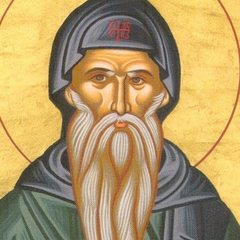 John Cassian
 Ordained by John at Constantinople, and loyal to him all his life. He called John “a marvel of faith and purity”.
Cassian, On the Incarnation of the Lord, Book 7, chapter 31The great pagan orator who taught him rhetoric. He admired John's mother, and on his deathbed named John as the heir he had lost.
Sozomen, Church History, Book 8, chapter 2The bishop who noticed John as a bright young man and kept him close. He baptised him, made him a reader, and later a deacon.
Palladius, Dialogue, chapter 5A rich widow and deaconess of Constantinople, and his closest friend. Seventeen of his letters to her survive. After his fall she was put on trial and would not give way.
Sozomen, Church History, Book 8, chapter 24Bishop of Rome. He tried to get John a fair hearing, and his envoys were sent home in disgrace. The West would not share communion with John's enemies until John's name was added to the roll of departed bishops.
Sozomen, Book 8, chapter 28; Theodoret, Book 5, chapter 34He opposed making John bishop, but had to consecrate him. Five years later he led the Synod of the Oak that deposed him.
Palladius, Dialogue, chapters 5 and 8At first she backed him: she paid for the silver crosses carried in his night processions. Then she took his sermons against luxury as aimed at her, and pressed for both his exiles.
Socrates, Church History, Book 6, chapters 8, 15 and 18A bishop from Cyprus who came to the capital to condemn the books of Origen, a Christian writer dead nearly two hundred years. He turned against John. As he left, he is said to have told John, “I hope that you will not die a bishop”. John is said to have replied, “Expect not to arrive at your own country.” The historian Socrates adds: “I cannot be sure that those who reported these things to me spoke the truth”. Epiphanius died at sea on the way home.
Socrates, Church History, Book 6, chapter 14how he died
He died on the road into a harsher exile, on 14 September 407, at a martyr's chapel near Comana in Pontus.
Soldiers marched him for three months towards Pityus, at the far edge of the empire. One guard was kind to him in secret. The other marched him through pouring rain and hot sun, hoping he would die.
Near Comana they spent the night at the chapel of the martyr Basiliscus. In the morning John begged them to wait. They set off anyway, but he fell so ill that they turned back.
At the chapel he asked for white clothes, and changed everything down to his shoes. He gave the rest away. He received Communion and prayed his usual words. At the last Amen he signed himself with the cross, and died.
He was buried beside Basiliscus. So many monks and virgins came from Syria, Cilicia, Pontus and Armenia that people thought they had been sent for.
Leaving his church for the last time
I see that the things concerning me have an end; I have finished my course and perhaps you will see my face no more.
To Olympias and three other women of his church, in the baptistery. He is echoing Paul.
His last words
Glory to God for all things
His “customary formula”, says his friend Palladius. Then he signed himself with the cross at the last Amen.
is he a saint?
Yes. Catholics, Orthodox and Copts count him a saint, and Anglicans and Lutherans remember him too.
- CatholicSaint and Doctor of the ChurchA memorial on 13 September
- OrthodoxSaintOne of the Three Holy Hierarchs
- CopticSaintOn 17 Hator, in its own calendar
- AnglicanRememberedA Lesser Festival in the Church of England. Also the Episcopal Church
- LutheranRememberedMissouri Synod and ELCA
He died deposed, and out of favour at court. The bishops of the West would not share communion with his enemies until his name was added to the roll of departed bishops. In 438 the emperor Theodosius the Younger, son of the empress who had exiled him, brought his body home. He laid his head against the coffin and prayed for pardon for his parents.
John the glory of the Episcopate of Constantinople, whose holy life obtained the reward of martyrdom without any show of Gentile persecution
At Constantinople, St. John, bishop, who was surnamed Chrysostom, on account of his golden flow of eloquence. He greatly promoted the interests of the Christian religion by his preaching and exemplary life, and after many toils, closed his life in banishment.
what to read first
On the Priesthood
John Chrysostom
A dialogue with his friend Basil, after John tricked Basil into being made a bishop. Funny at the start, searching after that. Jerome says it was the one book of John's he had read.
Read it freeThe Dialogue on the Life of St John Chrysostom
Palladius
Written by a bishop who stood by him, soon after he died. The best account of his fall and his death.
Read it freeLetters to Olympias
John Chrysostom
Letters from exile to his closest friend. The man behind the pulpit.
Read them freeFour Discourses on the Rich Man and Lazarus
John Chrysostom
His sermons on the rich and the poor, with his most quoted line.
Read them freetake the quizzes
 Quiz Which early Christian thinks like you? And which would argue with you? See where you stand beside John. Start
  Quiz Christian Personality Test John reads as The Forge. Find your own type. Start
 people like him
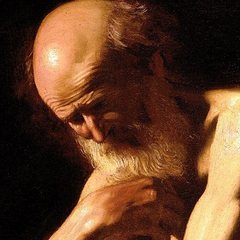 JeromeThe Forge
 The great translator of the Bible was a fighter by his own account. He wrote that in an argument he threw himself into the thick of it.
Jerome, Letter 48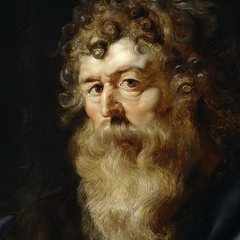 Paul the ApostleThe Forge
 The church in Jerusalem was still afraid of Saul, later called Paul. Barnabas, the “Son of Encouragement”, brought him to the apostles. Later the two fell out over young Mark, who had once left them. Barnabas wanted to give him a second chance. Paul would not. “Their disagreement was so sharp that they parted company.” John himself said of the two: “the one was more tender and indulgent, but this one more strict and austere”.
Acts 4:36; 9:27; 15:36-40; St John Chrysostom, Homilies on Actssources
His life, and his words
- Palladius, Dialogue on the Life of St John Chrysostom. Tr. Herbert Moore, 1921.
- Socrates, Church History, Book 6. Tr. A. C. Zenos, 1890.
- Socrates, Church History, Book 7. Same edition.
- Sozomen, Church History, Book 8. Tr. Chester D. Hartranft, 1890.
- Theodoret, Church History, Book 5. Tr. Blomfield Jackson, 1892.
- John Cassian, On the Incarnation of the Lord, Book 7. Tr. C. S. Gibson, 1894.
- On the Priesthood. Tr. W. R. W. Stephens, 1889.
- Letter to a Young Widow. Same translator.
- Letters to Olympias. Same translator.
- Homilies on the Statues. Same translator.
- Homily 1 on Eutropius. Same translator.
- Homilies on Matthew. Tr. George Prevost, revised by M. B. Riddle, 1888.
- Homilies on Acts. Tr. J. Walker, J. Sheppard and H. Browne, 1889.
- Homilies on First Corinthians. Tr. Talbot W. Chambers, 1889.
- Homilies on Ephesians. Tr. Gross Alexander, 1889.
- Sermons on Lazarus and the Rich Man, Sermon 2. Tr. F. Allen, 1869.
- Against the Jews, Homily 1, in Greek. Migne's text, on Wikisource.
- Philip Schaff, the life of St John Chrysostom, in the Nicene and Post-Nicene Fathers, volume 9, 1889.
Reference
- Catholic Encyclopedia, 1910, “St. John Chrysostom”
- Catholic Encyclopedia, 1910, “Doctors of the Church”
- Britannica, “St. John Chrysostom”
- Summa Theologiae, Part II-II, question 158, on the saying about anger
- Roger Pearse, preface to the online Against the Jews
- Catechism of the Catholic Church, paragraph 2446, on the Lazarus line
- John Paul II, letter to Bartholomew I, 27 November 2004, on the return of his relics
- Art Institute of Chicago, Cranach, The Penitence of Saint John Chrysostom
- Merriam-Webster, “Chrysostom”, for how to say it
Calendars
- USCCB, Memorial of Saint John Chrysostom
- The Roman Martyrology, 1916 edition
- Calendarium Romanum, 1969, on why the date moved
- OCA, Saint John Chrysostom, 13 November
- OCA, the Three Hierarchs, 30 January
- saint.gr, Greek
- saint.gr, Greek, the Three Hierarchs, 30 January
- Great Synaxaristes, Greek
- azbyka.ru, Russian
- Coptic Synaxarium, 17 Hator
- Church of England, Common Worship calendar
- The Episcopal Church, Lesser Feasts and Fasts 2022
- Concordia Publishing House, LCMS commemorations
- Evangelical Lutheran Worship, ELCA, the church year
Pictures
- Saint John Chrysostom, from the Magdalen Altar, workshop of Lucas Cranach the Elder, about 1520-1525. Bavarian State Painting Collections. Public domain.
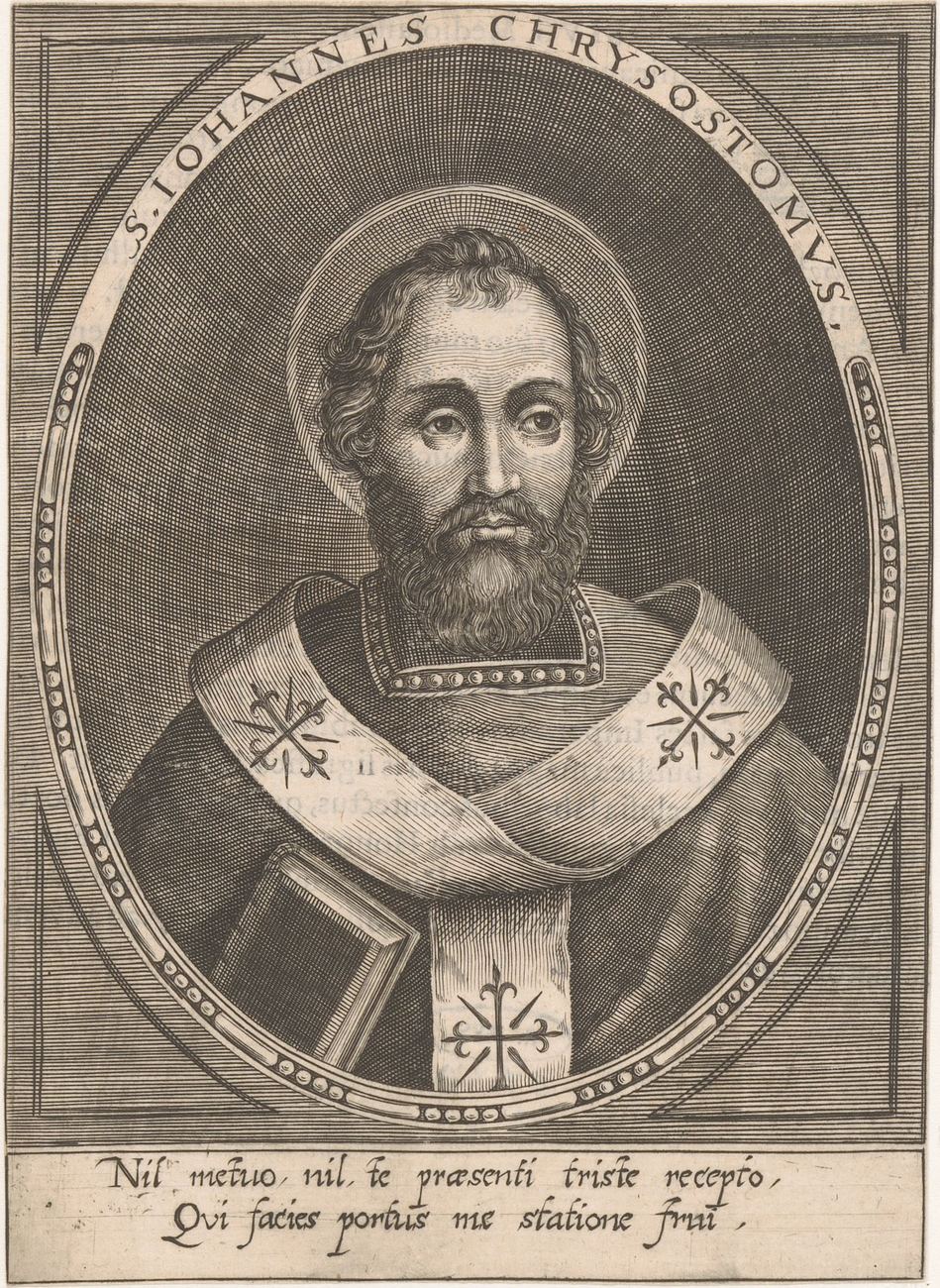
- H. Johannes Chrysostomus, an engraving by an unknown printmaker, possibly Dutch, 1600 to 1699, from an unknown book. Rijksmuseum, Amsterdam, RP-P-1907-50. CC0.
- St John Chrysostom, mosaic in Hagia Sophia, late 9th century, for his card. Public domain.
- Johannes Chrysostomus in ballingschap gestuurd, Jan Luyken, 1701, for a Dutch edition of Gottfried Arnold's book on the first Christians. Rijksmuseum, Amsterdam. CC0.