
John Cassian
Monk who carried the wisdom of the Egyptian desert to the West.
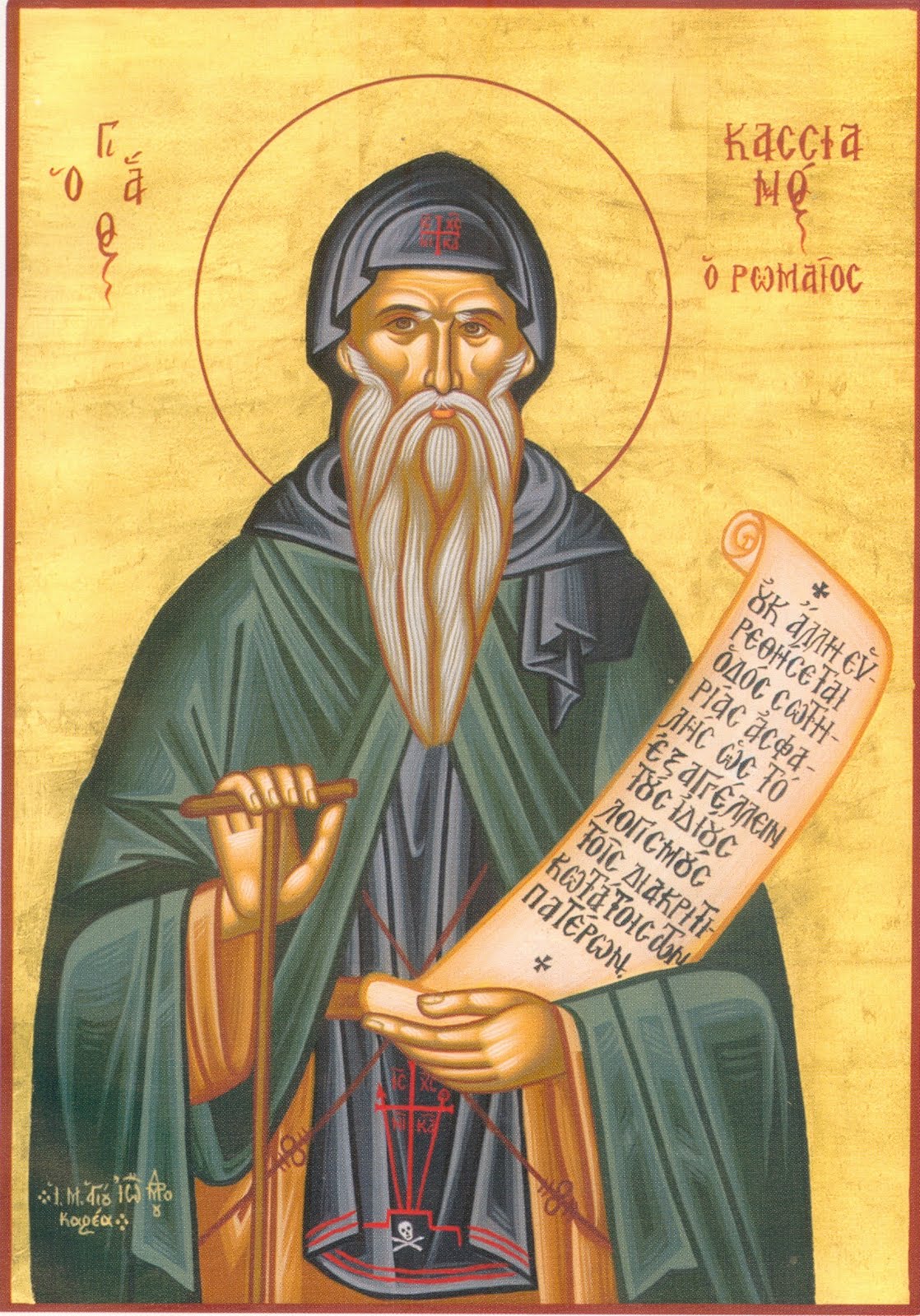
Picture: Saint Cassian the Roman, a modern Greek icon signed by the Monastery of St John the Forerunner at Karea. Wikimedia Commons.
Who was Cassian?
John Cassian was a monk who spent years with the desert monks of Egypt and wrote down what they taught. John Chrysostom made him a deacon. At Marseilles he founded two monasteries and wrote the Institutes and the Conferences, which carried the desert's wisdom to the West. Augustine's followers attacked his teaching on grace.
at a glance
His path, in order
- MonkAt Bethlehem, near the cave of the Nativity
- PupilYears among the monks of Egypt
- DeaconOrdained by John Chrysostom
- PriestFounded two monasteries at Marseilles
- WriterThe desert's teaching, in Latin
in numbers
- Years in Egypt, on a visit meant to be short7
- He and his friend Germanus went to learn from the desert monks
- Abba Joseph freed them from a rash promise to hurry back to Bethlehem
- Seven years later they made peace with their elders at Bethlehem and came back with their blessing
- Conferences he wrote down24
- Talks with 15 desert abbots
- One for each of the 24 elders in Revelation 4
did you know?
-
The seven deadly sins were once eight. Cassian was one of the early writers who counted eight. The number seven comes from Gregory the Great, and the great teachers of the Middle Ages kept it.
Catholic Encyclopedia, “Sin” -
A century after Cassian, Benedict's Rule named the Conferences first among the books to read aloud to monks each evening, before the last prayers of the day. The Rule also opens most of its hours of prayer with the verse Abba Isaac taught Cassian, the start of Psalm 70.
Rule of St Benedict, chapters 18 and 42 -
Early in Cassian's desert years, restlessness drove him out of his cell to visit Abba Paul. Abba Moses told him he had not escaped it. He had given in to it, and it would attack him harder next time.
Institutes, Book 10, chapter 25
- Born
- About 360, probably in Scythia Minor, today's Dobruja in Romania. Some scholars argued for Gaul. The only early witness, Gennadius, calls him “Scythian by race”.
- Grew up
- In a well-off Christian family, with land near woods. A tutor gave him a classical education. He had a sister. He became a monk young, with his friend Germanus.
- Died
- About 435, at Marseilles. No early source gives the day or the cause.
- Buried
- By tradition, in a marble tomb in the crypt of his own monastery of St Victor at Marseilles. His head and right hand were later kept there in reliquaries.
- Also called
- Cassian the Roman in the Orthodox Church, probably because he wrote in Latin. Greek calendars often drop the John. The monks of Egypt called him John.
- Status
- A saint in the Orthodox Church. In the Catholic Church, a local saint at Marseilles, never formally canonised. The Episcopal Church remembers him.
- In art
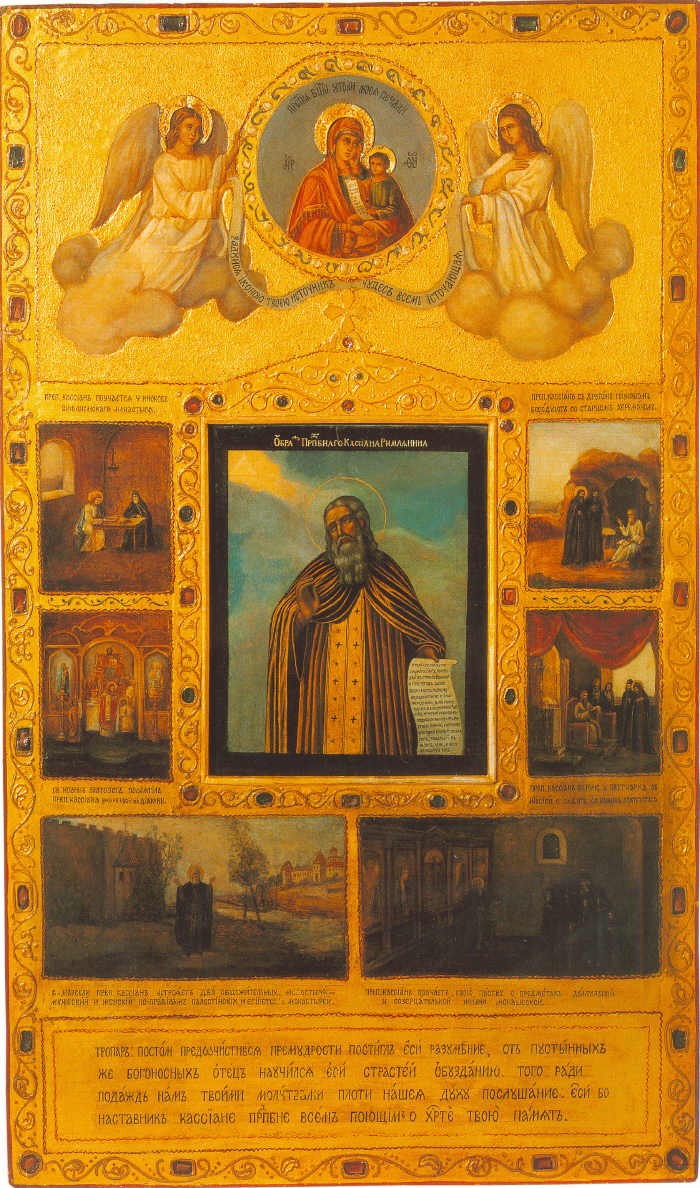
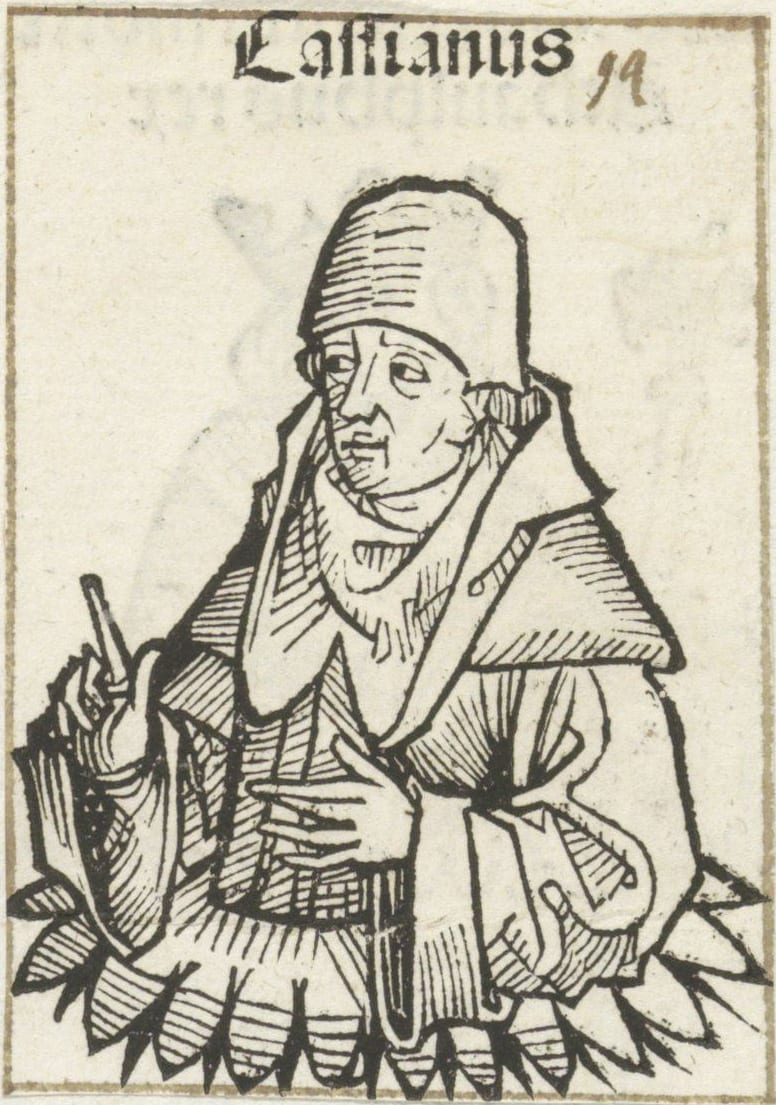
- In the East, an old monk with a grey pointed beard, sometimes hooded. In the West, from the 10th century, an author at his writing.
- Wrote
- Three works, all in Latin: the Institutes (12 books), the Conferences (24) and On the Incarnation, against Nestorius (7 books).
feast days
East and West, side by side
West
- Jul23
Catholic, as a local feast of Marseilles. The Roman Martyrology of 2004 lists him this day. He is not in the General Roman Calendar, nor in the 1916 Martyrology. Also the Episcopal Church, as a monastic and theologian.
East
- Feb28
Greek churches, the Orthodox Church in America and the Romanian Church, in years with no 29 February.
- Feb29
Greek churches, the Orthodox Church in America and the Romanian Church, in leap years. In the printed service books he is the only saint with a service that day.
- Mar13
Russian Church. It keeps him on 29 February, or the 28th in other years, by the old calendar. On today's calendar that is always 13 March.
Why a leap day? The oldest Greek lists, copied in Palestine in 1050 and 1063, put him on 28 February. From the 12th century a Jerusalem service book moved him to the 29th, and the printed service books kept it. 23 July is the feast of his own city, Marseilles. The Church of England and the Lutheran churches do not keep him.
what was he like?
+honest about his temper
Living alone as a hermit, he still lost his temper. He was cross with his pen for being too large or too small, and with his blunt penknife. When he was in a hurry to read, he was cross with his flint for being slow to spark. He cursed them, he admits, “or at least the devil”. His lesson: the faults you carry into the desert come with you.
Institutes, Book 8, chapters 18 and 19+bookish, and it bothered him
He told Abba Nesteros that the poems of his schooldays came back to him even at prayer. As he sang the Psalms, “the images of heroes fighting” rose before his eyes. Nesteros told him to give Scripture the same zeal, since “the mind of man cannot be emptied of all thoughts”.
Conferences, Conference 14, chapters 12 and 13+a friend for life
Germanus was with him from his first days as a monk: at Bethlehem, in the desert, at Constantinople and in Rome. Cassian writes that people said “a single heart and soul existed in our two bodies”.
Conferences, Conference 1, chapter 1+gave the credit away
He ends one of his books by telling readers where its good parts came from: “whatever in it pleases them belongs to the fathers, and whatever they dislike is all our own”.
Conferences, Conference 17, chapter 30what others said of him
The oldest account of his life is one paragraph long. Gennadius, a priest of his own city, wrote it in the late 400s.
He wrote from experience, and in forcible language, or to speak more clearly, with meaning back of his words, and action back of his talk.
Germanus, a priest, and with him Cassianus, a deacon, of John's party, both discreet men
…the first to introduce the rules of Eastern monasticism into the West
Sedulo legite, frequenter audite
his life in 13 moments
Bethlehem
About 380A famous abbot in their cell
Cassian and his friend Germanus became monks at Bethlehem. One day an old man arrived as a new novice and was put in their cell. He was Pinufius, a famous abbot from Egypt, on the run from praise. He had hidden once before, working in a monastery garden for nearly three years. At Bethlehem he was found out again and taken home in honour.
Conferences, Conference 20, chapter 1Egypt
On arrivingFasts broken for guests
In Palestine, Cassian and Germanus had learned never to eat before the set hour. In Egypt the old monks broke their fast to eat with them wherever they went. Only the Wednesday and Friday fasts were kept. One elder explained: “The opportunity for fasting is always with me. But as I am going to conduct you on your way, I cannot always keep you with me.” To welcome them, he said, was to welcome Christ.
Institutes, Book 5, chapter 24Diolcos
Still beginnersA cell given away twice
At Diolcos, Cassian and Germanus longed to stay among the hermits. Abba Archebius pretended he was leaving and gave them his cell with everything in it. Then he came back and built himself another. When more monks came, he did it again, and built a third. Cassian calls it his “pious fraud”.
Institutes, Book 5, chapters 36 and 37Egypt
In the desertCaught asleep
Late one night old Abba Theodore walked into young Cassian's cell to see what he was doing. He found him lying down on his mat after the evening prayers. He sighed, and called him by name: “How many, O John, are at this hour communing with God, and embracing Him, and detaining Him with them, while you are deprived of so great light, enfeebled as you are with lazy sleep!”
Institutes, Book 5, chapter 35Panephysis
Late 380s or 390sThe broken promise
Cassian and Germanus had promised their elders at Bethlehem, in the cave of the Nativity, to come back soon. In Egypt they told Abba Joseph they had “passed a sleepless night” over it. Joseph taught them that a rash promise may be broken for something better. They stayed seven years. Then they went home, made peace with their elders, and came back to the desert with their blessing.
Conferences, Conference 17, chapters 1 to 8 and 30Scete
In the desertA fall they saw
Old Heron had lived fifty years in the desert. He would not break his fast even at Easter. At last he obeyed a voice he took for an angel's. It told him he was too holy to come to any harm. To prove it, he threw himself down a deep well at night. He died on the third day, still sure he was right. Abba Moses reminded Cassian and Germanus of it: “remember what you lately saw happen before your very eyes”. Heron, he said, lacked discretion: he trusted his own judgement over the counsel of the elders.
Conferences, Conference 2, chapter 5Scete
399Serapion's tears
The bishop of Alexandria sent round a letter teaching that God has no body. Most of Egypt's monks were furious. Old Serapion had always pictured God in human form. A learned visitor persuaded him from Scripture, and everyone stood to give thanks. But as they prayed, Serapion burst into tears and threw himself on the ground: “They have taken away my God from me, and I have now none to lay hold of; and whom to worship and address I know not.” Cassian was there.
Conferences, Conference 10, chapters 2 and 3Constantinople
About 400 to 404Chrysostom's deacon
From Egypt, Cassian and Germanus went to Constantinople. There the bishop, John Chrysostom, made Cassian a deacon. In 404 Chrysostom's enemies drove him out. The church's gold, silver and clothing were handed to the city's officials, who signed as witnesses. Cassian and Germanus carried the receipt, to clear their bishop of the charges against him.
On the Incarnation, Book 7, chapter 31; Palladius, Dialogue, chapter 3Rome
404 or 405The appeal to the Pope
Cassian and Germanus carried a letter from Chrysostom's clergy to Pope Innocent I. His reply to Constantinople names them: “From the letters of your love that you forwarded to me through Germanus, the presbyter, and Cassianus, the deacon, I have learned, with anxious solicitude, the scenes of evil which you have placed before our eyes.” The appeal failed. Chrysostom died in exile in 407.
Sozomen, Church History, Book 8, chapter 26Marseilles
About 415Two monasteries
Nothing is known of him for about ten years. Then he is at Marseilles. He founded a monastery for men by the tomb of the martyr Victor, and one for women. Gennadius, writing in the late 400s, says both were still standing then.
Gennadius, chapter 62; Catholic EncyclopediaMarseilles
About 420 to 428The two great books
Bishop Castor of Apt wanted his new monastery run the Egyptian way, so Cassian wrote the Institutes for him. They cover a monk's outward life, then the eight chief faults. The Conferences followed: the desert abbots' talks on the inner life. Castor died before they were done. Cassian dedicated them to bishops and monks of Provence, among them Honoratus and Eucherius of Lérins.
Institutes, Preface; Conferences, PrefacesMarseilles
430A last book, for Leo
He had meant to stop writing. “I had contemplated and almost determined on taking refuge in silence”, he says. But Leo, the archdeacon of Rome, asked him to answer Nestorius. Leo later became Pope Leo the Great. Nestorius, the bishop of Constantinople, would not call Mary the Mother of God. Cassian wrote seven books in haste, before the Council of Ephesus.
On the Incarnation, PrefaceMarseilles
After 432Attacked, and silent
Prosper of Aquitaine, a lay champion of Augustine, wrote a book against Cassian's thirteenth Conference. Prosper never named him, and spoke of him with respect. No reply by Cassian is known. It is the last we hear of him.
Gennadius, chapter 85; Catholic Encyclopedia
wonders he wrote down
His own books and the oldest account of his life, by Gennadius, record no miracle of his. He wrote down wonders the desert monks told him, and his teachers put them firmly in second place.
A dead man answers
A heretic was leading the simple people of Egypt astray with clever arguments. Abba Macarius, the first monk of Scete, challenged him to raise a dead man instead. The heretic agreed, then fled Egypt. So Macarius took the people to the tombs, where the Egyptians kept their embalmed dead, and spoke to a very old body. It rose and answered him. It said it had lived under ancient kings and never heard the name of Christ. Abba Nesteros told Cassian and Germanus this story. Macarius sent the man back to his rest:
“Sleep in peace with the others in your own order, to be roused again by Christ in the end.”Conferences, Conference 15, chapter 3
The stolen biscuit
Abba Moses told Cassian and Germanus a story Abba Serapion used to tell the younger monks. As a boy, Serapion hid a biscuit in his clothes every day after supper, and ate it in secret. One evening his abbot, Theonas, spoke to visitors about secret thoughts. The boy broke down, laid the biscuit out before them all and begged forgiveness. Theonas told him his confession had set him free. Serapion never felt the craving again. When he confessed, Serapion said, this happened:
“A burning lamp proceeding from the folds of my dress filled the cell with a sulphureous smell so that the pungency of the odour scarcely allowed us to stay there”Conferences, Conference 2, chapter 11
The greater miracle
Abba Nesteros told Cassian and Germanus that the desert fathers never went looking for miraculous powers. When they had them, “they would never use them, unless perhaps extreme and unavoidable necessity drove them to do so”. Macarius, he said, made the dead man speak out of love, not for glory. And holiness is the greater wonder:
“It is a greater miracle to root out from one's own flesh the incentives to wantonness than to cast out unclean spirits from the bodies of others, and it is a grander sign to restrain the fierce passions of anger by the virtue of patience than to command the powers of the air.”Conferences, Conference 15, chapters 2, 3 and 8
his words
Much of the Conferences is spoken by the abbots he met, and no one can say how much is theirs and how much his. The Institutes and On the Incarnation are in his own voice. Each line says whose it is. The translation is Edgar Gibson's, of 1894.
A saying he could not keep
A monk ought by all means to fly from women and bishops.
An old saying of the fathers, from his book on vainglory. Neither, he explains, will let a monk keep “the quiet of his cell”. He admits that he failed on both counts, “since I could not avoid my own sister, nor escape the hands of the bishop”. The bishop's hands mean ordination: John Chrysostom made him a deacon, and he was later a priest. In Latin, omnimodis monachum fugere debere mulieres et episcopos.
Institutes, Book 11, chapter 18The end of our profession indeed, as I said, is the kingdom of God or the kingdom of heaven: but the immediate aim or goal, is purity of heart.
Discretion is the mother of all virtues, as well as their guardian and regulator.
For a wrong thought is enfeebled at the moment that it is discovered.
O God, make speed to save me: O Lord, make haste to help me.
That is not a perfect prayer, wherein a monk understands himself and the words which he prays.
the eight faults
Eight of his twelve Institutes take one fault each: gluttony, fornication, love of money, anger, dejection, acedia, vainglory and pride. He calls them “the eight principal faults”. The Catholic Encyclopedia calls them “the principal or deadly sins”.
Anger
He allows no anger at all, not even for a good reason. The words “without a cause” in Matthew 5:22, he says, were added by copyists “who did not think that anger for just causes was to be banished”. Any anger blinds:
“It makes no difference whether gold plates, or lead, or what metal you please, are placed over our eyelids, the value of the metal makes no difference in our blindness.”Institutes, Book 8, chapters 6 and 21
Acedia
Acedia is a weariness of heart that strikes a monk about noon. Some elders, he says, called it “the midday demon spoken of in the ninetieth Psalm”. That is Psalm 91 in most Bibles today. His picture of the restless monk could have been written today. The cure he passes on from Egypt is work: “a monk who works is attacked by but one devil; but an idler is tormented by countless spirits”.
“He looks about anxiously this way and that, and sighs that none of the brethren come to see him, and often goes in and out of his cell, and frequently gazes up at the sun, as if it was too slow in setting”Institutes, Book 10, chapters 1, 2 and 23
Vainglory
Other faults weaken when beaten, he says. This one “when it is beaten rises again keener than ever for the struggle”. The elders compared it to an onion: strip off one skin and there is another. If the devil cannot make a monk vain of neat clothes, he makes him vain of shabby ones:
“For where the devil cannot create vainglory in a man by means of his well-fitting and neat dress, he tries to introduce it by means of a dirty, cheap, and uncared-for style.”Institutes, Book 11, chapters 4, 5 and 7
often misquoted
He founded Semi-Pelagianism.
What the sources sayThe word is modern. The Catholic Encyclopedia says “the word was coined between 1590 and 1600”. In his day his critics spoke of “relics of the Pelagians”. Pelagius had taught that human nature is sound and can do good by its own strength. Cassian opposed him, and says a Pelagian monk named Leporius “was admonished by us and corrected by God”. What is fair to say: his thirteenth Conference teaches that a good will can sometimes start in us, and the Council of Orange rejected that view in 529.
Catholic Encyclopedia, “Semipelagianism”; On the Incarnation, Book 1, chapter 4He mocked Augustine as a Cicero.
What the sources sayHe names no one. His real words say the old fathers did not receive the faith “through dialectical syllogisms or the eloquence of a Cicero”. Some read the passage as aimed at Augustine's school. The note that Cicero means Augustine was added in a modern retelling by the Orthodox Church in America.
Institutes, Book 12, chapter 19The letter teaches what happened; allegory, what to believe; the moral sense, what to do; anagogy, where you are heading. This rhyme is his.
What the sources sayA rhyme of the medieval Scholastics. His own passage is Abba Nesteros reading “one and the same Jerusalem” four ways: as the city of the Jews, the Church of Christ, the heavenly city of God, and the soul.
Conferences, Conference 14, chapter 8; Catholic Encyclopedia, “Biblical Exegesis”God gives him a feast only every fourth year, because he would not help a peasant.
What the sources sayA Russian folk tale, not church teaching. In it Cassian will not help a peasant pull his load, so as not to reach heaven with dirty clothes. St Nicholas helps and arrives dirty. So God gives Nicholas two feasts a year and Cassian one every four years. On his day, Russian peasants often stayed at home for fear of his evil eye. The real date comes from old Greek calendars.
First Things, 2013, retelling Linda Ivanits, Russian Folk BeliefHe ruled 5,000 monks at St Victor.
What the sources sayAn 11th-century claim from the abbey's own charters, made when it was stressing how old it was. Gennadius, writing in the late 400s, says only that he founded two monasteries.
Orthodox Encyclopedia; Gennadius, chapter 62the hard parts
Some of his teaching troubled readers from the start, and some is hard to read today. Here it is plainly, in his words and in his critics'.
Grace and effort
In the thirteenth Conference, Abba Chaeremon teaches that God's grace comes first and does most. But sometimes, he says, the first stir of a good will is our own, and God then strengthens it. Augustine's followers heard in this an echo of Pelagius. He had been condemned for teaching that human nature is sound and can do good by its own strength. In 529 the Council of Orange rejected the idea that a good will can begin in us. A sixth-century list credited to Pope Gelasius called Cassian's work apocryphal. That meant, says the Catholic Encyclopedia, that it held wrong teaching.
“And when He sees in us some beginnings of a good will, He at once enlightens it and strengthens it and urges it on towards salvation, increasing that which He Himself implanted or which He sees to have arisen from our own efforts.”Conferences, Conference 13, chapter 8; Catholic Encyclopedia
Guilty, with a plea for mercy
The Catholic Encyclopedia sums up the quarrel: “St. Augustine regarded man in his natural state as dead, Pelagius as quite sound, Cassian as sick.” Its judgment is that Cassian made a purely natural act “the first step to salvation”. Gibson, his translator, was an Anglican scholar. He returns “a verdict of guilty”, with a plea for mercy. He calls Cassian's teaching “an honest attempt to vindicate human responsibility”, and says Augustine's “was one-sided and required to be balanced”. The Eastern Church, Gibson notes, always held “a milder view of the effect of the Fall”.
Catholic Encyclopedia, “John Cassian”; Gibson, Prolegomena, chapter 1A lie like a strong medicine
Abba Joseph teaches that a lie may be right in grave danger. Gibson says Cassian “makes his own the sentiments of Abbot Joseph on the permissibility of lying”. Augustine held that every lie is a sin. Hellebore, in Joseph's picture, is a poisonous plant used as a drug:
“And so we ought to regard a lie and to employ it as if its nature were that of hellebore; which is useful if taken when some deadly disease is threatening, but if taken without being required by some great danger is the cause of immediate death.”Conferences, Conference 17, chapters 17 and 30
The father and the river
He tells this story as praise. Patermucius entered a monastery with his son of about eight. To test the father, the boy was neglected and beaten in front of him. Then the abbot told him to throw the child in the river. He threw him in, and monks posted on the bank snatched the boy out. It was revealed, Cassian says, that the father “had copied the deed of the patriarch Abraham”.
“Then he, as if this had been commanded him by the Lord, at once snatched up the child as quickly as possible, and carried him in his arms to the river's bank to throw him in.”Institutes, Book 4, chapters 27 and 28
A wife left behind
He tells how Abba Theonas left his wife to become a monk, though she would not agree. Then he insists he is only reporting what happened:
“But let no one imagine that we have invented this for the sake of encouraging divorce, as we not only in no way condemn marriage…”Conferences, Conference 21, chapters 9 and 10
where he stood
One line is his own, from the Institutes. The other three are spoken by desert abbots in his Conferences. His translator Gibson says he made Abba Joseph's view on lying his own. TapClick “Show his line” to read it.
Your answers are next to his. From your result on . See your result
“Most of the time, it's better to say less.”
Cassian strongly agrees.
You
On record in the Conferences. Not quoted here.
“Wisdom is worth learning from anyone, even people who don't share your faith.”
Cassian disagrees.
You
On record in the Conferences. Not quoted here.
“Anger at real wrongdoing can be a good thing.”
Cassian strongly disagrees.
You
Show his line
For the end and aim of patience consists, not in being angry with a good reason, but in not being angry at all.Institutes, Book 8, chapter 21
“If you had to choose, you'd grow closer to God alone in quiet than among other people.”
Cassian agrees.
You
On record in the Conferences. Not quoted here.
“Lying can be the right thing to do if it protects someone.”
Cassian strongly agrees.
You
Show his line
But if we prefer what is for another's advantage to our own good, and satisfy the demands of the Apostle, we shall certainly have to put up with the necessity of lying.Conferences, Conference 17, chapter 19, where Abba Joseph speaks
“The best way to live is free of strong emotions, with only a steady peace inside.”
Cassian strongly agrees.
You
On record in the Institutes. Not quoted here.
“Your body is a friend to look after, not an enemy to fight.”
Cassian agrees.
You
Show his line
For excess of fasting and gluttony come to the same thing, and an unlimited continuance of vigils is equally injurious to a monk as the torpor of a deep sleep.Conferences, Conference 2, chapter 16, where Abba Moses speaks
“Miracles still happen today, just as they did in the Bible.”
Cassian agrees.
You
On record in the Conferences. Not quoted here.
“In many Bible stories, the deeper meaning matters more than the history.”
Cassian agrees.
You
Show his line
But as the renewal of our soul grows by means of this study, Scripture also will begin to put on a new face, and the beauty of the holier meanings will somehow grow with our growth.Conferences, Conference 14, chapter 11, where Abba Nesteros speaks
“If you believe God is calling you, follow, even if your family begs you not to.”
Cassian strongly agrees.
You
On record in the Institutes. Not quoted here.
“A church should keep out people who openly live in serious wrongdoing.”
Cassian agrees.
You
On record in the Institutes. Not quoted here.
See where you stand beside him. Take the quiz
friends, family and rivals
 John Chrysostom
 The bishop of Constantinople, who made him a deacon. More than twenty-five years after Chrysostom's exile, Cassian still called him “a marvel of faith and purity”, and his own teacher: “for it was he who taught me what I have written”.
On the Incarnation, Book 7, chapter 31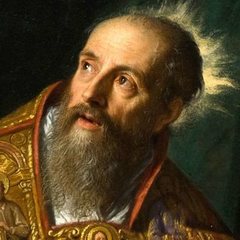 Augustine of Hippo
 Cassian's thirteenth Conference answered Augustine's teaching on grace, and Augustine's followers attacked it. Yet against Nestorius, Cassian still cites “Augustine the priest of Hippo Regiensis” among his witnesses.
On the Incarnation, Book 7, chapter 27His closest friend, some years older, from his first days as a monk. They went everywhere together, as far as Rome. Abba Joseph asked if they were brothers by birth. No, Cassian says: they were joined “in a tie of spiritual and not carnal brotherhood”. After Rome, Germanus is not heard of again. The Romanian Church made him a saint in 1992 and keeps his day with Cassian's.
Conferences, Conference 16, chapter 1; Catholic Encyclopedia; Orthodox EncyclopediaHe never names her, and admits he could not keep away from her. Scholars think she may have joined his women's house at Marseilles, but no early source says so.
Institutes, Book 11, chapter 18; Orthodox EncyclopediaThe famous abbot who hid as a novice in Cassian and Germanus's cell at Bethlehem. When they reached Egypt, he gave them a lodging in his own cell, at the far corner of his garden.
Conferences, Conference 20, chapters 1 and 2The desert elders whose talks fill the Conferences. Fifteen are named.
ConferencesAs archdeacon of Rome he asked Cassian to write against Nestorius. Cassian calls him “my esteemed and highly regarded friend”. He became Pope Leo the Great.
On the Incarnation, PrefaceA lay follower of Augustine, and Cassian's first critic. Gennadius, who took Cassian's side, describes Prosper's book as “an anonymous book against certain works of Cassianus, which the church of God finds salutary, but which he brands as injurious”.
Gennadius, Lives of Illustrious Men, chapter 85The bishop of Constantinople who would not call Mary the Mother of God. Cassian answered him in seven books. He calls him “you most wicked and shameless contaminator of an illustrious city”. The Catholic Encyclopedia thought the book written in haste, and weaker than his others.
On the Incarnation, Book 7, chapter 30how he died
No one recorded how he died. Gennadius, his first biographer, says only that with his book against Nestorius he “made an end, both of writing and living, at Marseilles”.
He died about 435, in the reign of the emperors Theodosius and Valentinian. By tradition he was buried in the crypt of his own monastery of St Victor.
is he a saint?
Yes in the East, and locally in the West. The Orthodox Church counts him a saint. The Catholic Church never formally canonised him, but he is a saint of Marseilles.
- OrthodoxSaintSt Cassian the Roman, 29 February
- CatholicLocal saintMarseilles, 23 July. Never formally canonised
- AnglicanRememberedEpiscopal Church, 23 July. Not in the Church of England's calendar
- LutheranNot keptNot in the Missouri Synod or ELCA calendars
Marseilles honoured him early. In 596 Pope Gregory the Great wrote to the abbess of the women's house Cassian had founded, and spoke of “the day of the Saint's anniversary” there.
Then his teaching on grace counted against him. The Roman Martyrology left him out for centuries, and the 1916 edition still has no entry for him. In 1894 his translator Gibson wrote that his name “is not found in the Calendars of the West”. He was usually called “the blessed Cassian”.
The Roman Martyrology of 2004 lists him as a saint on 23 July. An asterisk marks the entry as a local feast, read only where he is honoured. In our translation from the Latin: At Marseilles in Provence, Saint John Cassian, priest. He founded two monasteries, one for men and one for women. Skilled by long experience of monastic life, he wrote the Institutes and the Conferences of the Fathers, to build up monks.
…the monastery consecrated to the honour of Saint Cassian…
Although never formally canonized, St. Gregory the Great regarded him as a saint…
a prayer he wrote
He ended his last book with a prayer to God, in his own voice. Here it is whole, in Gibson's translation of 1894.
Beyond and above all I pray with all my heart and voice, to Thee, O God the Father of our Lord Jesus Christ, that Thou wouldest fill with the gift of Thy love whatever we have written by Thy bounteous grace. And because, as the Lord our God Thine Only Begotten Son Himself taught us, Thou hast so loved this world as to send Thine Only Begotten Son to save the world, grant to Thy people whom Thou hast redeemed that in the Incarnation of Thine Only Begotten Son they may perceive both Thy gift and His love: and that all may understand the truth that for us Thine Only Begotten, our Lord God, was born and suffered and rose again, and may so love it that the condescension of His glory may increase our love: and let not His Humility lead to a diminution of His honour in the hearts of all men, but let it ever produce an increase of love: and may we all rightly and wisely comprehend the blessings of His Sacred Compassion, so as to see that we owe the more to God, in proportion as for our sakes God humbled Himself yet lower.
what to read first
The Institutes
John Cassian
Twelve short books: a monk's day, then the eight chief faults one by one. Book 10, on restlessness, reads as if written today.
Read it freeThe Conferences
John Cassian
Talks with the desert abbots. Start with Conference 1, on the goal of life, and Conference 10, on the one-line prayer.
Read them freeLives of Illustrious Men, chapter 62
Gennadius of Marseilles
The oldest account of his life, one paragraph long, from his own city.
Read it freeGibson's introduction
Edgar C. S. Gibson, 1894
Everything his own writings tell us about his life, in order, and a fair verdict on the quarrel over grace.
Read it freetake the quizzes
 Quiz Which early Christian thinks like you? And which would argue with you? See where you stand beside Cassian. Start
  Quiz Christian Personality Test Which of eight types are you? Find your own. Start
 sources
His life, and his words
- John Cassian, Institutes. Tr. Edgar C. S. Gibson, 1894.
- John Cassian, Conferences. Same translation.
- John Cassian, On the Incarnation of the Lord. Same translation.
- Gibson's translation on CCEL, with his introduction and notes. Nicene and Post-Nicene Fathers, second series, volume 11.
- The Latin of Institutes, Book 11. Petschenig's edition, with Gibson's English.
- Gennadius, Lives of Illustrious Men. Tr. Ernest Cushing Richardson, 1892.
- Palladius, Dialogue on the Life of St John Chrysostom. Tr. Herbert Moore, 1921.
- Sozomen, Church History, Book 8. Tr. Chester D. Hartranft, 1890.
- Gregory the Great, Letters, Book 7, letter 12. Tr. James Barmby, 1895.
- The Rule of St Benedict, chapter 42. Tr. Boniface Verheyen.
- Augustine, Enchiridion, chapter 18, on lying. Tr. J. F. Shaw, 1887.
Reference
- Catholic Encyclopedia, 1908, “John Cassian”
- Catholic Encyclopedia, 1912, “Semipelagianism”
- Catholic Encyclopedia, 1909, “Biblical Exegesis”
- Orthodox Encyclopedia, “Ioann Kassian Rimlyanin”, in Russian
- First Things, on the Russian folk tale, 2013
Calendars
- The Roman Martyrology, 2004 edition, 23 July
- The Roman Martyrology, 1916 edition
- Nominis, French bishops' conference, Saint Jean Cassien
- OCA, Venerable John Cassian the Roman
- saint.gr, Greek
- Great Synaxaristes, Greek
- azbyka.ru, Russian
- basilica.ro, the Romanian Patriarchate
- The Episcopal Church, Lesser Feasts and Fasts 2022
- Church of England, Common Worship calendar
- Concordia Publishing House, LCMS commemorations
- Evangelical Lutheran Worship, ELCA, the church year
Pictures
- John Cassian, a modern Greek icon signed by the Monastery of St John the Forerunner at Karea. Wikimedia Commons, from pravicon.com, tagged public domain.
- Venerable John Cassian the Roman, with scenes from his life, Russian icon, 18th and 19th centuries. Public domain.
- Johannes Cassianus, a woodcut from Hartmann Schedel's Nuremberg Chronicle, 1493. Rijksmuseum, Amsterdam. CC0.