
Augustine of Hippo
Teacher, convert and bishop of Hippo, who told his own restless story to God in the Confessions.
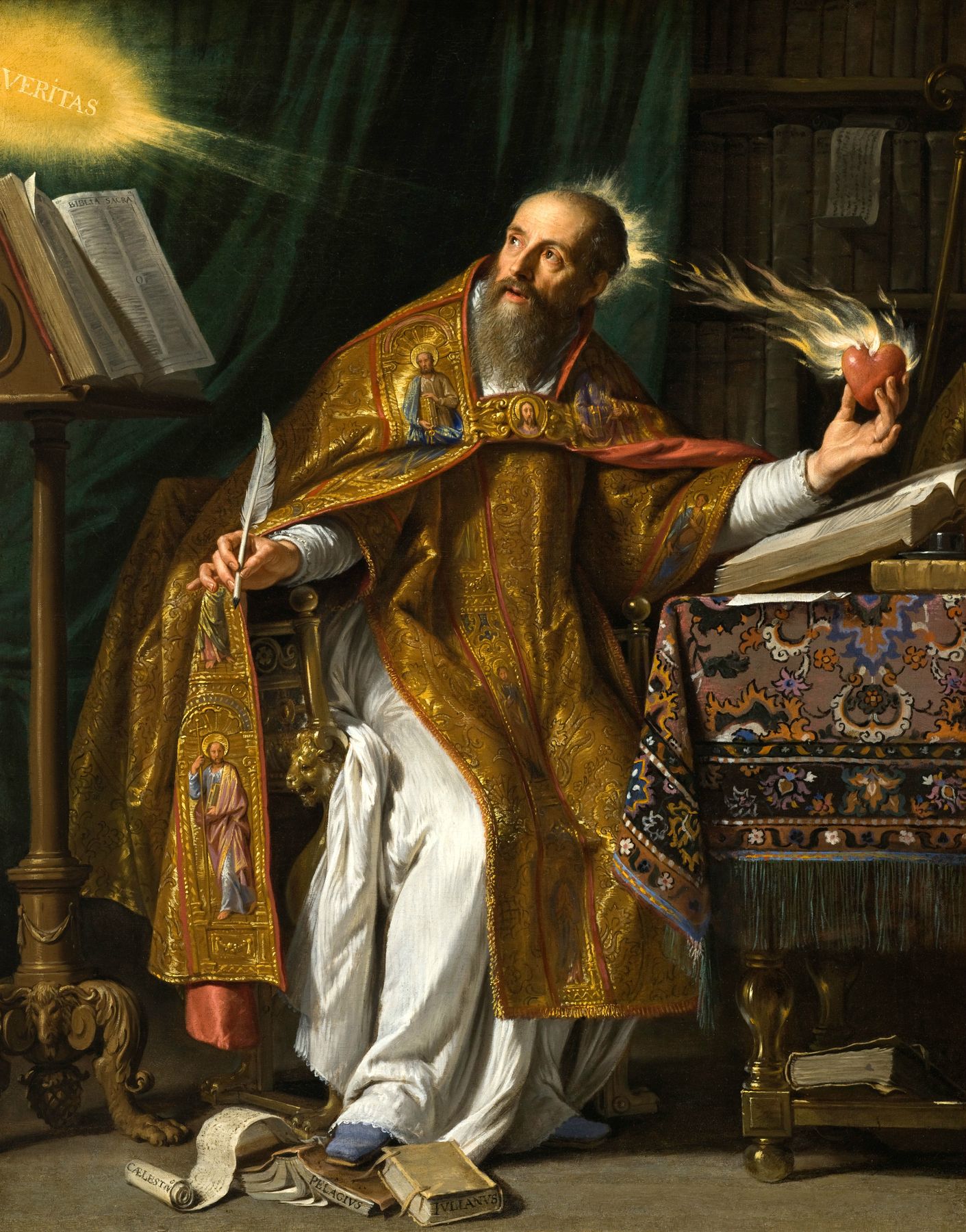
Picture: Saint Augustine, Philippe de Champaigne, about 1645-1650. Los Angeles County Museum of Art. Public domain.
Who was Augustine?
Augustine was a teacher of public speaking from North Africa. For years he chased pleasure, success and a religion that made sense to him. In a garden at Milan in 386 he finally turned to Christ. He became bishop of Hippo and wrote the Confessions, the story of his life told to God.
at a glance
His path, in order
- TeacherCarthage, Rome, Milan
- MonkWith friends at Thagaste
- PriestSeized at Hippo, 391
- BishopOf Hippo, about 395 to 430
in numbers
- Million words of his that survive5
- More than five million, says Britannica
- From sermons to books of theology
- Works he reread in old age93
- Divided into 232 books, or parts
- Correcting what he now thought wrong
- Healings written down at Hippo70
- Almost seventy in under two years
- At the new shrine of St Stephen's relics
did you know?
-
As a boy he hated Greek. He understood not a word, and his teachers drove him on with threats and punishments. As a bishop he said his Greek scarcely counted as knowledge at all.
Confessions, Book 1, chapter 14; Answer to Petilian, Book 2, chapter 38 -
He had never heard of Antony of Egypt until a visitor from the emperor's court told him, shortly before he turned to Christ in a garden at Milan. The visitor also told of two officials at Trier who found a Life of Antony in a monks' cottage, and gave up their careers that same afternoon.
Confessions, Book 8, chapter 6 -
He knew what time is, he wrote, as long as no one asked him. Asked to explain it, he did not know.
Confessions, Book 11, chapter 14 -
The only silver on his table was the spoons. The dishes were clay, wood or marble, and that was his own choice.
Possidius, Life, chapter 22 -
He held that even babies sin. He had watched one, too young to talk, turn pale and glare at another baby sharing its nurse's milk.
Confessions, Book 1, chapter 7
- Born
- 13 November 354, at Thagaste in Numidia, today Souk Ahras in Algeria. He gives the day himself.
- Grew up
- At Thagaste. He went to school at Madauros, then Carthage. His mother Monica was a Christian. His father Patricius was a pagan until near the end of his life.
- Died
- 28 August 430, at Hippo, of a fever. It was the third month of the Vandals' siege of his city.
- Buried
- At Hippo, with his friend Possidius there. The 1916 Roman Martyrology says his body was later taken to Sardinia, then to Pavia in Italy. The Orthodox Church in America says his relics lie today in San Pietro in Ciel d'Oro there.
- Also called
- Aurelius Augustinus, his Latin name. Blessed Augustine, in the Russian Church and the Orthodox Church in America. Saint Augustine, Bishop of Hippo, in the Greek churches. Often called the Doctor of Grace.
- Status
- A saint and a Doctor of the Church to Catholics. On the Orthodox calendar as Blessed Augustine, and Saint in Greek calendars. Anglicans keep his day, and Lutherans remember him.
- Patron of
- Britannica lists brewers, printers, converts and theologians, and the Augustinian orders.
- In art
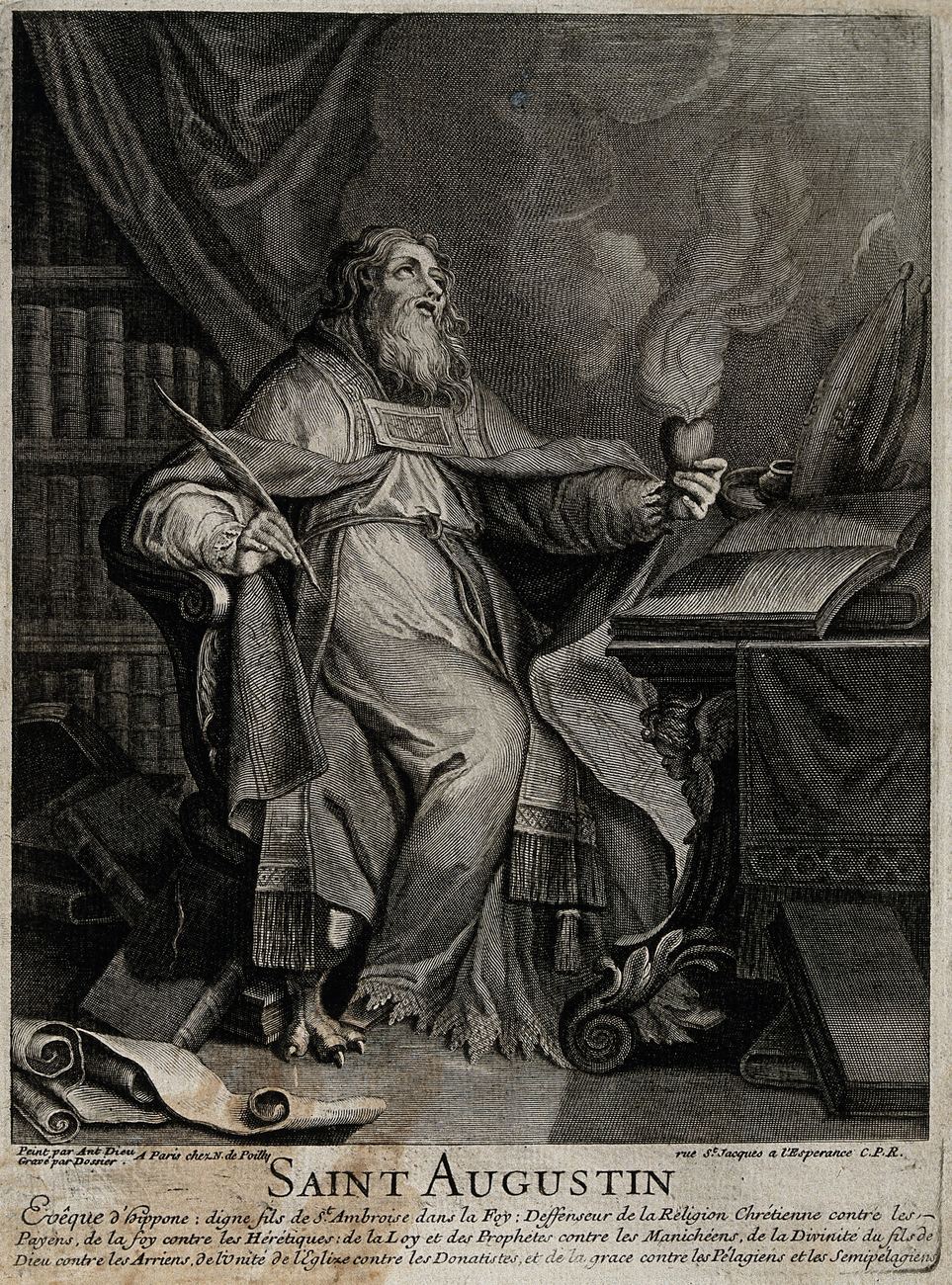
- A bishop with a book and a pen. Often holding a heart, burning or pierced by an arrow. Sometimes with a child and a shell at the seashore, from a medieval legend.
- Wrote
- So much that scarcely any student could read it all, says his friend Possidius. Near the end he reviewed 93 of his works, in 232 books. His letters and sermons are not counted in that.
- Pronounced
- AW-guh-steen of HIP-oh. Also said aw-GUS-tin.
 The Spark
 His personality type
Light-hearted, and at his best when there is something to do.
In Gregory the Great's terms
- Cheerful
- Restless mind
Our reading of him as a young man, from the Christian Personality Test. The personality test reads him as he was before his conversion, when he loved talk, jokes and reading with friends. In the test, the Spark's opposite is The Deep Well, and its example is his mother, St Monica.
See The Sparkfeast days
East and West, side by side
West
- Feb28
In the 1916 Roman Martyrology, on the last day of February: his body brought from Sardinia to Pavia.
- May5
In the 1916 Roman Martyrology: his conversion, at Milan.
- Aug28
Catholic memorial. Also the Church of England, the Episcopal Church, and Lutherans in the Missouri Synod and the ELCA.
East
- Jun15
Greek churches and the Church of Cyprus, as Saint Augustine. The Orthodox Church in America, as Blessed Augustine. The Russian Church keeps it on the old calendar, which is 28 June on today's calendar.
The West keeps 28 August, the day he died. The Orthodox churches agree on 15 June, but no source we found says why. Churches on the old calendar keep each date 13 days later.
what was he like?
+quick to weep, and not ashamed of it
He wept when the people of Hippo seized him to be ordained. He wept for his mother after she died. If anyone thinks that a sin, he wrote, “let him not laugh at me, but rather, if he be a man of a noble charity, let him weep for my sins against Thee”. On his deathbed he read psalms hung on his wall, and wept.
Possidius, Life, chapters 4 and 31; Confessions, Book 9, chapter 12+could not live without friends
What held him to his friends, he wrote, was talk and jokes, kindness, good books read together, and even the chance “to differ at times without ill-humour”. After his baptism he always shared a home with others. First he lived with friends at Thagaste, then with his clergy at Hippo.
Confessions, Book 4, chapter 8; Possidius, Life, chapters 3, 5 and 25+no gossip at his table
He had two lines written on his dining table: “Who injures the name of an absent friend / May not at this table as guest attend.” Once some bishops, close friends of his, forgot the lines and gossiped anyway. He told them sternly that either the verses came off the table, or he would leave in the middle of the meal. His friend Possidius was at the table that day.
Possidius, Life, chapter 22+the poor came first
When the church's money ran out, he told the people plainly that he had nothing left to give the poor. He even had the church's sacred vessels broken up and melted down, “for the sake of captives and of the many who were in need”. His friend Possidius says some people disapproved.
Possidius, Life, chapter 24+easily distracted, and honest about it
He admits that a dog chasing a hare in a field could pull his mind away from serious thoughts. At home, “a lizard catching flies” could do it too. He went on to praise God for such tiny creatures, but he says that is not what caught him first.
Confessions, Book 10, chapter 35+changed his mind, and said so
Near the end of his life he reread every book he had written. Whatever he now found out of line with the Church's teaching, “this he himself censured and corrected”, says his friend Possidius. The result was two books of corrections, the Retractations.
Possidius, Life, chapter 28what others said of him
Three men wrote down what they thought of him. Possidius was his friend for almost forty years. Jerome, an older scholar, argued with him by letter for more than twenty years. Macedonius, a Roman official in Africa, answered one of his letters.
But I believe that they were able to derive greater good from him who heard and saw him as he spoke in person in the church, and especially those who knew well his manner of life among men.
…you are challenging an old man, disturbing the peace of one who asks only to be allowed to be silent, and you seem to desire to display your learning.
Go on and prosper! You are renowned throughout the whole world; Catholics revere and look up to you as the restorer of the ancient faith, and—which is a token of yet more illustrious glory—all heretics abhor you.
I am struck with wonder at your wisdom, both in the books you have published and in this letter which you have not found it too great a burden to send me by way of intercession for those in distress.
his life in eleven moments
Thagaste
Aged 15, about 370The pears
One night he and a gang of friends stripped a pear tree near his family's vineyard. The pears were not even good, and he had better at home. They ate a few and threw the rest to the pigs. Nearly thirty years later he spent pages of his Confessions asking why. His answer: the thrill was the theft itself. “To do this pleased us all the more because it was not permitted.”
Confessions, Book 2, chapters 2 to 9Carthage
His 19th to 28th yearsNine years a Manichee
In his nineteenth year he read Cicero's Hortensius and was “roused to a desire for wisdom”. As a student at Carthage he joined the Manichees, a sect he would later write against. He stayed with them nine years.
Confessions, Book 3, chapter 4; Book 4, chapter 1; Book 8, chapter 7; Possidius, Life, chapter 1Thagaste
Teaching in his home townThe friend who died
Back home as a young teacher, he grew close to a friend he had known since childhood, and drew him into the Manichees. Within a year the friend fell ill with a fever, and was baptised while unconscious. When he came round, Augustine joked about it. The friend told him to stop if he wanted to stay friends. A few days later he died. “Mine eyes sought him everywhere, but he was not granted them.” Augustine wrote, “I became a great puzzle to myself.”
Confessions, Book 4, chapter 4Carthage
383Lying to his mother
He wanted to teach in Rome. His mother Monica followed him to the harbour, to stop him or to go with him. He told her he was only waiting to see a friend off. She spent the night praying in a chapel to St Cyprian by the shore, and he sailed without her. “And I lied to my mother—and such a mother!—and got away.”
Confessions, Book 5, chapter 8Milan
A teacher in MilanThe bishop who read in silence
Milan asked the prefect of Rome for a teacher of public speaking. The prefect, Symmachus, set him a test speech and sent him. In Milan he went to hear the bishop, Ambrose, for his style, and stayed for what he said. He noticed that Ambrose read without a sound: “his heart searched out the sense, but his voice and tongue were silent”. Later he saw God's hand in it all: “To him was I unknowingly led by Thee, that by him I might knowingly be led to Thee.”
Confessions, Book 5, chapter 13; Book 6, chapter 3Milan
Late summer 386Take up and read
As a young man he had prayed, “Grant me chastity and continency, but not yet.” Now, torn in two, he left his friend Alypius and threw himself down in tears under a fig tree in a garden. “How long, how long? Tomorrow, and tomorrow? Why not now?” Then from a house nearby he heard a child's voice chanting, “Take up and read; take up and read.” He went back to where Alypius sat, opened Paul's letters, and read the first lines his eyes fell on, from Romans 13: “Not in rioting and drunkenness, not in chambering and wantonness, not in strife and envying; but put ye on the Lord Jesus Christ, and make not provision for the flesh, to fulfil the lusts thereof.” He read no further. “All the gloom of doubt vanished away.” Alypius joined him that day, and they went in to tell his mother, Monica. “She leapeth for joy, and triumpheth, and blesseth Thee.”
Confessions, Book 8, chapters 7 and 12Milan
Easter 387Baptised by Ambrose
Ambrose, the bishop of Milan, baptised him at Easter. Two others were baptised with him. One was his friend Alypius, a man so hard on his own body that he walked barefoot on the frozen ground of Italy. The other was his son Adeodatus. The boy was barely fifteen, and his father says he “in wit excelled many grave and learned men”.
Confessions, Book 9, chapter 6; Possidius, Life, chapter 1Ostia
387His mother's last words
Waiting at Ostia for a ship home, he and Monica stood alone at a window over the garden and talked about the life of heaven. About five days later she fell ill with a fever. His brother wished she could die in her own country. She told her sons, “Lay this body anywhere, let not the care for it trouble you at all. This only I ask, that you will remember me at the Lord's altar, wherever you be.” She died there, in her fifty-sixth year. Augustine was in his thirty-third.
Confessions, Book 9, chapters 10 and 11Hippo
391Seized in church
As a layman he kept away from any church that had no bishop, he later told his friends. He feared such a church would make him its bishop. Hippo had one, so he stood in the congregation without a care. But the old bishop, Valerius, told the people that the city needed a priest. They laid hands on Augustine and brought him forward, shouting, “while he wept freely”. Some thought he wept from wounded pride, because he was only made a priest. He said he wept at the dangers of ruling a church.
Possidius, Life, chapter 4; Catholic Encyclopedia, St. Augustine of HippoHippo
About 395Made bishop
Valerius, the old bishop of Hippo, was afraid another city would take his priest. Once he even hid him so that he could not be found. Then he wrote in secret to the primate at Carthage and had Augustine made bishop beside him. Augustine refused at first, because his own bishop was still alive. He gave way, and later said it should not have been done.
Possidius, Life, chapter 8Hippo
413 to 426The City of God
In 410 the Goths sacked Rome, and pagans blamed the Christians. At the suggestion of his friend Marcellinus, he began his answer in 413. He worked on it for thirteen years. It grew into twenty-two books about two cities, one built on love of self and one on love of God.
City of God, Book 1, preface; Book 14, chapter 28; Marcus Dods, translator's preface
his miracles
Two kinds of wonder are recorded. His friend Possidius tells of healings through Augustine's own prayers. Augustine himself wrote down healings that he saw or checked, most of them at the shrines of martyrs, and he had the stories read out in church. He says why:
For when I saw, in our own times, frequent signs of the presence of divine powers similar to those which had been given of old, I desired that narratives might be written, judging that the multitude should not remain ignorant of these things.
2 through his own prayers
-
Hippo
As priest and bishopDemons driven out
People asked him to pray for men possessed by demons. He prayed with many tears, and the demons left them.
“he entreated God in prayer with many tears and the demons departed from the men”
Possidius, his friend for almost forty years, says “I know also” that this happened.
Possidius, Life, chapter 29 -
Hippo
On his deathbed, 430The sick man
As he lay ill, a man brought a sick relative and asked him to lay his hand on him. Augustine answered that if he had any such power, “he would surely have applied it to himself first of all”. The man said a dream had sent him. So Augustine laid his hand on the sick man, and he went away healed.
“Go to the bishop Augustine that he may lay his hand upon him, and he shall be whole.”
The words the man heard in his dream. His friend Possidius, who tells the story, was in Hippo through the Vandals' siege.
Possidius, Life, chapter 29
A blind man sees
At Milan, Bishop Ambrose was shown in a dream where the bodies of the martyrs Protasius and Gervasius lay, and he found them. A well-known blind man of the city asked his guide to lead him there. He touched their bier with his handkerchief and put it to his eyes, and he saw again. Augustine was in the city at the time, and so was the emperor.
“The miracle which was wrought at Milan when I was there, and by which a blind man was restored to sight, could come to the knowledge of many”City of God, Book 22, chapter 8; Confessions, Book 9, chapter 7
The surgeon's knife
Before he was a priest, Augustine and his friend Alypius stayed at Carthage with Innocentius, a former lawyer. His surgeons had already operated on him without success. They said they must cut again, and he dreaded it. The night before, he threw himself down to pray with such sobs that Augustine could not pray at all, except for one line in his heart. Next morning the surgeon, knife in hand, searched for the place, and found it firmly healed. Augustine says it happened “in my presence, and under my own eyes”.
“O Lord, what prayers of Thy people dost Thou hear if Thou hearest not these?”City of God, Book 22, chapter 8
The trembling brother and sister
Paulus and Palladia came from Caesarea in Cappadocia. Their widowed mother had cursed her ten children for a wrong they did her, and since then they shook in every limb. At Hippo they prayed daily at the relics of St Stephen. On Easter morning Paulus fell down as if asleep, and rose healed. On the third day after Easter their story was read out in church. Soon after, Palladia went to the shrine, fell the same way, and rose healed.
“The whole church was filled with the voices of those who were shouting and congratulating him.”City of God, Book 22, chapter 8
his words
His friend Possidius says scarcely any student could read all he wrote. These lines are in the English of Schaff's Nicene and Post-Nicene Fathers, from the 1880s.
The first page of the Confessions
Thou hast formed us for Thyself, and our hearts are restless till they find rest in Thee.
The Confessions are written as one long prayer to God. In Latin, fecisti nos ad te et inquietum est cor nostrum donec requiescat in te.
Confessions, Book 1, chapter 1Too late did I love Thee, O Fairness, so ancient, and yet so new! Too late did I love Thee! For behold, Thou wert within, and I without, and there did I seek Thee.
Two cities have been formed by two loves: the earthly by the love of self, even to the contempt of God; the heavenly by the love of God, even to the contempt of self.
Justice being taken away, then, what are kingdoms but great robberies? For what are robberies themselves, but little kingdoms?
Once for all, then, a short precept is given thee: Love, and do what thou wilt.
For understanding is the reward of faith. Therefore do not seek to understand in order to believe, but believe that thou mayest understand.
O Lord the one God, God the Trinity, whatever I have said in these books that is of Thine, may they acknowledge who are Thine; if anything of my own, may it be pardoned both by Thee and by those who are Thine. Amen.
often misquoted
“The world is a book, and those who do not travel read only one page.”
What the sources sayNot his. Quote Investigator, a website that traces sayings, finds it first in Richard Lassels's travel book of 1670. Lassels only credited Augustine with calling the world a great book. Augustine did preach that creation is like a great book, meaning that it shows God. That line is under Where he stood, on nature.
Quote Investigator, 2025; Augustine, Sermon 68“In essentials unity, in non-essentials liberty, in all things charity.”
What the sources sayNot his. The Augustine scholar James O'Donnell cannot find it in his works. It comes from the 1600s. Marco Antonio de Dominis printed it in 1617. Rupertus Meldenius used it about ten years later, in a plea for peace in the Church.
James J. O'Donnell, Georgetown“He who sings well prays twice.”
What the sources sayNot in his works. The nearest is his Exposition of Psalm 73 (72 in the Latin): one who sings praise does not only praise, but praises gladly, and loves the One he sings to.
Fr John Zuhlsdorf, 2006“Pray as though everything depended on God; act as though everything depended on you.”
What the sources sayNot his. It is usually credited to Ignatius of Loyola, but it is not in his writings either. The earliest printing the Catholic Answers writer Trent Horn found is from 1868. A saying like it, turned the other way round, first appears in a collection of Ignatian sayings from 150 years after Ignatius died.
Trent Horn, Catholic Answers Magazine, 2019“Hope has two beautiful daughters, anger and courage.”
What the sources sayNot found in his works. Francis X. Maier, a fellow in Catholic studies, says he could never find its source. A friend of his who is an Augustine scholar told him it is apocryphal.
Francis X. Maier, First Things, 2021He said we should love the sinner and hate the sin.
What the sources sayNot in those words. The nearest is a letter giving a rule to a community of nuns. Faults are to be corrected “with due love for the persons and hatred of the sin”.
Letter 211, section 11He met a child on the beach trying to empty the sea into a hole, and learned he could never grasp the Trinity.
What the sources sayA late medieval legend. It is not in his writings, or in the Life by Possidius. William Caxton added it to his English Golden Legend in 1483. He had seen it painted on an altar at Antwerp, and he says he could not find it in the Latin.
Shari Boodts, Medievalists.net, 2019He and Ambrose made up the Te Deum on the night of his baptism, singing verse by verse.
What the sources sayA later tradition, traced back only to the end of the 700s. The Catholic Encyclopedia says scholars now generally reject it.
Catholic Encyclopedia, 1912, Te Deumwhere he stood
Each line is Augustine's own. TapClick “Show his line” to read it.
Your answers are next to his. From your result on . See your result
“A good hearty laugh is good for the soul.”
Augustine agrees.
You
On record in On the Catechising of the Uninstructed. Not quoted here.
“Most of the time, it's better to say less.”
Augustine disagrees.
You
Show his line
I began to be more grieved at having refrained from saying what I ought to have said, than I had before been grieved by having said what I ought not.Expositions on the Psalms, Psalm 39, section 4
“Wisdom is worth learning from anyone, even people who don't share your faith.”
Augustine strongly agrees.
You
Show his line
Moreover, if those who are called philosophers, and especially the Platonists, have said anything that is true and in harmony with our faith, we are not only not to shrink from it, but to claim it for our own use from those who have unlawful possession of it.On Christian Doctrine, Book 2, chapter 40
“Anger at real wrongdoing can be a good thing.”
Augustine strongly agrees.
You
Show his line
In our ethics, we do not so much inquire whether a pious soul is angry, as why he is angry; not whether he is sad, but what is the cause of his sadness; not whether he fears, but what he fears.City of God, Book 9, chapter 5
“There's nothing wrong with being rich, as long as you use it well.”
Augustine strongly agrees.
You
Show his line
In this Scripture it is covetousness that is condemned, not gold, or silver, or riches, but covetousness.Sermon 61 (11 on the New Testament), section 10
“If someone you know is doing wrong, it's your job to tell them.”
Augustine strongly agrees.
You
On record in the City of God. Not quoted here.
“Even if you believe you'll see them again, it's right to weep openly for someone you've lost.”
Augustine agrees.
You
Show his line
There is nothing in the sorrow of mortals over their dearly beloved dead which merits displeasure; but the sorrow of believers ought not to be prolonged.Letter 263, to Sapida
“Lying can be the right thing to do if it protects someone.”
Augustine strongly disagrees.
You
Show his line
How much braver then, how much more excellent, to say, I will neither betray nor lie?On Lying, chapter 13
“Giving to the poor isn't generosity. It's paying back what's already theirs.”
Augustine strongly agrees.
You
Show his line
The superfluities of the rich are the necessaries of the poor. Thou possessest what belongs to others, when thou possessest more than thou needest.Expositions on the Psalms, Psalm 147, section 12
“Nature can teach you as much about God as the Bible can.”
Augustine agrees.
You
Show his line
But there is a great book: the very appearance of created things. Look above and below, pay attention, read. God did not make letters of ink for you to know Him by. He set before your eyes the very things He made.Sermon 68, section 6. Our translation
“The best way to live is free of strong emotions, with only a steady peace inside.”
Augustine strongly disagrees.
You
Show his line
And if that is to be called apathy, where the mind is the subject of no emotion, then who would not consider this insensibility to be worse than all vices?City of God, Book 14, chapter 9
“Your body is a friend to look after, not an enemy to fight.”
Augustine strongly agrees.
You
Show his line
They are not destroying themselves; they are taking care of their health.On Christian Doctrine, Book 1, chapter 24
“God still speaks to people through dreams.”
Augustine agrees.
You
On record in Letter to Evodius. Not quoted here.
“Miracles still happen today, just as they did in the Bible.”
Augustine strongly agrees.
You
Show his line
For even now miracles are wrought in the name of Christ, whether by His sacraments or by the prayers or relics of His saints; but they are not so brilliant and conspicuous as to cause them to be published with such glory as accompanied the former miracles.City of God, Book 22, chapter 8
“Some questions about God are better left alone.”
Augustine strongly disagrees.
You
Show his line
Let us therefore so seek as if we should find, and so find as if we were about to seek.On the Trinity, Book 9, chapter 1
“If you believe God is calling you, follow, even if your family begs you not to.”
Augustine strongly agrees.
You
Show his line
A father must be honoured, but God must be obeyed. He that begot us must be loved, but He that created us must be preferred.Sermon 100 (50 on the New Testament), section 2
“A church should keep out people who openly live in serious wrongdoing.”
Augustine disagrees.
You
Show his line
Let the good tolerate the bad; let the bad change themselves, and imitate the good.Sermon 73 (23 on the New Testament), section 4
“A Christian can fight in a just war with a clear conscience.”
Augustine strongly agrees.
You
Show his line
Do not think that it is impossible for any one to please God while engaged in active military service.Letter 189, to Boniface
“Governments should use their laws to promote the Christian faith.”
Augustine strongly agrees.
You
Show his line
In that he is man, he serves Him by living faithfully; but in that he is also king, he serves Him by enforcing with suitable rigor such laws as ordain what is righteous, and punish what is the reverse.Letter 185, The Correction of the Donatists, chapter 5
“Becoming a better person is mostly down to your own effort.”
Augustine strongly disagrees.
You
Show his line
And my whole hope is only in Your exceeding great mercy. Give what You command, and command what You will.Confessions, Book 10, chapter 29
“In the end, God will save everyone.”
Augustine strongly disagrees.
You
Show his line
Wherefore, as the eternal life of the saints shall be endless, so too the eternal punishment of those who are doomed to it shall have no end.City of God, Book 21, chapter 23
See where you stand beside him. Take the quiz
the hard parts
Some of what he taught and did is hard to read today, and some Christians reject it. Here it is plainly, in his own words where we have them.
Forcing the Donatists back
At first he held that no one should be forced into the Church. By 408 he had changed his mind, and he backed the emperor's laws against the Donatists, a rival church in Africa. What changed it, he says, was his own town. It had once been wholly Donatist. Fear of those laws brought it back, and now it would hardly believe it had ever been Donatist. He still begged judges to spare Donatists' lives, even men who had killed a priest. Of punishing wrongdoers in general, he admitted, “I confess that I make mistakes daily in regard to this.” In the 1680s his letters on the Donatists were used to justify the persecution of Protestants in France. The Archbishop of Paris had two of them printed. The French Protestant Pierre Bayle answered them point by point. He argued that Augustine's reasons for force were false. To change your mind because the laws worked was, he wrote, one of the worst ways of reasoning there is. He thought Augustine sincere and well-meaning, but carried away: “He had a great share of Knowledg, but he had more Zeal.”
“But this opinion of mine was overcome not by the words of those who controverted it, but by the conclusive instances to which they could point.”Letter 93, to Vincentius; Letter 133, to Marcellinus; Letter 95, to Paulinus; Pierre Bayle, A Philosophical Commentary on Luke 14:23, the part on Augustine's letters (English translation, 1708), page 370
Babies who die unbaptised
He taught that anyone who dies with only the sin they were born with is lost, and that includes babies who die unbaptised. Their punishment, he held, is the lightest of all. Later Catholic theologians softened what the Church's International Theological Commission calls “the strict opinion of St. Augustine”. In 2007 the Commission found “serious theological and liturgical grounds for hope that unbaptised infants who die will be saved and enjoy the Beatific Vision.” It calls this hope, not sure knowledge. Pope Benedict XVI approved it for publication.
“the mildest punishment of all will fall upon those who have added no actual sin, to the original sin they brought with them”Enchiridion, chapter 93; International Theological Commission, The Hope of Salvation for Infants Who Die Without Being Baptised (2007), sections 22 and 102
Hell that never ends
He held that the punishment of hell never ends, as the life of heaven never ends. Some Christians of his day hoped that all would be freed in the end. He argued with them, kindly but firmly.
“I must now, I see, enter the lists of amicable controversy with those tender-hearted Christians”City of God, Book 21, chapter 17
Original sin and predestination
The Orthodox Church in America (OCA) quotes two Orthodox scholars who sum up his teaching. Everyone inherits the guilt of Adam's sin. God is not bound to save anyone, and He chose whom He would save before they were born. Western theology built on this, the scholars add, from Aquinas to Luther and Calvin. Some Orthodox count it among his errors, as a question put to the OCA shows.
“Everyone is born guilty of the original sin.”OCA, Questions and Answers, quoting Prokurat and Golitzin, Historical Dictionary of the Orthodox Church
The woman he sent away
For years he lived with a woman he never names, and they had a son. His mother worked hard to find him a wife. Then the woman was sent away, as an obstacle to the marriage. His marriage was still two years off, so he took another mistress while he waited. He tells it all against himself: he was “not so much a lover of marriage as a slave to lust”.
“And she went back to Africa, making a vow unto Thee never to know another man, leaving with me my natural son by her.”Confessions, Book 6, chapter 15
Sex and marriage
He counted marriage good, but a life without sex better. Britannica sums up the long debate: his views on sexuality “were humane in intent but have often been received as oppressive in effect”.
“marriage and continence are two goods, whereof the second is better”Of the Good of Marriage, section 8; Britannica
No woman in his house
No woman lived or stayed in his house, not even his widowed sister, who led a community of nuns. Women who asked to see him met him only with clergy present. He said it was so that no weak person would be given a cause to fall, and no one could slander his clergy.
“No woman ever lived or stayed in Augustine's house, not even his own sister”Possidius, Life, chapter 26
friends, family and rivals
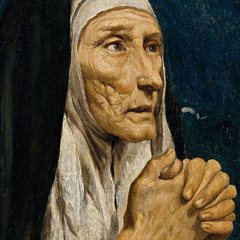 Monica
 His mother, honoured as St Monica. For years she wept and prayed for him. A bishop told her, “it is not possible that the son of these tears should perish.” She lived to see him baptised, and died at Ostia soon after.
Confessions, Book 3, chapter 12; Book 9, chapters 10 to 13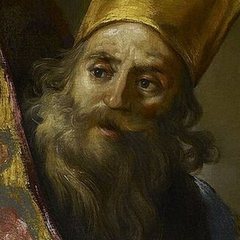 Ambrose
 Bishop of Milan. “That man of God received me like a father,” Augustine wrote. Ambrose baptised him at Easter 387. Years later Augustine still kept rules he had learned from Ambrose: never find a wife for another man, and never urge anyone to join the army.
Confessions, Book 5, chapter 13; Possidius, Life, chapters 1 and 27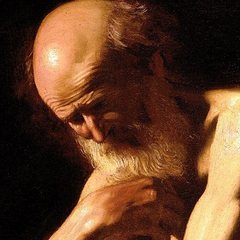 Jerome
 Jerome and Augustine wrote to each other for more than twenty years. Augustine questioned how Jerome read Galatians, and his new translation of the Old Testament from the Hebrew. The early letters were sharp. By 418 Jerome was praising him warmly.
Augustine, Letters 28, 40, 72, 82 and 195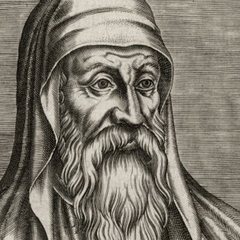 Origen
 Augustine rejected Origen's hope that even the devil and his angels would be freed in the end. He wrote that “Origen was even more indulgent” than those Christians of his own day who hoped that all would be freed, and that the Church, “not without reason, condemned him for this and other errors”.
City of God, Book 21, chapter 17 John Cassian
 Cassian and his fellow monks in southern Gaul resisted Augustine's teaching on grace. The Catholic Encyclopedia calls Cassian “the soul and head of the whole movement”. About 433, after Augustine's death, Augustine's defender Prosper of Aquitaine wrote a book against him.
Catholic Encyclopedia, SemipelagianismHis father, a pagan and a town councillor of Thagaste. His wife Monica won him to faith near the end of his life.
Confessions, Book 2, chapter 3; Book 9, chapter 9; Possidius, Life, chapter 1His son, born to the woman he lived with for years. He was baptised with his father at fifteen, and died young, a year or two later. Augustine wrote of him, “of me was there naught in that boy but the sin”. The rest, he says, was God's gift.
Confessions, Book 9, chapter 6His closest friend, from Thagaste. He was with Augustine in a garden at Milan when Augustine turned to Christ. He read on from the same page, and turned to Christ that day too. They were baptised together. He became bishop of Thagaste.
Confessions, Book 8, chapter 12; Roman Martyrology (1916), 15 AugustA monk of his house who became bishop of Calama. He tells of a bishop of Calama wounded in a Donatist ambush, without saying it was himself. He stayed in Hippo through the Vandals' siege and wrote the first Life. They were friends for almost forty years, “with no bitter disagreement”.
Possidius, Life, chapters 12 and 31A monk who came to Africa after the Goths took Rome. His followers were condemned at Carthage in 412 for attacking the teaching of original sin. He could not bear Augustine's prayer “Give what You command, and command what You will” when a bishop quoted it to him in Rome. Augustine wrote against his teaching for almost ten years.
On the Gift of Perseverance, chapter 53; Possidius, Life, chapter 18; Catholic EncyclopediaA rival church in Africa, which baptised again anyone who came to it from the Catholics. Their armed bands, the Circumcellions, lay in wait for him on the roads more than once. One time his guide took the wrong road by mistake, and so he escaped.
Possidius, Life, chapters 9 to 12how he died
He died of a fever on 28 August 430, in the third month of the Vandal siege of Hippo. He was 75.
The Vandals had crossed from Spain and laid Africa waste. Of all the churches of Africa, his friend Possidius says, Augustine saw only three still standing: Carthage, Hippo and Cirta. Possidius and other bishops took refuge with him in Hippo.
At table one day he told his friends what he was asking of God, and they all joined in his prayer. In the third month of the Vandals' siege he fell ill with a fever.
He had the shortest penitential psalms copied and hung on the wall by his bed. He read them and wept. For his last ten days he asked to be left alone to pray, except when the doctors came or food was brought.
He preached until his last illness. His sight and hearing were sound to the end, and he died with his friends beside him, “while we stood by and watched and prayed”. He made no will, because he owned nothing. He asked again and again that the church's library be kept safe for the future.
His prayer during the siege
I would have you know that in this time of our misfortune I ask this of God: either that He may be pleased to free this city which is surrounded by the foe, or if something else seems good in His sight, that He make His servants brave for enduring His will, or at least that He may take me from this world unto Himself.
Said at table to his friend Possidius and the other bishops sheltering with him in Hippo. Possidius adds, “In truth the Lord did not deprive His servant of the reward of his prayer.”
is he a saint?
Yes to Catholics and Anglicans, and Lutherans remember him. The Orthodox keep him on their calendar as Blessed Augustine, and Greek calendars call him Saint.
- CatholicSaintA Doctor of the Church. Memorial on 28 August
- OrthodoxBlessedOn the calendar on 15 June. Saint in Greek calendars
- AnglicanSaintA Lesser Festival in the Church of England, 28 August
- LutheranRememberedMissouri Synod and ELCA, 28 August
Catholics count him one of the four great Doctors of the Latin Church, with Ambrose, Jerome and Gregory the Great. In 1298 Pope Boniface VIII ordered the feasts of all four kept across the whole Church.
Some Orthodox say he was never a saint, because of his teaching on predestination. The Orthodox Church in America (OCA) was asked about it. It answered that he is on the Orthodox calendar, and that a Moscow Patriarchate calendar lists him among the saints' names given at baptism. Among the Orthodox, “Blessed” is a title, not a step before sainthood, as with Blessed Xenia of St Petersburg. The OCA adds that there is no record of a formal glorification, and that the Orthodox glorify saints in a different way. Its hymn for his day calls him “a lover of prayer, and a pillar of repentance”.
Blessed Augustine is respected in the Orthodox Church as a teacher, because of his wonderful defense of the Church's teachings against the various heresies of his time, but because of his errors in his teachings about predestination in the salvation of man, he was never considered a saint.
…in terms of a formal “canonization” or “glorification” of Augustine by the Orthodox Church there is of course no record
…the birthday of St. Augustine, bishop and famous doctor of the Church. Converted and baptized by the blessed bishop Ambrose, he defended the Catholic faith with the greatest zeal against the Manicheans and other heretics…
a prayer he wrote
From the prayer that opens his Soliloquies, written soon after his conversion, in 386 or 387.
God, from Whom to be turned away, is to fall: to Whom to be turned back, is to rise again: in Whom to abide, is to stand firm. God, from Whom to go forth, is to die: to Whom to return, is to revive: in Whom to have our dwelling, is to live. God, Whom no one loses, unless deceived: Whom no one seeks, unless stirred up: Whom no one finds, unless made pure.
what to read first
Confessions
Augustine
His own story, told to God, from infancy to his mother's death. Books 1 to 9 are the story. Books 10 to 13 turn to memory, time and Genesis.
Read it freeThe Life of Augustine
Possidius
By a friend of almost forty years who was with him at the end. Short.
Read it freeThe City of God
Augustine
Twenty-two books, begun after Rome was sacked in 410. Book 14, chapter 28 is the heart of it.
Read it freeHomilies on the First Epistle of John
Augustine
Ten sermons on love. Homily 7 has “Love, and do what thou wilt”.
Read them freetake the quizzes
 Quiz Which early Christian thinks like you? And which would argue with you? See where you stand beside Augustine. Start
  Quiz Christian Personality Test Augustine reads as The Spark as a young man. Find your own type. Start
 people like him
 Philip NeriThe Spark
 Philip's biographer says he had “a very lively temperament, and without the least tendency to melancholy”. Philip hated idleness so much “that no one ever found him unemployed”. He welcomed all who came, rich and poor alike, and his room became known as “the Shelter of Christian Mirth”.
Pietro Giacomo Bacci, Life of St Philip Nerisources
His life, and his words
- Augustine, Confessions. Tr. J. G. Pilkington, in Schaff's Nicene and Post-Nicene Fathers.
- Possidius, Life of St. Augustine. Tr. Herbert T. Weiskotten, 1919.
- Augustine, City of God. Tr. Marcus Dods. Also on New Advent.
- Augustine, Letters. Tr. J. G. Cunningham. Letters 72 and 195 are Jerome's.
- Augustine, Sermons on the New Testament. Tr. R. G. MacMullen.
- Augustine, Expositions on the Psalms. Tr. J. E. Tweed.
- Library of the Fathers, vol. 39, Augustine on the Psalms, Oxford, 1857. For Psalm 147.
- Augustine, Homilies on the First Epistle of John. Tr. H. Browne.
- Augustine, Tractates on the Gospel of John. Tr. John Gibb.
- Augustine, On the Trinity. Tr. A. W. Haddan.
- Augustine, Soliloquies. Tr. C. C. Starbuck.
- Augustine, On Christian Doctrine. Tr. J. F. Shaw.
- Augustine, Enchiridion. Tr. J. F. Shaw.
- Augustine, On Lying. Tr. H. Browne.
- Augustine, Of the Good of Marriage. Tr. C. L. Cornish.
- Augustine, On the Gift of Perseverance. Tr. Peter Holmes and Robert Ernest Wallis.
- Augustine, Answer to Petilian the Donatist, Book 2. Tr. J. R. King, rev. Chester D. Hartranft.
- Augustine, Sermon 68, in Latin. The line on nature under Where he stood is our translation.
- Augustine, Retractations, Book 2, in Latin, for the count of his works
- The Latin text of the Confessions, Book 1
- Pietro Giacomo Bacci, Life of St Philip Neri. Tr. F. I. Antrobus, 1902.
Reference
- Catholic Encyclopedia, 1907, “Life of St. Augustine of Hippo”
- Catholic Encyclopedia, “Doctors of the Church”
- Catholic Encyclopedia, “Semipelagianism”
- Catholic Encyclopedia, 1912, “Te Deum”
- Britannica, “Saint Augustine”
- OCA, Questions and Answers, “St. Augustine & Original Sin”
- Merriam-Webster, “Augustine” and “Hippo”, for how to say them
- Quote Investigator, on “The world is a book”, 2025
- James J. O'Donnell, “A common quotation from Augustine?”
- Fr John Zuhlsdorf, on “He who sings prays twice”, 2006
- Trent Horn, Catholic Answers Magazine, “St. Ignatius Said What?”, 2019
- Francis X. Maier, First Things, “Hope and Her Daughters”, 2021
- Shari Boodts, Medievalists.net, “The child by the seaside”, 2019
- International Theological Commission, “The Hope of Salvation for Infants Who Die Without Being Baptised”, 2007
- Pierre Bayle, A Philosophical Commentary on Luke 14:23, the part on Augustine's letters. English translation, London, 1708.
Calendars
- USCCB, Liturgical Calendar 2026
- Catholic Culture, 28 August 2026
- The Roman Martyrology, 1916 edition
- OCA, Blessed Augustine, Bishop of Hippo
- OCA, Troparion and Kontakion
- saint.gr, Greek
- Church of Cyprus, Greek
- azbyka.ru, Russian
- Church of England, Common Worship calendar
- The Episcopal Church, Lesser Feasts and Fasts 2022
- LCMS, Commemorations
- Evangelical Lutheran Worship, ELCA, the church year
Pictures
- Saint Augustine, Philippe de Champaigne, about 1645-1650. Los Angeles County Museum of Art. Public domain.
- Saint Augustine of Hippo. Line engraving by N. Dossier after A. Dieu (the Wellcome Collection now names the engraver Michel Dossier), published by N. de Poilly, Paris, about 1734 to 1750. Wellcome Collection, V0031648. CC BY 4.0.
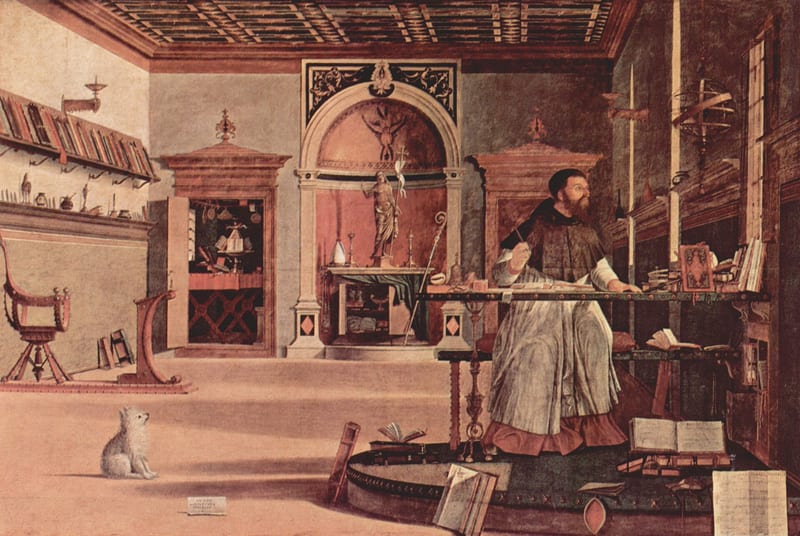
- St Augustine in His Study, also called the Vision of St Augustine, Vittore Carpaccio, 1502. Scuola di San Giorgio degli Schiavoni, Venice. Public domain.