
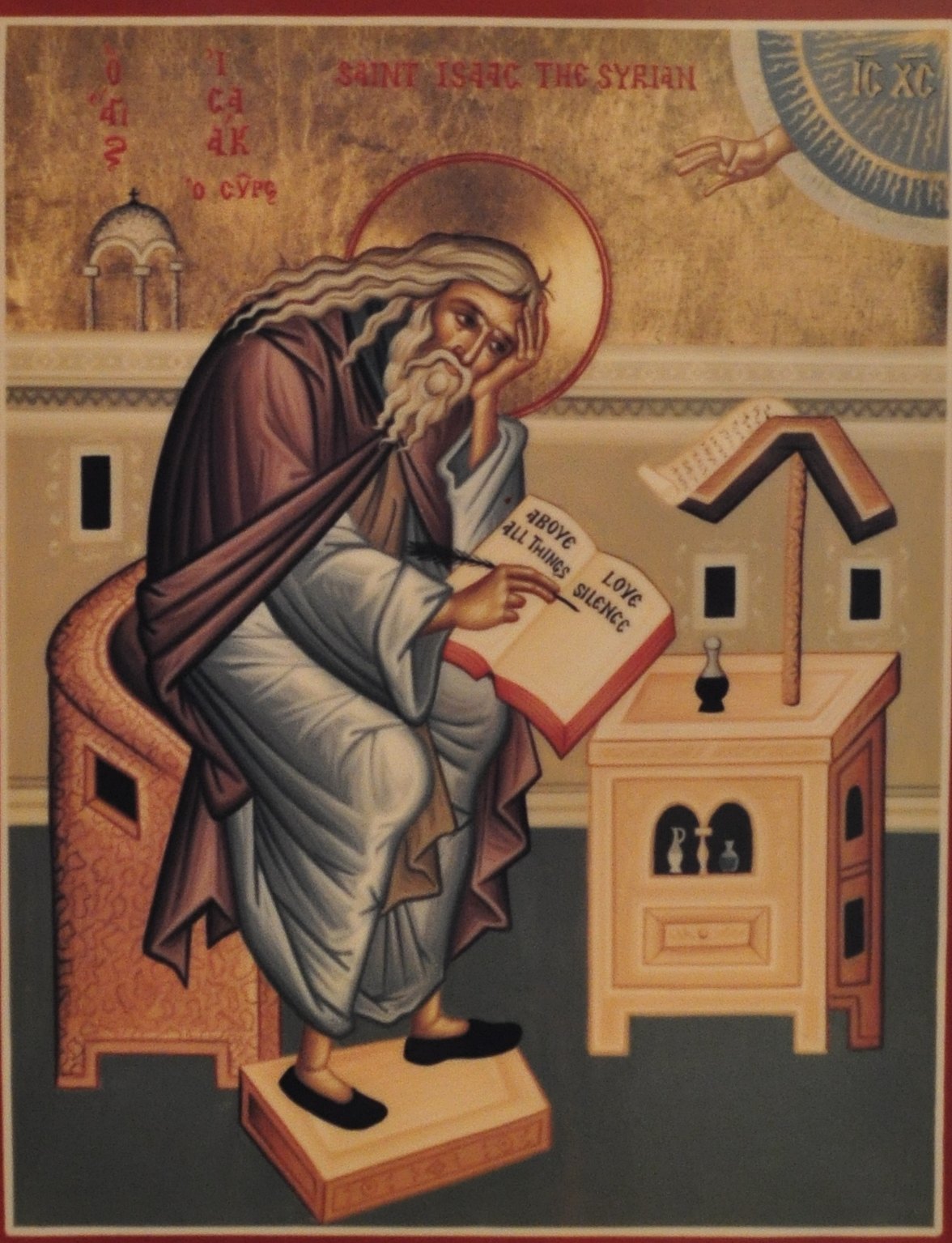
Isaac the Syrian
Bishop of Nineveh for five months, then a hermit whose writings are now read across the churches.
Picture: Saint Isaac the Syrian, a modern icon. Photo: Ted (bobosh_t) on Flickr, CC BY-SA 2.0.
Who was Isaac?
Isaac was a monk from Beth Qatraye, on the Gulf coast of Arabia. In the late 600s he was made bishop of Nineveh, in today's Iraq. He gave it up after five months and became a hermit in south-west Iran, where he went blind. His writings on prayer, silence and mercy are read across the churches.
at a glance
His path, in order
- MonkAnd a teacher, in Beth Qatraye
- BishopOf Nineveh, for five months
- HermitIn the mountains of south-west Iran
- WriterBlind; his fellow monks wrote down his teaching
in numbers
- Months as bishop of Nineveh5
- Some time between 676 and 680
- Then he gave up the post to be a hermit in the mountains
- Loaves he ate a week3
- With small vegetables
- Never anything cooked
- Latin manuscripts that survive60+
- Of his book, in a version made around 1200
- Widely read in Europe from the 1200s
did you know?
-
He wrote that wild beasts grow tame when a humble man comes near. They wag their tails and lick his hands and feet. They smell on him, he says, the smell Adam had before the Fall, which Christ gave back to us.
Ascetical Homilies, chapter 82 -
One of his chapters is a run of blunt sayings. Sit with vultures rather than with the greedy, it says, and among lions rather than among the proud. Better a pig's company than a chatterer's.
Ascetical Homilies, chapter 50 -
In 2012 the Assyrian Church of the East opened a monastery named after him in Salida, California. The bishop who opened it, Mar Awa, became that church's patriarch in 2021. In 2024 he was beside Pope Francis when Rome added Isaac to its Martyrology.
Assyrian Church News, 2012 and 2021; Holy See Press Office, 2024
- Born
- Some time in the 600s. No year is recorded. At Beth Qatraye, on the Gulf coast of Arabia, today Qatar and its neighbours.
- Grew up
- In Beth Qatraye. He studied the Church's writings and their commentaries there. Nothing is recorded of his parents.
- Died
- Around 700, old and blind, at the monastery of Rabban Shabur, near Shushtar in south-west Iran. No day or year is recorded.
- Buried
- In the monastery of Rabban Shabur, where he died.
- Also called
- Isaac of Nineveh, the name Rome and scholars use. Isaac Sirin in Russian. Abba Isaac in Greek. His fellow monks called him the second Didymus, for his gentleness.
- Status
- A saint to the Orthodox. The Catholic Church added him to its Roman Martyrology in 2024. In life he was a bishop of the Church of the East.
- In art
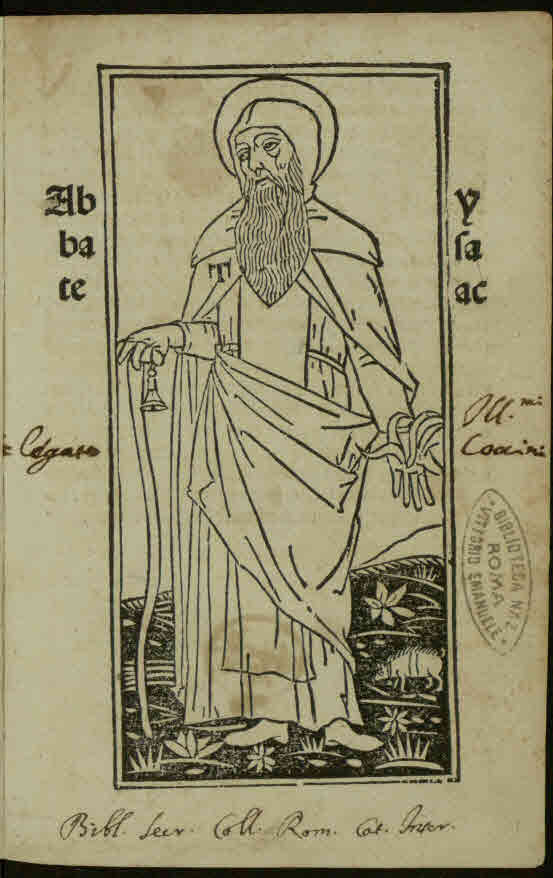
- A woodcut in a Venice book of 1500 shows him as a hooded abbot. It gives him the signs usually given to St Antony: a tau cross, a staff with a bell, and a pig at his feet.
- Wrote
- Short discourses in Syriac, for monks living alone. Three Parts are known. Much of the First, of 82 chapters, was put into Greek and read everywhere. In English it is usually called the Ascetical Homilies. A Second Part, of 41 chapters, and a Third, of 17, have come to light in modern times.
- Pronounced
- EYE-zik the SEER-ee-un. Or EYE-zik of NIN-uh-vuh.
feast days
East
- Jan28
OCA (the Orthodox Church in America), beside Ephrem the Syrian. Also the Russian Church, on the old calendar. That is 10 February on today's calendar.
- Sep28
Greek churches and Mount Athos. St Paisios, a 20th-century monk of Mount Athos, chose this day.
Why two dates? The Greek calendar had no official day for him. By custom he was remembered on 28 January, beside Ephrem. St Paisios of Mount Athos had a service written for him and chose 28 September. In the West, the Catholic Church added him to its Roman Martyrology in 2024, but the texts that announced it give no day. Many websites say 28 January, but we found no Church text that does. He is not in the Anglican, Episcopal or Lutheran calendars.
what was he like?
+merciful to every creature
He passed on an old monk's teaching and made it his own. The sum of purity, it says, is “a heart full of mercy unto the whole created nature”. Such a heart prays with tears even for the reptiles, and for those who do it harm.
Ascetical Homilies, chapter 74+gentle and humble
His fellow monks nicknamed him the second Didymus, “because he was placid and kind and humble, and his speech was meek”. He said he had not lived “one thousandth of what I have written with my hands”.
The second early notice; Ascetical Homilies, chapter 22+slow to judge
He told monks not to scold anyone, “not even those who are very evil in their behaviour”. Weep for the sinner instead, he said, and pray for him, “that thou mayest resemble Christ, Who was not angry with sinners but prayed on their behalf”.
Ascetical Homilies, chapter 50+generous without asking
He told monks to give without sorting people out: “Do not make any distinction between the rich and the poor nor know who is worthy and who is not worthy. Deem all men worthy of bounty on thy part.”
Ascetical Homilies, chapter 4+hard on himself
Three loaves a week, nothing cooked, and reading until he went blind. His own brother, a monk too, begged him by letter to come and visit. Isaac wrote back: “Do not ask from me, o my brother, what gives consolation to body and mind, but let me seek the salvation of my soul.”
Ascetical Homilies, chapter 42+in love with silence
“Silence is a symbol of the future world,” he wrote. “Speech is an organ of this world.” Yet he did not tell monks to shun people: “Be a friend of all men, but a solitary in thy mind.”
Ascetical Homilies, chapters 66 and 50+tired of church quarrels
His own church was in communion with no other. Still, he warned monks against “reading books which accentuate the differences between the confessions, with the aim of causing schisms”.
Ascetical Homilies, chapter 4what others said of him
Almost all we know of his life comes from two short notices. One is by Isho'dnah of Basra, in the 800s. The other is by an unknown writer, and was printed by the scholar Rahmani. Isaac says very little about himself. After gathering it all, his translator Wensinck wrote: “the real man is in his book.”
He penetrated deeply into the divine mysteries and wrote books on the divine behaviour of solitaries.
For we confess that we are pupils of Mar Isaac the bishop of Ninive.
…had somehow got hold of a copy of the sayings and sermons of “the God-fearing Father Isaac the Syrian,” which he read persistently for years together, understanding very little of it, but perhaps prizing and loving it the more for that.
Isaac's writings possess passages of singular beauty and elevation, and remind the reader of Thomas à Kempis.
His teaching lays great emphasis on the immensity of divine love and on the need for humanity to respond to this with wonder and humility.
his life in six moments
Beth Qatraye, today Qatar
The 600sA monk on the Gulf
Isaac was born on the Arabian shore of the Gulf. He studied the Church's writings and their commentaries. Then he became a monk and a teacher in his own country. About 676 George, head of the Church of the East, came to Beth Qatraye. When George went home, he took Isaac with him to Beth Aramaye, in today's Iraq.
The second early notice; Brock, e-GEDSHNineveh, by today's Mosul
Some time from 676 to 680Bishop for five months
George, head of the Church of the East, made him bishop of Nineveh, in the monastery of Beth Abe. Five months later he gave it up. Isho'dnah of Basra, writing in the 800s, says only that it was “for a reason which God knows”. An early account by an unknown writer says that “because of his keen mind and his zeal, he could endure the pastoral function for five months only”. In Isaac's own book, a hermit asks God, “Perhaps, my Lord, grace has been withdrawn from me on account of my episcopal rank?” The answer was no: in the desert God had provided for him, and now men did. His translator took the hermit to be Isaac himself.
Isho'dnah; the second notice; Ascetical Homilies, chapter 35Mount Matut, south-west Iran
After he left NinevehAmong the hermits
He climbed the mountain of Matut in Beth Huzaye, in today's south-west Iran. There he “lived in solitude among the anchorites who were there”. An early account by an unknown writer adds that a man it calls Papa gave him leave to go.
Isho'dnah; the second noticeRabban Shabur, near Shushtar
Late 600sBlind, and dictating
Later he moved to the monastery of Rabban Shabur. There he came to know the Scriptures deeply. His reading and his hard way of life cost him his sight. After that his fellow monks wrote down his teaching. He ate three loaves of bread a week, with small vegetables, and never anything cooked. His translator Wensinck adds, without giving a source, that he slept sitting up.
Isho'dnah; the second notice; Wensinck, IntroductionRabban Shabur
Late 600sThree disputed sayings
He said three things that others would not accept. Daniel bar Tubanitha, bishop of Beth Garmai, took offence. What the three were is not known. Isho'dnah of Basra, who wrote of him in the 800s, adds: “I think that envy was aroused against him by people of the country”. Centuries later, a catalogue of writers says Daniel wrote a “Solution of the difficulties in the writings of Mar Ishak of Nineveh”.
Isho'dnah; 'Abdisho', tr. Badger; Catholic EncyclopediaMar Saba, near Jerusalem
Late 700s to todayThe book that crossed every border
His church was in communion with no other. Yet in the late 700s or early 800s, two monks of Mar Saba, a Greek monastery near Jerusalem, put much of his First Part into Greek. From there it went into Slavonic, Latin and many more tongues. More than sixty manuscripts survive of a Latin version made around 1200, and an Italian one was printed at Venice in 1500. In 1880 Dostoevsky put his book in the hands of an old servant in The Brothers Karamazov. In 2024 the Catholic Church added Isaac to its Martyrology.
Brock, e-GEDSH; Catholic Encyclopedia; Holy See, 2024; L'Osservatore Romano, 2025
his words
Isaac wrote in Syriac. These lines are from A. J. Wensinck's English of 1923, made from the Syriac. The chapters are numbered as in the Syriac. English versions made from the Greek number them differently.
Asked what a merciful heart is
The burning of the heart unto the whole creation, man, fowls and beasts, demons and whatever exists; so that by the recollection and the sight of them the eyes shed tears on account of the force of mercy which moves the heart by great compassion.
An old monk's answer, which Isaac makes his own. It is the line he is best known for.
Ascetical Homilies, chapter 74Be on peaceful terms with thy soul; then heaven and earth will be on peaceful terms with thee. Be zealous to enter the treasury within thee; then thou wilt see that which is in heaven. For the former and the latter are one, and entering thou wilt see both. The ladder unto the Kingdom is hidden within thee and within thy soul. Dive into thyself [freed] from sin; there thou wilt find steps along which thou canst ascend.
As a handful of sand thrown into the ocean, so are the sins of all flesh as compared with God's mind. As a fountain that flows abundantly is not dammed by a handful of earth so the mercy of the Creator is not vanquished by the wickedness of the creatures.
But I say: if the merciful be not even above justice, he is not merciful.
This life has been given thee for repentance; do not spend it with various things.
There is no prayer which is heard so soon as when a man asks to be reconciled with those who are angry with him. And when a man charges himself with the fault, this prayer is answered without delay.
Oft when I was writing these things, my fingers paused on the paper. They could not bear the delight which had fallen into the heart and which made the senses silent.
often misquoted
He resigned as bishop over a debt. He asked a lender to give a debtor more time, and the man told him: “Leave your Gospel out of this!”
What the sources sayA later story, from the Arabic tradition, which the Orthodox Church in America (OCA) still tells. The earliest account of his life says only that he resigned “for a reason which God knows”. His translator judged the debt story this way: “It has, however, the value of an anecdote only.”
Isho'dnah; Wensinck, Introduction; OCAHe lived in the 500s, was a monk of Mar Matthew near Nineveh, and went to the desert of Scetis in Egypt.
What the sources sayThat is an old account, which the Orthodox Church in America (OCA) and azbyka.ru still give. Both early accounts of his life put him under George, head of the Church of the East, in the later 600s, and scholars follow them. The Catholic Encyclopedia thought the older account was made up by a rival church, “eager to claim so great a writer”.
Catholic Encyclopedia; Brock, e-GEDSH; OCAHe is the Syrian hermit Isaac in Gregory the Great's Dialogues, or Isaac of Antioch.
What the sources sayThree different men. Gregory's Isaac came “out of Syria to the city of Spoleto” in Italy, in the 500s. Isaac of Antioch was a priest of the 400s. An Italian version of Isaac the Syrian's book was even credited to Gregory's Isaac, of Spoleto.
Gregory, Dialogues, Book 3, chapter 14, with Gardner's note; Catholic EncyclopediaOnly 82 chapters of his survive, and he was a monk from Kurdistan.
What the sources sayBritannica says both, but it is out of date. A Second Part of 41 chapters and a Third of 17 have since come to light. Beth Qatraye, where he was born, is the Gulf coast of Arabia. The monastery in Kurdistan, Beth Abe, is where he was made bishop.
Britannica; Brock, e-GEDSHEverything under his name in the Greek Ascetical Homilies is his.
What the sources sayNot quite. The Greek also carries three short works by John of Dalyatha and a shortened letter of Philoxenos under his name. A work called the Book of Grace has been wrongly credited to him too.
Brock, e-GEDSHHe wrote that a merciful heart burns with love for every creature.
What the sources sayThe passage is real, but the word love is not in it. The heart burns “unto the whole creation”. It is an old monk's answer, which Isaac makes his own. In the Syriac it is chapter 74. English versions from the Greek number it differently.
Ascetical Homilies, chapter 74where he stood
Each line is his own, from A. J. Wensinck's English of 1923. His plainest lines on whether hell will end are in the next section. TapClick “Show his line” to read it.
Your answers are next to his. From your result on . See your result
“A good hearty laugh is good for the soul.”
Isaac disagrees.
You
Show his line
Be not friends with one that loves laughter and derision.Ascetical Homilies, chapter 50
“Most of the time, it's better to say less.”
Isaac strongly agrees.
You
Show his line
Love silence above all things. It brings thee near the fruit which the tongue is too weak to interpret.Ascetical Homilies, chapter 65
“Anger at real wrongdoing can be a good thing.”
Isaac strongly disagrees.
You
Show his line
A zealous man will never reach peace of mind. And he that is destitute of peace is also destitute of gladness. Peace of mind is called complete health, zeal is the contrary of peace.Ascetical Homilies, chapter 50
“If you had to choose, you'd grow closer to God alone in quiet than among other people.”
Isaac strongly agrees.
You
Show his line
Love the ease of solitude rather than satisfying the hunger of the world and the converting of the multitude of heathen peoples from error unto adoring God.Ascetical Homilies, chapter 4
“If someone you know is doing wrong, it's your job to tell them.”
Isaac strongly disagrees.
You
“Nature can teach you as much about God as the Bible can.”
Isaac strongly agrees.
You
Show his line
The first book given by God to the rational beings, is the nature of the created things. Written teachings have been added only after aberration.Ascetical Homilies, chapter 5
“Your body is a friend to look after, not an enemy to fight.”
Isaac strongly disagrees.
You
Show his line
The knowledge of God does not dwell in a body that loves comfort.Ascetical Homilies, chapter 6
“Some questions about God are better left alone.”
Isaac agrees.
You
Show his line
By faith we are instructed about those unattainable things, not by investigation and the power of knowledge.Ascetical Homilies, chapter 51
“If you believe God is calling you, follow, even if your family begs you not to.”
Isaac strongly agrees.
You
On record in the Ascetical Homilies. Not quoted here.
“Becoming a better person is mostly down to your own effort.”
Isaac disagrees.
You
Show his line
For the help of God is necessary for deliverance. When he knows that he needs divine help, he will frequently pray. And by much beseeching the heart becomes humble.Ascetical Homilies, chapter 8
“In the end, God will save everyone.”
Isaac strongly agrees.
You
Show his line
The retribution of the sinners is this, that He repays them with resurrection instead of with justice.Ascetical Homilies, chapter 50
See where you stand beside him. Take the quiz
hard questions
Where Isaac is questioned, in the words of both sides.
Which church was he in?
He was a bishop of the Church of the East, whose head sat at Seleucia-Ctesiphon. It had not accepted the Council of Ephesus of 431. The Catholic Encyclopedia of 1910 calls him “A Nestorian bishop”. Yet it thinks the three sayings that caused offence in his lifetime “were of too Catholic a character to be compatible with Nestorian heresy”. He praised Theodore of Mopsuestia, whom a council condemned in 553. His translator found a passage in the Syriac that “looks like a Nestorian addition”, and it is missing from the Greek. In 2024 the Vatican said he belonged to “a Church that was no longer in communion with any other”.
Catholic Encyclopedia; Wensinck's note to chapter 33; Holy See, 2024Will hell end?
He wrote that sin had a beginning and will have an end. Hell too had a beginning, “but its end is not known”. Even those in hell, he says, “are tormented with the scourgings of love”. In the First Part of his writings he does not say plainly that hell will end. Our quiz Which early Christian thinks like you? shows one line of his. It speaks of grace at the resurrection. The lines below are plainer.
“Sin, hell and death do not at all exist with God. For they are facts, not persons. Sin is the fruit of will. There was a time, when it was not. And there will be a time, when it will not be. Hell is the fruit of sin; at some time or other it had beginning; but its end is not known.”Ascetical Homilies, chapters 26 and 27
Will all be saved?
His Second Part says more openly that hell will end. Those chapters came to light in modern times. Sebastian Brock put them into English in 1995. Metropolitan Hilarion Alfeyev, an Orthodox bishop, wrote a book on Isaac. He calls him one of the greatest theologians of the Orthodox tradition. He does not doubt that Isaac hoped all would be saved. He says this hope is not the same as Origen's teaching, which a council condemned in 553. But he adds a caution:
“The teaching on universal salvation, which is so explicitly preached by Isaac the Syrian, has never been approved by the Orthodox Church.”Hilarion Alfeyev, St Isaac the Syrian, a Theologian of Love and Mercy, a paper given in Rome in 2008, the part on eschatology
Too hard on monks?
He asked a great deal of monks. He praised hermits who kept their fast while “feeding upon drugs and dry stubble”. He tells of a recluse who would not go to his dying brother, saying, “should I then honour nature above Christ?” He told a monk who had given everything up that his “rank is higher than that of almsgivers”. But he also held up Macarius the Great, who at ninety walked more than forty miles to bring a sick man fresh bread. And he wrote this:
“But if he see the brother according to the flesh and to profession, in trouble, or rather: Christ rejected and vexed, and he flee and hide himself, pretending a sham solitude — he that acts thus, is without mercy.”Ascetical Homilies, chapters 36, 41, 4 and 81
A later story
Some Orthodox hold that he was fully Orthodox. A book about St Paisios of Mount Athos, a monk of the 20th century, reports one testimony. In it, Paisios sees the holy fathers pass before him in a vision. One of them stops and says: “I am Isaac the Syrian. I am completely Orthodox.” The book itself adds: “We are not in a position to endorse or to reject the reliability of this witness.”
Hieromonk Isaac, Elder Paisios of Mount Athos (2012), as quoted by OrthoChristianfriends, family and rivals
 Abba Arsenius
 A desert father who shunned company. Isaac tells how Arsenius sat with visiting fathers and brothers in silence, and sent them away in silence.
Ascetical Homilies, chapters 41 and 65Head of the Church of the East. He brought Isaac north from the Gulf and made him bishop of Nineveh.
Isho'dnah; the second noticeA relative of Isaac's, says an early account of his life by an unknown writer. It calls him the “commentator of the church”.
The second early noticeThe bishops of Nineveh before and after him. Sabrisho also left the post, to live as a hermit.
Isho'dnahBishop of Beth Garmai. Three things Isaac said scandalised him. He also wrote a book on the difficulties in Isaac's writings.
Isho'dnah; 'Abdisho', tr. BadgerBishop of Mopsuestia, who died in 428. His writings stood high in Isaac's church. Isaac never met him, but cites him often and calls him “the light of the whole world”.
Ascetical Homilies, chapter 19; Wensinck, Introduction; Catholic EncyclopediaOlder writers he quotes by name. Diodore is “the clever and acute Mar Diodorus of Tarsus”. Sebastian Brock, who put Isaac's Second Part into English, names Evagrius as one of two authors Isaac seems to have valued most.
Ascetical Homilies, chapters 1 and 37; Brock, e-GEDSHDesert fathers he held up to monks who looked down on others. Agathon nursed a sick stranger for six months, then said he wished he could give a leper his own body and take the leper's.
Ascetical Homilies, chapter 81A 20th-century monk who loved Isaac's book. He had a service written for Isaac and chose 28 September as Isaac's feast day.
saint.gr; OrthoChristianhow he died
He died old and blind, around 700, at the monastery of Rabban Shabur. No day, illness or last words are recorded.
Both early accounts of his life say only that he lived to a great age. Isho'dnah of Basra says he “departed this temporary life” and was buried in the monastery of Rabban Shabur. The other, by an unknown writer: “When he had grown old and had reached a high age, he departed unto our Lord.”
The year of his death is not recorded. Britannica puts it about 700.
is he a saint?
Yes. The Orthodox honour him as a saint, and the Catholic Church added him to its Roman Martyrology in 2024.
- OrthodoxSaint28 January, or 28 September on Athos
- CatholicSaintIn the Roman Martyrology since 2024
- Church of the EastHonouredHis own church. He was one of its bishops
- AnglicanNot rememberedNot in Common Worship or Lesser Feasts and Fasts
- LutheranNot rememberedNot in the Missouri Synod or ELCA calendars
His own church was cut off from the rest. Even so, the Vatican says, monks of every tradition soon counted him among their saints and fathers.
Pope Francis announced his entry in the Martyrology on 9 November 2024, beside Mar Awa III, head of the Assyrian Church of the East. He called Isaac “one of the most venerated Fathers of the Syro-Oriental tradition, acknowledged as a teacher and a saint by all traditions”. It was done with the agreement of the Assyrian and Chaldean patriarchs.
The Vatican's newspaper, L'Osservatore Romano, explained in 2026 that adding him to the Martyrology is not a canonisation. The Catholic Church is recognising a holiness already proclaimed in other churches.
a prayer he wrote
He wrote prayers to Christ into his book. This one is from chapter 40.
O Christ, Who art the only strong one, blessed is the man whom Thou supportest and in whose heart are the steps towards Thee. Turn Thou, O Lord, our face away from the world by desire of Thee, so that we see it as it is, without taking shadows for truth. Throw, O Lord, zeal into our heart before death comes, that at the time of our departure we may know for what purpose our entrance in and our departure from this world have served.
what to read first
Mystic Treatises
Isaac, tr. A. J. Wensinck
His First Part in English, made from the Syriac in 1923. The Introduction gives both early notices of his life.
Read it freeThe same book, searchable
Internet Archive
Wensinck's translation with full-text search, without the Introduction.
Read it freeThe first three chapters
Wikisource
Wensinck's first three chapters, typed out. Easy to read on a phone.
Read them freeIsaac of Nineveh
The Catholic Encyclopedia, 1910
A short older overview. Some of its judgements are dated.
Read it freetake the quizzes
 Quiz Which early Christian thinks like you? And which would argue with you? See where you stand beside Isaac. Start
  Quiz Christian Personality Test Which of eight types are you? Find your own. Start
 sources
His life, and his words
- Isaac of Nineveh, Mystic Treatises. Tr. A. J. Wensinck from Bedjan's Syriac, 1923. Its Introduction gives both early notices of his life in English: Isho'dnah of Basra's and the one Rahmani printed.
- The same, on the Internet Archive. Same translation, without the Introduction.
- A second scan, on the Internet Archive. Same translation.
- 'Abdisho' bar Brikha, Catalogue of Syriac writers. Tr. G. P. Badger, The Nestorians and their Rituals, volume 2, 1852.
- Gregory the Great, Dialogues, Book 3. With Edmund Gardner's note, 1911.
- Fyodor Dostoevsky, The Brothers Karamazov. Tr. Constance Garnett, 1912.
- Isaac of Nineveh, The Second Part, chapters 4 to 41. Syriac with English by S. P. Brock, 1995 (CSCO 224 and 225).
Reference
- Catholic Encyclopedia, 1910, “Isaac of Nineveh”
- Catholic Encyclopedia, 1910, “Theodore of Mopsuestia”
- S. P. Brock, e-GEDSH, “Isḥaq of Nineveh”, Gorgias Encyclopedic Dictionary of the Syriac Heritage
- e-GEDSH, “Beth Qaṭraye”
- Hilarion Alfeyev, St Isaac the Syrian, a Theologian of Love and Mercy. A paper given in Rome, 4 April 2008; excerpts printed by Richard Beck, 2020.
- Britannica, “Isaac of Nineveh”
- L'Osservatore Romano, “Isacco di Ninive e l'itinerario di libertà che porta a Dio”, 27 January 2025
- L'Osservatore Romano, “I santi via dell'unità nel XXI secolo”, January 2026
- OrthoChristian, on St Paisios and St Isaac
- Merriam-Webster, “Isaac”, “Syrian” and “Nineveh”, for how to say it
- Assyrian Church News, “Statement on the Election of the 122nd Catholicos-Patriarch”, 11 September 2021
Calendars
- Pope Francis, address to Mar Awa III, 9 November 2024
- Holy See Press Office, Inclusion of Isaac of Nineveh in the Roman Martyrology, 9 November 2024
- OCA, Saint Isaac the Syrian, Bishop of Nineveh
- azbyka.ru, Russian
- saint.gr, Greek
- Assyrian Church News, the monastery of Mar Isaac of Nineveh
- Church of England, Common Worship calendar
- The Episcopal Church, Lesser Feasts and Fasts 2022
- Evangelical Lutheran Worship, ELCA, the church year
- Concordia Publishing House, LCMS commemorations
Pictures
- St. Isaac the Syrian Icon, photographed by Ted (bobosh_t) on Flickr. CC BY-SA 2.0.
- Abbate Ysaac, woodcut, Venice, 1500. BEIC. Public domain.
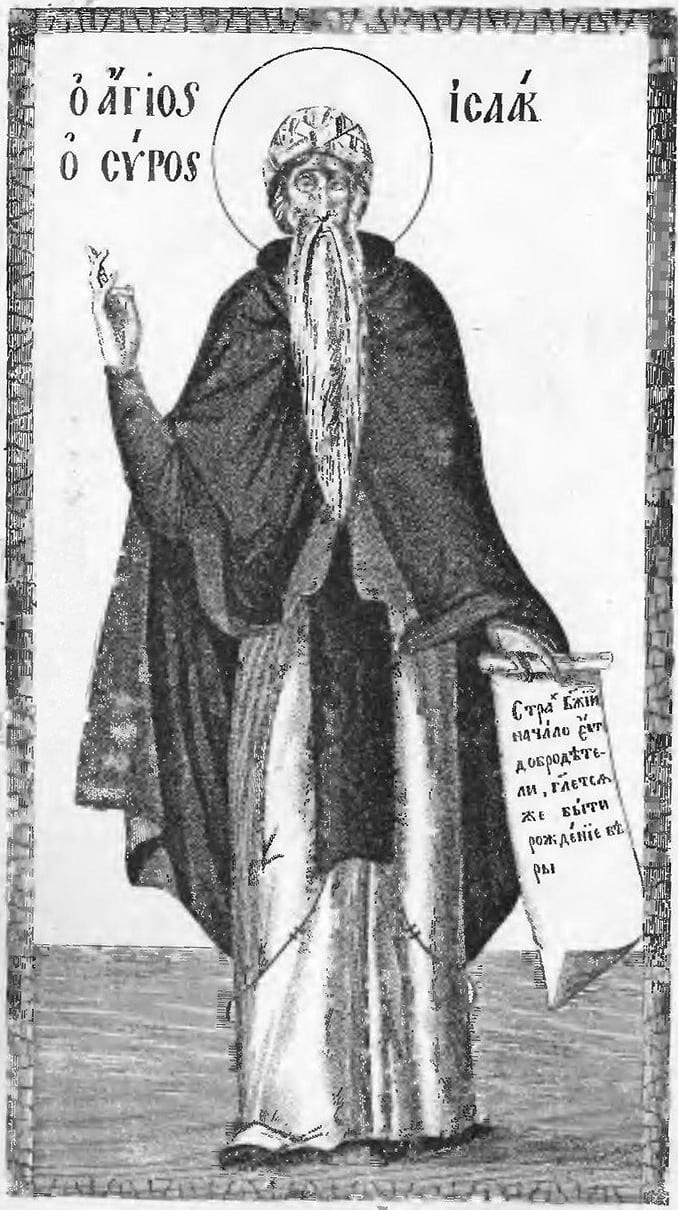
- Saint Isaac the Syrian, the frontispiece of his Ascetical Homilies in Russian (Sergiev Posad, 1911), copied from a Slavonic manuscript of 1359. Public domain.