
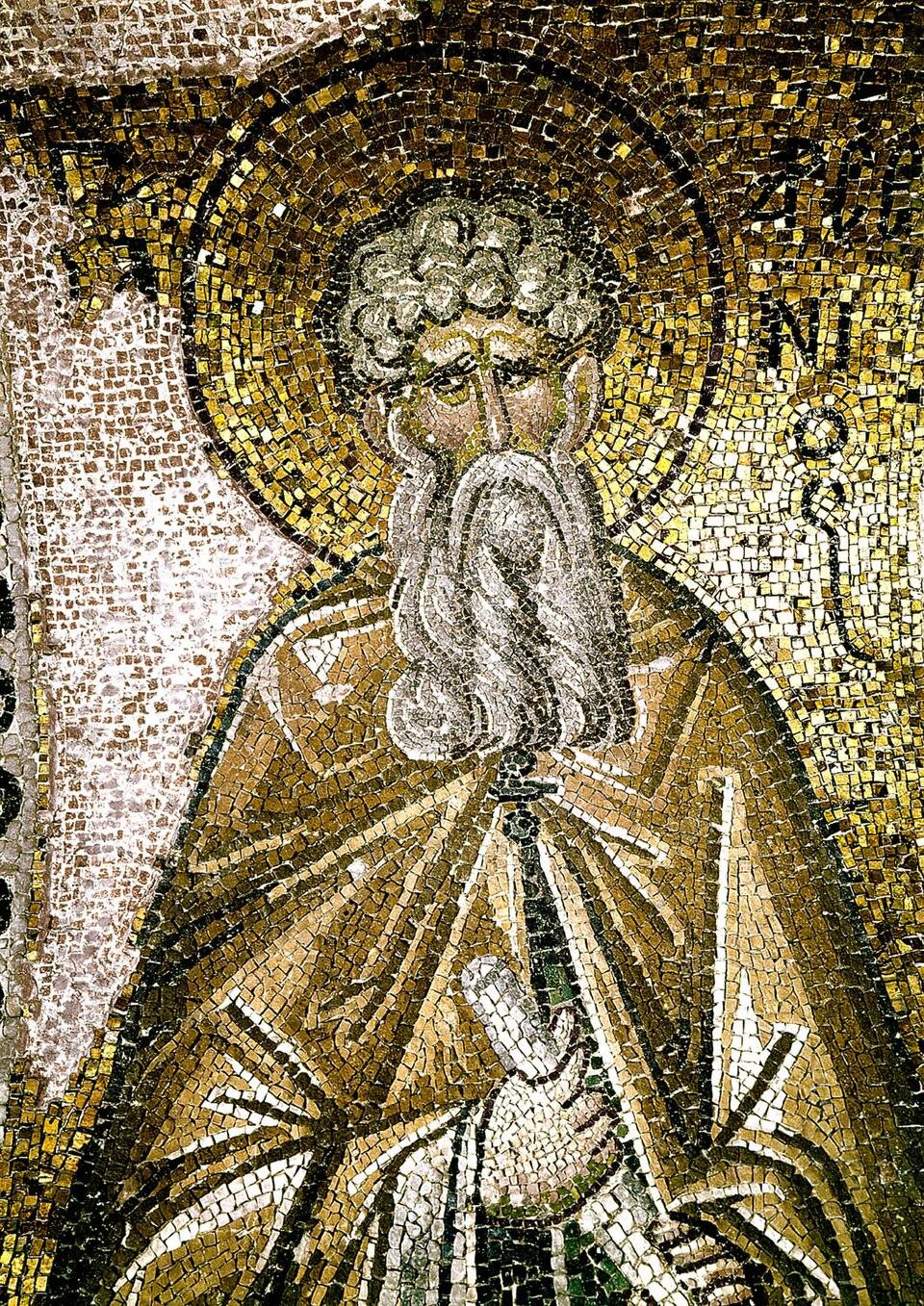
Arsenius the Great
A Roman nobleman who traded a senator's rank and 1,000 servants for a monk's hut in the desert.
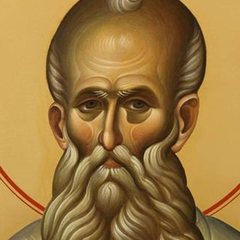
Picture: Saint Arsenius, a Byzantine mosaic in the side chapel of the Pammakaristos church, Istanbul, now the Fethiye Mosque. Photograph by the Byzantine Institute, 1949 to 1963. Dumbarton Oaks, CC0.
Who was Arsenius?
Arsenius the Great (lived from AD 354 to about 449) was a deacon of Rome who taught the sons of the emperor Theodosius the Great in Constantinople. About AD 394 he left the palace in secret to become a monk at Scetis in the Egyptian desert, where he spent 40 years and became known for his silence and his tears.
at a glance
His path, in order
- DeaconOf the Church of Rome
- TutorTo the emperor's sons, from AD 383
- MonkIn Egypt's desert, from about AD 394
- HermitAlone in a far-off hut
- ExileDriven out by raiders, about AD 434
- Last yearsBy the Nile, until about AD 449
in numbers
- Servants who waited on him at court1,000
- All richly dressed, in silk and gold
- In the desert his clothes were the poorest of all
- Years he taught the emperor's sons11
- He taught the elder son, Arcadius, from AD 383
- The younger, Honorius, joined for the last three years
- Miles from his hut to the church32
- He made the trip only on Sundays and feast days
- Other monks brought him all he needed
- Years he lived95
- He spent 40 years in the world and 40 at Scetis
- After raiders drove him out, he lived 15 more by the Nile
did you know?
-
Arsenius often prayed through the whole night. As morning came and his body begged for rest, he would tell sleep, “Get thee gone, O wicked handmaiden,” and allow himself only a very short nap before he stood up again. “One hour's sleep is sufficient for a monk,” he used to say, “provided that he be strenuous.”
The Paradise, Book 1, chapter 3 -
Arsenius ate each kind of fruit once a year. As soon as he heard that a fruit was ripe on the trees, he asked for some to be brought to him, “so that he might give thanks to God.”
The Paradise, Book 2, on the rule of life
- Born
- In Rome in AD 354, to a noble family related to senators.
- Died
- About AD 449 at Troë in Egypt, when he was 95 years old. The Catholic Encyclopedia gives the year as 450.
- Also called
- Abba Arsenius, from the word for father that monks used for their elders. Also Arsenius the Great, the name the people of his own day gave him because they admired him so much.
- Learned in
- The Scriptures, and the literature of Greece and Rome, which he read in both Greek and Latin.
- Ordained
- A deacon of the Church of Rome, living a quiet life at home with his sister when he was chosen to teach the emperor's sons.
- Taught
- Arcadius for 11 years from AD 383, and his younger brother Honorius for the last three of them. Both were sons of Theodosius and grew up to be emperors.
- Left the court
- About AD 394, when he was 40 years old. He left in secret and took a ship to Alexandria.
- Disciples
- Alexander and Zoilus, who lived near him, and later Daniel.
- His words
- Remembered by other monks and written down in the sayings of the desert fathers.
- Status
- A saint in the Orthodox, Coptic and Catholic churches.
- Looked like
- He was tall and a little stooped in old age, with white hair and a beard that reached his waist. His constant tears had worn away his eyelashes.
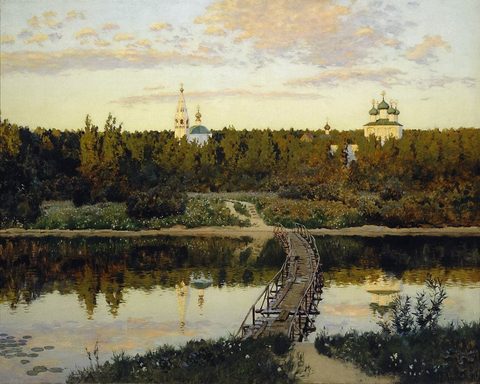
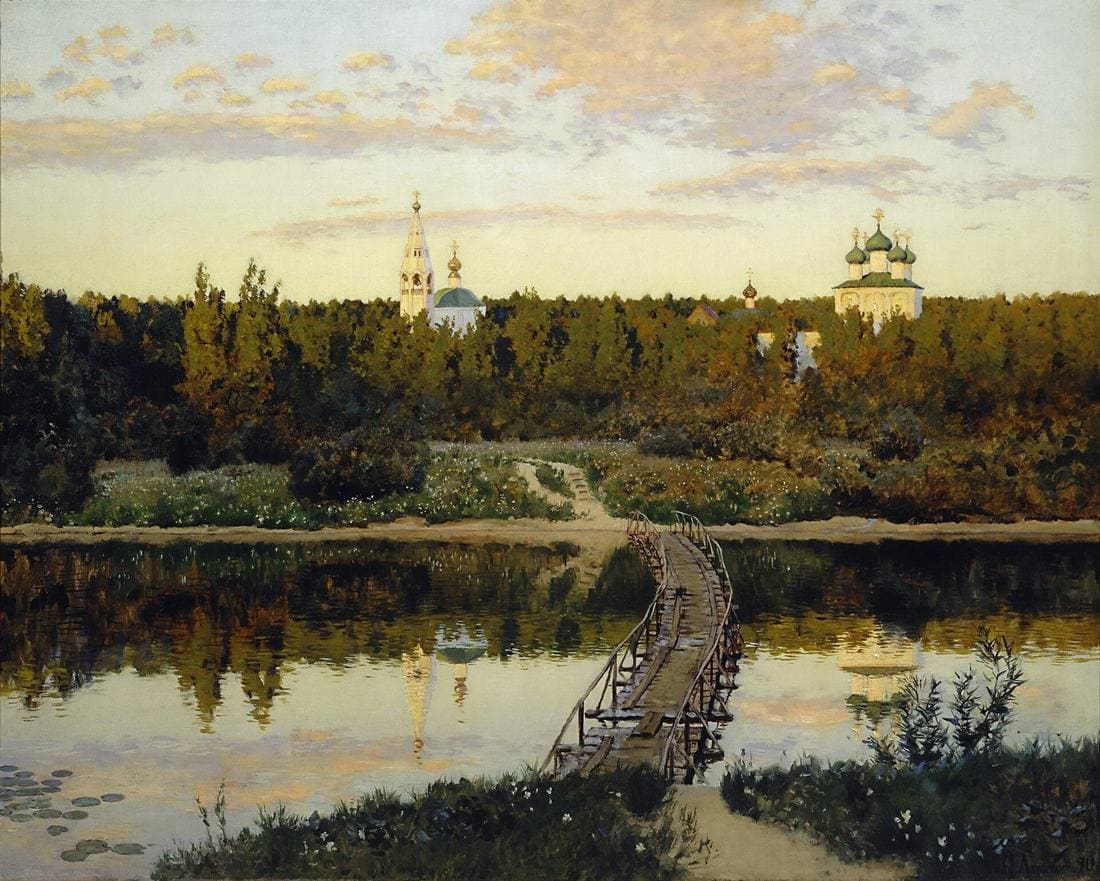 The Still Water
His personality type
Careful by nature, and at his best when life is quiet.
In Pope Gregory the Great's terms
- Careful
- Tranquil mind
Our reading, from the Christian Personality Test. He is one of the test's three examples of the type. He gave up his place as the emperor's tutor to live in the desert, where a voice told him to “flee, keep silence”.
See The Still Waterfeast days
East and West
West
- May8
The Catholic Church lists him on this day in the 2004 edition of its Roman Martyrology, the official list of saints.
- Jul19
His day in older editions of the Roman Martyrology, such as the English one of 1916.
East
- May8
Orthodox churches, among them the Greek Church and the Orthodox Church in America.
- May21
Churches on the old (Julian) calendar, which runs 13 days behind ours, keep his 8 May on this day. So does the Coptic Church.
Catholics and Orthodox now keep the same day, 8 May.
what was he like?
+a lover of silence
Arsenius once visited some monks who lived where reeds grew. Hearing the reeds rustle in the wind, he told them, “If the man who dwelleth in silence heareth but the twittering of a sparrow, he shall not be able to acquire that repose in his heart which he seeketh.” How much less, he asked them, could they find that peace with all those reeds around them?
The Paradise, Book 1, chapter 1+humble enough to learn
Arsenius asked an old Egyptian monk who had never been to school about the thoughts that trouble the mind. Another monk wondered why a man who knew Greek and Latin so well would put questions to a villager. Arsenius answered, “With Greek and Latin learning I am well acquainted, but I have not yet learned the alphabet of this villager.”
The Paradise, Book 2, on the rule of life+kind, in secret
Some monks came from Alexandria to see Arsenius while he was ill. They went home hurt, because he kept the visit short to stop them making a habit of it.
After they left, he did not eat, drink or even sit down until he was sure they were home. He told them why on a later visit: “for I knew that for my sake ye had given yourselves trouble.”
The Paradise, Book 1, chapter 8+sorry for his old life
Arsenius made rope from palm leaves that he kept soaking in water. He changed that water only once a year and simply topped it up as it dried, until it stank. The other monks asked him why he put up with it. He told them, “It is right that I should endure this foul smell.” He viewed it as paying for the perfumes and scented oils he had enjoyed at court.
The Paradise, Book 1, chapter 6+no use for a fortune
An officer brought Arsenius the will of a relative, a senator who had just died and left him everything. Arsenius was about to tear it up when the officer fell at his feet, afraid he would be tried for his life if it were torn up.
Arsenius spared the will but would not take the fortune. He told the officer, “I died before he did, though he hath only now died,” and sent him away.
The Paradise, Book 2, on the rule of life; Butler, Lives of the Saints, 19 July+hard to visit, even for an archbishop
Archbishop Theophilus of Alexandria came with a judge to see Arsenius and begged him for a word of wisdom. Arsenius kept silent for a while before asking whether they would keep his word if he gave them one. Once they had promised, he told them, “In whatsoever place ye hear that Arsenius is, come not nigh thereunto.”
The Paradise, Book 1, chapter 1what others said of him
Nearly all we know of Arsenius comes from the stories Egypt's early monks told about one another, which were later written down as the sayings of the desert fathers.
…in this way lived Abbâ Arsenius, who took care each day to stand up before God without sin, and he drew nigh unto Him with tears like the sinful woman.
Blessed art thou, O Arsenius, because thou hast remembered this hour.
Blessed art thou, O Abbâ Arsenius, for thou didst weep over thyself in this world.
Thus he voyaged with the Spirit of God on the ocean of this world in the ship of solitude, in exalted peace…
his life in nine moments
Constantinople
AD 383Tutor to the emperor's sons
Theodosius wanted a tutor for his sons. He asked the western emperor Gratian to find one in Rome, where Pope Damasus put forward Arsenius. Arsenius came to Constantinople to teach the elder son Arcadius, whose younger brother Honorius joined the lessons later. Theodosius made him a senator and told his sons to honour him as a father.
One day the emperor came in and found the boys sitting at their lessons while their teacher stood. Displeased, he made Arsenius sit and the boys stand to listen to him.
Catholic Encyclopedia, 1907; Butler, Lives of the Saints, 19 JulyConstantinople
About AD 394A voice in the palace
The honours of court weighed on Arsenius, who had long wanted to leave and become a monk. He prayed, “O Lord, direct me how to live,” and a voice answered, “Arsenius, flee from men, and thou shalt live.”
He slipped out of the palace in secret, sailed to Alexandria and went into the desert of Scetis. Theodosius grieved to lose him and had him searched for by land and sea without finding him.
The Paradise, Book 1, chapter 1; Butler, Lives of the Saints, 19 JulyScetis
About AD 394Bread on the floor
Arsenius reached Scetis and asked to join the monks there, who sent him to the elder John the Dwarf. John had been warned who the newcomer was and decided to test him. At supper he let the other monks sit down and left Arsenius standing without a word, a hard welcome for a man used to the court.
Halfway through the meal John threw some bread on the ground and told him, as if he did not care, to eat it if he wanted. Arsenius got down on the ground and ate it there. John needed no more proof than that and told the others Arsenius was fit to be a monk.
Catholic Encyclopedia, 1907; Butler, Lives of the Saints, 19 JulyScetis
Soon after AD 394A second voice
At Scetis Arsenius prayed the prayer he had prayed in the palace, asking God how to live. Again a voice answered him, “Arsenius, flee, keep silence, and lead a life of silent contemplation, for these are the fundamental causes which prevent a man from committing sin.”
So he chose a hut far from the church and the other monks and seldom left it. On the days he went to church, he sat behind a pillar so that he would see no one and no one would see him.
The Paradise, Book 1, chapters 1, 5 and 6; Butler, Lives of the Saints, 19 JulyScetis
After AD 395The emperor's letter
After Theodosius died, Arsenius's old pupil Arcadius ruled the East as emperor. He found out where his tutor was and wrote to him at Scetis to ask for his prayers. He wanted Arsenius back at court as his adviser and offered him the taxes of Egypt to give away to the monasteries and the poor.
Arsenius neither went back nor wrote. He sent back only a spoken prayer, asking God to forgive all their sins, his own included. As for the money, he said he could not take charge of it, “being already dead to the world.”
Butler, Lives of the Saints, 19 July; Catholic Encyclopedia, 1907Scetis
Before AD 434Judged for a pillow
A priest brought Arsenius to the church during an illness and laid him on a palm-leaf mat with a small pillow. An old monk who saw him there was offended and said, “And this is Arsenius lying upon such things!”
The priest asked the old monk how he had lived before he became a monk. The old monk had been a poor shepherd and now had more than he needed. The priest told him that Arsenius had given up 1,000 servants in silk and gold and the softest of beds. Seeing that Arsenius had chosen hardship while he himself had found ease, the old monk said, “Father, forgive me; I have sinned.”
The Paradise, Book 1, chapter 10Scetis
About AD 434Driven out by raiders
Raiders from Libya attacked Scetis twice in Arsenius's time. The first raid, about a year after he arrived, drove him away only until the raiders went home. About AD 434 they came again and killed several monks. This time Arsenius left Scetis for good after 40 years there. He went away in tears to Troë, a rocky hill across the Nile from the old capital of Memphis.
Butler, Lives of the Saints, 19 July; The Paradise, Book 1, chapter 5Troë
After AD 434Back, like Noah's dove
Arsenius's disciples Alexander and Zoilus lived near him at Troë. Troubled one day, Arsenius sent them off without saying why and sailed for Alexandria, where he fell seriously ill. The two wondered how they had offended him but could think of nothing.
Once he was well he came back to Troë, where the three fell at one another's feet in tears. Alexander told him his leaving had been wrong, because people blamed the disciples for driving the old man away. Arsenius agreed, but he said people would now see him as the dove that found no rest anywhere else and flew back to Noah's ark. That comforted the disciples, who lived with him again.
The Paradise, Book 1, chapter 8Canopus
About AD 444The lady from Rome
A noblewoman sailed from Rome to Alexandria to see Arsenius. He refused the archbishop's plea to receive her, so she went to his hut anyway, saying she had come “to see a prophet.” He happened to be outside, and she fell at his feet. He asked whether she meant to boast of it in Rome. She begged only for his prayers, and he said, “I will pray to God that He may blot out the memory of thee from my heart.”
Grief made her ill, until the archbishop explained that Arsenius spoke so because the devil fights holy men through women, and that he would always pray for her soul. She sailed home glad.
The Paradise, Book 1, chapter 8; Butler, Lives of the Saints, 19 July
his visions
Both are kept in the sayings of the desert fathers.
Two boats on the Nile
A monk came to Scetis to see Arsenius, and a guide took him to his hut. They prayed and sat down, and when no one spoke the visitor soon left with his guide. The visitor then asked to meet Moses, a former robber, who welcomed them and fed them. Asked which of the two he liked better, he chose Moses.
An old monk heard of it and asked God how both could please Him, since one fled from people for His sake and the other welcomed them. Then the old monk saw two great boats on the river. Arsenius sailed in silence with the Spirit of God in one, while Moses sailed in the other with angels who fed him honey from the comb.
“suddenly there appeared unto him on the river two great boats”The Paradise, Book 1, chapter 1
Three scenes in a vision
Arsenius once told his disciple Daniel of a vision, speaking as if someone else had seen it. A voice showed an old monk a man who could not lift his bundle of wood yet kept cutting more, like a sinner who adds sins instead of repenting.
Then he saw a man pour water from a well into a hollow, where it ran back into the well, as good works are lost when other motives are mixed into them.
Last came two riders carrying a beam crosswise, too wide for a temple door. Because neither would humble himself to follow the other and take it in end first, both stayed outside, like the proud who will not take Christ's humble way into God's kingdom.
“a man should be watchful in his labour, lest he toil in vain”The Paradise, Book 2, on the rule of life
his words
E. A. Wallis Budge translated his sayings into English in 1907.
A saying he often repeated
I have many times repented that I spoke, but that I held my peace I have never repented.
He also used to remind himself that he had come to the desert to be with God rather than with people, saying, “Arsenius, for this thou didst go forth.”
The Paradise, Book 1, chapter 1God knoweth that I love you, but I cannot be both with God and with men.
If we seek God He will be revealed unto us, and if we lay hold upon Him, He will remain with us.
The monk is a stranger in a foreign land…
…if it be burnt in the furnace it will support the building like a stone.
myths and misquotes
Arsenius fled the court because he had whipped the young prince Arcadius, who turned against him.
What the sources sayThe oldest sources say a voice told him to flee and never mention the prince's anger. That story first appears some 500 years later, in the saints' lives retold by the Byzantine writer Symeon Metaphrastes.
Butler, Lives of the Saints, 19 July; Encyclopaedia Britannica, 1911, Symeon MetaphrastesArsenius would talk to no one.
What the sources sayHe shut out the curious but gave a short answer to monks with real questions. Seven monks once asked him what a monk's work is.He told them he had asked two old men the same question when he was new to the desert, and they said to do as they did. Asked what the two old men did, he answered, “The one acquired great humility, and the other obedience.”
The Paradise, Book 1, chapter 10; Butler, Lives of the Saints, 19 JulyThe saying about never regretting silence began with Arsenius.
What the sources sayThe saying is centuries older than Arsenius, although he repeated it often. About AD 100 the Greek writer Plutarch already called it a saying of the poet Simonides, “that he had often repented him of talking, but never of keeping silent.”
Plutarch, Of Garrulity, or Talkativeness, in Goodwin's edition of the Moralsfriends, family and rivals
 Moses the Black
Moses was a robber who became a monk at Scetis in Arsenius's time. He welcomed the visitors Arsenius would not see, and in an old monk's vision of two boats on the Nile, God was with them both.
The Paradise, Book 1, chapter 1He ruled the East from AD 379 and brought Arsenius from Rome to teach his sons. When Arsenius fled the palace, Theodosius had him searched for by land and sea.
Catholic Encyclopedia, 1907; Butler, Lives of the Saints, 19 JulyArsenius taught him from AD 383. Once he was emperor, Arcadius wrote to Scetis to call his old tutor back to court, though Arsenius would not come.
Catholic Encyclopedia, 1907; Butler, Lives of the Saints, 19 JulyJohn was the elder of Scetis who took charge of Arsenius when he first came from court. He tested the newcomer's humility at supper and afterwards kept him under his guidance.
Catholic Encyclopedia, 1907; Butler, Lives of the Saints, 19 JulyThey were Arsenius's first two disciples, who lived near him and ran his errands. They stayed with him into his old age at Troë, after raiders drove him from Scetis.
Butler, Lives of the Saints, 19 July; The Paradise, Book 1, chapter 8Arsenius took Daniel as his third disciple, after Alexander and Zoilus. Many of the stories about Arsenius in the sayings of the desert fathers come from what Daniel remembered.
Butler, Lives of the Saints, 19 July; The ParadiseAs archbishop of Alexandria he came to Arsenius for a word of wisdom and was told to keep away. Even so, on his deathbed he called Arsenius blessed for keeping the hour of death always in mind.
The Paradise, Book 1, chapters 1 and 4; Butler, Lives of the Saints, 19 Julyhow he died
Arsenius died at Troë about AD 449, when he was 95 years old. No source says what he died of.
Arsenius spent three years at Canopus before he went back to Troë for his last two years, because he could not bear living so close to the great city of Alexandria. As his end drew near, he asked his disciples for one thing only. They were to remember him at the Eucharist and hold no other memorial for him.
He also warned Alexander and Zoilus that they would answer for it before Christ if they let anything of his be kept as a relic.
The two disciples wept and asked how they could bury him on their own, since they did not know how to give anyone a funeral. He told them to tie a rope to his feet, drag his body to the top of the hill and leave it there.
The monks saw Arsenius weep at the very end, as he had wept all his life. Yet he died in great peace and full of faith.
When the monks asked, “Art thou also afraid, O father?”
The dread of this hour hath been with me in very truth from the time when I became a monk, and was afraid.
Why he asked for no memorial but the Eucharist
If in my life I have done any thing that is accepted by God, through His mercy, that I shall now find again.
is he a saint?
The Orthodox, Coptic and Catholic churches all count Arsenius a saint.
- OrthodoxSaintOn 8 May, as Arsenius the Great
- CopticSaintOn 13 Bashans in its own calendar, which is our 21 May
- CatholicSaintOn 8 May, in the Roman Martyrology
In the time of Theodosius, he retired into a wilderness, where, endowed with every virtue and shedding continual tears, he yielded his soul to God.
a prayer he cried out
The monks who looked after Arsenius once came to his hut while demons were attacking him. From outside the door they heard him cry out to God, as he often did with tears.
O God, forsake me not. I have never done before Thee anything which is good, but grant, O Lord, according to Thy grace, that I may begin in the way.
what to read first
The Paradise of the Holy Fathers, volume 2
Tr. E. A. Wallis Budge, 1907
Budge's English translation of the sayings of the desert fathers. Arsenius's stories run all through it, starting with the very first saying, the voice that called him out of the palace.
Read it freeSt. Arsenius, Anchoret
Alban Butler, Lives of the Saints, 1866
The fullest old life of Arsenius in English, from the court to his death at Troë. Butler's title calls him an anchoret, an old word for a hermit. The life is in volume 7, under 19 July.
Read it freeSt. Arsenius
Catholic Encyclopedia, 1907
His life on one page, from the court he left to his first test in the desert.
Read it freeVenerable Arsenius the Great
Orthodox Church in America
The life of Arsenius that the Orthodox Church in America gives for his feast on 8 May.
Read it freetake the quizzes
 Quiz Which early Christian
thinks like you? And which would argue with you? Start
 Quiz Christian


Personality Test Arsenius reads as The Still Water. Find your own type. Start
people like him
 Gregory of NazianzusThe Still Water
Gregory was a Christian writer of the 300s who had loved “calm and retirement” from his youth. He ran away when his father made him a priest against his will.
His friend Basil once called him lazy for refusing a bishop's post. Gregory wrote back, “My greatest business always is to keep free from business.”
Gregory of Nazianzus, Oration 2; Letter 49 JeremiahThe Still Water
Called to be a prophet, Jeremiah pleaded, “I surely do not know how to speak, for I am only a child!” He did not refuse for long.
Pope Gregory the Great says Jeremiah held back for fear that “by speaking he should lose the gains of silent contemplation”.
Jeremiah 1:6; Gregory the Great, Pastoral Rule, Book 1sources
His life, and his words
- The Paradise, or Garden of the Holy Fathers, volume 2. Tr. E. A. Wallis Budge, 1907.
- Alban Butler, Lives of the Saints, volume 7, 19 July, “St. Arsenius, Anchoret”, 1866 edition.
- Isaac of Nineveh, Mystic Treatises. Tr. A. J. Wensinck, 1923.
- Plutarch, Of Garrulity, or Talkativeness. In Plutarch's Essays and Miscellanies, ed. William W. Goodwin, volume 4.
- Gregory of Nazianzus, Oration 2 and Letter 49. Tr. Browne and Swallow, in Schaff's Nicene and Post-Nicene Fathers.
- Gregory the Great, Pastoral Rule. Tr. James Barmby, in Schaff's Nicene and Post-Nicene Fathers.
- The Berean Standard Bible, Jeremiah 1:6.
Reference
- Catholic Encyclopedia, 1907, “St. Arsenius”
- Encyclopaedia Britannica, 1911, “Symeon Metaphrastes”
- E. A. Wallis Budge, preface to The Paradise, on the Syriac collection of Anan-Isho.
Calendars
- Martyrologium Romanum, 2004 edition, 8 May
- The Roman Martyrology, 1916 English edition, 19 July
- OCA, Venerable Arsenius the Great, 8 May
- synaxarion.gr, Greek, 8 May
- St-Takla.org, the Coptic Synaxarium, 13 Bashans
Pictures
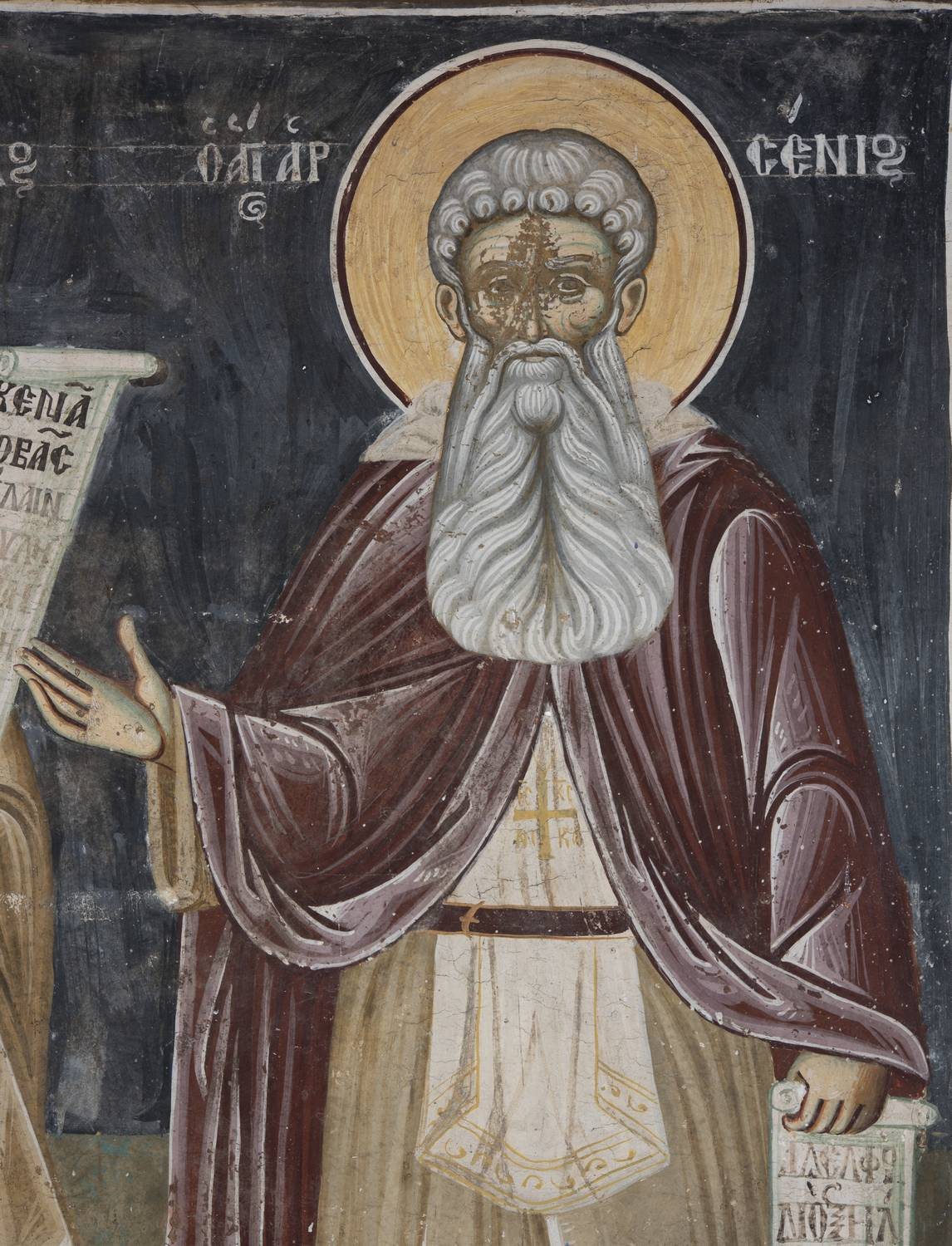
- Fethiye Camii, parekklesion, St. Arsenius, detail of bust. Byzantine Institute, 1949 to 1963. Dumbarton Oaks, CC0.
- Saint Arsenius the Great, fresco of 1749, Holy Monastery of Pantokrator, Mount Athos. Photo: epantokrator.gr.
- Saint Arsenius, fresco in the Church of the Theotokos Peribleptos, Ohrid, Michael Astrapas and Eutychios, about 1295. Public domain. His card on the Saints page; his face in the personality test is from the same fresco.