
Moses the Black
A slave and robber chief who became a monk in the Egyptian desert and would not sit in judgement on anyone's sins but his own.
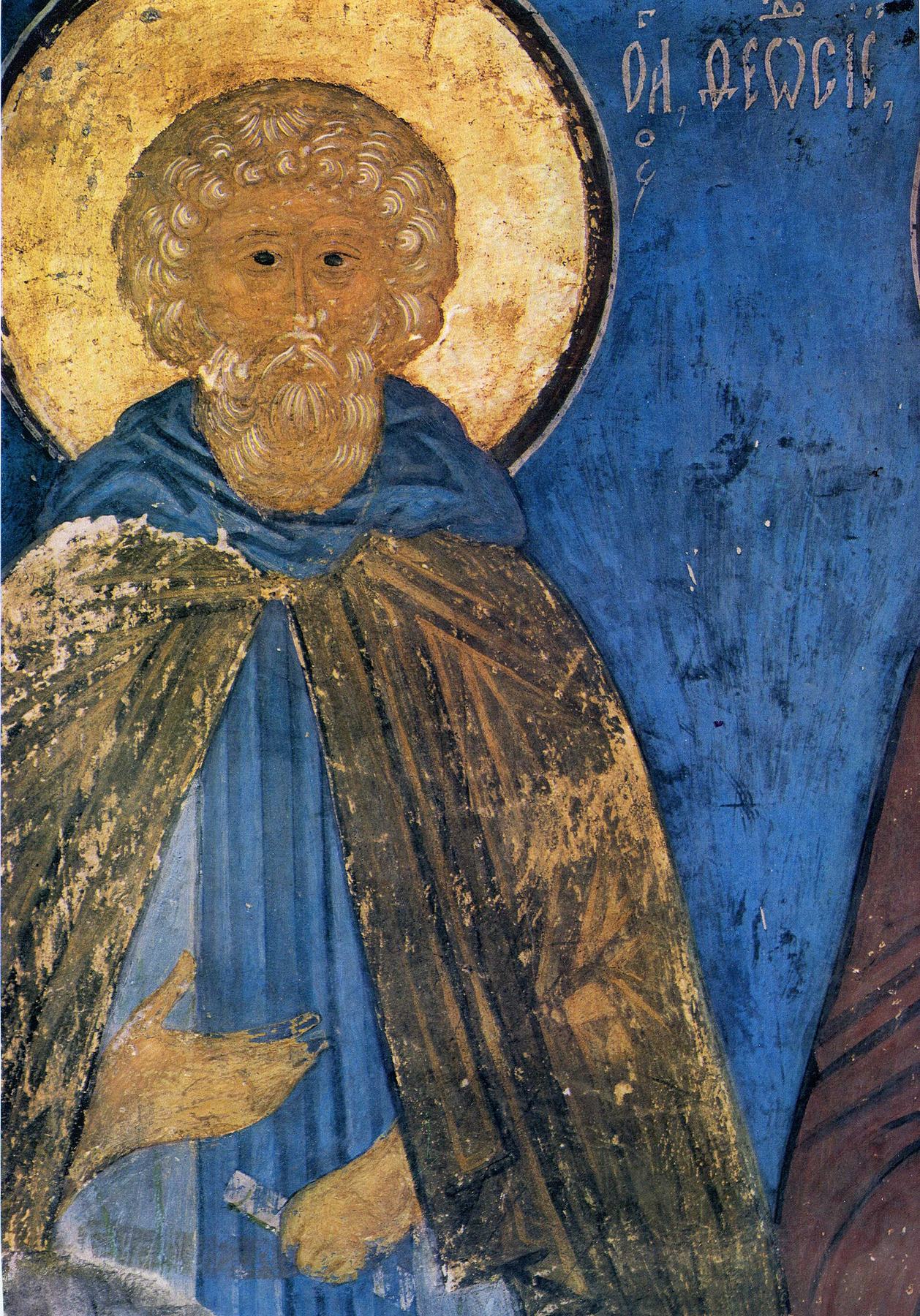
Picture: Saint Moses the Ethiopian, a fresco dated 1479 to 1481 in the Cathedral of the Dormition, Moscow Kremlin. Public domain.
Who was Moses?
Moses the Black was an African who went from slave to robber chief to monk in the Egyptian desert of Scetis in the late 300s. He is best remembered for his humility and for refusing to judge a brother who had sinned. Raiders killed him about the year 400, when he refused to run.
at a glance
His path, in order
- SlaveThrown out by his master for his crimes
- RobberLed a band of robbers in Egypt
- MonkTaught by Isidore in the Egyptian desert
- PriestOrdained after a test of his humility
- TeacherTaught the monks not to judge
- MartyrKilled by raiders about the year 400
in numbers
- Robbers he carried to the church4
- They broke into his hut, not knowing whose it was
- When they learned who he was, all four became monks
- Years he prayed standing all night6
- It was an elder's advice against the dreams of his old life
- He would not sleep, kneel or close his eyes
- Prayers a day in his years of fasting50
- He lived on 12 ounces of dry bread a day
- He was fighting the habits of his days as a robber
- Disciples he left behind70
- He was 75 years old when he died
did you know?
-
The film Moses the Black opened in American cinemas on 30 January 2026, with Chukwudi Iwuji as Moses and Omar Epps as a Chicago gang leader who begins to see visions of the saint.
Fathom Entertainment, press release of 19 November 2025 -
On 2 July the Episcopal Church keeps his day with a prayer asking God to deliver us “from the paths of hatred and violence”.
Lesser Feasts and Fasts 2022, 2 July
- Born
- About AD 325.
- Died
- About AD 400, when he was 75 years old. Raiders killed him at Scetis.
- Buried
- The Coptic Church keeps his body in the Monastery of El-Baramous, one of four ancient monasteries still standing in Wadi El Natrun.
- Also called
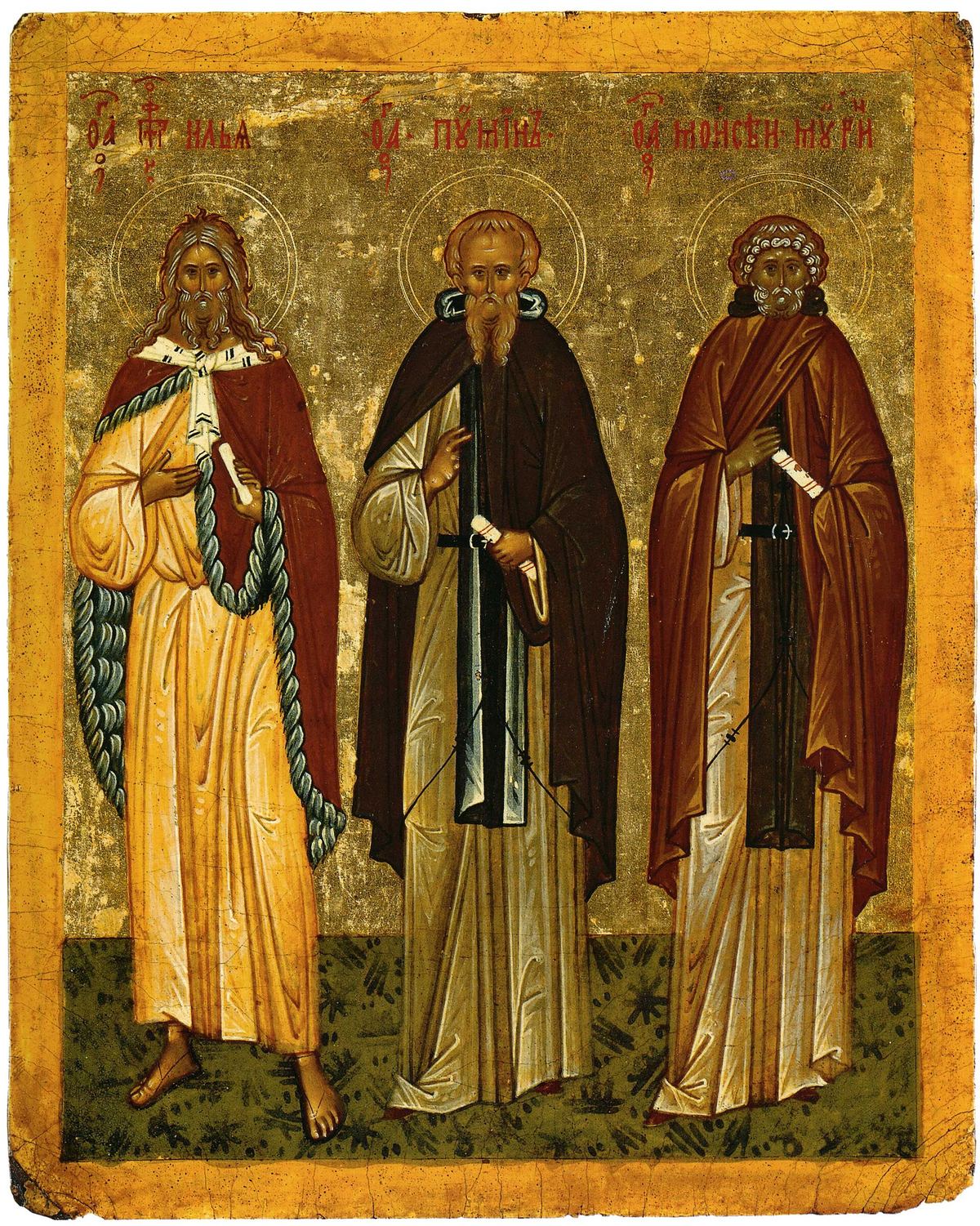
- Moses the Ethiopian, Moses the Robber and Abba Moses. The desert monks called a respected elder abba, or “father”. Russian icons name him Moses Murin, “like an Ethiopian”.
- Lived at
- Scetis, the desert valley northwest of Cairo now called Wadi El Natrun. Its monks lived alone in huts and met in church on Saturdays and Sundays.
- Wrote
- Nothing of his own survives, but the monks kept his sayings, among them a short set of rules for life he gave the monk Poemen.
- Status
- A saint of the Coptic, Orthodox and Catholic churches, also remembered by the Episcopal Church.
- In art
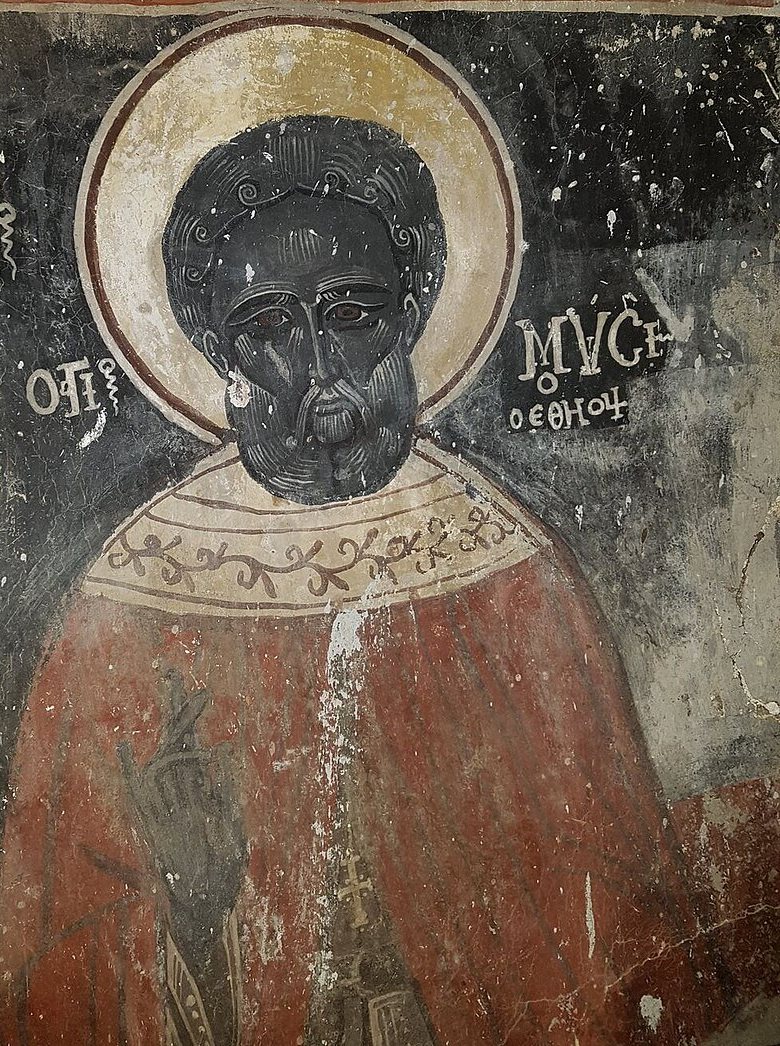
- Icons show him as an elderly monk with white curly hair and a short white beard. Russian painters made his skin as pale as that of the saints around him, but a Greek fresco of the 1700s shows him as a black man.
feast days
East and West
West
- Jul2
The Episcopal Church keeps his day in Lesser Feasts and Fasts as Moses the Black, Monastic and Martyr.
- Aug28
The Catholic Church lists him in the Roman Martyrology, its calendar of saints for every day of the year.
East
- Jul1
The Coptic Church keeps the day of his martyrdom on 24 Paoni in its own calendar.
- Aug28
The Orthodox Church in America.
- Sep10
The Russian Church, which keeps 28 August on the old (Julian) calendar, 13 days behind.
what was he like?
+slow to judge
When a brother sinned, the monks met to judge him, but Moses refused to come until the priest fetched him.
He came with a leaking basket of sand on his shoulders. When the monks asked what it meant, he told them the sand was his sins, running out behind him where he could not see them. “And I, even I, have come this day to judge shortcomings which are not mine.” The monks let the brother go without another word.
The Paradise of the Holy Fathers, volume 2, Book 1, chapter 10, saying 542, tr. Budge (1907)+his guests came first
The monks were told to fast through the week before Easter, but that week Moses cooked a little food for some brothers who had come to visit.
His neighbours saw the smoke and reported him to the clergy, who knew how hard he lived. That Saturday the clergy told him in front of everyone that he had broken the command of men but kept the command of God.
The Paradise of the Holy Fathers, volume 2, Book 1, chapter 9, saying 441, tr. Budge (1907)+silent when insulted
The elders of Scetis once tested Moses by mocking his colour before all the monks: “Why doth this Ethiopian come and go in our midst?” He kept quiet, but when the meeting ended and they asked if it had troubled him, he admitted that it had.
An old teacher of monks later said that his heart had not yet found peace, but that holding his tongue for God's sake was already a virtue.
The Paradise of the Holy Fathers, volume 2, Book 1, chapter 1, saying 55, and Book 2, Appendix, 669, tr. Budge (1907); the Latin Verba Seniorum, Book 16, saying 7+teaching one step at a time
A brother at Scetis asked Moses whether he should go and work at the harvest. Before answering, Moses asked whether he would do as he was told.
When the brother promised that he would, Moses told him to give up the harvest, stay in his hut and eat nothing but dry bread and salt once a day until Pentecost. Only when the brother had done all this did Moses show him how to live as a monk.
The Paradise of the Holy Fathers, volume 2, Book 1, chapter 1, saying 18, tr. Budge (1907)+willing to learn from the young
Moses called the young monk Zechariah his son, yet he asked him to give the brothers a word of encouragement. Zechariah laid his cloak under his feet and trod on it, saying, “Except a man let himself be trodden upon thus he cannot be a monk.”
The Paradise of the Holy Fathers, volume 2, Book 1, chapter 1, saying 31, and chapter 10, saying 543, tr. Budge (1907)what others said of him
I am compelled to tell his wicked acts in order to show the virtue of his repentance.
For they say so sudden a conversion from vice to virtue was never before witnessed, nor such rapid attainments in monastical philosophy.
Sometimes Divine Grace moveth a man suddenly, even as it moved Abbâ Moses, the Ethiopian
This saint took the Kingdom of Heaven by force
his life in eight moments
Egypt
His youthA slave, then a robber
Moses was a house slave of a government official in Egypt until his master threw him out for his immorality and his thieving. He went on to lead a band of robbers, and people said he had killed men too. The Coptic Church remembers him as a man of great strength who loved to eat and drink and whom no one dared to stand against.
Palladius, Lausiac History, chapter 19; Coptic Synaxarium, 24 PaoniThe Nile
His days as a robberAcross the Nile for revenge
When a shepherd and his dogs spoiled one of his night raids, Moses set out to kill him. The shepherd kept his flock across the Nile, which was in flood and about a mile wide, so Moses swam it with his sword in his teeth and his shirt on his head.
While he was swimming, the shepherd had time to escape by burying himself in the sand. Moses killed the four best rams instead, tied them together and swam back. At a small farm he skinned them, ate the best of the meat and traded the skins for wine, and after drinking it he walked 50 miles back to his gang.
Palladius, Lausiac History, chapter 19Scetis
Before his baptismHe becomes a monk
In the oldest account, Moses was stricken with guilt over one of his crimes and went to the monks.
In the Coptic telling, his masters worshipped the sun, and Moses would ask the sun whether it was God, then pray to the God he did not know to make Himself known. When someone told him that the monks of Scetis knew the true God, he went to them with his sword at his side.
The priest Isidore was frightened at the sight of him until Moses told him he had come to learn about God. Isidore took him to Macarius the Great, who taught him the faith and baptized him.
Palladius, Lausiac History, chapter 19; Coptic Synaxarium, 24 PaoniThe church
Now a monkFour robbers on his back
Robbers broke into the hut where Moses lived, not knowing whose it was. He was still so strong that he tied all four of them together, carried them to the monks' church on his back like a bundle of straw and asked the brothers, “Since I am not allowed to hurt anyone, what do you bid me do with these?”
The robbers confessed their sins, and when they learned who had caught them, they said to themselves, “If he who was so great and powerful in brigandage has feared God, why should we defer our salvation?” All four gave up the world and became monks.
Palladius, Lausiac History, chapter 19His hut
His early yearsSix years standing
The lust of his old life tormented Moses until he nearly gave up being a monk. Isidore told him that a dog hangs about a butcher's shop out of habit but stops coming once the shop is shut and nobody feeds it, and that the demon would give up on him the same way if he held out.
So Moses set out to starve the habit, eating nothing but 12 ounces of dry bread a day. The lust still burned in his dreams, and another elder advised him to give up sleep. For six years after that he stood all night in the middle of his hut, praying without kneeling or closing his eyes, and still he could not master the lust.
Palladius, Lausiac History, chapter 19The well
By nightWater for the old monks
Moses fought the lust of his old life by wearing out his body with hard work. The older monks had to fetch their water from far off, some from five miles away, so at night he would slip into their huts, take their water jars and fill them at the well without anyone knowing.
Palladius says the demon that tempted him lost patience and lay in wait at the well. As Moses bent over the water, it struck him across the back with a club and left him for dead. Next morning a man who came for water found him and told Isidore, who carried him to the church. It was a year before Moses was well again.
Palladius, Lausiac History, chapter 19; Sozomen, Church History, Book 6, chapter 29Scetis
After his illnessSet free at last
Isidore told Moses to stop provoking the demons, but he refused, saying, “I will never cease until the appearance of the demons ceases.” Isidore answered, “In the name of Jesus Christ your dreams have ceased,” and told him to come to Communion. He explained that Moses had been made to suffer for his own good, so that he would never boast of beating his passions himself.
Isidore taught him that no one is cleansed of his passions by hard work alone, without the power of the Spirit given in baptism and renewed in the Body and Blood of Christ. Humbled, Moses took Communion. Two months later Isidore asked after him, and Moses told him that nothing troubled him any more.
Palladius, Lausiac History, chapter 19; The Paradise of the Holy Fathers, volume 2, Book 2, Appendix, 617, tr. Budge (1907)The altar
As a deaconTested by the bishop
The bishop saw Moses in the long white robe of the clergy and said, “Behold, thou art wholly white, O Abbâ Moses.” Moses asked him whether he was white inside as well as out.
To test his humility, the bishop told the clergy to drive Moses out of the sanctuary and listen to what he said. They threw him out with the words “Get outside, O Ethiopian,” and Moses obeyed without a word of complaint. Outside, they heard him tell himself that they had treated him rightly.
The Coptic book of saints tells the test a little differently and ends it with his ordination, when the bishop called Moses back, made him a priest and told him that now all of him had become white.
The Paradise of the Holy Fathers, volume 2, Book 1, chapter 10, saying 477, tr. Budge (1907); Orthodox Church in America, life of Moses; Coptic Synaxarium, 24 Paoni
his miracles and visions
The monks who knew Moses told of rain that came when he prayed for his guests, of a vision of angels on his side and of another of two boats on a river.
3 wonders the monks remembered
-
The far desert
Far from waterRain for his guests
Moses grew so weary on the long road to a new home in the far desert that he began to fear he would never find water there. A voice told him, “Go on, and fear not,” and he settled there.
His only jar of water ran dry while he was cooking lentils for a large group of monks who had come to visit. Moses kept going in and out of his hut, praying, until a great cloud came over and poured down rain that filled every jar he had.
When the monks asked why he had kept going in and out, he told them he had been arguing his case with God, Who had brought him to that dry place.
“I had no water for His servants to drink”
Seen by the monks visiting him.
The Paradise of the Holy Fathers, volume 2, Book 1, chapter 13, saying 619, tr. Budge (1907) -
Isidore's roof
In his fight with lustMore angels than demons
Lust beset Moses so fiercely that he left his hut and went to Isidore for help. Isidore begged him to go back, but Moses answered, “Father, I cannot bear it.”
Isidore took him up onto the roof and told him to look west, where Moses saw crowds of demons drawn up for battle, and then east, where countless holy angels stood in great glory. Isidore explained that God sends the angels to help the saints and that they outnumber the demons, as the prophet Elisha once told his frightened servant. Moses took courage and went back to his hut without fear.
“for those who are with us are many”
Seen by Moses, with Isidore beside him.
The Paradise of the Holy Fathers, volume 2, Book 1, chapter 11, saying 562, tr. Budge (1907); 2 Kings 6:16 -
Scetis
A brother's visitTwo boats on the river
A brother came to Scetis to see the monk Arsenius, but Arsenius sat with him in silence, so the brother asked to be taken to “Abbâ Moses who was a thief” instead. Moses welcomed him with joy and fed him well. Asked which of the two he preferred, the brother chose Moses.
An old monk heard of it and prayed for God to show him the meaning. God showed him two great boats on the river. In one, Arsenius travelled in silence with the Spirit of God, and in the other the angels of God were feeding Moses with honey from the comb.
“one fleeth from the world for Thy Name’s sake, and another receiveth and is gracious for Thy Name’s sake.”
The old monk's prayer.
The Paradise of the Holy Fathers, volume 2, Book 1, chapter 1, saying 21, tr. Budge (1907)
Palladius says that in the end Moses feared demons less than “we fear these flies”. Palladius, Lausiac History, chapter 19
his words
His words come from an old Syriac collection of the desert monks' sayings, put into English by Wallis Budge in 1907.
To a brother at Scetis
Get thee gone, and sit in thy cell, and thy cell shall teach thee everything.
The brother had asked for a word to live by. A monk's cell was the hut where he lived and prayed alone.
The Paradise of the Holy Fathers, volume 2, Book 1, chapter 1, saying 62It is better for a man to put himself to death rather than his neighbour, and he should not condemn him in anything.
If we allow ourselves to view closely our own sins we shall not see those of our neighbour. It is folly for a man to forsake his own dead and to lament over that of his neighbour.
If a man doth not put himself in the attitude of a sinner, his prayer will not be heard before God.
If works do not correspond to prayer he who prayeth laboureth in vain.
The man who fleeth from the world is like unto ripe grapes, but he who dwelleth among the attractions of the children of men is like unto sour grapes.
Secret withdrawal [from work] maketh dark the mind, but for a man to endure and to persevere in his works maketh light the mind in our Lord, and it strengtheneth and fortifieth the soul.
myths and misquotes
Moses the Black came from Ethiopia.
What the sources sayNo one knows his country, because the oldest account of his life describes him only as “an Ethiopian by race and black”, and the Greek word Aithiops (“Burnt-face”) was used for any dark-skinned African.
Palladius, Lausiac History, chapter 19; Liddell, Scott and Jones, Greek-English Lexicon, “Αἰθίοψ”Isidore took Moses up on a roof at dawn and told him, “Only slowly do the rays of the sun drive away the night,” and that a monk becomes perfect just as slowly.
What the sources sayThe sunrise lesson appears only in modern retellings. The old sayings tell a different rooftop story, in which Isidore showed Moses demons in the west and a greater host of angels in the east.
The Paradise of the Holy Fathers, volume 2, Book 1, chapter 11, saying 562; St Moses the Black Priory, history page (2011)He is the Moses whose talks open the Conferences, John Cassian's record of what the desert elders of Egypt taught him.
What the sources sayNo one can be sure, because the Moses of the talks was taught as a boy by Anthony the Great, while Moses the Black came to the monks only after years as a slave and a robber. So Cassian's translator Edgar Gibson thought the speaker “possibly a different person”.
John Cassian, Conferences, Conferences 1, 2 and 3, with Gibson's notes (1894)He led a gang of 75 robbers.
What the sources sayThe number belongs to his age, not his gang, because the old sources say he was 75 years old when he died. Palladius and Sozomen say only that he led a band of robbers.
Palladius, Lausiac History, chapter 19; Sozomen, Church History, Book 6, chapter 29; Wikipedia, “Moses the Black”, for the claimfriends, family and rivals
 Arsenius
 had taught the emperor's sons before he left the palace for a life of silence at Scetis. An old monk's vision of two boats showed that God was with him in his silence and with Moses in his welcome.
The Paradise of the Holy Fathers, volume 2, Book 1, chapter 1, sayings 1 and 21; Catholic Encyclopedia, “St. Arsenius”Moses turned to Isidore whenever his old lusts came back. He wore himself out fighting them, and Isidore told him to rest, because there is a measure in everything.
Palladius, Lausiac History, chapter 19; The Paradise of the Holy Fathers, volume 2, Book 2, Appendix, 617Moses gave Poemen a short set of rules for life, and most of them come back to the same point, that a man should bear his own sins and never judge his neighbour.
The Paradise of the Holy Fathers, volume 2, Book 2, Questions and Answers, 119 to 127When Moses went to draw water, he found Zechariah praying at the stream with the Spirit of God resting on him like a dove. At Zechariah's death, Moses looked up to heaven and told him to rejoice, because the gates of heaven had opened.
The Paradise of the Holy Fathers, volume 2, Book 1, chapter 1, saying 31, and chapter 13, saying 624In the Coptic telling, Macarius the Great was the elder who received Moses as a monk and taught him how to live in the desert.
Coptic Synaxarium, 24 PaoniMoses asked the elder Sylvanus, “Is it possible for a man to make a beginning each day?” Sylvanus told him that a man who is willing to work can begin again every day.
The Paradise of the Holy Fathers, volume 2, Book 2, Questions and Answers, 240how he died
Raiders killed him at Scetis about the year 400, when he was 75 years old. He had told the other monks to run, but he stayed.
Moses was sitting with some of the brothers when he told them that raiders were coming to Scetis that day, and that they should get up and run. When they asked whether he would run too, he replied that he had been waiting many years for this day, because as a robber he had lived by the sword.
The brothers answered that they would not run either but would die with him, and Moses told them that each man must decide for himself.
There were seven brothers with him when he warned them that the raiders were at the door, and one of them lost his nerve and hid behind a pile of palm leaves. The raiders came in and killed Moses and the other six. From his hiding place the brother saw seven crowns come down and rest on their heads.
To the brothers, as the raiders came
I have been expecting this day to come for many years past, so that might be fulfilled the command of our Redeemer, Who said, ‘Those who take the sword shall perish by the sword’
is he a saint?
He is a saint of the Coptic, Orthodox and Catholic churches, and the Episcopal Church keeps his day as well.
- CopticSaintA martyr, on 24 Paoni (1 July)
- OrthodoxSaintKept on 28 August
- CatholicSaintIn the Roman Martyrology, 28 August
- EpiscopalRememberedIn Lesser Feasts and Fasts, 2 July
The Roman Martyrology names him on 28 August. Its 2004 Latin edition sums up his life in a play on words, ex insigni latrone insignis anachoreta, from notable robber to notable hermit.
The Coptic Church credits “the power of repentance” with turning a slave, robber and killer into a “great Father, teacher, comforter, and priest”, and his name is still spoken at the altar in its prayers.
He converted many robbers, and led them to a monastery.
what to read first
The Lausiac History, chapter 19
Palladius
The oldest account of his life, with the swim across the Nile, the four robbers and his long fight against lust. It takes about five minutes to read.
Read it freeThe Paradise of the Holy Fathers, volume 2, Book 1, chapter 10
The desert monks' sayings, tr. Wallis Budge
A chapter of sayings on humility, among them the leaking basket of sand and the bishop who had Moses driven from the altar to test him.
Read it freeChurch History, Book 6, chapter 29
Sozomen
A short life of Moses among the other monks of Scetis, in a history of the Church written in the 400s.
Read it freeConferences, Conference 1
John Cassian
John Cassian spent years among the monks of Egypt and wrote down their talks. The first is about the goal of a monk's life, which is a pure heart. It comes from an elder called Moses, who may not be Moses the Black.
Read it freetake the quizzes
 Quiz Which early Christian
thinks like you? And which would argue with you? Start
 Quiz Christian
Personality Test Which of eight types are you? Find your own. Start
sources
His life, and his words
- Palladius, The Lausiac History, chapter 19. Tr. W. K. Lowther Clarke, 1918.
- The Paradise or Garden of the Holy Fathers, volume 2. Tr. E. A. Wallis Budge, 1907, from the Syriac. The sayings of Moses in Book 1, chapters 1, 6, 9, 10, 11 and 13, and Book 2.
- Sozomen, Church History, Book 6, chapter 29. Tr. Chester D. Hartranft. Nicene and Post-Nicene Fathers, second series, volume 2, 1890.
- John Cassian, Conferences 1, 2 and 3. Tr. Edgar C. S. Gibson, with his notes. Nicene and Post-Nicene Fathers, second series, volume 11, 1894.
- Coptic Synaxarium, 24 Paoni, “Martyrdom of the Great Saint Anba Moses the Black”, on CopticChurch.net.
- Orthodox Church in America, “Venerable Moses the Ethiopian of Scete”.
Reference
- Catholic Encyclopedia, 1911, “Palladius”
- Liddell, Scott and Jones, Greek-English Lexicon, “Αἰθίοψ”
- St Moses the Black Priory, Raymond, Mississippi, its history page, as archived in 2011, for the sunrise story
- Wikipedia, “Moses the Black”, for the claim of 75 robbers
- Fathom Entertainment, on the film of 2026
Calendars
- The Roman Martyrology, 1916 English edition, 28 August
- Martyrologium Romanum, 2004 edition, 28 August
- The Episcopal Church, Lesser Feasts and Fasts 2022, 2 July
- Orthodox Church in America, 28 August
- Azbuka Very, the Russian Church's calendar, 10 September
- Coptic Synaxarium, 24 Paoni
Pictures
- Saint Moses the Ethiopian, fresco, Dormition Cathedral of the Moscow Kremlin, Wikimedia Commons. Public domain.
- Saints Poimen, Elijah, and Moses the Black, icon, Novgorod Museum, Wikimedia Commons. Public domain.
- Reverend Moses Murin, fragment of a Novgorod icon of the late 1400s, Wikimedia Commons, for the hub's card. Public domain.
- Saint Moses the Ethiopian, fresco, Agios Panteleimon, Tsaritsani, Wikimedia Commons. Public domain.