
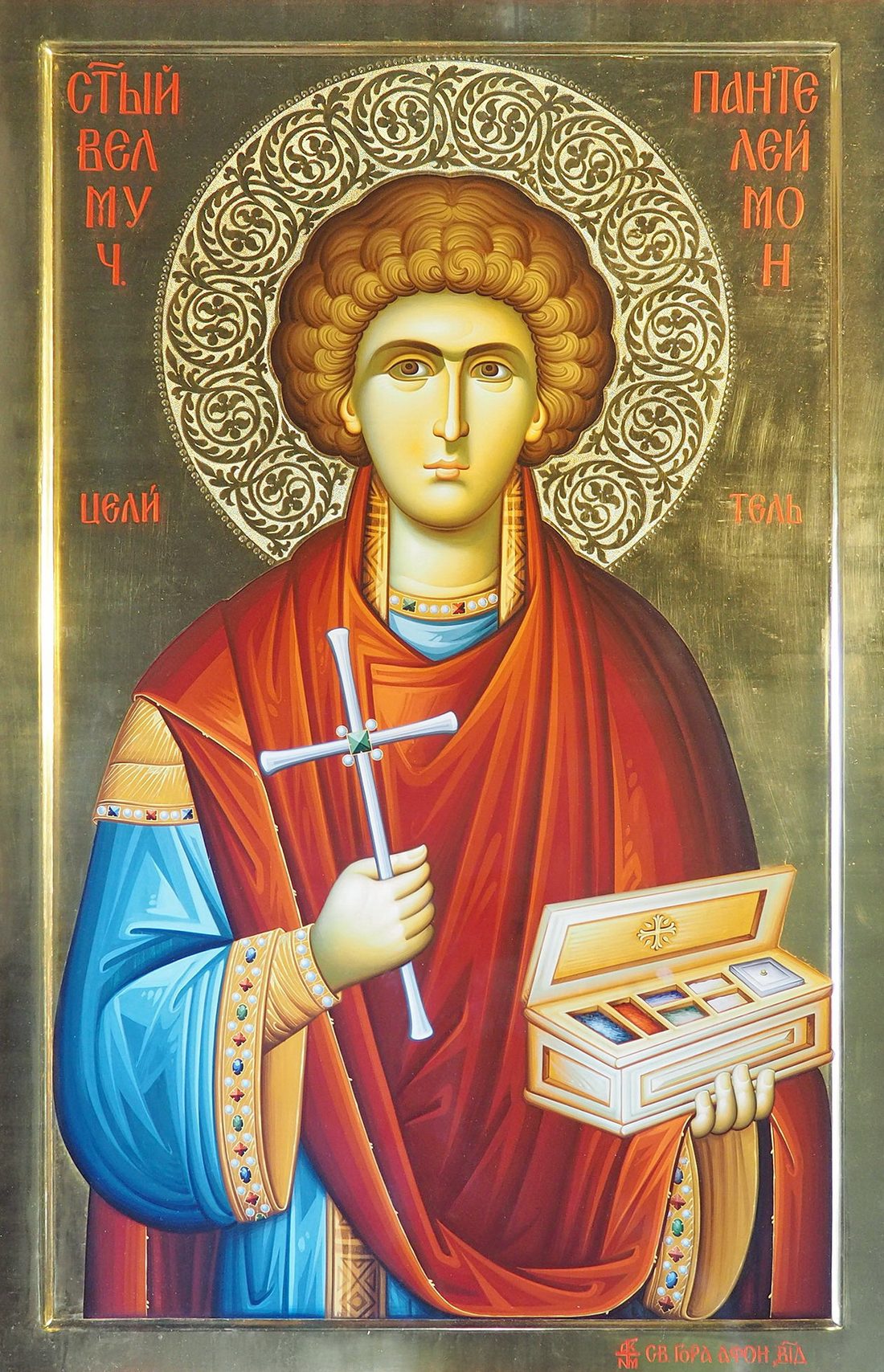
Why people ask St Panteleimon
Healing
His name means “all-merciful”, and the Orthodox Church calls on him when it blesses water and in its prayers for the sick.
Greatmartyr and Healer Panteleimon, Orthodox Church in America
His feast day
27 July: His feast in the Catholic Church and in the Orthodox churches on the new calendar. Those on the old calendar keep it on 9 August.
Greatmartyr and Healer Panteleimon, 27 July, Orthodox Church in America; The Roman Martyrology, 1916, 27 July: “At Nicomedia, the martyrdom of St. Pantaleon, a physician.”
When it is said
It is the main hymn of St Panteleimon’s feast on 27 July.
Its four short lines are easy to say before an operation or beside a sickbed.
Where it comes from
No author known
Who was St Panteleimon?
Panteleimon studied medicine in the city of Nicomedia, and the emperor Maximian wanted to make him a court doctor. He became a Christian and gave his life to the sick and the poor, treating everyone who came to him without charge and healing them in the name of Jesus Christ. Maximian later ordered his head to be cut off.
Orthodox Church in America, Greatmartyr and Healer Panteleimon
Why is he called Panteleimon?
He was born Pantoleon and was given the name Panteleimon, which means “all-merciful”, when he was baptized. The hymn uses that name as it asks him to pray to “the merciful God” for the forgiveness of our sins.
Orthodox Church in America, Greatmartyr and Healer Panteleimon; Greek text, glt.goarch.org
Sung when the sick are anointed
In Holy Unction the priests bless oil and anoint the sick person with it in the form of a cross. While a priest says one of the service’s prayers, a set of short hymns is sung, and this hymn to Panteleimon is among them. The translator G. V. Shann printed it there in his English Book of Needs in 1894.
Greek text of Holy Unction, glt.goarch.org; G. V. Shann, Book of Needs (1894)
In Greek
Ἀθλοφόρε ἅγιε, καὶ ἰαματικὲ Παντελεῆμον,
πρέσβευε τῷ ἐλεήμονι Θεῷ,
ἵνα πταισμάτων ἄφεσιν,
παράσχῃ ταῖς ψυχαῖς ἡμῶν.
From the Greek Menaion for 27 July, on the Greek Orthodox Archdiocese of America’s liturgical texts site.