
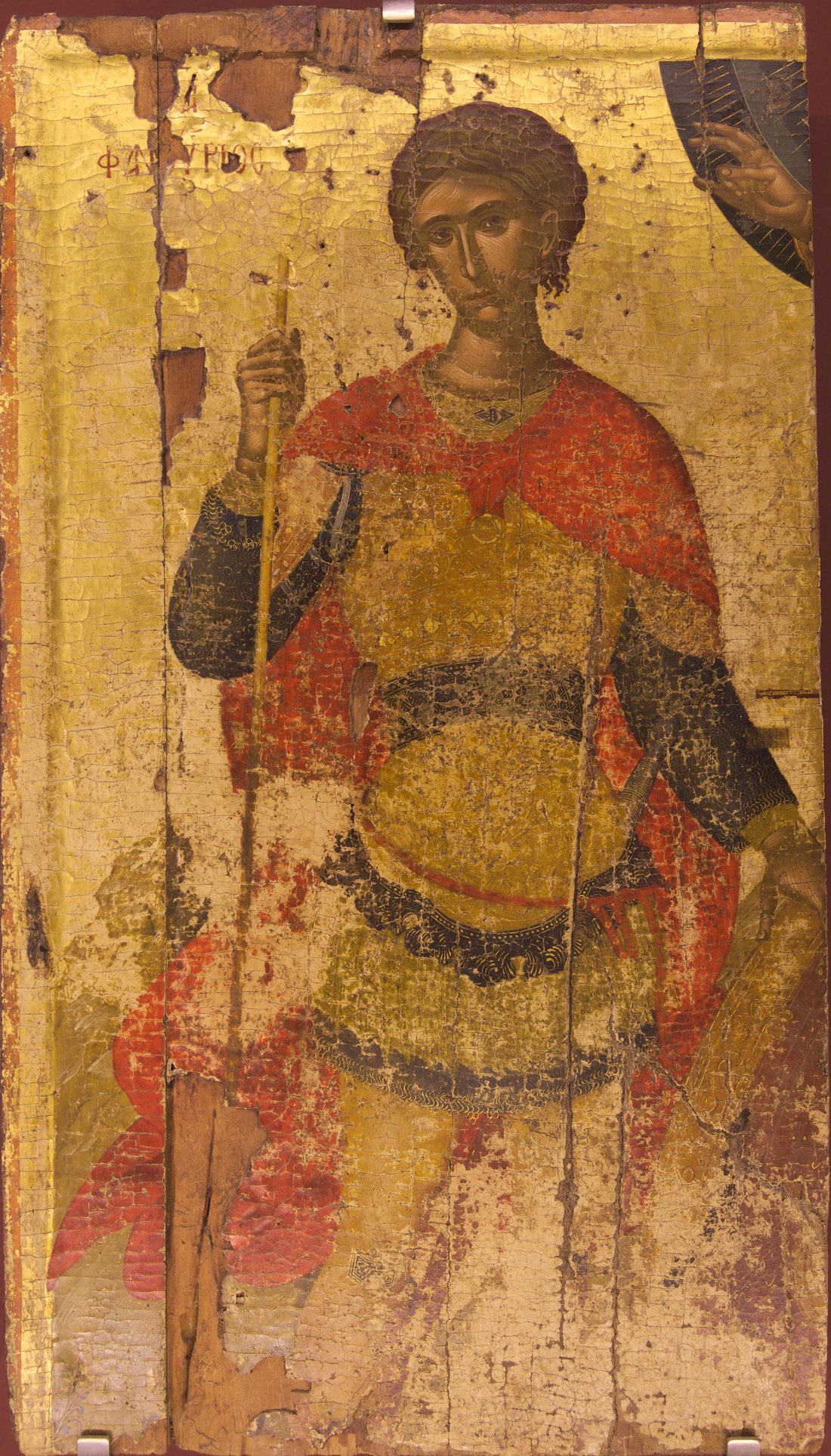
Why people ask St Phanourios
Lost things
His name sounds like the Greek word for “to reveal”, so the Orthodox ask him to reveal what they have lost. Many promise him a cake called a fanouropita, and when the thing turns up they bake it and share it with friends and the poor. As they do, they pray for his mother, because tradition says she was a sinner and that he helps those who pray for her.
Saint Phanourius, Orthodox Church in America; John Sanidopoulos, “The Life and Lore of Saint Phanourios”, 2014; “Fanouropita: Greek cake for lost items”, Basilica.ro, the news agency of the Romanian Patriarchate
His feast day
27 August: His feast in the Orthodox churches on the new calendar. Those on the old calendar keep it on 9 September.
Saint Phanourius, 27 August, Orthodox Church in America; Azbyka, 9 September (the old calendar)
When it is said
The troparion and kontakion are sung on his feast, 27 August. Anyone who asks his prayers when something is lost can say them at home. The second troparion ends on his prayers to the Lord for our souls.
Where it comes from
No author known
Who was St Phanourios?
Nothing certain is known about who Phanourios was or when he lived. Tradition says that at the end of the 15th century or the start of the 16th, workers repairing the city walls of Rhodes uncovered a ruined church. Among its damaged icons was one of Phanourios that looked newly painted. It showed a young soldier holding a cross, with scenes of a martyr’s sufferings around the border.
The priests he freed
The kontakion remembers a story from his Life. Three young deacons from Crete sailed to the island of Kythera to be made priests. On the way home they were captured at sea and taken to Rhodes to be sold as slaves. They prayed before his icon there. The Life says he broke their chains, and all three were freed and went home to Crete with a copy of the icon.
What the words mean
St Phanourios and lost things
The Orthodox Church in America’s Life says his name sounds like the Greek verb for “to reveal”. For this reason, it says, people ask his prayers to find lost things, and when a thing turns up they bake a sweet bread and share it with the poor. In Greece the cake is called a fanouropita.
Saint Phanourius, Orthodox Church in America; Fanouropita: Greek cake for lost items, Basilica.ro, the news agency of the Romanian Patriarchate
In Greek
Οὐράνιον ἐφύμνιον, ἐν γῇ τελεῖται λαμπρῶς,
ἐπίγειον πανήγυριν νῦν ἑορτάζει φαιδρῶς, ἀγγέλων πολίτευμα·
ἄνωθεν ὑμνῳδίαις εὐφημοῦσι τοὺς ἄθλους,
κάτωθεν Ἐκκλησίᾳ τὴν οὐράνιον δόξαν·
ἣν εὗρες πόνοις καὶ ἄθλοις τοῖς σοῖς Φανούριε ἔνδοξε.
Ἱερεῖς διέσωσας, αἰχμαλωσίας ἀθέου,
καὶ δεσμὰ συνέθλασας, δυνάμει θείᾳ θεόφρον·
ἤσχυνας, τυράννων θράση γενναιοφρόνως·
ηὔφρανας, Ἀγγέλων τάξεις Μεγαλομάρτυς·
διὰ τοῦτό σε τιμῶμεν, θεῖε ὁπλῖτα Φανούριε ἔνδοξε.
Ὡς ἄστρον ἀνέτειλας, τῇ Ἐκκλησίᾳ Χριστοῦ,
καὶ πάντας κατηύγασας, φανερωθεὶς θαυμαστῶς, Φανούριε ἔνδοξε·
ὅθεν τοῖς εὐφημοῦσι, τὴν σὴν ἄθλησιν Μάρτυς,
νέμεις τῶν σῶν θαυμάτων, τὴν σωτήριον χάριν,
πρεσβεύων τῷ Κυρίῳ, ὑπὲρ τῶν ψυχῶν ἡμῶν.
From the Greek service of St Phanourios for 27 August (the melodos.com liturgical library).