
Boethius
A Roman statesman and philosopher, who wrote his great book in prison while he waited to die.
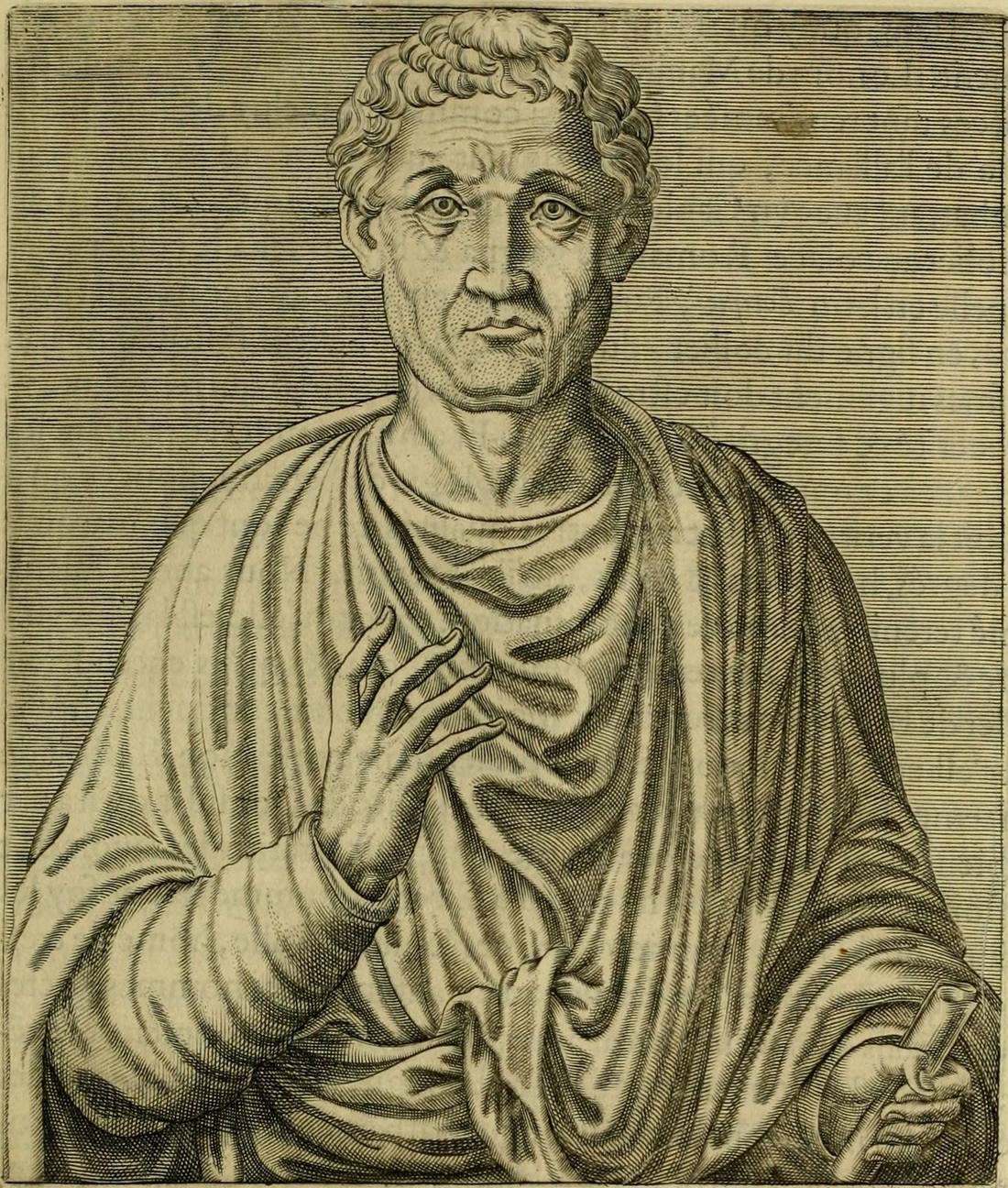
Picture: Boethius, an imagined likeness, André Thevet, Les vrais pourtraits et vies des hommes illustres, 1584. Public domain.
Who was Boethius?
Boethius was a Roman senator and scholar in Italy, under the Gothic king Theodoric. He put Aristotle's logic into Latin, and the West learned it from him for centuries. He rose to head the king's civil service. Then he was accused of treason and condemned unheard. In prison, before he was killed, he wrote The Consolation of Philosophy.
at a glance
His path, in order
- ScholarPut Greek philosophy into Latin
- ConsulSole consul in 510
- Master of OfficesHead of the civil service, 522
- PrisonerWrote the Consolation in his cell
in numbers
- Sons made consul together2
- In 522, though both were young
- He gave the speech praising King Theodoric that day
- Miles from his judges500
- Condemned “unheard and undefended”
- “Near five hundred miles away”, he says
did you know?
-
A geometry book under his name shows Hindu-Arabic numerals, zero and all. If he wrote that passage, these numerals were in Europe by about 500. But the book was put together centuries later, and no reliable evidence shows he knew them.
Smith and Karpinski, The Hindu-Arabic Numerals, 1911; Orthodox Encyclopedia -
Chaucer put his prison book into English, and so did Queen Elizabeth I. An Old English version is older still, and its preface says King Alfred the Great made it.
W. J. Sedgefield, King Alfred's Version of the Consolations of Boethius, 1900 -
He taught that music comes in three kinds. The first is the harmony of the universe, and the second the harmony within a human being. Only the third is music played on instruments.
His book on music, Book 1, chapter 2; Orthodox Encyclopedia -
He took up a question the medieval schools argued over for centuries. Do kinds of things, like animal or man, exist in their own right, or only in the mind? His answer, following Aristotle: they exist in things, and the mind draws them out.
Commentary on Porphyry, Book 1; Orthodox Encyclopedia
- Born
- About 480, at Rome. Some scholars say a few years earlier. No ancient source gives the year.
- Grew up
- In Rome, in the old family of the Anicii. His father, consul in 487, died when he was a child. The senator Symmachus raised him, and he married Symmachus's daughter, Rusticiana.
- Died
- In 524, or perhaps 526, near Pavia in northern Italy. King Theodoric had him put to death without a hearing.
- Buried
- At Pavia, in the church of San Pietro in Ciel d'Oro, St Peter in the Golden Sky. The bones of St Augustine lie in the same church.
- Also called
- His full name was Anicius Manlius Severinus Boethius. At Pavia he is St Severinus Boethius, San Severino Boezio in Italian.
- Status
- A local saint for Catholics, honoured at Pavia as a martyr. He is not in the Church's general calendar. The Orthodox, Anglicans and Lutherans do not keep him.
- In art
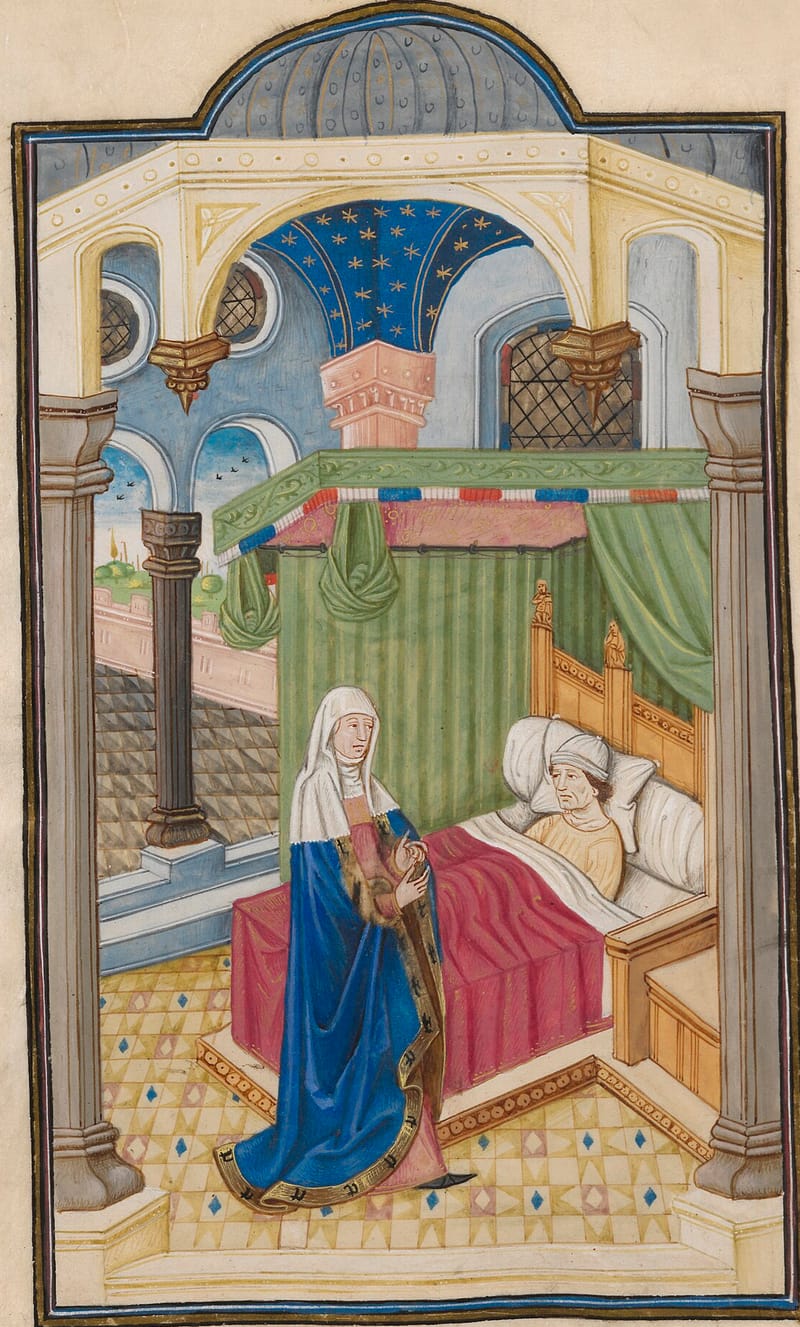
- A scholar in a cap, often in prison or in bed, with Lady Philosophy beside him. In his book she holds a notebook and a staff. The wheel of Fortune often turns nearby.
- Wrote
- The Consolation of Philosophy, in five books. Five short works of theology, one of them perhaps not his. Latin translations of Aristotle's logic and of Porphyry, with commentaries. Textbooks on arithmetic and music.
- Pronounced
- boh-EE-thee-us.
feast days
West
- Oct23
Catholic, at Pavia, where his church keeps it as a solemnity. Also in today's Roman Martyrology, which names him a martyr. The 1916 edition does not list him. Not in the General Roman Calendar.
No Orthodox calendar keeps him. Neither do the Church of England, the Episcopal Church, the Missouri Synod or the ELCA. No source says why 23 October, and no ancient source gives the day he died.
what was he like?
+honest about what he did not know
At a meeting, a letter from Eastern bishops to the Pope was read out. It asked about Christ's two natures. Everyone loudly said the answer was obvious, but no one really answered it. Boethius admits he had no answer either. The difference was that he lacked “the false assumption of a knowledge that I had not got”. So he held his peace and thought it through, “chewing the cud of constant meditation”. The result was his treatise Against Eutyches and Nestorius.
Against Eutyches and Nestorius, preface, with the Loeb note+no friend to the powerful
He says he went into public life to put philosophy into practice, and it made him enemies. He stood up to King Theodoric's officials when they preyed on the weak. When a forced sale in a time of famine threatened Campania with starvation, he fought it before the king and stopped it. “I have had to think nothing of giving offence to the powerful in the cause of justice.”
Consolation of Philosophy, Book 1, prose 4+a lover of music
When Clovis, king of the Franks, asked for a harper, King Theodoric turned to Boethius to choose one, “because you, being such a lover of music yourself, will be able to introduce us to the right man”. His own textbook on music, say his translators Stewart and Rand, “was in use at Oxford and Cambridge until modern times”.
Cassiodorus, Variae, Book 2, letter 40; Stewart and Rand, Introduction+wrote for the few
He wrote his treatise on the Trinity for his father-in-law, Symmachus. He used hard, new words on purpose. He said so plainly: “The rest of the world I simply disregard: they cannot understand, and therefore do not deserve to read.”
On the Trinity, prefacewhat others said of him
He was praised in his own day, even by the king who later had him killed, and for centuries after.
You have thoroughly imbued yourself with Greek philosophy. You have translated Pythagoras the musician, Ptolemy the astronomer, Nicomachus the arithmetician, Euclid the geometer, Plato the theologian, Aristotle the logician, and have given back the mechanician Archimedes to his own Sicilian countrymen (who now speak Latin).
…because they practised philosophy and were mindful of justice in a manner surpassed by no other men, relieving the destitution of both citizens and strangers by generous gifts of money, they attained great fame and thus led men of the basest sort to envy them.
The sainted soul, which the fallacious world / Makes manifest to him who listeneth well; / The body whence ’twas hunted forth is lying / Down in Cieldauro, and from martyrdom / And banishment it came unto this peace.
his life in six moments
Rome
A childAn orphan in a great house
His father, a former consul, died when he was small. He grew up in the house of Symmachus, a senator admired for his character and learning. Later he married Symmachus's daughter, Rusticiana. In his prison book, Lady Philosophy reminds him how, “when orphaned and desolate, thou wast taken into the care of illustrious men”.
Consolation, Book 2, prose 3; Catholic EncyclopediaRome
His life's workGreek into Latin
He set out to put all of Plato and Aristotle into Latin, with notes. He never finished, but he translated much of Aristotle's logic, and wrote textbooks on arithmetic and music. The Catholic Encyclopedia says the medieval schools, down to the twelfth century, “depended entirely on Boethius for their knowledge of Aristotle's doctrines”.
Stewart and Rand, Introduction; Stanford Encyclopedia of Philosophy; Catholic EncyclopediaItaly
In the king's serviceClocks for a king
King Theodoric used Boethius's learning in diplomacy. He asked him to have a water-clock and a sundial made, as a gift for the king of the Burgundians. “Exert yourself therefore, oh Boetius, to get this thing put in hand,” the king wrote.
Cassiodorus, Variae, Book 1, letter 45Rome
522Two sons, two consuls
He had been consul himself in 510, holding the office alone. In 522 his two young sons were made consuls together. They rode out with a train of senators behind them. In the senate house he gave the speech praising King Theodoric. Then he sat between his sons at the Circus and handed out gifts to the crowd. In his prison book, Lady Philosophy says Fortune gave him “a boon which she had never before granted to any private person”. That year the king made him Master of Offices, head of the civil service.
Consolation, Book 2, prose 3; James, ProemVerona
About 523Standing with Albinus
An informer, Cyprian, accused the senator Albinus of writing to the emperor at Constantinople against King Theodoric. Boethius spoke up for him in the king's presence: “The charge of Cyprianus is false, but if Albinus did that, so also have I and the whole senate with one accord done it; it is false, my Lord King.” Cyprian then brought false witnesses against Boethius too, and the king believed them.
Anonymus Valesianus, part 2, sections 85 and 86; Consolation, Book 1, prose 4Pavia
In prisonCondemned unheard
He and Albinus were locked in a church's baptistery. Later he was held on an estate near Pavia. King Theodoric had him sentenced without a hearing. Boethius says the senate itself passed decrees against him. Besides the charge of treason, he writes, “they falsely asserted that in the pursuit of my ambition I had stained my conscience with sacrilegious acts”. In prison, waiting to die, he wrote The Consolation of Philosophy.
Anonymus Valesianus, part 2, section 87; Consolation, Book 1, prose 4
who is lady philosophy?
She is not a real woman. She is Philosophy herself, the love of wisdom, pictured as a woman. She is the other voice in the book Boethius wrote in prison, The Consolation of Philosophy. She talks, scolds and comforts him like a real teacher, so she is easy to take for one.
An idea with a voice
Boethius tells the book as if it really happened, and he plays himself in it. Philosophy comes to him in the form of a woman, much as Justice is pictured today as a woman holding scales. She is an idea given a voice, not a visitor. He gives Fortune a voice in the same way, in Book 2. The Stanford Encyclopedia of Philosophy calls the book “an imagined dialogue between the prisoner Boethius and a lady who personifies Philosophy”. He tells of her coming like a vision:
“it seemed to me that there appeared above my head a woman of a countenance exceeding venerable.”Consolation, Book 1, prose 1; Stanford Encyclopedia of Philosophy
How he pictures her
He describes Lady Philosophy with care. She seems very old, yet full of strength. Her eyes blaze, keener than any human eye. Her robe is one she wove with her own hands, dulled now by age and neglect. On its hem is the Greek letter P, and at its top the letter Th. Steps like a staircase climb from one to the other. The book's English translator, H. R. James, explains the letters in a note: P for the life of action, Th for the life of thought. She holds a notebook in her right hand and a staff in her left. Even her height will not stay still:
“At one moment it exceeded not the common height, at another her forehead seemed to strike the sky; and whenever she raised her head higher, she began to pierce within the very heavens, and to baffle the eyes of them that looked upon her.”Consolation, Book 1, prose 1, with James's note
Her torn robe
Lady Philosophy's robe is torn. Violent hands have ripped it, each snatching what he could. Later she tells him who did it. After Socrates died, she says, the Epicureans, the Stoics and the rest each tried to seize what he left. They dragged her off as their prize:
“they tore in pieces the garment which I had woven with my own hands, and, clutching the torn pieces, went off, believing that the whole of me had passed into their possession.”Consolation, Book 1, prose 1 and prose 3
She raised him
Lady Philosophy speaks to him like a nurse, in the old sense of the word: a woman who feeds a child and brings it up. She calls him her child. When he recognises her at last, he calls her “my nurse, Philosophy, whose halls I had frequented from my youth up”. This is his way of saying he had studied philosophy since he was young. So in a sense she was with him all his life. She is the learning he had followed since his youth, come to find him in his cell. She asks him:
“Art thou that man, who, erstwhile fed with the milk and reared upon the nourishment which is mine to give, had grown up to the full vigour of a manly spirit?”Consolation, Book 1, prose 2 and prose 3
What she teaches him
Lady Philosophy treats him like a patient, one book at a time. In Book 2 she shows him that Fortune's gifts were never his to keep. In Book 3, that wealth, rank, power, fame and pleasure cannot make anyone happy. True happiness is God Himself. In Book 4, that the wicked only seem to win, for only the good have real power. In Book 5, that God knows what we will choose, and yet we choose freely. But first, in Book 1, she finds the root of his sickness:
“Thou hast ceased to know thy own nature.”Consolation, Book 1, prose 6; James's summaries of Books 2 to 5; Stanford Encyclopedia of Philosophy
After him
Readers kept Lady Philosophy alive for centuries. The Old English version of the book, whose preface names King Alfred, has the prisoner know her as “his own mother, that same Philosophy that long before had trained and taught him”. Dante found her too. He had loved a woman called Beatrice. When she died, he lost what he called “the chief delight of my Soul”. For comfort he turned to Boethius's book, though he found it hard at first. Reading it, he came to love Philosophy herself, “the Lady of these authors, of these sciences, and of these books”. Like Boethius, he pictured her as a woman:
“I imagined her in the form of a gentle Lady; and I could imagine her in no other attitude than a compassionate one.”The Old English Boethius, tr. Sedgefield (1900); Dante, The Banquet, the second treatise, tr. Sayer (1887); Catholic Encyclopedia
his prison book
He wrote The Consolation of Philosophy in his cell. It is a dialogue in five short books, prose and poems in turn. The historian Edward Gibbon called it “a golden volume not unworthy of the leisure of Plato or Tully”. Tully is Cicero.
A doctor at his bedside
The book opens with him in tears, writing sad verses with the Muses of poetry at his bed. Then a woman appears above him: Lady Philosophy. She drives the Muses out, and spends five books talking him back to sense. He wrote himself as the patient. Her first words are for the Muses.
“Who has allowed yon play-acting wantons to approach this sick man—these who, so far from giving medicine to heal his malady, even feed it with sweet poison?”Consolation, Book 1, prose 1
Fortune's wheel
Lady Philosophy lets Fortune speak for herself. Why complain, Fortune asks, when she only takes back what was never his? Rising and falling is her game, and she never stops playing it.
“I turn the wheel that spins. I delight to see the high come down and the low ascend.”Consolation, Book 2, prose 2
God's knowledge and our freedom
The Consolation's last book asks a hard question. If God knows what we will choose, are we free? Lady Philosophy answers that God sees all of time at once. So His knowing is “not foreknowledge as of something future, but knowledge of a moment that never passes”. Seeing a thing happen does not force it to happen. Medieval writers on God and time started from his definition of eternity.
“Now, eternity is the possession of endless life whole and perfect at a single moment.”Consolation, Book 5, prose 6; Stanford Encyclopedia of Philosophy
Plato in a Christian's book
Lady Philosophy teaches some of Plato's ideas. One poem says all learning is remembering what the soul knew before, with a hedge: “If Plato's teaching erreth not, / We learn but that we have forgot.” Another follows Plato's Timaeus, notes the translator H. R. James, down to a world-soul “of threefold nature, moving all”. The Catholic Encyclopedia finds “evident traces of the influence of the Neo-Platonists” in the book, and little that is Christian. His translators Stewart and Rand disagree:
“The development of the argument is anything but Neoplatonic; it is all his own.”Consolation, Book 3, poems 9 and 11; Catholic Encyclopedia; Stewart and Rand
Why no Christ?
The book never names Christ. Thomas Hodgkin, who translated Cassiodorus's letters, wrote in 1886 that “the name of Christ is never once mentioned, the tone, though religious and reverential, is that of a Theist only”. Some critics said Boethius was no Christian, or gave up his faith in prison. But Cassiodorus, who knew him, lists his Christian works: “He wrote a book concerning the Holy Trinity, and certain dogmatic chapters, and a book against Nestorius.” His translators Stewart and Rand explain the silence, setting the book beside the Tractates, his short works of theology:
“In the Consolation he is writing philosophy; in the Tractates he is writing theology.”Hodgkin, The Letters of Cassiodorus; Catholic Encyclopedia; Stewart and Rand, Introduction
Its last words
The book ends with Lady Philosophy's charge to live well, since God sees all we do.
“Great is the necessity of righteousness laid upon you if ye will not hide it from yourselves, seeing that all your actions are done before the eyes of a Judge Who seeth all things.”Consolation, Book 5, prose 6
his words
Most of these lines come from the Consolation, the dialogue he wrote in prison. In it the prisoner, Boethius himself, complains, and Lady Philosophy answers. Each line says who speaks. The Consolation is in H. R. James's translation of 1897.
In prison, remembering his sons' great day
For truly in adverse fortune the worst sting of misery is to have been happy.
The prisoner speaks: Boethius himself, after Lady Philosophy has listed all his blessings. In Latin, Nam in omni aduersitate fortunae infelicissimum est genus infortunii fuisse felicem.
Consolation of Philosophy, Book 2, prose 4Sovereign Ruler, Lord of all! / Can it be that Thou disdainest / Only man? ’Gainst him, poor thrall, / Wanton Fortune plays her vainest. / Guilt’s deserved punishment / Falleth on the innocent.
If God exists, whence comes evil? Yet whence comes good, if He exists not?
For truly I believe that Ill Fortune is of more use to men than Good Fortune.
Cease, then, to seek the wealth thou hast lost, since in true friends thou hast found the most precious of all riches.
What law can lovers move? A higher law is love!
The individual substance of a rational nature.
often misquoted
Dante first had the thought: “There is no greater sorrow / Than to be mindful of the happy time / In misery.”
What the sources sayDante wrote those words, but the thought is older. In prison Boethius wrote that “the worst sting of misery is to have been happy”. The Catholic Encyclopedia calls Dante's lines “a haunting memory of Boethius”.
Dante, Inferno, Canto 5; Consolation, Book 2, prose 4; Catholic Encyclopedia“There is nothing either good or bad but thinking makes it so” is a line of Boethius.
What the sources sayIt is Hamlet's. H. R. James borrowed Hamlet's words when he translated Boethius in 1897: “nothing is wretched, but thinking makes it so”. The Latin is plainer: nihil est miserum nisi cum putes, nothing is wretched unless you think it so.
Shakespeare, Hamlet, Act 2, scene 2; Consolation, Book 2, prose 4The Latin proverb Si tacuisses, philosophus mansisses (if you had kept silent, you would have stayed a philosopher) is his.
What the sources sayOnly the first half. In his book, a vain man is told he will prove himself a philosopher if he bears insults patiently. He bears them, then boasts of it. His critic retorts that he would have proved it, had he kept quiet: “I should have hadst thou held thy peace.” The Latin there is si tacuisses. The words about staying a philosopher are not in his book.
Consolation, Book 2, prose 7, in English and in LatinHe invented the wheel of Fortune.
What the sources sayNo. Cicero speaks of Fortune's wheel, fortunae rotam, in a speech nearly six centuries earlier. Boethius gave it a voice. His Fortune says, “I turn the wheel that spins.” Medieval copies of his book often paint it.
Cicero, Against Piso; Consolation, Book 2, prose 2The historian Edward Gibbon called him “the last of the Romans”.
What the sources sayWith a catch: “the last of the Romans whom Cato or Tully could have acknowledged for their countryman”. His translators Stewart and Rand put it another way: “Boethius was the last of the Roman philosophers, and the first of the scholastic theologians.”
Gibbon, The Decline and Fall of the Roman Empire, chapter 39; Stewart and Rand, Introductionwhere he stood
Two of these lines are his own, from his short works on God. Three come from the Consolation, where Lady Philosophy answers him: he wrote them, but he gave them to her. TapClick “Show his line” to read it.
Your answers are next to his. From your result on . See your result
“Most of the time, it's better to say less.”
Boethius agrees.
You
On record in the The Consolation of Philosophy. Not quoted here.
“Wisdom is worth learning from anyone, even people who don't share your faith.”
Boethius strongly agrees.
You
Show his line
Examine carefully what I have said, and if possible, reconcile faith and reason.Theological Tractates, Tractate 2, to John the Deacon, the last lines
“Anger at real wrongdoing can be a good thing.”
Boethius disagrees.
You
Show his line
Pity is rather due to the criminal, who ought to be brought to the judgment-seat by his accusers in a spirit not of anger, but of compassion and kindness.The Consolation of Philosophy, Book 4, prose 4, in Philosophy's voice
“Giving to the poor isn't generosity. It's paying back what's already theirs.”
Boethius agrees.
You
On record in the The Consolation of Philosophy. Not quoted here.
“The best way to live is free of strong emotions, with only a steady peace inside.”
Boethius strongly agrees.
You
Show his line
Joy, hope and fear Suffer not near, Drive grief away: Shackled and blind And lost is the mind Where these have sway.The Consolation of Philosophy, Book 1, poem 7, in Philosophy's voice
“Some questions about God are better left alone.”
Boethius strongly disagrees.
You
Show his line
I have long pondered this problem with such mind as I have and all the light that God has lent me.Theological Tractates, On the Trinity, the first words
“Becoming a better person is mostly down to your own effort.”
Boethius agrees.
You
Show his line
Therefore, withstand vice, practise virtue, lift up your souls to right hopes, offer humble prayers to Heaven.The Consolation of Philosophy, Book 5, prose 6, in Philosophy's voice
See where you stand beside him. Take the quiz
friends, family and rivals
 Augustine of Hippo
 Augustine and Boethius never met. Boethius hoped his book on the Trinity would show “the seeds sown in my mind by St. Augustine's writings”. Today they lie in the same church at Pavia.
On the Trinity, preface; Orthodox EncyclopediaHis father-in-law, who raised him. In the prison book Lady Philosophy calls him “a man whose splendid character does honour to the human race”. Soon after Boethius died, King Theodoric had Symmachus brought to Ravenna and killed too.
Consolation, Book 2, prose 4; Anonymus Valesianus, section 92His wife, Symmachus's daughter. The historian Procopius remembers her as “a woman who was always lavishing her wealth upon the needy”. Years later, when the Goths took Rome, she was reduced to begging for bread. The Goths accused her of destroying Theodoric's statues, to avenge her father and her husband, and wanted her killed. King Totila protected her.
Procopius, History of the Wars, Book 7, chapter 20Made consuls together in 522, while still young. After Theodoric died, his daughter gave back to the children of Symmachus and Boethius their fathers' estates.
Consolation, Book 2, prose 3; Procopius, History of the Wars, Book 5, chapter 2A friend in the Church. Boethius sent him three of his short works of theology, one of them “to his saintly master and reverend father John the Deacon”. The Catholic Encyclopedia says he was afterwards Pope John I.
Theological Tractates 2, 3 and 5; Catholic EncyclopediaThe senator accused of writing to the emperor against Theodoric. Boethius defended him, and fell with him.
Anonymus Valesianus, sections 85 and 86The official who accused Albinus, then brought false witnesses against Boethius too.
Anonymus Valesianus, sections 85 and 86Men he names among his accusers. Basil had been dismissed from King Theodoric's household and was driven by his debts. The king had sentenced Opilio and Gaudentius to banishment for various crimes. On the very day he ordered them out of Ravenna, they laid their charge against Boethius.
Consolation, Book 1, prose 4The Ostrogothic king of Italy, an Arian Christian. Arians held that the Son of God was created by the Father. He trusted Boethius for years, then had him condemned unheard and killed. The historian Procopius says he wept over it before he died.
Anonymus Valesianus, sections 86 and 87; Procopius, History of the Wars, Book 5, chapter 1A fellow statesman and a relative. He drafted King Theodoric's letters to Boethius. A note of his confirms that Boethius really wrote the Christian treatises that bear his name.
Cassiodorus, Variae; Hodgkin, The Letters of Cassiodorus; Stewart and Rand, Introductionhow he died
He was put to death near Pavia in 524, or perhaps 526, on King Theodoric's orders. He was never given a hearing.
A short chronicle by an unknown writer of the sixth century tells how he died. It becomes hostile to King Theodoric when it reaches his last years. It says the king had him killed on the estate where he was held, usually taken to be Calvenzano, near Pavia. “He was tortured for a long time with a cord bound about his forehead so tightly that his eyes cracked in their sockets, and finally, while under torture, he was beaten to death with a cudgel.” No last words are recorded.
King Theodoric then had Boethius's father-in-law, Symmachus, brought to Ravenna and put to death on a false charge. He feared that grief for his son-in-law would turn Symmachus against him. Pope John I came back from a mission to Constantinople. The king treated him as an enemy, and the Pope died a few days later.
The historian Procopius tells what happened to the king. A few days after Symmachus and Boethius were killed, a great fish's head was served to Theodoric at dinner. “This seemed to Theoderic to be the head of Symmachus newly slain.” He ran to his room, shivering, and lay under a heap of covers. He told his doctor, wept for the wrong he had done Symmachus and Boethius, and died not long after. Procopius calls the killings the king's “first and last act of injustice” to his subjects.
is he a saint?
Yes, for Catholics, as a local saint. Pavia has long honoured him as a martyr, and Rome confirmed that in 1883. He is not in the Church's general calendar. The Orthodox, Anglicans and Lutherans do not count him a saint.
- CatholicSaint (local)Honoured at Pavia, confirmed by Rome in 1883. In today's Roman Martyrology on 23 October
- OrthodoxNot a saintNo feast. The Orthodox Encyclopedia calls him a saint of the Catholic Church
- AnglicanNot keptNot in Common Worship or Lesser Feasts and Fasts 2022
- LutheranNot keptNot in the Missouri Synod or ELCA calendars
On 15 December 1883 the Congregation of Rites in Rome confirmed that Pavia had honoured him as a saint from time out of mind, and Pope Leo XIII ratified it the same day. The decree names him servo Dei Severino Boetio, philosopho martyri sancto nuncupato: the servant of God Severinus Boethius, philosopher and martyr, called a saint. Today's Roman Martyrology lists him on 23 October as a martyr. It says he wrote the Consolation in prison and served God with integrity until King Theodoric put him to death. The English edition of 1916 does not list him. Pope Benedict XVI came to honour his tomb in 2007.
Was he killed for his faith? The decree of 1883 says so. It calls Theodoric a most zealous follower of the Arian heresy, acerrimus, uti erat, Arianae haeresis sectator, who set out to destroy three Catholic leaders: Pope John, Symmachus and Boethius. Arians held that the Son of God was created by the Father. The Council of Nicaea had condemned that teaching in 325. The decree adds that the king had him buried in secret, for fear Catholics would honour him as a martyr.
The sixth-century sources give other reasons. One chronicle says the charge was treason, over a letter to the emperor. Boethius himself names treason and sacrilege. A Catholic saints' site, santodelgiorno.it, says plainly that his execution had political motives. Three facts stand behind both views. Theodoric was an Arian Christian. The emperor Justin was pressing the Arians in the East. And Pope John died soon after Boethius, held by the king as an enemy.
There can be no reasonable doubt, then, that Boethius died a Christian, though it is not easy to show from documentary sources that he died a martyr for the Catholic Faith. The absence of documentary evidence does not, however, prevent us from giving due value to the constant tradition on this point.
Boethius was without doubt a Christian, a Doctor and perhaps a martyr.
a prayer he wrote
He wrote this prayer for Lady Philosophy to sing, in Book 3 of the Consolation. After it, she shows him the highest good.
Oh, grant, almighty Father, / Grant us on reason's wing to soar aloft / To heaven's exalted height; grant us to see / The fount of good; grant us, the true light found, / To fix our steadfast eyes in vision clear / On Thee. Disperse the heavy mists of earth, / And shine in Thine own splendour. For Thou art / The true serenity and perfect rest / Of every pious soul—to see Thy face, / The end and the beginning—One the guide, / The traveller, the pathway, and the goal.
what to read first
The Consolation of Philosophy
Boethius, translated by H. R. James
Written in prison. Five short books of prose and poems. Start with Book 1: he tells his own story in the fourth prose section.
Read it freeThe Theological Tractates
Boethius, translated by Stewart and Rand
His five short works of theology. On the Trinity opens with his preface to Symmachus.
Read them freeThe fall of Boethius
The Anonymus Valesianus, translated by J. C. Rolfe
Sections 85 to 96 of a sixth-century chronicle: the charge, his death, and what followed. Two pages.
Read it freeThe Letters of Cassiodorus
Cassiodorus, translated by Thomas Hodgkin
Book 1, letter 45: King Theodoric's letter about the water-clock, with its praise of his learning.
Read it freetake the quizzes
 Quiz Which early Christian thinks like you? And which would argue with you? See where you stand beside Boethius. Start
  Quiz Christian Personality Test Which of eight types are you? Find your own. Start
 sources
His life, and his words
- Boethius, The Consolation of Philosophy. Tr. H. R. James, 1897.
- Boethius, The Theological Tractates. Tr. H. F. Stewart and E. K. Rand, Loeb, 1918.
- The Tractates and the Consolation, Latin and English. The same Loeb edition, for the Latin.
- Anonymus Valesianus, part 2. Tr. J. C. Rolfe, Loeb, 1939.
- Procopius, History of the Wars, Book 5. Tr. H. B. Dewing, Loeb, 1919.
- Procopius, History of the Wars, Book 7. Same edition.
- Cassiodorus, The Letters of Cassiodorus. Tr. Thomas Hodgkin, 1886.
- Dante, Paradiso, Canto 10. Tr. Henry Wadsworth Longfellow.
- Dante, Inferno, Canto 5. Same translator.
- Dante, The Banquet, the second treatise. Tr. Elizabeth Price Sayer, 1887.
- King Alfred's Version of the Consolations of Boethius. The Old English version in modern English, by W. J. Sedgefield, 1900.
- Edward Gibbon, The Decline and Fall of the Roman Empire, volume 4, chapter 39.
- Shakespeare, Hamlet, Act 2, scene 2.
- Cicero, Against Piso, in Latin.
Reference
- Catholic Encyclopedia, 1907, “Anicius Manlius Severinus Boethius”
- Stanford Encyclopedia of Philosophy, “Boethius”
- Orthodox Encyclopedia, “Boethius”, in Russian
- Merriam-Webster, “Boethius”, for how to say it
Calendars
- Acta Sanctae Sedis, volume 16, the decree of 15 December 1883, pages 302 and 303
- Cathopedia, San Severino Boezio, with the Roman Martyrology for 23 October, in Italian
- The Roman Martyrology, 1916, the English edition, 23 October: no entry for him
- Santo del giorno, San Severino Boezio, in Italian
- Basilica di San Pietro in Ciel d'Oro, San Severino Boezio, in Italian
- USCCB, the readings for 23 October 2026
- OCA, the lives of the saints for 23 October
- Church of England, Common Worship calendar
- The Episcopal Church, Lesser Feasts and Fasts 2022
- Lutheran Church–Missouri Synod, Commemorations
- Evangelical Lutheran Worship, ELCA, the church year
Pictures
- Boece Severin, in André Thevet, Les vrais pourtraits et vies des hommes illustres, volume 3, 1584. Internet Archive. Public domain.
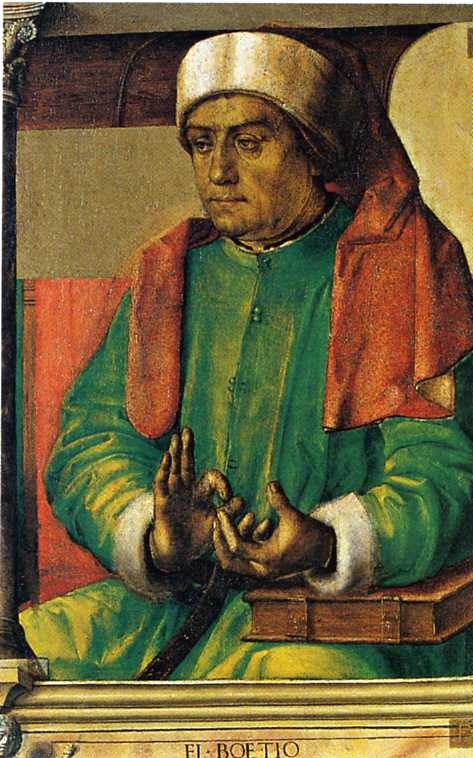
- Fl Boetio, Justus van Gent and Pedro Berruguete, about 1472-1476. Galleria Nazionale delle Marche, Urbino. Public domain.
- Philosophy in discussion with Boethius on his sickbed, a miniature in a Consolation copied at Bruges, 1470. Utrecht University Library, Hs. 1335. Public domain.