
Francis of Assisi
The merchant's son who kissed a leper, gave everything away and founded the Friars Minor.
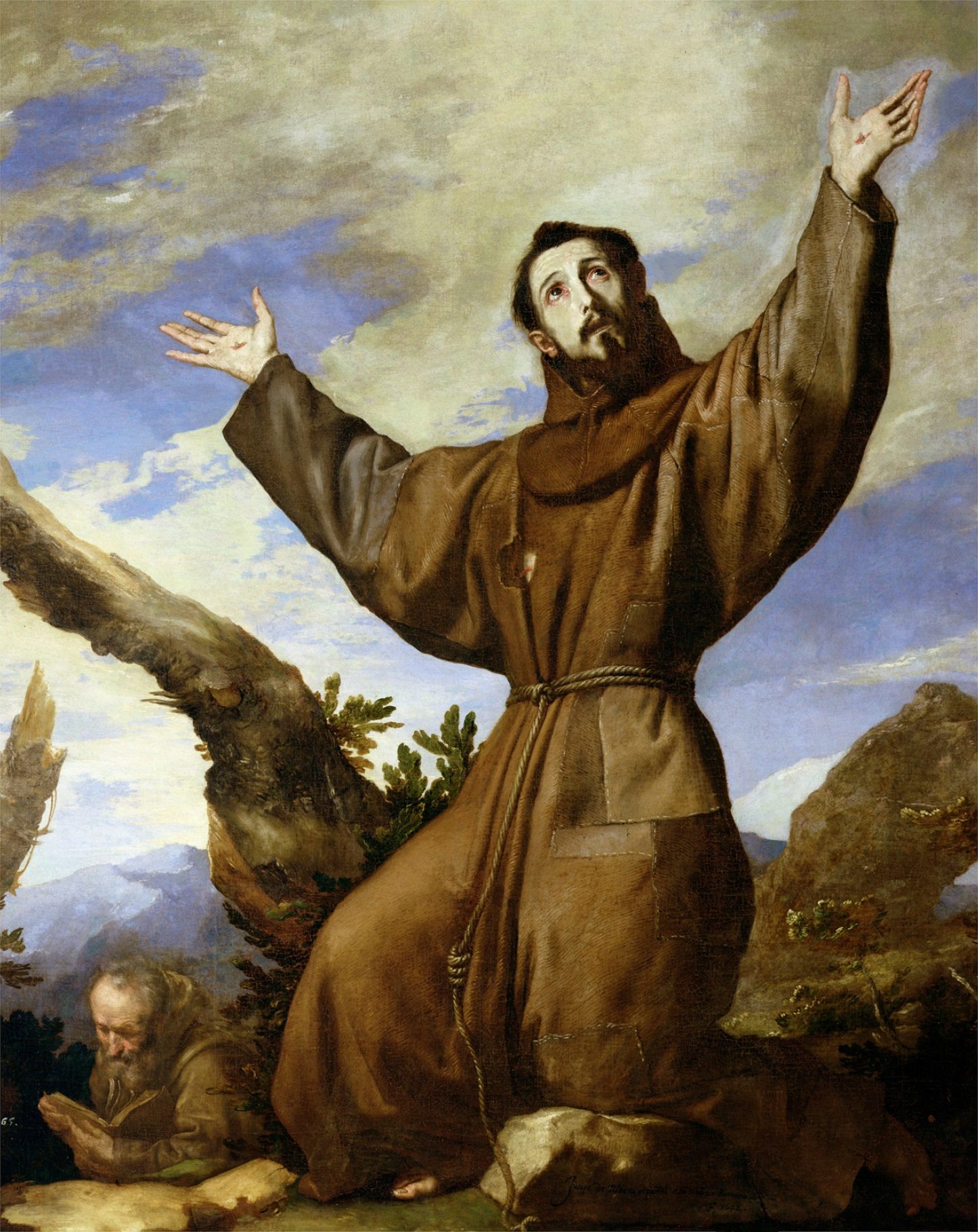
Picture: Saint Francis of Assisi, Jusepe de Ribera, 1642. Monastery of El Escorial. Public domain.
Who was Francis?
Francis was the son of a rich cloth merchant of Assisi, in Italy. About 1206 he gave everything away, to his father's fury, and lived as a beggar for Christ. The brothers who joined him became the Friars Minor. He preached to birds and to a sultan, kept Christmas with a real manger, and bore wounds like Christ's.
at a glance
His path, in order
- Merchant's sonSold fine cloth in Assisi
- Prisoner of warA year in Perugia, 1202
- PenitentRebuilt ruined churches, 1206
- FounderOf the Friars Minor, 1209
- PreacherTo crowds, birds and a sultan
- HermitOn La Verna, 1224
- PoetThe Canticle of the Sun, 1225
in numbers
- Wounds he bore from 12245
- Hands, feet and side
- He hid them while he lived
- Friars said to attend one meeting of his order5k
- The “Chapter of Mats”, at the Portiuncula, 1220 or 1221
- Named for their shelters of wicker and rush mats
- Months from his death to sainthood21
- Died 3 October 1226
- Canonised 16 July 1228
- Writings in his own hand that survive2
- A letter to Brother Leo, at Spoleto
- A sheet of praises, at Assisi
- Nights spent searching for his coffin52
- Hidden under the altar in 1230
- Found on 12 December 1818
did you know?
-
Preaching before Pope Honorius III and his cardinals, he was so full of joy that “he moved his feet as if dancing”.
Celano, First Life, chapter 73 -
He loved the birds, and wanted them to feast at Christmas too. If he ever spoke with the emperor, he said, he would ask for a law that on Christmas Day everyone scatter grain on the roads for them, “especially our sisters the larks”.
Celano, Second Life, chapter 200 -
One year Christmas fell on a Friday, a day when Christians ate no meat, and Brother Morico said they should keep the fast. Francis would not hear of it. On the day Christ was born, he said, “the very walls should eat flesh”, or at least be greased with meat on the outside.
Celano, Second Life, chapter 199
- Born
- In 1181 or 1182, at Assisi in Umbria, Italy. His father, Pietro di Bernardone, was a rich cloth merchant. His mother was Pica.
- Named
- Baptised Giovanni, or John. His father was in France when he was born, and on his return he renamed the boy Francesco.
- Died
- On the evening of 3 October 1226, at the Portiuncula below Assisi. His first biographer, Celano, dates it to the Sunday, 4 October.
- Buried
- At San Giorgio in Assisi. In 1230 he was moved to the great church built for him, and hidden deep under its altar.
- Made a saint
- 16 July 1228, at Assisi, by Pope Gregory IX, his old friend and protector.
- Founded
- The Friars Minor, the Lesser Brothers, in 1209. With Clare, a young noblewoman of Assisi, he founded the Poor Ladies, today's Poor Clares. Then an order of penance for lay people, now called the Third Order.
- Also called
- Il Poverello, the little poor man.
- Wrote
- Two Rules, a Testament, letters, prayers, 28 short Admonitions and the Canticle of the Sun, which he made in the Umbrian speech of his day.
- Patron of
- Italy, with Catherine of Siena. Also of animals, and since 1979 of all who care for ecology.
- In art
- A brown or grey habit tied with a knotted cord, the five wounds, and often birds.
- Status
- A saint to Catholics and Anglicans. Lutherans remember him. He is not on the Orthodox calendar.
- Pronounced
- FRAN-sis of uh-SIS-ee. Merriam-Webster also gives uh-SEE-see.
feast days
West
- May25
His body carried into his new church at Assisi in 1230, in the 1916 Roman Martyrology.
- Sep17
The stigmata, the marks of his wounds, in the 1916 Roman Martyrology. Since 1969 this feast is left to local calendars.
- Oct3
The Episcopal Church, in its Lesser Feasts and Fasts of 2022: the day he died.
- Oct4
Catholic memorial. Also a Lesser Festival in the Church of England, and a commemoration in the ELCA, as a renewer of the church.
Why 4 October? He died on the evening of the 3rd. His body was carried into Assisi on the 4th, and his first biographer, Celano, dates his death to that day, a Sunday. When Pope Gregory IX made him a saint, he ordered his feast kept “on the day of his death”. Rome's calendar of 1969 moved the feast of the wounds to local calendars, because it doubles the feast of 4 October. The Orthodox churches keep no day for him.
what was he like?
+joyful, on purpose
He held that joy was the best guard against the devil: “The Devil most exults when he can filch from a servant of God his joy of spirit.” So, says his biographer Celano, “He strove therefore ever to be gladsome of heart.” When robbers stopped him in a wood, he was singing God's praises in French. He told them, “I am a herald of the great King.”
Celano, Second Life, chapter 125; First Life, chapter 16+courteous to everyone
Once, still a merchant, he sent a beggar away rudely. He was so ashamed that he resolved to “never in future deny anything to any one asking him for the sake of God”. His biographer Celano adds that this was out of character, “for he was most courteous”.
Celano, First Life, chapter 17+tender to every creature
“Even towards little worms he glowed with exceeding love,” says his biographer Celano. He picked them off the path so no one would tread on them. When fish were caught, he would throw them back alive, “bidding them beware of being caught a second time”. In winter he had honey or the best wine set out for the bees. He called every creature brother or sister.
Celano, First Life, chapters 61, 80 and 81+hard on his own body
He called his body Brother Ass. One winter night, fighting temptation, he threw himself into the snow and made seven heaps of it. He told his body, “this large one is thy wife”, and the rest were its children and servants, freezing and waiting to be clothed. At the end of his life he asked Brother Ass's pardon for treating it so harshly.
Celano, Second Life, chapters 116 and 117; Catholic Encyclopedia (1909)+no use for money
His motto for the brothers was “Let dung and money be loved and valued alike”. A visitor once left coins at the church, and a brother touched them to put them on a window sill. Francis made him carry the money out in his mouth, and drop it on a heap of asses' dung.
Celano, Second Life, chapter 65+small on purpose
His Rule said of the brothers, “And be they lesser”. When it was read, he said, “I will that this brotherhood be called the Order of Lesser Brethren”, the Friars Minor. He never became a priest, and stayed a deacon all his life.
Celano, First Life, chapters 38 and 86what others said of him
Thomas of Celano, a friar who knew him, wrote the first Life in 1228 and 1229, at the bidding of Pope Gregory IX. People have argued about Francis ever since.
He was stedfast in purpose, firm in virtue, persevering in grace, and in all things the same. He was swift to pardon and slow to be angry.
The master of these Brothers is named Brother Francis; he is so lovable that he is venerated by everyone.
From out that slope, there where it breaketh most its steepness, rose upon the world a sun.
For he treated the whole mob of men as a mob of kings.
…a harmless enthusiast, pious and sincere, but hardly of sane mind…
his life in 13 moments
Assisi
His youthThe king of the feasts
He worked in his father's cloth trade, but he was merrier and freer with money than his father. He went “round the city of Assisi day and night in company with his like”, and spent all he had on banquets. His parents said he lived like a prince's son, not theirs. When the neighbours talked, his mother answered: “What think ye of my son? He shall yet be the son of God by grace.”
Legend of the Three Companions, chapter 1Perugia
1202 to 1203A year in chains
Assisi went to war with Perugia, and Francis was taken prisoner. The other captives were gloomy, and he laughed at his chains. When they called him mad, he answered: “I shall yet be worshipped as a Saint all the world over.” There was a proud knight among them whom everyone shunned. Francis bore with him and got the others to make peace with him.
Celano, Second Life, chapter 4Spoleto
About 1205A dream of arms
He set out to fight in Apulia, hungry for glory. Before he left, he dreamed his house was full of “saddles, shields, lances”, where there were usually bales of cloth. On the road, at Spoleto, a voice asked him in the night: “Which can do the better for thee, the lord, or the servant?” He said the lord. The voice asked why, then, he was leaving the lord for the servant. He turned round and rode home.
Celano, First Life, chapter 5; Legend of the Three Companions, chapter 2Near Assisi
About 1205The leper
Lepers had always disgusted him. Even when he saw their houses two miles off, he held his nose. Then one day, riding near Assisi, he met a leper. He got down from his horse and kissed him, and the leper, holding out his hand, “received money and a kiss with it”. His biographer Celano, in his second Life, adds that when Francis looked back, “he could not see that leper at all”. Twenty years later he began his Testament with that day.
Celano, First Life, chapter 17; Second Life, chapter 9San Damiano
About 1205“Repair My house”
He went to pray in San Damiano, a crumbling church below the town. The painted crucifix spoke to him: “Francis, go repair My house, which as thou seest is wholly falling into ruin.” He took it literally. He rode to Foligno, sold a load of scarlet cloth and the horse too, and offered the money to the priest. Then he set about rebuilding the church with his own hands.
Celano, Second Life, chapter 10; First Life, chapters 8, 9 and 18Assisi
1206Naked before the bishop
His father dragged him home and locked him up, then took him before Bishop Guido to get his money back. Francis gave the money back. Then, without a word, he took off all his clothes and handed them to his father. He “stripped himself stark naked before all the bystanders”. The bishop wrapped him in his own cloak.
Celano, First Life, chapters 12 to 15; Second Life, chapter 12The Portiuncula
About 1208The Gospel of the road
He was mending a third ruined church, St Mary of the Portiuncula, in the plain below Assisi. At Mass he heard the Gospel where Christ sends out His disciples with no gold, no bag, no staff and no shoes. He asked the priest to explain it, and cried: “This is what I wish, this is what I am seeking, this I long with all my inmost heart to do.” He took off his shoes, put down his staff and tied his tunic with a cord.
Celano, First Life, chapters 21 and 22Rome
1209 or 1210The Pope's dream
Men of Assisi began to join him. With eleven brothers he went to Rome, to ask Pope Innocent III to approve a short rule taken from the Gospel. His biographer Celano, in his second Life, says the Pope had lately dreamed that the Lateran basilica was falling, and that “a certain Religious, a man small and despised, was propping it on his own back”. Innocent approved the rule by word of mouth.
Celano, First Life, chapters 32 and 33; Second Life, chapter 17The Portiuncula
Palm Sunday, 1212Clare
Clare was a young noblewoman of Assisi who had heard him preach. On the night after Palm Sunday she slipped out of her family's house by “a door much barred and obstructed with stones”, and came to the brothers at the Portiuncula. There her hair was cut off, and she gave her life to God. She soon settled at San Damiano, the church Francis had rebuilt, with the women who became the Poor Clares.
The Life of St Clare, ascribed to Thomas of Celano, tr. Charlotte Balfour (1910); Catholic Encyclopedia (1909)Damietta, Egypt
1219Across the lines
During the Fifth Crusade he crossed from the Christian camp to the Muslim one. He was beaten by the soldiers, and brought before the Sultan of Egypt. The story is told below, in “Francis and the Sultan”.
Celano, First Life, chapter 57Fonte Colombo
1223The Rule written twice
His brothers now numbered thousands. His rule of 1221 was too long and loose to serve as a formal rule. He went up to Fonte Colombo, a hermitage near Rieti, and wrote a shorter one. He gave it to Brother Elias, his vicar, who not long after “declared he had lost it through negligence”. Francis went back and wrote it again, in twelve chapters. Pope Honorius III approved it on 29 November 1223, and the Friars Minor still profess it.
Catholic Encyclopedia (1909); Paschal Robinson, The Writings of St Francis (1906)Greccio
Christmas, 1223A manger in the woods
Two weeks before Christmas he asked a friend at Greccio to prepare the feast: “I would make memorial of that Child Who was born in Bethlehem, and in some sort behold with bodily eyes His infant hardships.” The friend made ready a manger with hay, an ox and an ass. People came through the woods with torches. Mass was said over the manger, and Francis, a deacon, sang the Gospel. When he said “Bethlehem”, he said it “in the manner of a sheep bleating”.
Celano, First Life, chapters 84 to 86San Damiano
1225The Canticle that made peace
Nearly blind and in pain, he stayed in a hut by San Damiano, where Clare and her sisters lived. There he made his Canticle of the Sun. Then the bishop and the mayor of Assisi fell out. He added a verse on those who forgive, and sent two brothers to sing it before them both. The mayor wept, and said that he would forgive even the murder of his own son: “if any one should have slain my blood-friend or my son I will forgive him”. The bishop answered: “My office bids me be humble, yet because I am naturally prompt to wrath, it behoves that thou shouldst pardon me.”
Catholic Encyclopedia (1909); The Mirror of Perfection, chapter 101, a compilation of about 1318, tr. Robert Steele
francis and the sultan
In 1219 he walked out of the crusaders' camp and into the Sultan's. Three early writers tell it, each in their own way, and people still argue over what it meant.
The earliest witness
The Fifth Crusade was besieging Damietta, a port of Egypt. Jacques de Vitry, bishop of Acre, was in the Christian camp. He wrote home in 1220, soon after Francis went to the Sultan. His letter says the Sultan listened, and asked for a sign:
“For days together he announced the word of God to the Saracens, but with little success; then the sultan, King of Egypt, asked him in secret to entreat God to reveal to him, by some miracle, which is the best religion.”Jacques de Vitry, letter of 1220, in Paul Sabatier, Life of St. Francis of Assisi (1894), tr. Louise Seymour Houghton
Celano, ten years on
In the first Life by his biographer Celano, the Sultan's soldiers seize Francis, insult him and beat him. The Sultan himself receives him with honour and offers him rich gifts. Francis refuses them all, and the Sultan is amazed:
“He was deeply stirred by his words and heard him very willingly.”Celano, First Life, chapter 57
The fire, forty years later
His later biographer Bonaventure, writing about 1260, adds a challenge. Francis offers to walk into a great fire with the Sultan's priests, or alone, if the Sultan and his people will believe. The Sultan says no. His priests would not do it, he answers, and he fears his people would revolt. The French historian Paul Sabatier doubted the story in 1894: “We know how little such an appeal to signs is characteristic of St. Francis.” In Bonaventure the Sultan answers:
“I do not believe that any of my priests would be ready to expose himself unto the fire in defence of his faith, or to undergo any sort of torture.”Bonaventure, Life of St Francis, chapter 9, tr. E. Gurney Salter; Sabatier (1894)
Two readings
His early biographers say plainly why he went to the Sultan. Celano speaks of “the lofty purpose to attain martyrdom”. Bonaventure says he went “that by the shedding of his blood the Faith of the Trinity might be spread abroad”. He came back alive, and the Sultan stayed a Muslim. His own Rule of 1221 gives brothers going among Muslims two ways to act. “One way is not to make disputes or contentions”, living among them and saying openly that they are Christians. The second is open preaching: “The other way is that when they see it is pleasing to God, they announce the Word of God.” Some read him as a missionary who meant to convert the Sultan or die. Others see a bridge between two faiths. G. K. Chesterton, in 1923, called the visit a great effort that
“broke off short like the beginnings of a great bridge that might have united East and West, and remains one of the great might-have-beens of history”Celano, First Life, chapter 56; Bonaventure, chapter 9; Rule of 1221, chapter 16; Chesterton, St. Francis of Assisi (1923)
his miracles
Thomas of Celano wrote the first Life of Francis at Pope Gregory IX's bidding. It came just after the canonisation, less than three years after Francis died. It ends with a long list of healings at his tomb. At the start Celano says where his stories come from:
…those things that I have heard from blessed Francis' own mouth or have understood from faithful and approved witnesses…
5 wounds, from La Verna
-
La Verna
September 1224The seraph
Two years before he died, he was keeping a long fast on the mountain of La Verna. In a vision he saw a man like a seraph, with six wings, fixed to a cross. He was glad at its kind look and afraid of its suffering, and could not tell what it meant. Then his own body began to change.
“marks of nails began to appear in his hands and feet, such as he had seen a little while before in the Man crucified Who had stood over him”
Brother Leo was with him. On a sheet of praises Francis wrote for him there, Leo noted that it was made “after the vision and speech of the Seraph and the impression of the Stigmata of Christ in his body”.
Celano, First Life, chapter 94; Brother Leo's note, in Robinson (1906) -
Umbria
1224 to 1226Hidden
His hands and feet bore what looked like nails made of his own flesh, with round heads on one side and bent points on the other. His right side had a wound that often bled on his tunic. He hid them from nearly everyone. Once Brother Rufino, reaching into his tunic to scratch an itch for him, touched the wound in his side. Francis pushed his hand away and asked the Lord to forgive Rufino.
“he concealed the stigmata most diligently from strangers”
Brother Elias saw the side wound while Francis lived. Brother Rufino, says his biographer Celano, “touched it with his own hands”.
Celano, First Life, chapter 95 -
The Portiuncula
October 1226Seen by all
When he died, the brothers kissed his hands and feet, and the people of Assisi crowded in to see. Celano says they saw in his flesh
“not the prints of the nails but the nails themselves formed out of his flesh and retaining the blackness of iron”
Brother Elias, his vicar, wrote to the whole Order the next day: “For a long time before his death our Brother and Father appeared as crucified, having in his body five wounds which are truly the stigmata of Christ.”
Celano, First Life, chapters 112 and 113; Elias's letter of 1226, in Sabatier (1894)
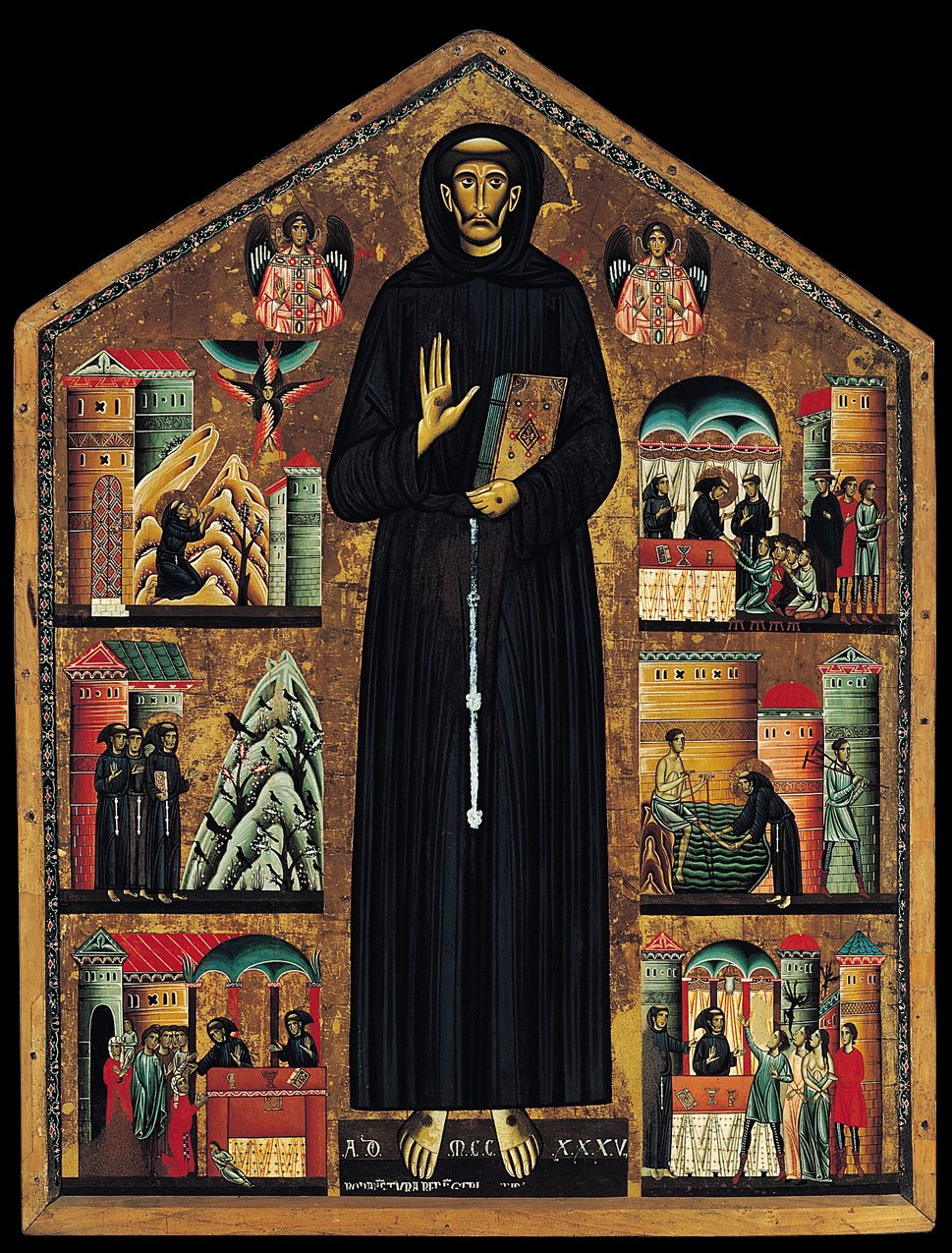
Nine years after his death, Bonaventura Berlinghieri painted him for the church at Pescia with the wounds in his hands and feet. The panel is dated 1235, and it is still at Pescia. Sabatier (1894), Critical study of the stigmata; the panel at Pescia
The sermon to the birds
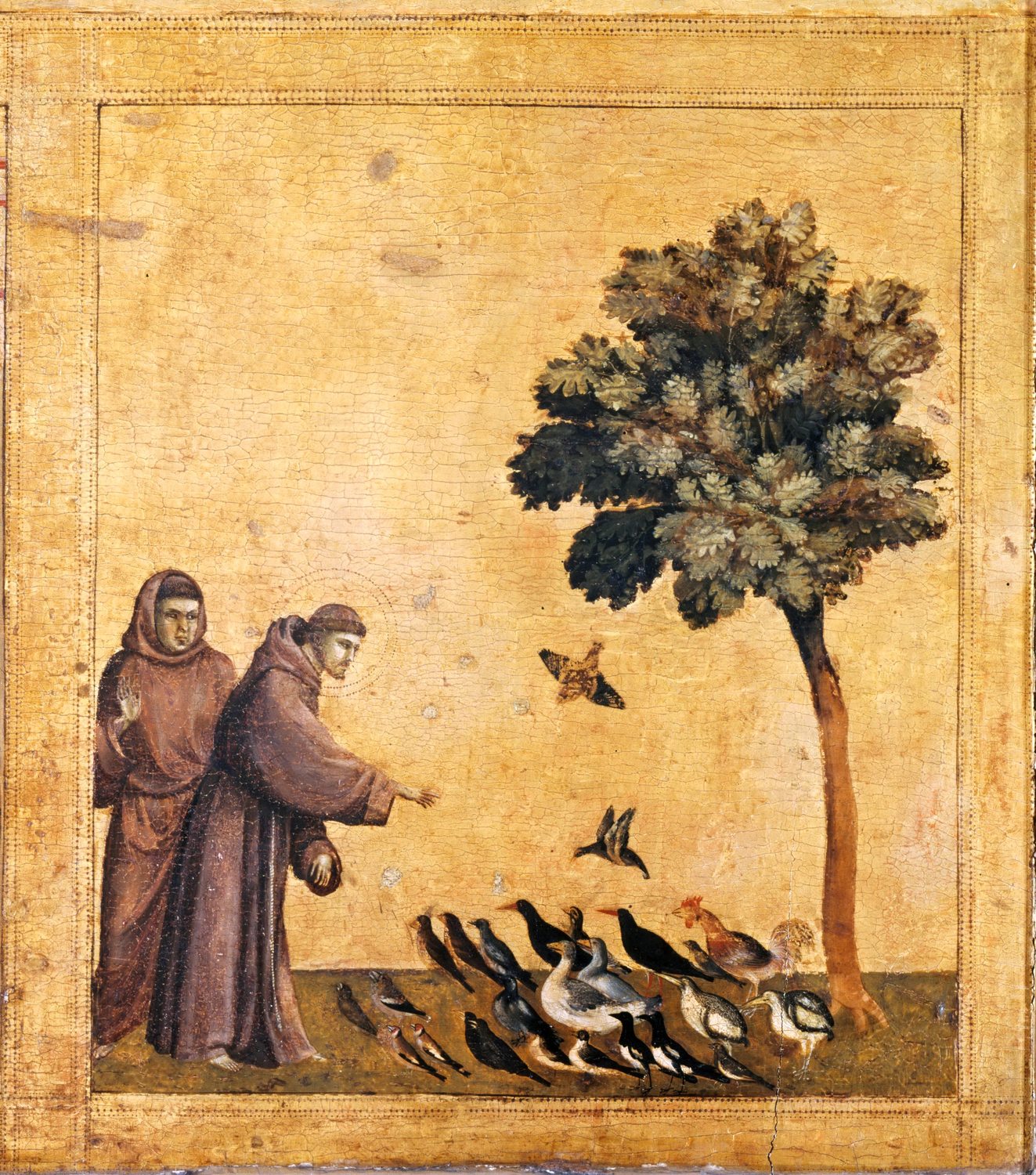
Near Bevagna he saw a great gathering of birds: doves, rooks and others. He left his companions on the road and ran to them, and they did not fly away. So he preached to them. The birds stretched their necks, spread their wings and gazed at him, as he and his brothers used to tell it. After that he blamed himself for never having preached to birds before.
“My brother birds, much ought ye to praise your Creator, and ever to love Him Who has given you feathers for clothing, wings for flight, and all that ye had need of.”Celano, First Life, chapter 58
The swallows at Alviano
He stood up to preach at the fortress of Alviano, but the swallows nesting there chattered so loudly that no one could hear. He spoke to them, and they were silent until the sermon was over. The people said: “Truly this man is a Saint, and a friend of the Most High”.
“My sisters, the swallows, it is now time for me to speak too, because you have been saying enough all this time.”Celano, First Life, chapter 59
Brother Fire
His eyes were failing, and a surgeon came to burn his temple with a red-hot iron, from the ear to the eyebrow. The brothers fled. Francis spoke to the fire as his brother, and asked it to be gentle. The iron went in hissing. When the brothers came back, he told them he had felt nothing. The surgeon said: “I tell you, brethren, I have seen wondrous things to-day”.
“I tell you of a truth I felt no heat of fire nor any pain in my flesh.”Celano, Second Life, chapter 166
The wolves of Greccio
The people of Greccio were plagued by wolves and by hail. He preached to them and promised them relief if they turned back to God. From that hour, says his biographer Celano,
“nor did wolves nor hail cause any further mischief”Celano, Second Life, chapter 35
A later legend: the wolf of Gubbio
His most famous animal story is not told by his early biographers, Celano and Bonaventure. It is in the Little Flowers, an Italian book made from a Latin collection compiled some time after 1322, a century after his death. A wolf is eating the people of Gubbio. Francis goes out alone, makes the sign of the cross, and the wolf lies down at his feet. He makes a peace: the town will feed the wolf, and the wolf will harm no one. The wolf lays its paw in his hand.
“Friar wolf, I desire that thou pledge thy faith to me to keep this promise, that I may have full trust in thee.”The Little Flowers, chapter 21, tr. Thomas Okey (1910)
his words
Francis left writings of his own. His two Rules, his Testament, letters, prayers and the Canticle of the Sun survive. His writings are given here in Paschal Robinson's translation of 1906, and his spoken words as Thomas of Celano recorded them, in A. G. Ferrers Howell's translation of 1908.
From his Testament, 1226
When I was in sin it seemed to me very bitter to see lepers, and the Lord Himself led me amongst them and I showed mercy to them. And when I left them, that which had seemed to me bitter was changed for me into sweetness of body and soul.
The first lines of the Testament he left his brothers as he was dying. It opens with his time among the lepers.
Testament of St Francis, tr. Paschal Robinson (1906)Henceforth I may freely say ‘Our Father Who art in heaven,’ not any more ‘father Pietro di Bernardone,’ to whom lo! I not only restore the money but give up all my clothes.
The Lord revealed to me this salutation, that we should say: “The Lord give thee peace.”
What a man is in the sight of God, so much he is, and no more.
I need no more, my son: I know Christ, the poor man crucified.
I say to thee: Yes, my son, and as a mother.
often misquoted
He said, “Preach the Gospel at all times. Use words if necessary.”
What the sources sayNo such line is in his writings or in any early Life. The nearest is his Rule of 1221, on preachers: “Nevertheless, let all the brothers preach by their works.” But he preached with words all his life, and his Rule of 1223 tells his preachers to speak “with brevity of speech because the Lord made His word short upon earth”.
Rule of 1221, chapter 17; Rule of 1223, chapter 9; The Gospel Coalition, FactCheckerHe wrote the Peace Prayer, “Lord, make me an instrument of your peace.”
What the sources sayIt first appeared in December 1912, in French and unsigned, in a small Paris magazine called La Clochette: “Seigneur, faites de moi un instrument de votre paix.” About 1920 it was printed on the back of a picture of St Francis, without his name. It was first called his in 1927, and the first known English version is from 1936. Its shape does echo his real Admonitions: “Where there is poverty and joy there is neither cupidity nor avarice.”
Christian Renoux, The Origin of the Peace Prayer of St. Francis, Franciscan Archive; Admonitions, 27He tamed the wolf of Gubbio.
What the sources sayThe story is first told in the Latin collection behind the Little Flowers, compiled some time after 1322. His biographer Celano, writing about twenty years after Francis died, tells only of wolves that stopped troubling Greccio after he preached. Thomas Okey, who translated the Little Flowers in 1910, suggested that a brigand nicknamed Brother Wolf, or a cruel lord, “may easily have been developed into the fierce wolf of Gubbio”.
Thomas Okey, introduction to The Little Flowers (1910); Celano, Second Life, chapter 35He walked through fire to convert the Sultan.
What the sources sayIn Bonaventure's Life of about 1260 he offers to, and the Sultan declines. Jacques de Vitry and Celano, the earliest writers, tell no such offer. The Sultan did not become a Christian.
Bonaventure, chapter 9; Sabatier (1894)He was a priest.
What the sources sayHe was a deacon. At Greccio one Christmas, notes his biographer Celano, he sang the Gospel “for he was a Levite”, the old word for a deacon. The Episcopal Church's book of saints says “he resisted all efforts to persuade him to become a priest”.
Celano, First Life, chapter 86; Lesser Feasts and Fasts 2022, 3 OctoberHe made the first nativity set, with Mary, Joseph and the Baby.
What the sources sayHis biographer Celano tells of the Christmas at Greccio: a manger with hay, an ox and an ass, and Mass said over the manger. He mentions no figures of Mary, Joseph or the Child. One man there saw, in a vision, a child lying in the manger.
Celano, First Life, chapters 84 to 86He was born in a stable, like Christ.
What the sources sayA legend of the 1400s. The Catholic Encyclopedia says it came from “the desire of certain writers to make his life resemble that of Christ”.
Catholic Encyclopedia (1909), St. Francis of Assisifriends, family and rivals
A young noblewoman of Assisi who ran from home to follow him in 1212. She led the Poor Ladies at San Damiano for about forty years. His funeral procession stopped there so that she could see him.
The Life of St Clare (1910); Catholic Encyclopedia (1909)His father, a rich cloth merchant. He fought his son's new life with curses and chains, and took him before the bishop for his money.
Celano, First Life, chapters 10 to 15; Second Life, chapter 12His mother. In his wild youth she told the neighbours that he would yet be a son of God.
Legend of the Three Companions, chapter 1He wrapped Francis in his own cloak when he stripped, and stood by him in Rome in 1209.
Celano, First Life, chapters 15 and 32His first companion. Francis blessed him by name as he was dying.
Catholic Encyclopedia (1909)His closest friend among the brothers, and with him on La Verna. He kept the sheet of praises Francis wrote for him, and noted on it when and why it was written.
Paschal Robinson, The Writings of St Francis (1906)His vicar in the last years. He announced the wounds to the Order, and built the great church at Assisi. He later fell out with the brothers and with Pope Gregory IX, who excommunicated him.
Sabatier (1894); Howell's index to Celano (1908)He approved Francis's first rule by word of mouth, after dreaming that a small, despised man held up the Lateran basilica.
Celano, Second Life, chapter 17As Cardinal Hugolino he protected the brothers. As Pope he made Francis a saint in 1228, and told the friar Thomas of Celano to write Francis's Life.
Celano, First Life, preface and chapters 119 to 126The Sultan of Egypt, who received Francis in his camp at Damietta in 1219.
Celano, First Life, chapter 57; Jacques de Vitry (1220)A Roman noblewoman he called “Brother Jacoba”. She came to his deathbed, and he let her in, though women were not allowed in the friary.
Catholic Encyclopedia (1909)A friar who joined him about 1215. He wrote the first Life of Francis in 1228 and 1229, and a second between 1244 and 1247, from the memories of his companions.
A. G. Ferrers Howell, introduction to The Lives of S. Francis (1908)how he died
He died at the Portiuncula, below Assisi, on the evening of 3 October 1226. He was about 44.
For two years he had been ill: his eyes, his whole body, the wounds. He asked to be carried down to the Portiuncula, where his Order began. He blessed the brothers one by one, and had bread broken and shared among them, as at the Last Supper.
At the end he asked to be laid naked on the bare ground, and covered the wound in his side with his hand. The Passion from John's Gospel was read to him. He began Psalm 142, “I cried unto the Lord with my voice”, and died at its last verse: “Bring my soul out of prison”.
The next day his body was carried up into Assisi. The procession stopped at San Damiano, so that Clare and her sisters could see him. In 1230 he was moved to the great church built in his honour, and hidden under the altar so deep that no one could find him until 1818.
To the brothers, from the bare ground
I have done my duty, may Christ teach you yours.
To death
Welcome, my sister Death.
He had added a verse to his Canticle for “our sister, the bodily death”.
is he a saint?
Yes, for Catholics and Anglicans, and Lutherans remember him. The Orthodox churches do not count him among their saints.
- CatholicSaintCanonised 1228; memorial on 4 October
- AnglicanSaintA Lesser Festival in the Church of England
- LutheranRememberedELCA, 4 October; not in the Missouri Synod's calendar
- OrthodoxNot on the calendarHe lived after the split of 1054
He was made a saint quickly. Pope Gregory IX, who had known him as a friend, canonised him at Assisi on 16 July 1228, less than two years after he died. The cardinals said that miracles were hardly needed:
The Orthodox churches keep no day for him. He lived in the West after the break between the churches in 1054, and it was Rome that declared him a saint. The Orthodox Church in America says that stigmata “are foreign to the Orthodox experience”, and so it has no official position on them. Some Orthodox writers treat his visions as a spiritual danger. The old Roman Martyrology gives him this line:
No need for miracles to attest the most holy man's most holy life, which we have seen with our eyes, handled with our hands and proved under the teaching of truth.
At Assisi, in Umbria, the birthday of St. Francis, confessor, founder of the Order of Minorites, whose life, filled with holy deeds and miracles, was written by St. Bonaventure.
a prayer he wrote
The opening of the Canticle of the Sun, which he made at San Damiano in 1225, in the Umbrian speech of his day. Paschal Robinson kept his translation plain and close to the original. Pope Francis took the title of his 2015 letter on care for our common home from its refrain, “Laudato si’, mi’ Signore”. William Draper's hymn All Creatures of Our God and King is an English version of it.
Most high, omnipotent, good Lord, praise, glory and honor and benediction all, are Thine. To Thee alone do they belong, most High, and there is no man fit to mention Thee. Praise be to Thee, my Lord, with all Thy creatures, especially to my worshipful brother sun, the which lights up the day, and through him dost Thou brightness give; and beautiful is he and radiant with splendor great; of Thee, most High, signification gives. Praised be my Lord, for sister moon and for the stars, in heaven Thou hast formed them clear and precious and fair.
what to read first
The Lives of S. Francis of Assisi
Thomas of Celano
Both of Celano's Lives: the first written within three years of Francis's death, the second about twenty years on, from the memories of his companions.
Read it freeThe Writings of Saint Francis of Assisi
Francis, tr. Paschal Robinson
Everything he wrote, and it is short: the Rules, the Testament, the Admonitions, the letters and the Canticle.
Read it freeThe Little Flowers, the Mirror of Perfection and the Life of St Francis
Everyman edition, 1910
The legends of the 1300s, the memories of his companions, and Bonaventure's official Life, in one book.
Read it freeThe Legend of Saint Francis by the Three Companions
Leo, Rufino and Angelo, tr. E. Gurney Salter
His youth and his first brothers, as three of his closest friends remembered them.
Read it freeSt. Francis of Assisi
G. K. Chesterton
A short, bright book of 1923 by a writer who loved him.
Read it freetake the quizzes
 Quiz Which early Christian thinks like you? And which would argue with you? Start
  Quiz Christian Personality Test Which of eight types are you? Find your own. Start
 sources
His life, and his words
- Thomas of Celano, The Lives of S. Francis of Assisi. Tr. A. G. Ferrers Howell, 1908.
- The Writings of Saint Francis of Assisi. Tr. Paschal Robinson, 1906.
- The Legend of Saint Francis by the Three Companions. Tr. E. Gurney Salter, 1902.
- The Little Flowers, the Mirror of Perfection and Bonaventure's Life of St Francis. Tr. Thomas Okey, Robert Steele and E. Gurney Salter, Everyman, 1910.
- The Life and Legend of the Lady Saint Clare. Tr. Charlotte Balfour, 1910, from a French version of 1563.
- Paul Sabatier, Life of St. Francis of Assisi. Tr. Louise Seymour Houghton, 1894. With the letters of Jacques de Vitry and Brother Elias.
- G. K. Chesterton, St. Francis of Assisi, 1923.
- Dante, Paradiso, canto 11. Tr. Henry Wadsworth Longfellow, 1867.
Reference
- Catholic Encyclopedia, 1909, “St. Francis of Assisi”, by Paschal Robinson
- Britannica, “St. Francis of Assisi”
- Christian Renoux, The Origin of the Peace Prayer of St. Francis, Franciscan Archive
- The Gospel Coalition, FactChecker: Misquoting Francis of Assisi
- OCA, Questions and Answers, Manifestations
- A. I. Osipov, Tell Me Who Your Saints Are, in English on John Sanidopoulos's site
- Pope John Paul II, Inter Sanctos, 29 November 1979, on the patron of ecology
- Pope Francis, Laudato si', 2015
- Hymnary.org, “All creatures of our God and King”
- Merriam-Webster, “Assisi”, for how to say it
Calendars
- Calendarium Romanum, 1969, on 4 October and 17 September
- The Roman Martyrology, 1916 edition, 25 May, 17 September and 4 October
- USCCB, Liturgical Calendar 2026, San Francisco de Asís, 4 October
- Church of England, Common Worship calendar
- The Episcopal Church, Lesser Feasts and Fasts 2022
- Evangelical Lutheran Worship, ELCA, the church year (final draft, 2006)
- The Lutheran Church–Missouri Synod, Commemorations
Pictures
- San Francesco, Cimabue, detail of the fresco in the Lower Church, Assisi, 1278 to 1280. Public domain.
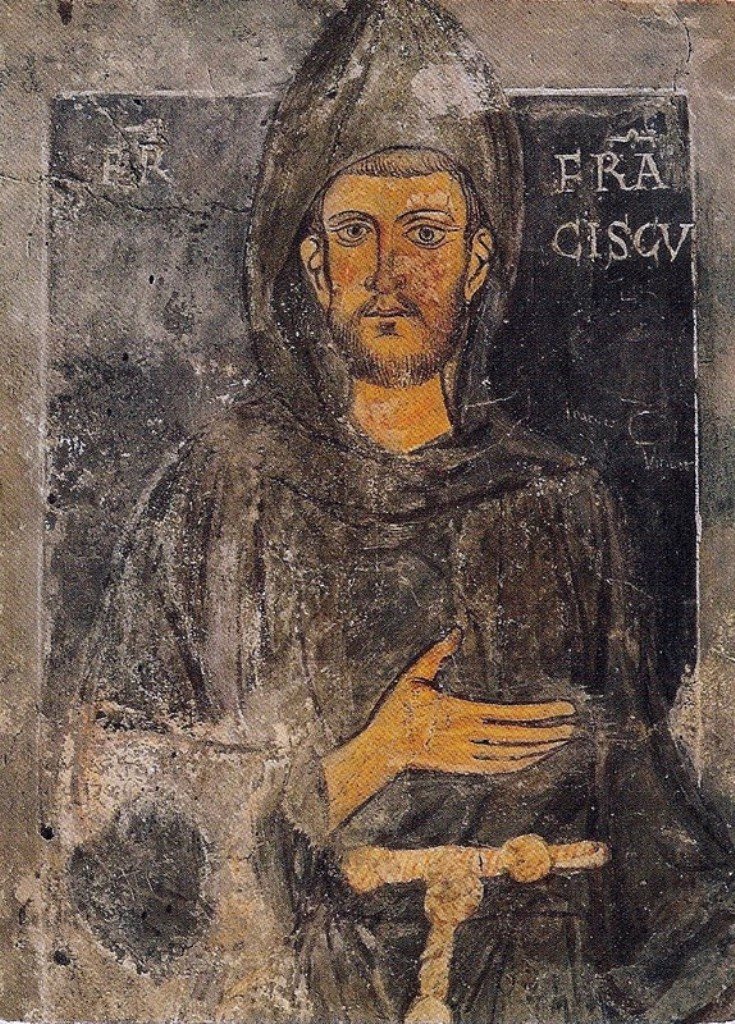
- Brother Francis, wall painting in the Sacro Speco, Subiaco (detail). Public domain.
- Saint Francis preaching to the birds, Giotto, 1295 to 1300. Louvre, Paris. Public domain.
- Saint Francis and scenes of his life, Bonaventura Berlinghieri, 1235. San Francesco, Pescia. Public domain.