
Thomas Aquinas
The Angelic Doctor, who showed that faith and reason agree. His Summa, and the Thomism it began, still shape Christian thought.
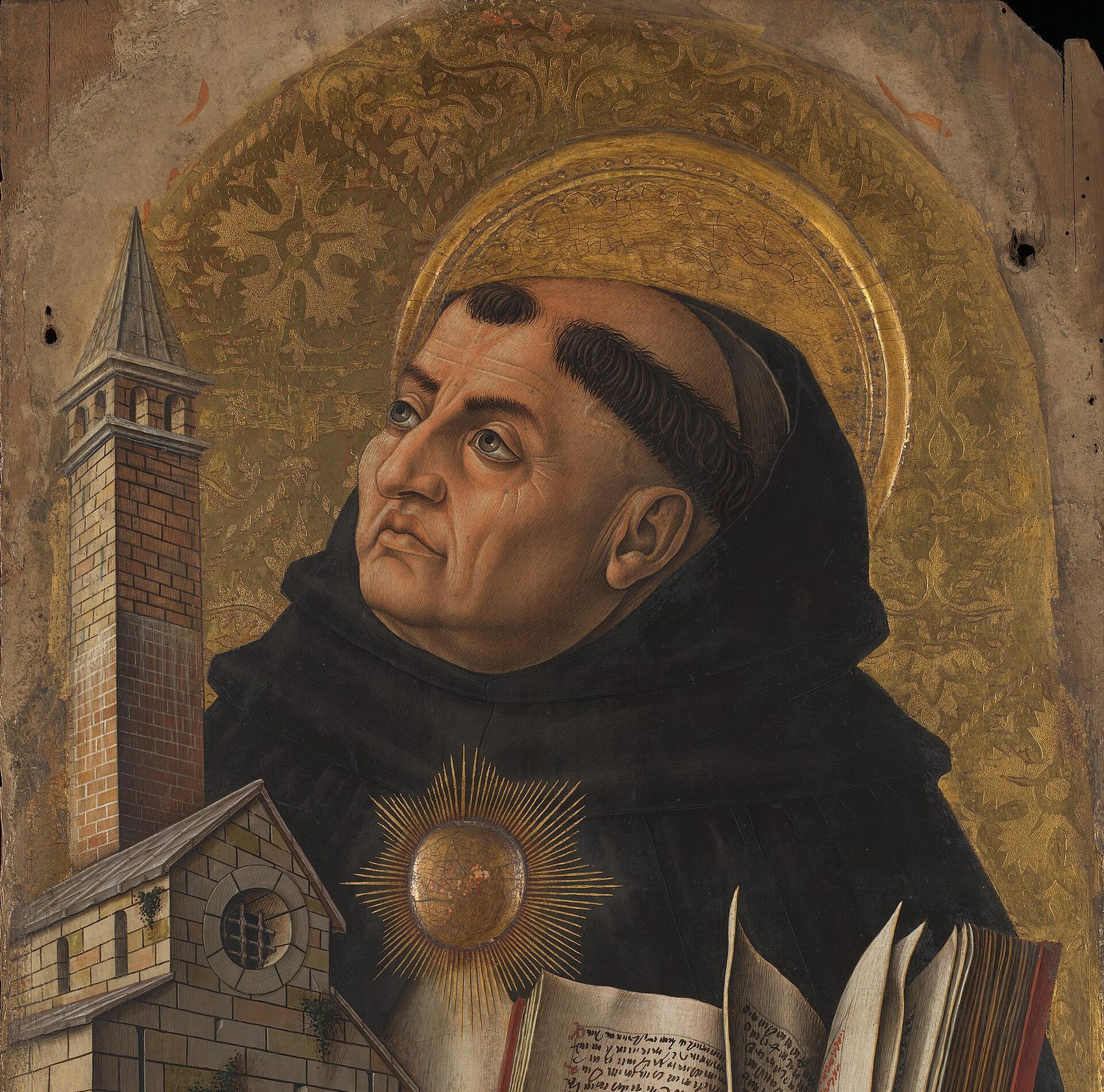
Picture: Saint Thomas Aquinas, Carlo Crivelli, 1476 (detail). National Gallery, London. Public domain.
Who was Thomas?
Thomas Aquinas was an Italian Dominican friar, and one of the most influential theologians in Christian history. He showed how faith and reason work together, and the Church calls him the Angelic Doctor. His Summa Theologiae asks hundreds of questions on God and man; he left it unfinished when he died in 1274.
at a glance
His path, in order
- OblateGiven to the monks of Monte Cassino at five
- FriarA Dominican, against his family's will
- StudentUnder Albert the Great, at Cologne
- TeacherMaster of theology at Paris, from 1257
- WriterOf the Summa, left unfinished in 1273
in numbers
- Secretaries he dictated to at once4
- Each on a different subject
- Two of the four, Reginald and Hervey, said he did
- Church Fathers the Summa quotes52
- With 41 popes and 19 councils
- Augustine most of all
- Propositions condemned at Paris in 1277219
- Some of them were his
- Three years to the day after he died
- Commentaries on his works6,000
- By one estimate, in 1912
- Written in the six centuries after he died
did you know?
-
Walking to Paris as a young friar, he was asked what he would give to be king of that city. He answered: “I would rather have S. John Chrysostom's treatise on the Gospel of S. Matthew than be king of the whole of France.”
Roger Bede Vaughan, The Life and Labours of S. Thomas of Aquin (1875) -
One evening, dictating on the Trinity, he held a candle for his scribe. He was so lost in thought that he let it burn down in his fingers without noticing.
Placid Conway, Saint Thomas Aquinas (1911) -
Two hymns still sung at Catholic Benediction, the Tantum ergo and the O salutaris, are the closing verses of hymns he wrote for the feast of Corpus Christi.
Catholic Encyclopedia (1912), “St. Thomas Aquinas”; Caswall, Lyra Catholica, Hymns at Benediction -
In Dante's Paradise, it is Thomas, a Dominican, who tells the life of Francis of Assisi, the founder of the other great order of friars.
Dante, Paradise, canto 11, tr. Longfellow (1867)
- Born
- At Roccasecca, in the Kingdom of Naples, at the end of 1225 or in 1227. Even at his death, no one was sure of his age.
- Family
- His father, Landulf, was count of Aquino. His mother, Theodora, was countess of Teano. They were kin to the emperor Frederick II.
- Order
- The Dominicans, the Order of Preachers, from about 1243.
- Taught at
- Paris, twice, and Cologne, Rome, Naples, and the Italian towns where the pope's court stayed.
- Died
- 7 March 1274, at the Cistercian abbey of Fossanova, south of Rome, on his way to the Council of Lyon. He was about 49.
- Buried
- At Fossanova. Since 1369, in Toulouse, in France.
- Also called
- The Angelic Doctor, Doctor Angelicus. As a student, “the dumb Sicilian ox”.
- His name
- Aquinas means “of Aquino”, his father's county.
- In looks
- Tall and heavily built, with a large head, slightly bald. His skin, says one of his first biographers, was “like the colour of new wheat”.
- Wrote
- More than sixty works in a life of under fifty years: the Summa Theologiae, the Summa contra Gentiles, commentaries on Aristotle and on Scripture, and the hymns for Corpus Christi.
- Status
- A saint since 1323 and a Doctor of the Church since 1567, for Catholics. Patron of Catholic schools. Not a saint to the Orthodox.
- In art
- A friar in the black and white of the Dominicans, often with a sun on his breast, a book, or a church in his hands.
- Pronounced
- uh-KWY-nus.
feast days
West
- Jan28
Catholic memorial of a priest and Doctor of the Church, since 1969. Also kept by the Church of England, the Episcopal Church and the Lutheran ELCA. The Lutheran Missouri Synod's calendar does not list him.
- Mar7
The day he died, and his feast in the Roman calendar from 1323 until 1969. His day in the 1916 Roman Martyrology.
Why two days? Pope John XXII set his feast on 7 March, the day he died. But that day usually falls in Lent, when saints' memorials give way. So in 1969 Rome moved it to 28 January, the day in 1369 his body was brought to Toulouse. The Orthodox churches do not keep him at all.
what was he like?
+truthful, even in a joke
A novice called him to the window: “Look, look, there is an ox flying over the convent”. Thomas looked. The others laughed. He answered: “I was not so simple as to believe that an ox could fly, but I never imagined that a religious man could stoop to falsehood”.
Placid Conway, Saint Thomas Aquinas (1911)+quiet
His silence in class made his fellow students think him slow. Years later he was asked why he had said so little at Cologne, where he studied under Albert the Great. “It was because I had not yet learned to speak before such a mind as Albert”, he said.
Placid Conway, Saint Thomas Aquinas (1911)+humble
In 1265 the pope named him archbishop of Naples. “With tears he begged to be excused”, and was. On his last journey his companion Reginald told him he would surely be made a cardinal. He answered: “There is no state in which I can be of more use to my Order than that in which I am at present”.
Catholic Encyclopedia (1912); Placid Conway, Saint Thomas Aquinas (1911)+prayer before study
The readings for his feast in the Breviary, the Church's daily prayer book, say he never began to study without first praying. Every day he read a little of John Cassian's Conferences. “In such reading I find devotion, whence I readily ascend to contemplation”, he explained.
Catholic Encyclopedia (1912), “St. Thomas Aquinas”+fair to the other side
Every article of the Summa opens with the case against his own answer: usually three arguments, sometimes twenty. Only then does he answer, and he replies to each in turn. The Catholic Encyclopedia praised “His extraordinary patience and fairness in dealing with erring philosophers”.
Placid Conway, Saint Thomas Aquinas (1911); Catholic Encyclopedia (1912)+lost in thought
At the table of King Louis IX of France, he sat silent through the meal. Suddenly he struck the table with his fist, so that the cups jumped, and cried: “The argument is clinched against the Manichees!” His prior rebuked him. The king smiled and had a secretary write the argument down.
Placid Conway, Saint Thomas Aquinas (1911)what others said of him
A poet, a Greek cardinal, a pope, a Protestant reformer and two churches, in their own words.
Of the lambs was I of the holy flock / Which Dominic conducteth by a road / Where well one fattens if he strayeth not.
the most saintly of learned men and the most learned of saints
He has enlightened the Church more than all other Doctors, and more profit can be gained in a single year by the study of his works, than by devoting a lifetime to that of other theologians.
Take away Thomas and I will destroy the Church
Aquinas’s vast, monumental Summa Theologiae dominated official Roman Catholic theology until the Second Vatican Council in the 1960s.
Although his theology is now considered to be conventional by many Christians, especially among Roman Catholics, in his own day Thomas was considered a bold thinker, even a “radical,” and certain aspects of his thought were condemned by the ecclesiastical authorities.
his life in nine moments
Monte Cassino
About 1230“What is God?”
His father was count of Aquino, and the family had great hopes for him. At five he was sent to the Benedictine monks of Monte Cassino, the great abbey near his home. His family, says his biographer Conway, meant him one day to rule it as its abbot. His teacher, says the Catholic Encyclopedia, was surprised to hear the child ask again and again: “What is God?”
Catholic Encyclopedia (1912); Placid Conway, Saint Thomas Aquinas (1911)Naples
About 1243A beggar's habit
He studied at the university of Naples. There he met the Dominicans, a new order of friars who lived by begging and gave their lives to preaching. He asked to join them. The Catholic Encyclopedia says “The city wondered that such a noble young man should don the garb of poor friar.” His mother hurried to Naples. The friars, fearing she would take him away, sent him north toward Rome.
Catholic Encyclopedia (1912), “St. Thomas Aquinas”Roccasecca
About 1244Locked up at home
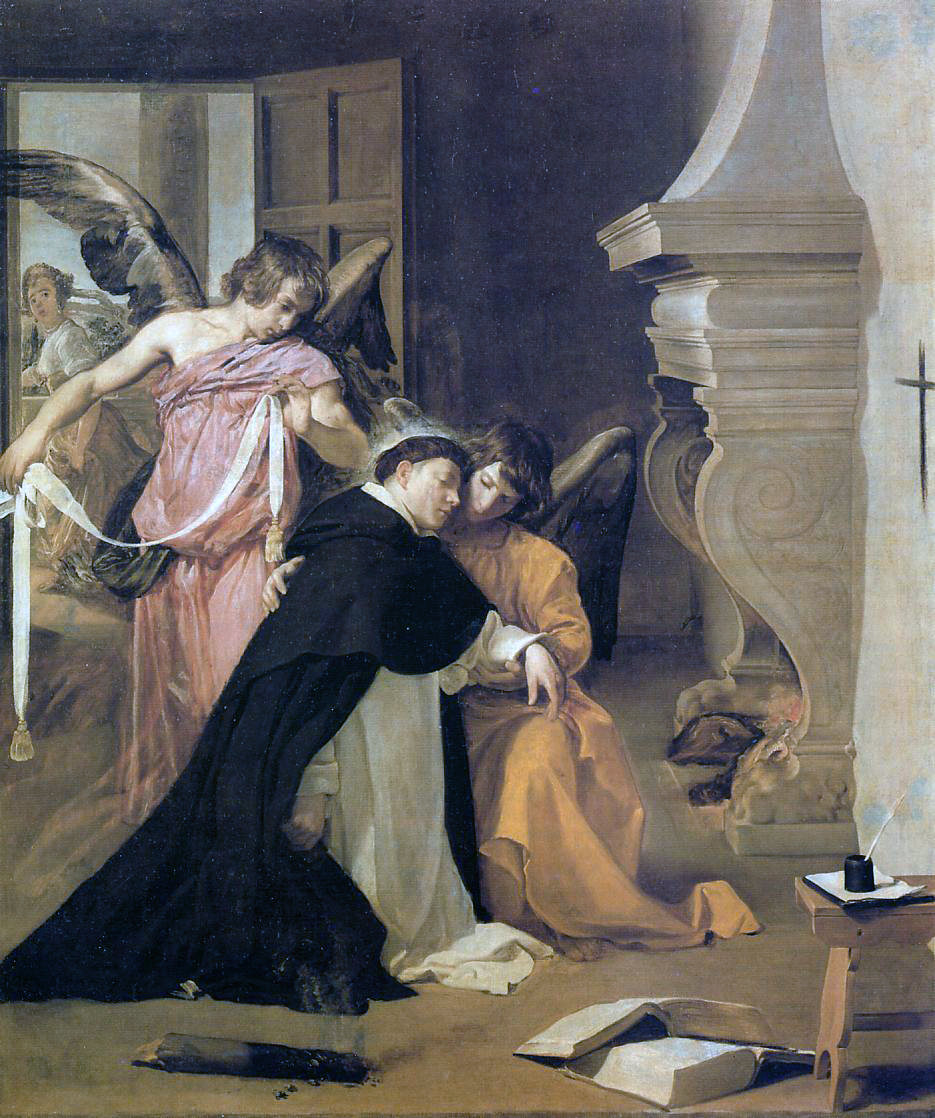
He had joined the Dominicans against his family's will. His brothers, soldiers of the emperor, caught him on the road near Acquapendente and took him home to the family castle. He was kept there nearly two years. His mother, brothers and sisters tried every way to change his mind. Then, his first biographers say, his brothers sent a woman into his room to tempt him. In the words of the Catholic Encyclopedia, “the pure-minded novice drove the temptress from his room with a brand which he snatched from the fire.”
Catholic Encyclopedia (1912), “St. Thomas Aquinas”Roccasecca
About 1245Out in a basket
His time locked up in the family castle was not wasted. His mother softened, and a sister got books in to him: the Bible, Aristotle's Metaphysics, and the Sentences of Peter Lombard, the textbook of the schools. He even won over his sisters: one of them, Marietta, became a nun and died an abbess. At last he was let go: he was lowered from the castle in a basket, “into the arms of the Dominicans”, and made his vows.
Catholic Encyclopedia (1912); Placid Conway, Saint Thomas Aquinas (1911)Cologne
The late 1240sThe dumb ox
He studied under Albert the Great, the most famous scholar of the Dominicans. The other students took his silence for dullness and nicknamed him “the dumb Sicilian ox”. One offered to help him with a lesson, got hopelessly lost, and was quietly set right by Thomas. Albert heard of it, and made him defend a hard question in front of everyone. Albert argued against him, and could not shake him. Then Albert said: “We call this young man a dumb ox, but his bellowing in doctrine will one day resound throughout the world.”
Catholic Encyclopedia (1912); Placid Conway, Saint Thomas Aquinas (1911)Paris
1256 to 1257A master at last
The masters of the University of Paris did not want friars teaching among them. One of them, William of Saint-Amour, wrote a book against the begging orders, and Thomas wrote a defence of them. The pope condemned William's book on 5 October 1256 and ordered the friars admitted. With the help of King Louis IX, Thomas became a master of theology. Many biographers date it 23 October 1257. His first lecture was on “The Majesty of Christ”, on a verse of Psalm 104: “He waters the mountains from His chambers; the earth is satisfied by the fruit of His works.”
Catholic Encyclopedia (1912); Psalm 104:13 (BSB)The pope's court
1264Hymns for a new feast
Pope Urban IV kept him close, in Rome and the towns where the court moved. In 1264 Urban ordered a new feast for the whole Church, Corpus Christi, in honour of the Eucharist. He asked Thomas to write its prayers. Thomas wrote the office and its hymns: the Pange lingua, the Lauda Sion, the Sacris solemniis and the Verbum supernum. They are still sung. The hymn writer John Mason Neale ranked the Pange lingua among the very finest hymns of the Western Church.
Catholic Encyclopedia (1912), “Corpus Christi” and “Pange Lingua Gloriosi”; Placid Conway (1911)Rome
From 1265A book for beginners
His order sent him to Rome to run a school for its students at Santa Sabina. There he began his great work, the Summa Theologiae. It was meant for students. Its first lines say so: “we purpose in this book to treat of whatever belongs to the Christian Religion, in such a way as may tend to the instruction of beginners.” It grew to hundreds of questions, each divided into articles, from God and creation to Christ and the sacraments. He worked on it for the rest of his life, in Rome, Paris and Naples.
Summa Theologiae, Prologue, tr. English Dominican Fathers; Placid Conway (1911)Naples
6 December 1273He wrote no more
On the feast of St Nicholas he said Mass in the chapel of St Nicholas at Naples. Something happened to him there. After that Mass he never wrote or dictated again, and the Summa stopped in the middle of the questions on penance. Reginald, his companion, begged him to go on. “I can do no more,” he said. At last he made Reginald swear to tell no one while he lived, and told him why. In Roger Vaughan's translation: “All I have written appears to me as so much rubbish, compared with what I have seen and what has been revealed to me!” The Latin word is palea: straw, or chaff.
Vaughan, The Life and Labours of S. Thomas of Aquin (1872 and 1875), from the canonisation inquiry; Catholic Encyclopedia (1912)
his miracles
The first accounts of his life are full of wonders, and ninety-six miracles, says his biographer Conway, were attested for his canonisation. The pope who made him a saint went further:
He has wrought as many miracles as he has written Articles.
The white girdle
When his brothers sent a woman into his room at the family castle to tempt him, he drove her out with a burning stick from the fire. Then, the story goes, he knelt and begged God to keep him pure in mind and body. He fell asleep, and two angels came and tied a white cord around his waist, so tightly that he woke with a cry. He told no one until near the end of his life, when he told his companion Reginald. The cord, says the biographer Placid Conway, is kept at Chieri, near Turin.
“We gird thee with the girdle of perpetual virginity.”Catholic Encyclopedia (1912); Placid Conway, Saint Thomas Aquinas (1911)
The crucifix speaks
At Naples in 1273 he had just finished writing on the Eucharist. Three of the friars saw him lifted up in prayer, and heard a voice from the crucifix on the altar praise what he had written and ask what reward he wanted. He answered, “None other than Thyself, Lord.”
“Thou hast written well of Me, Thomas; what reward wilt thou have?”Catholic Encyclopedia (1912), “St. Thomas Aquinas”
Levitating in prayer
Friars at Naples said they had seen him levitating while he prayed. Conway, drawing on his first biographers:
“Frequently he had been observed to be raised several cubits in the air, while engaged in prayer.”Placid Conway, Saint Thomas Aquinas (1911)
Help with Isaiah
His first biographers tell of visitors from heaven. When a passage of Scripture defeated him, he fasted as well as prayed. Once, they say, the apostles themselves came to him.
“Sts. Peter and Paul came to aid him in interpreting an obscure passage in Isaias.”Catholic Encyclopedia (1912), “St. Thomas Aquinas”
The herrings
On his last journey he fell ill at his niece's castle, and he could eat nothing. Asked what he might like, he remembered a fish he had eaten in France, herring, “but it is rare and very dear in these parts.” His doctor met a fisherman coming from Terracina, and found herrings at the bottom of his basket of sardines. Still Thomas would not eat them, for fear of indulging himself. His companion Reginald coaxed him. When Thomas asked where the fish came from, Reginald replied:
“It is God who has sent them.”Placid Conway, Saint Thomas Aquinas (1911): Reginald's words
Sight at his bier
His body lay in the choir of Fossanova with the face uncovered. The subprior, John of Ferentino, was completely blind.
“placed his eyes against those of the saint, and instantly saw.”Placid Conway, Saint Thomas Aquinas (1911)
his words
His own words, in the English Dominican Fathers' translation of the Summa Theologiae (1911 to 1925).
Faith and reason
Since therefore grace does not destroy nature but perfects it, natural reason should minister to faith as the natural bent of the will ministers to charity.
From the first question of the Summa. His whole work rests on it. In his Latin: gratia non tollat naturam, sed perficiat.
Summa Theologiae, First Part, question 1, article 8Because we cannot know what God is, but rather what He is not, we have no means for considering how God is, but rather how He is not.
For even as it is better to enlighten than merely to shine, so is it better to give to others the fruits of one's contemplation than merely to contemplate.
Hence whatever certain people have in superabundance is due, by natural law, to the purpose of succoring the poor.
Therefore, since every pleasure assuages sorrow, sorrow is assuaged by such like bodily remedies.
For we pray not that we may change the Divine disposition, but that we may impetrate that which God has disposed to be fulfilled by our prayers
the five ways
His most famous argument fills one short article of the Summa. It opens: “The existence of God can be proved in five ways.” Each way starts from something anyone can see.
1. From change
Things change. Nothing changes itself: something already actual must move it, as fire makes wood hot. The chain of movers cannot run back forever, or nothing would be moving now.
“Therefore it is necessary to arrive at a first mover, put in motion by no other; and this everyone understands to be God.”Summa Theologiae, First Part, question 2, article 3
2. From causes
Everything we see is caused by something else. Nothing causes itself. And the chain of causes cannot run back forever: take away the first cause, and you take away all the rest.
“Therefore it is necessary to admit a first efficient cause, to which everyone gives the name of God.”Summa Theologiae, First Part, question 2, article 3
3. From things that need not exist
Things come to be and pass away. If everything could fail to exist, then at some time nothing would have existed, and nothing could ever have begun. So something must exist that cannot fail to exist.
“Therefore we cannot but postulate the existence of some being having of itself its own necessity, and not receiving it from another, but rather causing in others their necessity. This all men speak of as God.”Summa Theologiae, First Part, question 2, article 3
4. From degrees
We call some things better, truer or nobler than others. More and less are measured against a most. So there is something best and truest, and it is the cause of all good in things.
“Therefore there must also be something which is to all beings the cause of their being, goodness, and every other perfection; and this we call God.”Summa Theologiae, First Part, question 2, article 3
5. From order
Things without minds act for an end, nearly always in the same way, to the best result. That is not chance. An arrow hits its mark because an archer aimed it.
“Therefore some intelligent being exists by Whom all natural things are directed to their end; and this being we call God.”Summa Theologiae, First Part, question 2, article 3
Where reason stops
He never claimed reason could prove everything. That God is Three in One, he held, is known only because God has revealed it. Later thinkers doubted the proofs themselves. Immanuel Kant, in his Critique of Pure Reason, said the argument from a necessary being “contains a perfect nest of dialectical assumptions”.
“It is impossible to attain to the knowledge of the Trinity by natural reason.”Summa Theologiae, First Part, question 32, article 1; Kant, Critique of Pure Reason, tr. J. M. D. Meiklejohn
often misquoted
On his deathbed he called all his writing straw, and disowned it.
What the sources sayHe said it three months before he died, in December 1273, and to one man, his companion Reginald, whom he swore to secrecy. It reached the record through the witnesses at the inquiry for his canonisation. The words change with the translator: “so much rubbish” in Vaughan, “like a handful of straw” in Conway, and in the Catholic Encyclopedia “of little value”. Nor did he disown his books. Dying, he left all he had written “to the judgment and correction of the Holy Roman Church”.
Vaughan (1875); Conway (1911); Catholic Encyclopedia (1912)He and the other schoolmen argued about how many angels can dance on the head of a pin.
What the sources sayHe never asks it. What he does ask, in the Summa, is whether two angels can be in the same place at once. His answer is no: “There are not two angels in the same place.”
Summa Theologiae, First Part, question 52, article 3“If the highest aim of a captain were to preserve his ship, he would keep it in port forever.”
What the sources sayQuote sites give this as his. It is a modern paraphrase, traced to the legal philosopher Lon Fuller in the 1960s. What Thomas wrote is drier, and about happiness: “a captain does not intend as a last end, the preservation of the ship entrusted to him, since a ship is ordained to something else as its end, viz. to navigation.” Man's happiness, he goes on, does not lie in keeping his body safe either.
Goodreads; They Didn't Say It (2024); Summa Theologiae, First Part of the Second Part, question 2, article 5He was poisoned by King Charles of Anjou.
What the sources sayDante says so. In the Divine Comedy Charles comes to Italy and “Thrust Thomas back to heaven”. The accounts of his last journey, as Conway and the Catholic Encyclopedia tell them, speak of a blow to the head on the road and an illness, not poison.
Dante, Purgatory, canto 20, tr. Longfellow (1867); Conway (1911); Catholic Encyclopedia (1912)He wrote the hymn Adoro te devote.
What the sources sayTradition says so, but it is disputed. His biographer Conway says he recited it as he died. But it was never part of the prayers and hymns he wrote for Corpus Christi. The Dictionary of Hymnology (1907) admits: “Of the actual date of the composition of this hymn we have no record.” The oldest copy that survives was made about fifty years after his death. Those who defend it as his point to echoes of it in Jacopone da Todi, a friar who lived at the same time.
Conway (1911); Julian, A Dictionary of Hymnology (1907); Catholic Encyclopedia (1907), “Adoro Te Devote”; EWTN, “The Adoro Te Devote”his hardest sayings
Some of his lines trouble readers today, Catholics among them. Here they are in his own words, with what critics and his own Church have said.
On women
He took from Aristotle the idea that a female is a male that did not form fully. He adds a qualification: in the individual, a woman is “defective and misbegotten”; in human nature as a whole, she is not, but is intended by God. He held that even before any sin, woman was naturally under man's rule, “because in man the discretion of reason predominates”. Yet he also held that the image of God “is found both in man and in woman”, and that Eve was made from Adam's side, not his head or his feet, so as to be neither his ruler nor his slave. The Catholic Encyclopedia of 1912, itself a Catholic work, answered that Aristotle's view “must, therefore, be rejected”, and called the medieval definition drawn from it, femina est mas occasionatus, “untenable”.
“As regards the individual nature, woman is defective and misbegotten … On the other hand, as regards human nature in general, woman is not misbegotten, but is included in nature's intention as directed to the work of generation.”Summa Theologiae, First Part, question 92, articles 1 and 3, and question 93, article 4; Catholic Encyclopedia (1912), “Woman”
On heretics
He held that a heretic who refused to recant after two warnings should be handed to the state and put to death. His reason: to corrupt the faith that gives life to the soul is worse than to forge money. Yet Jews and pagans, he held, must never be forced to believe, “because to believe depends on the will”. The historian of the Inquisition Henry Charles Lea (1888) wrote that he “lays down the rules with merciless precision”. The Catholic Encyclopedia (1910) granted that “it cannot be said that his arguments altogether compel conviction”. The Catholic Church has taught religious freedom since the Second Vatican Council's declaration of 1965.
“Wherefore if forgers of money and other evil-doers are forthwith condemned to death by the secular authority, much more reason is there for heretics, as soon as they are convicted of heresy, to be not only excommunicated but even put to death.”Summa Theologiae, Second Part of the Second Part, question 11, article 3, and question 10, article 8; Lea, A History of the Inquisition of the Middle Ages, volume 1 (1888); Catholic Encyclopedia (1910), “Inquisition”; Second Vatican Council, Dignitatis Humanae (1965)
On Mary's conception
Catholics hold that Mary was kept free of original sin from the moment she was conceived: a dogma defined in 1854. Thomas held that she was cleansed of it in the womb, before she was born. The Catholic Encyclopedia notes that as a young man he had written in its favour, and argues that if he and Bonaventure “had known the doctrine in the sense of the definition of 1854, they would have been its strongest defenders instead of being its opponents”.
“But the Blessed Virgin did indeed contract original sin, but was cleansed therefrom before her birth from the womb.”Summa Theologiae, Third Part, question 27, article 2; Catholic Encyclopedia (1910), “Immaculate Conception”
The Orthodox East
He wrote Against the Errors of the Greeks on the questions that divided East and West, and died on his way to the council at Lyon that tried to reunite them. In the next century some Byzantines read and translated him. One Greek treatise against the monk Gregory Palamas, says the Catholic Encyclopedia, has two books that are “nothing but translations from St. Thomas's” Summa contra Gentiles. But councils at Constantinople upheld Palamas, and his teaching that God is known in His energies, not in His essence. The Orthodox Church in America describes Palamas's opponent Barlaam as “educated in the Scholastic spirit prevailing in Western Europe at that time”. A Catholic writer, Adrian Fortescue, called Palamas's teaching “fundamentally opposed to the whole conception of God in the Western Scholastic system”.
“He explained that the Essence (or Super-Essence) of God is utterly unknowable and incomprehensible, while at the same time, the actions, operations, or Energies of God, which are also uncreated and fully divine (such as the Divine Light), are communicated to people by divine grace and are open to human knowledge and experience.”OCA, The Orthodox Faith, volume 3, “Saint Gregory Palamas”; Catholic Encyclopedia (1910), “Hesychasm”
friends, family and rivals
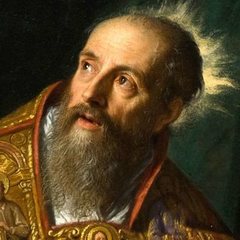 Augustine of Hippo
 Dead eight centuries before Thomas was born, and the Father he quoted most. Among the Fathers, says the Catholic Encyclopedia, “his favourite was St. Augustine”.
Catholic Encyclopedia (1912)His teacher at Cologne and Paris, and the famous scholar who answered the students who called Thomas a dumb ox. After Thomas died, the old man “hastened to Paris to defend his beloved disciple”.
Catholic Encyclopedia (1912), “St. Thomas Aquinas” and “Thomism”His companion, secretary and confessor. Thomas told him the secret of the white cord that angels tied around his waist. He begged Thomas to finish the Summa, and held him as he died.
Catholic Encyclopedia (1912); Conway (1911)The great Franciscan teacher of the same years. A story says they became doctors at Paris on the same day, and each wanted the other to go first. The pope summoned both to the Council of Lyon.
Catholic Encyclopedia (1912)The king, and a saint. The evening before his council met, says Thomas's biographer Conway, he would tell Thomas the business to be settled. He only smiled when Thomas, lost in thought at dinner, struck the royal table.
Conway (1911)His mother, countess of Teano. She fought hard to keep him from the friars, then softened, and let the friars bring him new robes in his captivity.
Catholic Encyclopedia (1912)Soldiers of the emperor Frederick II. They seized him on the road and held him in the family castle for nearly two years.
Catholic Encyclopedia (1912)One got books to him in captivity. Marietta became abbess of St Mary's at Capua. In his last winter he spent a week with another, the Countess of San Severino. By then he had stopped writing. He seemed so entranced that he would hardly speak to her.
Catholic Encyclopedia (1912); Conway (1911)The pope who kept him at his court and asked him for the prayers and hymns of Corpus Christi.
Catholic Encyclopedia (1908), “Corpus Christi”; Conway (1911)A Paris master who attacked the begging friars and their right to teach. Thomas answered his book, and the pope condemned it in 1256.
Catholic Encyclopedia (1912)Bishop of Paris. In 1277 he condemned 219 propositions, some of them Thomas's. A later bishop withdrew the censure in 1325.
De Wulf, History of Medieval Philosophy (1909)how he died
He died at the Cistercian abbey of Fossanova, south of Rome, on 7 March 1274, on his way to the Council of Lyon. He was about 49.
Pope Gregory X had called a council at Lyon to reunite the Greek and Latin churches. He told Thomas to bring his book Against the Errors of the Greeks. Thomas left Naples on foot on 28 January 1274, with his companion Reginald.
Near Terracina, deep in thought, “he struck his head violently against a fallen tree and lay stunned for some time”. He went on, but his strength was failing. At his niece's castle at Maenza he fell ill and could take no food. The monks of Fossanova, seven miles off, asked him to come to them, and on 10 February they carried him into their abbey.
The monks of Fossanova cut and carried wood for his fire. “Whence comes this honour”, he exclaimed, “that servants of God should carry wood for my fire!” They begged him to explain the Song of Songs, and from his bed he did. His biographer William of Tocco thought it fitting that the great teacher should “finish his teaching by the Canticle of Love between Jesus Christ and the faithful soul”.
The old accounts do not say what illness killed him. They tell only of a blow to his head, of strength already failing, and of a sickness in which he could not eat. The Catholic Encyclopedia says simply that on the road “strength failed him”.
He died early in the morning of 7 March 1274.
Carried into the abbey
This is my rest for ever and ever: here will I dwell, for I have chosen it
The words of a psalm, whispered to his companion.
Receiving Communion for the last time
I receive Thee, the price of my redemption, for Whose love I have watched, studied, and laboured. Thee have I preached; Thee have I taught. Never have I said anything against Thee: if anything was not well said, that is to be attributed to my ignorance.
He submitted all he had written to the judgment of the Church.
is he a saint?
Yes, for Catholics: a saint since 1323 and a Doctor of the Church since 1567. Anglicans and many Lutherans remember him. The Orthodox Church does not count him a saint.
- CatholicSaint and DoctorCanonised 1323, Doctor 1567, 28 January
- OrthodoxNot on the calendarNot counted a saint
- AnglicanRememberedChurch of England and Episcopal Church, 28 January
- LutheranRememberedELCA, 28 January; not the Missouri Synod
At first his good name was not safe. On 7 March 1277, three years to the day after he died, the bishop of Paris, Stephen Tempier, condemned 219 propositions. Most were aimed at followers of the Muslim philosopher Averroes. But some, says the historian Maurice De Wulf, “embodied Thomist doctrines”. The same year the archbishop of Canterbury, Robert Kilwardby, himself a Dominican, condemned some of his teaching at Oxford.
His order stood by him. Pope John XXII made him a saint at Avignon on 18 July 1323. In February 1325 a later bishop of Paris, Stephen de Bourret, withdrew the 1277 condemnation, declaring that “that blessed confessor and excellent doctor, Thomas Aquinas, had never believed, taught, or written anything contrary to the Faith or good morals”.
Pius V named him a Doctor of the Church in 1567. In 1879 Leo XIII called him “the prince and master of all Scholastic doctors”, and the next year made him patron of all Catholic universities and schools.
The Orthodox Church has never counted him a saint. The lives of the saints of the Orthodox Church in America do not name him. The 1916 Roman Martyrology gives him this line:
St. Thomas of Aquin, confessor and doctor, of the Order of Preachers, illustrious by the nobility of his birth, the sanctity of his life, and his knowledge of theology.
a hymn he wrote
Two verses of the Pange lingua, his evening hymn for Corpus Christi, in Edward Caswall's translation of 1849. The first is the fourth verse, the hardest to translate: the hymn writer John Mason Neale called Caswall's “the best version”. The second is the Tantum ergo.
Word made Flesh, the bread of nature / By His word to Flesh He turns; / Wine into His Blood He changes: / What though sense no change discerns? / Only be the heart in earnest, / Faith her lesson quickly learns. / Down in adoration falling, / Lo! the sacred Host we hail; / Lo! o’er ancient forms departing, / Newer rites of grace prevail; / Faith, for all defects supplying, / Where the feeble senses fail.
what to read first
Summa Theologiae: the Five Ways
Thomas Aquinas
The famous article on whether God exists, with the two before it. The best way in to how he thinks. A few minutes.
Read it freeSumma Theologiae: the whole
Thomas Aquinas
The complete English Dominican translation, question by question. Dip in anywhere: each article is short.
Read it freeSaint Thomas Aquinas
Placid Conway
A short, warm life by a Dominican, from 1911, with the stories from the early biographers.
Read it freeSt. Thomas Aquinas
Catholic Encyclopedia
The 1912 article: his life, his works, and his influence, with the sources of each story.
Read it freeLyra Catholica
Edward Caswall
Thomas's hymns for Corpus Christi, and the Adoro te, in Caswall's Victorian translations still sung today.
Read it freetake the quizzes
 Quiz Which early Christian thinks like you? And which would argue with you? Start
  Quiz Christian Personality Test Which of eight types are you? Find your own. Start
 sources
His life, and his words
- Summa Theologiae. Tr. Fathers of the English Dominican Province, 1911 to 1925. First Part, questions 1, 2, 3, 32, 52, 92, 93; First Part of the Second Part, questions 2 and 38; Second Part of the Second Part, questions 10, 11, 66, 83, 188; Third Part, question 27.
- Summa Theologica, Part I (Prima Pars), the same translation, for the Prologue and question 3.
- Summa Theologiae, First Part, question 1, the Latin text (Corpus Thomisticum).
- Placid Conway, Saint Thomas Aquinas of the Order of Preachers. Longmans, 1911.
- Roger Bede Vaughan, The Life and Labours of S. Thomas of Aquin. Abridged edition, 1875; and the full edition, volume 2, 1872, with the Latin of the canonisation inquiry (archive.org, lifelaboursofsth02vauguoft).
- Edward Caswall, Lyra Catholica. 1849; 1884 edition.
- Dante, The Divine Comedy. Tr. Henry Wadsworth Longfellow, 1867. Paradise, cantos 10 and 11; Purgatory, canto 20.
Reference
- Catholic Encyclopedia, 1912, “St. Thomas Aquinas”
- Catholic Encyclopedia, 1912, “Thomism”
- Catholic Encyclopedia, “Feast of Corpus Christi”; also “Pange Lingua Gloriosi” and “Adoro Te Devote”
- Catholic Encyclopedia, 1912, “Woman”
- Catholic Encyclopedia, 1910, “Inquisition”
- Catholic Encyclopedia, 1910, “Immaculate Conception”
- Catholic Encyclopedia, 1910, “Hesychasm”, by Adrian Fortescue
- Maurice De Wulf, History of Medieval Philosophy. Tr. P. Coffey, 1909.
- Henry Charles Lea, A History of the Inquisition of the Middle Ages, volume 1. 1888.
- John Julian, A Dictionary of Hymnology, 1907, “Adoro te devote”
- Immanuel Kant, The Critique of Pure Reason. Tr. J. M. D. Meiklejohn.
- The Orthodox Church in America, The Orthodox Faith, volume 3, “Saint Gregory Palamas” and “The West”
- EWTN, “The Adoro Te Devote”, by Edward McNamara
- They Didn't Say It, “St. Thomas Aquinas and ships”, 2024
- Goodreads, for the line wrongly given to him
- Merriam-Webster, “Thomas Aquinas”, for how to say it
Calendars
- USCCB, Liturgical Calendar 2026, Saint Thomas Aquinas, Priest and Doctor of the Church, 28 January
- Calendarium Romanum, 1969, with its note on the move to 28 January
- The Roman Martyrology, 1916 edition, 7 March
- Church of England, Common Worship calendar
- The Episcopal Church, Lesser Feasts and Fasts 2022
- Evangelical Lutheran Worship, ELCA, the church year (final draft, 2006)
- The Lutheran Church–Missouri Synod, Commemorations
- OCA, lives of the saints named Thomas
Pictures
- Saint Thomas Aquinas, Carlo Crivelli, 1476. National Gallery, London. Public domain.
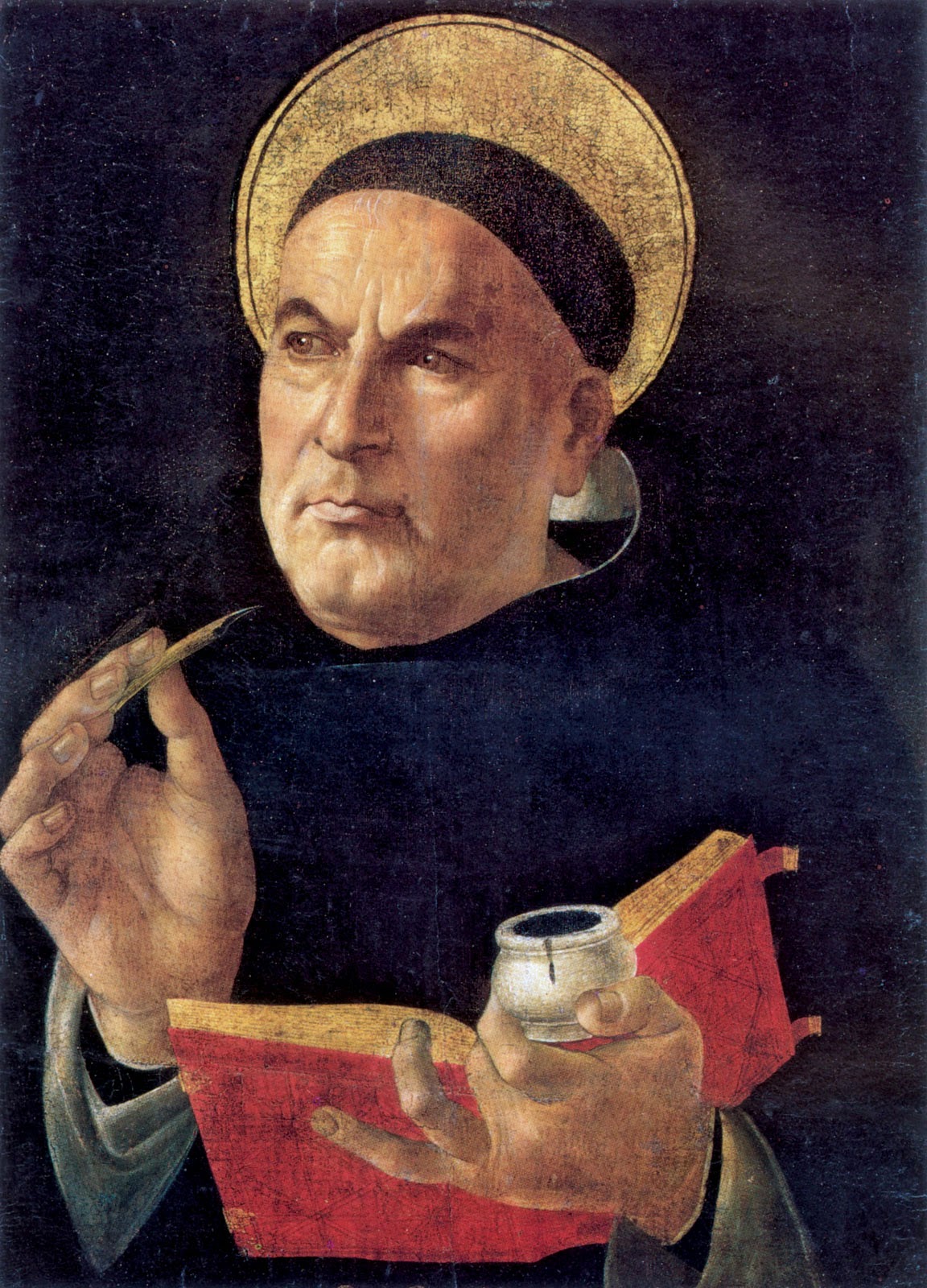
- Thomas Aquinas by Sandro Botticelli, Sandro Botticelli. Public domain.
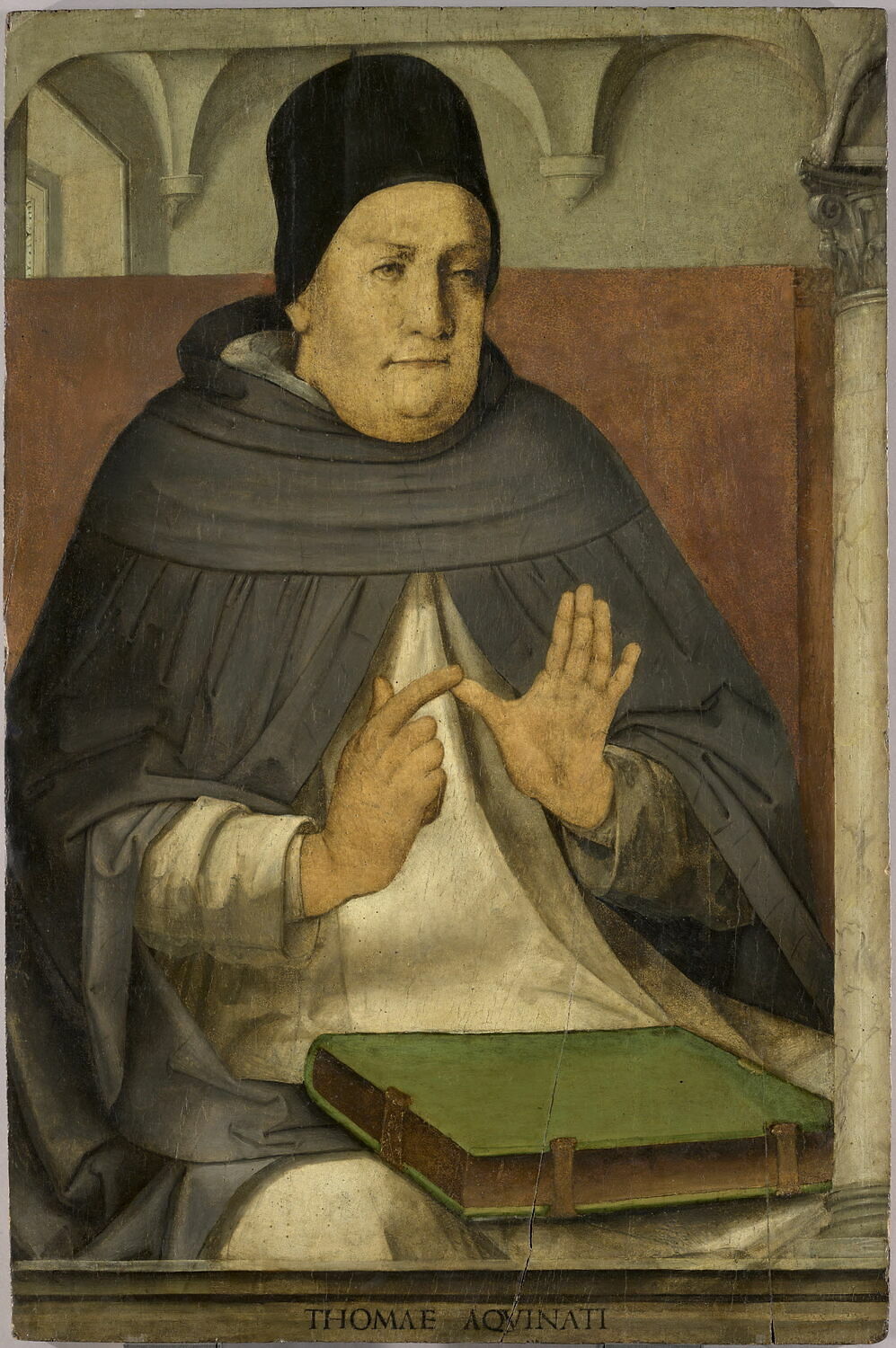
- Saint Thomas d'Aquin, Justus van Gent and Pedro Berruguete. Louvre, Paris. Public domain.
- The Temptation of St Thomas Aquinas, Diego Velázquez, 1632. Museo Diocesano de Arte Sacro, Orihuela. Public domain.