The Reformation was an argument about how a person is put right with God, and about who has the last word when Christians disagree. It began over the sale of indulgences in 1517, split Western Europe within a lifetime, and left five questions that churches still answer differently today.
Why did Martin Luther start the Reformation?
He did not think he was starting anything. In 1517 Luther was a friar and a professor of Bible at Wittenberg, and what provoked him was a fundraising campaign.
An indulgence remitted the punishment the church still required for sins already confessed. It was never sold as forgiveness, but it was understood to shorten a soul’s time in purgatory, where the medieval West believed the saved were purified before heaven, and that is what made it sell. Albrecht of Brandenburg had borrowed heavily from the Fugger bank to pay Rome for his appointment as Archbishop of Mainz. An indulgence was authorised in his lands on these terms: half the takings would build the new St Peter’s, half would clear Albrecht’s debt. A Dominican friar, Johann Tetzel, preached it, and a Fugger clerk went with him to keep the books.
Luther wrote ninety-five short propositions in Latin, aimed at scholars, and posted them to Albrecht on 31 October 1517. The first is the whole thing in a sentence: “When our Lord and Master Jesus Christ said, ‘Repent,’ He willed the entire life of believers to be one of repentance.” Whether he also nailed a copy to the door of the Castle Church that day is the most famous thing about him and the least certain. The letter is documented. The hammer is not.
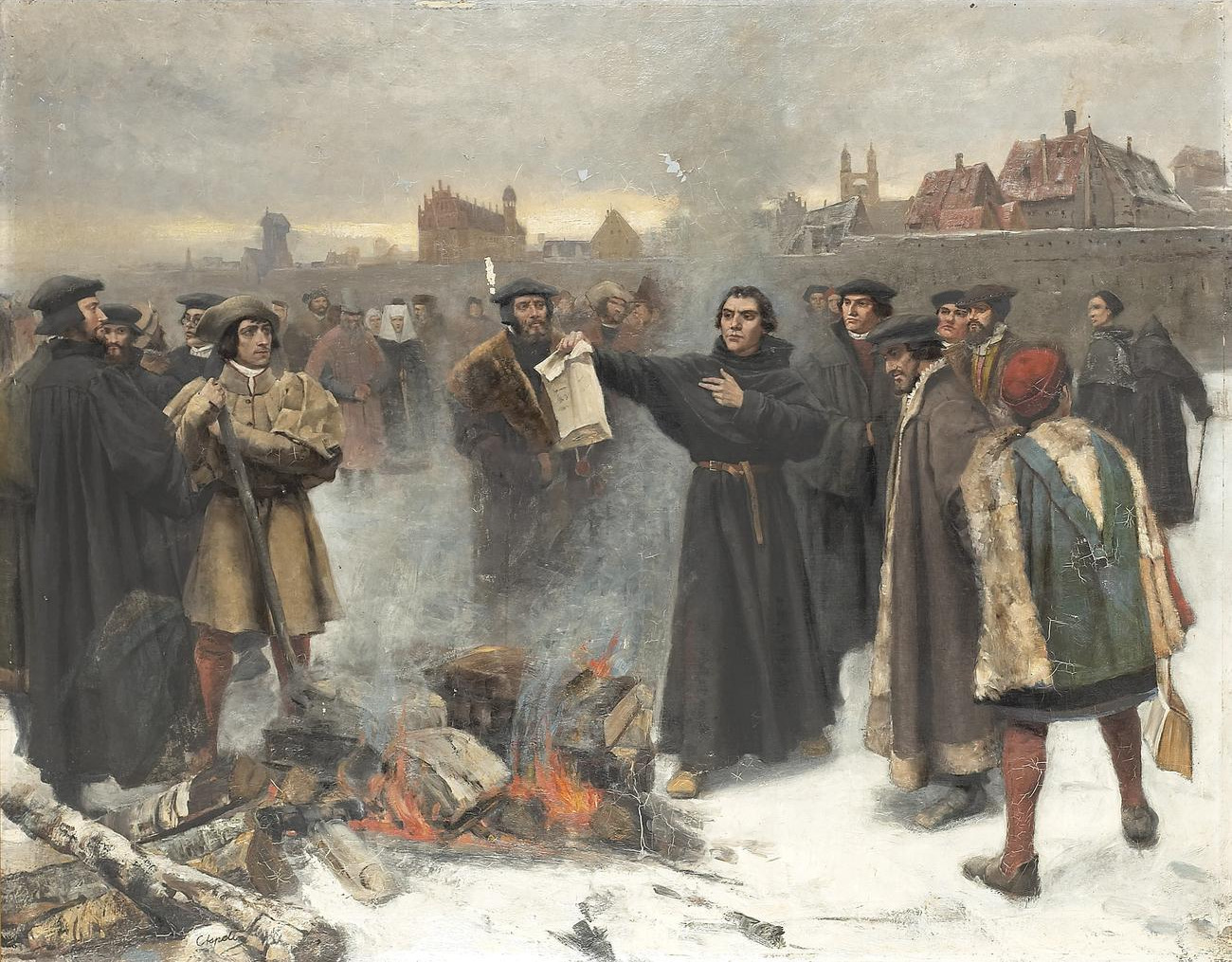
Rome answered with a bull, a formal papal letter, giving him sixty days to recant. On 10 December 1520 he burned it at the Elster Gate in Wittenberg, with the church’s law books on the same fire, and was excommunicated on 3 January 1521.
In April he stood in front of the Holy Roman Emperor. At the Diet of Worms he was shown his own books and asked to take them back. He took a day to think, and on 18 April 1521 answered that unless he was convinced by Scripture or by plain reason he could not and would not recant. (“Here I stand, I can do no other” is probably a later addition to the record.) On 25 May the emperor made him an outlaw.
How is a person put right with God?
Everything else hangs on this one.
Luther’s answer was justification by faith alone: God counts a sinner righteous because of Christ, received by trusting Him, not because of anything the sinner has first managed to become. Underneath it sits a harder question, and Protestants split over that one too. Does a person contribute anything to their own conversion? Monergists (the view that God alone brings someone to believe) say no, not even the decision. Synergists (the view that a person freely cooperates with the grace God gives) say grace always comes first and makes faith possible, but each person can still say no. That is the argument people mean today when they say “predestination” or “free will”.
Rome gave its answer at the Council of Trent on 13 January 1547: grace comes first and enables everything, yet the will freely cooperates and can refuse, and justification really makes a person righteous rather than only declaring them so. Both sides quoted Romans. Both sides quoted Augustine.
Where the traditions land on grace is still the sharpest line on the map.
Who has the last word?
The second argument was about authority, and it is why the first could not be settled.
Luther’s position hardened into what is now called Scripture alone, or the Bible alone: creeds and confessions can carry real authority, but only Scripture is beyond error, any council may get something wrong, and nothing may be demanded as an article of belief that cannot be shown from the Bible. The Formula of Concord put it flatly in 1577, calling Scripture “the only rule and norm” and receiving the ancient creeds as witnesses to it. Westminster said in 1646 that councils may err.
Trent had already answered, on 8 April 1546: the gospel is preserved in the written books and in unwritten traditions from the apostles. Catholics and Orthodox Christians read the Bible inside the church that received it, and hold that the creeds, the councils and the early Fathers are God’s appointed way of guarding it.
Lutheran theologians at Tübingen once sent a Greek Augsburg Confession to the Patriarch of Constantinople, hoping the East would prove an ally against Rome. The letters ran from 1573 to 1581 and broke down on exactly this question: what place the Fathers have in reading Scripture.
Both cases are on the authority axis.
What happens at the Lord’s Supper?
In October 1529 Philip of Hesse got Luther and Zwingli into a room at Marburg to agree a common front. They agreed on fourteen of fifteen articles. The fifteenth broke them.
Zwingli held that in “this is My body” the word “is” means “signifies”: the Supper is a memorial of His death until He comes, and the blessing in it comes through the believer’s trust, not through the bread. Luther held that Christ’s body is genuinely there, given with the bread, however impossible to explain. Calvin landed between them in 1559: a real presence, spiritual rather than physical, received by faith through the Spirit. Rome affirmed transubstantiation, the teaching that the bread and wine become Christ’s body and blood, at the Fourth Lateran Council in 1215, and defined it at Trent in 1551.
That disagreement decided who could kneel at a rail together, and it is why Protestantism arrived as two movements rather than one. The Table axis runs from sacramental to memorial, and most churches sit along it rather than at an end.
Who should be baptised?
A third group thought both sides had stopped halfway. On the evening of 21 January 1525, in a house in Zurich, George Blaurock asked Conrad Grebel to baptise him on his own confession of belief. Grebel did, Blaurock baptised the others, and the Anabaptist movement began. The city council had ordered infants baptised three days earlier. Felix Manz, whose mother’s house they were standing in, was drowned in the Limmat two years later. Catholic and Protestant authorities both executed Anabaptists.
Underneath is the question the Supper asks, which is why the Compass keeps the two on one axis. Does God do something through the water, joining a child to Christ and to His people before that child can understand it, or is baptism a believer’s public confession of what God has already done? Infant baptism or believers’ baptism is still the first thing most people notice when they change churches.
What should a Sunday look like?
The fifth argument was the one ordinary people felt every week. Zwingli stripped Zurich’s service back to reading, preaching and prayer, with no singing at all. Luther kept the shape of the Mass, put it into German, and filled it with hymns the congregation sang themselves. Thomas Cranmer gave England one book in its own language in 1549. Then the Puritans argued that only what Scripture commands belongs in worship, and Richard Hooker replied that the church may order whatever Scripture does not forbid. That exchange is still running: a set liturgy and the church calendar on one side, a free order on the other. It is the worship axis, and most people can place themselves on it in seconds.
The two arguments the Reformation did not have
The Compass asks six questions. Two are not sixteenth-century fights at all, which is worth knowing before anyone claims the Reformers for a modern position.
Whether tongues, prophecy and healing are still given was not a live division then. The Reformers largely assumed those gifts belonged to the apostles’ lifetime, and Westminster said in 1646 that God’s former ways of revealing His will had “now ceased”. The argument as we have it begins at Azusa Street in 1906. The gifts axis is barely a century old.
The same goes for the rapture and the future of Israel. The Augsburg Confession of 1530 went the other way and condemned the expectation of an earthly kingdom before the resurrection. The system most people mean by “the end times” comes from J. N. Darby in the 1830s and reached the pews through the Scofield Reference Bible in 1909. The kingdom axis is younger than the railway.
What did the Reformation actually change?
The Bible stopped being a foreign object. Luther’s German New Testament appeared in September 1522, the complete Bible in 1534, and the printing press made both cheap enough to own. Congregations sang. Clergy married. Rome held its own council and came out of it sharper than it went in.
And the word “Protestant” got invented on 19 April 1529, when a minority of German princes and cities entered a formal protest at the Diet of Speyer against a ruling they said they could not obey. It began as a legal term for people who had objected, a more modest origin than it sounds.
Why is Reformation Day on 31 October?
Because of the letter. It is a public holiday in nine German states and in Slovenia, and kept by Lutheran and Reformed churches worldwide.
The date is probably not an accident. The Castle Church at Wittenberg held one of the largest relic collections in Europe, over seventeen thousand items by the 1518 inventory, and it went on show every All Saints’ Day, 1 November, with indulgences attached to viewing it. A complaint about indulgences delivered on 31 October arrived the day before the crowds.
You already hold a position on most of these, whether or not you have put it into words. The Theology Compass takes three minutes and shows which of eighteen Christian traditions your answers sit nearest.