
The gift of evangelism
- 3Statements
- 3Recorded acts
- 17Gifts
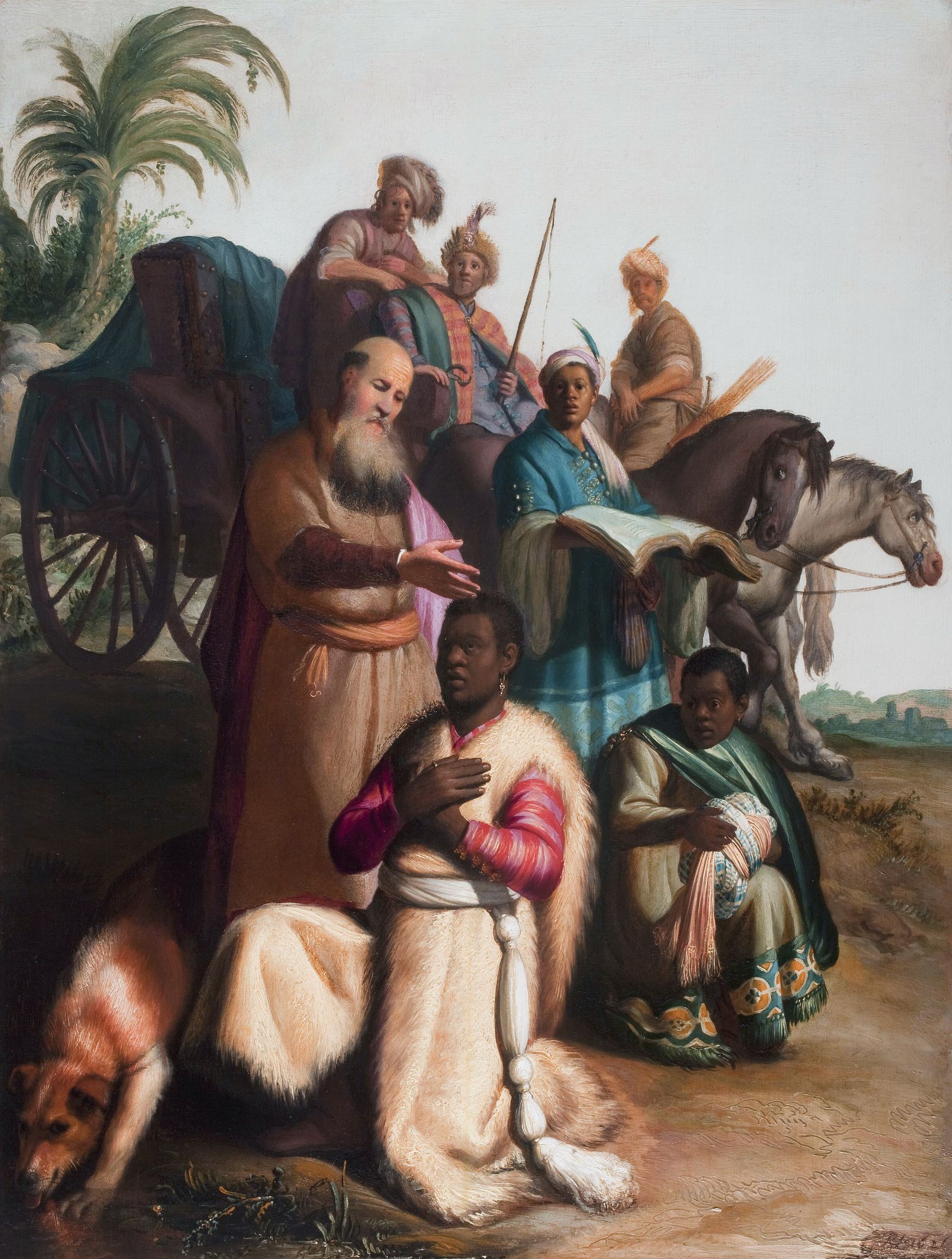
Picture: The Baptism of the Eunuch, Rembrandt, 1626. Museum Catharijneconvent, Utrecht.
From your result on . See your result
- Evangelism
A low row is something these statements did not find, not a verdict on you.
What is the spiritual gift of evangelism?
Evangelism is the gift of telling the good news to people who have not heard it or do not hold it, and finding those conversations easy to start. Ephesians 4:11 names evangelists among the people Christ gave to His church. The word itself appears three times in the New Testament.
Why it matters
A church grows by birth, by transfer or by this. Most Christians do not have the gift and are still asked to be ready with an answer when somebody asks (1 Peter 3:15), which is a much lower bar and a far commoner situation. The people who do have it are useful mostly because they show everybody else that the conversation is survivable.
Where does the Bible name it?
-
and some, evangelists
Ephesians 4:11
World English Bible British Edition
What does the gift of evangelism look like in a church?
Telling the good news to people who have not heard it or do not hold it. Of the four gift lists only Ephesians 4:11 names it, and the noun itself turns up three times in the whole New Testament: Philip, whom Luke calls the evangelist (Acts 21:8), the list in Ephesians, and Paul’s instruction to Timothy to “do the work of an evangelist” (2 Timothy 4:5). Timothy, who is told to do the work, is never given the title.
In an ordinary week it is the conversation with the plumber that somehow got round to God. It is the person who brings a friend who has never been inside a church, and the one whose neighbours ask what Christians actually believe, because they have worked out that asking will not be awkward.
People notice it in themselves by where they keep ending up. You are in these conversations without having steered them there. People who do not go to church put their questions to you rather than to the vicar. You are aware of the times you kept quiet, in a way that other people are not.
The gift is most often confused with being extroverted, and Luke’s own example rules that out: Philip preaches to a city and then, on the same page, goes to one man in a chariot and starts from the passage the man happened to be reading (Acts 8:5-8, 26-35). It is also confused with teaching, which works with people who already hold the thing. Evangelism starts a long way further back, with somebody who may not want the conversation at all.
Did you know?
-
The only man the New Testament calls an evangelist was first appointed to wait on tables. Philip is one of the seven chosen in Acts 6, and Luke gives him the title fifteen chapters later.
Acts 6:5; Acts 21:8
-
After the persecution in Jerusalem the good news spread through refugees rather than through the leadership. Everyone was scattered “except for the apostles”, and “those who were scattered abroad went around preaching the word”.
Acts 8:1 and 8:4, World English Bible British Edition
-
Paul tells Timothy to “do the work of an evangelist” without ever calling him one, which suggests the work can be asked of somebody who does not have the gift.
2 Timothy 4:5, World English Bible British Edition
Who did this in the Bible?
-
Acts 8:5-8
Philip proclaimed the Christ in the city of Samaria; the crowds listened when they heard and saw the signs he did, unclean spirits came out, many paralysed and lame were healed, and there was great joy in that city.
-
Acts 8:26-35
Told by the Spirit to go near the chariot, Philip ran to the Ethiopian official, asked whether he understood what he was reading, and beginning from that Scripture told him about Jesus.
-
Acts 21:8
Luke later calls him Philip the evangelist, and Paul’s company stayed at his house in Caesarea.
Suggest a correction. Corrections that are applied are recorded in the public changelog.