
The gift of faith
- 3Statements
- 2Recorded acts
- 17Gifts
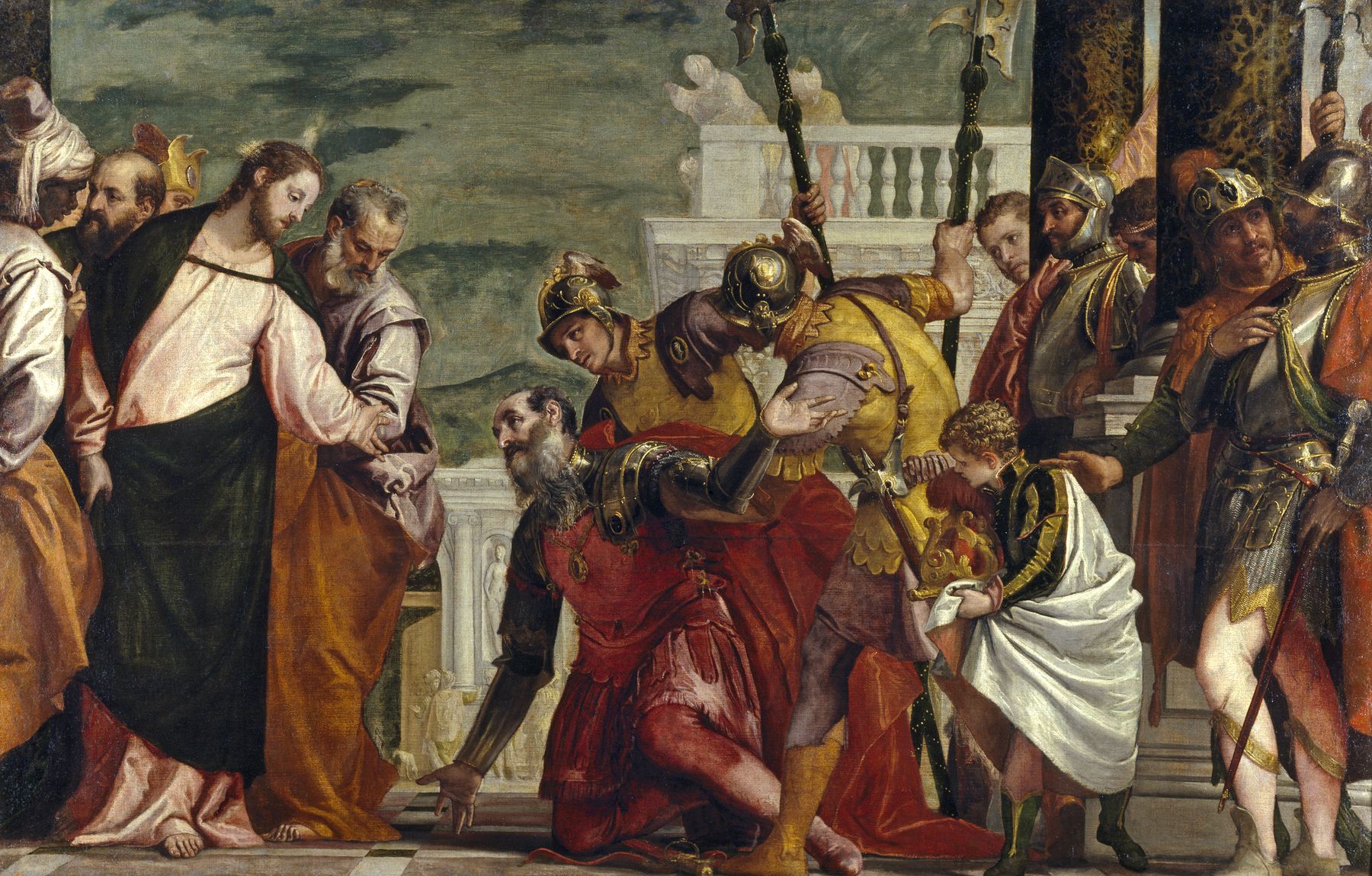
Picture: Jesus and the Centurion, Paolo Veronese, about 1571. Museo del Prado, Madrid.
From your result on . See your result
- The gift of faith
A low row is something these statements did not find, not a verdict on you.
What is the spiritual gift of faith?
The gift of faith in 1 Corinthians 12:9 is not believing at all, which is asked of every Christian. It is listed as given to some and not to others: a settled certainty that God will do a particular thing, held after other people have stopped expecting it.
Why it matters
Every worthwhile thing a church does passes through a stretch where the evidence says stop. This is the gift that keeps a few people asking anyway, and it is why some congregations attempt things that look reckless on paper. It is also easy to abuse, which is presumably why Paul puts it in a chapter about a body rather than about a hero.
Where does the Bible name it?
-
to another faith by the same Spirit
1 Corinthians 12:9
World English Bible British Edition
What does the gift of faith look like in a church?
Listed as something given to some and not to others, so it is not about whether you believe. These statements look only for a habit of staying sure, and saying so, after other people have stopped expecting a thing to come right, and for people coming to ask whether you still are. Paul elsewhere writes of “all faith, so as to remove mountains” (1 Corinthians 13:2). Paul names this in the same sentence as healing, miracles and tongues (1 Corinthians 12:8-10), and Christians disagree about which of the gifts in that sentence God still gives today.
In an ordinary week it is whoever keeps praying for the building fund after the figures have said no. It is the person who says this one will come good about somebody everybody else has written off, and is still saying it three years later, and has been right often enough that people remember.
People notice it in themselves by what others ask them. When a thing has gone quiet, somebody comes and asks whether you still think it will happen. You find yourself saying so out loud in a room that has given up. You are rarely the first to say stop.
The two things it is most often confused with are saving faith, which every Christian has and which no list of gifts would single out, and optimism, which is a temperament rather than a gift and does not need a subject. Paul’s own measure is deliberately extreme and then deliberately deflated: all faith, enough to remove mountains, and without love it is nothing (1 Corinthians 13:2). The Romans list opens with the same warning against making any gift a rank, telling everyone to think of themselves reasonably, “as God has apportioned to each person a measure of faith” (Romans 12:3).
Did you know?
-
Paul’s own measure of this gift is deliberately extreme and then deliberately deflated: “if I have all faith, so as to remove mountains, but don’t have love, I am nothing”.
1 Corinthians 13:2, World English Bible British Edition
-
Luke describes Stephen twice within three verses, first as “full of faith and of the Holy Spirit” and then as “full of faith and power”.
Acts 6:5 and 6:8, World English Bible British Edition
-
The clearest picture of it in Acts is a man on a foundering ship telling everyone aboard to cheer up, on the strength of something said to him the night before.
Acts 27:21-25
Who did this in the Bible?
-
Acts 27:21-25
In the storm, with those aboard long without food, Paul stood up and told them to cheer up: an angel had stood by him that night and said all aboard would live, and he said he believed God that it would be just as he had been told.
-
Acts 6:5-8
Among the seven the disciples chose, Luke singles out Stephen as a man full of faith and of the Holy Spirit, and three verses later as full of faith and power, performing great wonders and signs among the people.
Suggest a correction. Corrections that are applied are recorded in the public changelog.