
The gift of showing mercy
- 3Statements
- 2Recorded acts
- 17Gifts
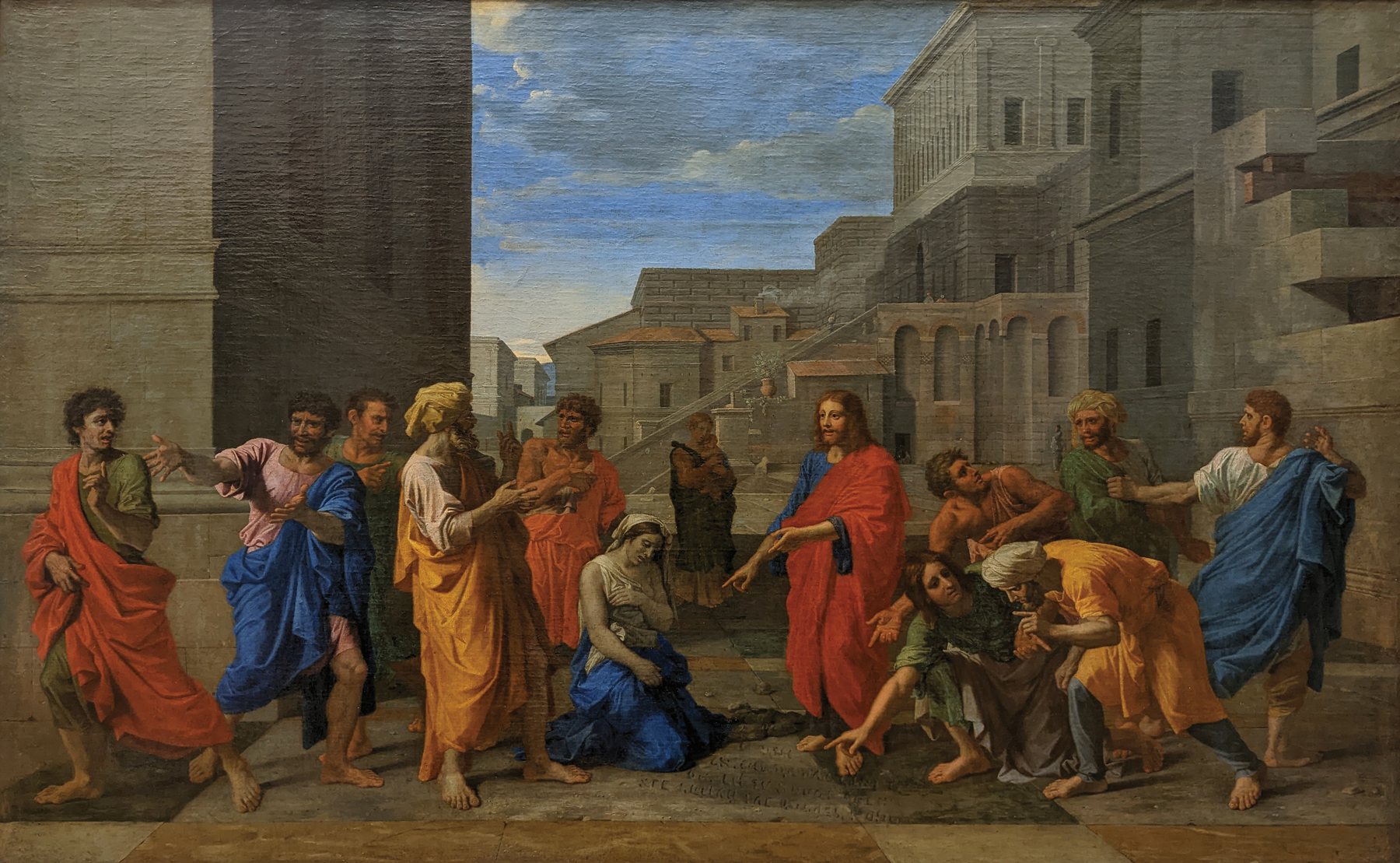
Picture: Christ and the Woman Taken in Adultery, Nicolas Poussin, 1653. Musée du Louvre, Paris.
From your result on . See your result
- Showing mercy
A low row is something these statements did not find, not a verdict on you.
What is the spiritual gift of mercy?
Mercy is the gift of going towards people in distress and doing what eases it. Romans 12:8 names it and adds one instruction: do it with cheerfulness. The gift is not feeling sorry for somebody. It is staying in the room, and then coming back next week.
Why it matters
Suffering in a church lasts far longer than the attention a church usually gives it, and this is the gift that covers the gap. A congregation with strong teaching and no mercy is a place where people learn a great deal and grieve alone. The cheerfulness clause matters too, because help offered grudgingly is remembered as a debt.
Where does the Bible name it?
-
he who shows mercy, with cheerfulness
Romans 12:8
World English Bible British Edition
What does the gift of showing mercy look like in a church?
Going towards people in distress and doing what eases it. Romans 12:8 names it last in its list of seven, and the one thing it asks is that mercy be shown with cheerfulness, so that help does not arrive with a sigh attached.
In an ordinary week this is the person who sits with the widow for a whole afternoon and does not look at the clock. It is whoever visits in the third week, once the first rush of visitors has stopped and the ward has become boring. It is the one who takes the call at eleven at night, and the one who goes to the funeral of somebody they barely knew because the family will be thin on the ground.
People notice it in themselves by which way they move. When somebody starts crying you go closer instead of giving them room. People at their lowest come to you, including people who hardly know you, which is puzzling until you realise they can tell. You leave a conversation carrying somebody else’s weight, and it does not put you off going back.
It is most often confused with serving, and the difference is the target: serving answers a job, mercy answers a person, and mercy will sit in a room where there is nothing to fix. It is also confused with encouraging, which wants a stalled person moving again, while mercy is content to be still with somebody who cannot move yet. The everyday mix-up is with ordinary kindness, which is asked of every Christian. What is named here is the settled habit of going where distress is rather than away from it.
Did you know?
-
The word for cheerfulness in Romans 12:8, hilarotes, appears nowhere else in the New Testament. Its matching adjective is the one in “God loves a cheerful giver”.
Romans 12:8; 2 Corinthians 9:7; hilarotes, Strong’s Greek 2432
-
Paul’s word for mercy is the one the lawyer reaches for at the end of the good Samaritan, and he will not say “the Samaritan”. Asked which man was a neighbour, he answers, “He who showed mercy on him”, and Jesus replies, “Go and do likewise.”
Luke 10:37, World English Bible British Edition; Romans 12:8; eleeo and eleos, Strong’s Greek 1653 and 1656
-
Luke calls Tabitha of Joppa “full of good works and acts of mercy” and then says what they were: clothes, which the widows were still holding up to show Peter after she died.
Acts 9:36-39, World English Bible British Edition
Who did this in the Bible?
-
Acts 9:36-39
Tabitha of Joppa, whom Luke describes as full of good works and acts of mercy, had made tunics and other garments, which the widows showed Peter, weeping, after she died.
-
2 Timothy 1:16-18
Paul writes that Onesiphorus often refreshed him, was not ashamed of his chain, and in Rome sought him diligently and found him.
Suggest a correction. Corrections that are applied are recorded in the public changelog.