Sign Up My Profile
Patron saints

St Thomas’s prayer before study

The prayer before study that Catholics credit to St Thomas Aquinas, said before reading, writing or an exam.

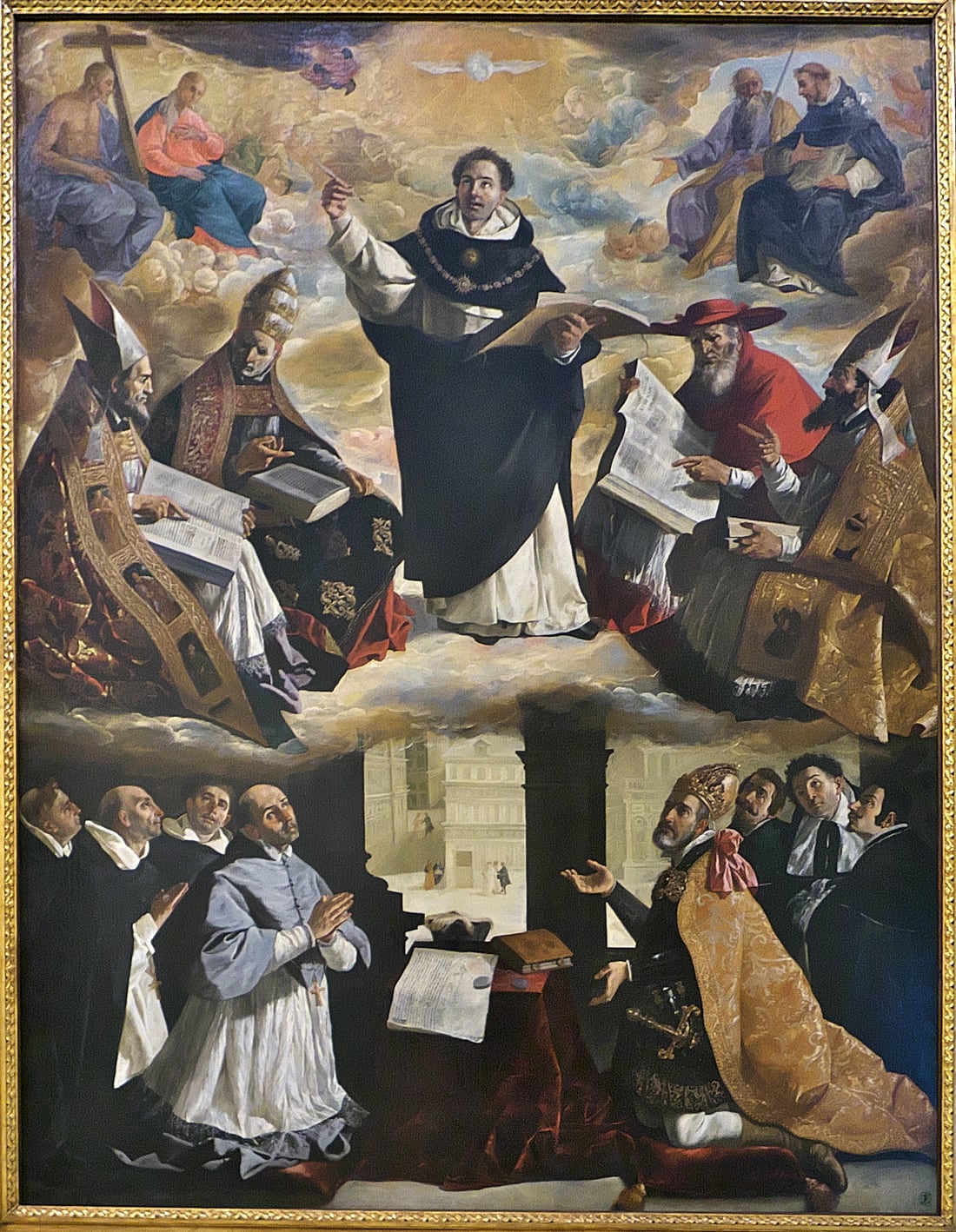
Picture: Francisco de Zurbarán, The Apotheosis of St Thomas Aquinas, 1631, Museo de Bellas Artes, Seville

The words of the prayer

Plain English

Creator beyond all words,from the treasures of Your wisdomYou set the angels in three ranks,placed them in wonderful order above the highest heaven,and arranged every part of the universe with perfect beauty.

You are called the true Source of light and wisdom,the First Beginning, high above all things.Be pleased to pour a ray of Your brightnesson the darkness of my mind,and take from me the double darkness I was born in,sin and ignorance.

You Who make the tongues of little children speak well,teach my tongue,and pour the grace of Your blessing on my lips.

Give me a sharp mind to understand,a memory that holds what I learn,a good way of learning and skill in it,fine insight to interpret,and a rich gift for speaking.

Prepare my beginning,guide me as I go on,and bring my work to its end,You Who are true God and man,Who live and reign for ever and ever.Amen.

Traditional wording, 1910

O ineffable Creator, Who, of the treasures of Thy wisdomhast formed the nine choirs of Angels,and set them on high above the heavens in a wonderful order,and hast exquisitely fashioned and knit together all parts of the universe;

do Thou, Who art the true fountain and one principle of light and wisdom,deign to shed the brightness of Thy light upon the darkness of my understanding,and thus to disperse the twofold darkness of sin and ignorancewherein I was born.

O Thou, Who makest eloquent the tongues of babes,instruct my tongue,and pour forth on my lips the grace of Thy blessing.

Grant me acuteness in understanding what I read,power to retain it,subtlety to discern its true meaning,and clearness and ease in expressing it.

Do Thou order my beginnings,direct and further my progress,complete and bless my ending;Thou Who art true God and true Man,Who livest and reignest world without end.Amen.

Plain English by Wiser Walk, from the Latin. How the wording is made. Traditional wording: an unnamed translator, The Raccolta (London, 1910 edition), 1910.

His story

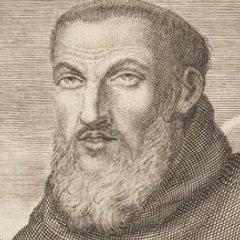
His noble family locked him up at home to stop him becoming a Dominican friar, but he joined the friars all the same. At Cologne his fellow students took his silence for slowness, but his teacher Albert the Great said, “We call this young man a dumb ox, but his bellowing in doctrine will one day resound throughout the world.” He became the great teacher of Paris and wrote the Summa Theologiae, which was still unfinished when he died in 1274.

“St. Thomas Aquinas”, Catholic Encyclopedia, 1912

His feast days

  • 28 January: His feast in the Catholic Church.

  • 7 March: The day he died, his feast until 1969, in the Catholic Church.

The General Roman Calendar since 1969; The Roman Martyrology, 1916, 7 March

Why people ask St Thomas Aquinas

Students and exams

Pope Leo XIII made him the patron of Catholic universities, colleges and schools in 1880.

Leo XIII, brief Cum hoc sit, 4 August 1880

Where it comes from

Who wrote it

Credited to St Thomas, though no one knows for sure that he wrote it. The oldest list of his works that names it dates from about 1413, 139 years after his death, and Pope Leo XIII granted an indulgence for it as his prayer in 1880.

Jacques Échard, Scriptores Ordinis Praedicatorum, vol. 1 (Paris, 1719), on the list of Louis of Valladolid

In Latin

Creator ineffabilis, qui de thesauris sapientiæ tuætres angelorum hierarchias designastiet eas super cælum empyreum miro ordine collocasti,atque universi partes elegantissime disposuisti.

Tu inquam, qui verus fons luminis et sapientiæ dicerisac supereminens principium,infundere digneris super intellectus mei tenebrastuæ radium claritatis,duplices, in quibus natus sum, a me removens tenebras,peccatum scilicet et ignorantiam.

Tu, qui linguas infantium facis disertas,linguam meam erudias,atque in labiis meis gratiam tuæ benedictionis infunde.

Da mihi intelligendi acumen, retinendi capacitatem,addiscendi modum et facultatem, interpretandi subtilitatem,loquendi gratiam copiosam;

ingressum instruas, progressum dirigas, egressum compleas,tu, qui es verus Deus et homo.Qui vivis et regnas in sæcula sæculorum. Amen.

From The Raccolta (London, 1910 edition), no. 52, pp. 47-48, the text Pope Leo XIII indulgenced in 1880.
Close to this

Every saint’s prayer Saints by need

Suggest a correction

Berean Standard Bible