
When it is said
The Church sings it on 26 November, his feast day, at the morning service called Matins.
He is honoured most in the Churches of the Greek tradition.
A parent may pray it over a baby’s cradle.
Where it comes from
No author known
Who was St Stylianos?
Stylianos lived in Paphlagonia, in Asia Minor, sometime between the 4th and 6th centuries. When his parents died, he gave his inheritance to the poor and became a monk. Because the other monks grew jealous of his zeal, he had to leave. He went to live alone in a cave, where he spent his time in prayer and fasting. People came looking for him there to hear his teaching or to be healed through his prayers.
A protector of children
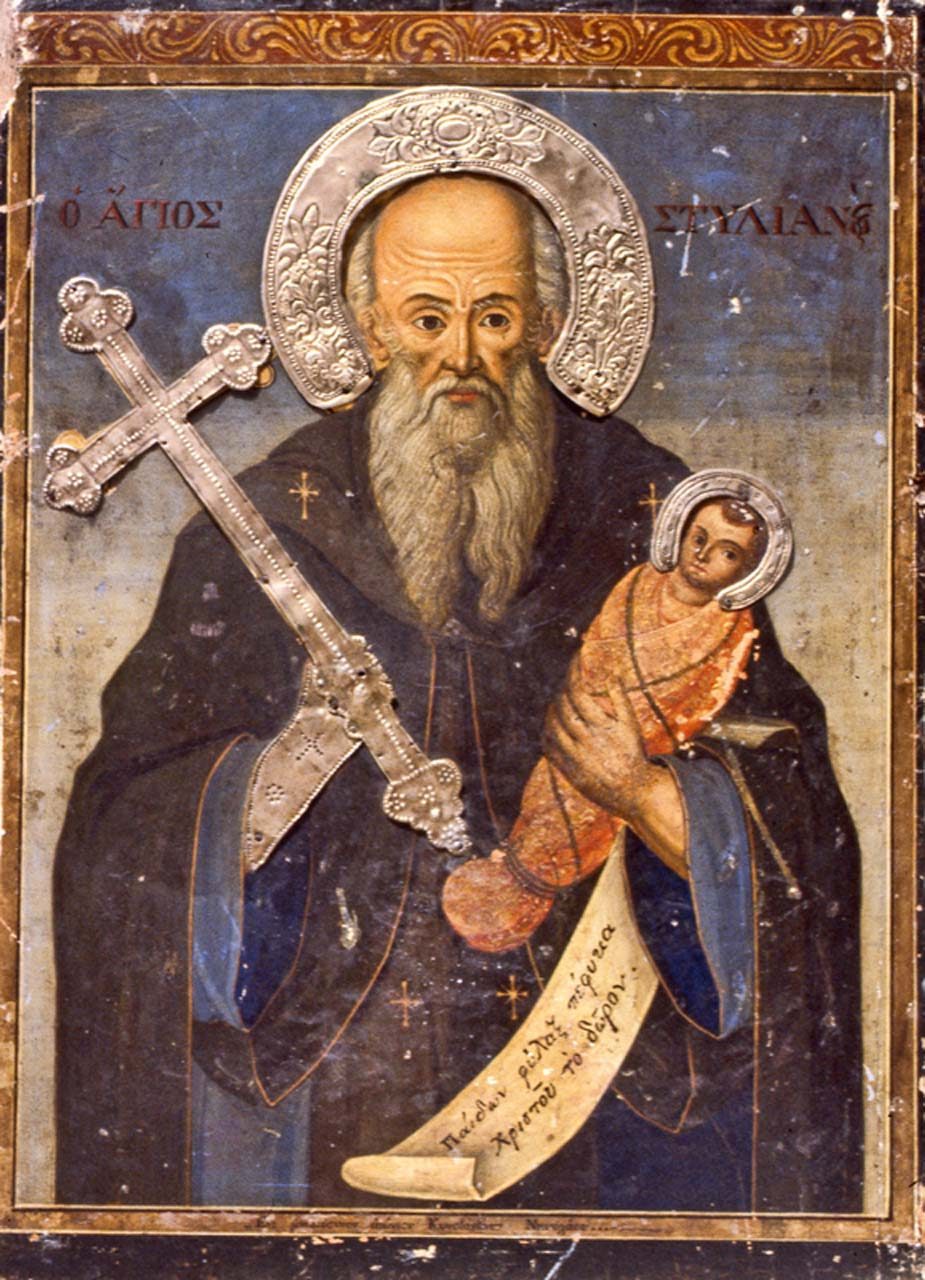
Stylianos loved children and healed them when they were sick. After his death, people in Paphlagonia had his icon painted whenever a child fell ill, and they hung it over the child’s bed. His icons show him holding a baby in his arms. Christians still ask him to protect their children. Women who cannot have a child ask his prayers too.
St Stylianus of Paphlagonia, Orthodox Church in America; St Stylianos of Paphlagonia, Azbyka.ru (in Russian)
What the words mean
Why does the hymn name Samuel?
Before Samuel was born, his mother Hannah promised God that her son would belong to Him all his life. The hymn says Stylianos was made holy from his mother’s womb as Samuel was, and that he glorified Christ from the time he was a baby.
1 Samuel 1:11
The Scripture in it
And she made a vow, saying, “O LORD of Hosts, if only You will look upon the affliction of Your maidservant and remember me, not forgetting Your maidservant but giving her a son, then I will dedicate him to the LORD all the days of his life, and no razor shall ever touch his head.”
Bible text: Berean Standard Bible, public domain.
In Greek
Ἁγιασθεὶς ἀπὸ μητρῴας νηδύος,
ὥσπερ ὁ Θεῖος Σαμουὴλ Θεοφόρε,
ἀσκητικῶς ἐδόξασας Χριστὸν τὸν Θεὸν·
ὅθεν τῶν ἰάσεων, ἀνεδείχθης ταμεῖον,
καὶ προστάτης ἔνθεος, νεογνῶν καὶ νηπίων·
ὁ γὰρ Χριστὸς δοξάζει σε λαμπρῶς,
ὃν ἀπὸ βρέφους, Στυλιανὲ ἐδόξασας.