Sign Up My Profile
Prayers

Orthodox prayers for a sick child

First comes the Russian Church’s prayer for gravely ill children and their parents, then two parents’ pleas to Jesus from the Gospels.

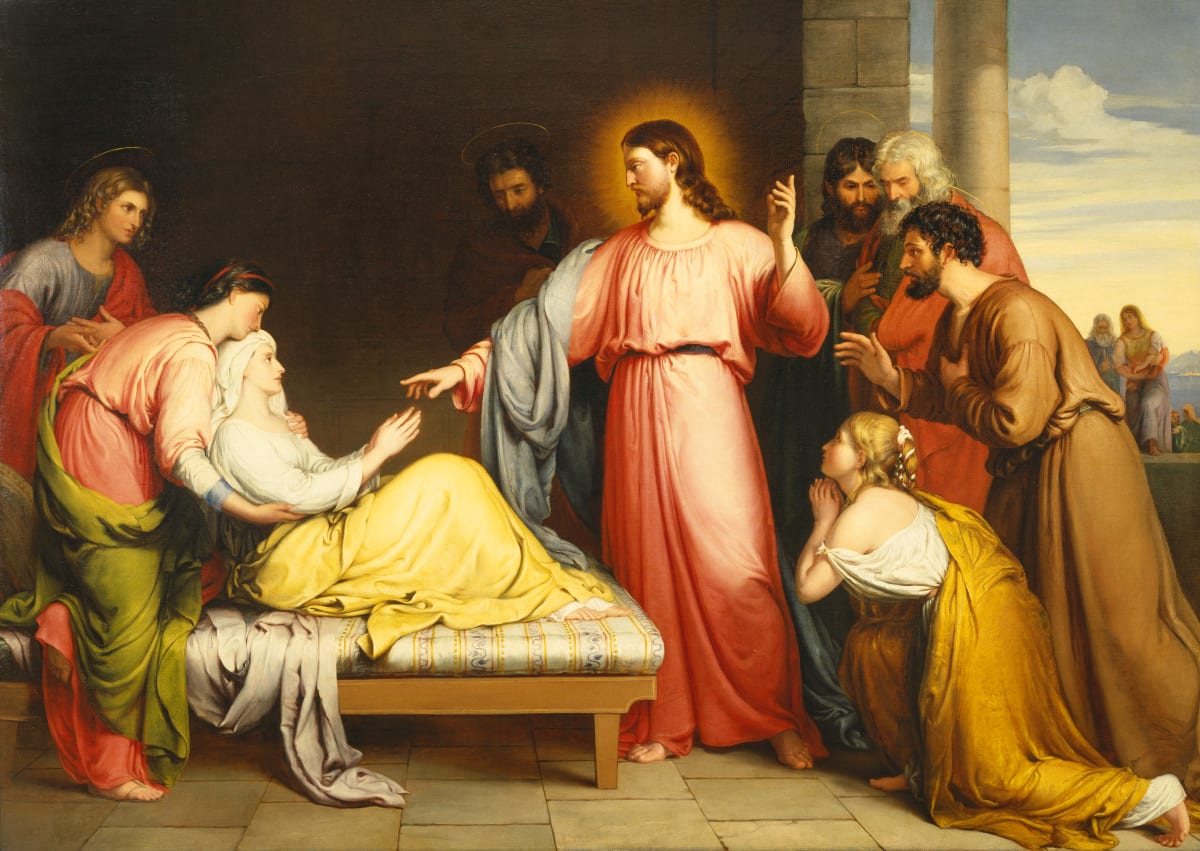
Picture: John Bridges, Christ Healing the Mother of Simon Peter’s Wife, 1839

4 prayers and 1 to the saints

For your child, and for you

Prayer for a sick child

Plain English only: no traditional English wording is given for this prayer

Master, Lover of mankind, Lord Jesus Christ our God,long-suffering and rich in mercy:great is Your mercy, and Your compassion is beyond words.Your love embraces all,and nothing is impossible for You, if only You will it.

For You said, Lord,“Let the children come to Me,for the kingdom of God belongs to such as these.”You raised the daughter of Jairus from her deathbed,and when a royal official whose son lay sick in Capernaumcame to You in hope, You told him,“Go, your son will live.”

So we, sinful and unworthy, run to Youand fall down before You in repentance.We pray to You for children, infants and young peoplewho are ill and suffer cruelly from grave illnesses.Do not turn them away as they come to Youand look to You for mercy,but raise them from their sickbedwhole and completely well.

Look also, O God, on the parents of the sick children.Heal their grieving hearts with Your divine words.Strengthen those who are losing heart,lift up those who have fallen into despair,and fill them with faith, hope and trust in Your mercy.

For Yours it is to have mercy on us and to save us, O our God,and to You we give glory,and to Your Father, Who is without beginning,and to Your all-holy, good and life-giving Spirit,now and ever, and for ever and ever. Amen.

A priest prays it in the service for gravely ill children that the Russian Church approved in 2025. It asks Christ to raise the children from their sickbed and to heal their parents’ grieving hearts, and a parent can pray it at home or beside a hospital bed.

Plain English by Wiser Walk, from the Church Slavonic (no English translation was found, so this one is our own). How the wording is made.
Where it comes from, and the Church Slavonic

A father’s plea

Prayer of the royal official

Lord, come down before my child dies.

Traditional wording, 1611

Sir, come down ere my child die.

A royal official begged Jesus to come down to Capernaum and heal his dying son. Jesus answered him, “Go. Your son will live,” and the fever left the boy at that very hour (John 4:46-53).

Plain English by Wiser Walk, from the Greek of John 4:49, with the King James wording beside it. How the wording is made. Traditional wording: The King James translators, The King James Version, 1611.

The father’s first word in Greek, Kyrie, can mean “Sir” or “Lord”. The King James Version has “Sir”. The Slavonic Gospel read in Russian churches has “Lord”, and so does the plain wording.

Where it comes from, and the Greek

A mother’s cry

Prayer of the Canaanite woman

Have mercy on me, Lord, Son of David.

Lord, help me.

Traditional wording, 1906

Have mercy on me, O Lord, Thou Son of David.

Lord, help me.

A mother kept crying out to Jesus for her daughter until He healed the girl. The Church reads her story in Holy Unction, its service for the sick.

Plain English by Wiser Walk, from the Greek of Matthew 15:22 and 15:25, with Hapgood’s 1906 wording beside it. How the wording is made. Traditional wording: Isabel F. Hapgood, Service Book of the Holy Orthodox-Catholic Apostolic Church, 1906.

Where it comes from, and the Greek

A short hymn, with their name

Troparion for the sick

O Christ, You alone are quick to help.Come quickly from on highand visit Your suffering servant (name).Free them from sickness and bitter pain.Raise them up to sing to Youand glorify You without ceasing,through the prayers of the Mother of God,O only Lover of mankind.

O Christ, You alone are quick to help.Come quickly from on highand visit me, Your suffering servant.Free me from sickness and bitter pain.Raise me up to sing to Youand glorify You without ceasing,through the prayers of the Mother of God,O only Lover of mankind.

Traditional wording, 1894

Thou that alone art quick to help, O Christ,make manifest from on high a speedy visitation to Thine ailing servant:deliver him from sicknesses and bitter pains,and raise him up, that, without ceasing, he may praise and glorify Thee,through the God-bearing one’s entreaties,O Thou sole Lover of mankind.

Orthodox families pray this short hymn at home whenever someone is ill, and the Church sings it in Holy Unction too.

Plain English by Wiser Walk, from the Greek. How the wording is made. Traditional wording: G. V. Shann, Book of Needs of the Holy Orthodox Church, 1894.

Where it comes from, and the Greek

To a saint · A protector of infants

Kontakion of St Stylianos

Made holy from your mother’s womblike godly Samuel,O God-bearing one,you glorified Christ Godby your life of self-denial.

So you were shown to be a storehouse of healingsand a holy protector of newborns and infants.For Christ, Whom you glorified from the time you were a baby,glorifies you with splendour, O Stylianos.

Traditional wording

Sanctified from the womb like another Samuel,you glorified God by your labors.Having become a healer and protector of Christ's babes and sucklings,He has glorified you, O Stylianos.

The Church remembers St Stylianos as a healer of sick children, and after his death people hung his icon over a sick child’s bed. The hymn for his feast names him a protector of newborns and infants.

Plain English by Wiser Walk, from the Greek, with the Orthodox Church in America’s English beside it. How the wording is made. Traditional wording: Orthodox Church in America, Troparia and kontakia for 26 November, on its website.

Where the OCA’s English ends “He has glorified you”, the Greek adds that Stylianos glorified Christ from the time he was a baby.

Where it comes from, and the Greek

Scripture for this

22A synagogue leader named Jairus arrived, and seeing Jesus, he fell at His feet 23and pleaded with Him urgently, “My little daughter is near death. Please come and place Your hands on her, so that she will be healed and live.” 24So Jesus went with him, and a large crowd followed and pressed around Him.

Mark 5:22-24 The Russian Church reads this passage in its service for gravely ill children. Jairus’s plea is the one every parent at a sickbed makes.

But Jesus overheard their conversation and said to Jairus, “Do not be afraid; just believe.”

Mark 5:36 Jesus spoke to Jairus after messengers brought news that the girl had died. Then He took her hand and she got up (Mark 5:41-42).

As a father has compassion on his children, so the LORD has compassion on those who fear Him.

Psalm 103:13 The love that keeps a parent at a sick child’s bedside is the psalm’s picture of the Lord’s compassion.

“Can a woman forget her nursing child, or lack compassion for the son of her womb? Even if she could forget, I will not forget you!”

Isaiah 49:15 God answered His people through Isaiah when they cried that He had forgotten them (Isaiah 49:14).

See that you do not look down on any of these little ones. For I tell you that their angels in heaven always see the face of My Father in heaven.

Matthew 18:10 Jesus spoke of children like the one He had called to stand among His disciples (Matthew 18:2).

In the same way, the Spirit helps us in our weakness. For we do not know how we ought to pray, but the Spirit Himself intercedes for us with groans too deep for words.

Romans 8:26 A parent too frightened or tired to find the words can rest on this verse.

Bible text: Berean Standard Bible, public domain.

Close to this

All prayers

Quiz What prayer do you need right now? A few honest taps about where you are, and a prayer of the Church for exactly that. 8 questions, about 3 minutes. Start

Suggest a correction

Berean Standard Bible