
When it is said
The Orthodox Church reads her story in Holy Unction, its service of anointing the sick with oil. There the priests read the Gospels in turn, and the sixth priest reads this one.
The prayer he says next thanks God, the Physician of souls and bodies, Who freed her daughter.
Any parent may pray her two cries for a child who is suffering.
Where it comes from
Author known
A mother who would not give up
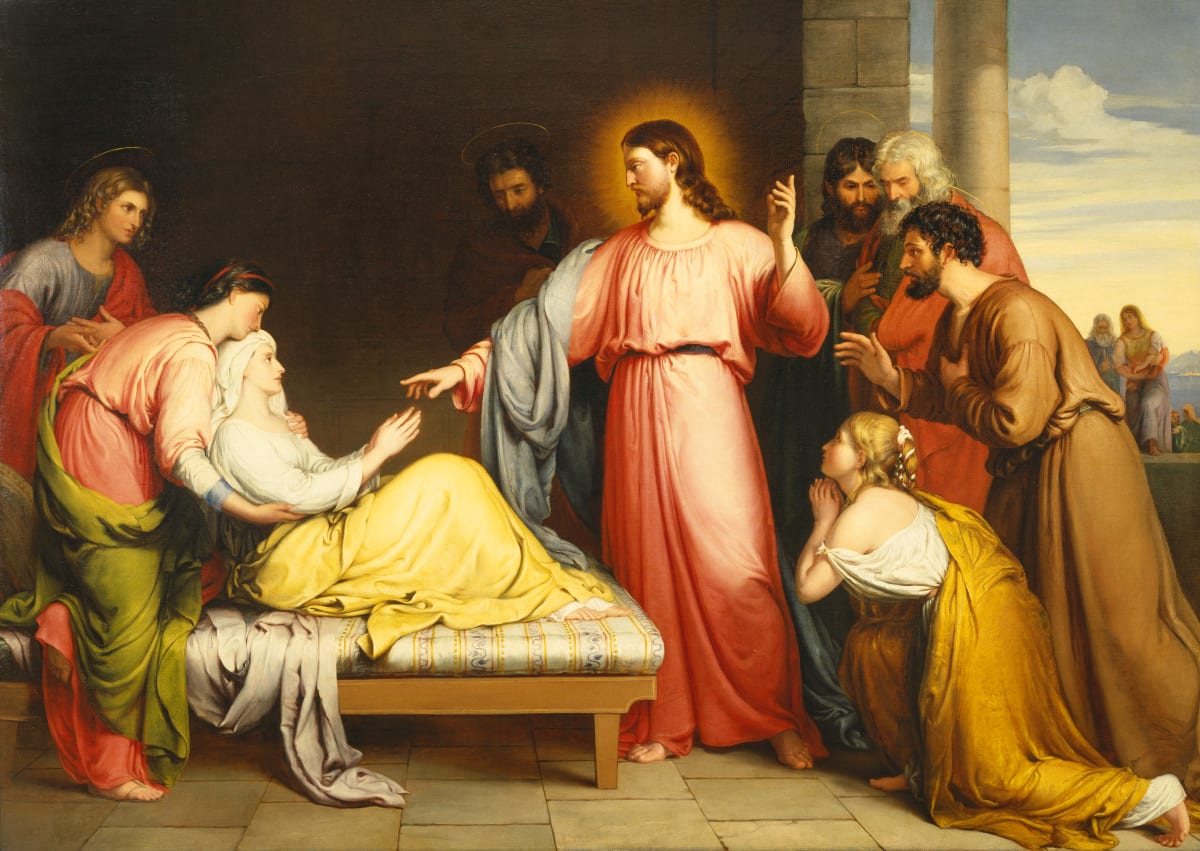
Jesus had gone to the district of Tyre and Sidon. A Canaanite woman came crying out to Him, because a demon was tormenting her daughter. At first He did not answer a word, and then He said He had been sent only to the lost sheep of Israel. She knelt before Him: “Lord, help me!” He answered that it was not right to take the children’s bread and toss it to the dogs. She replied that even the dogs eat the crumbs that fall from their master’s table. Jesus said, “O woman, your faith is great!” Her daughter was healed that very hour.
Matthew 15:21-28, Berean Standard Bible
“Have mercy on me”
St John Chrysostom, archbishop of Constantinople, noticed that she did not say “Have mercy on my daughter”, but “Have mercy on me”. He gave her reason in her own voice. Her daughter could not feel her own illness, “but it is I that suffer her innumerable woes.” A child’s pain is the mother’s too.
John Chrysostom, Homily 52 on Matthew (English translation of 1888)
In Mark’s Gospel
Mark tells the same story. He calls her a Greek woman of Syrophoenician origin, whose little daughter had an unclean spirit. She fell at Jesus’s feet and kept asking Him to drive the demon out. She went home and found her child lying on the bed, and the demon gone.
Mark 7:24-30, Berean Standard Bible
What the words mean
“Lord, help me”
Chrysostom also noticed that she asked no one to plead for her. He pictures her reasoning: “He Himself is Lord.” So she did not say “Entreat and beseech”, but simply “Help me.” He praised her for a bold faith that was not ashamed to ask, “a goodly shamelessness”.
John Chrysostom, Homily 52 on Matthew (English translation of 1888)
The Scripture in it
And a Canaanite woman from that region came to Him, crying out, “Lord, Son of David, have mercy on me! My daughter is miserably possessed by a demon.”
The woman came and knelt before Him. “Lord, help me!” she said.
As Jesus went on from there, two blind men followed Him, crying out, “Have mercy on us, Son of David!”
Bible text: Berean Standard Bible, public domain.
In Greek
Ἐλέησόν με, Κύριε, υἱὲ Δαβίδ·
Κύριε, βοήθει μοι.
From Matthew’s Gospel in Greek (15:22 and 15:25), on Greek Wikisource.