Sign Up My Profile
Prayers

Quick Orthodox prayers for when you only have a moment

Short prayers for a busy day that take only a breath or a few seconds. Pray them on the move or between tasks.

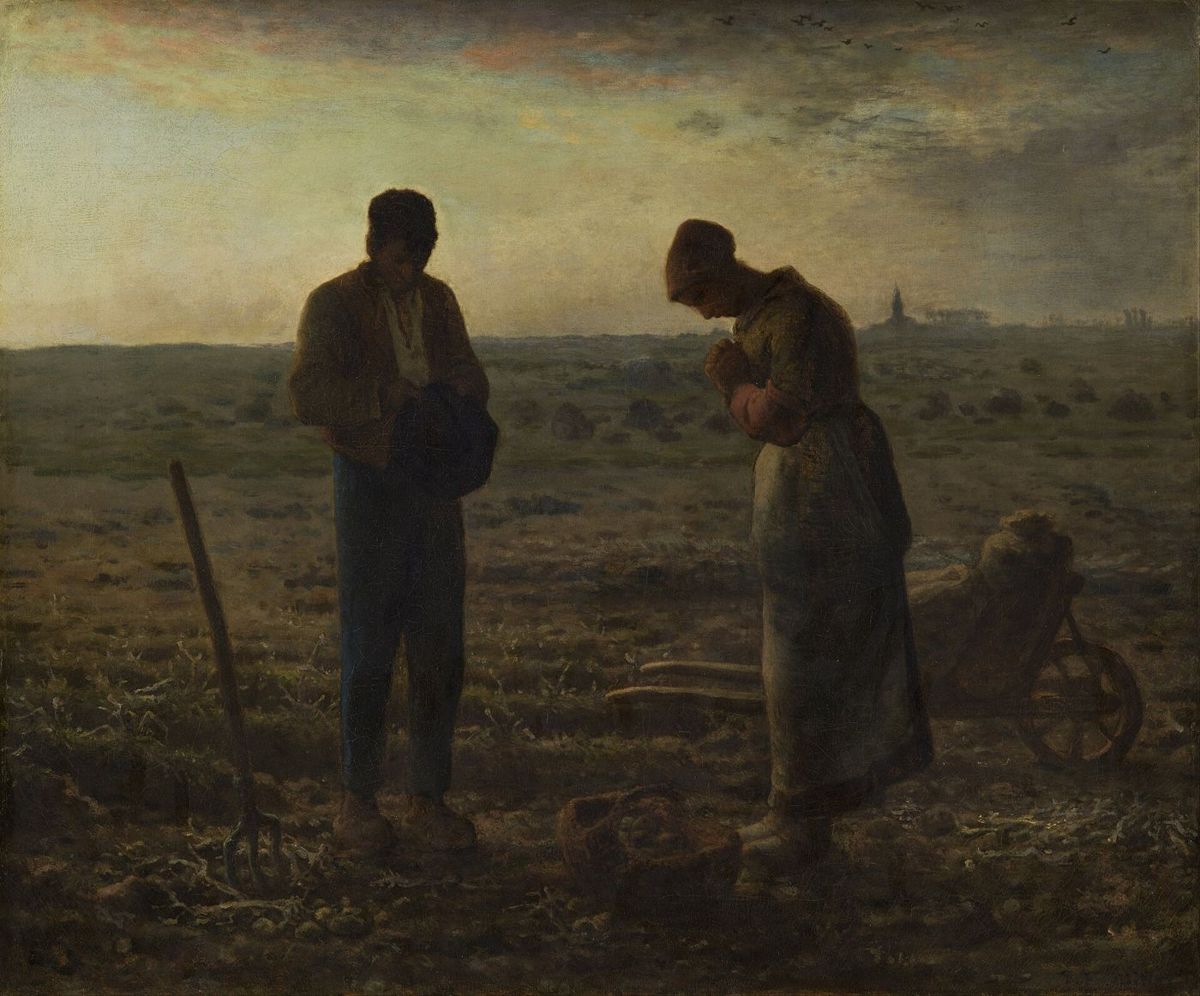
Picture: Jean-François Millet, The Angelus, 1857–59

5 prayers and 2 to the saints

Anywhere, at any time

The Jesus Prayer

Lord Jesus Christ, Son of God,have mercy on me, a sinner.Said slowly, many times over

Traditional wording, 1916

Lord Jesus Christ, Son of God,have mercy upon me a sinner.

It is one line, said slowly aloud or in silence. Because it belongs to no service, it fits a walk, a queue or a sleepless minute.

Plain English by Wiser Walk, from the Greek and the Slavonic, with Robinson’s 1916 wording beside it. How the wording is made. Traditional wording: N. F. Robinson, Monasticism in the Orthodox Churches, 1916.

Where it comes from, and the Greek

In one breath

Lord, have mercy

Lord, have mercy.Three times, twelve times or forty times

Traditional wording, 1906

Lord, have mercy.

Two blind men and ten lepers cried out to Jesus for mercy (Matthew 20:30 and Luke 17:13). In church the people answer petition after petition with these words.

Plain English by Wiser Walk, from the Greek, with Hapgood’s 1906 translation beside it. How the wording is made. Traditional wording: Isabel F. Hapgood, Service Book of the Holy Orthodox-Catholic Apostolic Church, 1906.

Where it comes from, and the Greek

Before anything

O God, come to my assistance

O God, come to my assistance;O Lord, make haste to help me.Said again and again

Traditional wording, 1894

O God, make speed to save me:O Lord, make haste to help me.

It is the first verse of Psalm 70. A monk of Egypt taught St John Cassian to pray it at work, at meals, in bed and on the road.

Plain English by Wiser Walk, from the Latin of Cassian’s Conferences, with Gibson’s 1894 translation beside it. How the wording is made. Traditional wording: Edgar C. S. Gibson, Nicene and Post-Nicene Fathers, Second Series, vol. 11, 1894.

Where it comes from, and the Latin

When you need help now

Prayer of the Canaanite woman

Have mercy on me, Lord, Son of David.

Lord, help me.

Traditional wording, 1906

Have mercy on me, O Lord, Thou Son of David.

Lord, help me.

A mother cried out to Jesus for her suffering daughter (Matthew 15:22-25). Her two short lines are quick to pray when help cannot wait.

Plain English by Wiser Walk, from the Greek of Matthew 15:22 and 15:25, with Hapgood’s 1906 wording beside it. How the wording is made. Traditional wording: Isabel F. Hapgood, Service Book of the Holy Orthodox-Catholic Apostolic Church, 1906.

Where it comes from, and the Greek

When you are going under

Lord, save me

Lord, save me!

Traditional wording, 1611

Lord, save me.

Peter had only a moment as he began to sink in the waves. He cried out these words, and Jesus took hold of him at once (Matthew 14:30-31).

Plain English by Wiser Walk, from the Greek of Matthew 14:30, with the King James wording beside it. How the wording is made. Traditional wording: The King James translators, The King James Version, 1611.

Where it comes from, and the Greek

To the Mother of God · To the Mother of God

Rejoice, O Virgin Theotokos

Rejoice, O Virgin Theotokos,Mary full of grace, the Lord is with you.Blessed are you among women,and blessed is the fruit of your womb,for you gave birth to the Saviour of our souls.

Traditional wording, 1894

Theotokos, Virgin,—Hail! Mary, full of grace,the Lord is with thee:blessed art thou among women,and blessed is the fruit of thy womb,for thou hast borne the Saviour of our souls.

It joins the angel Gabriel’s greeting to Mary with Elizabeth’s blessing (Luke 1:28, 42) and takes a few seconds to say.

Plain English by Wiser Walk, from the Greek, with Robertson’s 1894 translation beside it. How the wording is made. Traditional wording: J. N. W. B. Robertson, The Divine Liturgies, 1894.

Robertson, like the Western prayer, says “Hail” where the Greek word means “rejoice”.

Where it comes from, and the Greek

To a saint · To your own saint

Prayer to your patron saint

Pray to God for me,holy (name), you who pleased God,for I run with all my heart to you,who are quick to help me and to pray for my soul.

Traditional wording, 1982

Pray to God for me holy (your Patron Saint),for with fervor I run to you,swift helper and intercessor for my soul!

In one line it asks the saint whose name you bear to pray for you. It comes in the Russian morning prayers, said each day.

Plain English by Wiser Walk, from the Church Slavonic of the Russian prayer book, with St Tikhon’s 1982 translation beside it. How the wording is made. Traditional wording: St Tikhon’s Seminary Press, Orthodox Daily Prayers, 1982.

The book leaves a blank before “(your Patron Saint)” for the saint’s name.

Where it comes from, and the Church Slavonic

Scripture for this

7And when you pray, do not babble on like pagans, for they think that by their many words they will be heard. 8Do not be like them, for your Father knows what you need before you ask Him.

Matthew 6:7-8 Jesus warns against heaping up words. Your Father knows what you need before you ask Him.

Do not be quick to speak, and do not be hasty in your heart to utter a word before God. For God is in heaven and you are on earth. So let your words be few.

Ecclesiastes 5:2 God is in heaven and you are on earth, so let your words be few.

4“What is your request?” replied the king. So I prayed to the God of heaven 5and answered the king, “If it pleases the king, and if your servant has found favor in your sight, I ask that you send me to Judah, to the city where my fathers are buried, so that I may rebuild it.”

Nehemiah 2:4-5 When the king asked him a question, Nehemiah prayed to the God of heaven before he answered. A prayer can fit between two sentences.

Morning, noon, and night, I cry out in distress, and He hears my voice.

Psalm 55:17 Morning, noon and night, David cried out to God in his distress, and God heard his voice.

16Rejoice at all times. 17Pray without ceasing. 18Give thanks in every circumstance, for this is God’s will for you in Christ Jesus.

1 Thessalonians 5:16-18 Pray without ceasing, and give thanks in every circumstance. The Orthodox often answer this call with the Jesus Prayer.

In the same way, the Spirit helps us in our weakness. For we do not know how we ought to pray, but the Spirit Himself intercedes for us with groans too deep for words.

Romans 8:26 When we do not know what to pray, the Spirit Himself intercedes for us with groans too deep for words.

Bible text: Berean Standard Bible, public domain.

Close to this

All prayers

Quiz What prayer do you need right now? A few honest taps about where you are, and a prayer of the Church for exactly that. 8 questions, about 3 minutes. Start

Suggest a correction

Berean Standard Bible