
When it is said
It is the kontakion of Christmas: the feast’s second short hymn, after the troparion. At Matins, the morning service, it comes after the sixth song of the canon, the long chain of hymns at its heart. The first stanza of Romanos’s long poem follows it.
It is sung through the feast, to 31 December. Churches on the old calendar keep these days 13 days later, to 13 January.
Where it comes from
Author known
St Romanos the Melodist
Romanos came from Emesa in Syria, today’s Homs. He became a deacon and lived in Constantinople, where he died about AD 556. He wrote long sermons in verse, meant to be sung, called kontakia. In his genuine ones, the first letters of the stanzas spell his name, with words such as “the humble Romanos”.
Orthodox Church in America, Venerable Romanus the Melodist; Orthodox Encyclopedia (Pravoslavnaya Entsiklopediya), “Roman Sladkopevets”; Fr Steven Kostoff, “St. Romanos the Melodist and the Kontakion”, Orthodox Church in America
A scroll in a dream
The Church’s books of saints’ lives tell how this hymn began. On Christmas Eve, Romanos fell asleep after the night service. The Mother of God appeared to him and gave him a scroll to eat. When he woke, he sang this hymn at once. Later tellings add that he had just been scolded for singing badly.
Orthodox Encyclopedia (Pravoslavnaya Entsiklopediya), “Roman Sladkopevets”; Fr Steven Kostoff, “St. Romanos the Melodist and the Kontakion”, Orthodox Church in America
A poem of 24 stanzas
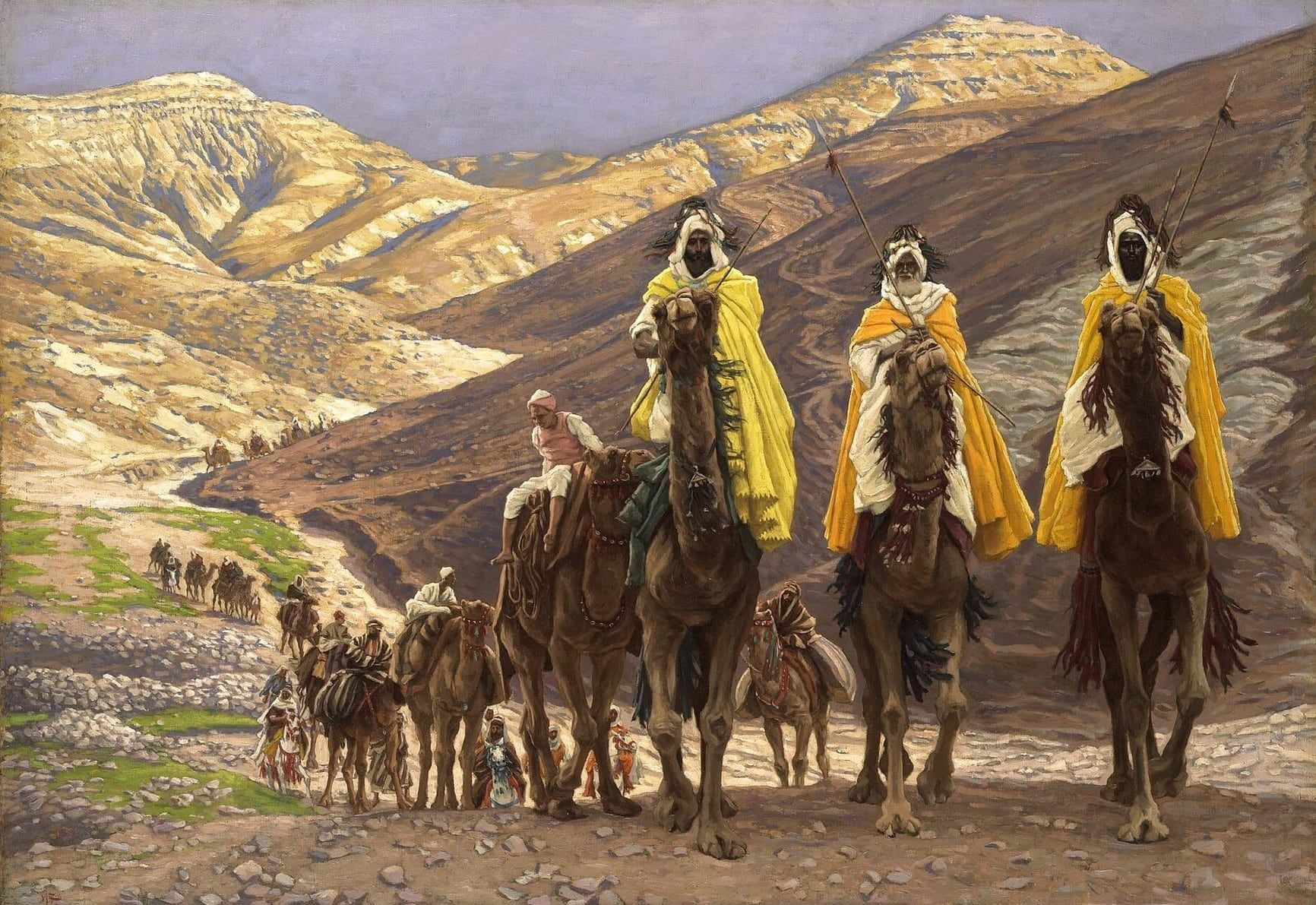
The verse sung today opens a long poem of 24 stanzas. Most of it is a conversation between the Mother of God and the wise men. Every stanza ends with the same words: a little Child, God before all ages. Until the 1100s, the choirs of two great churches of Constantinople sang it at the emperor’s Christmas banquet.
Fr Steven Kostoff, “St. Romanos the Melodist and the Kontakion”, Orthodox Church in America; Wikipedia, Romanos the Melodist
What the words mean
“Above all being”
The Greek calls Christ “hyperousios”: the One above all being, beyond everything that exists. English books have put it in different ways. G. V. Shann wrote “him above all essence” in 1891. Isabel Hapgood wrote “the Supersubstantial” in 1906. The hymn sets this word beside a cave: the One beyond all things is born in one.
The Greek Menaion, 25 December; G. V. Shann, Euchology (1891); Isabel F. Hapgood, Service Book (1906), the Nativity of Christ
The Scripture in it
Therefore the Lord Himself will give you a sign: Behold, the virgin will be with child and give birth to a son, and will call Him Immanuel.
He alone is immortal and dwells in unapproachable light. No one has ever seen Him, nor can anyone see Him. To Him be honor and eternal dominion! Amen.
And suddenly there appeared with the angel a great multitude of the heavenly host, praising God and saying: “Glory to God in the highest, and on earth peace to men on whom His favor rests!”
After they had heard the king, they went on their way, and the star they had seen in the east went ahead of them until it stood over the place where the Child was. When they saw the star, they rejoiced with great delight.
For unto us a child is born, unto us a son is given, and the government will be upon His shoulders. And He will be called Wonderful Counselor, Mighty God, Everlasting Father, Prince of Peace.
Bible text: Berean Standard Bible, public domain.
In Greek
Ἡ Παρθένος σήμερον, τὸν Ὑπερούσιον τίκτει,
καὶ ἡ γῆ τὸ Σπήλαιον, τῷ Ἀπροσίτῳ προσάγει.
Ἄγγελοι μετὰ Ποιμένων δοξολογοῦσι.
Μάγοι δὲ μετὰ ἀστέρος ὁδοιποροῦσι·
δι' ἡμᾶς γὰρ ἐγεννήθη, Παιδίον νέον, ὁ πρὸ αἰώνων Θεός.