
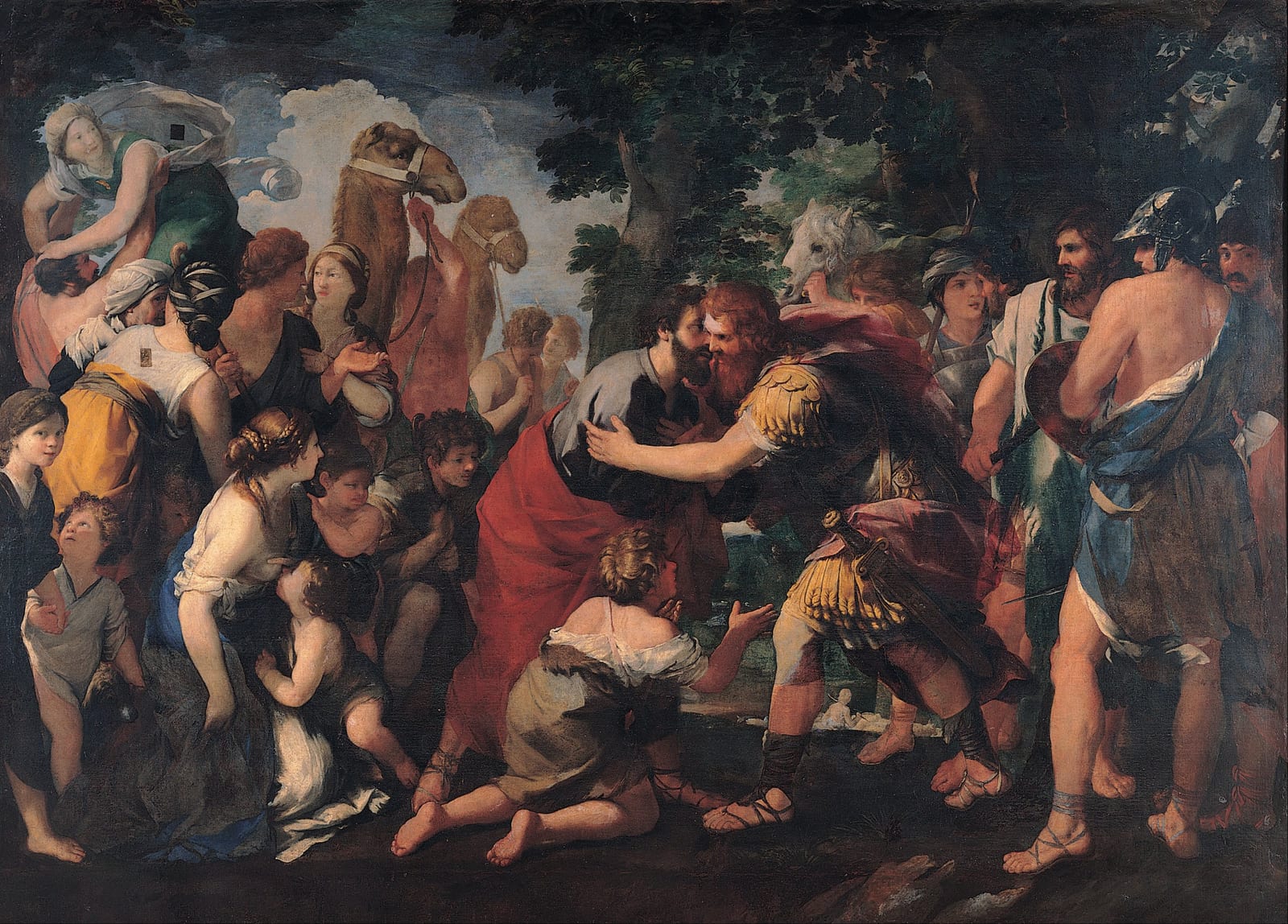
When it is said
In the Liturgy of St James the priest prays it in a low voice at the Creed. Then he greets the people with “Peace to all”, and the deacon asks them to greet one another with a holy kiss.
The Orthodox Church serves this Liturgy only now and then, for example in Jerusalem on 23 October, the feast of St James.
At home, someone who has fallen out with a friend might pray it for the two of them.
Where it comes from
No author known
The Liturgy of St James
The Liturgy of St James bears the name of James the brother of the Lord, remembered as the first bishop of Jerusalem. By the early 400s it was the main service of Holy Communion in Jerusalem and Antioch. Most scholars date the form we know to the late 300s. Its oldest manuscript is a book from the 800s that was used in Damascus.
“Liturgy of Saint James”, Wikipedia; The Divine Liturgy of St James in Church Slavonic, translator’s foreword
Why a kiss?
Talks to the newly baptized in Jerusalem explain the kiss of peace. They are credited to St Cyril, the city’s bishop in the 300s. In them the kiss is no greeting between ordinary friends. It joins souls and asks for full forgiveness. The talks tie it to Jesus’ command to make peace with a brother before bringing a gift to the altar, and call it “reconciliation, and for this reason holy”.
The Scripture in it
… and with diligence to preserve the unity of the Spirit through the bond of peace.
And over all these virtues put on love, which is the bond of perfect unity.
Rid yourselves, therefore, of all malice, deceit, hypocrisy, envy, and slander.
Bible text: Berean Standard Bible, public domain.
In Greek
Ὁ πάντων Θεὸς καὶ Δεσπότης
ἀξίους ἡμᾶς ἀπέργασαι τῆς ὥρας ταύτης τοὺς ἀναξίους, Φιλάνθρωπε·
ἵνα καθαρεύοντες ἀπὸ παντὸς δόλου καὶ πάσης ὑποκρίσεως
ἑνωθῶμεν ἀλλήλοις, τῷ τῆς εἰρήνης καὶ τῆς ἀγάπης συνδέσμῳ,
βεβαιούμενοι τῷ τῆς Σῆς θεογνωσίας ἁγιασμῷ
διὰ τοῦ μονογενοῦς Σου Υἱοῦ, Κυρίου δὲ ἡμῶν Ἰησοῦ Χριστοῦ,
μεθ’ Οὗ εὐλογητὸς εἶ σὺν τῷ παναγίῳ καὶ ἀγαθῷ καὶ ζωοποιῷ Σου Πνεύματι,
νῦν καὶ ἀεὶ καὶ εἰς τοὺς αἰῶνας.
From the Divine Liturgy of St James, Greek Orthodox Archdiocese of America (glt.goarch.org).