Sign Up My Profile
Prayers

The prayer of Hezekiah

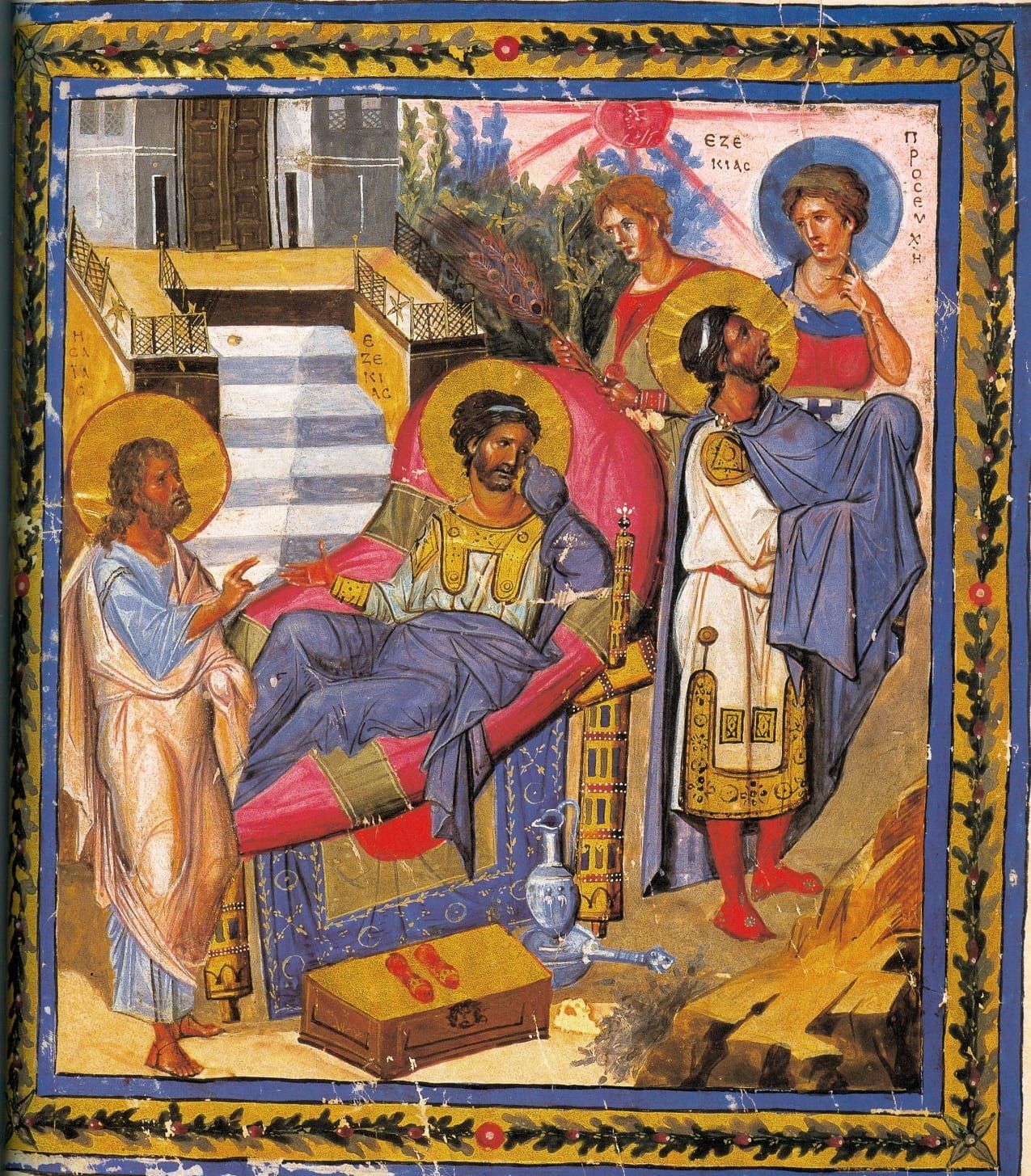
A prayer from the Bible for a life-threatening illness. King Hezekiah prayed it when he was told he would die. After God healed him, he wrote the song that follows it.

Picture: The Paris Psalter, The Illness and Prayer of Hezekiah, Constantinople, mid-900s AD

The words of the prayer

Plain English

When he was told he would dieRemember, LORD, I beg You,how I have walked before You faithfullyand with my whole heart,and have done what is good in Your sight.

His song after he recoveredI said, “In the prime of my lifeI must go through the gates of the grave.I am robbed of the rest of my years.”I said, “I will not see the LORD,the LORD in the land of the living.I will look on no one againamong those who live in the world.”

Like a swift or a crane I cried out;I moaned like a dove.My eyes grew weak from looking upward.Lord, I am oppressed; come to my aid!

Indeed, it was for my own goodthat I had such bitterness.In Your love You kept my soulfrom the pit of destruction,for You have cast all my sins behind Your back.

The grave cannot thank You;death cannot praise You.Those who go down to the pitcannot hope for Your faithfulness.The living, the living, they thank You,as I do today.A father tells his children of Your faithfulness.

The LORD will save me,and we will play my songs on stringed instrumentsall the days of our lifein the house of the LORD.

Traditional wording, 1611

Remember now, O LORD, I beseech Thee,how I have walked before Thee in truth and with a perfect heart,and have done that which is good in Thy sight.

I said in the cutting off of my days,I shall go to the gates of the grave:I am deprived of the residue of my years.I said, I shall not see the LORD, even the LORD,in the land of the living:I shall behold man no more with the inhabitants of the world.

Like a crane or a swallow, so did I chatter:I did mourn as a dove:mine eyes fail with looking upward:O LORD, I am oppressed; undertake for me.

Behold, for peace I had great bitterness:but Thou hast in love to my soul delivered it from the pit of corruption:for Thou hast cast all my sins behind Thy back.

For the grave cannot praise Thee, death can not celebrate Thee:they that go down into the pit cannot hope for Thy truth.The living, the living, he shall praise Thee, as I do this day:the father to the children shall make known Thy truth.

The LORD was ready to save me:therefore we will sing my songs to the stringed instrumentsall the days of our life in the house of the LORD.

Plain English by Wiser Walk, from the Hebrew (Isaiah 38:3, then verses 10, 11, 14 and 17 to 20 of the song), with the King James Version beside it. How the wording is made. Traditional wording: The King James translators, The King James Version, 1611.

When it is said

Pray the first part when the news is bad.

Pray the song when the worst is past, to thank God for the days ahead.

Where it comes from

Author known

Who was Hezekiah?

Hezekiah was a king of Judah in the time of the prophet Isaiah. When he fell ill and was close to death, Isaiah came to tell him to put his house in order, because he would die and not recover (Isaiah 38:1). Hezekiah turned his face to the wall and prayed, weeping bitterly (Isaiah 38:2-3).

The King James Version, on eBible.org

Fifteen more years

Isaiah had not yet crossed the middle court on his way out when the LORD sent him back. God had heard Hezekiah’s prayer and seen his tears, and He would heal him and add 15 years to his life (2 Kings 20:4-6). At Isaiah’s word a cake of figs was laid on the king’s boil, and he recovered (2 Kings 20:7).

The King James Version, on eBible.org

The song he wrote

After he recovered, Hezekiah wrote a song, which the Book of Isaiah gives in full (Isaiah 38:9-20). It remembers his fear of dying in the prime of life, and it ends by thanking God, Whom the dead cannot praise but the living can (Isaiah 38:18-19). The Greek Old Testament heads the song as the prayer of Hezekiah.

The King James Version, on eBible.org; The Greek Old Testament in Brenton’s translation, on eBible.org

The Scripture in it

… saying, “Please, O LORD, remember how I have walked before You faithfully and with wholehearted devotion; I have done what is good in Your sight.” And Hezekiah wept bitterly.

Isaiah 38:3 Quoted His prayer when he was told he would die.

“Please, O LORD, remember how I have walked before You faithfully and with wholehearted devotion; I have done what is good in Your sight.” And Hezekiah wept bitterly.

2 Kings 20:3 Quoted The same prayer, in the second telling of the story.

I said, “In the prime of my life I must go through the gates of Sheol and be deprived of the remainder of my years.” I said, “I will never again see the LORD, even the LORD, in the land of the living; I will no longer look on mankind with those who dwell in this world.”

Isaiah 38:10-11 Quoted The song remembers his fear of dying in the prime of life.

“I chirp like a swallow or crane; I moan like a dove. My eyes grow weak as I look upward. O Lord, I am oppressed; be my security.”

Isaiah 38:14 Quoted His cry to the Lord in the illness.

Surely for my own welfare I had such great anguish; but Your love has delivered me from the pit of oblivion, for You have cast all my sins behind Your back. For Sheol cannot thank You; Death cannot praise You. Those who descend to the Pit cannot hope for Your faithfulness. The living, only the living, can thank You, as I do today; fathers will tell their children about Your faithfulness. The LORD will save me; we will play songs on stringed instruments all the days of our lives in the house of the LORD.

Isaiah 38:17-20 Quoted The song ends in thanks for his healing.

Bible text: Berean Standard Bible, public domain.

Close to this

All prayers

Suggest a correction

Berean Standard Bible